For seven years, no one had heard laughter inside Ashborne Hall.
Not during Christmas dinners.
Not during weddings held elsewhere in the family.
Not when Parliament praised its master.
Not even when his younger brother stood before him, voice breaking, begging him to return to the living.
The Duke of Ashborne had become a name spoken carefully.
Powerful.
Respected.
Feared.
A man wrapped so tightly in grief that even his servants moved around him as if he were a portrait rather than flesh and blood.
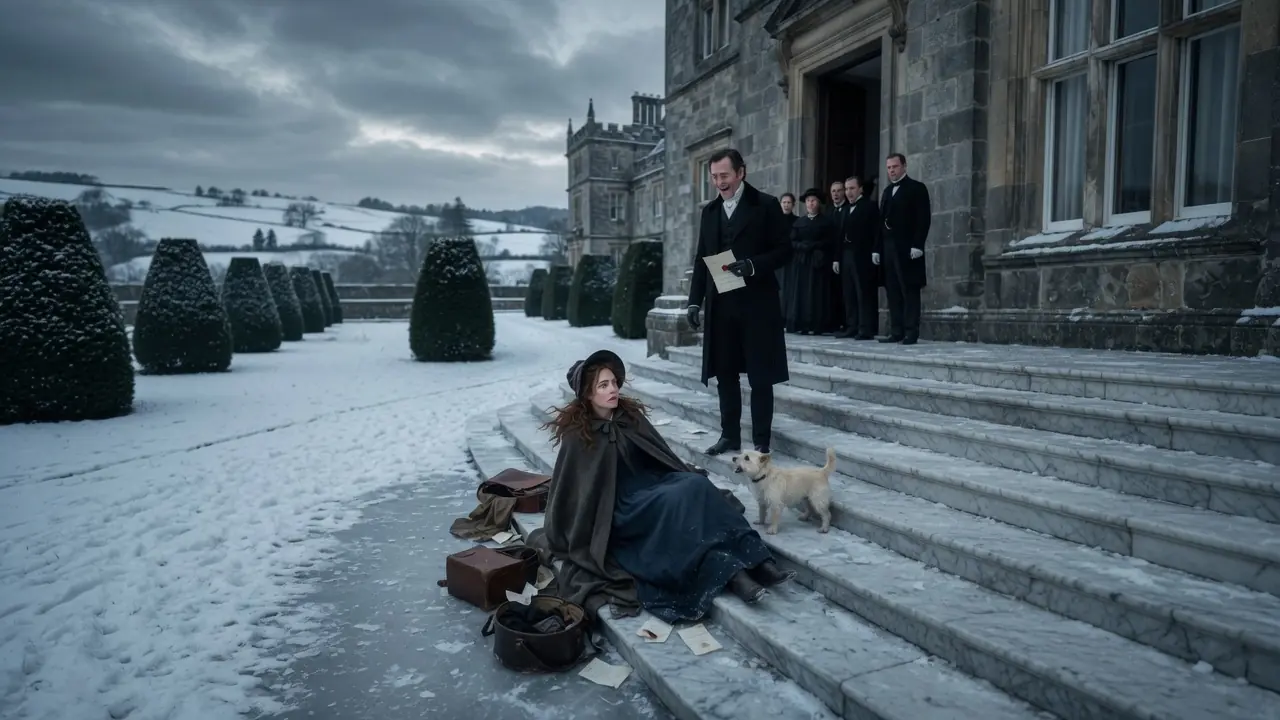
Then, one frozen January afternoon, a carriage stopped before the front steps.
A young woman climbed down with a letter carrying his seal.
A letter he had never sent.
She arrived with two trunks, a damaged hatbox, a furious little dog, and nowhere else in England to go.
Benedict Sterling, Duke of Ashborne, came down the icy steps intending to dismiss her.
He knew exactly what he meant to say.
He had already hardened himself enough to say it.
Then she slipped.
Not neatly.
Not gracefully.
She fell in the most spectacular manner possible, scattering her dignity, her reticule, and several calling cards across the marble.
She landed at his feet.
And Benedict Sterling, who had not laughed in seven years, laughed.
The household went still.
Because in that moment, something impossible had happened.
And no one in Ashborne Hall was prepared for what would follow.
Ashborne Hall had looked the same for seven years.
Anyone who came near it could feel it before they reached the gate. Time seemed to have stopped there. Frost clung to the stone like memory. The fountains in the courtyard had been frozen so long that no servant bothered to wonder whether water still ran beneath the ice.
The yew hedges stood dark and severe along the drive, trimmed into perfect lines, less like garden ornaments than sentries guarding a place no longer meant for joy.
It was January in Derbyshire.
The sky was low and pewter-colored. Snow lay in pale sheets across the fields. The long road to the house twisted between bare oaks whose black branches reached upward like hands.
Guests had not used that road in years.
Inside, Ashborne Hall was spotless and lifeless.
The air held a chill that fires never fully defeated. Black mourning fabric still remained in corners of the upper gallery because three different maids had once tried to remove it, and three times they had been ordered to leave it alone.
The ballroom doors stayed shut.
The music room slept beneath drawn curtains and dust covers. A velvet cloth had rested over the pianoforte for so long that the younger servants had never heard a note played from it.
The nursery on the third floor remained locked.
It had been locked since the night of January fourteenth, seven years earlier.
The key still hung beside the door.
Benedict had placed it there with his own hand.
He had never touched it again.
At thirty-five, Benedict Sterling was counted among the most influential men in England. He controlled twelve thousand acres of Derbyshire land, managed the interests of nearly three hundred tenant families, and held a voice in Parliament that men listened to even when they disliked him.
He was not a cruel landlord.
His tenants knew that.
His servants knew that.
His younger brother, Lord Sebastian Sterling, knew it most of all, because Sebastian remembered the man Benedict had been before grief hollowed him out.
But the man now seated in the estate study, surrounded by ledgers, letters, petitions, and cold gray light, was difficult to love.
Easy to obey.
Easy to respect.
Nearly impossible to reach.
Benedict moved his pen over a tenant report without raising his head. Everything on his desk was arranged with exact precision. Letters sorted by urgency. Estate papers stacked by date. The inkwell placed in the same position where Harlon Goodwin, the butler, set it every Monday whether it needed to be replaced or not.
His coat fit perfectly.
His cravat was immaculate.
His dark hair was brushed neatly back.
His face betrayed nothing.
Once, society had praised that face for its severity. Now that severity had become something people avoided meeting directly.
He signed off on a petition concerning drainage in the north fields and placed it in the appropriate stack.
He did not look outside.
There was no reason to.
Nothing ever came to Ashborne Hall.
Then, from below, came the sound of the front doors opening.
Mrs. Matilda Warren’s voice followed.
Low.
Controlled.
Surprised.
And then came a noise that had no place in that house.
A dog barked.
Small.
Sharp.
Offended.
Benedict’s pen stopped.
For a moment, he held it above the paper, listening with the faint irritation of a man waiting for the world to correct itself.
The barking came again.
He set down the pen.
Sebastian Sterling, meanwhile, was in London feeling the first true weight of his own plan.
He had spent the previous night at his club drinking more port than wisdom permitted, trying not to imagine what would happen when the carriage reached Ashborne.
He was twenty-nine, dark-haired like his brother, but quicker in movement and lighter in manner. He had inherited their father’s charm and their mother’s cleverness. People often mistook his easy smile for carelessness.
They were wrong.
Sebastian had been watching Benedict disappear for seven years.
He had tried everything.
Invitations to London.
Ignored.
Guests at Ashborne.
Tolerated once, then discouraged forever after.
Gentle conversation about Evangeline.
Met with silence.
Talk of the future.
Met with polite refusals that made the topic feel indecent.
Seven years of seeing Benedict survive without truly living.
Seven years of watching his brother become a steward of his life rather than a participant in it.
So Sebastian had done something he knew was wrong.
He had contacted Mrs. Helena Whitaker, a discreet marriage broker in London, known for arranging private matches for families who did not wish their situations discussed publicly.
He had described Benedict selectively.
Carefully.
He had used Benedict’s name.
And worse, he had used the Ashborne seal, taken from his brother’s correspondence drawer three months earlier and never returned.
The woman Mrs. Whitaker found was named Cecilia Pembroke.
Twenty-five years old.
A gentlewoman by birth, though without parents, fortune, or protection.
She had worked as a companion and music tutor. According to Mrs. Whitaker, she was in difficulty and needed security as urgently as Ashborne needed life.
Now he suspected it only made his guilt more elaborate.
The carriage that carried Cecilia Pembroke to Ashborne Hall was uncomfortable, but she had expected nothing else.
It was the cheapest carriage available in the village of Harwick, the last place of any size before the roads narrowed into frozen ruts. She sat wrapped in her traveling cloak, Pip tucked under her arm, reviewing the facts in her head again and again.
The letter had borne the Ashborne seal.
Mrs. Whitaker was respected.
The terms had been clear.
A practical match. A widowed duke in need of a second duchess. A woman of good reputation in need of safety.
No romance had been promised.
Cecilia had no intention of imagining any.
She had twenty-five pounds in her purse. Two trunks. One cracked hatbox. A bundle of music sheets she had refused to abandon. And Pip, a cream-colored terrier weighing twelve pounds but behaving as though he were responsible for the defense of the nation.
She was not here to dream.
She was here because every other door had closed.
When the carriage turned through the iron gates and Ashborne Hall rose ahead, all gray towers and winter silence, Cecilia felt something in her chest tighten.
The house was magnificent.
And wounded.
She could feel that even from the road.
It was not a place without beauty. It was a place where beauty had been left alone too long.
She straightened her spine, adjusted her grip on Pip, and reminded herself she had not come to feel sympathy for a house.
She had come to survive.
The carriage halted at the front steps.
A footman opened the door.
Cecilia stepped down carefully into the sharp air.
Mrs. Warren stood in the doorway, her expression polite enough to be proper and shocked enough to be honest.
Behind her, three footmen had appeared. A young maid hovered near the entrance hall, openly staring.
Then a figure moved beyond the housekeeper.
Cecilia looked up.
The man descending the steps drove every prepared thought from her mind.
He was tall.
Dark.
Dressed completely in mourning black.
He moved with the certainty of a man who had never had to question whether the world would make room for him.
His face startled her.
She had expected age.
Or coldness.
Perhaps both.
He was neither, exactly.
He was thirty-five, and his face carried the evidence of a man who had felt too much and decided never again to show it.
Controlled.
That was the word.
He seemed the most controlled person she had ever seen.
Then another word came, unwanted and inconvenient.
Grieving.
Not merely cold.
Grieving.
There was a difference.
The Duke stopped on the final step.
His gaze moved from the carriage to her trunks, from the cracked hatbox to the dog, who barked at him with all the authority of a magistrate, and finally to Cecilia herself.
For a moment, he studied her.
Then Mrs. Warren handed him the letter.
He read it.
Nothing in his face changed.
But his eyes did.
Something flat and dangerous passed through them.
“Miss Pembroke.”
His voice was low, precise, and entirely composed.
“Your Grace.”
Cecilia began to curtsy.
Later, she would blame the ice.
A thin film of it lay on the marble step, invisible and treacherous. Her boot found it at the exact moment her weight shifted.
Her heel slid.
Her arms flew outward.
The cracked hatbox struck a footman’s tray, sending calling cards into the air like white birds. Her reticule burst open, spilling its contents across the stone. Pip leapt from her arms and shot forward, barking as if announcing battle.
Her bonnet tipped over one eye.
Then Cecilia fell.
Not prettily.
Not quickly.
She performed a long, dreadful slide across the icy marble, one that allowed everyone present ample time to understand what was happening and no time at all to prevent it.
She landed at the Duke’s boots, surrounded by scattered belongings and wounded dignity.
Pip barked once, sharply, as if confirming the emergency.
The footmen froze.
The young maid pressed both hands over her mouth.
Mrs. Warren looked as though her professional composure had been attacked from within.
Harlon Goodwin, butler of twenty-two years, went pale.
Sebastian, standing by the doorway with the expression of a man who had set something in motion and was now reconsidering his relationship with consequences, pressed both hands to his mouth.
And Benedict Sterling laughed.
It was not a polite laugh.
Not a small exhale.
Not an aristocratic acknowledgment of amusement.
It was real.
Full.
Helpless.
Startled out of him from some place that had been locked away for years.
The entire household stopped breathing.
No one had heard that sound in seven years.
Benedict recovered first.
He pressed his mouth closed and rebuilt his composure by visible effort, like a man reassembling armor in public.
Then he extended a gloved hand.
Cecilia took it.
She stood.
Straightened her bonnet.
Tried to locate what remained of her dignity and found only fragments.
Then she looked up at him.
His expression was controlled again.
But she had seen the break in it.
That single unguarded instant.
And something inside her responded before she could command it not to.
“Miss Pembroke,” he said, “whatever invitation brought you here was not written by me.”
The small hope she had carried through frozen roads began to collapse.
“I see,” she said quietly.
“You will be returned to London by morning. I will arrange the carriage.”
“I cannot return to London, Your Grace.”
He paused.
Cecilia lifted her chin.
“There is no London left for me.”
The silence changed.
Benedict looked at her properly then.
Not as an error to be corrected.
As a problem with a human face.
For the first time, he seemed not entirely certain of his next sentence.
Then the mask returned.
“Come inside,” he said.
The drawing room was large, elegant, and cold.
Not freezing. Ashborne Hall was too well run for that. But cold in a deeper way, the way rooms become when they are maintained rather than inhabited.
The fire in the grate burned politely, not generously. The curtains had been opened, but the January light entered thin and gray, unable to soften the room.
Cecilia sat in a green brocade chair beneath a blanket Mrs. Warren had produced without being asked. Pip had been taken to the kitchen by a nervous footman named Edwin, after Harlon solemnly informed him the dog was to be treated as a guest.
Benedict stood by the fire.
He did not sit.
“Tell me how this happened,” he said.
Cecilia told him everything.
About Mrs. Whitaker.
About the correspondence.
About the seal.
About the terms she had believed were genuine.
As she spoke, she watched his expression. It barely moved, but she saw the moment he understood Sebastian’s involvement.
A muscle tightened in his jaw.
“And your situation in London?” he asked. “You said you cannot return.”
Cecilia looked at her hands.
Then she raised her eyes and chose honesty.
“I was employed in Lord Dorian Vaughn’s household for fourteen months as companion and music tutor. Last spring, he made advances I could not accept. When I refused him, he dismissed me without a character reference. Afterward, he sent his own version of events to several households where I might have found employment.”
She spoke plainly because if she did not, the words might hurt more.
“No respectable family will take me without a reference. I have no parents, no near relatives, and no fortune. The arrangement described in your letter appeared to offer dignity and shelter.”
Her voice remained steady.
“I did not come here seeking romance, Your Grace. I came because it seemed to be the last open door.”
Benedict said nothing for a while.
Something moved behind his eyes.
Not pity.
Something harder.
Anger, perhaps.
Not at her.
At the sort of man who could ruin a woman’s livelihood because she refused to surrender herself to him.
“You are not my intended bride,” Benedict said. “You are not my betrothed. This arrangement was created by deception, and I will address that. But you were brought here under false pretenses, and for that I owe you an apology.”
Cecilia looked at him.
“That is more gracious than I expected.”
“You may remain for a short time while I make suitable arrangements. But I want there to be no misunderstanding. There will be no marriage between us. No attachment. No future of that nature.”
“I understand.”
Her voice was quiet.
“I have been unwanted before, Your Grace. I recognize the shape of it.”
The words struck more accurately than either of them expected.
Benedict looked into the fire.
For several seconds, he said nothing.
He knew something of being unwanted by life itself.
Of being tolerated by a world that had taken the one thing he had loved most and left him to continue as if continuation were not its own kind of punishment.
“I will speak to Sebastian,” he said.
He found his brother in the library.
Sebastian stood by the window with a glass of brandy and the expression of a condemned man trying to appear philosophical.
Benedict entered and shut the door.
“You used my seal.”
“Yes.”
“You forged my name in correspondence with a marriage broker.”
“Yes.”
“You sent for a woman who believed she had been invited here by me.”
“Yes.”
Benedict’s voice remained even.
“Explain.”
Sebastian set down the glass.
He looked at his brother not with his usual easy charm, but with the exhaustion of someone who loved too much to keep pretending.
“You have been dying by inches for seven years.”
Benedict went very still.
Sebastian continued.
“Not dramatically. Not all at once. But every winter there is less of you. More estate business. More Parliament. More ledgers. Less brother. Less man. Less life.”
“Enough.”
“No.” Sebastian’s voice softened. “That is the problem. It has never been enough.”
Benedict turned toward the shelves.
Sebastian stepped no closer.
“I watched you stop laughing. Stop dancing. Stop letting fires burn because warmth reminded you of rooms she once stood in. I watched you cover Evangeline’s portrait and then cover yourself more completely.”
Benedict’s hand rested on the spine of a book he was not reading.
“I did it because I am afraid of losing you,” Sebastian said. “I have tried every proper method. They failed. So yes, I did something improper. Something unforgivable. But if Evangeline died once, Benedict, must you die every morning after her?”
The room held the words.
Benedict did not answer for a long time.
When he finally spoke, his voice was low.
“You will never interfere in my life this way again.”
“No.”
“She stays until I arrange something suitable for her. Nothing more.”
Sebastian lowered his head.
But he remembered the laugh.
He had heard it.
And he thought perhaps one crack in grief might be enough, if it opened in the right place.
Cecilia soon learned that being allowed to remain temporarily in a house was only slightly different from being allowed to exist temporarily in it.
Not comfortable.
But possible.
She asked Mrs. Warren whether there was any work she might do.
The housekeeper studied her and, being a practical woman, gave her three tasks: arrange flowers in the entrance hall, sort music sheets in the morning room, and assist with correspondence that had accumulated during Mrs. Warren’s recent illness.
Cecilia handled the music with ease.
The correspondence went almost as well, except for one unfortunate inkwell, which tipped over the margin of a letter to the Derbyshire Agricultural Society. She blotted it quickly and placed it aside with the dignity of a woman refusing defeat.
The flowers proved more treacherous.
While arranging white roses in the entrance hall, she stepped back to view the result and collided directly with the suit of armor in the alcove.
It rang like a church bell.
Cecilia turned to the armor and said calmly, “My apologies.”
Harlon appeared from the corridor.
“The armor has endured worse, Miss Pembroke.”
“I hope this need not be recorded.”
“The household accident ledger has not been opened in seven years,” Harlon said gravely. “I shall endeavor to preserve its dignity.”
Several servants witnessed this exchange.
None laughed.
Not exactly.
But warmth entered the hall in a way that had nothing to do with the fire.
Benedict noticed.
He told himself he was simply aware of a guest’s movements.
Practical awareness.
Nothing more.
He noticed Cecilia thanking Edwin for retrieving Pip from the kitchen. He noticed the way she held the dog’s face between her hands and spoke to him as though he were a person with opinions worth hearing.
Pip seemed to believe this absolutely.
He noticed Cecilia sitting on the morning room floor surrounded by music, sorting pages with the confidence of someone who knew every measure.
He noticed her apologize to armor.
Then he returned to his study, reviewed estate papers, answered letters, and almost succeeded in not thinking of her for the rest of the afternoon.
That night, Benedict found himself on the third floor.
He had not decided to go there.
His feet simply knew the path.
They had carried him there countless times over seven years, during the hours when the house slept and grief had fewer witnesses.
He stood before the nursery door.
The key hung on its hook beside him.
Six inches from his hand.
He did not touch it.
He never touched it.
He simply stood there, as he had stood so many nights before, in the strange space between endurance and refusal.
A soft sound came from behind him.
He turned.
Cecilia stood ten feet away with a candle in her hand.
She had clearly become lost in the corridors. Ashborne’s east and west wings were not easy to distinguish in darkness, and she had been in the house only a short time.
She saw him.
Then the door.
Then the key.
Then his face.
She did not ask.
Instead, she moved quietly to the opposite wall, sat on the floor, placed her candle beside her, and looked at the flame.
It was a polite place to look when a man stood outside a locked nursery at night, not crying, but also not entirely free of tears.
Benedict did not tell her to leave.
After a while, he sat on the floor across from her.
The corridor between them was quiet, but unlike the rest of Ashborne’s silence.
Less like a tomb.
More like a room before dawn.
After a long time, Benedict said, “This house was not always silent.”
Cecilia kept her gaze on the candle.
“No house is born that way, Your Grace.”
He said nothing.
But something in him loosened by a fraction.
Days at Ashborne began to change before anyone admitted they had changed.
Fires were lit more often.
Officially, Mrs. Warren said the east wing guest rooms had grown damp and that better household management required more heat.
Harlon did not contradict her.
The servants did not either.
Everyone understood the fires had less to do with dampness and more to do with the young woman in the blue traveling gown.
On Cecilia’s third morning, she asked if the morning room curtains might be opened.
“Even grief,” she told Mrs. Warren lightly, “should not be permitted to mildew the draperies.”
Mrs. Warren looked at her for a long moment.
Then she opened them.
Winter light entered the room.
Cold.
Clear.
Almost harsh.
But real.
The room seemed to inhale.
Mrs. Warren stood in that light without speaking. Then she returned to her work, her face caught somewhere between sorrow and relief.
The curtains remained open.
By the end of the week, others were open too.
Not by order.
By contagion.
Darkness loses confidence when light becomes a habit.
Benedict found Cecilia in the library on a Tuesday.
She had climbed onto a stool to reach a volume of Scarlatti sonatas placed far too high on the shelf. She stretched onto her toes, fingers just short of the spine, when the stool rocked.
He crossed the room in three strides.
His hands caught her waist just before the stool went sideways.
She fell back against him, her back meeting his chest, his arms steadying her for the briefest moment before she found the floor again.
It lasted less than a breath.
But it was enough.
He felt the warmth of her through layers of cloth.
The faint scent of rose water in her hair.
The hitch in her breathing.
He released her at once.
She turned, cheeks flushed.
“Must you declare war on every elevated object in this house?” he asked.
She gathered her composure with impressive speed.
“Only the ones that insult me first, Your Grace.”
He almost smiled.
Almost.
Instead, he retrieved the Scarlatti volume, handed it to her, and left the library before looking back became impossible to justify.
In the corridor, he stopped and placed one hand flat against the wall.
His heart was behaving in a manner he found deeply inconvenient.
Dinner went badly two nights later.
Not because Benedict intended it to.
It went badly because a man can live too long in severity and forget that truth, spoken coldly, can wound even when it is accurate.
He remarked, with precise detachment, that a woman in Cecilia’s situation should not expect any particular future from temporary shelter.
The sentence fell between them and could not be recalled.
Cecilia set down her fork.
She did not weep.
She did not argue.
She simply became quiet in the way a person becomes quiet when choosing dignity because honesty would hurt too much.
Then she excused herself and went upstairs.
Benedict remained at the table.
He finished his wine.
He reviewed the drainage report he had brought with him, a habit he had long maintained and was beginning, distantly, to recognize as evidence of a man who had forgotten what dinner was for.
Then he went to the library and worked until the fire burned low.
He did not ring for coal.
The room grew colder.
Around two in the morning, he reached for a blank sheet of paper and found instead a folded blanket on his desk.
Cream wool.
Warm.
Mrs. Warren’s best.
Not the servants’ supply.
Beneath it lay a note.
Grief is not weakness, Your Grace. But warmth is not betrayal.
No signature.
None needed.
Benedict held the paper for a long time.
The candles sank lower.
At last, he wrapped the blanket around his shoulders.
He sat alone in the dark library, seven years after his world had broken, and let grief come as grief, not as discipline.
Evangeline’s face.
The night.
The silence afterward.
The winter mornings when he woke and discovered the world had continued without asking his permission.
He wept without sound, as men do when they have been taught to survive sorrow rather than show it.
When it passed, he folded the blanket carefully and placed Cecilia’s note inside his coat.
He did not feel healed.
But he felt less alone.
That frightened him more.
A few nights later, Benedict heard music.
He had been upstairs again, standing outside the nursery door in that nightly ritual he refused to name. On his way back toward the study, the sound reached him.
The pianoforte.
Soft.
Tentative.
As though the player was unsure whether the instrument still had permission to speak.
The melody was familiar.
Scarlatti.
Bright, delicate, and touched with sadness.
The sort of piece Evangeline had once played in winter.
Benedict stopped.
The music grew more confident, not bold, but present.
The notes moved through the corridors, past covered furniture and locked rooms, through seven years of imposed stillness.
Only music.
Only sound.
Only life returning to a house that had forgotten how to receive it.
He opened the music room door.
Cecilia stopped instantly.
She sat at the pianoforte with only the front of the velvet cover lifted, as if trying to disturb as little as possible.
“I apologize,” she said. “I know I should not have—”
“Continue,” Benedict said.
She looked at him.
He crossed to a chair near the window and sat, his back straight, his face turned slightly away.
“Please,” he added.
Cecilia turned back to the keys.
She played for twenty minutes.
He listened.
She could feel his attention, not as pressure, but as warmth. She played Scarlatti, then a quieter piece of her own, composed during the months after Lord Dorian Vaughn destroyed her name and she sat in a rented room in Holborn with too little money and too much silence.
She played because the room needed it.
Because she needed it.
Because the keys were cold beneath her fingers and slowly becoming warm.
When the last note faded, Benedict said quietly, “You play as though you are apologizing for being heard.”
Cecilia looked down at her hands.
“Some rooms teach women to fear making sound.”
The words touched something inside him.
He stood and crossed to the pianoforte. He rested one finger on the lowest key without pressing it.
His hand was near hers.
Close enough to be felt.
She looked up.
His face was not fully composed. Something in it struggled: desire, fear, grief, and the old habit of retreat.
His hand brushed hers.
Briefly.
Accidentally, though far too precisely.
“This should not happen,” he whispered.
Cecilia felt the warmth of the moment, then felt him withdrawing before he moved.
She understood.
And she would not show him that it hurt.
“No, Your Grace,” she said evenly. “Very little that happens to me seems to happen as it should.”
He stepped back.
The distance returned.
He left without another word.
She remained at the pianoforte long after he was gone, hands still in her lap.
Benedict did not sleep that night.
He lay in darkness and thought of Evangeline because he believed memory might correct him.
He thought of her laughter, her hands on the keys, the way she turned after finishing a piece, waiting for his opinion.
That love had been real.
The pain was real too, familiar and almost comfortable after so long.
But beneath it was Cecilia in candlelight.
Cecilia’s hand near his.
Cecilia saying some rooms punish women for sound, and his overwhelming desire to break every room that had ever taught her such a lesson.
He told himself he would not think of it.
He thought of it until morning.
Lady Vivien Carrington arrived on Thursday.
She came correctly.
Calling card sent the day before.
Morning visit at the proper hour.
Perfectly dressed, perfectly timed, perfectly composed.
Lady Vivien was forty-two and elegant in the way of women who made nothing accidental. She had expected, eventually, to become Duchess of Ashborne.
Not immediately.
Not without patience.
But for three years, she had placed herself carefully in Benedict’s orbit, understanding that a grieving duke required time.
She had given him time.
She had not expected a Cecilia Pembroke to arrive in a hired carriage with a cracked hatbox and a dog, then somehow take up residence while fires were lit in rooms long kept cold.
News had reached Lady Vivien through three letters.
She was interested.
Very interested.
She sat in the drawing room and discussed the winter relief ball with Benedict. The estate had traditionally hosted it to raise funds for tenants, but it had not been held since Evangeline’s death. With the winter harsh and tenant families in need, Vivien had positioned herself as the proper woman to revive it.
Then Cecilia entered with Pip under one arm and correspondence under the other, having clearly taken a wrong turn.
The house was large.
She had been there twelve days.
She stopped at the sight of Lady Vivien.
Vivien smiled.
“Oh,” she said. “You must be the guest. How charming.”
The word guest carried a blade inside it.
Cecilia heard it.
“Lady Carrington,” she said. “Forgive the interruption.”
To Benedict, she added, “I will leave these on the hall table, Your Grace.”
She began to retreat with dignity, though Pip chose that moment to growl at Lady Vivien with the seriousness of a creature ten times his size.
“No,” Benedict said.
Cecilia stopped.
“Lady Carrington was leaving,” he said. “Please stay.”
Vivien looked at him for a long, measured moment.
Then she rose with perfect grace, made her farewell, and left without appearing anything but composed.
But the look she gave Cecilia in the doorway had no grace in it.
Sebastian found Cecilia in the library later that day.
He sat across from her without formality.
“Lady Vivien harms people without ever raising her voice.”
“I know,” Cecilia said, sorting letters. “I have known women with that talent.”
“I am sorry my actions placed you where she could harm you.”
Cecilia paused.
Then she said, “You did not ruin me, Lord Sebastian. You merely delivered me to a house where my ruin could be seen.”
Sebastian winced.
“That was exact, unkind, and deserved.”
She looked at him then.
He seemed younger in his guilt. Not careless now. Only afraid for his brother and ashamed of the road he had chosen.
“You did it because you love him,” she said more gently. “I understand that. But good intentions are not armor for the person placed in their path.”
He nodded slowly.
“What can I do?”
“Stop apologizing to me. Start telling him the truth.”
That evening, a storm came down from the north, and the lamps in the west corridor went out.
Cecilia was returning from Mrs. Warren’s sitting room with one candle in hand. The flame flickered at every draft.
The wall lamp ahead had gone dark.
She stepped forward carefully.
And walked directly into Benedict.
He caught her by the arms.
Her free hand landed against his coat.
They stood in the dark corridor with the storm pushing against the windows and the small candle trembling between them.
Neither moved.
His hands were warm through her sleeves.
She could hear the rain.
The wind.
His breathing.
“You have brought disorder into my house, Cecilia,” he said quietly.
Her name, without formality, struck her harder than it should have.
“I am sorry, Your Grace.”
“I did not say I wished you to stop.”
The candlelight was faint. The storm made the corridor feel private and impossible.
The moment stretched.
Then Edwin appeared at the far end carrying a lamp, earnest and oblivious.
They stepped apart.
The corridor became ordinary again.
“I will have Harlon see to the lamps,” Benedict said.
“Thank you,” Cecilia replied.
She went to her room and sat on the edge of her bed, hands folded, heart restless.
She thought of the rules she had made for herself.
No dependence on powerful men.
No hope.
No vulnerability that could be used as a weapon.
Those rules had been easier before a grieving duke said her name in the dark.
Three days later, a letter arrived bearing Lord Dorian Vaughn’s seal.
Cecilia read it alone.
Then she sat very still until the cold inside her chest loosened enough for her to breathe.
Dorian’s handwriting was elegant.
His words were polite.
He had learned she was at Ashborne. He intended to call. He was concerned for her welfare. He wished to offer assistance.
Assistance.
A pretty word with poison beneath it.
Cecilia knew exactly what it meant.
He had heard where she was. He considered her a threat. He was coming to manage her.
She went to Benedict’s study.
He told her to enter.
Without preface, she placed the letter on his desk.
He read it.
His face did not change.
That was how she knew he was angry.
“Tell me everything,” he said.
So she did.
The full truth.
Lord Dorian’s household.
The pressure.
Her refusal.
Her dismissal.
The letters he had sent afterward.
The quiet destruction of her livelihood.
Benedict listened without interrupting. His pen was in his hand, but he never wrote.
When she finished, he said, “He attacked your name because he could not command your will.”
The accuracy of it tightened her throat.
“He will not come to Ashborne Hall,” Benedict said.
“You cannot prevent a gentleman from calling socially. Courtesy requires—”
“He will not come to Ashborne Hall,” he repeated.
Cecilia held his gaze.
“Powerful men have promised to protect me before. It is generous in theory. It does not always survive the presence of other powerful men.”
Benedict set down his pen.
“I do not want your gratitude, Miss Pembroke. I want your honesty when you are afraid.”
She looked at him for a long moment.
Then, against all caution, she asked, “And what do you want?”
He did not answer at once.
For a moment, something uncertain moved in his eyes.
“I find,” he said, “that I am not entirely sure. That is rare for me.”
She left thinking honesty might be far more dangerous than lies.
Lord Dorian Vaughn arrived on Friday.
He was as she remembered him.
Tall.
Fair.
Elegant.
Composed with the ease of a man who had never been denied anything that mattered to him.
He greeted Benedict correctly.
He greeted Cecilia with a familiarity that felt like a hand at the back of her neck.
“Miss Pembroke,” he said. “How well you look. The country air suits you.”
“Thank you, Lord Vaughn.”
Tea was brought.
The conversation was elegant and poisonous.
Dorian spoke of Cecilia’s unfortunate departure from his household with such smooth concern that anyone ignorant of him might have believed him kind.
Benedict understood him within six minutes.
He said nothing until Dorian, reaching for his cup, let his elbow knock Cecilia’s teacup toward the table edge.
She caught most of it, but tea splashed onto Dorian’s trousers.
His expression tightened. He looked at Cecilia with the silent accusation of a man accustomed to making women responsible for his own actions.
Benedict’s voice cut through the room.
“Careful, Vaughn. That cup has shown better breeding than you.”
Dorian turned.
Benedict looked back with perfect composure and unmistakable warning.
Dorian was intelligent enough to know the difference between an indifferent duke and one who had begun paying attention.
He left within the hour.
Later, walking the cleared path between snowy hedges, Cecilia turned to Benedict.
“You cannot claim me only when another man threatens to.”
He stopped.
“You have told me clearly that I am here temporarily. You have told me there is no attachment. Then when Lord Vaughn or Lady Carrington makes me vulnerable, you step forward and imply otherwise. It is confusing, Your Grace. And it is not kind.”
He did not defend himself.
“You are right,” he said.
She had expected argument.
The admission surprised her.
“I know there is inconsistency,” he continued. “I do not yet know what to do with it.”
“Neither do I,” she said.
They stood in the cold garden.
The silence between them was not easy.
But it was true.
That night, in the library, Benedict told her what truth he had found.
She sat in the reading chair with a shawl around her shoulders. Pip slept before the fire. Benedict stood near the hearth.
“You frighten me,” he said.
Cecilia looked up.
“Because you make me want what I buried. I had arranged my life so that I desired nothing beyond duty. Then you arrived, fell at my feet, and reminded me I was still alive. I resent that more than is reasonable.”
She did not speak.
“I tell you this not because I intend to act on it,” he added. “Only because you asked for honesty.”
Cecilia closed her book.
“I will not be loved as a remedy,” she said. “I will not be the medicine for your grief. If you want me, it must be for myself. Not because I opened curtains and made the servants light fires.”
“Pity,” Benedict said quietly, “has never made me forget how to breathe.”
The fire crackled.
Cecilia stood and went to the door.
He did not stop her.
At the threshold, she turned.
“Find out what you want, Benedict. When you know, tell me.”
Then she left him alone with the fire and Pip, who opened one eye and regarded him with profound judgment.
Three days later, Sebastian brought news.
Lady Vivien and Lord Dorian had been seen speaking together at a Derbyshire dinner.
“They are comparing notes,” Sebastian said.
Benedict looked up.
“Dorian will give her Cecilia’s past, twisted as he prefers it. Vivien will know exactly how to use it. The winter relief ball is the perfect room. Everyone present. Everyone listening.”
Benedict said nothing.
Sebastian continued, “They will make her look like a schemer. They will say she arranged her arrival here. They will make her a scandal you cannot afford.”
“Will you allow it?” Sebastian asked finally.
Benedict’s answer was immediate.
“No.”
Ashborne Hall opened its ballroom for the first time in seven years.
Those who remembered it remembered the room as Evangeline’s favorite. Not because it was hers, but because she had filled it with life.
She had chosen flowers for the entrance.
Arranged the candles.
Played hostess beneath the chandeliers.
Laughed there.
Danced there.
The room had seemed to laugh with her.
Opening it again was no small act.
It took three days.
Dust sheets came down. Crystal was polished until it caught every candle flame. The floor shone like dark water. The musicians’ gallery was unlocked and aired.
Flowers arrived from the village.
White flowers.
Cecilia had suggested them carefully. Mrs. Warren had paused, then agreed without speaking.
Cecilia helped where she could. She folded place cards, assisted with supper arrangements, knocked one vase from a side table, backed into a floral display, and nearly lost the seating plan to a draft.
Benedict watched from doorways and told himself he was supervising.
He was not.
On the night of the ball, Cecilia came downstairs in pale blue silk, silver embroidery shining faintly at the hem and sleeves. Her hair was pinned with small pearls.
She was not beautiful in the obvious manner society praised first.
She was beautiful in the way a person becomes beautiful when she stops apologizing for taking up space.
Benedict saw her from the landing and descended the stairs.
He stood before her and tried to find something appropriate to say.
“You look…”
He stopped.
Cecilia smiled faintly, though uncertainty shadowed her eyes.
“Like someone pretending she belongs?”
He held her gaze.
“Like someone this house has been waiting for.”
Color touched her face.
She looked away before he could see how deeply the words landed.
They entered the ballroom together.
The county came in silk, jewels, cold air, curiosity, and judgment. Ashborne Hall received them with flawless formality.
Benedict moved through the room with practiced control.
Sebastian softened corners and deflected questions.
Cecilia stood near the supper room with a glass in both hands, watching.
She knew something was coming.
Rooms like this had currents. Women like Lady Vivien did not strike without choosing the exact angle. Men like Dorian did not wound unless others would admire the cut.
It began with Vivien near the supper room door.
She spoke softly to a cluster of matrons, lamenting the dangers faced by women without family, women who found themselves in unfamiliar houses under unusual circumstances.
She did not say Cecilia’s name.
She did not have to.
Eyes turned.
Then Dorian, on the other side of the room, answered a question about Cecilia’s time in his household with gentle regret.
Instability.
Professional difficulty.
A sad misunderstanding.
The whispers spread.
Dismissed companion.
No reference.
Arrived in a hired carriage.
Convenient accident.
Someone near the musicians said, “Fell at his feet and into his house. Remarkable aim.”
Laughter followed.
Polite.
Cruel.
Social.
Cecilia set down her glass.
She did not look at anyone.
She began walking toward the side door.
She knew when a room had decided against her.
All that remained was leaving with dignity.
Then the ballroom went quiet.
Not gradually.
All at once.
The music stopped.
Guests turned.
Benedict Sterling stood in the center of the ballroom.
For the first time in seven years, the master of Ashborne Hall stood where the room could see him fully.
And he was not there to entertain.
He looked at Lord Dorian Vaughn.
“Lord Vaughn,” he said.
His voice carried the weight he used in Parliament, the tone men remembered long after he sat down.
“Miss Pembroke served in your household for fourteen months. She left because you made advances she had every right to refuse. Afterward, you used your influence to make honest employment nearly impossible for her.”
The room froze.
“Your account was false. It was malicious. You will not repeat it here or anywhere else.”
Dorian’s face lost its charm.
Benedict turned to Lady Vivien.
“Lady Carrington, I have respected your intelligence. Tonight, you have chosen to use it poorly. You know the difference between judgment and cruelty. I suggest you remember it.”
Vivien lifted her chin.
But said nothing.
Then Benedict faced the entire room.
“Miss Pembroke did not shame this house,” he said. “She revived it.”
The silence deepened.
“I have not laughed in seven years. Those of you who know me know this is true. Seven years ago, I lost someone I loved beyond language, and I mistook grief for loyalty. I made of this house a monument and called it devotion.”
Across the room, Cecilia stood motionless.
“Last month, Cecilia Pembroke arrived here by mistake. She slipped on the icy steps, landed at my feet in a disaster of skirts and hatboxes, and made me laugh for the first time since Evangeline died.”
A ripple moved through the room.
“She did not plan it. She was mortified by it. But from that ridiculous, ordinary, human moment, life began returning to this house.”
He paused.
“I believed choosing life again would betray the dead.”
His voice lowered.
“I no longer believe that.”
Then he crossed the ballroom toward Cecilia.
The crowd parted.
When he reached her, he offered his hand.
“The music seems to have stopped,” he said. “Shall we give it a reason to begin again?”
She looked at him.
“Are you certain?”
“I have been certain longer than I have been brave enough to admit.”
She placed her hand in his.
The musicians began.
They danced.
Not perfectly.
Benedict had not danced in seven years, and Cecilia was not graceful enough to disguise every misstep. At one point she stepped on his foot and apologized. He told her he was not certain he wished her to improve.
She laughed.
A true laugh.
He thought it might be the finest sound that ballroom had ever held.
Afterward, in a quiet corridor beyond the ballroom, Cecilia stopped.
“Do not do this because it is honorable,” she said. “I have had enough men behave correctly toward me while wanting nothing to do with me.”
“I defended you because I love you,” Benedict said.
The words came simply.
They surprised him only because they were not difficult.
Cecilia looked at him for a long moment, measuring the promise, the man, the truth beneath both.
He waited.
Then he touched her cheek gently, carefully, as though asking permission with his hand before asking with his mouth.
She closed her eyes for a moment.
When she opened them, her answer was there.
He kissed her.
Quietly.
Warmly.
Surely.
Not as spectacle.
As truth.
When they drew apart, her forehead rested against his.
“Seven years is a long time,” she whispered.
“Yes.”
“I am sorry it took so long.”
“I arrived rather recently,” she said. “I cannot accept blame for the full delay.”
He almost smiled.
“That may be the first statement from you I do not entirely believe.”
She laughed.
This time, so did he.
They were returning to the ballroom when Mrs. Warren appeared from the corridor leading to the east wing. She carried a small sealed letter.
“Your Grace,” she said. “During repairs to Her Ladyship’s old writing desk, this was found beneath the bottom drawer. It appears to have been there for years.”
Benedict took it.
The handwriting struck him before the words did.
Evangeline’s.
For Benedict, to be opened when the time is right.
Beneath that, in smaller writing:
You will know when.
Cecilia saw his face and understood.
She touched his arm briefly.
“I will return to the ballroom,” she said.
Then she left him alone.
She gave him that.
The letter.
The corridor.
The space to hear a woman he had loved before her.
It was an act of kindness so quiet that it nearly broke him.
Benedict opened the letter.
He read it once.
Then again.
Evangeline had written it months before she died, during one of those clear, private hours when she must have known more than she admitted.
She wrote that she knew him.
That his love was deep enough to become a weight if left unshared.
That she did not want his devotion to turn into punishment.
That real love did not need misery to prove itself loyal.
She told him that if joy ever returned, not replacing her, never erasing her, but living beside her memory as two fires may warm different rooms in the same house, he must not close the door.
She asked him not to make a tomb out of fidelity.
She asked him to live.
At the end she had written:
You have always known how to love well, Benedict. Trust that. Trust yourself.
Standing in the corridor with music faint behind the doors, Benedict felt the last chain loosen.
Not violently.
Quietly.
Like ice giving way in spring.
Later, he found Cecilia outside the nursery.
She sat on the floor in the third-floor corridor, shoes tucked beneath her blue skirts, a lamp beside her.
She looked up when he approached.
She saw his face and did not ask.
He sat across from her, exactly as they had sat weeks before.
“She told me to live,” he said.
Cecilia stayed silent.
“She knew I would hold still. That I would think moving forward meant abandoning her. She knew I would need permission from the person I thought I was honoring.”
He looked toward the nursery door.
“She was always cleverer than I was.”
“She sounds remarkable,” Cecilia said.
“She was.”
A pause.
“She would have been furious with me for the last seven years.”
“I imagine she might have been,” Cecilia said gently.
For the first time, something like a smile crossed his face.
He stood.
Reached for the key.
Took it down.
Placed it in the lock.
The turn was small and clean.
The door opened.
The nursery was smaller than Cecilia expected.
Dust softened everything. A cream-painted cradle stood by the window, a carved bird at one end. A rocking horse waited beside the wall. On a shelf sat a rattle, two cloth animals, and an unopened christening gift.
A chair stood near the window.
Someone had once sat there waiting.
Benedict walked to the window and pulled back the curtains.
Moonlight entered.
The garden below shone pale beneath the stars.
“Evangeline,” he said softly.
Then, after a pause, “Edmund.”
The name of his son.
The son who had lived twenty minutes on the night that ended everything.
The walls did not fall.
The room remained.
The world continued.
Cecilia stood at the doorway until he turned.
“Come in.”
She entered.
She stood beside him at the window.
She did not speak.
She simply took his hand.
This time, he held on.
Three days later, Benedict asked Cecilia to marry him in the music room.
He made no elaborate arrangement.
That was not his nature.
The fire was lit.
The pianoforte uncovered.
Two candles burned on the mantel.
Cecilia came in from the library, where she had been helping Sebastian sort a disastrous archive, and stopped when she saw him.
He stood beside the pianoforte, composed in a new way.
Not armored.
Certain.
“Sit,” he said.
She sat.
He remained standing.
“You arrived at Ashborne by mistake,” he began. “A deception I did not arrange and for which I was furious for approximately three days.”
Her mouth twitched.
“Then you became impossible to ignore through a combination of clumsiness, intelligence, courage, and a dog with poor judgment.”
Somewhere belowstairs, Pip barked as if insulted.
“You played music where silence had been law. You left a blanket for a man too proud to ask for warmth. You sat outside a locked door and asked nothing. That was one of the kindest things anyone has ever done for me.”
Cecilia’s eyes shone.
“You did not replace Evangeline,” he said. “You never tried. I loved you for that before I admitted I loved you at all.”
He drew a slow breath.
“You reminded me that grief is not a house one must live in forever. You reminded me that warmth is not betrayal. You made Ashborne Hall a home again. And you brought an extraordinary amount of disorder.”
She smiled through tears.
“I have discovered,” he said, “that the disorder is essential.”
He looked at her fully.
“I am asking you to be my wife. Not because Sebastian arranged anything. Not because you lack another place to go. Not because you made me laugh, though I intend to let you continue. I ask because I love you. Because I choose you. Because I want to wake in this house knowing you are in it.”
Cecilia stood too quickly.
Her skirt caught the music stand.
The stand tipped.
Benedict, who had learned to anticipate her particular form of calamity, caught it before the sheets fell.
They both looked at it.
Then at each other.
“Yes,” she said.
He set the stand aside, crossed to her, and took her face in both hands.
The room glowed with firelight.
The pianoforte stood open behind them.
Ashborne Hall breathed around them.
He kissed her as a man kisses the woman who returned him to the living.
She kissed him back as a woman who had decided that wanting could be safe when freely chosen.
From belowstairs, Pip barked again with righteous disapproval at being excluded from important developments.
They broke apart.
Benedict looked toward the door.
Then back at her.
And laughed.
Sebastian’s reaction was exactly what Cecilia expected.
He took both their hands, apologized again for the deception, and admitted with inconvenient sincerity that he was grateful for the result.
He offered to stand witness at the wedding.
Cecilia said she would forgive him entirely if he promised never again to arrange anyone’s life through forged correspondence.
Sebastian agreed, though he claimed privately that the outcome had been excellent.
Benedict gave him the old look from childhood.
Do not test me.
Sebastian smiled.
Mrs. Warren heard the news from Harlon, who had heard it from Edwin, who had heard it from the kitchen maid. She went to her sitting room and cried quietly.
When asked, she denied everything.
They married on the fifteenth of March in the village church below the Ashborne estate road.
It was not a grand wedding.
Neither of them wanted one.
They preferred a ceremony witnessed by people who mattered, not performed for people who merely wished to watch.
Sebastian stood beside Benedict.
Mrs. Warren sat in the first pew and lost the battle for composure during the vows.
Harlon stood at the back, rigid with feeling.
Edwin stood beside him and felt everything less quietly.
Cecilia walked down the aisle in pale ivory, two cream roses pinned at her collar.
Benedict watched her come toward him and understood with perfect clarity that his life had divided into before and after.
They spoke the vows.
They meant them.
In the months that followed, Ashborne Hall became alive again.
Not as it had been before.
Something different.
Something that honored the past without living inside it.
Evangeline’s portrait was returned to the upper gallery, unveiled and framed properly, surrounded by the winter flowers she had loved.
Her memory was not hidden.
It was kept.
The nursery remained open, clean, and filled with light.
Not yet a child’s room.
But no longer a tomb.
A room waiting in its own time.
In April, the ballroom hosted a spring concert for tenant families after a brutal winter. Moving the pianoforte from the music room caused noise, confusion, and several unfortunate collisions.
In the middle of it, Cecilia knocked over an armful of flowers. They scattered in four directions. The head footman reached the limit of his composure.
Benedict entered, saw the scene, stood still, and began to laugh.
The servants all discovered urgent reasons to step outside.
One warm morning in May, the windows of Ashborne Hall stood open. The gardens had turned green. The east corridor was full of signs that two people now lived there: estate maps Cecilia had annotated, scattered music, and Pip’s possessions distributed with great strategic confidence.
Cecilia crossed the entrance hall carrying an armful of music with a cup of tea balanced on top.
This was, by any reasonable standard, a mistake.
Benedict saw it from the stairs.
He watched her pass the flowers, the hall table, the morning room door, determined not to lose the tea.
She nearly succeeded.
At the turn of the corridor, her foot caught the rug.
She wobbled.
The music fell.
The tea somehow survived.
She braced herself against the wall, looked at the scattered sheets, then up at him.
“You see,” she said. “I am improving.”
Benedict reached the bottom of the stairs, gathered the fallen music, took the tea from her hand with the ease of a man well practiced in this precise rescue, and looked at her with a warmth he had once forgotten how to show.
“No, Duchess,” he said. “I am.”
She laughed.
Pip barked from the kitchen as if in agreement.
And Benedict Sterling, Duke of Ashborne, who had once locked away music, light, warmth, and laughter because grief had taught him to mistake stillness for loyalty, laughed freely in the entrance hall of his own home.
His wife stood beside him.
His dog voiced opinions from the kitchen.
And the seven-year winter of Ashborne Hall was finally over.
For seven years, the house had been a monument to loss.
Its fires low.
Its rooms preserved.
Its music silenced.
But Cecilia Pembroke had arrived by mistake, fallen at the Duke’s feet in a disaster of skirts and dignity, and taught a grieving man what all his discipline had failed to teach him.
That love returning is not betrayal.
It is grace.
And even a house that remembers sorrow can, in time, remember how to laugh.
That was how Cecilia found the place she was always meant to belong.
Not through perfection.
Not through planning.
But through one beautiful, impossible, clumsy accident.