Mid-argument, my wife blurted that she was in love with someone else, then spent the next hour chasing me through the house, swearing she had made it up.
I said nothing because the name she did not mean to drop told me everything, and I had already started building something she would never see coming.
My name is Preston Turner. I am forty-four years old. I work as an industrial boiler maintenance specialist for a regional utility contractor out of Columbus, Ohio.
It is not glamorous work. You show up before dawn, troubleshoot equipment that could take your hand off if you look at it wrong, and fix things other people do not want to deal with.
I was good at it.
Still am.
The problem was I brought that same fix-it mindset home and applied it to a marriage that Naomi had already mentally checked out of while I was still under the hood, trying to figure out what was making the noise.
We had been married eleven years.
No kids.
That used to bother me more than it did by the end.
Looking back, maybe it was a mercy.
It was a Tuesday in late October when everything detonated.
I remember because I had just come off a double shift at the Hard Road plant, and my boots were still muddy when I walked through the front door.
Naomi was in the kitchen, arms folded, jaw tight.
She had that look, the coiled spring look, that meant she had been rehearsing something all day.
It started over dishes.
Of all the ridiculous things.
She said I never pulled my weight around the house, that she was tired of being invisible, that I treated the apartment like a hotel.
I stood there with my jacket half off, too tired to argue and too stubborn to apologize for something I had not done.
And that was when the fuse hit the powder.
“You know what?” she snapped, her voice sharp enough to cut glass. “I do not even care anymore. I am in love with someone else.”
The room went dead quiet.
I heard the refrigerator hum.
I heard a car pass outside.
I stood very still.
She stared at me like she was waiting for a detonation, like she had lobbed a grenade and expected the walls to come down.
Instead, I picked up my jacket from the floor, hung it on the hook by the door, and walked to the kitchen sink to wash my hands.
“Preston.”
Her voice followed me down the hall.
“Say something.”
I did not.
I dried my hands, set the towel on the counter, and headed toward the bedroom.
That was when she started chasing me through the house.
And I mean that almost literally.
She followed me from the kitchen to the hallway to the bedroom doorway, her voice climbing with every step.
“I did not mean it. It was not true. I was just angry. Preston, stop walking away from me.”
I turned around slowly.
I looked at her standing in the doorway, chest heaving, eyes wild, backpedaling on words she had chosen with her whole chest two minutes ago.
“You said what you said,” I told her, keeping my voice even.
“It was just an argument,” she insisted, throwing her hands up. “People say things they do not mean when they are angry. You know that.”
“Do they?” I replied. “Because that one came out pretty clean.”
No stomping.
No hostile gesturing.
Her mouth opened and closed.
She shifted tactics, voice softening, hands reaching out.
“I made it up to get a reaction. That is all. I just needed you to feel something.”
I looked at her for a long moment.
Then I nodded once.
Not in agreement.
Just an acknowledgment.
And I closed the bedroom door between us.
She knocked twice.
I did not answer.
That night, I lay on top of the covers, staring at the ceiling with my boots still on, thinking about the word someone.
Not nobody.
Not nothing.
Someone.
You do not blurt a word that specific by accident.
You do not reach for that particular weapon unless you have been carrying it for a while, keeping it sharp, waiting for the right fight.
I did not sleep, but I was not broken either.
I was calculating.
By the time the sun came up and I heard Naomi moving around in the kitchen, making coffee, pretending the previous night was a weather event that had already passed, I had already started taking inventory.
Eleven years.
One mortgage.
Two cars.
A joint account.
And one sentence six words long that she wanted to walk back like it was a parking ticket.
I showered, got dressed, and came out to find a plate of eggs on the table and a smile on her face that did not reach her eyes.
“I thought we could talk,” she offered.
“Sure,” I said, sitting down. “Pass the salt.”
She blinked, sat down slowly across from me, and watched me eat like she was trying to figure out what kind of animal I had become overnight.
The truth was, I had not become anything.
I had just finally woken up.
The next three days ran on routine.
I got up at five, made coffee, went to work, came home, ate, and went to bed in the guest room.
Naomi tried twice to restart the conversation.
Both times I gave her the same thing.
Polite, measured nothing.
Not the silent treatment, just a door she could not find the handle on.
She did not like that.
She needed the push-pull, the argument that circled back and eventually landed somewhere she could manage.
My stillness threw her.
I watched her recalibrate in real time, shifting from guilt to irritation to something that looked almost like panic.
I was not trying to punish her.
I was listening.
Just not to her.
On Friday night, she had her friend Diane over.
They went through a bottle of wine in the kitchen while I watched the game in the other room with the volume low enough to hear the conversation bleed through the wall.
I was not eavesdropping on purpose, but I stopped pretending I was not when I heard Diane’s voice drop into that careful, wine-softened register people use when they are about to say something they probably should not.
“You still have not told him it was Troy.”
I did not move.
I did not breathe.
Naomi said something low and fast that I could not catch.
Diane’s answer came through clearer.
“I am just saying if he finds out from someone else first—”
“He will not,” Naomi’s voice snapped, sharp and final. “Drop it.”
I set my drink down on the coffee table.
Slowly.
The way you set something down when you do not trust your own hands.
Troy.
My third cousin Troy, who had sat at my kitchen table two Thanksgivings ago, shook my hand, and told me I had a great place.
Who had borrowed three hundred dollars from me four years back for a car repair and paid it back in installments like it was a formal loan because he said that was what men did.
Who I had defended to my mother when she said he was a little too smooth for his own good.
I sat with that name the way you sit with a diagnosis.
Quiet.
Still.
Letting it settle into the correct compartment.
After Diane left, Naomi came into the living room looking loose and careful at the same time.
The way people look when they have had just enough wine to think they are more controlled than they are.
“Good night?” she asked, reaching for the remote.
“Fine,” I said.
She sat at the other end of the couch and pulled a blanket over her legs.
We watched ten minutes of something neither of us was watching.
Then I said, casually, without looking away from the screen, “How is Troy doing these days?”
The silence that followed was its own kind of answer.
I felt her go rigid from six feet away.
“Fine,” she said finally. “I think. I have not talked to him.”
“Mhm.”
I nodded like that was a perfectly satisfying response.
She said nothing else.
Neither did I.
But I filed every detail.
The half-second pause.
The dropped eye contact.
The way her hand stopped moving under the blanket.
Evidence does not always come in documents.
Sometimes it comes in a space between one word and the next.
I waited until she went to bed.
Then I sat at the kitchen table with a notepad and started writing down what I knew for certain, what I suspected, and what I needed to find out.
Not because I am dramatic.
Because that is how I work.
You do not troubleshoot a failed system by going on feeling.
You map the problem first.
And the more I mapped it, the uglier the picture got.
I started pulling at the calendar of my memory.
The last twelve months.
Slowly.
Carefully.
The way you peel back insulation to find the damaged line underneath.
March, Naomi started going to Tuesday evening pottery class she never once showed me a single piece from.
May, she was forty minutes late to my buddy Curtis’s cookout, flushed and apologetic. She said she had lost track of time running errands.
July Fourth weekend, she had volunteered to pick up Troy from the airport when he visited, said it was on her way.
It was not.
August, she changed her phone passcode, said it was a security update.
October, the argument.
The sentence.
I sat there in the quiet kitchen, counting up twelve months of small, explainable things that had just stopped being explainable.
A year.
The whole shape of it laid out in front of me like a blueprint for something I never agreed to build.
I closed the notepad and put the cap on the pen.
The marriage had not died the night she said those six words.
It had been dying for a year while I was at work keeping other people’s systems running.
The sentence was just the moment the pressure gauge finally hit zero.
I went to the guest room, lay down, and stared at the ceiling.
Tomorrow, I decided, I would call Curtis.
Curtis Harmon had known me since we were twenty-two years old, working summer maintenance at the same industrial plant outside Columbus.
He was the kind of man who did not fill silence with noise.
You could sit with Curtis for an hour without either of you saying much and walk away feeling like something had gotten settled.
That Saturday morning, I drove to his place in Worthington, and before I even had my jacket off, he handed me a mug and pointed to the kitchen table like he already knew this was not a social call.
I told him everything.
The argument.
The sentence.
Troy’s name through the wall.
The twelve months of small lies I had been reconstructing in my head like a machine someone had quietly been taking parts from.
Curtis listened without interrupting.
When I finished, he set down his mug and looked at me straight.
“How long have you been sitting on this alone?” he asked.
“Five days,” I said.
He nodded slowly.
“And what do you want to do about it?”
That was the right question.
Not, “Are you okay?”
He could see I was not falling apart.
Not, “What happened?”
He had just heard it.
“What do you want to do?”
I appreciated that more than I could say.
“I want to be ready before she knows I am moving,” I told him.
Curtis leaned back in his chair.
“Then you need two things: a lawyer and a plan. In that order.”
He gave me a name, not from a billboard or a late-night commercial, but from a conversation he had had three years ago at a job site with a foreman who had just come out the other side of a brutal divorce and kept everything he had built.
The attorney’s name was Gerald Fitch.
Office downtown.
Small practice.
No flashy website.
Curtis said the foreman described him as the kind of man who won quietly and completely.
I called Monday morning.
I had an appointment by Wednesday.
Between those two points, I kept doing what I had been doing.
Showing up to work.
Coming home.
Maintaining the surface.
Naomi had settled into a cautious warmth, the kind that felt performed.
She made my preferred dinners twice that week, refilled my coffee without being asked, and laughed a little too readily at things I said.
She was trying to rebuild something with small gestures, and I let her believe they were landing.
Meanwhile, I was doing inventory of a different kind.
Tuesday night, after she went to bed, I went through the filing cabinet in the second bedroom, the one she called the office but mostly used for storing things we never dealt with.
I pulled out the mortgage documents, both car titles, our joint account records going back three years, and our retirement plan statements.
I spread them across the kitchen table and photographed every page with my phone.
Then I found something I had not looked at in years.
Our refinance agreement from eighteen months ago, the one the bank had walked us through in about twenty minutes while Naomi kept checking her phone.
Page seven.
Clause 4.1.
Property disposition in event of dissolution.
I read it three times.
She had been in a hurry to sign that day, said she had a lunch to get to.
I put everything back exactly as I found it, drove to a FedEx the next morning before my shift, and printed two copies of everything.
One set went into a folder I labeled Equipment Transfer Records and locked in my toolbox at work.
The other went into a padded envelope I mailed to Curtis with a text that just said, Hold this for me.
He replied with a single word.
Done.
Wednesday afternoon, I walked into Gerald Fitch’s office and sat across from a man in his early sixties with wire-rimmed glasses, a desk stacked with folders, and the unhurried manner of someone who had seen every version of this situation and never once been surprised by it.
I told him the short version.
He asked four specific questions, took notes on a legal pad in handwriting so small I could not read it from across the desk, and then looked up at me over his glasses.
“You have not confronted her directly?” he confirmed.
“No,” I said.
“Good. Do not. Not yet.”
He tapped his pen on the pad.
“People make mistakes when they are confronted. They move money. They delete things. They get defensive and start building a counternarrative. Right now, you have the advantage of positioning. Let us not waste it.”
He used a word I had not expected.
Architecture.
He said we were going to build a structure.
Clean.
Sound.
Load-bearing.
So that when the moment came, she would have no wall left to lean on.
I drove home that evening and pulled into the driveway to find Naomi’s car already there, lights on inside, the smell of something cooking when I opened the door.
She looked up from the stove with a smile that almost reached her eyes.
“Good day?”
“Productive,” I said, hanging up my jacket.
She had no idea she had been outmaneuvered in a game she thought she was still winning.
It was Curtis who found out about Pamela, not through any deep digging, just the kind of lateral thinking you develop when you have spent twenty years solving mechanical problems.
He knew Troy’s situation through a mutual acquaintance, a guy named Vince who ran a parts supply warehouse south of Columbus and knew everyone’s business without ever seeming to ask.
Curtis called Vince on a Thursday, asked a few careful questions, and called me Friday morning before I left for work.
“Troy has been married three years,” Curtis said. “Wife’s name is Pamela, and from what Vince tells me, she is not exactly in the dark.”
I sat in my truck in the driveway, engine idling.
“She knows?”
“Knows and stays,” Curtis confirmed. “Vince says it is one of those arrangements where she has decided her situation is preferable to starting over. Nice house, joint income. She looks the other way.”
I thought about that for a moment.
About Pamela and her nice house, deciding that was enough.
I respected her right to make that choice.
I just had absolutely no intention of making the same one myself.
“I want to talk to her,” I said.
Curtis paused.
“Preston—”
“Not to blow anything up. To let her know what her husband has been doing under my roof, with my wife, for a year.”
I kept my voice level.
“She deserves to know the full picture, even if she has already decided what to do with it.”
Curtis thought it over.
“I will get you her number.”
It took two days.
I called Pamela on a Sunday afternoon from my truck, parked outside a hardware store two miles from the house.
She picked up on the third ring.
Her voice was careful from the first word, the voice of someone who had learned to brace before answering.
I introduced myself, said my name and my relation to Troy.
There was a silence, then a sound that was not quite a laugh.
“I was wondering if this call would happen eventually,” she said.
“Then you know why I am calling,” I replied.
“I know,” she admitted, quiet, a little flat. “I have known about this one for about eight months.”
This one.
I noted the phrasing.
It said more than she probably intended.
“I am not asking you to do anything,” I told her. “I just thought you should know it has been going on for a year, not however long he told you, and that it happened in my house, at my table.”
Another silence.
When she spoke again, her voice had shifted.
Something tighter under it.
Something that sounded less like resignation and more like a door she had been leaning against had just gotten pushed from the other side.
“Thank you for telling me,” she said finally. “I mean that.”
We hung up.
I sat in the parking lot for a few minutes, then drove home.
I did not know what Pamela would do with what I had given her.
That was not my responsibility.
But I had given her the complete truth, and that mattered to me.
I was not the kind of man who withheld information from someone who had the right to it, even if her husband was the one who had wronged us both.
What I did not anticipate was how fast it would move.
By Tuesday, Troy had called Naomi twice.
I knew because I had set up a second phone, prepaid, registered to my work address, and used it to run a basic call log check on her home Wi-Fi.
Nothing elaborate.
Just enough to see the incoming numbers.
Troy’s cell showed up at 6:47 p.m. and again at 9:13 p.m.
Both calls were short.
The second one lasted under a minute.
That night, Naomi was distracted at dinner.
Pushing food around her plate.
Checking her phone under the table like she thought I was not watching.
I ate my meal, asked about her week, and listened to her answers with the focused patience of a man who already knows more than he is showing.
After dinner, I washed the dishes while she sat on the couch.
At one point she said, unprompted, “Have you talked to Troy lately?”
I turned off the faucet and looked at her over my shoulder.
“Not recently,” I said. “Why?”
She shrugged, eyes back on her phone.
“Just asking.”
“Just asking.”
I turned the faucet back on and finished the dishes.
Behind me, I heard her type something fast and then set the phone face down on the cushion.
The sound of someone containing a situation.
Trying to stay ahead of something that was already behind her.
Pamela had moved faster than I expected, and now the whole board was shifting.
Good, I thought.
Let it shift.
I held it together for three weeks.
Three weeks of measured responses and careful silence and letting Naomi believe the temperature in our house was slowly returning to normal.
Three weeks of documents and phone calls and quiet architecture.
I was proud of that discipline.
I had built it deliberately, the same way you build containment around a pressure system.
Methodical.
Reinforced.
Load-tested.
But pressure systems fail.
That is the one thing you learn early in my line of work.
Not if.
When.
It happened on a Thursday evening.
I had come home from a twelve-hour shift at the Hard Road plant where a secondary boiler had thrown a fault code at four in the morning, and I had spent the better part of the day crawling through a maintenance shaft that smelled like burning insulation.
I was exhausted in the specific bone-deep way that does not respond to sitting down.
I just wanted food, quiet, and eight hours of sleep.
Naomi was on the phone when I walked in.
She was leaning against the kitchen counter with her back to the door, laughing.
A real laugh.
Not the careful social laugh she had been using around me.
And she did not hear me come in over the sound of her own voice.
“I know, I know,” she was saying, bright and easy. “He has been in this weird quiet phase. It is actually kind of nice, honestly.”
I stood in the hallway, jacket still on, keys in hand.
She turned and saw me.
The laugh stopped like someone had cut a wire.
She said a quick goodbye to the phone and set it face down on the counter.
“Hey,” she offered. “Did not hear you come in.”
“Clearly,” I replied, walking past her toward the refrigerator.
She followed.
“Long day?”
“Yeah.”
“I made chicken,” she added, gesturing at the stove. “It is still warm.”
I pulled out a container of leftovers instead.
Set it on the counter.
Started looking for a fork.
And that was when she did it.
She reached across me, opened the wrong drawer, and said in that bright, redirecting tone she used when she wanted to control the temperature of a room, “That is the thing about you, Preston. You always make things harder than they need to be.”
I stopped.
Something in my chest that had been compressed for three solid weeks shifted loose all at once, and I turned around and looked at her with an expression I had not shown her in a long time.
“Harder than they need to be,” I repeated, quiet, dangerously quiet.
She must have heard something in my voice because she took a half step back.
“I just meant—”
“I know what you meant.”
My voice rose, and I let it.
“You meant that if I just swallowed everything quietly and went back to being the guy who fixes the cabinet and pretends not to notice, things would be easier. Easier for you.”
“Preston, calm down.”
“I am not going to calm down.”
I set the fork on the counter hard enough that it rang against the tile.
“You told me you were in love with someone else. You said those words in this kitchen, standing right where you are standing now. And then two minutes later, you were chasing me down the hallway, telling me you made it up. Which is it, Naomi? Because it cannot be both.”
“I explained that,” she started.
“You explained nothing.”
My voice filled the room, and she flinched.
Not from fear.
From the shock of it.
Three weeks of calm had made her forget what it looked like when I stopped containing myself.
“You handed me a grenade and then asked me to act like it was not live. You have been walking around here making chicken and pouring my coffee like everything is fine while I have been carrying around the name Troy for three weeks.”
The silence that dropped after that word was absolute.
Naomi’s face went white.
Not pale.
White.
Her mouth opened, then shut.
“That is right,” I said, quieter now, chest still heaving. “I know the name. I know it is not nothing, and I know it has been going on a lot longer than one argument.”
She pressed her back against the counter like she needed something solid behind her.
“How did you—”
“It does not matter how.”
I picked up the fork, pointed it briefly in her direction, not threatening, just punctuating, and set it back down.
“What matters is that you looked me in the face every single morning for a year, and you smiled, and you handed me coffee, and you let me think we were fine. That is not a mistake. That is a decision.”
Her eyes were filling, but I was past the point where that moved me.
I turned away, picked up my container of leftovers, and walked to the other end of the kitchen.
My hands were shaking, not from anger, but from the physical cost of finally releasing three weeks of compression.
I stood with my back to her and focused on breathing.
Behind me, I heard her make a sound, low and broken, like the beginning of a sob she was trying to swallow.
“Preston,” she said softly, “I am sorry.”
I did not answer right away.
I just stood there until my hands steadied.
Then I turned around and looked at her.
Really looked.
The way you look at something you are trying to memorize before it is gone.
“I know you are,” I said. “But sorry does not rebuild what you spent a year taking apart.”
I took my food to the guest room and closed the door.
I did not slam it.
That would have meant I still needed her to hear me.
I did not.
I had said what needed saying, and I had meant every word.
And now that pressure was out, I could think clearly again.
I sat on the edge of the bed and ate cold leftovers in the dark.
My hands had stopped shaking.
My mind was running clean and fast and focused, the way it did after a hard shift when everything that was not essential had been burned away.
I thought about Gerald Fitch.
About page seven.
Clause 4.1.
About the envelope sitting in Curtis’s spare room.
The architecture was still standing.
I just needed to blow off some steam before the next phase.
Tomorrow, I decided, things would start moving faster.
I gave Naomi two days of cold normal.
Not hostile.
Just distant and functional, the way two strangers share a waiting room.
I watched her process the outburst the way I had watched pressurized equipment release.
Initially chaotic.
Then settling.
Then going still as the new reality calibrated itself.
She stopped trying to recapture warmth.
Started being careful instead, measuring her words before she used them.
Good.
Careful was manageable.
Careful meant she was starting to understand stakes.
On Saturday morning, she went to her friend Diane’s place, and I made the call I had been planning since the night of the argument.
I had her parents’ number from the family contact list on our shared Google account, the same account I had already quietly backed up and saved offline.
Her father, Raymond Stokes, was a retired corrections officer from Zanesville.
Old school in the truest sense.
A man who believed that if you gave your word, you kept it.
And if you made a promise, you honored it, even when it cost you something.
I called him at ten in the morning.
He picked up on the second ring with his usual directness.
“Preston, everything all right?”
“Not entirely, Raymond,” I said.
I thought carefully about how to do this.
Not as a weapon.
Not as a performance.
But as one honest man talking to another.
“I need to tell you something, and I want to be straight with you because I have always respected how you operate.”
He went quiet in the way men like Raymond go quiet.
Completely.
Attentively.
Without filling the space.
I told him the basics.
The argument.
The sentence.
The name Troy.
The twelve months of evidence I had reconstructed.
I told him I was not calling to start a war or ask him to pick sides.
I told him I was calling because he deserved to know the truth about what was happening in his daughter’s marriage before it became a public matter.
When I finished, Raymond was silent for a long moment.
“Troy,” he said finally.
The word came out flat and heavy, like a stone dropped in still water.
“Your people’s Troy?”
“Yes, sir.”
Another silence.
Then, quietly, “How long have you known?”
“A few weeks,” I said. “But it has been going on for about a year.”
I heard him exhale, the slow, controlled breath of a man who had spent decades keeping his composure under pressure and was not about to stop now.
“I appreciate you calling me directly,” he said. “That took something.”
“You raised her,” I replied simply. “You had the right to know.”
We spoke for another few minutes.
Nothing specific.
Nothing that felt like strategizing.
And then we said goodbye.
Raymond’s voice, when he signed off, was quieter than it had started.
Heavier.
I knew what was coming, not because I had engineered it, but because I knew Raymond Stokes.
A man like that did not sit on something like this.
Naomi called me at noon.
I was in the garage working on my truck when my phone buzzed on the workbench.
I let it ring, then listened to the voicemail.
Her voice was tight, controlled, and underneath the control was something shaking.
“My dad called me. I do not know what you said to him, but he is... he is furious, Preston. He wants me to come to Zanesville this weekend. My mother is barely speaking to me.”
A pause.
“I do not know what you are doing, but this is between us. You did not have to involve my family.”
I set the phone back on the workbench and went back to work.
She was home by two, walked into the garage, and stood in the doorway with her arms crossed and her jaw set.
Her eyes were red from what had clearly been a difficult phone call with her parents.
“Why would you do that?” she demanded.
I set down my wrench and turned to face her, leaning back against the truck.
“Because your father is an honest man, and he deserved the truth.”
“That was private.”
“So was our marriage,” I shot back evenly. “That did not stop you.”
She pressed her lips together, and I watched her struggle to find the angle that worked.
She had lost the moral high ground weeks ago.
Now she was trying to find a foothold on the practical argument.
“This is a family matter. It stays in the house.”
But that argument assumed I was still invested in protecting her reputation.
I was not.
“My father called me a coward,” she said.
And for a second, her voice lost all its armor.
Just a woman who had heard something from her father she could not bear to hear.
I felt something.
Not satisfaction.
Not cruelty.
Just the quiet weight of a consequence arriving at its natural destination.
“What did you say back?” I asked.
She did not answer.
She looked at the floor instead.
“Naomi,” I said, and waited until she looked up. “The truth does not stop being true because you prefer it stayed private. You made choices. This is what choices look like when they come full circle.”
She left the garage without another word.
I picked up my wrench, went back to the truck, and worked until the light started to fade.
From inside the house, I heard the muffled sound of her crying on the phone once.
Her mother, probably.
Or Diane.
I turned on my radio and kept working.
Gerald Fitch had given me one standing instruction.
Stay predictable.
Same schedule.
Same habits.
Same face at home.
Do not give her a reason to get defensive and start moving things around.
I had followed that to the letter for weeks.
I left for work at the same time every morning, came home within the same thirty-minute window every evening, and kept the surface of our marriage polished enough that Naomi had no idea how much had shifted underneath it.
That Thursday, I had a short day.
A side inspection out in Reynoldsburg wrapped up two hours ahead of schedule.
The client signed off without revisions, and I was pulling out of their parking lot by 2:15, a full three hours before I was normally home.
I thought about driving around, killing time, maintaining the schedule the way Fitch had advised.
I decided against it.
I was tired of manufacturing normal.
I pulled into our street at 2:40 and noticed Troy’s truck immediately.
Dark blue.
Extended cab.
The one with the cracked left taillight he had been meaning to fix for two years.
Parked two houses down.
Not in our driveway.
Not directly in front.
Tucked back a little.
The parking choice of a man who knew he should not be there.
I sat in my truck for about thirty seconds.
Then I got out, walked up the front path, unlocked the door, and stepped inside.
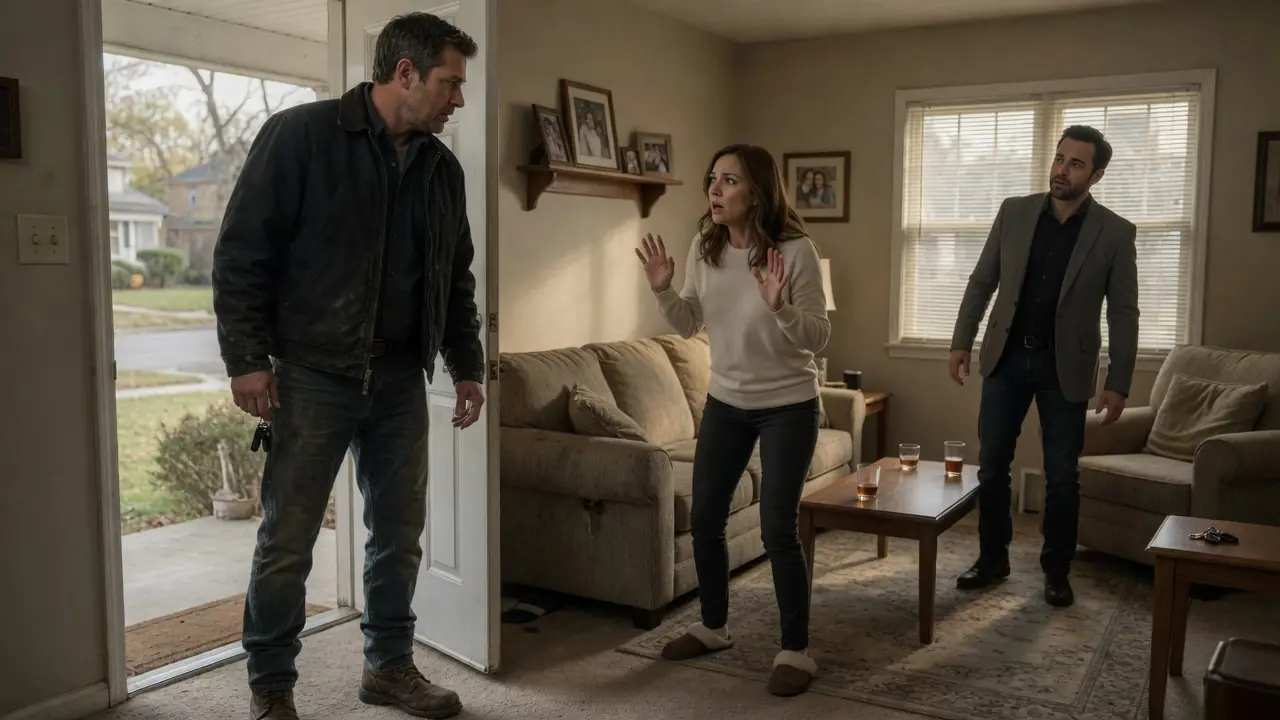
They were in the living room.
Naomi on the couch.
Troy in the armchair closest to the window.
Both of them with drinks.
Both of them looking at each other with an easiness that told me this was not the first afternoon they had spent this way.
The moment they heard the door, Troy was on his feet like a man who had been rehearsing an exit.
Naomi’s drink hit the coffee table hard.
Troy looked at me with the expression of a man whose entire internal system had just gone into emergency shutdown.
Eyes wide.
Face pale.
Shoulders pulled back toward the wall behind him.
Then Naomi started screaming.
Not crying.
Not explaining.
Screaming, full volume.
Hands up, voice filling the room like she was trying to drown out whatever was about to happen with sheer noise.
“What are you doing home? You do not just walk in here. This is not okay, Preston. You cannot just show up early and act like—get out. I mean it. You need to leave right now. This is my house too.”
I stood in the doorway and looked at her.
Then I looked at Troy, who had pressed himself against the far wall with the posture of a man who desperately wanted to become part of the wallpaper.
And then I laughed.
Not a short, ironic exhale.
A real laugh.
The kind that comes from somewhere deep when something is simultaneously too absurd and too perfectly timed to treat any other way.
I stood there in my own living room, jacket still on, keys in hand, and I laughed while my wife screamed at me for coming home.
Naomi’s voice climbed higher.
“Do not you laugh at me. I am serious. This is not funny. You need to leave this house right now.”
“This is my house, Naomi,” I said, still almost smiling, my voice completely calm beneath her volume. “I pay the mortgage on it. You want someone to leave, you are looking at the wrong person.”
Troy had been inching sideways toward the hallway like he was hoping I would forget he existed.
I looked at him directly, and he froze.
“Troy,” I said.
He opened his mouth.
Nothing came out.
“You do not have to say anything,” I told him, quieter now. “I already know everything worth knowing. But I want you to look at me and understand something.”
I paused.
“You sat at my table. You shook my hand. You borrowed money from me and paid it back in installments because you said that was the honorable thing to do.”
I let the word land.
“You should think hard about that word.”
His jaw worked.
His eyes were still wide.
He looked, honestly, like a man who was hoping the floor would do him a favor.
Naomi had gone quiet during that exchange.
The screaming had shut off the moment I stopped reacting to it.
And now she was watching me with something that was not anger anymore.
It was closer to dread.
Troy picked up his keys from the side table.
He did not look at either of us as he moved toward the door.
I stepped aside and held it open.
He walked out without a word, and I closed the door behind him.
Not gently this time.
The frame shook.
Naomi stood in the living room, arms wrapped around herself.
“Preston—”
“We will talk tomorrow,” I said, walking past her toward the bedroom. “Not tonight.”
“You cannot just—”
“Tomorrow, Naomi.”
I closed the bedroom door.
This time, I did not hear her follow.
I sat on the edge of the bed and stared at the floor for a long moment, hands on my knees.
The laugh had been real, but underneath it had been something heavier that I did not let surface in front of her.
That was the rule.
Whatever happened inside, nothing useful came from putting it on display.
I took out my phone and texted Curtis two words.
It is time.
He replied in under a minute.
Fitch tomorrow?
I typed back.
First thing.
Then I set the phone on the nightstand and lay back on top of the covers, staring at the ceiling, listening to the house settle around me.
In the living room, after a long silence, I heard Naomi sit back down on the couch.
I heard her pick up her phone.
I heard her start talking in a low, urgent voice that she thought I could not hear.
She was running out of runway, and she did not know it yet.
I met with Gerald Fitch Friday morning and walked him through what had happened.
Troy in the living room.
The screaming.
The whole scene.
He listened without changing his expression.
When I finished, he nodded once, made a note, and told me the timeline was now our friend.
“She is rattled,” he said. “Rattled people make moves. Let us make sure every move she makes is one we have already accounted for.”
We finalized the next sequence over the following four days.
Fitch handled the legal architecture quietly and precisely, the way he described it at our first meeting.
By Tuesday, the paperwork was in order.
Property transfer documentation built on the refinance clause she had signed without reading.
Account separation filings.
A clean and complete asset inventory.
He said it with characteristic calm.
“She will see the structure only after it is already weight-bearing.”
On Wednesday evening, I came home from work to find Naomi out.
She had texted that she was having dinner with Diane.
I had approximately two hours.
I went straight to the second bedroom closet, pulled out the four storage boxes I had staged there over the previous week, and started moving through the house.
I was not careful about it.
I was not folding things or packing neatly.
I opened Naomi’s closet and pulled clothes out by the armful, hangers and all, and pushed them into boxes without separating them.
Shoes went in loose on top of whatever was already there.
The decorative items on her vanity.
The perfume collection she had been building for years.
The jewelry organizer.
The framed photo of her and Diane from a trip to Savannah.
All of it went in without ceremony or sorting.
I moved fast and without sentiment.
She had had a year to treat this house like it meant something.
I was past the point of treating her things like they did.
The boxes went to the front hallway.
Four of them, stacked two high.
Her life compressed into cardboard without apology.
I did not leave a note.
I did not arrange them neatly.
I just set them by the door like freight.
Then I walked to the kitchen, made a sandwich, and sat down to eat it.
She came home at nine.
I heard the front door open.
Heard her stop.
Heard the silence stretch out as she processed what she was looking at.
Then she appeared in the kitchen doorway.
“What is this?”
Her voice was tight and low.
“Your things,” I said, not looking up from my plate.
“You packed my things.”
“Loosely speaking, yes.”
She stepped into the kitchen.
“Preston, you cannot just—”
“I did not touch anything that was jointly ours,” I said, cutting her off cleanly. “The joint items stay until the paperwork says otherwise. What is in those boxes is yours. I will make arrangements.”
Her voice went up.
“You do not get to decide when I leave my own home.”
I set down my sandwich and looked at her levelly.
“Naomi, you brought another man into this house, into our living room, on a Wednesday afternoon.”
I kept my voice even, each word placed like a tool going back on a shelf.
“You do not get to tell me what I get to decide about this house anymore. That privilege left with Troy.”
Her mouth tightened.
Tears came.
The real kind this time, I could tell, but she held them back through what looked like genuine effort.
“I have nowhere to go on short notice,” she said.
“Diane has a spare room,” I replied. “You were just at her house.”
She looked at the boxes, then at me, then back at the boxes.
Calculating.
Hoping for a lever she did not have.
“I want to talk to someone,” she said finally. “A counselor. Both of us.”
“You should absolutely talk to someone,” I told her, standing up and taking my plate to the sink. “I genuinely encourage that.”
I rinsed the plate and set it in the rack.
“As for both of us, that conversation should go through our attorneys at this point.”
She exhaled like something had collapsed inside her.
“You have already talked to a lawyer.”
“I have,” I said simply. “And they are very good.”
I dried my hands, walked past her to the hallway, and paused at the stack of boxes.
I looked back at her once, at the woman I had spent eleven years building a life with, who had spent one year quietly dismantling it.
“I am not angry,” I told her, and I meant it. “But I am done.”
I went to the guest room and closed the door.
Outside, after a long time, I heard her moving.
The sound of a box being lifted.
The front door opening.
Then closing.
Then opening again.
She was making arrangements.
Naomi moved into Diane’s spare room eleven days after the boxes appeared in the hallway.
She took what she could fit in her car that first night and came back twice more with Diane’s SUV.
Each time, I was either at work or in the garage, and each time, she moved through the house quickly and quietly, like someone who had finally accepted the new geography of things.
On the fourteenth day, I got a call from a number I did not recognize.
A woman’s voice, professional and clipped, identified herself as Dana Hollister, attorney at law, representing Naomi Turner in the matter of marital dissolution.
She wanted to schedule an initial four-way meeting, both parties, both attorneys, within the week.
I wrote down the name, thanked her politely, and called Gerald Fitch before I had even pulled out of the parking lot.
“She moved first,” I told him.
“Good,” Fitch said without hesitation. “It means she is scared and working from a reactive position. What is the attorney’s name?”
I told him.
There was a brief pause.
“Dana Hollister,” he repeated. “Aggressive, theatrical, good at making noise.”
Another pause.
“She has never beaten me.”
We met four days later in a conference room downtown.
Neutral ground.
A rented space with a long table and no windows.
Naomi sat across from me for the first time since she had finished removing her things, and she looked composed in the careful, constructed way of someone who had spent the morning building armor.
Dana Hollister sat beside her, a woman in her fifties with sharp eyes and a leather portfolio she opened before anyone else had settled.
Hollister opened with a property claim framed around Naomi’s eleven years of domestic contribution, followed by a spousal support argument built on income disparity.
She delivered it smoothly and watched me across the table as she spoke, clearly gauging whether the presentation was landing.
I kept my face neutral.
Under the table, I had my copy of the refinance agreement open to page seven, clause 4.1.
When she finished, Fitch opened his folder.
He did not raise his voice.
He did not perform.
He simply began laying documents on the table, one at a time, like a man setting tools on a workbench before a job he had already completed in his head.
The refinance clause.
The primary income documentation.
The asset transfer paperwork already filed.
The account separation already processed.
Three years of financial records showing the consistent and documented structure of household funding.
By the time Fitch reached the fourth document, Hollister had stopped writing.
By the sixth, Naomi was looking at the table instead of at me.
“The structure is already built,” Fitch said pleasantly, stacking his documents back into the folder. “We are not here to negotiate the foundation. We are here to discuss the terms of transition within it.”
Hollister asked for two weeks to review.
Fitch gave her one.
I drove home that afternoon and sat in the driveway for a few minutes.
The house felt different from the outside now.
Not smaller.
Just more honestly itself.
A building with a value and a deed and a mortgage I had paid ninety percent of, instead of the projected backdrop of a life I had been performing in.
I went inside, changed clothes, and drove to the coffee shop on 5th Street where I had started going in the mornings after Naomi left.
It was quiet, good light, a counter by the window where you could sit with a cup and not be required to be anything in particular.
The woman at the end of the counter looked up when I sat down.
She had been there twice before.
I noticed her the way you notice someone who takes up the right amount of space without trying to fill all of it.
Dark hair.
Reading glasses pushed up on her head.
A paperback open face down beside her coffee.
“You are the regular who orders the dark roast and stares at the window,” she said.
“Guilty,” I replied.
“Isla,” she offered, extending a hand.
“Preston,” I said and shook it.
She went back to her book.
I went back to my coffee.
We sat in comfortable quiet for twenty minutes, and somewhere in that quiet, something settled in me.
Not dramatically.
Not with ceremony.
Just the simple recognition of what peace actually felt like when it was not being maintained by effort.
I left first.
Nodded on my way out.
She nodded back.
It was not a beginning yet, but it was not nothing either.
The divorce finalized on a Thursday in late January, eight weeks after that first four-way meeting.
Naomi received her car, her personal belongings, and a settlement figure Fitch described as fair, proportionate, and final.
The house stayed with me.
The retirement account stayed with me.
The joint account had already been separated four months prior.
Hollister filed two counter motions in the final stretch.
Fitch dispatched both of them without drama and billed me for four hours.
Naomi signed everything on a Tuesday afternoon.
I was not in the room.
Fitch handled it, and he called me afterward with the same unhurried manner he used for everything.
“It is done,” he said. “Clean. Complete.”
“Thank you, Gerald,” I told him. “I mean it fully.”
That evening, Curtis came over with a six-pack, and we sat on the back porch in the cold and did not say much.
At one point, he raised his can and said, “You handled that like a man.”
I raised mine back, and that was the whole ceremony.
Troy disappeared from the family landscape with the quiet efficiency of someone who understood he had used up every benefit of the doubt he was ever going to get.
Pamela left him two months after my phone call.
Not because I had asked her to, but because the full picture, once seen clearly, apparently looked different than the partial one she had been living with.
I heard this through Curtis, who heard it through Vince.
I did not follow up.
It was not my chapter.
Naomi moved to a rental in Westerville.
Her parents, particularly her father Raymond, had not, from what I understood, returned to the warmth they had had with her before that phone call.
Some things realign when the truth comes out, and not everything realigns back.
On the last Friday of February, I went to the coffee shop on 5th Street.
Isla was at the counter.
Same spot.
Same glasses on her head.
Different book.
She looked up when I came in, and something in her expression said she had noticed the absence of whatever weight I had been carrying the last few times.
“You look different,” she said.
“Better or worse?” I asked, sitting down.
She considered it with the seriousness the question deserved.
“Lighter,” she decided.
I ordered my dark roast.
She closed her book.
We talked for an hour about her work as a physical therapist, about boiler systems and why I had chosen a trade over an office, about the particular satisfaction of fixing something that was broken and having it hold.
At some point, she laughed at something I said.
A real laugh.
Without any performance in it.
And I thought, there it is.
That is the sound of something that does not need maintenance to stay running.
I asked if she wanted to have dinner sometime.
She said yes without deliberating over it.
I drove home through the February cold with the heat on and the radio low.
I thought about eleven years and what they had built and what they had cost, and about what it meant to come out the other side of something like that still standing.
Still whole.
Still capable of sitting across from someone new and feeling genuinely curious about what came next.
The house was quiet when I got home.
Just mine.
The right kind of quiet.
Not the absence of something lost, but the presence of something earned.
I did not have a word for what was starting with Isla.
I did not need one yet.
I just knew that, for the first time in a long time, I was walking toward something instead of managing something falling apart.
Some people mistake a quiet man for a weak one.
Preston never raised his voice to demand respect.
He simply stopped giving access to anyone who had not earned it.
And in the end, that is what real strength looks like.