The wind screamed across the frozen landscape like a living thing, hungry and vicious. Margaret Sinclair gripped the edge of the carriage seat as the wheels jolted over another rut in the road, her knuckles white beneath her worn gloves. She could barely see the second carriage ahead through the swirling snow. She could barely hear anything over the howl of the storm. “Mama, I’m cold,” Clara’s small voice cut through the chaos. “I know, darling. Just a little longer.” The lie tasted bitter. Margaret had no idea how much longer.
They’d been traveling for hours since leaving the last village, and the road to Yorkshire had disappeared beneath the snow. Frances clutched her younger sister tighter, her own face pale. At ten years old, she was trying so hard to be brave. “We’ll be all right, Clara. We will.” The carriage lurched violently. Someone screamed, Louisa, maybe, or Amelia. Margaret’s heart hammered as the driver shouted something unintelligible into the wind. Then the world tilted.
The smaller carriage ahead had stopped, listing to one side like a wounded animal. Through the white curtain of snow, Margaret could see figures spilling out, her daughters, thank God, moving, but the wheel, the wheel was shattered. “Stay here,” she commanded Frances and Clara, then pushed open the door into the storm. The cold hit her like a fist. Her skirts whipped around her legs as she fought her way forward, snow stinging her face.
Elellanena was already there. Her eldest at twenty-two was trying to help Beatrice down from the broken carriage. The six-year-old was sobbing, her small body shaking. “She’s burning up, Mama,” Elellanena’s voice was tight with fear. “She’s been feverish since this morning.” Margaret pressed her hand to Beatrice’s forehead and felt her world narrow to a single point of terror. The child was on fire.
“We can’t go on,” the driver said, appearing at her elbow. His face was grim. “Wheels done. And even if it wasn’t, we’ll all freeze to death before we reach the next village. This storm’s getting worse.” “Then what do you suggest?” Margaret heard the edge of hysteria in her own voice and forced it down. She had ten daughters depending on her. She couldn’t break. Not now, not ever.
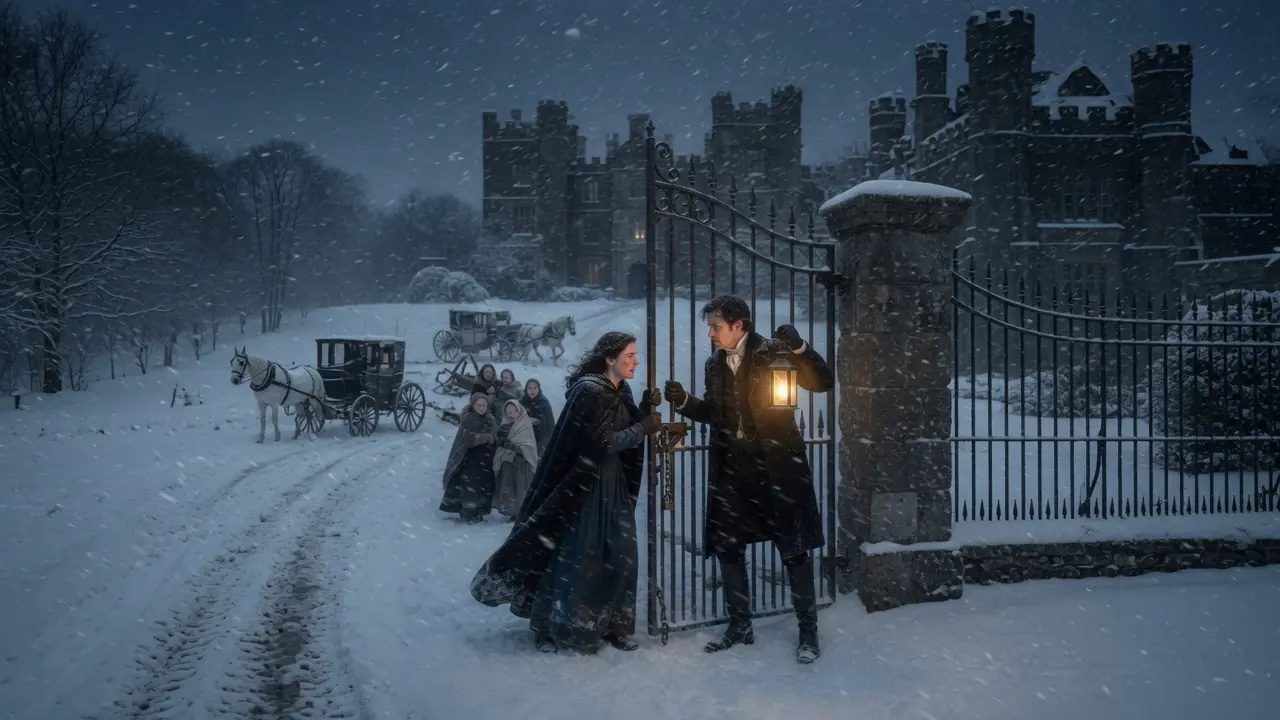
The driver pointed into the darkness. “There’s a manor house about a quarter mile that way. Big gates. Haven’t seen anyone there in years, but it’s shelter.” “Take us there.” Margaret’s voice could have cut glass. “My daughter is dying.” Twenty minutes later, Margaret stood before iron gates that rose from the snow like the bars of a prison. Beyond them, barely visible through the storm, a massive house loomed against the dark sky. No lights, no movement, just stone and shadow, and the promise of walls between her children and the killing cold.
She hammered on the gates with both fists. “Hello? Please. We need help. My daughter is sick. Please.” Nothing. Only the wind answered. Rosalind appeared at her side, the eldest daughter’s face set with determination. Even half frozen, even desperate, she looked like her father, sharp-minded, stubborn, unwilling to yield. “Let me try.” Rosalind’s voice was hoarse from the cold, but it carried.
She gripped the gates and shouted into the darkness. “We know you’re in there. We know this is Ashwell Manor. I don’t care if you haven’t opened these gates in seven years. You’re going to open them now, Rosalind. My six-year-old sister has a fever, and we’ve been traveling in a blizzard for eight hours. Our carriage is broken, and we have nowhere to go.”
Rosalind’s words came faster, harder. “You can hide in there forever if you want, but tonight you’re going to choose. Let us in or know that a child froze to death at your gates because you were too much of a coward to answer a knock.” Silence. Margaret felt hope dying in her chest. Then, like a ghost materializing from the storm, a figure appeared on the other side of the gates. An old man, thin and severe, carrying a lantern. His eyes swept over them. Two carriages, eleven frozen women, a child limp in her mother’s arms.
“His Grace does not receive visitors.” “His Grace,” Rosalind said, her voice like ice over steel, “can send us away in the morning if he’s that determined to be alone. But right now, my sister needs warmth and a bed. And unless your master wants to explain to God why he let a child die on his doorstep, I suggest you open this gate.” The old man’s eyes narrowed. For a terrible moment, Margaret thought he would refuse. Then the lock clicked. The gate swung open.
The entrance hall of Ashwell Manor was like stepping into a cathedral built for ghosts. Marble floors stretched into shadow. A grand staircase curved upward into darkness. Dust motes danced in the lamplight, and the air smelled of disuse and silence. Margaret barely registered any of it. She was focused on Beatrice, on getting her warm.
“Mrs. Peton will show you to rooms,” the old servant, Peton, she assumed, gestured toward a severe-looking woman who had appeared from a side corridor. “There is a room with a fire already laid for the child.” “Thank you,” Margaret meant it with every fiber of her being. “Thank you so much.” As Mrs. Peton led them up the stairs, Margaret counted heads. All ten daughters, all moving. Catherine helping Harriet, who had twisted her ankle. Josephine carrying their smallest bag. Amelia clinging to Elellanena’s hand. They were safe for now. They were safe.
“Where are we?” Beatrice whispered. “Somewhere safe.” Margaret pressed a kiss to her daughter’s burning forehead and prayed she was telling the truth. Rosalind left her mother and Eleanor with Beatrice and went exploring. She knew she shouldn’t. They were guests, uninvited guests really, who had essentially forced their way in. But the house called to her, this strange dead place full of covered furniture and closed doors.
She found the library by accident, following a corridor that seemed less dusty than the others. The door was ajar, and lamplight spilled through the gap. Someone was inside. Rosalind pushed the door open slowly. The library was magnificent. Three stories of books, spiral staircases leading to galleries, leather chairs positioned near a massive fireplace, and standing before one of the shelves, a book open in his hands, was a man.
He looked up at the sound of her entrance. He was younger than she’d expected, thirty-five perhaps, though his eyes looked older. Dark hair, strong features, and an expression of such profound irritation that Rosalind almost laughed. “You must be the Duke of Ashwell.” “And you must be one of the women currently invading my home.” His voice was cultured, cold. “I assume you’re here to thank me for my charitable nature.”
“Actually, I’m here because I got lost looking for a washroom,” Rosalind stepped fully into the library, refusing to be intimidated. “But since you mention it, yes, thank you. My sister would likely be dead if you’d left us out there.” “How gratifying to know I’ve done my good deed for the decade.” He turned back to his book, dismissing her. “The servants will show you out in the morning when the storm clears.”
“Of course. We wouldn’t dream of imposing on your precious solitude any longer than absolutely necessary.” He glanced at her sharply. “Was that sarcasm?” “Was your comment about charity genuine concern?” Rosalind moved closer, drawn despite herself to the book in his hands. “What are you reading?” “Marcus Aurelius. Meditations.” He closed the book with a snap. “Not that it’s any of your concern.”
“The happiness of your life depends upon the quality of your thoughts,” Rosalind quoted from memory, watching surprise flicker across his face. “Ironic choice for someone who’s locked himself away from the world.” “You’ve read it.” “My father believed in education, even for daughters.” Rosalind’s throat tightened at the mention of her father. Two months dead, and the wound was still raw. “He used to say that her mind was the only thing no one could take from you.”
“He was wrong. They can take everything from you, Miss Sinclair.” “Rosalind Sinclair.” She studied him. This bitter man in his tomb of a house. “What did they take from you?” For a moment she thought he might actually answer. Something flickered in his eyes. Pain, maybe, or the ghost of it. Then his expression shuttered. “Good night, Miss Sinclair. I trust you can find your way back to your family.”
It was a dismissal. Rosalind recognized it and knew she should go. But something in her rebelled against his coldness, his determination to push the world away. “You know what I think?” she said softly. “I think you didn’t let us in because you’re charitable. I think you let us in because you’re lonely, and somewhere under all that ice, you’re still human enough to hate yourself for letting a child freeze to death.” His eyes locked on hers, and for three heartbeats, the air between them crackled with something Rosalind couldn’t name. Anger, maybe, or recognition, the acknowledgement of one wounded person seeing another.
“Get out of my library.” His voice was very quiet. Very dangerous. Rosalind went. But as she walked back through the dark corridors toward the warmth and noise of her sisters, she couldn’t stop thinking about the look in his eyes. He wasn’t a monster. He was just a man who’d been hurt so badly he’d forgotten how to be anything else. And God help her, she understood that completely.
Morning came cold and brilliant, the storm having blown itself out during the night. Rosalind woke to the sound of her sisters’ voices. Catherine and Harriet arguing about something. Frances trying to mediate. Louisa laughing. Normal sounds. Safe sounds. Beatrice’s fever had broken sometime before dawn. Margaret had stayed up all night watching her youngest daughter breathe. And now she slept in a chair by the bed, exhausted but relieved.
Rosalind slipped out quietly and made her way downstairs. The house looked different in daylight, still vast and shadowy, but less like a mausoleum. Weak winter sun filtered through tall windows, illuminating portraits on the walls. Aristocratic faces stared down at her. Generations of Ashwell ancestors watching the latest invasion of their ancestral home. She found Peton in what appeared to be a breakfast room.
“Miss Sinclair, you’re up early.” “Old habit.” Rosalind managed a smile. “Mr. Peton, I wanted to ask about the road to Yorkshire. Is it possible now that the storm has cleared?” The old man’s expression was carefully neutral. “I’m afraid not, miss. There’s been significant snow. The main road won’t be clear for at least a week, possibly two, and your carriage wheel is beyond simple repair. It will need to be replaced entirely.”
“A week? Two weeks?” Rosalind felt panic and something else, something she didn’t want to examine, rise in her chest. “His Grace must be thrilled,” she said quietly. “His Grace,” said a cold voice from the doorway, “is standing right here.” Rosalind turned to find Nathaniel Gray, Duke of Ashwell, watching her with those too-old eyes. He was dressed impeccably, despite the early hour, every inch the aristocrat. But there was something in the rigid way he held himself that suggested armor rather than confidence.
“Your Grace.” She managed what she hoped was a respectful nod. “Mr. Peton was just telling me about the roads.” “Yes. I’m aware. It appears you’ll be my guests for somewhat longer than anticipated.” He moved into the room and Rosalind noticed he kept distance between them, as if proximity was dangerous. “I trust your sister recovered.” “She did. Thanks to your hospitality.”
“It wasn’t hospitality. It was basic human decency.” He poured himself coffee with precise movements. “Don’t romanticize it into something it’s not.” “I wouldn’t dream of it.” Rosalind felt her temper rising and tried to control it. “We’ll try to stay out of your way. I know this is difficult for you.” “You know nothing about me, Miss Sinclair.”
“I know you’ve lived alone here for seven years. I know you read stoic philosophy and lock your gates against the world. I know you’re angry that we’re here, but you haven’t thrown us out, which means some part of you is still—” “Still what?” He set his cup down hard enough that coffee slopped over the rim. “Still capable of redemption? Still worth saving?” “I didn’t ask for your analysis.”
“No, you asked for solitude.” Rosalind met his glare steadily. “But you got me and my family instead. I’m sorry if that inconveniences your exile, Your Grace, but we didn’t choose to be here any more than you chose to have us.” For a long moment, they simply stared at each other. His jaw was tight, his hands clenched, but something in his eyes, something desperate and furious and achingly lonely, made Rosalind’s anger evaporate.
“I’m sorry,” she said quietly. “That was unkind. You saved my sister’s life. You’ve given us shelter. I have no right to judge how you choose to live.” He looked away first. “Your family may use the east wing. There are enough rooms there for all of you. Meals will be provided. But I expect—” He paused, seeming to struggle with the words. “I expect you to respect my privacy. I’m not accustomed to company.”
“Of course.” Rosalind felt an unexpected surge of sympathy. “We’ll be as quiet as possible.” “That,” he said, the ghost of dark humor in his voice, “seems unlikely given that there are eleven of you.” Despite everything, Rosalind smiled. “You may have a point.” He almost smiled back. Almost. Then he caught himself and the shutters came down again. “If you’ll excuse me, I have matters to attend to.” He moved toward the door, then paused. “Miss Sinclair, that book you quoted from last night. There’s a complete set of Aurelius in the library. You’re welcome to read it if you wish.”
He was gone before she could respond. The days that followed fell into a strange rhythm. Margaret organized the east wing, turning dusty rooms into living spaces for her daughters. Mrs. Peton thawed slightly, especially toward the younger girls. Peton maintained his severe expression, but Rosalind noticed he always ensured the fires were lit in the children’s rooms first. And the Duke, the Duke was a ghost in his own house.
Rosalind caught glimpses of him, a dark figure disappearing down corridors, his silhouette in a distant window. He never joined them for meals, never spoke to any of them except in brief, necessary exchanges. But every evening Rosalind went to the library. And every evening she found small signs that he’d been there. A different book left on the table, always something philosophical or historical. Once a note in precise handwriting. “If you found Aurelius interesting, try Epictetus. Different perspective, same fundamental truth.”
She read Epictetus, left her own note. “Interesting, but I prefer Seneca. More human, less clinical.” The next day, Seneca was waiting with a note. “Seneca was a hypocrite. Preached simplicity while living in luxury.” Her response: “Hypocrisy doesn’t negate truth. Even flawed messengers can carry valid messages.” It became a game, this exchange of philosophical barbs. Rosalind found herself thinking about what she’d write next, anticipating his responses. It was safer than actual conversation. Ideas instead of feelings. Theories instead of truths.
But sometimes, late at night, when she couldn’t sleep, she’d go to the library and find him there, reading by lamplight, his face unguarded in the assumption of solitude. Those were the moments that undid her. Seeing past the armor to the loneliness beneath. Once he looked up and saw her in the doorway. Neither of them spoke. Neither of them moved. They just looked at each other across the space of the library, and Rosalind felt something shift in her chest. Something dangerous and inevitable and terrifying.
Then Beatrice called for her from upstairs, and the moment shattered. But Rosalind lay awake that night, thinking about the expression in his eyes. It had looked almost like longing. Almost like hope. Almost like he was drowning and she was the only thing keeping him afloat. Two weeks became three. The roads were still impossible. Or so Peton reported. Rosalind was beginning to suspect the old servant was exaggerating the danger, giving them more time before they had to leave this strange sanctuary and face whatever waited for them in Yorkshire.
The house was changing. Or maybe she was changing, learning to see it differently. It wasn’t a tomb. It was just empty, waiting to be filled. The gardens were beautiful under their blanket of snow. The rooms were magnificent under the dust covers. Even the portraits on the wall seemed less judgmental and more curious, as if the Ashwell ancestors were intrigued by the invasion of their domain.
Her younger sisters were transforming the place simply by existing in it. Frances had discovered the old piano in the music room and spent hours coaxing sound from the neglected instrument. The notes were often discordant. The piano badly needed tuning. But they brought life to empty corridors. Amelia had befriended a large orange cat that appeared from nowhere and followed her everywhere, much to Nathaniel’s visible consternation the one time he’d encountered them in the hall.
Even Louisa, who’d been the most frightened during the storm, had started leaving books scattered throughout the house, marking her territory like a particularly literary cat. And Beatrice, fully recovered, had taken to drawing. Her subjects were always the same. The sad Duke who lives alone. Rosalind had found a dozen of these drawings tucked in various corners, each showing a tall, dark figure standing by himself while everyone else was grouped together in warmth and light.
“Why do you always draw him alone?” Rosalind had asked. Beatrice looked at her with those too-wise six-year-old eyes. “Because that’s how he is. But I don’t think he wants to be.” The breakthrough came on a Thursday afternoon, nearly a month after their arrival. Rosalind was in the library. It had become her refuge, the one place she felt close to her father, surrounded by the books he’d loved. When she heard shouting from the gardens, she ran to the window.
Below, in the snow-covered gardens, several of her sisters were engaged in what appeared to be a chaotic snowball battle. Catherine and Harriet against Josephine and Louisa, with Frances acting as enthusiastic but biased referee. They were laughing, pink-cheeked, covered in snow, and utterly, gloriously alive. And standing at the edge of the garden, watching them with an expression of such raw longing it hurt to see, was Nathaniel Gray.
Rosalind didn’t think. She just moved. She found him still standing there five minutes later when she’d thrown on her cloak and made it outside. He didn’t turn as she approached, but his shoulders tensed. “They’re loud,” he said flatly. “They’re happy.” Rosalind came to stand beside him, close enough that she could see the conflict in his face. “When was the last time you were happy, Your Grace?”
“I don’t remember.” The admission seemed to surprise him. “Seven years is a long time.” “What happened seven years ago?” For a moment, she thought he wouldn’t answer. Then, slowly, as if the words were being dragged from somewhere deep and painful, he began to speak. “I was accused of fraud. Investment fraud. My business partner, Lord Edmund Blackwood, had been embezzling from our joint ventures for years, covering his tracks by manipulating the accounts. When it was discovered, he blamed me. Said I was the one who’d stolen from our investors.”
Nathaniel’s voice was emotionless, but his hands were clenched. “Families were ruined. People lost their homes, their savings, and they all believed I’d done it.” “But you hadn’t.” “No. But I couldn’t prove that. Blackwood was meticulous, and I’d been too trusting, too careless with the details. By the time I realized what he’d done, the damage was complete.” He finally looked at her, and the pain in his eyes was staggering. “Do you know what it’s like to be condemned for something you didn’t do? To watch people you considered friends turn away, cross the street to avoid you, whisper behind your back?”
“Yes.” Rosalind’s voice was soft. “I do know. When my father died and his debts were revealed, our friends vanished overnight. Women I’d known my entire life suddenly didn’t recognize me on the street. We were treated like criminals for the crime of being poor.” Something flickered in his expression. Recognition, perhaps. Kinship.
“I came here,” he continued, “because I couldn’t stand to be in London anymore. Couldn’t stand the stares, the whispers, the accusations. I thought if I removed myself entirely, the anger would fade, but it didn’t. It just froze. Everything froze.” “Until eleven half-frozen women demanded you open your gates.” His mouth twitched. Not quite a smile, but close. “Yes. Until that.”
A snowball hit him squarely in the back. Nathaniel spun, startled, to find Beatrice standing ten feet away with another snowball already formed in her small hands. Her face was both guilty and defiant. “Beatrice!” Elellanena rushed over, mortified. “You can’t throw snowballs at the Duke.” “Why not?” Beatrice demanded. “He’s just standing there being sad. Mama says sometimes when people are sad, you have to make them play.”
Nathaniel stared at the child. Rosalind held her breath, waiting for his anger. Instead, slowly, he bent and scooped up a handful of snow, packed it methodically into a ball, and threw it gently, carefully, at Beatrice. It caught her on the shoulder. She shrieked with delight. “Teams!” Frances shouted. “Duke Nathaniel is on our side!” “I don’t think—” Nathaniel started, but Louisa grabbed his hand. “You have to. It’s three against four now. It’s not fair otherwise.”
Rosalind watched, something warm and painful expanding in her chest, as this remote, bitter man let himself be dragged into a snowball fight by a fourteen-year-old girl. He was terrible at it initially, too stiff, too self-conscious, but gradually something in him loosened. By the time Margaret came out to call them in for dinner, he was laughing. Actually laughing.
That night, for the first time in a month, Nathaniel joined them for dinner. He was quiet, withdrawn, clearly uncomfortable with the noise and chaos of eleven women around a table, but he was there. And when Amelia accidentally knocked over her water glass and burst into tears, convinced she’d ruined everything, he was the one who said gently, “It’s just water. Nothing that can’t be fixed.”
After dinner, he and Rosalind found themselves alone in the hallway. “Thank you,” he said quietly. “For not—I don’t know—for not making today into something bigger than it was.” “It was just a snowball fight.” “It was more than that. It was—” He struggled for words. “It was remembering what it feels like to be human.” Rosalind’s throat tightened. “You never stopped being human, Nathaniel. You just forgot for a while.”
It was the first time she’d used his name. His eyes widened slightly, and the air between them shifted, became heavier, more charged. “Rosalind,” he said, testing her name. “I should warn you. I’m not—I’ve forgotten how to do this. How to be around people. How to be anything other than angry and alone.” “Then learn again.” She stepped closer, drawn by something she couldn’t name. “We’re not going anywhere for a while. The roads are still blocked.”
“The roads have been clear for three days.” The confession came out rough. “I asked Peton to lie. I told myself it was because you needed more time to prepare. But the truth is,” he stopped, jaw clenched. “The truth is, I didn’t want you to leave.” His voice dropped to barely above a whisper. “Any of you. This house has been dead for seven years, and you brought it back to life, and the thought of it being empty again—” Rosalind kissed him.
She didn’t plan it. Didn’t think about propriety or consequences or what it meant. She just rose on her toes and pressed her lips to his, and for one perfect moment, the world stopped. Then he was kissing her back, his hands coming up to frame her face, and it was nothing like the chaste kisses she’d exchanged with her late husband. This was fire and desperation and seven years of loneliness finding its match.
They broke apart, both breathing hard. “We can’t,” Nathaniel said. But he didn’t let go of her. “Rosalind, I’m ruined. Disgraced. Being associated with me would destroy you.” “I’m already destroyed. I’m a penniless widow with ten dependents and nowhere to go. You can’t ruin something that’s already broken.” “You’re not broken.” His thumb traced her cheekbone. “You’re the strongest person I’ve ever met.”
“Then let me be strong enough for both of us.” He kissed her again, slower this time, tender and searching. And Rosalind felt something she hadn’t felt since her father died. Hope. The next week was stolen time, precious and precarious. They were careful, never alone together where the servants might see, never touching in front of her family. But Rosalind felt his eyes on her at dinner, felt the weight of his attention when she walked into a room, and the library became their sanctuary.
Every night, after her sisters were asleep, she’d slip down to find him waiting. They’d talk for hours about books, about philosophy, about the lives they’d had and the people they’d been before tragedy reshaped them. “I was going to be a diplomat,” Nathaniel told her one night. “Before the scandal. I wanted to travel, to represent England in foreign courts. I thought I could make a difference.” “You still could.”
“No.” His voice was firm. “That life is gone. I accepted that a long time ago.” “Accepting something doesn’t make it right.” He looked at her for a long moment. “You don’t give up, do you?” “I can’t afford to. If I give up, my family starves.” Rosalind said it matter-of-factly, but she saw him flinch. “I’m sorry. That was—” “True.” He reached for her hand, laced his fingers through hers. “You’re remarkable, Rosalind Sinclair. You know that.”
“I’m practical. There’s a difference.” “No. You’re remarkable.” He pulled her closer until she was standing between his knees as he sat in the library chair. “And I’m falling in love with you, which is possibly the most selfish thing I’ve ever done.” Rosalind’s heart stopped. “Nathaniel—” “I know I have nothing to offer you. No future, no prospects, just a crumbling manor and a destroyed reputation, but I needed you to know. I needed to say it out loud at least once.”
She kissed him instead of answering. Poured everything she felt into that kiss, all the fear and hope and desperate longing. When they finally broke apart, she was shaking. “I love you too,” she whispered. “God help me. I do.” They held each other in the firelight, and Rosalind tried not to think about what would happen when they finally had to leave. Tried not to think about the impossibility of their situation. A disgraced duke and a penniless widow with ten mouths to feed. But reality had a way of intruding.
The letter arrived on a Tuesday morning, delivered by a rider who’d braved the muddy roads from London. Peton brought it to Nathaniel at breakfast, his face carefully neutral. Rosalind watched Nathaniel’s expression change as he read. Shock, then fury, then something that looked like despair. “What is it?” she asked quietly. He handed her the letter without a word.
It was from someone named Lady Constance Worthington. The handwriting was elegant, the tone warm and concerned. She’d heard that the Duke of Ashwell had taken in some unfortunate travelers during the winter storms. How kind of him! How generous. She hoped he wouldn’t mind if she called on him. She was in the area visiting relatives and would so love to see him again after all these years. The letter was dated three days ago, which meant she’d be here today. Possibly within the hour, given the state of the roads.
“Who is she?” “An old friend. From before.” He stood abruptly, the chair scraping against the floor. “We were close once, before the scandal. She was one of the few people who didn’t immediately condemn me, but even she eventually stopped writing.” Something cold settled in Rosalind’s stomach. “And now she wants to visit. Now she wants to save you.” Nathaniel’s voice was bitter. “Constance always did have a savior complex. I’m sure she’s convinced I’ve been living like a hermit in squalor, desperately in need of rescue by a proper lady.”
“Haven’t you?” The words came out sharper than Rosalind intended. He looked at her. Really looked, and she saw understanding dawn in his eyes. “Rosalind—” “She’s from your world. Your proper aristocratic world. And I’m just the penniless widow you took pity on during a storm.” “That’s not—” “Fair? Isn’t it?” She met his eyes, daring him to deny it. “When she gets here, you’ll see the difference. You’ll remember what you’re supposed to be. Who you’re supposed to be with. And we’ll become what we’ve always been. Charity cases.”
“You know that’s not true.” “Do I?” Rosalind’s voice cracked despite her best efforts. “I’ve been living in a fantasy. We both have. But fantasies end, and I think yours is about to arrive in a very elegant carriage.” She left before he could respond. Before the tears threatening to spill could humiliate her further. She made it to the east wing, to the small room she shared with Elellanena and Catherine, before she broke.
Elellanena found her there twenty minutes later, face buried in her pillow. “Rosalind, what happened?” “Nothing. Everything.” Rosalind sat up, wiping her eyes furiously. “We need to leave as soon as the roads are fully clear. We’ve imposed on the Duke’s hospitality long enough.” “You’re in love with him.” It wasn’t a question. Elellanena sat beside her, taking her hand. “Oh, Rosie. Does he feel the same?”
“It doesn’t matter if he does.” “Of course it matters.” “No.” Rosalind shook her head. “He’s a duke. I’m nobody. That’s the only thing that matters.” “You have his love.” “Love isn’t enough.” Rosalind’s voice was flat. “I told him that. I should have believed it myself.” She wrote the letter that night. It was the hardest thing she’d ever done. Harder than watching her father die. Harder than facing their creditors. Harder than anything.
“Dear Nathaniel, I release you from any promises made. Your duty is to restore your name and your position. Mine is to protect my family. Those two duties cannot coexist. Please don’t write again. Please don’t come for me. I wish you every happiness with Lady Worthington or whomever you choose. You deserve peace. Rosalind.” She sealed it before she could change her mind. Sent it before dawn, before Elellanena could stop her. Then she cried until she had no tears left.
Two weeks passed with no response from Nathaniel. Rosalind told herself it was for the best. He’d accepted her decision, moved on, was probably already courting Constance properly, rebuilding his life the way he should have from the beginning. She tried to do the same. Found work as a seamstress for a local dressmaker. The pay was terrible, but it was something. Elellanena helped tutor the children of merchants who couldn’t afford proper governesses. Catherine took in washing. Slowly, painfully, they were building something like stability. It wasn’t happiness, but it was survival.
Then the invitation arrived. It was addressed to the entire Sinclair family, written in elegant script on expensive paper. “Lady Constance Worthington requests the honor of your presence at a spring ball to be held at Worthington House, London, May 15th, 1878.” Rosalind stared at it, her stomach churning. “This is a trap.” “Obviously,” Elellanena agreed. “She wants to parade us in front of London society. Show everyone how unsuitable we are. Humiliate us publicly so there’s no question about who Nathaniel should choose.”
Margaret took the invitation, her face hard. “Then we don’t go.” “We have to.” The words came from Catherine, surprising them all. At twenty, she was usually the quietest of the older sisters. “Don’t you see? If we don’t go, she wins anyway. She gets to say we were too ashamed to face society, that we knew we didn’t belong. But if we go, if we hold our heads high—” “We get destroyed anyway,” Rosalind said flatly. “Just publicly instead of privately.”
“Maybe,” Catherine’s eyes were fierce. “Or maybe we show them that we’re not ashamed of who we are. That we don’t need their approval to have dignity.” Rosalind looked at her mother, at Elellanena, at the younger sisters who had gathered to listen. They’d been through so much already. Lost their father, their home, their security. Been treated as burdens and worse. How could she ask them to walk into a room full of people who would judge and condemn them?
But looking at their faces, Catherine’s determination, Elellanena’s quiet strength, even Beatrice’s stubborn little chin, Rosalind realized she didn’t have to ask. “All right,” she said quietly. “We go to London.” Worthington House was magnificent in a way that made their modest Yorkshire accommodations look like servants’ quarters. Crystal chandeliers, marble floors, guests dripping with jewels and silk and old money. Rosalind and her family stood in the entrance hall in their carefully mended dresses, the best they had, but still obviously shabby compared to the splendor around them, and felt every eye turn toward them.
The whispers started immediately. “Is that them? The women from Ashwell?” “I heard there were ten daughters. Shameless, really, showing their faces here.” Rosalind felt Margaret stiffen beside her, felt Elellanena’s hand find hers. She lifted her chin. “We’re here,” she said quietly. “That’s what matters. We don’t have to stay long.”
But before they could retreat, Constance appeared. She looked stunning in emerald silk, diamonds at her throat. Every inch the perfect hostess. “The Sinclairs! How wonderful that you could come.” Her smile was brilliant, her eyes cold. “Please do come in. I’m sure everyone is dying to meet you properly.” It was a gauntlet thrown down. Accept the invitation to be paraded and mocked or flee and prove they didn’t belong.
Rosalind thought of Nathaniel, of the man who’d been dead inside until a snowstorm brought eleven women to his gates, of the way he’d looked at her in the courtyard and promised to fight for them. “Thank you, Lady Worthington,” she said clearly. “We’d be delighted.” The ballroom was worse than the entrance hall. Hundreds of people, all of them clearly aware of who the Sinclairs were and why they shouldn’t be there. Rosalind caught fragments of conversation as they moved through the crowd.
“Living there for months, completely unchaperoned—” “Ten daughters. Can you imagine the expense—” “Trying to trap the Duke. Obviously.” Lady Beatrice Hartley, the woman who’d humiliated Rosalind in Ashwell village months ago, was particularly vicious. She laughed loudly when Rosalind passed, making sure everyone could hear. “How brave of them to show their faces. I suppose when one has no shame, one can endure anything.”
Rosalind kept walking. Kept her head high. But inside she was dying. Then she saw him. Nathaniel stood across the ballroom talking with a group of older gentlemen. He looked different. More polished. More confident. The broken recluse was gone, replaced by the Duke he’d once been. He was magnificent. And when he looked up and saw her, everything else in the room disappeared.
He started toward her. Rosalind’s heart hammered. She wanted to run to him. Wanted to run away. Wanted— Constance intercepted him smoothly, her hand on his arm. “Nathaniel, darling, Lord Peton was asking about your investments.” But Nathaniel was still looking at Rosalind. “Excuse me.” He crossed the ballroom. The crowd parted. Rosalind felt her sisters press closer, protective, as he stopped in front of them.
“Miss Sinclair.” His voice was formal, but his eyes, his eyes were everything. “I received your letter.” “I know. I’m sorry. I thought it was best.” “It wasn’t.” He glanced around at the watching crowd, and something shifted in his expression. Decision. “Actually, this is perfect. I was going to wait. Do this properly. But—” He raised his voice. “May I have everyone’s attention, please?”
The ballroom went silent. Nathaniel turned to face the crowd, still standing beside Rosalind. “I know what many of you think of me. I know the rumors, the accusations, the shame that’s followed my name for seven years. And I know that by inviting Miss Sinclair and her family here tonight, Lady Worthington hoped to prove that they, and by extension I, don’t belong in polite society.”
Constance’s face went white. “Nathaniel, what are you—” “But she was wrong.” Nathaniel’s voice cut across hers. “Not about me. I was exactly as bad as you all thought. I was arrogant and careless, and I trusted the wrong person. But I’m not that man anymore.” He pulled papers from his jacket pocket. “These are signed statements from witnesses proving that Lord Edmund Blackwood orchestrated the investment fraud I was accused of. These are bank records showing his embezzlement. And this—” He held up a final document. “Is his confession, given to a magistrate three days ago. I’m not a thief. I never was.”
The ballroom erupted in shocked murmurs. Rosalind could barely breathe. Nathaniel turned to her. “But none of that matters compared to what I need to say next.” Rosalind’s heart hammered. “Miss Sinclair came to my door on the worst night of winter with her family, desperate and freezing, and demanded I remember what it meant to be human. And God help me, she was right.”
Nathaniel’s voice carried across the silent ballroom. “I was dead. Living in a tomb of my own making, too proud and too hurt to let anyone in. But she and her impossible, beautiful family, they brought me back to life. They taught me how to laugh again, how to feel again, how to love again.” He dropped to one knee. The entire ballroom gasped.
“I don’t care about my reputation. I don’t care about what society thinks. I care about you, Rosalind. I care about Margaret and Elellanena and Catherine and every single one of your sisters. You are the family I never knew I needed. And if you’ll have me, if you’ll all have me, I want to spend the rest of my life proving that love is enough. That it’s more than enough.”
Tears were streaming down Rosalind’s face. “You’re insane. You know that.” “I have ten sisters and a mother and no money and no prospects.” “And you’re the strongest, most brilliant, most infuriating woman I’ve ever met. Say yes, Rosalind. Please.” “There’s one condition.” Her voice was shaking, but firm. “My family comes with me. All of them. Not as burdens or charity cases, but as family. If you marry me, you marry all of us.”
“I know.” Nathaniel stood, took her hands. “I wouldn’t have it any other way. I’m asking for all of you. A real family, the kind I never had but always wanted.” Rosalind looked at her mother. Margaret was crying. Looked at her sisters, all ten of them, ranging from Beatrice’s six years to Elellanena’s twenty-two. Looked at the crowd of people watching, judging, waiting to condemn.
Then she looked back at Nathaniel, at the man who’d been willing to face the world that had destroyed him just to fight for her. “Yes,” she whispered. “Yes, of course. Yes.” He kissed her there in the middle of Constance Worthington’s ballroom, in front of God and London society and everyone who’d ever doubted them, and the room exploded. Some people applauding, some scandalized, some genuinely moved.
Constance looked like she’d been slapped. She recovered quickly, though, her expression smoothing into cold fury. “This is absurd. You can’t seriously expect—” “I expect nothing,” Nathaniel said, his arm around Rosalind, “except to be left alone to live my life with the woman I love. You wanted to humiliate the Sinclairs, Constance. You wanted to prove they didn’t belong in our world. But you were right. They don’t belong in this shallow, cruel world of yours. They belong in a better one. And I intend to help them build it.”
Before Constance could respond, someone else spoke up. An elderly woman Rosalind didn’t recognize, dripping with jewels and authority. “Well said, Ashwell.” Her voice carried across the ballroom. “I’ve known you since you were a boy, and I’ve never seen you look more like your father than you do right now. He would have been proud.” She turned to Rosalind. “And you, my dear, you have excellent taste in husbands and terrible taste in enemies. Lady Worthington, this is your ball, but if you’re wise, you’ll congratulate the happy couple and move on gracefully.”
It was permission from someone who clearly mattered in this world of rules and hierarchies. Other voices joined in, some grudging, some genuine. Even Lady Beatrice Hartley approached, her face stiff. “Miss Sinclair, I owe you an apology for my behavior in Ashwell. I was cruel, and I’m ashamed of myself.” She didn’t sound entirely sincere, but she was trying. “I wish you every happiness.” Rosalind managed to nod. “Thank you.”
They left the ball shortly after, Nathaniel’s carriage waiting outside. Eleven women, one duke, and a future that seemed impossible but somehow miraculously real. “Where are we going?” Beatrice asked from her perch on Nathaniel’s lap. She’d climbed up there without asking, and he’d looked startled but pleased. “Home?” Nathaniel said, looking at Rosalind. “We’re going home.” “To Ashwell?” Frances sounded hopeful.
“To Ashwell. It’s your home now. All of yours. For as long as you want it.” Margaret started crying again. Elellanena hugged Catherine. The younger girls began chattering excitedly about which rooms they’d claim, what they’d do in the gardens, whether the orange cat was still there. And Rosalind, sitting beside Nathaniel with his hand in hers, felt something she hadn’t felt in months. Peace. Hope. Home.
One year later, Ashwell Manor had been completely transformed. The dust covers were gone. The windows gleamed. Flowers bloomed in gardens that had been dead for years, and the house that had once been a tomb was now gloriously, chaotically alive. Elellanena was engaged to a kind young scholar she’d met at a lecture. Catherine had started painting again. Her work was actually being shown in a small London gallery. Harriet had discovered a passion for horses and spent most of her time in the stables. The younger girls were being properly educated by tutors Nathaniel had hired, thriving in ways they never could have before.
And Margaret, Margaret had blossomed into the mistress of the house, running Ashwell with efficiency and warmth, finally free from the weight of desperate poverty. As for Rosalind and Nathaniel, they’d been married six months. It had been a small wedding, just family and a few genuine friends, and it had been perfect.
Now, on a bright spring afternoon, Rosalind stood in the library where she’d first truly seen him. Nathaniel came up behind her, wrapped his arms around her waist, rested his hand on the gentle swell of her belly. “How are you feeling?” he murmured. “Enormous. And we’re only four months along.” He laughed. “You’re perfect.” “I’m terrified. What if I’m a terrible mother?”
“You raised ten sisters while grieving your father and facing financial ruin. You’re going to be an extraordinary mother.” He turned her to face him. “And you won’t be alone. We have eleven aunts ready to spoil this child absolutely rotten.” From outside came the sound of laughter. Frances practicing piano. Amelia chasing the cat. Louisa reading aloud to Beatrice in the garden. The sounds of family. Of home.
“Do you ever regret it?” Rosalind asked quietly. “Giving up the possibility of marrying someone like Constance? Someone who could have helped your social standing?” “Not for a single second.” Nathaniel cupped her face in his hands. “Rosalind, you gave me back my life. You and your impossible family. You taught me that love is worth fighting for. That family isn’t always blood. That home is wherever the people you love are. That’s what family does.”
A knock on the library door interrupted them. Beatrice poked her head in. “Mama says dinner’s almost ready. And Uncle Nathaniel, Clara wants to know if you’ll play chess with her after.” “Of course I will. Tell her to set up the board.” Beatrice disappeared, and they could hear her running down the hallway yelling about chess.
Nathaniel took Rosalind’s hand. “Ready?” “Always.” They walked out of the library together toward the dining room where their family waited. Through the windows, Rosalind could see Ashwell’s grounds bathed in golden afternoon light. The gardens were blooming. The house was full of warmth and noise and life. And in that moment, standing with Nathaniel’s hand in hers and her family’s laughter filling the house, Rosalind finally understood what her father had tried to tell her all those years ago.
Home wasn’t a place. It wasn’t a building or a title or a position in society. Home was the people you loved. The people who saw you at your worst and chose to stay. The people who fought for you when the world said you weren’t worth fighting for. Home was a lonely duke who’d opened his gates on the worst night of winter and found his heart again. Home was ten sisters who brought light and chaos wherever they went. Home was love. Messy and complicated and utterly, completely enough.
They entered the dining room together, and Rosalind looked around at her family, all of them, blood and chosen alike. Margaret at the head of the table, looking more relaxed than she had in years. Elellanena showing her fiancé the library catalog. Catherine arguing cheerfully with Harriet about riding. Josephine helping Louisa with her Latin homework. Amelia trying to sneak food to the cat. Frances playing quiet background music on the newly tuned piano. Clara setting up the chessboard with fierce concentration. And Beatrice drawing, as always, but now her pictures showed families together, not lonely figures standing apart.
Nathaniel pulled out Rosalind’s chair, then took his own seat beside her. Under the table, his hand found hers. “I love you,” he murmured, too quiet for anyone else to hear. “I love all of you. Thank you for saving me.” “We saved each other,” Rosalind whispered back. “That’s what family does.” And as dinner began, loud and chaotic and perfect, Rosalind closed her eyes for just a moment and sent up a prayer of gratitude. For the storm that had brought them here. For the Duke who’d been brave enough to open his gates. For the impossible journey from desperation to joy.
The winter had been brutal. But spring had come at last. And it was beautiful.