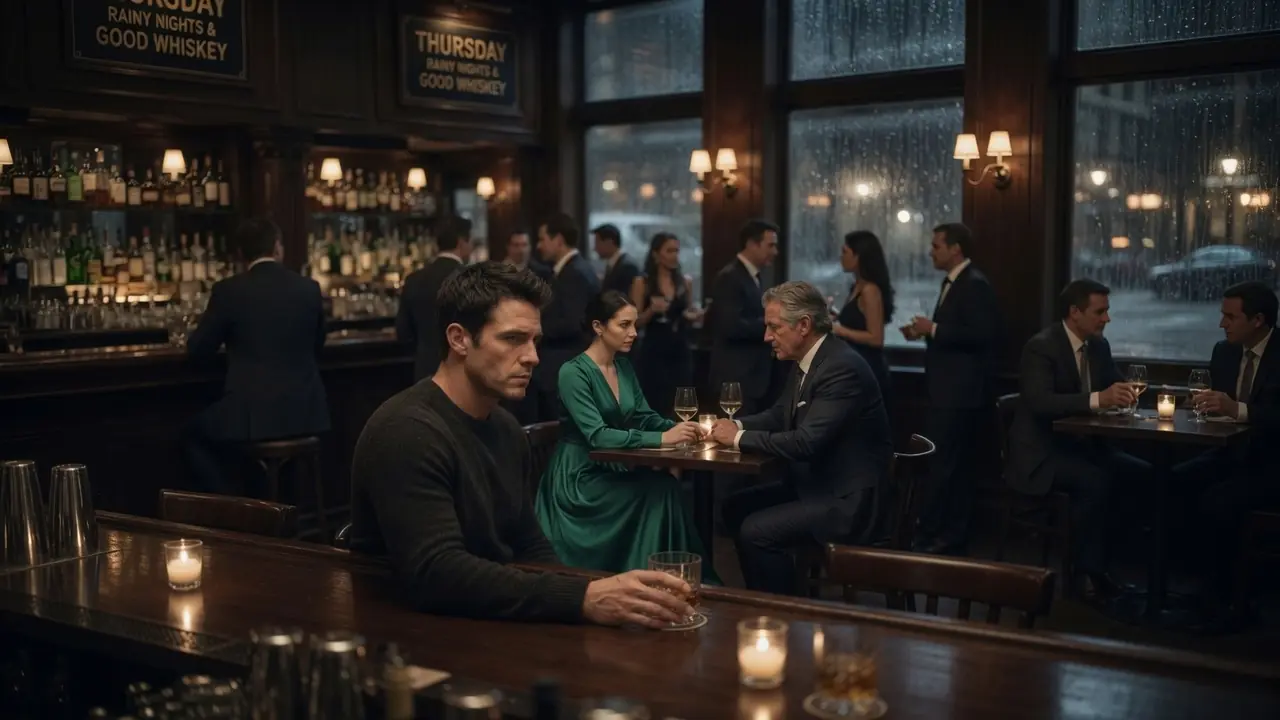
On a rainy Thursday night, in the middle of a crowded upscale bar, a 28-year-old single father had one plan: finish his drink and get home to his 6-year-old daughter. He wasn't looking for trouble, wasn't looking for a conversation, and certainly wasn't looking for anyone. But across the room, a woman sat frozen in the kind of quiet desperation that only someone truly paying attention would ever notice. Ryan Carter noticed. He stepped in, played the part, and got her out safely.
They went their separate ways, two strangers dissolving into the city night. Neither of them expected to ever see the other again. Ryan Carter had not always looked this tired. There had been a time, not so long ago, when the tiredness was just the ordinary kind, the kind that a full night's sleep could fix. The kind that faded after a weekend and two cups of coffee.
But 3 years had passed since the accident that took his wife, and the fatigue Ryan carried now was the kind that lived deeper, settled into the bones and the routines and the spaces between things he no longer said out loud. He was 28 years old, solidly built with hands that showed the story of his work, and he moved through the world with a quietness that people often mistook for shyness. It wasn't shyness. It was the careful stillness of a man who had learned to watch before he spoke, to understand a room before he entered it, and to absorb what other people missed because they were too busy being noticed.
His daughter, Grace, was 6 years old and the exact reason that Ryan Carter got out of bed every single morning. She had her mother's dark eyes and her father's stubborn streak, and she asked the kind of questions at breakfast that most adults wouldn't think to ask until they were much older. Ryan loved her with a ferocity that he rarely put into words, because words, in his experience, were never quite enough for the things that mattered most. He had been raising her alone since she was three, working as an electrical systems technician, taking jobs that ranged from rewiring older residential buildings to troubleshooting commercial systems across the city.
The work was honest, it paid, but it was also unstable, the kind of employment that came in waves, flush one month and dry the next, and with a daughter who needed stability more than almost anything else, Ryan had quietly begun to look for something better. The city they called home had that particular quality of large American cities, the sense that 10,000 different lives were being lived simultaneously within a few square miles, most of them completely invisible to each other. It was the kind of place where a man could walk 20 blocks and never once make eye contact, where a bar could be packed and loud on a Wednesday evening, simply because the week had already been too long.
Ryan had grown up in smaller towns, but the city suited him in the way that suits people who prefer to observe rather than perform. There was always something to watch, always a story visible in the gap between what someone said and what their body actually meant. He had developed this skill not from any professional training, but from years of necessity, from learning that the best way to protect the people he loved was to understand a situation before it became a problem. Evelyn Harper had also grown up in a world that required her to read people quickly, but for entirely different reasons.
At 27, she was the chief executive officer of a logistics technology startup that was scaling faster than most industry analysts had predicted. She had built the company over four years, starting with a concept and a laptop and a borrowed conference room, and she had grown it into something real, something with offices and staff and investors who flew in from the coasts to sit across from her. From the outside, she looked exactly like what the business press described her as: composed, precise, unflinching under pressure. She wore her authority with the ease of someone who had earned it twice over, and most people who met her in a professional context left feeling slightly less certain of themselves than they had been when they arrived.
The inside of Evelyn Harper's life in that period was considerably more complicated than her exterior suggested. The board of directors that governed her company had, over the past several months, been increasingly vocal about their belief that she needed to cultivate relationships with certain investors, relationships that, in their language, meant something more than contracts and quarterly calls. She understood exactly what was being implied. She had been navigating implications like these since she was a junior employee in someone else's company, and she had developed a nearly perfect performance of compliance, smiling at the right moments, deflecting without appearing to deflect, maintaining the appearance of cooperation while holding an internal line that she had promised herself she would never cross.
The performance was exhausting. The nights when she had to maintain it were the ones that left her feeling the emptiest. Victor Harlan was the investor that the board had most recently decided she should impress, a man in his late 50s, wealthy in the way certain kinds of men in certain kinds of cities are wealthy, with the specific confidence of someone who had rarely been told no by anyone who needed something from him. The bar was the kind of place that tried very hard to look effortless: warm lighting that was actually the result of meticulous design, music calibrated to feel spontaneous, bartenders trained to make every drink seem like a personal expression of craft.
On a rainy Thursday, it was packed with the usual mix of finance workers and after-hours professionals, the kind of crowd that generated a constant warm hum of conversation without any single voice rising above the rest. Ryan had come because a client in the building next door had asked him to check on a tripped breaker in the service area below street level, and the job had taken longer than expected, and by the time it was finished, the rain had turned serious. He settled onto a stool near the end of the bar, ordered something simple, and planned to stay exactly long enough for the worst of the weather to pass.
He was not paying particular attention to the rest of the room when he first noticed her. It was more that she moved in the particular way people move when they are trying very hard not to show that something is wrong, and Ryan Carter caught it even in his peripheral vision. She was seated at a corner table with an older man who carried himself with the authority of someone accustomed to controlling the shape of every room he entered. The woman was striking in a composed, deliberate way, dressed professionally, posture correct, expression arranged into something that passed, at a glance, for calm.
But Ryan was not glancing. He was watching the way her smile never quite reached her eyes, the way her body angled away from the man across the table even as she appeared to be leaning in, the way her fingers had curled around her glass not to drink from it, but to have something to hold on to. Victor Harlan reached across the table and touched her hand. It was not an ambiguous gesture. She didn't pull away.
Ryan caught fragments of conversation when the ambient noise dipped: something about the company's next funding round. Something about the importance of personal trust in business relationships. Something said in the careful language of implication that left no specific phrase to object to, and yet communicated its meaning with perfect clarity. He sat with it for a few minutes. He told himself it wasn't his business.
He told himself that he didn't know the full situation, that there could be a context he wasn't seeing, that adult professionals in a public bar were capable of managing their own circumstances. He ordered a second drink he didn't particularly want and looked at his phone. Grace's babysitter had sent a photo at 8:30. His daughter asleep in the living room chair. One hand tucked under her cheek, the small lamp on the side table burning warm in the otherwise dark room.
Ryan looked at the photo for a long moment and then set the phone face down on the bar. He thought about what he would want someone to do if Grace were ever in a chair across a room like that. Not now, not as a six-year-old, but someday when she was grown and navigating a world that had not changed in all the ways it should have. He thought about what it would mean to look at that situation and do nothing, to finish his drink and walk out into the rain and carry that inaction with him for years.
He was not, by nature, the kind of man who performed heroism for an audience. He was the kind of man who simply could not sit still when something needed to be done. He paid for his drinks, left cash on the bar, and walked across the room. He moved without hurry, without the energy of confrontation, the way a person moves when they belong somewhere and are simply arriving.
He came to the table and placed one hand lightly on the back of the woman's chair, not on her, on the chair, and he looked at her with the easiest expression he could manage and said, "I've been looking for you." The words were ordinary. The timing was perfect.
For a half second, the woman looked up at him with an expression that was raw, unguarded, in a way that her face had not been for the entire hour he had been watching her from across the room. Victor Harlan looked up with the expression of a man whose evening had just been interrupted by someone who had no right to do it. He asked, with a voice carefully constructed to convey authority without volume, exactly who Ryan was.
Ryan held the older man's gaze with a steadiness that communicated nothing aggressive and nothing apologetic, and said simply that he was an old friend, that he and the woman had been trying to connect all week, and that he was sorry to interrupt, but they had somewhere they needed to be. There was a moment suspended, charged, in which Victor assessed Ryan, the way men like him assessed men like Ryan, cataloging everything from the clothes to the posture.
Evelyn Harper, in that same suspended moment, made her decision. She looked up at Ryan and said, "I completely lost track of time." And the performance in her voice was so good that Ryan almost believed it himself. She excused herself with the poise of someone who had rehearsed it. And Ryan walked with her toward the door in the unhurried way of people who have known each other long enough to be comfortable, and neither of them said a word until they were through the door and out into the rain.
The air outside was cold and rain-washed and clean in the way that city air only manages to be in the middle of a genuine downpour. They stood under the narrow awning above the entrance, and for a moment neither of them spoke, not from awkwardness, but from the particular relief that comes when a performance ends and a person can simply breathe. Evelyn Harper took one slow breath and then another.
Ryan stood with his hands in his pockets and looked out at the wet street, giving her the space to gather herself without watching her do it. "Thank you," she said finally. Her voice was different out here, lower, quieter. The professional composure still present, but with something more genuine underneath it. "You didn't have to do that."
Ryan shrugged, a small movement, and said, "I thought you might need it." She looked at him then, really looked, with the same kind of attentive stillness that he had been using to watch her from across the bar. He returned the look without deflection, and neither of them looked away for a moment that lasted slightly longer than politeness required.
She asked him if he had done anything like that before, and he considered the question honestly before answering that he hadn't, exactly. She said he was good at it, that she had almost believed the story herself. He said she was better at it than he was, and that if she hadn't followed his lead so quickly, the whole thing would have fallen apart in about 10 seconds.
Something shifted in her face when he said that, not quite a smile, but the shape of one. The thing a smile becomes in a person who has forgotten to guard against it. The rain intensified briefly, and then settled back to its steady rhythm. Ryan glanced at his watch, a habit so unconscious that he didn't realize he'd done it until he caught her noticing.
He said it wasn't a problem, that he was just checking on his daughter. And he said the word daughter with the complete ease of someone for whom that fact was the most natural thing in the world. Evelyn heard it, and something in her chest registered it, not in a sentimental way, but the way a person registers a data point that reclassifies everything that came before it.
The man standing beside her had crossed a crowded bar and inserted himself into a difficult situation, not because he knew her, not because there was anything in it for him, not even because she had asked. He had done it because he had looked at the situation and decided it was wrong. They did not exchange names, they did not exchange numbers.
It was not that the conversation was unfriendly; it was, in its own quiet way, the most honest conversation either of them had had with a stranger in a long time. There was a natural boundary to it, an understanding that this was a moment complete in itself, that to try to extend it into something more structured would change its nature in a way that neither of them wanted. Evelyn said she would be all right from here, and she meant it.
And Ryan could hear that she meant it. He nodded. She thanked him again, and the second thank you was different from the first, more specific, more personal, carrying a weight that the polite version hadn't. They walked in opposite directions, and Ryan turned up his collar against the rain.
Evelyn stood for a moment under the awning after he had gone, watching the street without seeing it. Feeling something she didn't have an immediate name for: the strange, specific quality of having been helped by someone who wanted nothing in return. By the time Ryan got home, the rain had settled into a steady, soft sound against the windows.
The kind of rain that made an apartment feel more enclosed and warmer than it actually was. He paid the babysitter, a college student who lived two floors up and who treated Grace with exactly the combination of patience and entertainment that a 6-year-old required and stood in the doorway of the living room for a moment looking at his daughter. She had fallen asleep in the armchair just as the photograph had shown, one shoe still on and one shoe off, the small reading lamp casting a circle of amber light across her face.
Ryan stood there longer than was strictly necessary, crossed the room, removed the remaining shoe with the practiced gentleness of a person who had done this a hundred times without ever waking the sleeper and covered her with the blanket from the back of the chair. He didn't move her to her bed. He made himself a cup of coffee.
He knew he shouldn't drink this late and sat at the kitchen table with the folder he had assembled over the past 2 weeks: research on the company, printed notes about the role, the single page of his resume that represented 8 years of legitimate, practical experience without a college degree. The job listing had come through a placement service that a colleague had recommended, a posting for a senior systems operations coordinator at a logistics technology company that was expanding its physical infrastructure footprint across three states.
Ryan had read the description four times before applying, mapping each requirement against what he actually knew how to do, which had turned out to be more than he expected. He had been called for an interview within 48 hours. The company was called Harper Logistics.
He had looked it up with the thoroughness of someone who understood that preparation was the one variable he could actually control, reading everything publicly available about its growth, its operational model, and the problems in logistics infrastructure it was trying to solve. He had read the company's press releases and a profile in a business publication and a brief interview with its founder. The founder was referenced consistently by title rather than full name in most of the pieces he found.
And the one photograph he came across was small and not particularly detailed. And Ryan had formed a vague mental image of the company's leadership that was mostly composed of words rather than any specific face. He had not thought, as he closed the folder and put it by the door, about the bar. He had not thought about the woman.
The evening had the quality of something that had happened in a separate compartment of his life: significant while it was happening, sealed off now from the part that had to continue moving forward. He woke at 6:00 the next morning, made breakfast for Grace, dropped her at school with a hug that lasted a beat longer than usual, and drove to the address on the interview confirmation.
He had pressed his interview clothes the night before: a charcoal blazer over a dark shirt, clothes that were professional without pretending to be something he wasn't. He had polished his shoes, not because he thought it would make a decisive difference, but because his father had told him once that the way you treated the things other people wouldn't notice told you something true about the way you treated everything else.
He had the folder under his arm and the clear, focused calm of someone who had already accepted that the outcome was uncertain and decided to do the best he could regardless. He was, as he got out of the car, something he rarely allowed himself to feel. Hopeful.
Not recklessly, not with the brittle quality of hope that fears its own disappointment, but with the quiet, practical hope of a man who had done the work and was ready to let it speak for itself. Harper Logistics occupied the top four floors of a glass and steel building in the downtown core, the kind of building that communicated ambition through sheer architectural confidence.
The lobby was high-ceilinged and current with the particular aesthetic of companies that had grown fast enough to have real design budgets, but retained enough self-awareness not to overcorrect into pretension. The receptionist directed Ryan to the 11th floor with professional warmth, and the elevator opened onto a waiting area furnished in muted grays and greens with a view of the city on two sides and the quiet productive hum of a company that ran on purpose.
Ryan signed in and took a seat. He was 5 minutes early, which was exactly what he considered the appropriate margin: early enough to show respect for the appointment, not so early as to seem anxious. He reviewed the first page of his notes without actually reading them.
The words familiar enough to be more comfort than information, and let his attention drift the way it always did in a new environment, absorbing the room, the people passing through the hall, the rhythm of the place. He was good in environments like this, even when he didn't look like he belonged, because he had the particular confidence of someone who trusted his own competence more than he trusted any room's opinion of him.
The name caught his eye from across the waiting area, engraved on a placard mounted beside a set of frosted glass doors. Evelyn Harper, chief executive officer. He read it twice, the way you read something that doesn't immediately make sense, waiting for the words to rearrange themselves into a meaning he had anticipated.
They didn't rearrange. They stayed exactly as they were. Ryan sat with the information for a moment, not with panic, not with strategy, but with the kind of careful neutral consideration that he brought to everything that surprised him. He thought about what it meant.
He thought about whether it changed anything. He was still thinking when the frosted glass doors opened. She came through them already in motion, already managing multiple concerns simultaneously. A leather portfolio tucked under one arm and a conversation being concluded with someone behind her.
She was in a tailored dark suit, hair pulled back. Every element of her presentation calibrated with the precision he had noticed even in the dim light of a bar the previous evening. She turned toward the waiting area and her eyes moved to Ryan with the automatic assessing sweep of someone accustomed to reading rooms quickly and then the sweep stopped.
The silence lasted 4 seconds. Ryan counted them without meaning to. He held her gaze with the same steadiness he had held it in the rain the night before, not defiant, not apologetic, just present. He watched the sequence of calculations move across her face with extraordinary speed.
Recognition, processing, assessment, decision. She was very good at not showing things, but Ryan was very good at seeing them. And what he saw in those 4 seconds was the moment when a structure that has been under hidden stress suddenly has to bear a new and unexpected weight. Everything held, but nothing was quite the same as it had been.
Her expression settled into the specific neutrality of someone who had decided very deliberately what this moment was going to be. She walked toward him and extended her hand. "Ryan Carter," she said, and her voice was professionally level.
Ryan stood and shook her hand and said, "Yes, that's me." And neither of them acknowledged anything beyond those words. There was a precision to the mutual understanding that required no confirmation.
They both knew what they both knew and they had both, in the same instant, decided to proceed on the terms of the room they were actually in rather than the room they had shared the night before. She led him into a conference room where two other people were already seated. Patricia Owens, an operations manager with a decade of authority in her posture, and David Sorrento from the company's finance side.
Evelyn took her seat at the head of the table, opened her portfolio, glanced at the single sheet that was Ryan's resume, and placed it face down. Then she looked at Ryan with the direct, unhurried attention of someone who had decided to see something clearly. And she said, "Let's start."
Evelyn Harper did not begin with the questions Ryan had prepared for. She did not ask about his technical certifications or his years of experience or the specific systems he had worked on. Though all of that information was on the resume she had turned face down, she folded her hands on the table and asked, quietly and without preamble, "Tell me what you would do if you saw something that was clearly wrong, but that wasn't your responsibility to fix?"
Ryan did not answer immediately. He had learned, over years of working in environments where the cost of a wrong diagnosis was a live circuit and a burned hand, that the space between a question and an answer was where most of the real thinking happened. He considered it honestly, not what it was testing, not what answer would look best, but what he actually believed.
Then he said, "If I see it and I can do something about it, then it is my responsibility." "The job title doesn't change that." He paused for half a second and added, "If I walk past something wrong because it's not technically on my list, then I lose the right to be upset when something wrong happens to me that's not on someone else's list."
Evelyn wrote nothing down. Patricia Owens made a small note and looked up. David Sorrento leaned back slightly in his chair. The next question was about a time when Ryan had had to make a decision under time pressure without access to complete information.
He answered with an account of a specific job, not described in any storytelling way, but precisely and functionally, walking through the variables and the logic with the fluency of someone who had actually been inside the problem. He described what he had known, what he hadn't known, what he had prioritized, and what had happened.
He did not describe his decision as correct in retrospect. He described it as the best decision available with the information he'd had. The distinction was not lost on anyone in the room. Evelyn's questions continued in this vein, not case studies from a textbook, not hypothetical scenarios with clean edges, but questions that pressed for the texture of real experience, for what a person actually did in the uncontrolled conditions of actual work.
Ryan answered each one the same way he had answered the first. With the directness of someone who had nothing to perform, he did not use industry vocabulary for the purpose of sounding fluent in it. He did not attribute outcomes to himself that had been collaborative.
He did not minimize his mistakes or inflate his successes. He was simply accurate, and accuracy in an interview room is rarer than almost any credential. At one point, Patricia Owens asked him about managing a team under a tight deadline with an unreliable supplier.
Ryan answered by describing not just what he had done, but what he had failed to do initially, a miscommunication with a subcontractor that had cost two days, and what he had changed in his approach as a result. Owens made another note, and then, without looking up from her paper, almost smiled.
David Sorrento waited until Owens had finished, and then asked, with a careful neutrality that had the quality of a challenge packaged as a question, whether Ryan had concerns about stepping into a role requiring him to manage personnel with significantly more formal education than he had. Ryan looked at him without any change in expression, and said that he thought the more relevant question was whether he had the experience and judgment to do the job well, and that on both of those he was comfortable with his record.
He said it without heat, without apology, with the confidence of someone who had thought about this before and arrived at a conclusion he was at peace with. Sorrento held his gaze for a moment, and then looked at his own notes. Evelyn Harper, through all of this, watched Ryan Carter the way she watched everything: with a precision that missed nothing, and committed to no verdict before all the information was in.
She was aware of the complication, of the fact that she was evaluating someone she had encountered in a context as far removed from a professional interview as possible, of the risk that sentiment or its opposite, the overcompensation against sentiment, could color her judgment in ways that would serve neither her nor the company. She held all of this at careful arm's length and focused on what was actually in front of her.
She gave him a scenario drawn from an actual operational problem the company had faced the previous year, a real situation with genuine constraints, and a solution requiring a choice between speed and stability. She watched him work through it aloud, following the logic from premise to decision, and when he arrived at the answer she had been hoping for, not the answer she had expected, but the better one, she did not let the recognition show on her face.
She thanked him for his time, told him they were interviewing several candidates, and that he would hear within a week. Ryan nodded, gathered his folder, shook hands around the table, and left with the same steady composure with which he had entered.
The door closed. Patricia Owens looked at Evelyn and said, "He's good." Evelyn Harper looked at the closed door for a moment and said nothing. The meeting that afternoon was not pleasant.
The board's representative, Gerald Marsh, who had been on the board since before Evelyn had taken the company public, had reviewed the candidate pool with the particular attention of men who wanted to influence processes without appearing to control them. He had, before Evelyn finished reviewing her own notes from the morning, already formed a strong and vocal opinion.
The preferred candidate, in Marsh's estimation, was a man named Bradford Wells, an MBA from a program Marsh could name drop with satisfaction, a previous role at a company the board recognized and respected, and the kind of resume that processed efficiently through institutional evaluation, the sort of document that inspired confidence in people whose primary experience of candidates was reading documents about candidates.
Marsh laid out his argument in the measured cadence of someone accustomed to being right by default, and two other board members on the call nodded with the reflex agreement of people who had learned to position themselves adjacent to authority. Evelyn listened.
She had learned, over several years of managing this board, that listening completely was both a matter of respect and a tactical advantage. That people who interrupted gave up information before they had all of it, while the people who listened acquired clarity and found the actual fault lines.
She let Marsh finish and then asked several specific questions about Wells's operational experience, which turned out, under the pressure of specific questions, to be somewhat thinner than the resume implied. She noted this without dwelling on it and said she would complete her evaluation and be in touch with a recommendation by the end of the week.
After the call ended, she sat for a long time at her desk. She was not confused about her own judgment. She had made enough decisions under enough pressure to trust the process her mind ran when it was working correctly.
What she was sitting with was the familiar and unwelcome weight of having to defend a decision that ran against the preferences of people whose support she needed, and the question of whether the decision she believed was right was right enough to justify that cost. She thought about the night before.
She had not consciously tried not to think about it, but now, in the quiet of her office in the late afternoon light, she allowed herself to think about it directly. She thought about the precision of Ryan's intervention, not dramatic, not performative, just effective.
She thought about the rain-washed sidewalk outside the bar and the conversation they had had under the awning, the way he had given her space to breathe without making her feel that breathing was something she needed to explain. She thought, with a clarity that was uncomfortable because of how relevant it was, about the thing she had been fighting against for months with the board: the expectation that credibility was a function of presentation, that trust was something you could assess from a document, that value was most reliably found in recognizable forms.
She had been arguing, in meeting after meeting, that the company needed people who could actually do the things the roles required, rather than people who could compellingly describe themselves as the kind of person who could. Ryan Carter, in his interview that morning, had done exactly what she had been trying to describe.
He had been exactly what he was, without performance, without apology, and in doing so, had been more convincing than any amount of credential. Bradford Wells would likely be very good in the role. Ryan Carter, Evelyn believed, would be exceptional, not because he had impressed her in the conventional way, but because every answer he had given pointed to the same underlying quality, a quality the company actually needed at this particular stage in its growth.
She picked up her pen and wrote two names on a page. She sat with them for a while. Then she crossed one out. Evelyn called Patricia Owens first.
Owens was in her car heading home, and Evelyn could hear road noise in the background, but Owens answered with the full attention she always gave, regardless of the hour. Evelyn told her the decision. Owens was quiet for a moment, and then said, simply, "I think that's right."
She said she had been reviewing her notes from the morning, and that the more she went over them, the more the gap between Carter and the other finalists had clarified in Carter's favor, not on paper, but in the specific way that mattered most for what they actually needed someone to do. After the call, Evelyn spent 20 minutes writing the justification she would need for the board, not a defense, which would have been the wrong framing, but an analysis laying out the operational requirements of the role, and the specific evidence from each candidate's interview that mapped or failed to map against those requirements.
When she was finished, it was the kind of document that made the conclusion appear inevitable, which was how Evelyn always wrote documents when she was certain she was right. The call to Gerald Marsh was short.
She presented the analysis without editorializing and let the logic do its work. He raised two objections, both of which she had anticipated and both of which she addressed without raising her voice or conceding ground. He said he would review the document and come back to her.
She thanked him and ended the call. She did not know whether the board would accept the decision or continue to resist it. That was a variable she could not control.
What she could control was the quality of the decision itself and on that she was settled. Ryan received the call the following morning. He was in the parking lot of Grace's school having just watched his daughter disappear through the front doors in the particular way she had of moving as though wherever she was going was already exactly where she was supposed to be.
His phone rang with a number he recognized as the company's main line and he answered with the calm he had been maintaining all week. The practical calm of a man who had accepted every possible outcome before any of them arrived. The voice on the line was human resources, professional and warm and the offer was real.
A title, a salary that represented something meaningfully different from what Ryan had been earning. Health insurance that covered both of them. The kind of stability that he had been describing to himself as the goal for three years without entirely believing it was reachable.
He sat in the parking lot for a moment after the call ended. His hands on the wheel, the city moving around him with complete indifference to whatever had just changed for one person inside a parked car on a Tuesday morning. He did not allow himself to think much about who had made the decision or why.
It was a clean boundary that he had set the moment he had walked out of the interview. The evaluation had been what it was. He had answered everything honestly.
The outcome belonged to the process. He had not gotten the job because of the bar. He was not entirely certain of that but he believed it, and the belief was important to him in a way that was connected to the same instinct that had made him step across the room the previous Thursday night.
Ryan's first day at Harper Logistics had the particular texture of first days everywhere: the ID badge, the desk that was not yet his in the way things become yours over time, the introductions that required remembering more names than could be retained in a single morning. He moved through it with the same attentive steadiness that he brought to everything, asking the right questions, offering nothing unnecessary, already doing the work of learning the specific shape of this company's operations in the way they had evolved.
Patricia Owens met with him for an hour in the afternoon and came away from the conversation with the confirmed satisfaction of someone whose judgment had been validated. He saw Evelyn Harper in the hallway of the 11th floor on his third day, moving in the opposite direction, and the brief overlap of their paths had the quality of something ordinary: a new employee, the CEO, a professional acknowledgement in passing.
She said good morning and used his name, and he returned the greeting and used her title, and they continued in their respective directions. It was, on the surface, entirely unremarkable, and yet both of them were aware, in that brief crossing, of the history that the corridor didn't know about, and of the specific choice that the professionalism of the exchange represented.
The conversation that mattered happened at the end of his second week, in the evening, when the office had emptied out and Ryan was still at his desk reviewing infrastructure diagrams for a distribution center expansion that was 3 months behind schedule. He heard footsteps and looked up to find Evelyn Harper in the doorway with the look of someone who had decided to do something that her own discipline had been postponing.
She came in and sat across from him in the way a person sits when they intend to say something and want to do it directly. Ryan put down his pen. She said, "I want to ask you something, and I want you to answer honestly."
He said that was the only way he knew how to answer. She said, "If you had known who I was that night, who I was, what my company was, that I was going to be interviewing you the next morning, what would you have done?" She asked it with the careful neutrality of someone who had thought about the question for 2 weeks and was prepared for an honest answer, but not necessarily for any particular one.
Ryan was quiet for a moment. He thought about it with the seriousness it deserved. Then he said, "The same thing."
He said it without elaboration, without the qualifying language that would have made it easier to receive or harder to doubt, just those three words with the full weight of his certainty behind them. Evelyn Harper looked at him for a long moment.
Then she said, "I know." She said it in a way that meant she had known it for 2 weeks, that the answer was not a surprise, but that hearing it said aloud confirmed something that had been living in her chest as a hypothesis.
She nodded once, quietly, with the specific manner of someone who has been presented with information that changes something fundamental in their assumptions about the world. She said good night and left.
Ryan sat for a while after she had gone. With the infrastructure diagrams in front of him and the quiet of the empty office around him, and then he picked up his pen and went back to work. There are stories that resolve cleanly, that end with a declaration or a ceremony or a specific moment that arrives like a door closing firmly on everything that came before.
This is not entirely that kind of story. What happened to Ryan Carter and Evelyn Harper was more gradual and more real for being so, the slow accumulation of small moments, the incremental building of something that had its foundation not in circumstance, but in the consistent quality of two people's character across repeated encounters.
They would work together for months before they became friends in the full sense of the word. They would be friends for longer still before anything else began to take shape. What was already clear from the beginning was the quality of the foundation.
Ryan Carter had helped a stranger without knowing who she was, without calculating the return, without the safety net of anticipated gratitude. He had done it because his daughter was asleep in a chair at home, because he was trying to build a life worth teaching from, because the alternative, the walking past, the not noticing, the careful self-insulation was simply not something he was capable of.
That was the whole story. And that was also, in some ways, the only story. Evelyn Harper had made a professional decision in the face of significant institutional pressure, based on evidence and judgment, without the distortion of sentiment or the overcompensation against it.
She had chosen someone because the evidence supported it, and her own well-trained instincts confirmed what the evidence suggested. Those two things, taken together, accounted for everything that followed.
Kindness is not a strategy. That is its defining quality, the thing that makes it meaningful rather than merely tactical. A kindness deployed in anticipation of return is a transaction, and transactions are not kindness, however they dress themselves.
Ryan Carter had not been strategic in the bar on a Thursday night, and the fact that it returned to him in the form of stability for his daughter, in the form of someone who had reason to see clearly what he was, was not a lesson about tactics. It was a demonstration, quiet and unrepeatable, of the way that things connect in a world where most of the connections remain invisible until they aren't.
The last image is a simple one. It is late afternoon on a day in spring, several months on from where this story began. Ryan is at the gate of Grace's school, watching his daughter come through the crowd of exiting children with the specific, full-body joy of a 6-year-old who has had a good day and is about to see her father.
From across the street, stepping out of a car she has just arrived in, Evelyn Harper catches the moment without intending to. She sees a man and a small girl, the girl running, the man crouching to catch her. She watches for exactly as long as it takes for something to settle in her chest that she doesn't immediately have a name for.
Then she turns and walks into the building, carrying it quietly with her, the way certain things are best carried. Without words. Without announcement. Simply present and understood and real.