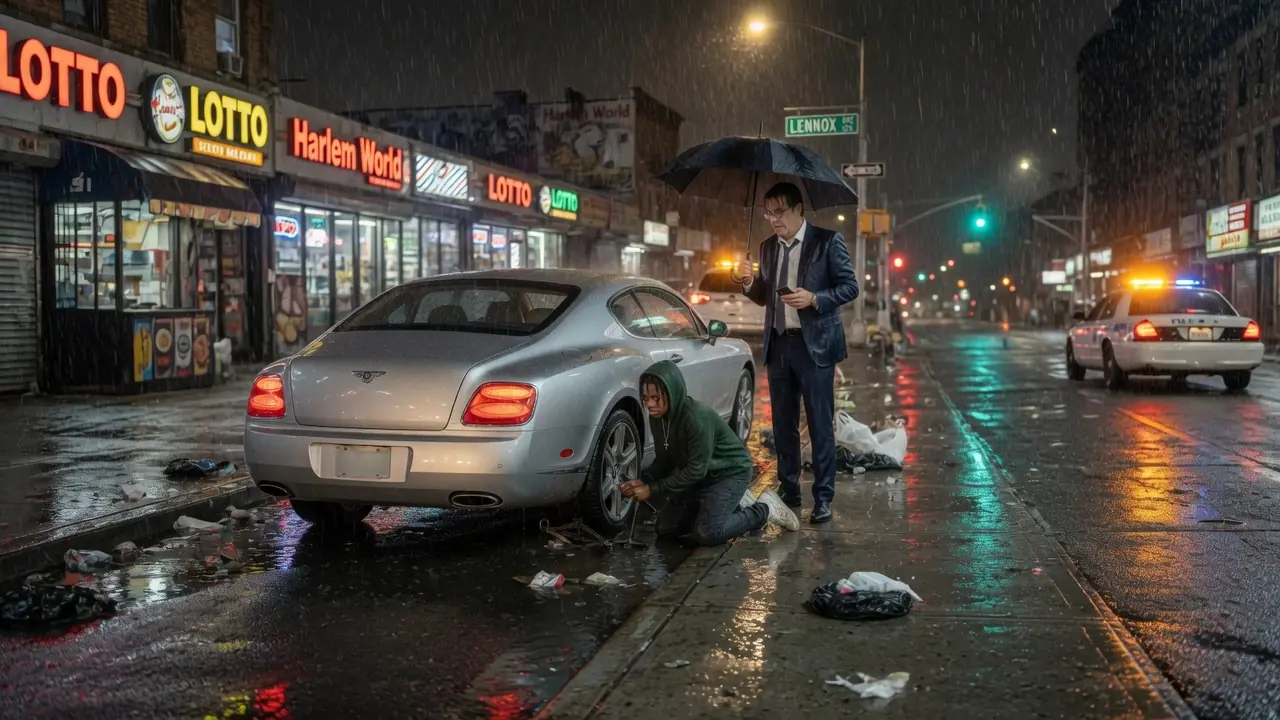
Lennox Avenue that Tuesday evening turned the Harlem pavement into a river of oil and grime. Most people rushed past with umbrellas tilted against the wind, but fifteen-year-old Tobias Grant stood perfectly still under the awning of Riverside Deli, watching a silver Bentley Continental stalled in the middle of 125th Street. The hazard lights blinked once, twice, a rhythm that didn't match the chaos of honking taxis and cursing drivers trying to squeeze around it.
Tobias knew that corner. He'd walked it every day since he was seven, cutting through on his way home from Marcus Garvey Park to the cramped studio apartment he shared with his grandmother on 131st. He knew which bodega owners would chase you out for lingering too long, which alleyways to avoid after dark, and which cars didn't belong in this neighborhood. A Bentley didn't belong here.
The driver's door opened. A man stepped out. White hair, navy suit soaked through in seconds, expensive shoes now ruined by the dirty water pooling at the curb. He looked around, phone pressed to his ear, and even from across the street, Tobias could see the frustration carved into his face. Nobody stopped. Not the woman with two kids pulling at her coat. Not the delivery guy on the electric bike. Not the group of teenagers laughing outside the Foot Locker.
Tobias felt his grandmother's voice in his head. Mind your business, baby. That's how you stay safe. But something made him step off the curb anyway. The man didn't notice him at first, too busy yelling into his phone about how his driver was forty minutes away and the spare tire wasn't in the trunk. And did anyone in this godforsaken city know how to help someone in an emergency?
Tobias cleared his throat. "Sir." The man turned, and for a split second Tobias saw it. That flicker of surprise, maybe suspicion, that always seemed to cross people's faces when they noticed him. Young. Black. Hoodie pulled up against the rain. "I can help," Tobias said louder this time over the sound of traffic and thunder rolling somewhere over the East River.
The man, the world would later know him as Vincent Harlo, founder of Harlo Tech Industries, worth an estimated $8.4 billion, stared at him like he'd just spoken another language. "You." Vincent's voice carried that particular brand of disbelief that Tobias had learned to recognize early. Not quite rude, just doubtful.
"I work at my uncle's garage in Amsterdam. Been changing tires since I was twelve." Tobias stepped closer, rain already soaking through his jacket. "You got a jack?" Vincent hesitated, his fingers tightened around his phone, and Tobias could see him doing the math, weighing risk, weighing options, weighing whatever assumptions lived in that space between them. Then the phone buzzed. Vincent glanced at the screen and his jaw clenched. "Fine." He popped the trunk. "But if you damage anything, I won't—"
The tools were pristine, barely used, still in their factory packaging. Tobias pulled out the jack and the lug wrench, feeling the weight of Vincent's stare on his back as he knelt in the water beside the rear tire. The lug nuts were tight. His hands slipped twice on the wet metal before he got the first one loose. Vincent stood there, arms crossed, rain streaming down his face, not saying a word.
Around them, the city kept moving. Sirens wailing. Somewhere on Lexington, a bus hissing to a stop at the corner. Someone shouting about missing the last train to White Plains. Tobias worked in silence the way his uncle Jerome had taught him. Don't rush. Don't force it. Respect the machine and it'll respect you back.
When the spare was finally on and tightened, Tobias stood and wiped his hands on his already ruined jeans. "Should hold till you get to a real shop. Don't go over fifty-five." Vincent stared at the tire, then at Tobias. Something shifted in his expression. Not quite gratitude, but close.
He reached into his jacket pocket and pulled out a wallet fat with bills. "How much?" "Nothing." Tobias shook his head. "Just helping." "Kid, I don't do charity. Name your price." "I don't want your money, sir."
Tobias looked down at the card, rain already smearing the ink. "I'm good. But thank you." "I'm serious." Vincent's voice dropped lower, urgent now. "I don't forget people who help me. You call." Before Tobias could respond, Vincent was back in the car. Engine roaring to life. Hazard lights off. The Bentley merged back into traffic and disappeared down Lennox Avenue, swallowed by the rain and the night.
Tobias stood there for a moment, card still in his hand, water dripping from his hood. He glanced around. Nobody had seen it. Nobody cared. He shoved the card into his pocket and started the walk home.
Three weeks later, everything changed. The eviction notice arrived on a Friday morning, taped to the door of apartment 4C like a death sentence on official city letterhead. Tobias found his grandmother, Dorothy Grant, sitting at the kitchen table, hands trembling around a mug of cold coffee, staring at the paper like it might disappear if she looked long enough. "Grandma." She didn't look up. "They're tearing down the building."
Tobias felt his stomach drop. "What redevelopment project?" "The whole block. Says we got sixty days to vacate." Her voice cracked on the last word. And Tobias saw something he'd never seen before. His grandmother, the woman who'd raised him after his parents died in a car crash on the FDR Drive when he was four. The woman who'd worked double shifts at Mount Sinai Hospital for twenty-three years. The woman who never cried. She was crying now.
"They can't do that. This is our home." "They can do whatever they want, baby. Says right here. Building's been sold to some development company. Lafayette Heights LLC. They're putting up luxury condos." Tobias grabbed the notice, scanning the dense legal language. Sixty days, non-negotiable. Failure to comply will result in forced removal by the New York City Marshal's office. He thought about the studio apartment, the water-stained ceiling, the radiator that clanked all winter, the view of the brick wall across the alley. It wasn't much, but it was theirs. The only home he'd ever known.
"Where are we supposed to go?" Dorothy shook her head, wiping her eyes with the back of her hand. "I don't know. Everything around here costs three times what we're paying. Even in the Bronx, I can't afford..." She stopped, unable to finish. Tobias felt rage building in his chest, hot and familiar. This was how it always went. People like them got pushed out. People with money moved in. The city called it progress.
He spent the next two weeks trying to find solutions. He called tenant rights organizations, showed up at community meetings in the basement of Abyssinian Baptist Church, listened to lawyers explain that technically, yes, the landlord had every right to sell, and yes, the city had approved the development plan, and no, there wasn't much they could do. "You can apply for emergency housing assistance," one lawyer told him, barely looking up from her stack of identical cases. "But the wait list is about eighteen months." Eighteen months. They had fifty-three days left.
Tobias walked home that night through streets that suddenly felt different. Scaffolding going up on every other building. New coffee shops where the old laundromat used to be. White people jogging past in expensive sneakers, Bluetooth headphones blocking out the sound of the neighborhood dying around them. He was crossing Malcolm X Boulevard when he remembered the business card. He'd shoved it in the pocket of his winter coat and forgotten about it.
Now, standing under a street light outside the shuttered Apollo Theater, he pulled out his phone and typed the number from the wrinkled, rain-aged card he'd kept. It rang four times. "Harlo." Vincent's voice, clipped and business-like, background noise suggesting he was in a car or maybe a restaurant. "Mr. Harlo, it's Tobias. Tobias Grant. I helped you with your tire." "Tobias." The background noise cut off suddenly. "I remember. What's wrong?"
Tobias hadn't expected that. Not the immediate recognition, not the shift in tone from busy executive to something almost concerned. "I..." He stopped suddenly, feeling stupid. What was he doing? This man didn't owe him anything. A flat tire didn't mean... "Never mind. I shouldn't have called." "Kid, I told you to call if you needed something. What happened?"
And maybe it was desperation. Maybe it was exhaustion. Maybe it was just that Tobias had nowhere else to turn. But he told him everything. The eviction notice, his grandmother, the sixty days, the impossible rents, the wait lists, and the slow suffocation of watching your neighborhood vanish around you. Vincent was silent for a long moment after Tobias finished. Then, "What's the address, kid? Of your building. What's the address?" Tobias told him. "Give me forty-eight hours," Vincent said. Then the line went dead.
Tobias stood there, phone still pressed to his ear, trying to understand what had just happened. Around him, Harlem moved through another Friday night. Music spilling from car windows. Couples arguing outside the bodega. Someone's grandmother calling down from a fourth-floor window about dinner getting cold. He walked home feeling more confused than hopeful.
Forty-three hours later, on Sunday afternoon, Dorothy answered a knock at the door to find a woman in a charcoal gray suit holding a briefcase and wearing an expression that belonged in a corporate boardroom, not a crumbling Harlem walk-up. "Mrs. Grant, my name is Simone Hastings. I'm general counsel for Harlo Tech Industries. May I come in?" Dorothy looked at Tobias. Tobias looked at the woman. Nobody moved.
"I think there's been a mistake," Dorothy said carefully. "No mistake. Mr. Harlo sent me. It's about your housing situation." They sat around the kitchen table, the same table where the eviction notice had landed like a bomb four weeks ago, and Simone opened her briefcase with the efficiency of someone who'd done this a thousand times. "Lafayette Heights LLC, the company that purchased your building, is owned by a venture capital firm called Meridian Group. As of nine o'clock this morning, Harlo Tech Industries acquired a controlling stake in Meridian Group."
She slid a document across the table. "Effective immediately, all eviction proceedings for this property have been suspended indefinitely." Dorothy's hands shook as she picked up the paper. "What does that mean?" "It means you're not being evicted. Your lease will be honored, and your rent will remain at the current rate, locked in for the next ten years."
Silence. The radiator clanked. Someone upstairs dropped something heavy. Outside, a car alarm went off and then stopped. "Why?" Tobias heard himself ask. Simone looked at him directly for the first time. "Mr. Harlo values integrity. You helped him when you had no reason to. He's returning the favor by buying a building. By buying the company that owns the building and fifty-three others like it across Manhattan and the Bronx." She pulled out another document. "He's also established a tenant protection fund to ensure that residents in those buildings can't be displaced by future development."
Dorothy made a sound, half laugh, half sob. "I don't understand." "You don't have to. Mr. Harlo wants to meet with you both tomorrow. His office in Midtown." Simone stood, smoothed her skirt. "A car will pick you up at nine." She was gone before either of them could respond.
That night, Tobias lay awake in the narrow space between the couch and the window that had been his bedroom for eleven years, staring at the water stains on the ceiling and trying to make sense of what had just happened. People didn't do things like this. Rich people especially didn't do things like this. There had to be a catch, some hidden agenda, some price they'd have to pay eventually. He thought about Vincent Harlo standing in the rain on Lennox Avenue, soaked and furious and helpless. He thought about the way Vincent had looked at him when Tobias refused the money. Maybe some people did remember.
The Harlo Tech building on Sixth Avenue looked like it had been designed to intimidate. All glass and steel. Seventy-three stories of corporate power rising above Bryant Park like a middle finger to gravity. Tobias and Dorothy rode the elevator to the sixty-eighth floor in silence, surrounded by executives in thousand-dollar suits who didn't look at them twice. Vincent's office took up the entire corner. Floor-to-ceiling windows overlooking Manhattan. Central Park to the north, the Empire State Building to the south, the whole city spread out like a circuit board glowing in the morning sun.
Vincent stood with his back to them, phone to his ear, finishing a conversation in that same clipped tone Tobias remembered from the first call. "I don't care what the board thinks. Make it happen." He ended the call and turned. "Mrs. Grant. Tobias." Dorothy gripped her purse like a life preserver. "Mr. Harlo, we can't thank you enough." "Don't thank me." Vincent crossed the room, his presence somehow smaller and more human than Tobias remembered. "I'm not doing this to be thanked." "Then why?" Tobias asked.
Vincent studied him for a long moment. Then he walked to his desk and picked up a framed photograph. A young boy, maybe ten years old, grinning at the camera with a gap-toothed smile. "My son, Nathan. He died twelve years ago. Leukemia." Vincent's voice stayed steady, but something flickered across his face. "Three months before he passed, we were driving through Connecticut. Tire blew out on Route 95, middle of nowhere. I couldn't get the spare on. Hands were shaking too badly. Too worried about getting Nathan to his treatment appointment." He set the photo down carefully. "A kid stopped. Couldn't have been more than seventeen. Fixed the tire in ten minutes. Wouldn't take any money. Just said he hoped my son felt better."
Vincent looked at Tobias. "We made it to the appointment. Nathan got three more months. Three more months of birthdays and baseball games and bedtime stories because some kid I'd never met decided to help. The office felt too quiet. I spent a year trying to find that kid. Never could. So I made myself a promise. If I ever got another chance to pay it forward, I wouldn't waste it."
Dorothy wiped her eyes. Tobias felt something tight in his chest. "But that's not the only reason you're here." Vincent pulled out a folder. "Simone ran a background check. Don't look at me like that. Standard procedure. You know what I found? Perfect attendance at A. Phillip Randolph High School. 3.9 GPA. Recommendations from three teachers saying you're the smartest kid they've ever taught. And you work twenty hours a week at your uncle's garage while taking care of your grandmother." He slid the folder across the desk. "Harlo Tech has a scholarship program. Full ride to any university in the country, plus a guaranteed internship here every summer until you graduate. After that, if you want it, a job."
Tobias stared at the folder like it might explode. "Sir, I... you helped me when I was stuck in the rain. Now I'm helping you." Vincent's expression softened. "Sometimes people surprise you. You surprised me. Don't waste it."
The next six months moved like a dream Tobias kept expecting to wake up from. He finished his junior year at Randolph with straight A's and a letter from Columbia University's engineering program. He spent the summer interning at Harlo Tech, learning about microprocessor design and artificial intelligence and systems architecture from engineers who'd worked at NASA and Google and MIT. His grandmother stopped working double shifts. The building on 131st Street got new windows and a repaired boiler and a fresh coat of paint. The other tenants, Ms. Patterson from 2B who made the best pound cake in Harlem, Mr. Dio from 5A who played saxophone at the Blue Note on weekends, the Rodriguez family from 3C with their four kids and two cats, they all stayed. The neighborhood didn't disappear.
But the story didn't end there. It was late September when Tobias saw the news segment. He was in his bedroom, still the narrow space by the window, but somehow it felt different now, bigger, filled with possibility instead of walls. Scrolling through his phone before bed, the headline made him stop. "Billionaire Vincent Harlo announces affordable housing initiative. Two billion commitment to preserve low-income communities."
He watched the press conference on his cracked phone screen. Vincent sat at a podium flanked by city officials and community organizers announcing a partnership with nonprofit housing organizations to purchase buildings across New York, Chicago, Los Angeles, and Atlanta. Buildings targeted for luxury development would instead be converted into permanently affordable housing. "We're calling it the Second Chance Housing Initiative," Vincent said into the microphone, cameras flashing. "Because everyone deserves a second chance. Everyone deserves a home."
The reporter asked where the idea came from. Vincent smiled, and Tobias saw something in that smile he recognized. "I met a young man who taught me that helping people isn't about money or power or what you get in return. It's about seeing someone who needs help and deciding in that moment to be the kind of person who stops." The interview ended. Tobias set his phone down. Outside his window, Harlem moved through another night. The city that had tried to push them out. The city that had almost succeeded. The city that kept changing and churning and forgetting the people who built it. That city was still there. But so were they.
A year and a half later, Tobias stood on the stage at Radio City Music Hall, cap and gown crisp against his shoulders, accepting his high school diploma in front of three thousand people and his grandmother sitting in the front row next to Vincent Harlo. The Columbia acceptance letter was already framed on his wall at home.
The story broke slowly at first, then all at once. A journalist from the New York Times picked it up. Human interest piece about a billionaire helping a teenager who'd changed his tire. Then CNN wanted an interview. Then Good Morning America. Then everyone. The narrative they built was simple. Poor Black kid helps rich white man. Rich white man changes kid's life. Feel-good story. American dream. Proof that kindness matters. And it was all true. But Tobias knew it was more complicated than that. He knew that for every story like his, there were thousands that ended differently. Evictions that went through. Families scattered across shelters and friends' couches and cities they'd never wanted to leave. Neighborhoods erased by development plans and tax incentives and the relentless machinery of capital that didn't care about history or community or the lives it displaced. He knew he was lucky. He knew luck shouldn't be necessary.
On a Tuesday afternoon in October during his second week at Columbia, Tobias stood in front of three hundred incoming freshmen at an orientation event and told his story. Not the simplified version from the morning shows. The real version. The eviction notice. The fear. The phone call. The miracle that shouldn't have had to be a miracle. "People keep asking me what I learned," he said, gripping the podium. "They want me to say something about kindness or hard work or how America rewards people who help others." He paused. "But here's what I actually learned. I got lucky. Vincent Harlo happened to remember. He happened to have the power to help. He happened to care. And because of those things that happened to line up in exactly the right way, my grandmother and I got to keep our home."
The auditorium was silent. "How many people don't get lucky? How many Dorothys are being evicted right now while we sit here? How many kids like me are working two jobs and getting straight A's and still watching their neighborhoods vanish?" He looked out at the sea of faces. Black, white, brown, Asian, every background imaginable. All of them chosen, admitted, given this opportunity. "We're the lucky ones. Every person in this room, we made it. But we can't forget the people who didn't. We can't pretend the system works just because it worked for us. We have to be the ones who change it."
Later, walking back to his dorm through the Columbia campus, the Gothic buildings and autumn leaves and students hurrying to class with coffee cups and textbooks, Tobias felt the weight of it. The responsibility. The knowledge that his story would be used as proof that the system was fine, that anyone could make it, that all you needed was hard work and a chance encounter. He pulled out his phone and called Vincent. "Tobias. How's the first month treating you?" "It's good. Really good." Tobias stopped under a tree, leaves falling around him like gold coins. "I gave a speech today about what happened." "Yeah? What did you say?" "That I got lucky. That luck shouldn't be required."
Vincent was quiet for a moment. "You're right. It shouldn't be." "The Second Chance Housing Initiative. How many buildings so far?" "Eighty-seven. Across twelve cities. About four thousand families." "That's incredible." "It's not enough." Vincent's voice carried something Tobias had heard before. That edge of frustration of someone who'd realized the problem was bigger than any one solution. "The system's broken, Tobias. I can buy buildings and fund scholarships and write checks until I'm dead and it still won't fix the fundamental issue." "So what do we do?" "We..." Vincent laughed, but it wasn't unkind. "You're nineteen. You should be worrying about midterms and which fraternity to join." "I'm not joining a fraternity." "Good. They're mostly idiots." Vincent paused. "You really want to know what I think we should do?" "Yeah." "Learn everything. Engineering, policy, economics, law, whatever it takes to understand how these systems work. Then build something better. You've got the mind for it. You've got the drive. And you've got something most people in my world will never have." "What's that?" "You remember what it's like to almost lose everything."
Four years later, Tobias graduated from Columbia with a degree in civil engineering and urban planning. Dual major. Summa cum laude. Vincent was there, front row, next to Dorothy, who was now retired and healthy and still living in apartment 4C. Tobias had job offers from six different companies. Google. Microsoft. Tesla. Two consulting firms. And Harlo Tech. He turned them all down.
Instead, he used the money he'd saved from his internship salary and a grant from the Second Chance Foundation, Vincent's newest initiative, to start a nonprofit called Legacy Housing Collective. The mission was simple. Work with community organizations to purchase buildings in gentrifying neighborhoods before developers could, then convert them into permanent affordable housing controlled by the residents themselves. The first building they saved was in Atlanta. The second in Chicago. The third back in Harlem, six blocks from where Tobias grew up.
By the time he was twenty-five, Legacy Housing had protected twelve buildings and helped establish tenant unions in eight more. The work was slow, frustrating, filled with legal battles and zoning disputes and city councils that didn't care and developers who had infinite money and patience. But it was work that mattered.
On a Friday evening in June, seven years after that rainy night on Lennox Avenue, Tobias sat in the office of Legacy Housing, a converted warehouse space in the South Bronx, reviewing lease agreements with his small team when his phone rang. Unknown number. "This is Tobias." "Mr. Grant." A woman's voice, young, nervous. "My name is Chenise Williams. I'm a sophomore at the Harlo Tech Scholars program. Mr. Harlo gave me your number." Tobias leaned back in his chair. "Okay. What can I do for you?" "I..." She hesitated. "My family's being evicted. The building we're in got sold to a development company and they're tearing it down to build luxury apartments. We've got thirty days."
Tobias closed his eyes. The script never changed. Just the names and the dates and the addresses. "Where?" "Bed-Stuy. Hancock Street." "Tell me everything." She did. The same story Tobias had lived. The notice on the door. The impossible rents. The mother working two jobs. The younger siblings. The fear. When she finished, Tobias was already pulling up property records on his laptop. "Chenise, I can't promise anything, but send me the eviction notice, the building address, and any other documentation you have. I'll see what we can do." "Really?" Her voice cracked with hope that Tobias knew was dangerous to give too freely. "Really. But listen. This fight is hard. The system's designed to work against people like us. Sometimes we win. Sometimes we don't." "I understand." "Good. Send me that information. I'll call you back in twenty-four hours."
After they hung up, Tobias sat in the quiet office, surrounded by case files and legal documents and maps of New York covered in colored pins marking buildings saved, buildings lost, buildings still in limbo. He thought about Vincent standing in the rain. He thought about the business card. He thought about luck and chance and the thin line between disaster and salvation. Then he picked up the phone and started making calls.
Three weeks later, Legacy Housing Collective, in partnership with the Second Chance Foundation and a coalition of tenant rights organizations, successfully negotiated with the development company to convert half the building on Hancock Street into permanently affordable housing. It wasn't a perfect victory. Ten families still had to leave. But twenty-three got to stay, including Chenise Williams and her mother and two brothers.
At the press conference announcing the deal, standing in front of the building with news cameras and community members and Vincent Harlo watching from the back of the crowd, Tobias spoke about the reality of the work. "This shouldn't be news. People keeping their homes shouldn't be extraordinary. But until we change the systems that treat housing as investment instead of human right, these fights will keep happening. And we'll keep fighting them. One building at a time if we have to."
Afterward, Vincent pulled him aside. "You know, the city council is voting on new zoning regulations next month. Regulations that would make what you just did almost impossible." "I know." "Have you ever thought about running for office?" Tobias laughed. "I'm twenty-six. I run a nonprofit with a staff of eight people and a budget that's mostly held together by grants and hope." "That's not a no." "That's not a yes." Vincent smiled. "Think about it. You've got the story. You've got the credibility. People trust you. People trust the narrative. Poor kid makes good. It's a fairy tale." "It's not a fairy tale. It happened." Vincent's expression turned serious. "But you're right that people will use it that way. They'll point to you as proof that anyone can succeed, that the system works, that we don't need to change anything. You know what stops them from doing that?" "What?" "You standing up and saying it's not enough. That you're the exception, not the rule. That the story shouldn't be about one kid getting lucky. It should be about building a world where luck isn't necessary."
Tobias looked at the building behind them. Twenty-three families who got to stay. Ten who didn't. The mathematics of inequality written in brick and glass and eviction notices. "I'll think about it." He did think about it. For two years, Legacy Housing grew from a small nonprofit to a national organization with offices in seven cities. While he testified before city councils and housing committees and state legislatures about tenant protections and affordable housing policy and the human cost of gentrification. While his grandmother turned seventy-five and he threw her a party in the same apartment on 131st Street, now surrounded by neighbors who'd watched him grow up and who'd stayed because someone had decided they mattered.
He thought about it when he was twenty-eight and the Bronx Democratic Party approached him about running for city council. He thought about it when community organizers told him they needed people like him in power. He thought about it when he saw Chenise Williams graduate from college with a degree in social work, ready to fight the same battles. He thought about it when he drove past the corner of Lennox Avenue and 125th Street and remembered standing in the rain at fifteen years old, deciding to help a stranger.
On a clear October morning, exactly ten years after that night, Tobias stood in front of a crowd of three hundred people at the Harlem State Office Building and announced his candidacy for New York City Council, Ninth District. "My name is Tobias Grant," he said into the microphone, feeling the weight of every eye on him. "I grew up six blocks from here. My grandmother raised me in a rent-controlled apartment that we almost lost to a development company that saw our neighborhood as profit margins instead of people." He told the story. Not the simplified version. The whole truth. "I got lucky. A man I helped remembered me when I needed help. But I've spent the last ten years working with families who didn't get lucky. Families who lost their homes. Kids who lost their neighborhoods. Communities that got erased because the system values profit over people."
The crowd was silent, hanging on every word. "I'm not running because I have all the answers. I'm running because I know the questions. How do we build a city that doesn't require luck to survive? How do we create systems that protect people instead of displacing them? How do we make sure the next kid standing in the rain helping a stranger doesn't have to pray for a miracle just to keep their home?" He paused, looking out at faces he recognized. Neighbors. Community organizers. Former teachers. His grandmother in the front row next to Vincent Harlo. Both of them watching him step into something bigger than anyone's story. "We do it together. We do it by refusing to accept that poverty is inevitable or that gentrification is progress or that some people matter more than others. We do it by showing up, by fighting, by building the city we deserve, not the city developers and politicians tell us we should accept."
The applause started slowly, then built like thunder. Three months later, Tobias won the primary with sixty-seven percent of the vote. Six months after that, he won the general election. At twenty-nine years old, he became the youngest member of the New York City Council in a decade.
On his first day in office, he introduced three bills. One to strengthen tenant protections. One to create a fund for community-controlled affordable housing. And one to restrict predatory development practices in low-income neighborhoods. None of them passed in the first year. Or the second. But he kept fighting. Five years into his term, the landscape started to shift. New council members. New mayor. New coalitions of tenant organizers and housing advocates and community leaders who'd spent decades fighting the same battles. The tenant protection bill passed. Then the housing fund. Then, in his seventh year on the council, after amendments and compromises and late-night negotiations that tested every political skill he'd learned, the development restrictions. It wasn't enough. It was never enough. Families were still being displaced. Rents were still rising. The fundamental inequality that had almost destroyed his life at fifteen was still destroying other lives every day. But it was progress. Real, measurable, structural progress.
On a Tuesday evening in March, Tobias stood in the renovated community center on 131st Street, the same building where he'd attended community meetings as a teenager trying to save his home, and spoke to a room full of residents about the new policies. "These laws won't fix everything," he told them honestly. "The system's too big, too entrenched, too designed to work against us. But they're a start. They're proof that when we organize, when we fight, when we refuse to disappear quietly, we can change things."
An older woman in the back raised her hand. "What happens when you're not in office anymore? When someone else gets elected who doesn't care about people like us?" "Then you hold them accountable the same way you've been holding me accountable. Power doesn't give rights. People do. These protections exist because you demanded them. And they'll stay because you keep demanding them."
After the meeting, walking home through the neighborhood he'd fought to preserve, Tobias ran into Jerome, his uncle, closing up the garage in Amsterdam. "Councilman." Jerome grinned, wiping grease from his hands. "Is it too important to change tires anymore?" "Never too important for that." Tobias helped him pull down the garage door. "You still got that old Buick in the back? The '95?" "Yeah. Why?" "The transmission's been slipping. I'll come by this weekend. Help you fix it." Jerome studied him. "You know, when you were fifteen, I never thought you'd end up here. Figured you'd move away as soon as you could. Leave all this behind." "Why would I leave? This is home." "Home that almost evicted you." "Home that taught me to fight."
They stood in the cooling evening air. The city humming around them. Sirens and music and voices and life. The same symphony Tobias had heard his entire life. "That man who helped you," Jerome said. "Vincent Harlo. Is he still around?" "Yeah. We talk every few weeks. He's funding a new initiative. Helping formerly incarcerated people find housing." "Does he ever regret it? Helping you?" Tobias thought about that. About the money Vincent had spent. The companies he'd acquired. The foundation he'd built. The bills Tobias had introduced that affected Vincent's business interests. That cost him money and profits and the ease of doing business in a city that had always favored people like him. "I asked him that once," Tobias said. "Last year when I was pushing the development restrictions bill. His lawyers told me it would cost Harlo Tech about forty million in delayed projects." "What did he say?" "He said, 'Good. Maybe I'll finally understand what it's like to lose something that matters.'" Tobias smiled. "Then he donated another ten million to Legacy Housing and told me to stop being afraid of making rich people uncomfortable."
Jerome laughed, the sound echoing off the closed storefronts. "That's a good man." "He's a complicated man who made a choice. Same as all of us."
That night, Tobias sat at his grandmother's kitchen table, the same table where the eviction notice had landed thirteen years ago, and helped her sort through old photographs. Pictures of his parents before the accident. Pictures of him at eight years old, gap-toothed and grinning. Pictures of the neighborhood from decades past when different families lived in the same buildings. When different stores lined the same streets. When the city was always changing but somehow the same.
"You know what I think about sometimes?" Dorothy said, holding a photo of Tobias's mother. "What would have happened if you hadn't stopped that night? If you just walked past that car?" "We would have figured something out. We always did." "Maybe. Or maybe we'd be living in some shelter in Queens and you'd be working full-time somewhere instead of changing the city." She set the photo down carefully. "God works in mysterious ways." "It wasn't God, Grandma." "Baby, luck is God. The universe puts you exactly where you need to be, exactly when you need to be there." She reached across and squeezed his hand. "You were supposed to be on that corner. That man was supposed to need help. And everything that came after that was supposed to happen, too."
Tobias wanted to argue. Wanted to explain that divine providence was a dangerous narrative. That it suggested the people who didn't get lucky somehow deserved their fate. That faith in cosmic justice let people ignore systemic injustice. But looking at his grandmother, at the peace in her face, at the home she'd kept, at the life she'd built through decades of double shifts and sacrifice and stubborn refusal to give up, he just squeezed her hand back. "Maybe you're right." "I'm always right. That's why you turned out so good."
The call came two years later on a Wednesday afternoon while Tobias was in a budget meeting at city hall. Vincent Harlo had collapsed during a board meeting. Heart attack. He was at Mount Sinai, the same hospital where Dorothy had worked for twenty-three years, in critical condition. Tobias left the meeting immediately, drove through Manhattan traffic that felt deliberately malicious, and arrived at the ICU to find Simone Hastings in the waiting room, still in her business suit, looking older than he remembered.
"How is he?" "Alive. Barely. They're saying the next forty-eight hours are critical." She looked up at him and Tobias saw something he'd never seen before. Simone Hastings, corporate lawyer, general counsel to a tech empire, was terrified. "He asked for you before the surgery. Said if something happens, you should know where the files are." "What files?" She handed him a key. "Everything. Every building the Second Chance Initiative owns. Every scholarship program. Every housing project. He's been transferring control gradually over the last year. Setting up a trust." Tobias stared at the key. "Why?" "Because you're the only person he trusts to keep doing the work after he's gone."
Vincent survived the surgery, spent three weeks in the hospital, then two months in recovery at his home in Connecticut. Tobias visited every weekend, bringing updates on council business and Legacy Housing cases and the new tenant union forming in Washington Heights. They never talked about the trust. Not directly. But on Tobias's last visit, before Vincent was cleared to return to work, sitting in the sunroom overlooking Long Island Sound, Vincent said something that stayed with him.
"You know what I regret most about my life?" "What?" "That it took losing my son to make me care about other people's sons." Vincent stared out at the water. "I spent forty years building wealth, building power, building walls between me and everyone else. And it took a dying child and a flat tire to realize I'd built a prison." He turned to face Tobias. "You've spent the last thirteen years trying to tear those walls down. Thirteen years against forty. That's not a good ratio." He turned to face Tobias. "You're going to do more than I ever did. You already have. But promise me something." "What?" "Don't wait for tragedy to teach you empathy. Don't wait for someone to need your help before you see them as human. The world's full of people standing in the rain, waiting for someone to notice their drowning. Notice them. All of them. Every time."
Six months later, Tobias announced he was running for Congress. The Thirteenth District, covering Harlem, Washington Heights, and parts of the Bronx. The same communities he'd fought for as a council member, now on a bigger stage. The campaign was brutal. His opponent, a three-term incumbent with deep pockets and establishment support, attacked him as inexperienced, idealistic, too radical, not radical enough, depending on the audience. The narrative about the billionaire helping the poor kid got weaponized both ways. Proof that the system worked or proof that Tobias was beholden to corporate interests.
Vincent stayed out of it publicly. But the Second Chance Foundation ran voter registration drives in every district housing project. Legacy Housing organized tenant unions that turned into voting blocks. And Dorothy Grant, seventy-nine years old and sharper than ever, became the campaign's secret weapon, speaking at churches and community centers about the grandson who'd never forgotten where he came from.
Tobias won by eight points. At thirty-six years old, he became the U.S. Representative for New York's Thirteenth Congressional District. His first bill in Congress was the National Tenant Protection Act. It died in committee. His second was the Community Housing Investment Act. It never got a hearing. His third was the Anti-Displacement Act. It was voted down two hundred eighty-seven to one hundred forty-three. But he kept fighting. Built coalitions with other progressive representatives. Testified before committees about housing policy and economic inequality and the hidden violence of gentrification. Used his platform to amplify the voices of people still standing in the rain, still waiting for someone to notice.
Progress was slow. Glacial. Sometimes invisible. But it was there. On a Friday evening in April during his third term in Congress, Tobias received an email from an address he didn't recognize. Subject: Thank you, Mr. Grant. "You don't know me, but I wanted to write to tell you that the community reinvestment program you helped pass last year saved my family's home. We were facing eviction in Baltimore and the emergency fund got us through. My daughter starts college next fall. She wants to study urban planning. She says she wants to help people the way you do. I know you probably get a thousand emails like this. I know one person's story doesn't change the big picture. But I wanted you to know that your work matters. That someone you've never met gets to stay in their home because you decided to fight. Thank you. Patricia Chen, Baltimore."
Tobias sat in his D.C. apartment, modest, nothing like the luxury condos most members of Congress maintained, and read the email three times. Then he pulled up his contacts and called Vincent. "I got an email today from someone in Baltimore. The reinvestment program helped her keep her home." "That's good." Vincent's voice sounded tired. He'd been dealing with health issues since the heart attack, moving slower, delegating more. "It made me think about that night. The tire." "Yeah." "If you hadn't needed help, if I'd walked past, if any single thing had been different, Patricia Chen would be homeless right now. Her daughter probably wouldn't go to college. And I wouldn't be in a position to help anyone else." "That's a lot of ifs." "Too many. That's my point." Tobias stood, walked to the window overlooking the Capitol building, lit up against the night sky. "The system can't depend on lucky encounters and billionaires having heart attacks and people happening to care. We have to build something structural. Something that works regardless of who meets who in the rain." "I know. That's why you're there. That's why you keep introducing bills that don't pass and giving speeches that most people don't hear and fighting fights that take decades." Vincent paused. "You sound frustrated." "I am frustrated. I've been in Congress for six years. The National Tenant Protection Act still hasn't passed. People are still being evicted. We're still having the same conversations."
"Tobias, when I was your age, I thought I could change the world with code and capital. It took me forty years to realize that real change happens at the speed of culture, not technology. You're doing the work. It matters even when it doesn't feel like it matters." "How do you know?" "Because thirteen years ago, you stopped in the rain. And now there's a girl in Baltimore going to college. That's how change works. One person at a time. One moment at a time. One decision at a time to be the kind of person who stops."
Three years later, after a midterm election that shifted the balance of power in Congress, after months of negotiations and compromises and amendments that weakened some provisions but strengthened others, after testimony from housing advocates and economists and families who'd been displaced, after a floor debate that lasted sixteen hours, the National Tenant Protection Act passed.
Tobias stood on the House floor at two in the morning, watching the vote tally climb, and felt something break open in his chest. Not relief. Not triumph. Something quieter and more complicated. Proof that the work mattered. That the system could bend. That change was possible even when it seemed impossible. The bill wasn't perfect. It didn't solve everything. Families would still struggle. Rents would still rise. The fundamental inequality would still exist. But it was progress. Real, structural, permanent progress.
He called his grandmother first. "We did it, Grandma. The tenant protection bill passed." She was crying before he finished the sentence. "Your parents would be so proud." Then he called Vincent. "I heard. I was watching it on C-SPAN." Vincent's voice was rough with emotion. "You did it." "We did it. None of this happens without you." "No. I just stopped in the rain. You built everything that came after."
The signing ceremony was at the White House three weeks later. Tobias stood behind the president, surrounded by housing advocates and community organizers and representatives who'd fought alongside him, and watched as the bill he'd introduced seven years ago became law. Afterward, at the reception, a young woman approached him. Early twenties. Nervous energy. Wearing a Black Lives Matter pin on her jacket. "Representative Grant, I'm Destiny Morrison. I'm from Ferguson, Missouri. My mom lost our house in 2018 to one of those predatory development schemes. We've been bouncing around ever since. Relatives' couches. Motel. A shelter for a while."
Tobias felt the familiar weight settle on his shoulders. "I'm sorry. The protections in this bill, they're not retroactive. I wish they were." "I know. But I wanted to tell you, watching you fight for this, seeing someone who understands what it's like, it made me want to fight too. I'm in law school now. Housing policy and tenant rights. I want to do what you're doing." She pulled out a notebook, worn and covered in stickers. "And I wanted you to sign this. My mom said I should get your autograph, but that's not what I want. I want you to write what you'd tell yourself when you were my age."
Tobias took the notebook, pen poised over blank paper. He thought about fifteen-year-old Tobias standing in the rain, making a choice without knowing it would change everything. He thought about the eviction notice and the phone call and the impossible luck that had saved him. He thought about Patricia Chen in Baltimore and Chenise Williams in Bed-Stuy and Destiny Morrison in Ferguson and the thousands of people whose stories he'd never hear. He wrote: "The system is broken, but people aren't. Fight for them anyway. Especially when it seems hopeless. Especially when nobody's watching. Especially when you're tired. Because somewhere someone is standing in the rain waiting for proof that the world can be different. Be that proof." He signed his name and handed it back.
Vincent Harlo died on a Thursday morning in November, eighteen years after a flat tire on Lennox Avenue. Tobias was in a committee meeting when he got the call from Simone. Heart failure. Peacefully in his sleep at his home in Connecticut. He'd been seventy-three years old. The funeral was private, but the memorial service filled St. Patrick's Cathedral. Tech executives and politicians and philanthropists and community organizers all gathered to mourn a man whose life had contained multitudes.
Tobias spoke because Vincent had asked him to in a letter delivered after his death. "Vincent Harlo was a complicated man," Tobias said from the pulpit, looking out at a sea of faces. "He built an empire before he built a conscience. He accumulated wealth before he understood its cost. He was, by his own admission, late to empathy." The cathedral was silent. "But he was also a man who changed. Who, confronted with his own helplessness in a rainstorm, saw an opportunity to be different. And who, given a second chance at connection, didn't waste it." Tobias pulled out the business card. Faded now. Rain-damaged. Creased from years in his wallet. He'd kept it all this time. "He gave me this eighteen years ago. I almost threw it away. It seemed impossible that a man like him would remember a kid like me. But he did remember. And that memory became a movement. Became buildings preserved and families protected and a generation of young people who learned that the world doesn't have to be the way it's always been." He looked at the casket draped in flowers. "Vincent Harlo taught me that change happens when powerful people decide to see powerless people as human. But more importantly, he taught me that none of us should have to depend on that decision. That we have to build systems where dignity isn't a gift from the generous. It's a guarantee for everyone."
After the service, Simone pulled Tobias aside and handed him an envelope. "He wanted you to have this. To be opened after." Inside was a letter handwritten in Vincent's precise script. "Tobias, if you're reading this, I'm gone. Good. I've been tired for a while now, and I've done what I could. There's something I never told you. That night on Lennox Avenue, I saw you standing under the awning for ten minutes before I got out of the car. I saw you watching. Deciding whether to help. And I saw the moment you chose to cross the street. That's when I knew you were different. Not when you fixed the tire. When you decided to try. Everything I built afterward, the Second Chance Initiative, the housing programs, the scholarships, was all trying to institutionalize what you did naturally. You saw someone who needed help and you didn't calculate the risk or the reward. You just helped. The world needs more people like you. I spent billions trying to create them. But you can't manufacture empathy. You can only create conditions where it's possible. Keep creating those conditions. Keep being proof that the world can be different. And when you're my age, tired and looking back, I hope you feel like you did enough. You will have. I promise. Vincent."
Tobias stood in the cathedral hallway reading and rereading the letter, feeling tears he didn't know he had left. The work continued. Tobias served four more terms in Congress, each one building on the last. The National Tenant Protection Act was strengthened twice. The Community Reinvestment Program expanded to fifty cities. Legacy Housing Collective, now run by Chenise Williams, protected over three hundred buildings across the country. Progress was still slow. The system was still broken. But it was less broken than before.
On a Tuesday evening in October, exactly twenty-five years after a flat tire on Lennox Avenue, Tobias stood in front of a crowd of five thousand people in Marcus Garvey Park and announced he was running for mayor of New York City. "Twenty-five years ago," he said into the microphone, his voice carrying over the crowd, "I was a kid from Harlem who almost lost everything. Today, I'm asking you to trust me to lead this city. Not because I have all the answers, but because I've spent my entire adult life fighting to make sure what happened to me doesn't keep happening to others." The crowd roared. "This city is changing. It's always been changing. But the question is, who does that change serve? Does it serve the people who built these neighborhoods or the developers who see them as profit? Does it serve the families who've lived here for generations or the luxury condos that replace them?" He paused, looking out at faces that reflected every part of the city. Black. Brown. White. Asian. Young. Old. Rich. Poor. Everyone struggling to hold on to a city that kept trying to push them out. "I'm running because I believe New York can be a place where you don't need luck to survive. Where housing is a human right, not an investment. Where your zip code doesn't determine your future. Where the city works for everyone, not just the people who can afford to stay."
His grandmother was in the front row. Eighty-five years old now. Still living in apartment 4C on 131st Street. She was crying. "They're going to say I'm too radical. Too idealistic. That these ideas are impossible. That they cost too much. That we can't afford to care about everyone." Tobias smiled. "But I've spent twenty-five years proving them wrong. Building coalitions. Passing bills. Protecting communities. And I'm going to keep proving them wrong as your mayor."
The campaign was the hardest fight of his life. Nine months of debates and fundraisers and attacks and exhaustion. Running against opponents with more money, more experience, more establishment support. But he had something they didn't have. He had a story that people believed in. Not because it was simple or inspiring or proof that the system worked, but because it was true. Because people recognized themselves in it. Because it promised that someone who remembered what it was like to stand in the rain might actually fight for them once in power.
Tobias won the primary with fifty-three percent of the vote. He won the general election with fifty-seven percent. At forty-one years old, he became the mayor of New York City. His first act in office was signing an executive order creating a tenant bill of rights for all city-owned housing. His second was appointing Chenise Williams as the city's first director of housing equity. His third was standing in front of the building on 131st Street, the building that had almost been torn down twenty-five years earlier, and announcing that the city was creating a fund to purchase buildings at risk of displacement and convert them into permanently affordable resident-controlled housing.
"This building was almost erased," he said, hand on the brick wall. "My grandmother and I were almost erased. But we weren't. Because someone decided we mattered. Now I'm using every tool I have as mayor to make sure the city decides everyone matters. No more miracles required. No more lucky breaks. Just policy that protects people instead of profit."
The work was slow. The city bureaucracy was massive. The opposition was fierce. Real estate developers. Conservative media. Politicians who saw any change as threat. But Tobias had learned patience. Had learned that change happened in inches, not miles. Had learned that every family kept in their home, every community protected, every inch of ground defended, that was victory.
Three years into his term, Dorothy Grant died peacefully in apartment 4C, surrounded by family in the home she'd fought to keep. Tobias spoke at her funeral in Abyssinian Baptist Church, the same church where he'd attended community meetings as a teenager. "My grandmother raised me to believe two things," he said, voice breaking. "That you help people who need help. And that you never forget where you come from." He looked at the casket. "She lived those values every day of her life. Worked herself to exhaustion so I could have opportunities she never got. Fought to keep our home even when the system said we didn't deserve it. And she taught me that strength isn't about never falling. It's about getting back up every time." He looked at the casket. "Everything I am, everything I've been able to do, it started with her. With her refusal to give up. Her refusal to let the world make us invisible. Her stubborn, magnificent insistence that we deserve to exist. To take up space. To matter."
After the funeral, cleaning out the apartment that had been his home for twenty-five years, Tobias found a box of letters his grandmother had kept. Letters from people Legacy Housing had helped. Letters from families who'd benefited from programs he'd passed. Letters from young people saying he'd inspired them to fight. At the bottom of the box was a newspaper clipping from eighteen years ago. The first article about him and Vincent. The Times piece that had started everything. And clipped to it, in his grandmother's handwriting: "My boy. Changing the world. One tire at a time."
Tobias sat on the floor of the empty apartment, surrounded by boxes and memories, and cried.
Five years later, on a fall evening in Harlem, Mayor Tobias Grant stood at the corner of Lennox Avenue and 125th Street, the exact spot where everything had changed, and cut the ribbon on the Vincent Harlo Community Center. The building housed legal aid services, tenant organizing resources, after-school programs, and a technology training center. On the wall inside the entrance was a plaque with Vincent's photo and a quote from his last letter. "You can't manufacture empathy. You can only create conditions where it's possible."
"This center represents what happens when we choose each other," Tobias said to the crowd gathered for the opening. "When we decide that our communities matter more than profit. When we build systems that protect people instead of displacing them." He looked around at the neighborhood. Still changing. Still struggling. Still surviving. "Twenty-eight years ago, I stood right here and made a choice to help someone. I didn't know what would come from it. Didn't know it would change my life or that I'd spend the rest of that life trying to make sure other people don't have to depend on chance encounters to survive." The crowd was silent, listening. "But here's what I've learned. Change isn't about one person getting lucky. It's about all of us deciding, over and over, every day, to be the kind of people who stop in the rain. Who see someone struggling and help. Who build communities where everyone has what they need, not just the people fortune favors." He paused. "This center is named for a man who got a second chance at being human. Who used his wealth and power to create opportunities for others. But it exists because of everyone who fought alongside him. The organizers and advocates and everyday people who refused to let their communities disappear."
As the crowd applauded and people filed into the new center, Tobias stood alone for a moment on the corner. He thought about fifteen-year-old Tobias, soaked in rain, making a choice. He thought about the eviction notice and the phone call and the impossible series of moments that had led here. He thought about Dorothy and Vincent and Patricia Chen and Chenise Williams and Destiny Morrison and all the people whose names he'd never known, whose lives had been changed by policies and programs and protections that started with one flat tire.
The rain began to fall. Light at first. Then heavier. Tobias tilted his face up to the sky and smiled. Somewhere in this city at this moment, someone was standing in the rain. Someone needed help. Someone was making a choice about whether to stop. Whether to care. Whether to cross the street. And because of the work, the bills and the programs and the systems built over decades, maybe that person's choice wouldn't have to matter so much. Maybe the safety net would catch them regardless. Maybe the city would work for them, not against them. That was the goal. That was always the goal. Not to make heroes necessary. To make heroes obsolete.
The rain fell harder. Tobias stood in it, remembering, and let himself feel the weight of twenty-eight years of fighting. Of building. Of refusing to accept that the world had to be the way it was. Then he walked toward the community center. Toward the work that was never finished. Toward the next person who needed help.