On her fortieth birthday, Juliet Cole stopped hoping for a husband. The decision was not a dramatic one. There was no rending of garments, no tearful farewell to a box of youthful mementos. It was a quiet settling, like dust motes coming to rest in a long undisturbed room.
It happened in the hallway of her sister's London townhouse, a space that was not and had never been her own. She was arranging flowers in a large vase, a task that always fell to her. Her sister Roxanna believed Juliet had a knack for it, which was Roxanna's way of saying it was a task beneath her own station as Mrs. Alistair Finch, but one that required a degree of taste her servants supposedly lacked.
Juliet was trimming the stem of a white lily when her niece and nephew, aged ten and twelve, came thundering down the grand staircase, their boots scuffing the polished wood. "Aunt Jules, can we have another sweetmeat?" called young Thomas, his face already sticky. "And Mama says we must practice our French with you after," added his sister Clara, pulling at the lace on Juliet's sleeve. "She says you have nothing else to occupy your time, so you will not mind."
Juliet managed a small, tired smile. "One sweetmeat each. And we shall conjugate our verbs at three." They scampered off toward the kitchens, their childish energy a stark contrast to the stillness in Juliet's heart.
It was then that she overheard her sister's voice from the drawing room, the door slightly ajar. Roxanna was speaking to a friend, her tone laced with that particular brand of theatrical pity Juliet had come to know so well. "Poor Juliet," Roxanna said, a sigh embedded in the words. "Forty years old today. Can you imagine? It is a mercy she has us. Alistair says she is as much a fixture here as the grandfather clock, and certainly as useful for minding the hours."
The friend murmured something indistinct in reply. "Oh, we do not mind, of course," Roxanna continued, her voice bright with magnanimity. "She is a wonderful help with the children, and she asks for so little. It is the least we can do for my dear unmarried sister. It is not her fault, I suppose. Some women are simply destined for the shelf."
Juliet stood perfectly still, the lily stem held tight in her fingers. The cool, waxy surface felt slick against her skin. She did not cry. She had learned a long time ago that tears were exactly what Roxanna wanted. They were a confirmation of the tragedy her sister had written for her. Instead, a profound and unexpected calm washed over her. "Destined for the shelf." The phrase was not new. She had heard it whispered at balls a decade ago, seen it reflected in the pitying eyes of married women, felt it in the way gentlemen's gazes slid past her to land on younger, brighter prospects.
But hearing it now, on this day from her own sister, it lost its sting. It became simply a fact. She was forty. She was unmarried. She lived on the charity of her sister's husband in a room at the top of the house that was comfortable but not her own. Her life was a quiet routine of borrowed time and borrowed space.
For years a small, stubborn coal of hope had glowed within her. A hope for a quiet man, a small cottage, a life that was hers. A hope for a love that was not grand or passionate, but steady and kind. Now, in the hallway, with the scent of lilies thick in the air, she let the coal go out. It was not a violent extinguishing. She simply stopped feeding it oxygen. She accepted the shelf. There was a strange freedom in it. If there was no hope, there could be no disappointment. If there was no striving, there could be no failure. She could be Juliet Cole, spinster, aunt, companion. She could be useful. She could be quiet. And that would be enough.
She finished arranging the flowers, her movements precise and unhurried. The bouquet was beautiful, a mix of white lilies and deep green foliage. It was a composition of quiet dignity. When she was done, she wiped her hands on her apron and went upstairs to her room, the grandfather clock in the hall chiming the quarter hour, marking the time she was no longer meant to mind.
That same week, she was required to attend a ball. Roxanna insisted. "You cannot simply hide yourself away, Juliet. People will talk. They will think you are mourning your own birthday. For heaven's sake, you must show a brave face." A brave face. Juliet felt she had been showing a brave face for twenty years.
She wore her best gown, a simple dress of dove gray silk that had been refitted three times. It had no fashionable flounces, no intricate beading. It was the color of a calm sea before a storm, and it made her feel invisible, which was precisely the effect she desired. In the glittering ballroom of Lady Danbury, surrounded by the bright plumage of the season's debutantes, Juliet was a wren in a flock of peacocks. She found a seat near a potted fern and settled in for the evening, her fan moving in a slow, steady rhythm. From this vantage point she could observe the machinations of the ton without being a part of them. She watched mothers push their daughters forward, saw young men preen and posture, witnessed the silent, coded exchanges that decided fortunes and futures. It was a play she had seen many times, and now finally she felt no longing to be one of the actors. She was merely an audience member.
It was from this quiet corner that she first became aware of him. He was not difficult to notice. Dominic, the Duke of Velmore, was a man carved from shadow and silence. He stood near a marble column, a head taller than most men in the room, dressed in immaculate, unadorned black. His hair was dark, his features sharp and aristocratic, but it was his stillness that commanded attention. While the rest of the room buzzed with motion and noise, he was an island of profound quiet.
They called him the Winter Duke, and the name suited him. His expression was one of cold, distant politeness, his gray eyes missing nothing but betraying less. Juliet had, of course, heard the gossip about him. He was immensely wealthy, powerful, and had remained stubbornly unmarried since inheriting the title a decade ago. He rarely came to London, and when he did, he moved through society like a ghost, observing, but never participating. They said he was frozen by some long-ago tragedy, that his heart was a block of ice. Looking at him now, Juliet could believe it. He seemed a man locked away inside himself.
She watched as a hopeful mama propelled her giggling daughter toward him. The Duke inclined his head, his expression unchanging. He murmured a few words, a perfect, chillingly polite refusal, and the duo retreated, their smiles faltering. He did this three more times, his courtesy as impenetrable as a wall of ice. Juliet found she felt a strange sort of kinship with him. He in his grandeur was as much an outsider as she in her obscurity. Both of them were present yet absent. Both of them were watching the play from the wings.
Juliet said nothing, merely fanning herself. The Duke, as if feeling their scrutiny, turned his head. His gaze swept past Roxanna without a flicker of interest, but then it landed on Juliet. For a moment their eyes met across the glittering expanse of the ballroom. His gaze was not like the others that had passed over her tonight. It did not slide away. It held. It was not warm, not flirtatious, but it was assessing. It was intelligent. For the first time all evening, Juliet felt not invisible, but seen. It was a deeply unsettling sensation. She saw a flicker of something in his own eyes. Surprise, perhaps, or recognition. One second. Two seconds. Three. Then she broke the contact, her heart giving a strange, unfamiliar lurch. She lowered her gaze to her lap, her fan suddenly still. "It was nothing," she told herself. A trick of the light, a moment of shared boredom. But the feeling lingered, the ghost of his attention, cool and sharp against her skin. She did not see him again for the rest of the evening.
Three days later, the Duke of Velmore called at the Finch residence. Juliet was in the schoolroom listening to Clara stumble through a French recitation when the butler, flustered and wide-eyed, appeared at the door. "Beg pardon, Miss Cole, but Mr. Finch requests your presence in his study immediately." Alistair Finch rarely requested Juliet's presence for anything. He was a man who moved through his own home with the vague air of a visitor, and he treated Juliet with a kind of polite bewilderment, as if he was never quite sure what her function was. "Is something amiss?" Juliet asked, rising. The butler's eyes darted nervously. "His Grace, the Duke of Velmore, is here, miss."
Juliet's hand went to her throat. The Duke here. It made no sense. He must have business with Alistair. Perhaps it concerned some investment or property. That had to be it. She smoothed her simple morning dress and followed the butler downstairs. The grandfather clock seemed to tick with unusual loudness as she walked past. When she reached the study, the butler opened the door and announced her softly. "Miss Cole, Your Grace."
Alistair was standing by the fireplace, looking thoroughly unnerved, and seated in the largest guest chair, as if he owned it, was the Duke of Velmore. He rose as she entered, a tall, imposing column of black wool. In the daylight, he seemed even more formidable than he had at the ball. The coldness was still there, but up close, she could see the fine lines of strain around his eyes, the rigid set of his jaw. This was not just coldness. It was control, a tightly held, iron-willed control.
"Miss Cole," he said. His voice was a low baritone, as devoid of inflection as his expression. "Your Grace," she murmured, giving a small curtsy. She looked to Alistair for some clue as to why she had been summoned, but her brother-in-law merely wrung his hands. "Please be seated," the Duke said, gesturing to a chair opposite him. She sat, her back ramrod straight. The silence in the room was thick and heavy. Alistair cleared his throat. "Well, ah, here she is."
The Duke's gray eyes rested on Juliet. They were the color of a winter sky, and just as unreadable. "Mr. Finch, Miss Cole, I will not waste your time with pleasantries. I am a man who values directness." He paused, and the clock in the hall seemed to be holding its breath. "I have come here today to ask for Miss Cole's hand in marriage."
The silence that followed was absolute. Juliet stared at him, certain she had misheard. Alistair made a small choking sound. "I... I beg your pardon, Your Grace," Alistair stammered. "You mean my sister-in-law Juliet? Is there another Miss Cole present?" the Duke asked, his tone dry. "No, but... but she is..." Alistair gestured vaguely, at a loss for words. "She is forty. She is a spinster. She is nothing." The words hung in the air, unspoken, but deafening.
The Duke's gaze did not leave Juliet's face. He seemed entirely unconcerned with Alistair's sputtering shock. He was speaking to her and only to her. "I will be frank, Miss Cole," he said, his voice quiet, but carrying immense weight. "This would not be a love match in the romantic sense. I am not a man given to flights of fancy. I require a duchess, one who can manage a great household with intelligence and grace, one who understands duty, one who does not demand constant entertainment."
His words were a series of cold, hard facts. It was a business proposition. He was hiring a duchess. "I observed you at Lady Danbury's ball," he continued. "You possess a stillness that is rare, a dignity. I believe you would be suitable." Suitable. The word was as unadorned as his coat. It was not a compliment, but it was not an insult either. It was a statement of fact. He had assessed her qualities and found them acceptable for the position.
Juliet looked at him, truly looked at him, at the man who had everything and yet seemed to possess nothing. At the man whose eyes held a grief so profound it had frozen him solid. He was not offering her passion or romance. He was offering her a contract, an escape. She thought of her room at the top of the house. She thought of her sister's pitying voice. She thought of the endless identical days stretching before her, filled with French verbs and flower arrangements, and the slow, quiet erosion of herself.
She had stopped hoping for a husband, for a love match, and now one had been offered. Not a love match, no, but a position, a title, a life of her own. Alistair was still stammering. "But Your Grace, with all due respect, Juliet is... she has passed the age of... of bearing an heir." The Duke finished for him, his voice clipped. "I have a cousin. The succession is secure, if not ideal. That is not my primary concern. My concern is finding a partner who understands silence."
He looked at Juliet again, and for a fleeting second she saw a crack in the ice, a flicker of something that looked like pleading. It was gone as quickly as it appeared. Juliet found her voice. It was steadier than she expected. "Why me, Your Grace?" He considered her for a long moment. "Because," he said slowly, "at the ball, everyone else was performing. You were not. You were simply there. You were real."
It was the most extraordinary thing anyone had ever said to her. She looked away from him at the worn pattern on the carpet. The Duke of Velmore was offering her a cage, but it was a gilded one, and in its way it offered more freedom than the comfortable, suffocating prison of her current life. She would be a duchess. She would be the mistress of her own home. She would have duties, responsibilities, a purpose that was not tied to her sister's whims. She would have his name, his protection. And in return, he asked only for her quiet dignity. He asked for her stillness. He asked for nothing she did not already possess in abundance.
She had stopped hoping for a husband. She had not, however, stopped being practical. She raised her eyes and met his gaze directly. "Your Grace," she said, her voice clear and calm. "I accept your proposal."
The aftermath of her acceptance was a storm of disbelief, and on her sister's part, barely concealed outrage. "The Duke of Velmore!" Roxanna shrieked, bursting into Juliet's room without knocking an hour after the Duke had departed. "You and the Winter Duke, it is preposterous. It is absurd. What did you do? Did you bewitch him?" Juliet was sitting by her window, looking out over the London rooftops. She felt strangely calm, detached from her sister's hysteria. "He made an offer, and I accepted it," she said simply. "But why?" Roxanna demanded, pacing the small room. "Why you? You are... You are Juliet. You are forty. He could have any debutante in London, and he chooses you."
The insult was plain. He could have anyone young and beautiful and important, and he chose someone old and plain and insignificant. "He said he found me suitable," Juliet replied, the word tasting strange on her tongue. "Suitable? What does that even mean? It's a marriage, not an application for a governess position." Roxanna stopped her pacing and stared at her sister, a new calculating look in her eyes. "He must be mad or... or there is something terribly wrong with him. They say he is cold, cruel. Juliet, you cannot do this. You will be miserable."
It was the first time in years Roxanna had expressed anything resembling concern for her happiness, and it rang utterly false. What Juliet heard was not concern for her, but indignation that she, the perpetual spinster, had made a match so far beyond Roxanna's own. She had disrupted the family narrative. The poor, pitiable aunt was about to become a duchess. "I have already given him my answer," Juliet said. "Then you must take it back. Think of your reputation. People will say you trapped him. They will laugh." "Let them laugh," Juliet said, her voice quiet but firm. "I have been laughed at before. It is a sound I am quite used to."
Roxanna stared at her, speechless for once. She was seeing a Juliet she did not recognize. A woman who was not apologetic, not deferential. A woman who had made a decision for herself without consultation or permission. The power dynamic between them, so firmly established for two decades, had fractured.
The next two weeks were a flurry of activity. The engagement was announced in the papers to the astonishment of the ton. Roxanna, having realized she could not prevent the marriage, pivoted to taking full credit for it. "My dear sister, always so quiet, but she has captured the most elusive prize in England," she would trill to her friends. "I always knew her depth would attract a man of substance."
Juliet endured it all with the same quiet detachment. She was fitted for a trousseau, a dizzying array of gowns and pelisses and bonnets, all in muted, elegant colors, chosen by the Duke's man of business. The bills were sent directly to Velmore House. For the first time in her life, she was being clothed in fabrics that were not chosen for their durability or their modest price.
The Duke himself she did not see again until the day the marriage contracts were to be signed. He called again at the Finch house and they were left alone in the drawing room for a quarter of an hour. It was excruciatingly awkward. He stood by the mantelpiece. She sat on the settee. "Are the preparations to your satisfaction?" he asked, his voice as formal as ever. "Yes, Your Grace. You are very generous." "It is necessary," he replied, as if discussing the purchase of livestock. He looked at her, his gaze clinical. "My lawyers have drawn up the settlements. They are, I believe, more than fair. You will have a generous personal allowance. The Dower House and its lands will be yours should you outlive me. You will want for nothing."
He was laying out the terms of her employment. She appreciated the clarity. "Thank you, Your Grace," she said. An uncomfortable silence stretched between them. Juliet felt a sudden, desperate need to understand. "Your Grace," she began, her hands twisting in her lap. "I must confess, I am still at a loss. I do not understand your choice."
He turned his head to look out the window at the busy London street below. His profile was stark, like a figure on a Roman coin. "Miss Cole," he said, his voice low. "My life, my house, has been silent for a very long time. It is a loud, intrusive silence, the kind that echoes. I have no taste for the chatter and noise that most people use to fill it. When I saw you at the ball, I saw a woman who was not afraid of quiet, who could inhabit it. I require a partner who will not try to banish the ghosts with frantic gaiety."
It was the most he had ever revealed of himself. He was not just offering her a position. He was asking for a specific kind of companionship. The companionship of shared silence. Before she could reply, Alistair and the lawyers were bustling in, and the moment was gone. She signed the documents where she was told, her signature, Juliet Cole, looking small and insignificant next to the bold, authoritative scroll of Velmore.
Two days later she was married in a small private ceremony in a Mayfair church. Roxanna wept into a lace handkerchief for effect. Alistair looked relieved. The Duke was a marble statue at her side. Juliet, in a traveling dress of dark blue velvet, felt as if she were watching a play about someone else. After the ceremony, they stepped directly into the Duke's waiting carriage. It was vast and dark and smelled of rich leather. The door closed, shutting out the city, shutting out her old life. She was now Her Grace, the Duchess of Velmore.
The carriage lurched into motion. They sat in silence on opposite sides of the wide seat. Juliet looked out the window as the familiar streets of London slid by, giving way to the green of the countryside. She was on her way to Farmont, the Duke's principal seat in Northumberland, on her way to a new life, a new home, a new silence. She did not know if she was a prisoner being transported or a refugee being saved. Perhaps she was both.
The journey to Farmont took three days. For three days, Juliet and her new husband coexisted in the close confines of the carriage, wrapped in a silence that was both profound and brittle. They spoke only when necessary, short, polite exchanges about the changing of horses or the quality of the inns where they stopped for the night. They took separate rooms. He was impeccably courteous, a perfect stranger who happened to be wearing her wedding ring.
Juliet spent the long hours watching the landscape change. The gentle hills of the south gradually gave way to the wilder, more dramatic scenery of the north. The sky seemed to grow larger, the colors more stark. It was a landscape that suited the man beside her, vast, beautiful, and profoundly lonely.
On the afternoon of the third day, the carriage turned off the main road and onto a private drive. A pair of magnificent wrought-iron gates bearing a ducal crest swung open for them. They drove for nearly a mile through a dense forest of ancient oaks and beeches before the trees parted and Juliet had her first sight of Farmont. It took her breath away.
The house was not a palace. It was not a frivolous fashionable creation of white stucco and ornate columns. It was a great sprawling manor of dark gray stone that seemed to have grown from the very land it stood upon. It was vast and imposing with mullioned windows that glittered like a thousand eyes in the late afternoon sun. It was a house built to withstand centuries, a fortress against the wildness of the northern moors that rolled away behind it. It was magnificent, and it was radiating a silence that made the silence in the carriage seem like a whisper.
As the carriage crunched to a halt on the gravel drive, the great front doors opened. A line of servants, dozens of them, stood assembled on the steps, a sea of black and white uniforms. At their head was a stern-looking man with silver hair who must be the butler and a woman in a stiff black dress who could only be the housekeeper.
The Duke alighted first, then turned and offered Juliet his hand. His touch was cool and impersonal as he helped her down. For a moment they stood side by side, facing the staff, facing the house. The Winter Duke and his quiet, unsuitable duchess. "Your Grace," the butler said, his voice a low rumble. He bowed deeply. "Welcome home."
The Duke gave a curt nod. "Mrs. Graves, this is the Duchess." The housekeeper, Mrs. Graves, was a formidable woman with eyes that missed nothing. She performed a stiff curtsy, her gaze sweeping over Juliet, taking in the simple traveling dress, the unadorned bonnet, the lack of jewels. Juliet could feel herself being weighed and measured. "Your Grace," the housekeeper said, her tone perfectly neutral.
Juliet met her gaze directly. "Mrs. Graves," she said, her own voice quiet but clear. "I am pleased to make your acquaintance." There was a flicker of surprise in the housekeeper's eyes. Perhaps she had expected someone timid or haughty. Juliet was neither.
The Duke led her inside. The great hall was even more imposing from within. It was cavernous, paneled in dark oak with a fireplace large enough to roast an ox. A double staircase swept upwards into the shadows. Banners bearing the family crest hung from the rafters, dusty and still. The air was cold, carrying the faint, clean scent of wood smoke and beeswax. But underneath there was something else, a scent of disuse, of sorrow. The whole house felt like it was holding its breath.
"Mrs. Graves will show you to your rooms," the Duke said, already turning away. "Dinner is at eight. I have work to attend to in my study." And with that, he was gone, striding down a long corridor and disappearing through a heavy oak door, leaving her alone with the housekeeper in the echoing hall. It was not a welcome. It was a transaction. He had delivered her to her new place of employment.
"This way, Your Grace," Mrs. Graves said, her voice betraying no emotion. She led Juliet up the grand staircase. Their footsteps were the only sound. Juliet ran her hand along the carved banister. The wood was cool and smooth as silk. She passed portraits of generations of Velmores, their painted eyes following her progress. They were a stern, proud-looking family.
The Duchess's apartments were in the east wing. They consisted of a sitting room, a bedroom, and a dressing room. They were vast, opulent, and utterly impersonal. The furniture was shrouded in dust covers, the air thick with the smell of lavender and disuse. "His Grace thought you would wish to choose your own fabrics," Mrs. Graves said, gesturing to the shrouded furniture. "The late Duchess. It has been many years."
Juliet walked to the window and looked out. Her rooms overlooked a formal garden, its intricate patterns now overgrown and blurred. Beyond it, the wild empty moors stretched to the horizon. "It is very quiet," Juliet said. "Yes, Your Grace," Mrs. Graves replied. "It has been quiet at Farmont for a long time."
A young maid, her face pale with awe, was assigned to her. Her name was Agnes. She helped Juliet unpack, her movements clumsy with nerves. Juliet spoke to her gently, asking her name, how long she had served at Farmont. The girl seemed shocked to be addressed so directly by a duchess, and her answers were shy monosyllables.
That evening, Juliet dressed for dinner in a gown of deep forest green. It was simple, but the fabric was exquisite. When she descended to the dining room, she found the Duke already there, standing before the fireplace. The room was immense, long enough to seat fifty, but a small table for two had been set at one end, a tiny island in a vast sea of polished mahogany. The distance between them felt like a mile.
Dinner was a silent, formal affair. Course after course was served and cleared away by silent-footed servants. The Duke ate with a focused intensity, his attention on his plate. He did not look at her. Juliet, accustomed to the boisterous, chaotic meals at her sister's house, found the silence unnerving. It was not the companionable quiet she had imagined, but a void.
After the meal, he spoke. "I trust your rooms are adequate." "They are more than adequate, Your Grace. They are beautiful." "Good." He placed his napkin on the table. "I generally retire to my study after dinner. You may use the drawing room or the library as you see fit. Good night." He stood, gave her a stiff, formal bow, and left the room.
Juliet sat alone at the long table, the candlelight flickering on the silver. She was a duchess. She was the mistress of this great silent house. And she had never felt more alone in her life.
The days at Farmont settled into a routine, a quiet, lonely routine. Juliet would rise early, breakfast alone in her sitting room, and then explore. The house was a labyrinth of corridors and rooms, many of them closed up and draped in white sheets, ghosts of a life that was no longer lived there. The staff were polite, efficient, and distant. They moved through the house like shadows, performing their duties with a practiced joyless perfection. They called her "Your Grace," but their eyes were wary. She was an outsider, an unknown quantity.
Her husband remained a remote and forbidding presence. She saw him only at dinner, where their silent, formal meals continued. He spent his days locked in his study or riding out across the moors alone. He never invited her to join him. He never asked about her day. He was fulfilling his part of the bargain. He had given her a home, a title, and financial security. He clearly felt his obligations ended there.
Juliet knew she had two choices. She could retreat into her beautiful empty rooms and live the life of a pampered prisoner, or she could claim her position, not by demanding it, but by quietly inhabiting it. She chose the latter.
Her first act was small but significant. The evening of her fourth day at Farmont, she sought out Mrs. Graves. She found the housekeeper in her office, a small, tidy room filled with ledgers and keys. "Mrs. Graves," Juliet began, "I have a request concerning dinner." The housekeeper's expression was unreadable. "Yes, Your Grace." "The dining room is very large. Would it be a great deal of trouble to have our meals served in the smaller breakfast parlor, and perhaps at a round table?"
Mrs. Graves blinked. It was the first time Juliet had seen her composure crack, if only for a second. "The breakfast parlor, Your Grace. It has not been used in years." "Then perhaps it is time it was," Juliet said gently. "The long table feels rather formal for just two people." The housekeeper looked at her, a long considering look. "As you wish, Your Grace. I will see to it."
That evening, when Juliet came down for dinner, she was shown to the breakfast parlor. It was a lovely, intimate room with windows overlooking the darkening gardens. A round table draped in white linen was set for two. The fire crackled in the hearth. The room was warm and welcoming.
When the Duke arrived, he stopped in the doorway, his eyes taking in the scene. He looked from the table to Juliet, a question in his gaze. "I hope you do not mind the change, Your Grace," Juliet said, her heart beating a little faster. "I took the liberty. The other room felt cavernous." He said nothing for a moment. He simply looked at the room, at the fire, at the table. Something shifted in his expression. The rigid control seemed to soften just for a second. "No," he said, his voice quiet. "I do not mind."
They sat down. The distance between them was now only a few feet, not a mile. The silence was still there, but it felt different. Less like a void and more like a shared space. It was the first small victory.
A few days later, a carriage arrived unannounced. From it emerged a formidable old woman with piercing blue eyes and a back as straight as a poker. She was dressed in elegant but old-fashioned black bombazine. "So," the woman said, her voice raspy but strong as she surveyed Juliet in the great hall. "You must be the one who finally managed it."
Before Juliet could respond, the Duke appeared from his study. The sight of the old woman brought a look of weary resignation to his face. "Mother," he said. "I was not expecting you." "Clearly," said the Dowager Duchess of Velmore. She turned her sharp gaze on her son. "You get married, Dominic, and you do not think to inform your own mother. I had to read it in the papers like a common gossip. I came as soon as I could. I had to see the woman who accomplished the impossible." Her eyes, bright and intelligent, returned to Juliet. "Well, do not just stand there, girl. Let me have a look at you."
Juliet found herself being scrutinized from head to toe. The Dowager Duchess Perseus walked a slow circle around her. "Hmm," she said finally. "Not a giggling debutante, thank God. And you have sensible eyes. What is your name?" "Juliet, Your Grace." "Perseus," the old woman corrected her. "If you are to be my son's wife, you will call me Perseus. Your Grace is for the servants." She turned to Dominic. "Leave us. I wish to speak with my new daughter-in-law."
The Duke, for the first time since Juliet had met him, looked almost relieved to be dismissed. He retreated back to his study and Perseus gestured for Juliet to follow her into a nearby drawing room. Unlike the other rooms, this one was not shrouded in dust covers. It was clearly the dowager's own territory.
Perseus lowered herself into a wingback chair by the fire and gestured for Juliet to take the one opposite. "Now," she said, her eyes pinning Juliet in place. "Tell me everything. Why did my ridiculous frozen son decide to marry you?" Juliet, surprised by the woman's directness, found herself telling the truth. "He said he required a duchess who was not afraid of silence."
Perseus snorted. "He would say something like that. Poetic nonsense. He married you because he looked at you and saw a woman, not a child, because he is drowning in this house, and he thought you might be a sturdy enough lifeboat." She leaned forward, her expression suddenly serious. "This is not an easy house, Juliet. It is full of ghosts. My younger son, Arthur, his death broke something in Dominic. Broke something in this place. Dominic has spent the last five years encasing himself in ice so he does not have to feel it. He has forgotten how to be anything else. But he watches you when you are in the library, when you walk in the garden. He watches you when he thinks no one is looking."
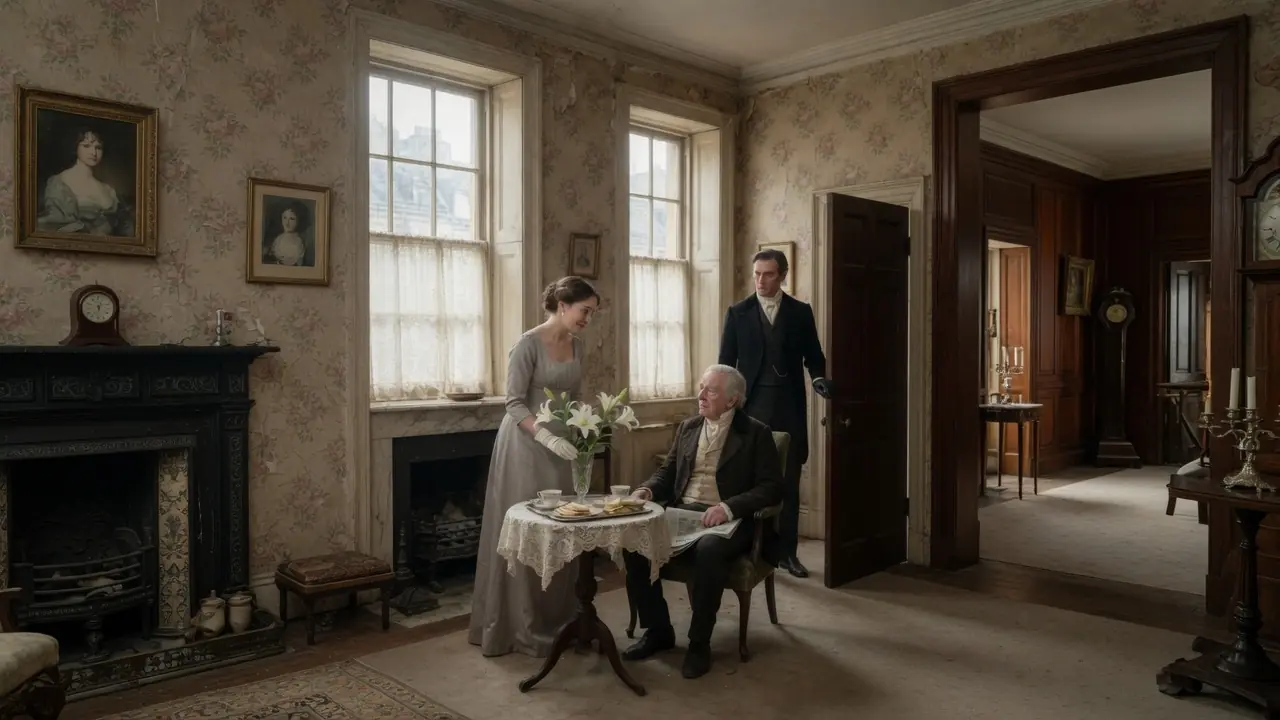
Juliet's needle paused. "He watches me as a man might watch a new horse he has acquired, to see if it is lame." Perseus laughed, a rare barking sound. "Perhaps, but even a man who buys a horse can grow fond of it, especially if it is a steady, quiet creature that does not shy at shadows." She leaned forward again, her blue eyes intense. "Be patient, Juliet. The north has long winters, but spring always comes eventually."
The day Perseus was to depart, she took Juliet's hands in her own dry, wrinkled ones. "You are good for him. You are good for this house. Do not let his silence defeat you. It is a habit, not a weapon." And then she was gone, and the house fell quiet once more, but it was a different quiet. The oppressive, echoing silence had been replaced by something softer, more expectant. It was the quiet of a held breath, but now it felt as if it was held in anticipation, not in grief.
Juliet continued her work in the library. It was her domain now. She had even brought in a comfortable chair and a small table, creating a space for herself amidst the towering shelves. The staff, led by Mrs. Graves, had begun to unbend toward her. They saw that she was not a demanding, flighty creature. She was quiet, she was kind, and she was bringing a subtle warmth back into the cold corners of the house. Mrs. Graves had started consulting her on menus. Agnes, the maid, had started to chatter, sharing small pieces of village gossip. The house was slowly, cautiously accepting her.
Dominic, too, seemed to be changing. He did not retreat to his study quite so immediately after their evening meal. Sometimes he would remain in the breakfast parlor, staring into the fire while she sat doing her needlework. They would not speak, but they were sharing the space. On two occasions, he had come into the library late in the evening while she was reading. He did not stay to talk, but would select a book and retreat, a silent acknowledgement of her presence in his family's sanctuary.
One rainy afternoon, she was walking down a long, little-used corridor in the east wing, when she noticed a door that was not locked. She had assumed all the rooms in this section were closed up. Curiosity piqued, she pushed it open. The room was a gentleman's bedchamber, but it was not shrouded in white. It was preserved, as if its occupant had just stepped out for a moment. A book lay face down on a bedside table. A pair of riding boots stood in a corner, and on the wall over the mantelpiece was a portrait.
It was of a young man, no more than twenty. He had the same dark hair and aristocratic features as the Duke. But where Dominic's face was a mask of cold control, this young man's was alive with laughter. His gray eyes, so like his brother's, were sparkling with mischief and joy. It had to be Arthur. He was so vibrant, so full of life, that looking at the portrait was like a physical blow. Juliet could feel the sheer shocking absence of him. This was the source of the silence. This was the ghost that haunted Farmont.
She heard a footstep behind her and turned, her heart in her throat. Dominic stood in the doorway, his face a thundercloud. "What are you doing in here?" he demanded, his voice harsh. "I... The door was open. I did not realize," she stammered. His eyes followed hers to the portrait, and his expression shuttered completely. The ice slammed back into place, thicker and colder than ever before. "This wing is private." "I'm sorry," she said softly. "He is... He was very handsome." "Get out," he said, his voice dangerously low.
Juliet recoiled as if struck. She had never heard such raw fury in his voice. Without another word, she turned and fled, her cheeks burning with humiliation. She did not stop until she was back in the safety of her own rooms. She had crossed a line. She had trespassed on his private grief, and he had thrown her out. The fragile truce between them was shattered.
That evening, she did not go down for dinner. She sent Agnes with a message that she had a headache and would take a tray in her room. She could not face him. She could not sit opposite him in their cozy breakfast parlor and pretend nothing had happened. She picked at her food, the silence of her own rooms feeling lonely again, not peaceful. She had made a terrible mistake. She had been a fool to think the ice was melting. It had only been a temporary thaw.
There was a knock on her door. She expected it to be Agnes come to collect the tray. "Come in," she called, her voice weary. The door opened and the Duke walked in. She stared at him, rising from her chair. He had never come to her rooms before. He looked awkward and out of place, a giant in her chintz-decorated sitting room. He did not look at her. He looked at the floor, at the fireplace, at the curtains.
"My behavior this afternoon was unacceptable," he said, the words sounding as if they were being dragged from him. "I apologize." Juliet was stunned into silence. The Duke of Velmore was apologizing to her. "You did nothing wrong," he continued, his voice still stiff. "The door should have been locked. It is my fault." He finally raised his eyes to meet hers. The anger was gone, replaced by a deep, hollowed-out exhaustion. "That room... I have not been in there myself in five years. Seeing you there, it was a shock."
"I understand," she said softly, "and I am sorry for your loss. The portrait... He looks like he was a wonderful young man." A spasm of pain crossed his face. He looked away again toward the window. "He was," he said, his voice barely a whisper. "He was everything I am not. Full of light." He stood there for a long moment, a man balanced on the edge of a precipice of grief. She could see the struggle within him, the desire to speak warring with a lifetime of iron control. She did not ask questions about Arthur. She simply waited, giving him the gift of her patient silence.
He seemed to pull himself back from the edge. "I trust your headache is not severe," he said, his voice regaining its formal tone. "It is much improved. Thank you." "Good." He gave a short, jerky nod. "Good night, Duchess." He turned and left as abruptly as he had arrived.
Juliet sank back into her chair, her body trembling. He had not broken. He had not told her what happened. But he had come to her. He had apologized. He had spoken his brother's name aloud to her. And in that moment, she knew with a certainty that settled deep in her bones, that this was no longer a business arrangement. She did not know what it was yet. But it was not just a contract. Something real, something fragile and precious was beginning to grow in the silent spaces of Farmont.
In the week that followed the incident with Arthur's room, a subtle but undeniable shift occurred in the dynamic between Juliet and Dominic. The apology had been a fissure in the wall he had built around himself, and through it something new was seeping. He did not become warm or effusive. That was not in his nature. But the rigid formality began to soften at the edges.
He started joining her in the library some evenings. He would read in his large leather armchair by the fire while she sat in her own smaller one, mending or reading herself. They rarely spoke, but the shared silence was comfortable now, companionable. It was the quiet of two people at ease in each other's presence, not the tense void of two strangers.
One evening he looked up from his book on agricultural reforms and found her studying the folio of architectural drawings she had discovered. "You find the house's anatomy interesting?" he asked. "Immensely," she replied. "It has been added to and altered so many times. It feels like a living thing." He rose and came to stand behind her chair, looking down at the drawing she was examining. She was acutely aware of his closeness, the scent of him, clean linen, old paper, and the faint cold air of the moors. "That is the original Tudor foundation," he said, his voice low as he pointed to a section of the drawing. "The west wing was added by my great-grandfather after the fire. He nearly bankrupted the estate to do it. He was a man of grand, foolish gestures." "It is beautiful," Juliet said, her finger tracing the elegant lines of the new wing. "It is," he agreed, "but the heart of the house is here." His finger moved to the older, more rambling section. "This is where the history is."
He was sharing his home with her, its stories, its secrets. He was letting her in. It was more intimate than any touch, any whispered endearment.
A few days later, a letter arrived, bearing Roxanna's familiar seal. Juliet read it in the breakfast parlor, a frown creasing her brow. "Is something amiss?" Dominic asked. He had begun to notice her expressions. "It is from my sister," Juliet said, folding the letter. "She intends to honor us with a visit. She and her children. She feels I must be terribly lonely here and require the cheer of family." Dominic's jaw tightened. "And when does she propose to inflict this cheer upon us?" Juliet was taken aback by his use of "us" and the undisguised annoyance in his tone. "She plans to arrive in a week's time." "I see." He placed his coffee cup down with a decisive click. "I will have Mrs. Graves prepare the guest wing. See that they are made comfortable, but do not allow them to disrupt your own routine. This is your home, Juliet. You are not their governess any longer."
He had used her given name. Not Duchess, not Miss Cole, but Juliet. The word spoken in his low, quiet voice landed in the space between them with the weight of a vow. It was the first time. She looked up at him, her heart skipping a beat. His gray eyes were steady on hers, and in them she saw a new and unfamiliar emotion. Protectiveness.
Roxanna's arrival was like a gale-force wind hitting a placid lake. She swept into Farmont with her two boisterous children, a mountain of luggage, and an air of supreme confidence, ready to inspect her sister's new life and find it wanting. "My dearest Juliet," she cried, enveloping her in a perfumed hug in the great hall. "You poor thing, you must be expiring of boredom in this gloomy old mausoleum." She cast a critical eye over the dark oak paneling. "And Your Grace," she said, turning to Dominic and offering a deep, flirtatious curtsy. "How good of you to welcome us! I do hope we can bring a little life to this quiet place."
Dominic's expression was arctic. "Mrs. Finch," he said with a curt nod. "Welcome to Farmont. I trust your journey was tolerable." The children immediately began to run riot, their shouts echoing in the vaulted hall that had been silent for so long. Thomas tried to slide down the banister while Clara demanded to see the ponies. Roxanna made no effort to restrain them. "Children, do behave," she said with a laugh. "You will wake the ghosts."
The visit was an exercise in torment for Juliet. Roxanna treated her with the same casual condescension as before, but now it was laced with a sharp, envious edge. She would issue backhanded compliments. "That gray silk is very sensible, Juliet, so suited to country life," and make pointed remarks about the house's somber atmosphere. She treated the staff like her own, issuing orders and making demands that left Mrs. Graves tight-lipped with fury.
But what was most telling was how she continued to treat Juliet as an unpaid servant. "Juliet, darling, be a dear and take the children off my hands for an hour. They are giving me a headache," she would say. Or, "Juliet, could you just speak to Cook about the menu? You know how I detest salty food." The first few times Juliet, falling back into old habits, complied. She found herself once again supervising French lessons and mediating squabbles. But then she would catch Dominic's eye across the dinner table, a cool questioning look that seemed to ask, "Why are you allowing this?"
The breaking point came on the third day. They were in the drawing room after dinner. Roxanna was complaining loudly about the lack of a recent London paper. "Honestly, it is like being at the end of the world here," she sighed dramatically. "Juliet, you must do something. Surely a duchess can arrange for a daily delivery." She then turned to her daughter. "Clara, your hem is coming down. Go and ask your aunt Jules to fetch her sewing kit and fix it for you. She is so clever with a needle."
Juliet froze. The familiar request was a cold splash of water. All her life she had been the one to fetch, to mend, to soothe, to serve. Before she could even form a reply, Dominic spoke. His voice was quiet, but it cut through the room like a shard of ice. "Clara," he said, his gaze fixed on the little girl. "Your aunt is the Duchess of Velmore. She is not a lady's maid. If your hem requires mending, you will ask your own mother, or you will ring for one of the staff whose duty it is."
The room went completely silent. Clara stared at him, her mouth agape. Roxanna's face flushed a blotchy, furious red. Dominic then turned his cool gaze upon Roxanna. "And in future, Mrs. Finch, you will address my wife with the respect her position demands. Her name is Your Grace, or if she permits it, Juliet. It is not 'Jules,' and she is not at your beck and call. Is that understood?"
Roxanna was speechless. She looked from the Duke's implacable face to Juliet's. In that moment, she saw that the world had irrevocably changed. Her sister was no longer her possession. Juliet felt a surge of something fierce and unfamiliar. It was not triumph. It was validation. He had defended her. He had claimed her publicly as his wife, as the mistress of his home.
"I... I meant no disrespect, Your Grace," Roxanna finally stammered. "It is just old habits. Juliet and I have always been so close." "Then I suggest you cultivate new habits," Dominic said, his tone leaving no room for argument. He rose from his chair. "Juliet, would you care for a game of chess in the library?" It was an order, a rescue, and an invitation all in one.
"Yes," Juliet said, her voice steady as she rose to her feet. "I would like that very much." She walked with him from the room, leaving her sister sitting in stunned, furious silence. She did not look back.
As they crossed the great hall, Dominic slowed his pace to match hers. He did not take her arm, but she could feel the protective warmth of his presence beside her. In the library, he set up the chessboard before the fire. They played in their usual, comfortable silence, but the air between them was charged with unspoken things. He had drawn a line in the sand. He had chosen her side over her family's. He had seen the quiet cruelty she had endured for years, and he had refused to allow it in his home. He had refused to allow it to be inflicted on his wife.
After a while, Juliet looked up from the board. "Thank you," she said softly. He did not pretend to misunderstand. "She had no right," he said, moving his knight. "This is your home. You will not be diminished here." He looked at her, his gray eyes serious. "I married you for your stillness, your dignity. I will not stand by and watch anyone, even your own sister, attempt to strip you of it."
In his words, she heard the echo of her own decision made on her fortieth birthday. She had stopped hoping, but she had not stopped being herself, and he, the cold, silent Winter Duke, had seen that self and valued it. He had seen her, truly seen her. She looked at the chessboard, at the carved ivory pieces, the king and the queen standing side by side. "Check," she said, her voice clear. A rare, true smile touched his lips. Not an almost, a real one. It transformed his face, chasing the shadows from his eyes. "So it is," he said.
Roxanna and her children left two days later, their departure as stiff and cold as their welcome had been chaotic. The house settled back into its quiet rhythm. But it was a new rhythm, a new quiet. It was the quiet of a partnership.
The north country autumn deepened, painting the moors in shades of rust and gold. The air grew crisp, and the evenings drew in long and dark. The storm that had been brewing between Juliet and Dominic had passed, leaving behind a clear and altered sky. Their life together found its settled pace, a quiet duet. The library was their shared territory. The round table in the breakfast parlor, their island. The gardens, now being slowly reclaimed from their wildness under Juliet's gentle direction, were where they walked in the afternoons.
He would speak of the estate, of the tenants and the farms, no longer as a man reporting to his business partner, but as a man sharing his life's work with his wife. He asked her opinion on crop rotation, on the repairs needed for the village church. She, with her practical mind and sharp observation, offered sensible, insightful counsel. He began to delegate tasks to her, giving her the household accounts to manage, trusting her judgment completely. She was not just a duchess in name. She was becoming the true mistress of Farmont.
But one door remained closed. The door to Arthur's room and the door to the deepest part of his grief. He had apologized for his anger, but he had not invited her into its source. Juliet did not push. She waited. She knew that some doors can only be opened from the inside.
The weather turned in late October. A great storm blew in from the North Sea, lashing Farmont with wind and rain for three days. The world outside the stone walls of the house dissolved into a gray howling fury. They were marooned, cut off from the world. On the second night of the storm, the wind howled in the chimneys like a hungry wolf. Even inside the thick walls of the library, they could hear it, a constant violent presence. The rain beat against the tall arched windows in furious gusts.
Dominic seemed particularly restless. He paced the length of the room, unable to settle with a book. He would stop at the window, stare out into the black, churning night, and then resume his pacing. Juliet watched him, a knot of apprehension tightening in her chest. The storm outside seemed to be mirroring one inside of him.
Finally, he stopped in front of her chair. "It was a night like this," he said, his voice strained. Juliet looked up at him. She did not need to ask what he meant. "The night Arthur died," he continued, his gaze fixed on the rain-streaked glass. "The wind was from the east. It came up so fast." He fell silent. But it was a different kind of silence now. It was the silence of a man gathering the strength to speak of the unspeakable. Juliet held her breath, her own book forgotten in her lap.
He turned from the window and looked at her, and his eyes were full of a pain so raw it was shocking. The ice was gone. The control was gone. There was only the grief, stark and terrible. "He loved to sail," Dominic said, his voice rough. "We had a small boat we kept at the coast. He was a better sailor than I was. More daring. He felt the wind," he said. "He understood it."
He walked to the fireplace and stood with his back to her, one hand resting on the cold marble of the mantelpiece. He was home from university. "He wanted to go out. I told him it was foolish, that a storm was coming. The fishermen had all brought their boats in. But he laughed. He said it was just a bit of a squall, that he would be back before it hit. He always thought he was invincible."
His shoulders hunched. "I should have forbidden it. I was his guardian, his older brother, the Duke. I should have put my foot down, but he could always persuade me. He had this light in him, and I didn't want to be the one to extinguish it." The wind shrieked outside, a mournful cry. "So... so I went with him," Dominic whispered. "I told myself it was to keep an eye on him, to make sure he was safe." His hand clenched into a fist on the mantelpiece. "We were a mile out when the storm hit. It was violent. The sky went black. The waves... I have never seen anything like it. The boat was a toy."
He was laughing at first, exhilarated. And then a wave caught us broadside. The mast cracked. It came down so fast." He stopped. The only sounds were the storm and his own ragged breathing. One second. Two seconds. Three. "It struck him," he said, his voice breaking. "He was knocked into the water. I went in after him. I had him. I had my hand on his collar. But the wreckage... the current was so strong, it pulled him away from me. It pulled him under. I searched for hours. The sea was chaos. I screamed his name until my throat was raw."
He fell silent again, his body rigid with the memory. Juliet rose from her chair and went to him. She did not touch him. She simply stood beside him. A quiet, steady presence in the face of his storm. "They found the boat the next day, smashed to pieces on the rocks," he said, his voice flat and dead. "They found him two days after that." He finally turned to face her, and his face was the face of a damned man. "It was my fault. I was there. I was supposed to be watching him. He was my responsibility. And I let him die."
The confession, held in for five long years, was out. It filled the room, a terrible living thing. Juliet looked into his devastated eyes. She saw the guilt that had frozen his heart, the self-blame that had been his constant companion. She did not offer him platitudes. She did not tell him it was an accident. The grief was too large for such small comforts.
Instead, she reached out and placed her hand gently on his clenched fist on the mantelpiece. Her touch was a small point of warmth in his cold, lonely world. "Dominic," she said, her voice soft but clear. She had never used his name in such a moment. It was an anchor. "You said he understood the wind. You said he was daring. You could not have forbidden him any more than you could have forbidden the tide to turn. You went with him to protect him. You went into the water to save him. You held on to him for as long as you could." She looked at him, her gaze unwavering. "You loved him. And love is not about control. It is about presence. You were present with him in his joy and in his end. That is all any of us can ever do."
He stared at her, her gray eyes wide, searching her face as if seeing it for the first time. He had expected condemnation or pity or attempts to reason away his guilt. He had not expected this, this quiet, absolute acceptance, this reframing of his failure not as a lack of control but as an act of love.
A single tear traced a path down his cheek. He seemed not to notice it. "It was not your fault, Dominic," she said again, her voice full of a certainty she felt in her soul. "It was a storm. You cannot command the sea." He let out a shuddering breath, a sound that seemed to be torn from the very depths of him. The tension that had held him rigid for five years began to release. He slowly uncurled his fist from under her hand, and with a hesitation that was heartbreaking, he took her hand in his. His skin was cold, but his grip was firm. It was the first time he had ever truly taken her hand. He held it, his thumb stroking the back of her palm as the storm raged on outside.
He did not speak again for a long time. He did not need to. In the warm firelit library, surrounded by the ghosts of his family and the fury of the elements, the Winter Duke was finally beginning to thaw. Juliet stood with him, their hands clasped together. A silent promise that he was no longer alone in the storm.
The storm broke before dawn. When Juliet awoke, the world was washed clean, bathed in a pale, watery sunlight. The silence that greeted her was not the heavy, oppressive silence of before, but a deep and profound peace.
She went down to breakfast and found Dominic already there. He was standing by the window, looking out at the glistening, rain-washed gardens. He turned as she entered, and the change in him was startling. The deep lines of strain around his eyes had eased. The bleakness was gone, replaced by a quiet gravity. He looked settled. "Good morning, Juliet," he said, and his voice was different, deeper, calmer. "Good morning, Dominic," she replied, a soft smile on her lips.
They sat at their round table. The conversation was not about the estate or the weather. He asked her about her childhood, about her parents. He asked her about the books she loved, the music she enjoyed. He was learning her as she had learned him. He was discovering the woman he had married.
After breakfast, he said, "Will you walk with me?" He led her not to the gardens, but up the grand staircase, down the long corridor of the east wing. He stopped before the door to Arthur's room. It was closed. He took a key from his pocket, unlocked it, and pushed it open, letting the morning light flood in. He led her inside. The room no longer felt like a shrine to a ghost. It felt like a memory, sad but peaceful.
He walked to the portrait over the mantelpiece and looked up at his brother's smiling face. "I am going to have this moved to the main gallery," he said. "With the other family portraits. It is time." He came out of the shadows. He turned to Juliet. "And I would like to reopen this wing. Perhaps we could turn these rooms into a nursery."
He said it so calmly, so matter-of-factly. But the implication struck Juliet with the force of a tidal wave. A nursery. He was no longer just thinking of securing the succession with a distant cousin. He was thinking of a future with her. She could not speak, could only look at him, her heart overflowing. He seemed to understand her silence. He stepped closer and gently took her hands in his. "Juliet," he said, his voice thick with emotion. "I married you for your silence, for your stillness. I thought that was what I needed, a quiet port in a storm. But you are not the port. You are the lighthouse. You do not offer a place to hide. You show the way home."
He raised her hand to his lips and pressed a gentle kiss to her knuckles. "I made a bargain for a duchess, but I have, by some miracle I do not deserve, found a wife. My wife." In the quiet, sunlit room, surrounded by the memory of a brother lost and the promise of a future yet to be made, Juliet Cole, who had stopped hoping for a husband on her fortieth birthday, finally found a home. She was not on a shelf. She was at the very center of a life, a heart, a love that was more real and profound than anything she had ever dared to dream of.
Epilogue. Two years later, the library at Farmont was warm, the fire crackling in the hearth. The late afternoon sun, low in the autumn sky, slanted through the tall windows, illuminating the rich colors of the Turkish rug and the spines of a thousand books. The room was no longer a silent sanctuary. It was the living heart of the house.
Juliet sat in her favorite chair, a book open but unread in her lap. Her gaze was on the scene before her. Dominic was on the floor on his hands and knees, a position of profound indignity for a duke. On his back, holding on to his collar for dear life, was their son, a one-year-old boy with his father's dark hair and, everyone said, his mother's calm, observant eyes. The baby, named Arthur, gurgled with delight as his father pretended to be a fearsome bear, growling in a low, rumbling voice that held nothing of the winter in it anymore. The sound of their laughter filled the room, a sound as warm and welcome as the firelight.
Perseus, the Dowager Duchess, sat in the opposite chair, her knitting needles clicking softly. She watched her son and grandson, a rare soft smile on her face. "I never thought I would see the day," she murmured to Juliet. "Dominic playing the fool. Arthur would have loved this." "He would have," Juliet agreed, her heart full. The ghost of the first Arthur was no longer a source of pain in this house, but a gentle, smiling memory.
A footman entered with the afternoon post on a silver tray. There was a letter for Juliet bearing Roxanna's familiar seal. She opened it. Her sister's letters had changed over the past two years. The pity and envy had been replaced by a grudging, bewildered respect. She wrote of London gossip, of her children's progress, and always ended with a stilted but sincere inquiry after Juliet's health and that of her family. She had even, in her last letter, asked for Juliet's advice on a matter concerning her daughter Clara. The world had righted itself.
Juliet folded the letter and looked back at her husband and son. Dominic had collapsed onto his back, and young Arthur was now crawling over his chest, patting his father's face with a chubby hand. Dominic caught the little hand and kissed it. His eyes, those gray eyes that had once been so cold, crinkling at the corners with love. He looked over at Juliet and smiled, a real, easy smile that was just for her. It was a look that said everything. It spoke of shared nights and quiet mornings, of partnership and passion, of a love that had not been a whirlwind discovery, but a slow, quiet, deliberate construction, built day by day, silence by silence, word by word. It was a love that had been chosen, earned, and treasured.
Juliet smiled back, her hand resting lightly on the gentle swell of her stomach where their second child was growing. The house was no longer silent. It was filled with life, with laughter, with love. It was home, and she, who had once been destined for the shelf, was at the very center of it all, seen and cherished, exactly as she was.