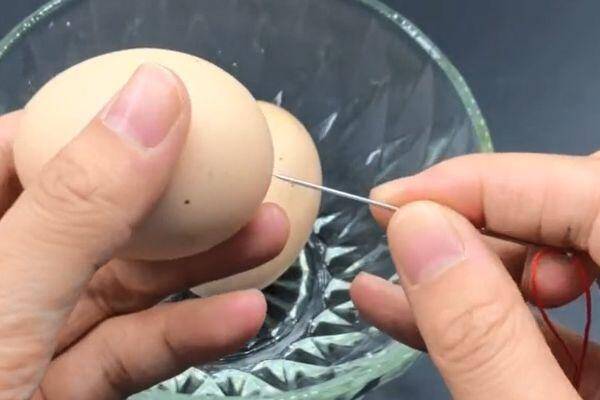
With this simple but effective tip, you are guaranteed to be extremely satisfied with your boiled eggs.
Eggs are an affordable and nutritious food that can be prepared in many delicious ways. Among them, boiled eggs are the simplest and most common method. However, if boiled incorrectly, eggs can be hard to peel, break easily, and lose their nutritional value.
In fact, there are several small tricks to make boiled eggs tastier and easier to peel, such as adding salt, white vinegar, or a few drops of lemon juice to the water. But few people know an extremely effective secret: using a pin to prick the egg before boiling it. Many people wonder: Why prick the egg? Does it cause the egg to crack?
Let’s explore the details of how to do this and the benefits of this small tip.
Preparation
– 1 chicken or duck egg
– 1 sewing needle, embroidery needle, or paperclip (medium size, not too big or too small). Before starting, make sure to clean the needle to ensure hygiene.
How to Prick the Egg Correctly
Gently use the needle to make a small hole in the larger end of the egg, where the air sac is located.
Avoid pricking the smaller end, as it may cause the shell to crack.
After pricking, place the egg in cold water. Many people wait for the water to boil before adding the egg, but this causes the shell to crack due to the sudden temperature change. Boiling eggs in cold water allows the heat to spread gradually, ensuring even cooking and making the shell easier to peel.
You can also add a little salt to the water. Salt helps to slightly disinfect and makes the egg shell peel off more easily.
Why Prick the Egg?
The small hole helps the air escape when the egg heats up, creating a gap between the shell and the egg white. As a result, the boiled egg becomes smoother, does not crack, and is much easier to peel.
Ideal Boiling Time for Eggs
-
4 minutes: The egg white sets, but the yolk remains soft – perfect for a runny egg.
-
5 minutes: The egg white holds its shape, and the yolk is slightly runny.
-
6 minutes: The egg white is firmer, and the yolk is thick and creamy.
-
8 minutes: The egg white is fully cooked, the yolk is a smooth yellow, and slightly sticky.
-
10 minutes: The egg is well-cooked, and the yolk becomes a darker yellow.
-
12 minutes: The egg is almost completely cooked, with a firm texture.
-
14 minutes: Both the egg white and yolk are fully cooked, with a characteristic grayish-green color.
In conclusion, pricking the egg before boiling is a simple trick that gives surprising results: the egg won’t crack, it will cook evenly, become smoother, and be much easier to peel.