Prof doesn't know black student is math prodigy. Sets impossible equation to mock him. Regrets it. Professor Harold Whitman had already decided what kind of student Elijah Brooks was before the semester even began. He had seen the name on the scholarship list attached to his roster.
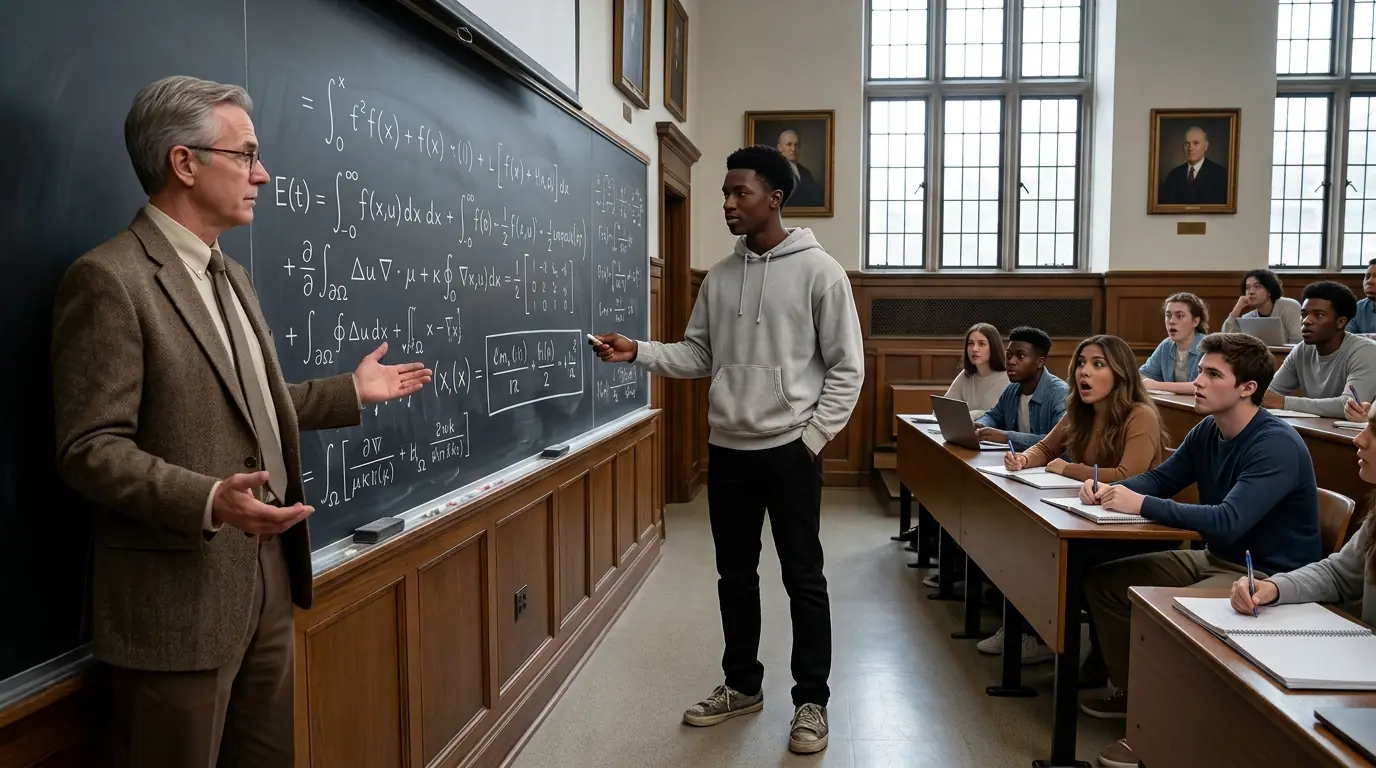
He had noticed the Mercer East address, the public high school, and the box marked first generation college student. By the time Elijah walked into Calculus Theory 301, wearing a faded gray hoodie and carrying a notebook with peeling corners, Whitman believed the details had confirmed one another. Elijah was usually the first student in the room and the last one to leave. He chose the third row, close enough to read the smallest symbols on the board, but far enough from the front that no one would mistake his attention for performance.
He rarely spoke unless he was certain of his answer. That silence made some students think he was shy. To Whitman, it looked like fear. The professor had taught at Bellweather University for 27 years. His portrait appeared on the mathematics department website beside a paragraph about rigor, tradition, and excellence.
Former students described his exams as endurance tests. Younger faculty lowered their voices when they disagreed with him. Whitman had learned that if a man spoke with enough certainty for long enough, most rooms would confuse confidence with proof. On the first morning, he wrote a theorem on the board without introducing himself.
There are people who arrive in this course because they have earned the right to be here, he said. There are others who arrive because an admissions committee wanted an attractive statistic. By October, the mathematics usually reveals which is which. Several students shifted in their seats.
Elijah looked at the theorem. It was a convergence result Whitman had copied incorrectly. A minus sign was missing from the denominator. Elijah noticed it before the professor finished the sentence, but he said nothing. His mother had taught him that every truth had a time, and the first 5 minutes in a new room were often better used for listening.
The student beside him did not share that instinct. Professor, she said, raising one hand, should that second term be negative? Whitman turned. Nina Flores was small, alert, and already holding three different colored pens. Her question had been polite, but he stared at her as if she had interrupted a memorial service.
He checked the board, erased the sign, and replaced it. A transcription error, he said. Do not confuse noticing one symbol with understanding the theorem. Nina's hand lowered. Elijah wrote the correction in his notebook.
Beneath it, in smaller letters, he wrote, "He punishes the person who sees the error. It was not mathematics, but it was still a pattern." Two weeks later, Whitman returned the first diagnostic exam. He moved down the aisle, dropping papers onto desks and making comments just loud enough for the class to hear. Careless, expected better.
At least this one is readable. Owen Parker received a 93 and a nod of approval. Owen had been captain of his private school math team, and he wore his confidence the way some people wore a varsity jacket. He looked at the number, leaned back, and smiled as if the result had restored the natural order of the room.
Then Whitman stopped at Elijah's desk. He looked at the paper, then at Elijah, then back at the class with a thin smile. Interesting, he said. A perfect score. Either Mr. Brooks is hiding extraordinary talent or he got very creative with outside help.
A few students laughed. Owen was one of them. Elijah did not look down. You can check every step, Professor. They're all there.
Whitman placed the paper on the desk, but kept two fingers on it, as though even the grade did not fully belong to Elijah. Confidence is cheap, he said. Proof is harder. Then check the proof. The laughter stopped.
Whitman released the page. We will. Elijah knew what the two words meant. They did not mean his answer would be checked. Every answer had already been checked.
They meant he would be watched. After class, Nina caught up with him in the stone corridor. You really got everything right? She asked. Elijah glanced at her.
She immediately raised both hands. That sounded terrible. I don't mean it like he did. I know. I got an 81.
I thought I understood the last proof until I saw the red marks. Could you show me what you did? They sat on a bench beneath a window, looking over the rain-dark courtyard. Elijah opened the worn notebook. Nina expected a copied formula or a clever trick.
Instead, he began with the definition and built the argument one step at a time. When she interrupted, he answered without making her feel slow. When she saw the point, he did not claim credit for it. 20 minutes later, Owen walked past with two friends.
He slowed when he saw them. "Already running a tutoring business," he asked. "Already needing one?" Nina replied.
Owen laughed, but his eyes stayed on Elijah's notebook. The pages were dense with symbols, arrows, and small boxes around questions Elijah had not yet answered. There were no copied solution manuals. There were ideas in motion. That evening, Elijah carried groceries up three flights of stairs to the apartment he shared with his mother.
Maya Brooks was asleep before her night shift at St. Catherine's Hospital, so he moved quietly. He set a container of soup in the refrigerator, replaced the burned-out bulb over the stove, and spread his books across the kitchen table. At 11:00, Maya appeared in blue scrubs with her hair tied back. "You eat?" she asked.
"Yes." She opened the refrigerator, saw the untouched soup, and looked at him. I ate something. Something is not dinner. She heated the soup while he worked. Maya did not understand the lines filling his notebook, but she understood his face when he was close to an answer.
She had seen that look when he was six and arranging bottle caps into prime number groups on the floor. She had seen it when he was 11 and asked why the bus schedule could not be optimized by treating routes as a network. At 14, he had found an error in a free online lecture and emailed the professor who made it. The professor wrote back three weeks later, not to apologize, but to ask how Elijah had noticed.