In the spring of 1971, a young woman named Helen Voss stood on the porch of a farmhouse that now belonged to her and made a decision that would send ripples of disbelief through the entire Willamette Valley. The air that Oregon morning was cool and damp, heavy with the scent of wet earth and the promise of a bloom that for years had brought more anxiety than profit. Her father Arthur was gone, laid to rest a month prior, leaving her with 30 acres of blueberry bushes, a mountain of quiet grief, and a farm that was slowly, stubbornly starving to death. The land itself was good, the soil dark and willing, but something was failing in the translation from flower to fruit. The yields had been dwindling for a decade, the berries small, the harvests a pale shadow of what her grandfather had pulled from this very ground.
Everyone knew the problem, or at least they knew the symptom: pollination. Farming by the 1970s had become a game of inputs. You didn’t just farm the land. You purchased solutions. If your soil was weak, you bought fertilizer. If pests arrived, you bought chemicals. And if your blossoms needed bees, you rented them. A man named Mr. Gable ran the biggest pollination service in the county. Every spring, his flatbed trucks would rumble down the gravel roads, dropping off gray, weathered boxes of commercial hives that had been trucked up from the almond orchards of California or hauled from some other monoculture crop hundreds of miles away.
The bees were tired, stressed, and disoriented. They were mercenaries, not partners, and they did their work with a weary inefficiency that showed in the harvest. But it was the way things were done. It was the conventional wisdom, as solid and unyielding as the basalt bedrock deep beneath the valley floor. That morning, Mr. Gable’s dusty blue truck pulled into the Voss driveway. He was a big man with a florid face and the easy confidence of someone whose services were not a luxury, but a necessity. He stepped out, leaving the engine to grumble a diesel tune, and pulled a clipboard from his dash.
He didn’t offer condolences for her father’s passing. Business was business. He just looked at Helen, a slip of a girl at 25 with her father’s serious eyes and hands already calloused from work, and got straight to it. “Helen, time to sign for the season. Price is up 5%. Same as for everyone. I’ll have the hives here by Friday.” Helen stood there on the porch, her arms crossed, not in defiance, but as if to hold herself together. She had spent the last week poring over her father’s ledgers, the neat columns of his cursive telling a story of escalating costs and diminishing returns. The pollination contract was the single largest expense after the mortgage. It was a gaping wound in the farm’s finances.
“I’m not giving up,” she said, her voice quiet but clear. “I’m not renting bees.” A slow smile spread across Mr. Gable’s face. It was a smile of condescending pity, the kind a man gives a child who doesn’t understand how the world works. “Well now, Helen, are you planning on pollinating those 30 acres by hand? Your bushes won’t set a thimble full of fruit without my girls.” He called them his girls, as if he had some personal relationship with the millions of insects he treated like disposable equipment. “I have another plan,” she said.
He laughed then, a short barking sound that startled a robin from the branches of the old oak tree. “Another plan? All right, let me know how that works out for you.” He slapped the side of his truck, the sound echoing in the quiet morning. He got back in, the springs groaning under his weight. And as he backed out of the drive, he leaned his head out the window. “Don’t come calling me in two weeks when your blossoms are dropping. My schedule will be full.” The truck rumbled away, leaving behind a cloud of blue smoke and the lingering scent of derision.
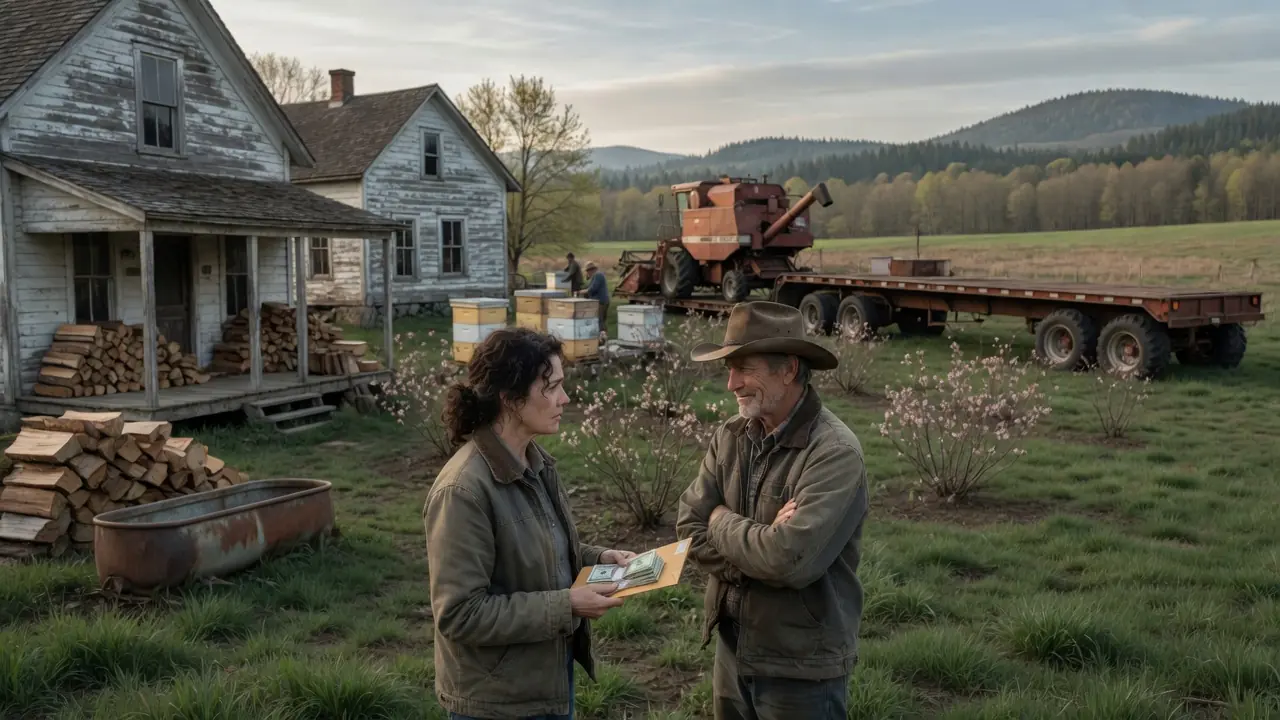
Helen didn’t watch him go. She was looking at the far corner of the property where a hulking shape of faded red metal sat rusting under a tarp. It was a grain combine. Her grandfather had bought it, believing diversification was the future. Her father had kept it, believing in its potential, a potential that the farm’s finances never allowed him to realize. It had been used three times in 20 years. It was a monument to a different dream. To Mr. Gable, and to every other farmer in the valley, that machine was an asset, a piece of real farming equipment. To Helen, it was a ghost, and she knew exactly what she was going to do with it.
Now, let me tell you about her father, Arthur Voss. He was not a foolish man. He was a quiet, methodical farmer who loved the land with a deep and abiding reverence. He was, however, a man of his time, caught in the gears of a system that promised progress but delivered dependence. He had taught Helen everything he knew, not with lectures, but with shared labor. He taught her to read the sky, to know the difference between a rain that would nourish and a rain that would flood. He taught her to listen to the soil, to crumble it in her hands and understand its thirst. He taught her observation.
His greatest legacy was not the farm, but a set of five leather-bound journals stored in his roll-top desk. For 30 years, Arthur had recorded everything: weather patterns, soil temperature, bloom dates, fertilizer application rates, rainfall, and most importantly, harvest yields right down to the row. He noted the arrival of Gable’s bees each year. “Hives arrived April 12th, seem weak this year.” Or “Bees active for two days, then a cold snap. Most stayed in the box.” He was documenting a problem he couldn’t solve. He knew the rented bees were failing him, but he saw no other way. He was trapped by the tyranny of the way things were done.
Helen spent her evenings that week under the light of a single lamp, poring over those journals. She wasn’t just reading words. She was communing with her father. She saw the pattern he had meticulously recorded but never fully interpreted. The yields were always best on the bushes closest to the wild patch of woods at the edge of their property, where native bumblebees and solitary masons lived. They were always worst in the center of the fields, the place furthest from any natural pollinator habitat. Gable’s bees dropped in for a two-week contract, did the bare minimum, then were hauled away. They were temporary labor. The farm didn’t need visitors. It needed residents.
The combine was sold a week later to a grain farmer from the next county over. The man who bought it couldn’t believe his luck getting it for such a low price. The other farmers who heard about the sale just shook their heads. There goes Arthur Voss’s daughter selling off the last piece of real value on that place. They figured the money was to pay down debt, a final act of surrender before the bank took over. They were wrong. Helen took that cash, every last dollar, and drove two hours south to a small family-run apiary she’d found after three days of phone calls. She didn’t buy new equipment. She bought 20 established colonies, 20 thriving, humming communities of Italian honeybees in weathered but solid Langstroth hives.
The old beekeeper she bought them from, a man with a face like a wrinkled apple, looked at her with sharp, curious eyes. “That’s a lot of bees for a hobby,” he’d said. “It’s not a hobby,” Helen replied, handing him the envelope of cash. “It’s an investment.” Have you ever wagered everything on an idea no one else believed in? Have you ever taken the collected wisdom of your community, of the experts, and turned your back on it to follow a quiet, insistent whisper of intuition? That is a lonely and terrifying place to be. For Helen Voss, that place was her 30-acre farm in the spring of 1971.
The day she brought the hives home was the day the whispers started in earnest. Her neighbors, the Jacksons to the west with their pear orchards and the Millers to the east with their apples, watched as she and the old beekeeper carefully unloaded the hives, placing them in four separate apiaries nestled in sheltered spots around her property. They saw her in the strange white suit and veil, a ghost moving through the rows of blueberry bushes. Mr. Miller, a man who considered himself a pillar of the farming community, stopped his tractor by her fence line a few days later. “Helen,” he called out, his voice carrying a note of paternal concern that barely masked his judgment. “What are you doing with all these bees? That’s a dangerous hobby.”
“They’re not for a hobby, Mr. Miller. They’re for the blueberries,” she said, not bothering to stop her work of setting up a water source for the nearest apiary. “Gable’s bees not good enough for you?” he asked, a smirk playing on his lips. “I think my bushes would prefer bees that live here,” was all she said. He drove off, shaking his head, and the story was all over the valley by supper time. Arthur Voss’s girl had lost her mind, selling a combine for bugs. It was the talk of the Grange Hall and the feed store. It was a joke told over beers at the local tavern. She was a woman alone, grieving and overwhelmed, and she’d made a foolish, emotional decision. They gave her one season before the bank put up the sign.
What is the difference between an expert and a wise person? An expert knows what has been done. A wise person understands what needs to be done. The experts of the Willamette Valley knew how to rent bees. Helen Voss was seeking a deeper wisdom. She was trying to understand the partnership that the land was asking for. The next two months were a masterclass in solitude and devotion. Helen became a student of the bee. She read every book she could find. She made mistakes. She got stung, her hands swelling up twice their normal size. She accidentally crushed a queen and had to perform a desperate, delicate operation to introduce a new one.
She learned the unique scent of a healthy hive, a warm sweet smell like beeswax and nectar. She learned the different hums: the contented buzz of a strong nectar flow, the angry roar of a disturbed colony, the high-pitched whine of a queenless hive. There was a moment of doubt. Of course, there was. It came one night in early May. A vicious, unseasonable storm blew in from the coast, lashing the valley with wind and icy rain. Helen lay awake in her father’s bed, listening to the oak tree thrash against the roof, and all she could think about were the hives. She pictured them being overturned, the colonies exposed, the bees freezing in the deluge. She saw her entire investment, the ghost of the red combine, washed away in a torrent of mud.
Every mocking voice, every pitying look she had received echoed in her mind: Gable’s smug face, Miller’s condescending tone. Had they been right? Had she traded a tangible asset for a fragile living thing she was not equipped to protect? The temptation to give up, to believe she was a fool, was a physical weight in the room. She got out of bed, lit an oil lamp, and went to her father’s desk. She opened his journal to the final year, his handwriting growing a little weaker. She found an entry from a day just like this one: “Hard rain last night. Wind took some blossoms. Gable’s hives are soaked. Bees won’t fly for days. Another loss.” He had faced the same storm, the same helplessness, but his problem was a hundred miles away on a flatbed truck. Hers was a few hundred yards from her back door.
She put on a raincoat over her nightgown, pulled on her boots, and grabbed a flashlight. She fought her way through the wind and rain to the nearest apiary. The hives were secure. She had placed them on stands behind a natural windbreak of cedar trees, just as the old beekeeper had advised. She put her hand on the side of the nearest hive. Through the wet wood, she could feel it, a faint, steady vibration, a low, powerful hum. They were clustered inside, keeping each other warm, protecting their queen, waiting out the storm together. They were alive, and they were resilient. They were home.
In that moment, her doubt was washed away by the rain. She was not their owner. She was their steward, and they were her partners. When the storm broke at dawn, the sun came out, and the world seemed new-washed and clean. Before the mist had even fully burned off the valley floor, her bees were pouring from the hives. They rose into the air in shimmering golden clouds, and they descended upon the blueberry blossoms. The sound, a sound no one in that valley had heard for 50 years, was extraordinary. It wasn’t the thin, temporary hum of a few thousand rented workers. It was the deep, resonant, omnipresent thrum of nearly a million resident bees working from the first light of dawn to the last light of dusk. Her farm was alive with the sound of pure focused industry.
The first sign of success was visible within weeks. The fruit set was staggering. On her neighbors’ farms, the blossoms would fall and reveal small clusters of two or three potential berries. On Helen’s farm, the blossoms fell to reveal thick, heavy bunches of five, six, even seven berries, all swelling with promise. The leaves of her bushes seemed a deeper green, as if energized by the sheer vitality of the life teeming around them. The land was responding to the renewed partnership. It was waking up. The whispers in the valley began to change. The tone of mockery softened into one of confused curiosity. Farmers would slow their tractors as they passed her fields, staring at the bushes. They couldn’t deny what they were seeing. Something was happening on the Voss farm.
Then came the harvest. It began in late June. The berries were not just plentiful. They were different. They were larger, with a dusty blue bloom that spoke of perfect health. They were sweeter, bursting with a flavor that was complex and wild. The crews she hired to pick worked with a kind of awe, filling their buckets faster than they ever had. Her yield per acre wasn’t just better than her father’s had been; it was double. In some sections of the farm, it was nearly triple the county average. She had to buy crates from two other suppliers because her initial order wasn’t nearly enough. The farm, which had been slowly dying, was now producing a torrent of life, and that was only the first part of the vindication.
The second part was golden and sweet. After the blueberry harvest, she harvested the honey. She had set aside a portion of the hives just for honey production, and the bees had filled the supers with a surplus she could hardly believe. It was a light amber honey with the delicate floral notes of blueberry blossoms. It was the pure distilled essence of her farm’s success. She extracted it herself in the old barn, the air growing thick with the scent of beeswax and warm honey. She poured it into simple glass jars with handwritten labels: “Voss Farm raw honey.” She took 100 jars to the weekend farmers market in town, hoping to sell a few. They were gone in an hour.
People came back for a second, then a third jar. The next weekend she brought 200. They were gone by noon. It was a second, completely unexpected stream of income. It was pure profit born not from a greater expense but from the solution to her first problem. When the final numbers were tallied in the fall, after all the berries were sold and the last jar of honey was gone, Helen sat at her father’s desk and did the accounting. The farm was not just stable. It was not just profitable. It was thriving beyond her wildest dreams. The income from the combine she had sold was replaced tenfold. The profits from her 30 acres with her dual income of berries and honey surpassed those of the Miller farm and the Jackson farm, both of which were three times her size.
She had paid off her father’s debts. She owned the farm free and clear. The land was hers. The bees were hers. The future was hers. The acknowledgment did not come all at once. It came quietly, like a changing tide. It began with Mr. Peterson, an old stern farmer with 100 acres of apples, a man who hadn’t given her the time of day in five years. He pulled his truck over one afternoon in late summer and just stood at her fence line. Helen was out inspecting her hives and she walked over to him. They stood in silence for a moment, the only sound the hum of the bees.
“Helen,” he said, his voice gruff. He nodded toward her fields, where the bushes, now bare of fruit, were already putting on the green growth that would promise the next year’s crop. “Never seen bushes look that healthy after a harvest.” “The bees did the work,” she answered simply. “They’re good partners.” He stared for another long moment, chewing on something he didn’t seem to know how to say. Finally, he just looked at her, his eyes holding a new and unfamiliar respect. “How did you know?” “My father taught me to watch,” she said. “The land tells you what it needs if you listen.” He just nodded, a slow, thoughtful dip of his chin. He got back in his truck and drove away. He didn’t apologize. He didn’t need to. The question was the apology. The question was the concession. The question was the acknowledgment that her quiet, foolish idea had been wiser than all of their loud, confident expertise.
The following spring, Mr. Peterson did not renew his full contract with Mr. Gable. He rented half the hives he usually did. The year after that, he started his own apiary with 10 hives he bought from the same old beekeeper Helen had. The Jacksons followed suit a year later. The tide was turning. Mr. Gable’s business began to shrink. His big blue truck seemed to rumble with a little less confidence. He never spoke to Helen again, but his dwindling presence in the valley was a louder statement than any words could be. He had sold a product. Helen had cultivated a system. In the end, the land always favors the system over the product.
Let’s jump forward 30 years, to the turn of the new century. Helen Voss was no longer the slip of a girl whom everyone underestimated. She was the matriarch of the valley, a woman with silver hair and hands that were a road map of hard work and sunshine. Her farm was a model of integrated, sustainable agriculture. She never bought another combine. Instead, she had fields of wildflowers planted between her blueberry rows, a permanent, beautiful buffet for her bees and the native pollinators who had returned in droves. Her farm was an oasis of biodiversity in a world still obsessed with monoculture. She was not the richest farmer in the valley in terms of acreage, but she was the most secure, the most respected, and the most profitable per acre. She owed no one.
Her greatest legacy, however, was not the money or the land, but the wisdom she passed on. She was out in the apiary one bright summer afternoon, her father’s old journal, now weathered and soft as cloth, sitting on top of a hive. Beside her stood her granddaughter, a girl of 10 with Helen’s own serious eyes, dressed in a small white bee suit. “You see that, honey?” Helen said, her voice gentle as she pointed to a frame she had lifted from the hive. It was heavy with capped honey, shimmering like stained glass in the sun. “That’s not just food. That’s security. That’s the profit from a healthy partnership. The salesman will tell you to buy their solutions in a bottle or a box. But the real solution is always in the system itself. It’s in the health of the soil, the strength of the bees, the wholeness of the land.”
The girl nodded, her eyes wide with wonder, not at the honey, but at her grandmother. She was inheriting more than a farm. She was inheriting a philosophy. The story of Helen Voss became a quiet legend in that valley. They said the experts mocked her for abandoning real farming. They said she sold a machine for a hobby. But the truth was she had abandoned a broken, dependent model and embraced the real foundational work of cultivation. She chose to listen to the intricate music of the land instead of the simple, discordant noise of the marketplace. She traded a ton of rusting idle steel for a million tiny, tireless partners. And the land remembered that choice. The land and the bees rewarded her for it a thousand times.