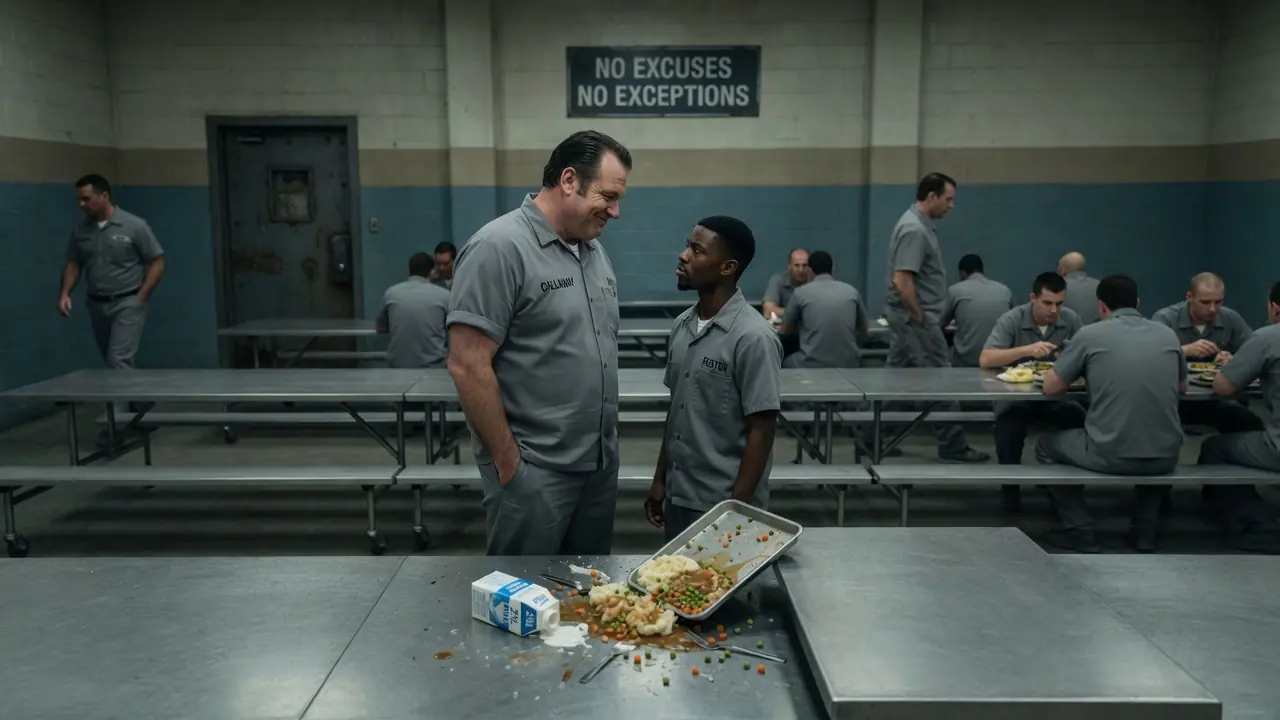
Brett Callaway walked past Theo’s table. His hand flicked out in a lazy swipe, almost bored. The tray slid off the edge and hit the floor with a clang. Pick it up, boy. You deaf? Pick it up. Brett smiled. Dogs eat off the floor. Suits you. His crew laughed. Three hundred men watched. Forks stopped moving.
Theo knelt and reached for the tray. Brett’s boot shot out. He kicked it. The tray spun across the concrete, clattering, spinning, gone. Then he laughed, slow and satisfied. Head tipped back like he’d already won. Theo stayed crouched a second longer. His chest rose once and fell once, the way his father taught him, counting the breath before the storm. Then the skinny kid stood up, and the whole room went silent.
Have you ever stood up knowing everyone wanted you to fall? Ironwood Correctional sat two hours north of the city, ringed by pine and razor wire. Block C held the young ones, men barely out of boyhood, eighteen to twenty-one. Loud, restless, always testing each other. The strong fed on the weak. Everyone knew the math. Theo Foster did not fit the math. He was small, quiet. He kept to a corner of the day room with a paperback, its spine cracked white from rereading. He folded his bunk sheets into sharp corners every morning. He ate without complaint. He watched more than he spoke. The others read that as fear. Fresh meat. A target. They were wrong, but it would take them a while to learn why.
Theo moved differently. When he crossed a crowded room, he never bumped anyone. His balance was low, even, controlled. When a door slammed, he didn’t flinch. His eyes simply found the source, measured it, let it go. Small things, things no one noticed. His father would have noticed. Sergeant Foster had spent twenty years teaching close-quarters combat to Marines. He came home from his last tour quieter than he left. He never raised his voice, never raised his hand. But every evening in the cramped backyard, he taught his two sons how to fall, how to breathe, how to end a fight before it started. Strength isn’t hurting people, he used to say. Real strength is knowing you can and choosing not to.
Theo was twelve when his father died. He kept the words like a second heartbeat. Now he kept something else, too. A letter folded small, hidden under his mattress. It was from his younger brother, Danny. Theo had read it so many times the creases had gone soft as cloth. He could recite it without looking. Some nights he did, just to hear his brother’s voice in his head. He did not talk about why he was in Ironwood. When men asked, he changed the subject. The truth was a weight he carried alone, and he meant to keep carrying it.
Across the block, Brett Callaway ran things. Brett was big, loud, and clever in the way dangerous men are clever. He had been inside long enough to own the place. He decided who got phone time, who got the good bunks, who paid and who bled. And he didn’t do it alone. Officer Dale Wittman worked Block C’s night shift. He wore the uniform, carried the keys, signed the reports. He also looked the other way for a price. Whatever moved through Ironwood that shouldn’t moved because Wittman let it. Brett supplied. Wittman protected. Between them they ran a quiet little empire behind the walls.
Theo wanted no part of it. He kept his head down and counted days. Then Sam Brooks pulled him aside in the laundry. Sam was older, calm, the kind of man who survived by seeing trouble early. He’d watched Theo for a week. You’re not like them, Sam said. That’s good. And it’s dangerous. I’m just doing my time. Nobody just does their time here, Sam lowered his voice. Brett’s watching you. When Brett watches a man, it’s because he wants something or because he’s scared of something. With you, I can’t tell which.
Theo said nothing. Stay out of the storeroom, Sam added. Whatever you do. But two days later, carrying mop buckets on cleanup detail, Theo opened the wrong door at the wrong time. The storeroom light was off. Voices inside. Brett’s laugh, the crinkle of plastic, the soft clap of something changing hands, and Wittman’s voice, low and easy, saying a number out loud. Theo froze in the doorway. Both men turned. For a long second nobody moved. Then Brett smiled, that same slow, satisfied smile he would wear later over a kicked tray. Wrong room, boy, Brett said softly.
Theo backed out, closed the door. His heart hammered against his ribs. He had just seen something he was never meant to see. And men like Brett did not leave loose ends. The next morning the message arrived. Theo sat down with his breakfast tray. Three of Brett’s men closed in around him. They didn’t sit. They stood, blocking the light. New rule, the biggest one said. Everybody pays rent. You pay with that. He nodded at Theo’s tray. Theo looked up. I need to eat. Should have thought of that before you went sniffing in storerooms. So that was it. The price of what he’d seen.
Theo sat alone with an empty table and the eyes of forty prisoners on him. He did not look down. He picked up his cup of water, drank it slow, and stared at the middle distance the way his father used to. Counting breaths. Letting the heat pass through and out. Across the hall, Brett watched the whole thing from his table. He had expected the kid to cry or beg or swing, anything he could use. Instead the boy just sat there, calm as still water, and somehow that calm made Brett look small in front of his own crew. He felt it land. A few men had seen the tray not move. A few had seen the boy let go on his own terms.
Brett drummed his fingers on the table. The boy knew about the storeroom. The boy wouldn’t break the easy way. That left the hard way. Something loud. Something public. Something that put the kid back in his place where everyone could see. Brett smiled to himself. He already knew when he’d do it. Brett did not move fast. He moved like a man who enjoyed the weight. It started small. Theo’s paperback vanished from his bunk. He found it two days later in the trash, pages torn out, spine snapped in half. The book had been his father’s. He held the ruined cover for a long time, then set it down and said nothing.
Next came the rumors. Word went around Block C that Theo was a snitch, that he’d been seen talking to the warden’s office, feeding names to staff. None of it was true. It didn’t have to be. In a place like Ironwood a rumor was a loaded gun, and Brett had pulled the trigger. Men who’d nodded at Theo now looked through him. His cellmate requested a transfer. At meals the seats around him emptied. Isolation was its own kind of violence, slow and quiet, and Brett knew exactly how to apply it.
In the yard a shoulder caught him hard from behind and sent him into the fence. He turned. No one met his eye. Just laughter drifting off and Brett somewhere in it, watching. Then the theft. A man two cells down reported his commissary missing. Chips, stamps, a watch. When the guards searched they found it all tucked inside Theo’s mattress. Theo had never touched it. He didn’t need to ask how it got there. Wittman ran the search himself. He held up the watch, turned it in the light, and looked at Theo with a flat, satisfied calm. Funny, Wittman said. Quiet ones are always the thieves.
Theo said nothing. Arguing would only feed it. He pulled extra cleanup shifts as punishment. He lost phone privileges. And the loss of the phone was the one that cut. Because the phone was how he heard Danny’s voice. That night, alone in his bunk, Theo took out the letter. He didn’t need the light to read it. He knew every line. Theo, I know what you did for me. I know you told them it was yours. You shouldn’t have. Every day I think about it. I’m staying clean. I’m going to make it count. Just come home. Danny.
Theo was eighteen. Danny was sixteen. The night the police came, the bag had been in the car they shared, and someone had to take the charge. Theo had looked at his little brother’s whole life stretched out ahead of him, and he had made a choice in half a second. He’d said the words, It’s mine. He did not regret it. But on nights like this the weight of it pressed down until he could barely breathe. So he breathed the way his father taught him. In for four counts. Hold out for four. He pictured the backyard, the worn grass, his father’s steady hands guiding his elbow. Strength is knowing you can and choosing not to. He held the words until his heartbeat slowed. He would not give Brett a reason. He would not risk a new charge, a longer sentence, anything that kept him from Danny. He would take it. He would take all of it. That was the plan.
But Brett wasn’t finished. Two cells over on the night shift, Brett and Wittman talked through the bars in low voices. He’s still here, Brett said. Still walking around like he owns the air. He hasn’t said anything, Wittman murmured. Maybe he won’t. Maybe, Brett didn’t sound convinced. But he saw. And a man who saw is a man who can talk to the wrong warden, to an investigator. One word from him and your pension’s gone, Dale. Mine, too. Wittman was quiet a moment. So what do you want? I want him broken, Brett said. Not hurt enough to bring heat. Just finished. So scared and so small that if he ever opens his mouth, nobody in here believes a word he says. He smiled in the dark. I want the whole block to watch him fold. After that he’s nothing. A snitch nobody trusts. Harmless. And if he doesn’t fold? Everybody folds, Brett said. I just have to push the right way in front of the right crowd. Wittman nodded slowly. Cafeteria’s full at noon. Noon, Brett agreed.
The next day the chow hall roared with three hundred voices. Theo carried his tray to the far end the way he always did now, looking for empty space. He found it. He sat. He didn’t see Brett until the shadow fell across the table. There he is, Brett said loud enough to turn heads. The quiet thief. The nearby tables went still. Phones came out. Brett had an audience now, and an audience was the whole point. Heard you don’t pay rent, Brett went on. Heard you think the rules don’t apply to you. He looked around, performing for the room. Let’s see how special you are.
His hand flicked out, a lazy swipe, almost bored. The tray slid off the edge and hit the floor. Rice and beans everywhere. Pick it up, boy! Theo looked at the mess. Said nothing. You deaf? Pick it up. Brett smiled. Dogs eat off the floor. Suits you. His crew laughed. Three hundred men watched. Forks stopped moving. Theo knelt and reached for the tray. Brett’s boot shot out. He kicked it. The tray spun across the concrete, clattering, spinning, gone. Then he laughed. Slow and satisfied. Head tipped back like he’d already won.
And something in Theo went very, very quiet. Not angry. Not afraid. Quiet. The deep, settled quiet his father had spent years teaching him. The quiet that came right before the only kind of fight worth having. The one you don’t start, but you finish. He thought of Danny. He thought of the watch in Wittman’s hand. He thought of a torn book in the trash. He had taken all of it, every bit, to keep his head down and get home. But a man could only kneel for so long.
Theo stayed crouched a second longer. His chest rose once. Fell once. Then the skinny kid stood up, and this time he wasn’t backing down. For a moment Theo just stood there. The room expected him to swing. Brett expected it, too. Wanted it. A wild punch from a smaller man was easy to answer. It would give Brett every excuse he needed. So Theo didn’t swing. He let his shoulders drop. He set his weight low and even, the way his father had taught him in the backyard a hundred summer evenings ago. He looked at Brett. Really looked. The way the big man’s weight sat forward on his toes. The drop of his right shoulder. The tell before a strike, plain as a road sign to anyone who knew how to read it.
Don’t start it, his father’s voice said. Only finish it. And only to protect. Theo wasn’t going to throw the first punch. He didn’t need to. Around them three hundred men leaned in, breath held, phones up. Behind him Sam’s voice came low and urgent. Theo, don’t. There’s cameras. They’ll bury you for this. Theo heard him. He knew Sam was right. He knew that whatever happened in the next ten seconds, Wittman would twist it into a weapon. But he also knew he was done kneeling.
He raised his open hands, not fists, palms out, calm. Walk away, Brett, he said quietly. Please. Brett’s face darkened. Then he cocked his arm and threw the punch. The punch came fast. A wide, heavy right hand thrown to end things in one shot. It never landed. Theo wasn’t where it was aimed. He had moved the instant Brett’s shoulder dropped. A small step off the line, just far enough. The fist sailed past his ear so close he felt the wind of it. The crowd gasped as one.
What happened next took maybe four seconds. People would watch it a thousand times and still struggle to see it all. Brett’s momentum carried him forward, off balance. His arm extended past its target. Theo’s hands were already moving. Not to strike, but to catch. His left palm cupped the back of Brett’s wrist. His right hand wrapped the elbow. He didn’t pull. He guided. He used the big man’s own weight, the way water guides a falling leaf, and turned the overextended arm into a lever.
There was no wildness in it. No anger. Every motion was small, economical, rehearsed ten thousand times on backyard grass until it lived in his hands. He wasn’t fighting Brett. He was redirecting him the way you’d steer a runaway cart away from a cliff. Brett’s feet left their footing. The floor came up to meet him. He hit the concrete on his back with a sound that punched through the silence. A heavy, flat slap of air leaving lungs. The whole hall heard it. Three hundred men flinched at once.
And then nothing. Theo did not pounce. He did not drop a knee or throw a finishing blow. He simply held the wrist, kept the joint locked just short of breaking, and crouched there over a man who, a heartbeat ago, had owned the entire block. Stay down, Theo said. Quiet. Even. It’s over. Brett bucked once, twice, his free hand clawing at the floor. Each time he moved, the lock tightened a fraction. Not to hurt, but to teach. Pain is a language. Theo was speaking it gently. Move and it hurts. Be still and it stops. Brett, gasping, understood. He went still.
For a long ringing moment the chow hall did not make a sound. Then Theo let go. This was the part people would replay in slow motion for weeks. The skinny kid released the wrist, rose to his feet, and stepped back one clean step away from the man on the floor. He didn’t gloat. He didn’t pose. He raised one open hand, palm out, the same gesture he’d offered before the first punch. An offer of peace made twice. Refused once. Then Theo turned, knelt by the spilled tray, and began picking up the scattered food with his bare hands, as if none of it had happened. As if a fallen kingdom weren’t lying behind him, blinking at the ceiling.
That image, the small man cleaning the floor while the bully lay flattened, would be the frame that traveled around the world, because someone was filming. Three tables over a kid named Dawson had his contraband phone out low against his chest, recording the whole thing. He’d meant to capture Theo’s humiliation. Instead he’d captured its reversal. The dodge. The throw. The release. The open hand. The quiet kneel. He would smuggle that clip out within the week.
Around the hall the silence finally broke. Not into cheering, but into a low, stunned murmur. Men leaned to one another. Did you see that? How did he— He didn’t even hit him. He just— The murmur carried a new sound under it. One Block C hadn’t aimed at Theo before. Respect. And something close to awe.
Brett pushed himself up on shaking arms. His mouth was bleeding where he’d bitten it on the way down. He looked around at his crew, at the watching faces, at the three hundred witnesses to the moment his myth had cracked. No one stepped forward to help him. For the first time, no one was afraid to be seen not helping him. He got to his knees, then his feet. He pointed a trembling finger at Theo’s back. You’re dead, he rasped. You hear me? You’re dead.
Theo didn’t turn around. He set the bent tray on the table, straightened it, and finally looked at Brett over his shoulder. I didn’t want this, he said. And the worst part for Brett was that he meant it.
The clip got out exactly as Dawson promised. A cousin on the outside posted it with four words. The kid who stood up. By the next morning it had two hundred thousand views. By the end of the week, millions. People who had never set foot in a prison watched a smaller man refuse to start a fight, refuse to finish a beaten one, and clean up a mess that wasn’t his. They saw restraint where they expected rage. They saw mercy where the script called for revenge. Comment sections filled with the same astonishment that had filled the chow hall. He didn’t even throw a punch. He just stood up.
Teachers shared it. Veterans shared it. Parents played it for their kids. The story spread faster than anyone could trace. A skinny Black kid in a forgotten correctional block had become overnight a symbol of something people were starving to see. Power that knows how to hold itself back.
But fame travels both ways. It reaches the people who love you. It also reaches the people who own the room you’re trapped in. Inside Ironwood that clip was not a triumph. It was a problem. Because a viral video meant cameras. Cameras meant questions. Questions meant someone somewhere might start looking closely at Block C, at who really ran it, and what really moved through that storeroom at night. That evening Theo was wiping down tables on cleanup detail when a shadow fell across the steel. He didn’t need to look up. He knew the boots.
Officer Dale Wittman stood over him. The viral clip already a fire he needed to put out. His face was very still. Too still. The calm of a man calculating exactly how to make a problem disappear. Big day, Wittman said softly. You’re famous now. Theo kept wiping. I didn’t ask to be. No, but you are. Wittman crouched down to Theo’s level. Close. His voice dropping so no camera could catch it. Let me tell you how famous works in here. Out there they think you’re a hero. In here you’re just a kid who put his hands on another man. And I write the report on what happened.
Theo’s hands stopped moving. I decide what those three hundred animals saw, Wittman went on. I decide what the cameras caught. And I’m telling you, you just made a mistake, boy. A bad one. He stood, smoothed his uniform, and walked away whistling. Theo stayed where he was, the wet rag cold in his fist, and understood that the fight in the cafeteria had been the easy part. The real one was just beginning.
The report Wittman wrote bore no resemblance to what three hundred men had seen. In his version Theo Foster was the aggressor. Unprovoked assault on inmate Callaway. A dangerous prisoner with a viral following and a violent streak. He filed it that night, ink still wet. And by morning Theo was in segregation. Solitary confinement. Twenty-three hours a day in a concrete box the size of a parking space. They called it protective custody. Everyone knew it was punishment.
Inside the box time lost its shape. No clock. No window. Just a sliver of light under a steel door and the muffled sounds of a prison that had decided officially that he was the problem. He kept himself together the only way he knew. He breathed in for four, held out for four. He recited Danny’s letter into the dark until the words felt like company. Just come home. He told himself he only had to last. Last long enough for the truth to catch up.
And the official story did its work. Wittman made sure of it. He walked the block telling his version. Foster jumped Callaway. Foster’s unstable. Foster thinks the rules don’t apply. Some men believed it because believing it was safer. The clip outside made Theo a hero. The lie inside made him a marked man. Both things were true at once, and only one of them could protect him.
Sam Brooks didn’t believe a word of it. Sam had seen the whole thing. He’d seen the swipe, the kick, the laugh, the punch Brett threw first. He’d seen Theo offer peace twice. And he’d watched, sick, as Wittman buried all of it under a signature. So Sam started doing something dangerous. Quietly, a name at a time, he began collecting accounts. Who saw Brett throw the first punch? Who saw the tray kicked? Who’d watched Wittman ignore weeks of bullying? He wrote nothing down. Writing was evidence, and evidence got found. He kept it all in his head, a careful ledger of witnesses, and he waited for someone with the power to listen.
He also knew about the clip. Dawson’s recording. The unedited one with the first punch clearly visible. A copy of it had made it outside. If anyone ever compared that footage to Wittman’s report, the lie would fall apart in a single frame. But none of that helped Theo in the box.
On the third night in segregation the lights in his corridor went out. Not a flicker. Not a power surge. A deliberate dark. Theo came awake instantly, the way his father had trained him. Eyes open. Body still. Listening. He heard the soft scrape of a key in a lock that should not have been opening. He heard the door of his cell ease back. He heard breathing that wasn’t his. Two men, maybe three, moving in the dark toward his bunk.
He understood at once what this was meant to look like in the morning. A prisoner found hanged in his cell. A tragic suicide. A troubled kid who couldn’t handle the pressure of fame and segregation. Wittman would write that report, too. And it would be clean. And it would be final. No more loose end. No more clip. No more questions about a storeroom.
They had picked the dark because they thought the dark made him helpless. They were wrong. Theo did not scream. Screaming wastes air and warns the enemy. He breathed once. In for four. The count his father gave him. And rolled off the bunk a half second before hands closed on empty blanket.
What happened in that cell no camera caught. But the men who came to end Theo Foster left that corridor faster than they entered it. One went out clutching a wrist that bent the wrong way. One ran. The space was tight. The dark was total. And in tight, dark spaces a man trained in close-quarters fighting has every advantage in the world. Theo didn’t beat them. He survived them the way his father had taught him to survive. Economically. Without rage. Doing only what the moment required, and not one thing more.
When the light snapped back on he was standing in the corner, chest heaving, knuckles raw, very much alive. A guard rounded the corner, drawn by the noise, and stopped dead at the sight. An open cell door. A prisoner standing. Two men gone. He keyed his radio with a shaking hand. The official silence around Theo Foster had just been broken by something nobody could unsee.
And that was the part Wittman could not explain. Because a suicide cell isn’t supposed to have signs of a struggle. A man who hangs himself doesn’t dislocate someone’s wrist on the way out. The failed attempt left marks on the attackers, on the cell, on the logbook that showed a door opening at two a.m. with no authorization. Wittman had reached too far, and in reaching he’d left fingerprints.
Outside the walls Danny Foster was unraveling. He’d seen the viral clip. He’d seen his brother become a hero to strangers. Then the calls stopped. The visits got denied. A rumor reached him that Theo was in solitary, that Theo was in danger, that something had happened in the night. Danny was sixteen and three hours away and powerless. And he did the only thing he could think of. He took the unedited clip, the one that showed the first punch, and he sent it to the one person whose name was on every Ironwood oversight document. He sent it to the warden.
Warden Eleanor Hayes had run Ironwood for six years. She was tough, fair, and very hard to fool. She’d taken the job believing a prison could correct instead of simply contain. And she’d spent six years watching that belief get tested. The viral clip had already crossed her desk. She’d seen the version the public saw. Now here was a second version, longer, clearer, sent by a frightened boy who signed it his brother. She watched it three times. She watched Brett swipe the tray. She watched him kick it. She watched him laugh. She watched a small inmate raise open hands and ask twice to be left alone. She watched the first punch thrown by Callaway, unmistakable. And she watched Foster answer it with a control she had not seen in twenty years of corrections work.
Then she pulled Wittman’s report and laid it beside the footage. They did not match. They did not even come close. Hayes sat very still for a long moment. Then she picked up her phone and made one call to her control room. I want every second of cafeteria camera footage from that day, she said. And the segregation logs for the last seventy-two hours. All of it on my desk within the hour. And nobody, nobody, touches the originals but me. She hung up. Somewhere below her, in a concrete box he wasn’t meant to survive, a kid was still breathing. Eleanor Hayes intended to find out exactly why someone had wanted him to stop.
Three days later they brought Theo out of the box for a hearing. It was held in a gray room with a long table. Warden Hayes at the head. Two senior officers beside her. A disciplinary board convened to decide whether Theo Foster had committed assault. Officer Wittman stood to one side, hands folded, the picture of professional calm. Brett Callaway sat across from Theo, healed now, smirking, certain the system would do what fists couldn’t.
Theo had no lawyer. He had only the truth, and a father’s voice in his head telling him to stay still until it was time to move. Wittman spoke first. He was good. Years of writing reports had taught him how to sound reasonable. Foster was a known troublemaker. The altercation was unprovoked. The segregation was for everyone’s safety. The incident in the cell that night was a fight Foster started with other inmates. Every sentence was smooth, plausible, and false. The record’s clear, Wittman finished. Foster’s a danger to this institution.
Hayes let the silence sit. Then she turned to Theo. Anything to say? Theo stood. He didn’t raise his voice. He never did. I didn’t want to fight him, he said. I asked him to walk away twice. There are three hundred men who heard me. He paused. My father taught me you never throw the first punch. You only answer one. That’s what I did. I didn’t hit him after he was down. I didn’t have to. Hurting him wasn’t the point. Stopping him was.
Brett snorted. Cute speech. You can ask the room, Theo said simply, and sat back down. That was when Hayes turned the monitor around. She played the footage. Not the public clip. The full cafeteria feed. Raw. Timestamped. Impossible to argue with. The whole table watched Brett walk over. Watched him swipe the tray. Watched him kick it and laugh. Watched Theo kneel to clean it up. Watched Theo rise with open hands. Watched Brett throw the first punch. Watched a skinny kid answer it with nothing but control.
The room was very quiet. Hayes watched it twice. The second time she watched the board’s faces instead of the screen. She saw the moment each of them understood they’d been handed a lie dressed as paperwork. Hayes paused the frame on Brett’s fist mid-swing, six inches from Theo’s head. That’s the first strike, she said. Thrown by your client, Officer Wittman. Not by mine. She let it hang. Your report says the opposite. Word for word. The opposite.
Wittman’s calm developed a hairline crack. Cameras miss context. Then let’s add context. She opened the door. Sam Brooks came in first, then another man, then another. One after another, inmates Block C had taught to stay silent walked into that room and spoke. Because for the first time someone with power was actually listening. Men who had paid Brett’s rent for years. Men who had watched friends bleed and said nothing. They were not brave by nature. They were brave because the warden’s open door made bravery survivable for the first time.
They described the weeks of bullying. The planted commissary. The burned book. The tray. The kick. The laugh. And then, carefully watching Wittman’s face go pale, they described the storeroom. The night deliveries. The number Wittman said out loud. The empire he and Brett ran behind the walls. Sam spoke last. The kid saw something he wasn’t supposed to see, he said. That’s the only crime Theo Foster committed. He saw it and these two tried to bury him for it. First with a lie. Then in a cell with the lights off.
Wittman started to speak. Hayes raised one hand and he stopped. She slid one more item across the table. A photograph of a letter. Danny’s letter, recovered from Theo’s belongings, entered now as character evidence. I’d like to know, Hayes said quietly, why an eighteen-year-old with no record, no gang ties, and the most disciplined self-control I’ve seen in twenty years is sitting in my prison at all.
Theo’s throat worked. For the first time his calm wavered. It wasn’t mine, he said. The words came rough. The thing they found in the car. It was my brother’s. Danny’s sixteen. He had his whole life. And I had mine half gone already in their eyes. So when they asked whose it was, I said mine. I said it before he could open his mouth. He looked at the photograph of the letter. He writes me every week. Tells me he’s staying clean. I’d do it again. I’d do it a hundred times. He gets to be somebody. That was the deal I made. Nobody else needed to know.
The room had gone still in a different way now. Even Brett wasn’t smirking. Somewhere in that silence was the sound of a story rearranging itself. The troublemaker becoming the protector. The thief becoming the brother who gave up his own freedom. Hayes looked at the boy in front of her. The one who took a charge for his brother. Took weeks of abuse to protect that secret. Took a beating in the dark and answered it with mercy. And never once asked anyone to feel sorry for him.
She closed the folder. Here is what the record will show, she said. Her voice was flat and absolute. Inmate Foster acted in lawful self-defense on two occasions with restraint this board finds frankly extraordinary. The assault charge is dismissed. The segregation order is void as of this moment. She turned to Wittman and her voice changed. Officer Dale Wittman, you are relieved of duty pending a criminal investigation into trafficking, falsification of records, and conspiracy to harm an inmate in your custody. Surrender your keys and your badge now.
Wittman’s professional calm finally died. He looked for one second like exactly what he was. A man who’d reached too far and felt the floor open beneath him. Two officers stepped to his sides. He set his keys on the table with a small final clink and they walked him out. Brett went next, his protection gone, his empire collapsing in real time, to a holding unit and charges of his own.
And then it was just Hayes and Theo in the gray room. The boy who had swallowed everything, the charge, the abuse, the lie, the dark, sat in the sudden quiet and felt something he hadn’t felt since his father died. Not victory. Something steadier than that. The feeling of being seen. Of the truth finally weighing exactly what it should.
Hayes studied him for a long moment. She had run this prison for six years. She had read ten thousand files. She had never met an inmate quite like this one. Foster, she said. That control. The way you fought without rage. The way you stopped instead of finishing. She leaned forward. I’ve trained officers who can’t do what you did under that kind of pressure. So tell me. Where did you learn that restraint?
Theo was quiet for a moment. Then he answered. My father, he said. He was a Marine. Close-quarters instructor. Twenty years. He came home and never raised his voice again. Theo’s eyes were steady. He used to tell me, strength isn’t hurting people. Real strength is knowing you can and choosing not to. He died when I was twelve. I’ve been trying to be worth what he taught me ever since.
Hayes was quiet for a long time. Then she nodded slowly, like a decision settling into place. In the weeks that followed the truth pulled Wittman’s whole operation apart, thread by thread. Investigators pulled phone records, storeroom logs, the names of suppliers on the outside. The empire he and Brett had built behind the walls collapsed into evidence boxes. Wittman was arrested at his home, charged with trafficking, falsifying records, and conspiracy. The badge that had protected him for years became the thing that sank him.
Brett Callaway lost everything that had made him Brett Callaway. No crew. No rent. No fear to trade on. Stripped of his myth, he was just a young man with a long sentence and nothing left to hide behind. What happened next surprised everyone, including Brett. Theo asked to see him. They met across a table. Two inmates. No audience this time. Brett braced for gloating. It didn’t come.
You threw the first punch, Theo said. I never wanted the second one. He paused. You spent so much energy being feared. You any good at anything else? Brett didn’t answer. But he didn’t sneer either. And something in that silence was different. The first crack in a wall that had taken years to build.
Theo could have let him rot. Instead he held a door open. That was the part his father would have understood best. Warden Hayes had been watching Theo for weeks, and an idea had taken hold of her. Ironwood was full of young men who knew only one language. Force. They hit because no one ever taught them another way to stand in the world. And here was a boy who’d been handed every reason to swing and chose not to.
So she built a program around him. It started small. A mat in the gym. A handful of inmates. Theo teaching what his father taught him. Not how to fight, but how to control. How to fall. How to breathe. How to stand your ground without throwing your fists. Discipline as a form of dignity. The first lesson was always the same one in his father’s words. Real strength is knowing you can and choosing not to.
The waiting list filled within a month. Brett signed up for it. Hayes almost said no. Theo said, Let him in. Brett came to the first class expecting to dominate and spent an hour on his back learning, for the first time in his life, that being stopped gently is its own kind of mercy. He kept coming. Slowly, week by week, the man who’d kicked a tray across a floor started to become someone his younger self would not have recognized.
And then, on a bright Saturday in the visiting room, Theo got the moment he’d been carrying himself toward all along. Danny came. The kid was taller than Theo remembered. Scared and shaking and sixteen. He sat down across the glass and couldn’t get the first words out. Theo waited the way he always did.
You shouldn’t have done it, Danny finally said. Taken the charge for me. I’d do it again, Theo said. Easiest thing I ever did. Danny broke then the way only a kid can. I’m staying clean. I swear. I’m going to make it count. I’m going to make it count. Theo, I know, Theo said softly. I always knew.
For the first time in two years the weight on Theo’s chest lifted. The secret wasn’t a secret anymore. The sacrifice had been seen. And his brother was going to be somebody, which had been the whole point from the very first half second. He had paid for it in full, and he would not have traded a single day.
Outside the walls the clip kept climbing. Ten million views. Twenty. People still couldn’t stop watching a small man choose not to destroy a larger one. They had no idea the best part of the story was only just beginning.
Six months later the mat in the Ironwood gym wasn’t the only one. The program had a name now. Foster’s idea, though he’d never have called it that. He just called it the class. Word of it had traveled the way the clip had traveled. And three other facilities in the state asked Hayes how she’d done it. She told them the truth. She hadn’t. A kid had. All she’d done was get out of his way.
The numbers told their own story. Fights in Block C dropped by half. Then more. Men who used to settle everything with their fists were learning a harder, quieter discipline. That the strongest thing you can do in a room is decide not to wreck it. Brett Callaway became the program’s first real success. Not overnight. Not cleanly. But the man who walked into that first class to dominate it ended up helping to run it. He stood in front of new arrivals, angry, scared kids who reminded him of himself. And he told them the truth about who he used to be.
I kicked a man’s food across this floor once, he’d say. Thought it made me big. It just made me small in front of three hundred people. Then he’d teach them how to fall without getting hurt. Redemption, it turned out, was a skill you could practice, too.
Wittman was convicted. The trafficking ring he’d protected was gone for good. The storeroom that started it all became, of all things, extra space for the program’s mats. And Theo Foster went home. The viral clip had drawn attention to his case, and attention had drawn a real lawyer. And a real lawyer had done what Theo never asked anyone to do. Looked at the whole story. The charge he’d taken for Danny. The time already served. The conduct inside. A judge reviewed it all and saw what Hayes had seen. A young man who’d spent his sentence becoming someone the world needed more of, not less.
His release came through on a gray Tuesday morning. He walked out the front gate with a paper bag of belongings and his father’s ruined paperback taped back together inside it. Danny was waiting in the parking lot. This time there was no glass between them.
Theo didn’t disappear into an easy life. He opened a small gym in his old neighborhood. The kind of place with secondhand mats and a hand-painted sign. He filled it with the kids everyone else had written off. The ones one bad day away from a cell of their own. He taught them to fall, to breathe, to stand their ground without throwing the first punch. Every new student got the same first lesson in the same words his father gave him. Strength isn’t hurting people. Real strength is knowing you can and choosing not to.
Some of them didn’t understand it at first. That was fine. Neither had the three hundred men in that chow hall the day a skinny kid stood up over a kicked tray and showed them what the words actually meant.
So here’s a question to sit with. The next time someone smaller, quieter, or easier to overlook stands up in a room that’s already decided they should stay down, will you be one of the people who looks away, or one of the people who finally listens?
Theo Foster spent two years being underestimated by everyone around him. The one thing he never did was underestimate himself.