“Walk away. This is none of your business.”
Brandon Sullivan stopped at the edge of the gas station parking lot. Six young men surrounded an older biker who was down on one knee among pieces of a broken plastic chair. The leader held a rusted pipe wrench in his fist.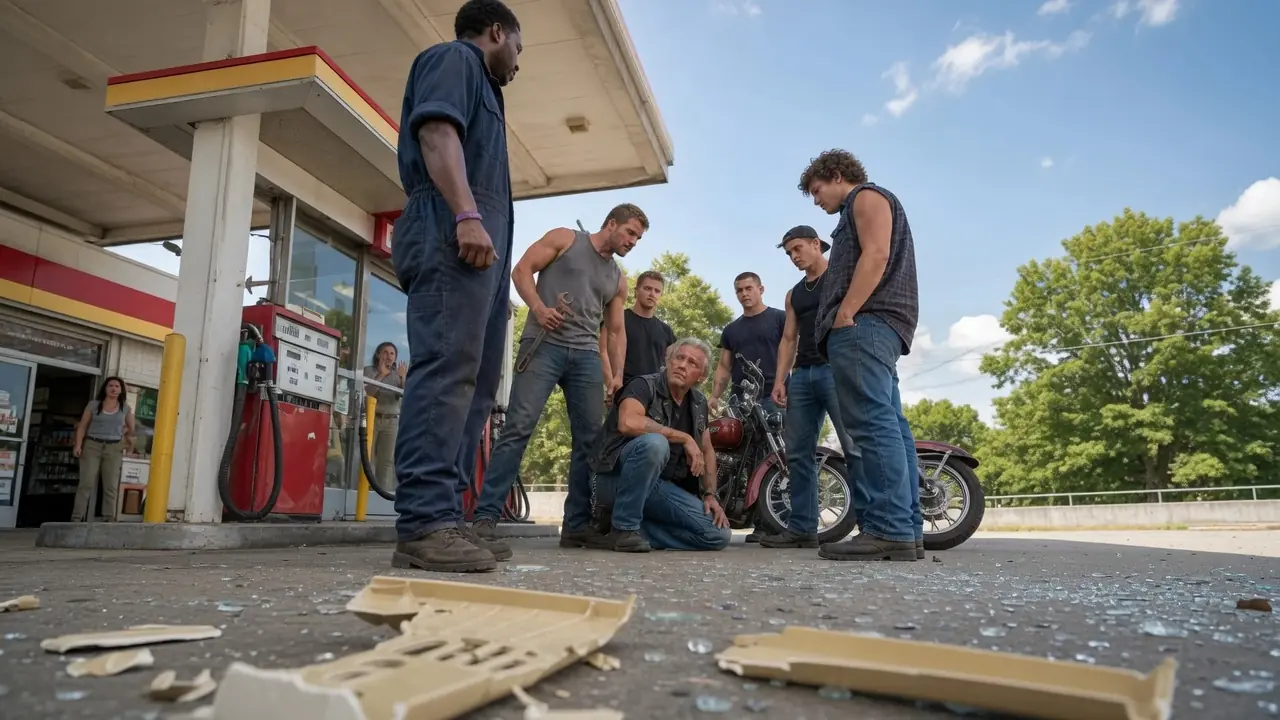
“Six against one?” Brandon asked. “You call that fair?”
The leader, Trent Vaughn, turned toward him with a sharp laugh. “Mind your own business before we put you on the ground beside him.”
The older biker lifted his head. His voice came out rough and strained.
“Help me. Please.”
Something broke open inside Brandon’s chest.
He thought of his six-year-old daughter waiting for him at home. He thought of the promises he made every morning before leaving for work—that he would come home safely, that he would never make her grow up without a father, and that he would show her what a good man looked like.
Then he looked at the old man again.
“He asked for help,” Brandon said. “I’m helping him.”
Trent tapped the wrench against his palm. The other five spread out, forming a loose circle around Brandon.
Six bullies. One Black single father with grease beneath his fingernails. One injured biker on the pavement.
By Monday morning, the man begging for help would be on every local news channel.
But before that happened, the world needed to learn who Brandon Sullivan had already become.
The hardest part of Brandon’s life was not the work.
It was raising a daughter alone while moving through a world that often looked at him as though he were about to take something.
At five in the morning, the kitchen light was already on in the small East Side house he shared with his grandmother and his daughter, Ava. Maylene Sullivan sat at the counter checking her blood sugar with the testing kit she had been using for three years. The number was high again, but she said nothing and simply wrote it in her notebook.
Brandon stood at the stove making scrambled eggs while Ava slept in the bedroom they had converted from an old dining room. Her pink lunchbox sat open on the counter beside a permission slip he still needed to sign. One of her sneakers rested beneath the kitchen table, and the other had somehow ended up beside the refrigerator.
The oven door would not close completely. Brandon pulled a screwdriver from his back pocket, beside the small adjustable wrench he always carried, and tightened the loose hinge.
“There,” he said. “It’ll hold until payday.”
Maylene smiled without looking up from her notebook. “You don’t have to fix everything around here, baby.”
“Somebody has to.”
He counted the cash in his pocket while the eggs cooked.
Thirty-four dollars.
Part of it had to cover bus fare. Ava needed money for a class trip on Friday. The refrigerator was nearly empty, and there was an overdue notice from the electric company beneath a magnet shaped like a strawberry.
Brandon paused beside the rent jar on the counter. He looked over his shoulder, then slid a folded twenty-dollar bill between the other bills inside.
He had almost reached the door when Maylene called his name.
“Brandon.”
He froze.
She stood in the kitchen doorway with her arms crossed. She was not angry. She looked worse than angry.
She looked disappointed and sad.
“Bring that back.”
“Grandma—”
“Bring it back, baby.”
He returned to the counter, removed the twenty from the jar, and held it in his palm.
Maylene lowered her voice. She had never needed to raise it.
“Listen to me one time. Our family, from your great-grandfather down, does not take what we did not earn. And we do not take from our children or grandchildren to pay for ourselves. Do you hear me?”
“Yes, ma’am.”
“That medical bill is mine.”
“It’s a lot.”
“It is still mine.”
“You helped me raise Ava after her mother left. You watch her every day while I’m working. I’m not going to let you lose this house because of doctor bills.”
Maylene placed a hand against his cheek.
“I don’t need you to save me, Brandon. I need you to raise that little girl into someone kind, and I need you to become a man I’ll still be proud of when I’m gone. That is how you pay me back.”
He glanced toward the bedroom.
Ava appeared in the hallway wearing purple pajamas, her hair tangled around her face. She rubbed one eye and held a stuffed rabbit beneath her arm.
“Daddy?”
Brandon immediately softened. He crouched and opened his arms.
“What are you doing awake, bug?”
“I heard voices.”
“Grandma and I were just talking.”
Ava looked at the money in his hand. “Do we have enough?”
The question hurt more than he allowed his face to show.
“We have everything we need.”
He kissed her forehead, carried her back to bed, and tucked the blanket beneath her chin. Before leaving, he placed the twenty inside his wallet instead of returning it to the jar.
Maylene had won the argument, but the medical bill still sat on the counter.
Brandon’s bicycle chain had broken two weeks earlier. He had fixed dozens of customers’ motorcycles and cars since then, but he had not found the time or money to repair his own transportation. After making sure Ava had breakfast and leaving her with Maylene, he walked twenty-two blocks to Hartman’s Auto.
The summer heat was already climbing.
At the corner gas station, he bought the least expensive soda in the cooler. A woman near the register watched him carefully.
“You work here, son?”
“No, ma’am. I’m a customer.”
She did not apologize.
He did not expect her to.
Three blocks later, a patrol car slowed beside him. The officer looked him up and down through the closed window, then continued driving.
Brandon kept walking.
He had learned not to react to those moments. His face remained still, even when something inside him tightened. He had dealt with suspicious glances since he was twelve, long before he became responsible for a child who studied everything he did.
Cole Hartman was already inside the repair shop with the hood of a Honda Civic raised, quietly cursing its alternator.
He looked up when Brandon entered.
“You’re early.”
“The bus didn’t come, so I started walking early.”
“The bus comes at six fifteen.”
“I know.”
Brandon pulled on his coveralls and went directly to a 1986 BMW R-series motorcycle sitting in the rear of the shop. It was old, stubborn, and unreliable—the kind of machine the other mechanics avoided because every repair revealed another problem.
Brandon worked on it the way some people prayed.
Quietly. Patiently. Without showing off.
Machines made sense in a way people often did not. A damaged engine did not pretend nothing was wrong. A stripped bolt did not judge the hand holding the wrench. If Brandon listened carefully enough, a machine would eventually tell him what it needed.
Around ten, a man in a polo shirt entered carrying the keys to a Lexus. He walked past Brandon and asked Cole whether the mechanic was available.
Brandon kept his head down.
Cole pointed toward him. “He is the mechanic.”
The customer blinked and attempted to recover. “Oh. Right. Of course.”
Brandon nodded politely and returned to his work.
He had learned to do that, too.
During lunch, he sat behind the shop and opened his backpack. Beside Ava’s folded permission slip was a library book titled Modern Custom Builders: A Visual History. He had already checked it out twice that year.
A crayon drawing Ava had made served as his bookmark. It showed Brandon standing beside an enormous red motorcycle, holding Ava’s hand. Above them, she had written in uneven purple letters, DADDY’S BIKE SHOP.
Brandon opened the book to a dog-eared page featuring a cherry-red 1959 Panhead. The motorcycle had polished metal, hand-laid pinstriping around the fuel tank, and a brass emblem near the seat.
The caption read: Henry “Iron Hank” Callaway, founder of Callaway Custom Cycles.
Brandon traced the pinstriping with his finger.
“Callaway,” he whispered. “Monroe. Roder. Foose.”
He said the builders’ names the way other men recited the names of professional athletes.
Cole passed him carrying a cup of coffee. He looked at the photograph.
“You ever want to build one of those?”
“One day.”
Cole studied him for a moment. “Yeah. You will.”
It was the kindest thing Cole had said in months.
Brandon left work late that afternoon with aching arms and the wrench still in his back pocket. He passed a billboard advertising the West Coast Custom Bike Show.
Entry fee: three hundred fifty dollars.
It might as well have said three hundred fifty thousand.
He stopped at the corner of Pine and Sixth when he saw Mrs. Davies struggling up her front steps with two grocery bags and a cane.
He crossed the street automatically.
“Let me carry those, ma’am.”
“Oh, Brandon, you don’t have to.”
“It’s nothing.”
He carried the bags into her kitchen and placed the refrigerated items near the sink. He did not wait for thanks. He waved, stepped outside, and continued walking.
Mrs. Davies watched him from the porch.
“That man,” she murmured, smiling. “Always taking care of somebody.”
Brandon did not hear her.
He was thinking about Maylene’s medical bill, Ava’s class trip, the empty refrigerator, and the cherry-red Panhead he had admired for years but never expected to see in person.
He almost stayed on Main Street that afternoon.
Almost.
His shift had run long, and he still needed to pick up milk before going home. To save time, he took the shortcut behind the Sunoco station on Fifth Street.
He did not see the motorcycle immediately.
Two blocks away, Henry Callaway was pumping fuel into the tank of the machine Brandon had studied in the library book.
Hank was sixty years old. He had built the cherry-red 1959 Panhead with his own hands when he was thirty, laying the pinstripes across the tank one careful line at a time.
He was riding alone because he preferred riding alone. His phone had lost power an hour earlier, but he was not concerned. He had traveled thousands of miles without help and had survived situations far worse than a dead phone.
Then he noticed the six young men climbing out of an old Chevrolet.
He noticed the way they looked at his motorcycle before they looked at him.
Hank had lived long enough to recognize hunger when it was disguised as admiration.
Trent Vaughn approached first. He was twenty-two and carried himself with the reckless confidence of someone who believed being feared was the same as being respected.
He whistled at the Panhead.
“Look at this antique. Grandpa rode his tricycle to the wrong side of town.”
Hank continued pumping fuel.
Cody spat on the pavement a few feet from Hank’s boot.
“You lost, old man? The nursing home is the other way.”
Hank did not answer.
Brett laughed while the other three spread out behind him. Six men now surrounded one older rider.
“What’s wrong?” Brett asked. “You deaf, or just too old to hear us?”
Hank returned the fuel nozzle to the pump. He still did not turn around.
Trent circled the Panhead and pretended to admire the paintwork.
“How much do you think this thing is worth? Eight thousand? Ten?”
“More than your car,” Cody said.
Trent laughed. “Grandpa probably won’t remember where he parked it tomorrow.”
A pickup passed the station. The driver looked toward the group, counted the men, and continued driving.
Cody kicked the rear tire.
Hank’s shoulders tightened for half a second and became still again.
That stillness should have warned them.
It did not.
Trent walked toward an abandoned metal toolbox beside the station’s old air pump. Rusted tools and forgotten parts lay inside. He reached down and pulled out a long pipe wrench.
He tested its weight in his hand.
“Keys, wallet, and watch. Do it slowly, or this will hurt.”
Hank turned around.
For the first time, the men saw his face. There was no fear in it and no surprise. His voice was low and steady.
“You do not want to do this, son.”
Trent stared at him.
“Walk away,” Hank said.
Trent laughed sharply and looked over his shoulder at his friends.
“You hear that? The old man thinks he’s giving us advice.”
A young mother pushing a stroller approached the station entrance. She saw the six men, the wrench, and Hank standing alone. She turned the stroller around and hurried away.
Inside the station, the clerk watched through the glass. He saw the wrench and counted the men.
Then he quietly slid the deadbolt across the door.
He did not call the police.
Cody picked up an empty bottle and smashed it against the concrete near Hank’s foot. Pieces scattered across the pavement.
Hank did not move.
Brett grabbed one of the cheap plastic chairs the station kept outside for customers. He swung it into Hank’s back. The chair cracked apart, and Hank dropped to one knee.
His breath left him in a rough exhale.
He remained there for a moment with his head lowered, gathering himself. His shoulder stiffened, and pain spread through his ribs.
He had once found himself in a similar position decades earlier—in another parking lot, surrounded by another group of men. He had promised himself afterward that he would never be powerless like that again.
Yet age had slowed him.
His phone was dead. He was alone. No one watching appeared willing to help.
Two miles away, Maylene checked her blood sugar for the second time that day. The number was still wrong.
She looked at the clock.
Brandon was late.
At the Sunoco station, Trent stood over Hank with the wrench.
“Are you ready to give us what we asked for, Grandpa? Or do we need to teach you some manners?”
On the wall behind them, almost erased by twenty years of weather, remained the outline of an old mural. It showed a motorcycle wheel with wings and several faded letters from a name that had once read Callaway Custom Cycles.
None of the six men noticed it.
Eight seconds would soon change two lives.
Only one of the men involved understood that something had begun.
Brandon turned the corner and stopped.
He saw the old man on one knee. He saw broken plastic and scattered glass. He saw Trent’s wrench and the five men surrounding him.
Brandon instinctively stepped backward.
His sneaker scraped the gravel.
Jesse turned toward the sound.
“Walk away,” he said. “This is not your block or your business.”
Cody looked Brandon over and laughed. “Somebody’s looking for trouble.”
Brett separated from the group, still holding part of the broken chair. He approached until he stood too close.
“You deaf, too? Go home. Tell your family you saw something and were smart enough to keep walking.”
Trent did not bother turning around.
“Let him go. He knows how things work around here. Don’t you?”
Brandon did not answer.
He looked past Brett and met Hank’s eyes.
Hank shook his head once. It was a small warning.
Go.
“Please, son,” Hank said. “Keep walking.”
Brandon stood motionless for two seconds.
He thought of Ava.
He imagined her asking him one day what he had done when someone needed help. He imagined having to choose between telling her the truth and teaching her that good people were allowed to look away when doing the right thing became dangerous.
His left hand closed into a fist.
His right hand touched the adjustable wrench in his back pocket.
They were telling him to walk away.
Maylene had raised him never to abandon someone who could not protect himself. Brandon was raising Ava by that same rule.
His eyes moved toward a rusted bicycle chain lying near a dumpster.
Then he acted.
He grabbed the chain with one hand and pulled the water bottle from his backpack with the other. He threw the bottle toward Trent, forcing him to turn away from Hank.
Brandon moved into the circle before the others understood what was happening.
Cody rushed him. Brandon lowered his shoulder and drove forward, knocking Cody off balance. The broken bottle slipped from Cody’s hand and skidded across the pavement.
Brett swung the chair fragment toward Brandon’s head. Brandon raised his forearm and absorbed the impact. Pain shot toward his shoulder, and his hand went numb.
He kept moving.
Jesse came from the side. Brandon snapped the loose chain low across the pavement, forcing Jesse to stumble and fall away from him.
Behind them, Hank moved.
The older biker had been kneeling quietly, controlling his breathing and studying every position around him. He rose with sudden force and swept one attacker’s legs from beneath him.
The man landed hard and lost his breath.
For the first time, the six men saw something in Hank’s face that unsettled them.
Trent recovered and charged Brandon with the pipe wrench.
Brandon twisted aside. The end of the tool dragged across his shoulder, leaving a line of burning pain but no serious wound. He dropped beneath the next swing, caught Trent’s wrist with the chain, and pulled until the wrench fell.
Hank stepped beside Brandon.
He placed one steadying hand on Brandon’s shoulder, then moved slightly in front of him.
“Boys,” Hank said, “walk away while you still can.”
There was no anger in his voice.
That frightened them more.
They did not know Hank’s name, but they sensed the authority behind his stillness. The air around the group seemed to change.
Trent stared at him for one long second.
Then he turned, grabbed his injured wrist, and ran.
The other five scattered after him. The Chevrolet tore out of the parking lot moments later.
Silence returned.
Brandon remained standing for one breath.
Then another.
His knees weakened, and he sat heavily on the curb. His body began shaking as the adrenaline drained away.
His forearm was already darkening with a bruise. His shoulder burned, and his knee had been scraped through his jeans. Nothing appeared broken, but he knew the pain would be worse the following morning.
Hank stood over him.
He did not look immediately at Brandon’s face. He looked at his hands.
They were the hands of a working mechanic—grease beneath the nails, small scars across the knuckles, and calluses developed through years of labor. A child’s purple hair tie was wrapped around his wrist because Ava had placed it there that morning and told him not to lose it.
The adjustable wrench remained in his back pocket. A library card had fallen from his wallet.
Hank crouched beside him and removed a folded blue bandana from his vest.
He wrapped it carefully around Brandon’s swelling forearm and tied it like a brace. His hands moved with the confidence of someone who had treated injuries many times.
Sunlight reflected from the steel ring on Hank’s right hand. A compass face had been set into the band.
Brandon stared at it for half a second before lowering his eyes.
Hank noticed.
“What is your name?”
“Brandon Sullivan.”
“Why did you do that, Brandon?”
Brandon was still trying to catch his breath.
He thought of Ava waiting at home. He thought of Maylene. He thought of the people who had driven past and the clerk who had locked the door.
Finally, he shrugged.
“Nobody else was going to.”
Hank studied him for a long time.
“How old are you?”
“Twenty-nine.”
“You have a family?”
“A six-year-old daughter.”
Hank glanced at the purple hair tie.
“You could have been badly hurt.”
“I know.”
“But you came in anyway.”
Brandon looked toward the empty road. “I couldn’t teach my daughter to be brave if I walked away from that.”
Hank slowly rose. His back cracked, and he winced once before hiding it.
He looked toward the Panhead. The motorcycle stood untouched twenty feet away. The attackers had never gotten close enough to take it.
Then he looked back at the single father sitting on the curb.
“You have no idea who you just helped.”
Behind them, sunlight touched the faded wall mural. The winged wheel and the remaining letters became briefly visible.
Brandon did not look at the wall.
He was looking at Hank’s compass ring and the way the bandana had been tied. Something in the back of his mind had begun to connect those details.
Hank reached inside his vest.
Brandon expected him to pull out a phone.
Instead, Hank removed a thick roll of cash. There were several thousand dollars in large bills.
He held it toward Brandon.
“Take it. For your arm and your trouble.”
Brandon looked at the money, then at Hank.
“No, sir.”
“You stepped between me and six men.”
“I’m not taking money for that.”
“Take it.”
“No, sir. I appreciate it, but I didn’t help you to get paid.”
Hank pushed the roll closer.
“For your daughter, then.”
Something flickered across Brandon’s face.
Hank did not know about the nearly empty refrigerator. He did not know about Ava’s class trip, the overdue electric bill, Maylene’s medical expenses, or the rent jar on the counter.
He did not know Brandon had twenty dollars in his wallet and barely anything else.
But Brandon heard his grandmother’s voice as clearly as if she stood beside him.
We do not take what we did not earn.
“I still can’t take it,” Brandon said.
Hank held the money out for another second.
Then he nodded.
He returned the roll to his vest without trying again. He looked at Brandon the way a master builder might examine an unexpectedly valuable tool.
“All right.”
Brandon pushed himself off the curb. His left arm hung stiffly at his side.
He began walking toward the road.
Then he passed the Panhead.
He stopped.
His attention moved across the cherry-red tank, the hand-laid pinstriping around the cap, and the small brass emblem near the seat. He had seen every detail in the library book.
Cherry-red 1959 Panhead.
Henry “Iron Hank” Callaway.
Founder of Callaway Custom Cycles.
Brandon looked at the motorcycle, then at the man, then back at the motorcycle.
Hank watched him understand. He did not confirm it. He did not deny it.
One corner of his mouth lifted.
Brandon swallowed and started walking again.
“Son,” Hank called.
Brandon turned.
“We don’t forget.”
Before Brandon could ask what he meant, Hank pulled on his helmet.
The Panhead started with a sound like distant thunder. Hank nodded once, kicked up the stand, and rode onto Fifth Street.
Brandon remained beside the road, holding his injured arm as the red motorcycle disappeared.
Then he began the long walk home.
Inside the Sunoco station, the clerk waited until both men were gone. He waited until the parking lot was empty.
Then he unlocked the door, lifted the phone, and called a number he had not used in years.
When someone answered, he lowered his voice.
“It was him. The man from the magazines.”
He listened.
“Yes. Iron Hank.”
Another pause.
“Some mechanic pulled him out. Black man, late twenties. Hartman’s Auto, I think. He had a little girl’s hair tie around his wrist.”
The clerk hung up.
Brandon reached home at six forty.
Maylene sat at the kitchen table beside her notebook and a glass of water. Ava was coloring on the floor.
They both looked up.
Maylene saw the blue bandana around his arm, the dirt on his jeans, and the way he favored one leg.
Ava stood immediately. “Daddy?”
“I’m all right.”
Maylene placed her pen down. “Brandon.”
“I caught my arm on a fence.”
Ava stared at the bruise beneath the bandana. “Fences don’t tie bandanas.”
Brandon looked at his grandmother.
Maylene raised an eyebrow.
He sighed. “There was a problem near the gas station.”
“What kind of problem?”
“An older man needed help.”
“And you helped him,” Maylene said.
Brandon did not answer.
She already knew.
Maylene pointed toward a chair. “Sit down.”
Ava climbed onto the chair beside him while Maylene removed the bandana. She examined his forearm, cleaned the scrape on his knee, and rewrapped the arm with gauze from the medicine cabinet.
Ava held his good hand.
“Were you scared?”
“Yes.”
“But you still helped?”
“Yes.”
“Why?”
Brandon looked at his daughter.
“Because being scared does not mean we leave somebody alone.”
Ava leaned against him.
Maylene folded the blue bandana carefully and placed it beside her notebook. She did not ask for every detail. Brandon did not offer it.
That night, he lay in bed staring at the water stain on the ceiling. Ava slept beside him after refusing to return to her own bed.
His shoulder throbbed.
Three words circled through his mind.
We don’t forget.
By the next morning, three things were already moving.
Brandon knew nothing about them.
The first was a black SUV climbing a private road into the hills outside town. Wyatt Donovan, known to everyone as Preacher, sat in the passenger seat speaking on the phone.
“He’s fine,” Preacher said. “Maybe two cracked ribs. He won’t admit it.”
He listened.
“No, he wasn’t alone by the end. A man stepped in. Twenty-nine, single father, mechanic from the East Side.”
Another pause.
“Yes. I know.”
Preacher looked through the windshield as the SUV passed through a security gate.
“Hank wants the entire table at the shop tomorrow. Bring the photographer.”
He ended the call.
The second development occurred downtown.
Linda Brennan, a reporter at the local news station, listened twice to an anonymous voicemail. Then she went to the records room and pulled an old folder from a cabinet.
The label read: Callaway, Henry—Custom Cycles, 1995 to Present.
The first photograph showed a man in his thirties standing outside a small motorcycle shop. A cherry-red Panhead was parked behind him.
Linda picked up her phone.
“I think I found something.”
The third development took place at a chapter clubhouse on the edge of town.
The building had wood-paneled walls, leather chairs, and a long oak table. Photographs of motorcycles and their builders covered the wall behind Hank’s seat.
Ten men sat silently around the table.
Hank spoke quietly.
“There is a man named Brandon Sullivan. He works at Hartman’s Auto on the East Side. I want to know about him.”
One of the older members leaned forward. “What kind of information?”
“Family. Work history. Bills. Trouble. Friends. Everything that tells me what kind of man he is.”
Preacher opened a notebook. “We already know he has a six-year-old daughter named Ava. The mother left when the child was an infant. His grandmother helps with childcare. He has no criminal record, no debt except household and medical bills, and he has never missed a child-support responsibility because there is nobody else paying.”
Hank’s expression did not change.
“Anything else?”
“He works full-time, repairs vehicles for neighbors after hours, and has checked the same motorcycle-building book out of the library six times. He walks to work when the bus fails. He turned down several thousand dollars yesterday.”
A man near the middle of the table spoke.
“What are we doing with this, Hank?”
Hank tapped his compass ring once against the oak.
“For twenty-five years, we have sat at this table and talked about remembering the men who helped us. Maybe it is time to begin passing something forward.”
No one answered.
“Find out everything,” Hank said. “Nobody approaches him yet.”
Across town, Brandon arrived early at Hartman’s Auto.
His arm hurt, and he had slept badly. Cole noticed the gauze immediately.
“What happened?”
“Walked into a fence.”
Cole grunted and returned to a tire iron.
That afternoon, Brandon noticed a man across the street pretending to read a newspaper. The man was not doing it convincingly, but Brandon was too tired to care.
He had no idea that forty-three motorcycles would soon be pointed toward Hartman’s Auto.
Two days later, Brandon was changing the oil in a Honda Civic when he heard the first engines.
At first, he thought the sound was thunder.
He stood, wiped his hands on a rag, and listened.
Five engines.
Ten.
Fifteen.
The sound continued growing.
Cole rolled out from beneath a vehicle with a wrench in his hand.
“What is that?”
“I don’t know.”
They walked toward the open bay door.
The roar turned onto Maple Street, and the entire block became still.
More than forty motorcycles entered in two lines, filling the street from curb to curb. Old custom machines rode beside newer ones. Chrome flashed beneath the afternoon sun, and chapter patches covered the riders’ backs.
Traffic stopped in both directions.
A woman across the street stepped onto her porch holding a dish towel. Children emerged from behind the laundromat. Mrs. Davies appeared on her front steps with her cane.
The motorcycles parked along the curb outside Hartman’s Auto.
One by one, the engines stopped.
Silence fell across the street.
A single motorcycle rolled forward.
Cherry-red 1959 Panhead.
Hank Callaway stopped in front of the repair shop, removed his helmet, and dismounted. Behind him, the other riders remained beside their motorcycles with their helmets held against their sides.
Cole made a sound that never became a full word.
“Brandon.”
“What?”
“That’s Iron Hank Callaway.”
Brandon said nothing.
Part of him had known from the moment he saw the motorcycle, the ring, and the bandana. He simply had not allowed himself to believe it.
A news van stopped at the end of the block. Linda Brennan stepped out with a camera operator behind her.
Hank approached until he stood six feet from Brandon.
He looked at Cole first.
“Cole Hartman?”
“Yes, sir.”
“I’ve heard good things about your shop. You have a good mechanic here.”
Cole tried to answer, but nothing came out.
Hank turned toward Brandon.
“How is the arm?”
“Healing.”
“And your daughter?”
Brandon’s eyes narrowed slightly. “She’s fine.”
Hank understood the concern.
“Relax. I asked around because I wanted to know the man who stepped in for me.”
A small Toyota stopped near the corner.
Maylene stepped out with Ava beside her. Mrs. Davies had called them the moment the motorcycles appeared.
Ava held her grandmother’s hand as they moved through the crowd.
“Daddy!”
Brandon’s face changed instantly.
He crouched as Ava reached him. She wrapped both arms around his neck, carefully avoiding the injured shoulder.
Maylene stopped beside them and looked at Hank.
She did not know him, but she understood immediately that he was the man Brandon had helped.
Hank removed his helmet from beneath his arm and held it against his chest. He gave Maylene a deep nod.
“Ma’am.”
She nodded back.
Then Hank raised his voice enough for the street and Linda’s microphone to hear him.
“I owe this man and his family an introduction. My name is Henry Callaway. Most people call me Hank. Some call me Iron Hank.”
He looked toward the camera.
“I founded Callaway Custom Cycles in 1995. We now operate shops in five states. I have also served as president of this chapter for twenty-five years.”
Murmurs moved through the crowd.
“That is why the clerk at the Fifth Street gas station locked his door instead of calling the police. He knew who I was. He knew who would eventually be called.”
Hank turned back toward Brandon.
“In our chapter, we have one rule above all others. We do not forget.”
The street remained silent.
“We do not forget who stood up. We do not forget who stayed quiet. We do not forget who turned away, and we do not forget who ran toward the danger.”
Ava tightened her arms around Brandon.
“Three days ago, a single father with a bruised arm and a wrench in his back pocket came into that parking lot. He did not ask my name. He did not ask who I was or what he would receive in return.”
Hank glanced at Ava.
“He knew he had a daughter waiting at home. He understood what he could lose. He came forward anyway.”
Brandon lowered his eyes.
“That is the kind of man I have spent my life looking for and have almost never found.”
Maylene’s eyes filled with tears.
Brandon did not cry. He stood holding his daughter, staring at the builder whose work he had studied for years.
Hank placed one hand on Brandon’s good shoulder.
“I told you we don’t forget.”
“Yes, sir.”
“I meant it. We have business to discuss, but not in front of cameras.”
He looked at Maylene.
“Please come to my shop tomorrow at ten. Bring Ava, too, unless she has school.”
“She has school,” Brandon said.
Ava frowned. “I can miss one day.”
Maylene looked down at her. “No, you cannot.”
Several people laughed softly.
Hank smiled. “Your grandmother is right.”
He turned toward Brandon again.
“Tomorrow at ten.”
“Yes, sir.”
Hank returned to the Panhead.
Forty-three engines started together.
The street shook with the sound.
No one on that block forgot it.
The following morning, Brandon and Maylene stepped out of a rideshare vehicle in front of the largest custom motorcycle shop in the state. Ava was at school, though she had made Brandon promise to describe every motorcycle afterward.
Hank waited at the front entrance with a folder in his hand.
He came down the steps to meet them.
“Mrs. Sullivan.”
“Mr. Callaway.”
“Thank you for coming.”
He held the door open. The brass handle featured the same compass design as his ring.
Brandon noticed.
Maylene noticed him noticing.
Inside was a converted warehouse with polished concrete floors, high ceilings, work bays, and motorcycles Brandon had only seen in magazines. Machines built by Callaway, Monroe, and other legendary builders stood within a few feet of him.
He kept his hands at his sides.
Hank led them through the showroom and into a private room with a long table and leather chairs. Framed photographs covered the walls.
He pulled out a chair for Maylene, sat across from her, and placed the folder between them.
“I am going to say two things,” Hank began. “Then we will talk.”
Maylene nodded.
“The first is for you, ma’am. I had my people review every medical bill in your name from the last eighteen months.”
Her hand tightened around her purse.
“We are paying them in full today.”
“Mr. Callaway—”
“I’m not finished. Your insulin, testing supplies, and doctor appointments will be covered through the chapter’s medical fund for as long as you need them.”
Maylene stared at him.
“We have a fund for our people,” Hank continued. “As of today, you are one of our people.”
Maylene did not answer.
Hank turned toward Brandon.
“The second thing is for you. We are offering you a paid apprenticeship at this shop, five days a week, beginning Monday.”
Brandon remained still.
“You will work beside my lead builders. You begin at the bottom—cleaning bays, preparing parts, carrying equipment, and doing whatever you are told. The hours will be difficult.”
Hank opened the folder.
“The pay is enough for you and your daughter to live on. Your schedule will allow you to take her to school three mornings a week. When it does not, we cover dependable childcare.”
Brandon looked up sharply.
Hank continued before he could respond.
“You will learn the trade from the men who taught me. That is the offer.”
Brandon waited.
“That’s all?”
“That’s all.”
“No free motorcycle?”
“No.”
“No shop?”
“No.”
“No publicity contract?”
Hank almost smiled. “Absolutely not.”
He leaned forward.
“Listen carefully. This is not a reward for what you did in the parking lot. The bandana was the reward. We are even on that.”
Brandon glanced at Maylene.
“This is an investment,” Hank said. “I invest in people, not stories. I do not give careers away. I give opportunities.”
He pushed the contract toward Brandon.
“Whatever follows—trade school, your own build, a shop with your name on it—you earn it. The way I earned mine.”
Brandon absorbed the words.
Then he nodded.
“Yes, sir.”
Maylene placed both palms on the table.
“May I speak now?”
“Yes, ma’am.”
“I appreciate everything you have offered. But I need you to understand something about our family.”
Hank waited.
“We do not take gifts we cannot repay. We have never accepted charity. If you pay my medical bills and I have no way to contribute, my grandson will not sleep at night.”
She glanced toward Brandon.
“And neither will I.”
Hank leaned back.
Maylene continued. “I can still work. I can answer a telephone, manage books, greet customers, and keep grown men from behaving foolishly. Find something useful for me.”
For several seconds, Hank simply studied her.
Then a small, genuine smile appeared.
“I had a feeling you would say something like that.”
“Did you?”
“I did.”
He tapped his ring against the table.
“All right. Here is my counteroffer.”
Maylene waited.
“When this man opens a community garage in the East Side—and he will—I want you behind the front counter every morning. Full wages.”
Brandon stared at him.
“You will greet the customers, manage the books, and set the tone. Without you, the shop does not open.”
Maylene extended her hand.
“Then we have an agreement.”
Hank shook it.
Brandon watched his grandmother negotiate with one of the most respected motorcycle builders in the country as though they were discussing vegetables at a neighborhood market.
He had one question.
“Hank?”
“Yes?”
“Why are you doing this?”
Hank’s expression became serious again.
“Because that is the code.”
He tapped the compass ring lightly against the table.
“You did the right thing when nobody was watching. We do not forget that. I do not need a greater reason, and neither should you.”
A knock came at the door.
Cole Hartman entered holding his cap in both hands. He looked uncomfortable surrounded by leather chairs and framed motorcycle history.
Hank pointed toward a seat.
“Cole, when we open the East Side community shop, I want you as a partner. Senior mechanic. Equity stake.”
Cole sat down slowly.
“You bring the teaching,” Hank continued. “I bring the construction and funding. Are you in?”
“You’re serious?”
“I never joke about shops.”
Cole looked at Brandon, then Maylene.
“Yes,” he said. “I’m in.”
Hank slid the apprenticeship contract across the table.
“Read every line. Sign only when you are ready.”
Brandon read it carefully. He checked the working hours, wages, childcare provisions, insurance, and training requirements.
Then he signed his name in deliberate handwriting.
Brandon Sullivan.
Maylene stood behind him with one hand on his shoulder.
By Friday, the story had a name.
By Sunday, it had appeared on three national networks.
Linda Brennan’s segment was titled The Eight-Second Rescue. Video of forty-three motorcycles outside Hartman’s Auto spread across social media and family group chats.
Letters began arriving from other cities.
Brandon kept every one in a shoe box beneath his bed. Ava decorated the box with motorcycles, hearts, and purple stars.
Motorcycle chapters and private donors sent money to a community fund created in Brandon’s name.
He refused to use any of it for himself.
“Save it for the shop,” he told Hank.
Hank smiled. “That was the correct answer.”
Three months later, Brandon had been working at Callaway Custom Cycles for ten weeks.
He arrived before sunrise and often remained after the other apprentices left. He cleaned work bays without complaint, studied every tool, and asked questions only after trying to solve problems himself.
The lead builders stopped calling him “the new guy.”
They began calling him Brandon.
Every afternoon, he hurried home to Ava. Some nights she sat at the kitchen table doing first-grade homework while he studied engine diagrams beside her.
“Are you in school, too?” she asked.
“Not yet.”
“You do a lot of homework.”
“I’m practicing.”
Ava considered that. “Practicing is school without a teacher.”
One Thursday, Hank called Brandon into the office.
“Trade school begins in the fall. We will cover tuition and books. You keep working here on weekends.”
Brandon looked at him.
“Yes or no?”
“Yes.”
“Good answer.”
At six months, Maylene’s blood sugar had remained stable longer than it had in five years. Her doctor asked what had changed.
She smiled and said, “My family finally learned how to accept organized help.”
That weekend, six chapter members arrived at the Sullivan house with lumber, tools, and a generator. Cole came with them. So did Preacher.
They worked every Saturday and Sunday for eight weeks.
They repaired the roof, replaced damaged insulation, built an accessibility ramp, and renovated the kitchen. Maylene refused to leave during construction. She sat on the porch with sweet tea and supervised every nail.
Ava followed the workers carrying a toy hammer.
“Measure twice,” she told them. “Daddy says that.”
By the end of the summer, Maylene could reach every cabinet without bending painfully. Ava had a bedroom with an actual door, and Brandon no longer slept on a folding couch in the living room.
At nine months, Brandon finished his first trade-school semester at the top of his class.
Hank called him into the office.
“It is time to write a business plan.”
“For what?”
“The East Side community garage.”
Brandon stared.
“You design it. You decide how it serves the neighborhood. You choose the staffing plan and present it to me by Christmas.”
“And if the plan isn’t good?”
“We keep working until it is.”
Brandon spent eight weeks at the kitchen table writing. Maylene corrected his spelling. Ava drew possible logos, most of which involved enormous purple motorcycles with wings.
At month twelve, Brandon presented the plan.
It included affordable repair rates, free monthly safety inspections, apprenticeship opportunities for teenagers, evening classes for single parents, and emergency transportation assistance for elderly residents.
Hank read the proposal twice.
Then he signed it.
The Sullivan and Callaway Community Garage opened on a Saturday in February.
Snow covered the ground beneath a bright, clear sky. Brandon had chosen the name himself.
Mrs. Davies became the first customer. She arrived with her grandson and an old car with a broken alternator she could not afford to replace.
Brandon fixed it in two hours.
He did not charge her.
He gave her grandson a soda and showed him how to identify the alternator beneath the hood.
Maylene sat behind the front counter wearing a clean apron. She wrote in a ledger with a pen Hank had given her.
She greeted every customer by name.
Ava sat at a small desk beside her doing homework and telling anyone who entered, “My daddy owns part of this place.”
By the end of the first week, Maylene remembered every customer, every vehicle, and every unpaid balance.
On the wall behind her hung a simple wooden frame.
Inside was the folded blue bandana Hank had tied around Brandon’s arm at the gas station.
Beneath it, three words had been carved into dark walnut.
WE DON’T FORGET.
When Hank attended the opening, he stood before the frame for a long time.
He did not explain what it meant to him.
He touched one fingertip to the glass, nodded once, and went to find Maylene at the counter.
A year and a half after the rescue, Trent Vaughn entered the community garage on a Tuesday morning.
He was sober and forty pounds lighter. His hands shook as he sat across from Brandon in the office.
Ava was doing homework in the next room.
Trent did not ask for forgiveness.
He asked for a job.
Brandon studied him for a long time.
He remembered the rusted wrench. He remembered the broken chair and Hank on one knee. He remembered the terror of wondering whether Ava would lose her father.
Then he stood, walked to the supply closet, and returned with a broom.
“Start there.”
Trent accepted it.
He did not say thank you. He nodded and began sweeping the front of the shop.
He was still working there a year later.
During the second year, Hank and Brandon began building a Panhead together.
It was not a gift. It was a teaching project that required eight months of evenings and Saturdays at the flagship shop.
Ava visited every weekend. Hank gave her a small stool so she could watch from a safe distance.
“What color will it be?” she asked.
“Your father decides,” Hank said.
“Purple.”
Brandon laughed. “We’ll discuss it.”
By then, two scholarships had been awarded under the Callaway-Sullivan name. One went to a young woman from the East Side who wanted to become a nurse. Another went to a single mother studying automotive technology.
A national trade magazine described the partnership as a model for community-based training.
Brandon still carried the adjustable wrench in his back pocket every day.
Two years after the gas station rescue, he was walking home from the garage when he heard shouting behind a building.
He knew the sound.
He was thirty-one now. His clothes were better, and his posture held more confidence, but the wrench remained in his pocket.
Ava was eight and waiting at the garage with Maylene.
Brandon was no longer easily frightened.
But he remembered what fear felt like.
He walked behind the building.
Three older boys had a smaller child pinned near the wall. The boy appeared to be twelve, with crooked glasses and a backpack on the ground. Library books had spilled across the gravel.
Brandon stepped into the gap.
He said nothing.
He simply looked at the three boys.
They looked back.
Then they noticed the words across his shirt.
SULLIVAN AND CALLAWAY COMMUNITY GARAGE.
Everyone on the East Side knew the name.
The largest boy swallowed. The group backed away, then turned and hurried off.
Brandon waited until they disappeared.
He crouched and began gathering the fallen books. One was a library book about engines.
It had the same style of sticker as the book Brandon once carried in his backpack.
“Is this yours?”
“Yes, sir.”
Brandon handed it over.
The boy’s hands were shaking.
“Why did you help me?”
Brandon placed the books inside the backpack. Then he knelt until they were at eye level.
He answered quietly.
“We don’t forget.”
The boy did not understand yet.
Brandon could see him storing the words somewhere safe.
He would understand one day.
Brandon removed a business card from his pocket and handed it over.
“You like engines?”
The boy nodded.
“Come to the garage Saturday at eight. Bring the library book. I’ll teach you.”
The boy held the card with both hands.
“Yes, sir.”
“Brandon. Not sir.”
“Yes, Brandon.”
He lifted the backpack onto his shoulders and began walking away. After ten steps, he turned around.
Brandon was still there.
Brandon nodded.
The boy nodded back, then ran home.
Brandon took the long route back to the garage.
Late afternoon light stretched across the rooftops. He passed the old Sunoco station on Fifth Street.
The business had a new owner, and fresh blue paint covered the outer wall. Yet beneath that paint, if someone knew where to look, the faint outline of a winged motorcycle wheel remained.
Brandon did not stop.
Through the front window of the community garage, he saw Maylene speaking with a customer while writing in her ledger.
Ava sat at the small desk beside her. She noticed Brandon and ran toward the glass.
He raised one hand.
She raised hers.
Then he entered the shop and lifted his daughter into his arms.
Brandon continued living in a world that sometimes watched him with suspicion.
There were still customers who looked past him for another mechanic. There were still strangers who judged him before hearing him speak. One heroic act did not erase prejudice, exhaustion, single parenthood, bills, or the ordinary difficulties of life.
What mattered was that Brandon chose kindness anyway.
He had not suddenly become courageous in the gas station parking lot.
Long before that afternoon, he had carried groceries for an elderly neighbor. He had walked twenty-two blocks when the bus failed. He had repaired a broken oven, cared for his grandmother, and raised his daughter through sleepless nights and uncertain mornings.
The fight did not create his character.
It revealed it.
People often imagine courage as something summoned during one enormous moment. In reality, courage is practiced quietly through hundreds of ordinary choices that nobody celebrates.
It is practiced in the way a father speaks to his child when he is exhausted. It appears in the way someone treats a cashier, a neighbor, an employee, or a stranger who cannot offer anything in return.
Those small choices become the person who is present when the real test arrives.
The important moment does not magically make someone brave.
It discovers whether that person has already been practicing bravery when nothing seemed to be at stake.
Brandon Sullivan had been practicing for years.
And when the moment found him, he did not walk away.