CEO Verona Blackthorne dropped a fifty dollars bill at mechanic Callum Reed's feet and laughed when he said he could start the jet that twelve specialists had abandoned.
“Fix it and I will pay you five million,” she announced before the entire hangar crew.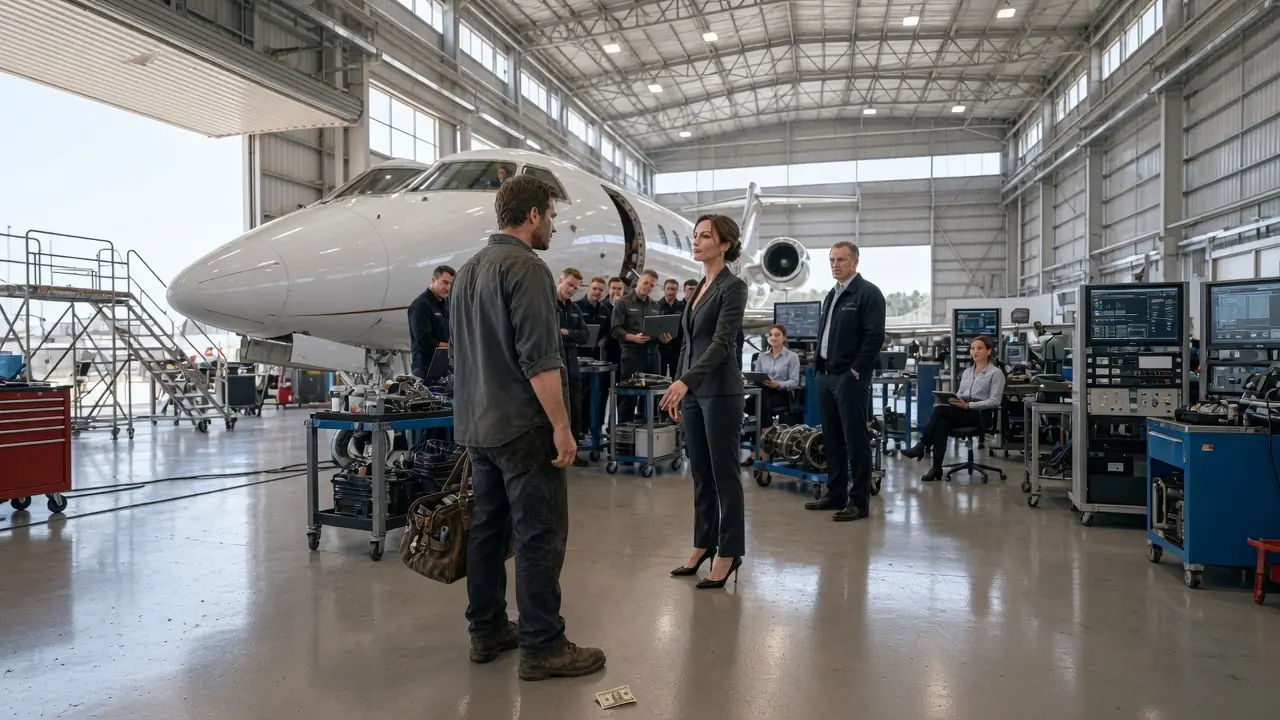
Callum did not answer.
The single father opened an access panel, pulled a maintenance pin installed backward, and asked the pilot to try the sequence. five minutes later, both engines roared to life, but Callum was not looking at the check she was already reaching for.
He was looking at the man at the far end of the hangar, who had just gone pale. The morning had started the way mornings always started for Callum Reed with an invoice he could not afford to ignore and a truck that took three attempts to turn over in the Texas heat.
Reed Aeroservice occupied a modest building on the south edge of Blackthorne Regional. Close enough to the main facility to collect their overflow work, but far enough that nobody from the main building ever thought to wave.
Callum had been running the shop for six years, ever since he left the Air Force with a folder full of commendations and a daughter who needed someone home before dark. The commendations lived in a cardboard box under his workbench.
The daughter, Paige, was sixteen now and sharper than anyone gave her credit for, which was a trait she had inherited from her father, whether she admitted it or not. The shop employed four technicians, carried certification across seven engine families, and was presently owed sixty-two thousand dollars by a charter operator who kept promising the wire transfer was coming.
That outstanding invoice was the reason Callum drove to the Blackthorne main hangar himself that morning rather than sending one of his crew. He was delivering a set of reconditioned auxiliary valves, but he was also hoping to catch a conversation with the facilities coordinator that might turn into a contract that might turn into the breathing room he desperately needed.
He pulled through the service gate at quarter to seven and immediately understood that something had gone wrong inside the big building. There were too many people moving with too much urgency.
And the Blackthorne Sovereign X, a seventy million dollars business jet that Callum had admired from a distance more than once, sat at the center of the hangar floor like a patient nobody could diagnose. He counted 12 technicians working across three separate stations.
Two of them on laptops connected to the avionics bay. Another three crowded around the engine control module in the left nacelle.
A woman in a charcoal blazer paced behind all of them with the measured restlessness of someone who understood exactly how much time was dissolving around her. Callum had never met Verona Blackthorne, but he had seen her photograph enough times in the trade press to recognize her from thirty feet away.
He signed in at the side desk, set his delivery box on the counter, and stood still long enough to listen. That was the thing about Callum Reed that people consistently underestimated.
He listened to machines the way other people listen to music, catching intervals and irregularities that were not visible on any readout. He heard it within 40 seconds.
The auxiliary intake valve closing a beat behind where it should have been, a half second lag that was small enough to dismiss and specific enough to mean something. The sound suggested the engine management computer was receiving a status signal it was not designed to receive at that stage of the startup sequence, which meant it was interrupting the ignition handoff to protect a system it believed was still in maintenance mode.
It was not a software fault. It was a mechanical flag that the software was reading correctly.
He filed the observation in the back of his mind and picked up his delivery box. Warren Pike materialized before he reached the side corridor.
He looked at Callum with the particular expression that senior personnel sometimes reserved for contractors. Not hostile exactly, but calibrated to remind the visitor where the boundary was.
Warren informed Callum that deliveries went through the receiving dock, that the hangar was restricted while the diagnostic team worked, and that farm machinery mechanics did not exactly have standing to loiter around a class 5 business jet. The remark landed without much weight.
Callum had heard variations of it since the first week he had opened the shop, and he had long since stopped carrying other people's opinions about his credentials. He told Warren what he had heard, described the lag, and offered the interpretation in plain terms.
Warren's expression did not change. He told Callum to leave his package and his observations at the door.
Verona overheard the exchange from twelve feet away. She was already at a level of stress that had compressed her patience to almost nothing.
The Sovereign X had to depart within ninety minutes for her to reach New York in time to close the Aurelius Flight Systems acquisition. And ninety minutes was already optimistic.
She turned toward Callum with an assessment that took approximately 3 seconds and registered everything she needed to know about his frayed collar, the oil stain across his left sleeve, and the delivery box under his arm. She asked him with a precision that was almost polite what he thought he was doing in her hangar.
Callum told her the same thing he told Warren. She studied him for a moment longer, then reached into the inside pocket of her blazer, produced a folded fifty dollars bill, and placed it on top of the delivery box he was still holding.
She told him to go get something to eat, and clear the restricted area. Callum looked at the bill.
He looked at the aircraft. He set the box down on the nearest surface, left the 50 sitting on top of it, and said that if she gave him five minutes and access to the external maintenance panel, he could tell her whether the problem was what he thought it was.
The twelve specialists paused.
Warren started to object.
Verona held up one hand to stop him, and in that gesture was a kind of dangerous amusement. the type a person produces when they've decided to let something play out purely for the satisfaction of being proven right.
She told him loudly enough for every person in the hangar to hear. If he started that engine, she would pay him five million dollars.
Callum's response was calm.
He asked her to say it again so everyone present could confirm they had heard it. She repeated it without hesitation.
He picked up his tool bag and walked toward the aircraft. What followed was not a performance.
There was nothing theatrical about the way Callum moved. No drawn out examination, no dramatic pauses designed to build suspense for his audience.
He pulled open the external access cover on the forward maintenance panel, checked the status of each mechanical interlock in sequence, and found what he had been looking for on the third one. The number two intake isolation pin had been installed in the reversed orientation.
It was a small piece of hardware machined to fit in only one direction under normal circumstances which meant the reversal had required deliberate effort rather than simple carelessness. The pin in this position was sending a continuous opencircuit signal to the engine management computer, convincing the system that the high-pressure intake was still unsealed.
The computer, functioning exactly as designed, refused to advance the startup sequence past the safety checkpoint. 12 technicians had spent three hours looking at software logs and replacement modules for a problem that lived in a mechanical component nobody had thought to verify by hand.
Callum oriented the pin correctly, checked the adjacent position sensor, verified the circuit path with a handheld meter, and walked to the base of the boarding stairs. He told the pilot, a composed man named Hartley, who had been sitting in the left seat since the first failed attempt, to run the sequence.
Hartley gave him a look that said he had already run the sequence 17 times and had no particular faith in a 17th attempt, but had nothing to lose.
He ran the sequence.
The left engine caught.
Then the right engine answered, rising through its power bands with the deep authoritative sound of a machine that had been waiting for someone to remove the obstacle from its path. The hangar fell completely silent, except for the turbines.
Verona's face passed through several expressions in rapid succession. Surprise, calculation, something close to genuine respect, and then a controlled return to composure that was itself revealing.
The pilot was already calling the tower. A legal assistant near the back wall was speaking quietly into her phone.
Warren Pike had not moved. He was standing in exactly the position he had been standing when the engines ignited.
And something in his stillness was wrong, in a way that Callum did not have a name for yet. Elise Tanner, the company's safety certification engineer, had moved to the nearest monitor station and was watching a readout with an expression that had shifted from relief into something more troubled.
Verona told her financial officer to begin preparing a payment authorization. She looked at Callum and said with a composure that cost her something that he had earned what he had been promised.
Callum did not acknowledge the remark. He walked back to the aircraft and stood beside the left engine nacelle with his head slightly forward and his eyes unfocused in the way people stand when they are not looking but listening.
Then he walked the length of the aircraft to the right nacelle and stood the same way. He turned back toward the cockpit and raised one hand to Hartley in a clear flat gesture.
Shut it down.
Warren's voice cut across the hangar before Hartley could respond, demanding to know what Callum thought he was doing, suggesting that this was a stalling tactic designed to extend his value before extracting a larger payment. Verona's voice was cooler, but carried the same implication.
She had a departure window that was closing, and she needed Callum to step away from the aircraft. Callum waited for the engines to complete their shutdown cycle before he spoke.
He walked to the monitoring station where Elise was standing and pointed at a specific section of the display. The fuel pressure in the left feed system was cycling in an irregular pattern.
Not dramatically, not in a way that would trigger an alarm, but in a rhythm that followed a period of approximately 4.3 seconds rather than the even baseline the system was designed to maintain. He told Elise to pull the data log from the last 40 minutes.
She did.
There was a three-second gap in the recording at the 11 minute mark. a gap that should not have existed in a continuous monitoring system.
He told Verona that the aircraft had a startup fault because someone needed it to have a startup fault. He also told her that there was a second problem underneath that one and the second problem had not been designed to ground the aircraft.
It had been designed to wait. Warren's response arrived within 60 seconds and it was the response of a man who had already prepared for this conversation.
He informed Verona that a set of auxiliary components supplied by Reed Aeroservice had been installed in the Sovereign X three days prior. He suggested that Callum had accessed the aircraft during that service call, introduced the fault that grounded the aircraft and then appeared this morning to solve the problem he himself had created in order to claim the five million dollars reward.
The logic was clean.
The delivery was measured and the accusation landed in the hangar with the weight of something that had been waiting for a moment to land.
Verona looked at Callum.
Callum looked at Warren with the expression of someone who had heard a specific kind of lie before and recognized its shape. Verona made the decision that was available to her under uncertainty.
She was not ready to declare either man credible over the other without evidence. She asked security to hold Callum in the crew lounge pending a verification review.
She told Warren that nobody was to touch the aircraft data systems until the review was complete.
Callum did not argue.
He handed his phone, his tools, and his signed delivery receipt to the security officer, then walked to the lounge without being escorted. He understood that arguing against a false accusation in the moment of its making was the behavior of a guilty person who had not yet prepared a defense.
He had nothing to prepare.
He simply waited.
Elise Tanner ran the component verification herself. The auxiliary valves supplied by Reed Aeroservice were correctly manufactured, correctly certified, and installed in a section of the aircraft that was entirely separate from the maintenance interlock where the fault had been created.
The reversed pin was located in an access zone that required a Blackthorn employee credential to enter. It was physically outside the area a vendor delivery would reach.
She brought this information to Verona in the form of a printed summary with timestamps.
Verona read it twice.
Then she pulled the electronic access log for the previous seventy-two hours and found an entry showing that Callum's vendor credential had been used to enter the forward maintenance bay at 3:17 in the morning 2 days earlier. She pulled the secondary verification and found a feed from the Reed Aeroservice security camera that placed Callum's vehicle.
And Callum himself, visible in the frame, at his own facility at that same hour, working on a medical transport aircraft that had come in as an emergency job. Someone had duplicated his vendor access code and used it to build a paper trail.
Verona did not come to the lounge herself. She sent Elise with the verification results and a straightforward offer.
The company would honor the five million dollars commitment if Callum signed a standard post-service confirmation stating the aircraft had been restored to airworthy condition. Callum read the document with the same calm attention he brought to every piece of paper a customer handed him.
Then he set it on the table and told Elise to tell Verona that he was not going to sign it because the aircraft was not in airworthy condition and putting his name on a document that said otherwise was not something he would do for five million dollars or any other sum. Elise took a moment before she responded because she had spent enough time around people who said things like that while meaning something else and she needed to confirm that Callum was not one of them.
He was not.
She sat down and they began to talk like two people working the same problem from different angles. The conversation in the crew lounge lasted 40 minutes and covered more ground than any formal briefing could have managed.
Callum explained the fuel pressure irregularity in terms that Elise could cross reference against her own observations. She explained that she had filed three anomaly reports over the preceding four months.
Each one documenting a pressure variance similar to what Callum had identified and each one closed by Warren with a notation attributing the variance to sensor drift rather than a systemic issue. Callum did not have to explain what that pattern meant.
Elise had understood what it meant when she filed the second report and been told to stop raising the same issue twice. She had kept personal copies of all three reports on a drive that was not connected to the company system, a habit she had developed during an earlier job at a regional carrier where a similar pattern had ended badly.
Verona, meanwhile, was having a different kind of conversation. Her father, Sterling Blackthorne, had been notified of the situation by a board member who had heard about the grounded jet through a contact at the aviation registry.
Sterling was seventy-nine years old, had founded the company out of a borrowed hangar in Amarillo, and had a talent for arriving at the center of a problem without being told exactly where the center was. He called Verona on her private line and told her in the flat and unhurried voice that had characterized every important conversation of his career that she needed to ground the aircraft officially, seal the data systems, and bring in an independent investigator before anyone else touched anything inside that hangar.
Verona told him that she needed to reach New York. Sterling told her that the only thing standing between her and a catastrophic board-level crisis was whether she made the right decision in the next twenty minutes.
She told him she was aware of that. He told her the person who would benefit most from her missing the Aurelius deadline was not her competitor.
It was Gideon Kincaid and it was time she stopped treating that as an abstract possibility. Verona did not immediately act on this information because a part of her was not willing to believe that the man who had served as her COO for six years had turned against her.
She told herself it was possible Sterling was overreacting, that his history with Gideon was colored by old disagreements about strategy, that the data was circumstantial. She sealed the aircraft and called an independent certification firm anyway because whatever she believed about Gideon's motives, the data gap in the monitoring log was real and the duplicated access credential was real.
And Callum Reed's decision to refuse five million dollars rather than sign a document he did not believe was real. She had been in enough rooms with enough people to know that the last of those three facts was the one that deserved the most attention.
The Aurelius acquisition had been 3 years in development and the culmination of a strategy Verona had built against significant internal resistance. Aurelius Flight Systems held two proprietary patents on hybrid battery integration for commercial aviation technology that would allow Blackthorne to enter a market segment that its competitors were only beginning to understand.
The acquisition price was four hundred thirty million dollars, a number that Gideon Kincaid had described in seven successive board presentations as excessive, reckless, and disconnected from Blackthorne's core competency. He had proposed instead a partial sale of the company's regional aviation division to a conglomerate called Meridian Aerospace, a transaction that would generate immediate cash but permanently reduce the company's independence.
Verona had blocked the Meridian proposal three times. Gideon had never forgiven her for it.
Callum working with Elise in the hangar after Verona had officially sealed the aircraft and authorized both of them to proceed with a full diagnostic review found the second layer of the problem within 2 hours. The flight management software in the Sovereign X contained a modification to the fuel pressure alerting protocol, a change that reduced the threshold for automatic system warnings by a factor of three during cruise phase.
Meaning that a pressure variance which should have triggered a cockpit alert at 10,000 ft would instead register as a normal operating parameter. The modification was not visible in the standard maintenance log.
It existed as an embedded subroutine attached to a routine update file. The update had been authorized and pushed from an executive level account 4 days prior.
Gideon Kincaid walked into the hangar at five in the afternoon with the practiced ease of a man who had decided that visibility was its own form of defense. He expressed concern about the grounded aircraft, asked about the timeline for returning it to service, and within 3 minutes suggested in a tone of reasonable management efficiency, that an outside contractor, who had been at the center of a disputed financial claim, probably should not be directing an internal safety review.
Callum had been crouched beside the aft electronics bay. When Gideon said this, he stood up slowly and observed that Gideon had walked directly to the avionics access port on the left side of the aircraft and stood four feet from it without being told it was there.
Gideon had not been briefed on the technical details of the investigation. He had not asked where to look.
He had simply known.
Elise pulled up the security footage from the previous night on a tablet. The footage showed Warren entering the aircraft at eleven fifty-three, moving through the cabin and spending fourteen minutes in the forward avionics bay before departing.
The footage also showed at the edge of the frame a figure standing near the hangar's secondary entrance, too far from the camera for a clear image, but close enough to confirm a second person's presence. The timestamp matched the window during which the software modification had been uploaded.
Warren had the physical access. The other person had the executive credentials.
The story reached the press before anyone in the hangar had decided what to call it. By the following morning, the version circulating in the aviation trade media described a grounded executive jet, a disputed five million dollars bet, and a mechanic from a struggling small business who had inserted himself into a crisis and was now preventing a major aerospace company from returning its aircraft to service.
The framing was not accidental. The language in the initial report matched talking points that originated as Verona's communications team later confirmed from a media briefing distributed by an address registered to Gideon's personal assistant.
Two of Callum's commercial clients called Reed Aeroservice that morning to suspend their accounts pending clarification of the company's legal situation. His insurance carrier placed two of his certifications under administrative review.
Gideon offered Callum fifty dollars0,000 through an intermediary packaged as a settlement of the wage claim arising from the original bet contingent on Callum signing a non-disclosure agreement and withdrawing from the investigation. The offer arrived in the form of a letter from a law firm Callum had never heard of.
hand-delivered to his shop by a courier who was conspicuously well-dressed for the neighborhood. Callum read the letter twice, thanked the courier politely, and locked the letter in his desk drawer.
The offer was useful, not because he was going to accept it, but because its existence confirmed that someone with significant resources was frightened of what the investigation would produce if it continued. Verona, watching her company's public narrative deteriorate in real time, made the kind of mistake that intelligent people make when they are under pressure.
She tried to contain the damage before she had confirmed its source. She considered releasing a statement attributing the media report to a misunderstanding and declining to address the bet until the investigation was concluded.
Sterling called her before she could authorize the statement and told her with the directness that had made him both an effective founder and a difficult father that she had two choices. She could allow the narrative to define her or she could be the one who defined it.
The first option required her to say nothing about Callum Reed which would leave him as the story's convenient antagonist. The second option required her to stand in front of her employees and say what had actually happened, including the part where she dropped fifty dollars at a man's feet and treated him like an inconvenience.
Callum, for his part, told Elise that he did not need Verona to defend him in public. He needed the aircraft data preserved, the access log secured, and the investigation transferred to a body that neither Gideon nor Warren could reach.
What Verona chose to say about him was her own concern. What she chose to do about the evidence was the company's survival.
Elise found the backup data file the same evening. A pre-modification snapshot of the flight management software that had been automatically archived by a secondary system Warren's team had apparently overlooked when they had cleaned the primary records.
The backup showed the unmodified alerting parameters and confirmed the precise timestamp of the change, which corresponded to Gideon's executive login session at four forty-one in the morning, 2 days before the scheduled departure. When she cross-referenced the session data against the building access log, the log showed Gideon's credential had been used to enter the facility at the same time.
When she cross-referenced against Gideon's corporate calendar, his assistant had recorded him as attending a dinner function in Dallas that evening, a function that, as it turned out, had ended at nine-thirty. Warren Pike was located at a roadside motel forty miles from the state line by the afternoon of the second day.
He had made no real effort to disappear. He had used his own credit card, registered under his own name, and was sitting in the parking lot when the investigators arrived.
He waived his right to wait for his attorney before making an initial statement. He confirmed that Gideon Kincaid had approached him six weeks earlier and offered to settle the personal debt Warren had accumulated through a failed real estate venture approximately $280,000.
in exchange for an action that Warren characterized with what appeared to be genuine self-deception as a simple maintenance irregularity. Warren insisted that his role was limited to reversing the intake isolation pin.
He had not touched the software. He had not known about the software modification until the investigation was already underway.
This meant that Gideon's arrangement with Warren had been designed to ground the aircraft for the departure window. Nothing more sophisticated than a mechanical delay.
The software modification was a separate intervention, one that transformed a scheduling obstruction into a potential flight safety incident. Callum traced the modification's code signature to a cyber security firm operating under contract to a consortium that had previously made an unsuccessful offer to acquire Aurelius Flight Systems.
Gideon had opened the door. Someone with a different agenda had walked through it and turned a sabotage of opportunity into something considerably more dangerous.
The board of Blackthorne Aerospace called an emergency governance session forty-eight hours after the investigation findings were delivered to the company's legal team. Gideon's attorneys arrived with a counternarrative.
The five million dollars bet was evidence of Verona acting impulsively, committing company resources without board approval, and relying on an unvetted outside contractor during a security-critical event. The argument was not without technical merit.
The bet had been made publicly in the company's own facility in front of employees and on camera without any prior authorization. If the board chose to read it as a leadership failure rather than a field decision under pressure, they had the paperwork to support that interpretation.
Sterling did not speak in Verona's defense during the session. He did not have to.
He had spent three days quietly confirming through contacts at the aviation registry and at two of the firms whose partners sat on the board that Gideon had been in preliminary discussions with Meridian Aerospace about a personal advisory role, a role contingent on the Aurelius acquisition failing and the regional aviation division sale proceeding. He laid this information in front of the board without interpretation.
the way a person lays a tool on a table and waits for the person across from them to understand its purpose. Verona addressed the board directly.
She confirmed that she had made the bet without authorization and that the fifty dollars she had dropped at Callum Reed's feet was an act of contempt she was not going to reframe as anything else. She stated that the five million dollars commitment was her personal responsibility if the board declined to classify it as a legitimate emergency service award.
And she placed a personal check for that amount on the table besides Sterling's documentation. She did not ask the board for their approval of the decision.
She asked them to consider what the Sovereign X's data log would have read if Callum Reed had signed the airworthiness confirmation she had initially offered him and whether that outcome would have reflected better or worse on the company's judgment. Callum appeared before the board at the end of the session, not at Verona's invitation, but at Sterling's.
He did not address the bet or the money. He presented a single exhibit, a simulation generated by Elise's team showing what the modified alerting system would have produced during a cruise phase fuel variance at 38,000 ft and what the unmodified system would have produced under the same conditions.
The difference was a warning delay of approximately twenty-two seconds. At crew speed and altitude, twenty-two seconds was the margin between a managed power reduction and a situation from which the flight crew would have needed both perfect information and immediate response.
The board voted unanimously to retain independent oversight of the safety investigation and to suspend Gideon pending the outcome. Callum was in his shop at six-fifteen the following morning when Verona arrived without an entourage.
She drove herself, which he gathered was unusual, and stood in the doorway of the main bay for a moment before she located him underneath the nose gear of a citation that had come in the day before. He rolled out on his creeper and looked up at her from the floor without standing, which was its own kind of statement about who was on whose ground.
She told him that the board had authorized the five million dollars payment as an emergency service award and that the legal documents were prepared. She also told him that the night before she had made a phone call to his daughter to explain what her father had done and why it mattered.
Paige had told her with the calm specificity of someone who had heard the story firsthand that her father did not need anyone to tell him his work mattered, but it was good for him to hear it from someone outside the family.
Callum stood up.
He listened to the full terms of the payment document, asked three questions about the language regarding his right to provide testimony in the ongoing investigation, and confirmed that no provision of the agreement required him to endorse the aircraft as airworthy or restrict his communications with the investigating authority. When Verona confirmed that it did not, he signed it.
He told her he was accepting the portion needed to clear the outstanding balance on the shop lease, settle the insurance review, and cover three months of payroll, and that the remainder would sit in a segregated account until the investigation concluded. She told him that was his decision to make.
He said he knew.
The conversation that followed was not long, but it covered more than either of them would have predicted. Verona acknowledged without prompting that she had spent two years watching Gideon oppose the Aurelius strategy and had attributed his resistance entirely to a difference in commercial philosophy because attributing it to betrayal would have required her to accept that she had misjudged someone she had trusted with the company's operations.
Callum told her about a crew chief he had served under in the Air Force. A man who had approved a maintenance sign off under pressure from a squadron commander and then spent the following decade carrying the weight of what had almost happened.
He said that the pressure to sign something you know is wrong does not diminish because the consequences don't materialize. It gets heavier because you spend the rest of your time wondering when the account will come due.
Paige stopped by the shop at lunchtime, which she did two or three times a week, and found her father eating a sandwich on the hood of the delivery truck, while a woman in a blazer stood nearby studying the component rack with what appeared to be genuine interest. Paige assessed the situation with the efficiency of a 16-year-old who had learned to read a room by watching her father read machines and decided there was nothing she needed to insert herself into.
She grabbed half of his sandwich, said hello to the woman in the blazer, and went back to her car. The Sovereign X underwent a comprehensive ground systems test ten days after the investigation's preliminary findings were delivered to the aviation authority.
No one flew in it. The test was conducted under joint oversight by the independent certification firm and a representative from the Federal Registry.
With Callum and Elise coordinating the technical sequence, they restored the original flight management software from Elise's backup archive, replaced the compromised signal routing in the left fuel feed system, and verified the mechanical integrity of every maintenance interlock. They then reproduced in a sealed simulation environment the conditions the aircraft would have encountered during a cruise phase fuel variance using the modified software.
The modified system produced no audible alert for the first eighteen seconds of the variance. The restored system flagged the anomaly in under four seconds and routed the event to both the primary and backup crew displays simultaneously.
The report was delivered to the board, to the aviation authority, and to three members of the press on the same day in the same format. At the same time, Verona had argued for a sequential release that would allow the company to manage the story.
Sterling had suggested, and Callum had seconded, that simultaneous release was the only version of Transparency that would actually function as transparency. Verona agreed with a delay that lasted approximately 10 seconds.
Gideon Kincaid was suspended from the company that afternoon and referred to the attorney general's office for investigation of security fraud, material misrepresentation to the board, and his role in facilitating the unauthorized access that had enabled the software modification. His attorney released a statement attributing everything to a misunderstanding of strategic intent.
Aurelius Flight Systems, whose board had been monitoring the situation through advisors since the first day of the grounding, issued a brief statement confirming that the document circulating as a signed acquisition agreement was a draft term sheet that had never been executed and that their preferred counterparty for the transaction remained Blackthorne Aerospace contingent on completion of due diligence. The deadline Verona had believed was immovable had never been the real deadline.
Gideon had circulated a fabricated version of the timeline to create pressure that did not exist. Sterling offered Callum the position of safety director two weeks later in a meeting that took place in the main conference room at Blackthorne with Verona present.
The title came with a compensation package that would have rendered Reed Aeroservice financially irrelevant within a year. Callum listened to the full offer, thanked Sterling for it, and declined.
He explained that what the company needed was not a safety director who reported to the CEO. It was an independent certification authority that reported to no one inside the company at all.
He proposed converting Reed Aeroservice into an arm's-length inspection and training center funded by Blackthorne but governed by a charter that explicitly prevented the company from overriding a technical finding. The center would certify technicians, conduct independent audits of Blackthorne's maintenance records, and provide a protected channel through which employees could raise concerns without routing through a management chain that might have an interest in suppressing them.
Verona agreed to the proposal and in agreeing to it she accepted something that most executives in her position would not have accepted, a permanent external check on decisions that had previously been internal. She understood and said so to the board when presenting the arrangement that the presence of such a check was not a constraint on the company's ability to operate.
It was the structure that made the company's operations worth trusting. Warren Pike entered a cooperation agreement with federal investigators and was assessed a civil penalty in lieu of criminal prosecution with the cooperation credit acknowledged in the settlement documents.
The characterization of his conduct as a single lapse committed under financial duress rather than a sustained pattern was contested by the investigation report which documented three earlier instances in which Warren had closed anomaly reports without adequate review. He retained his license under a consent order requiring additional supervision, a result that Callum considered lenient and Elise considered appropriately weighted against his subsequent cooperation.
The fifty dollars bill was never discarded. Verona retrieved it from the hangar floor herself.
On the afternoon of the day, she addressed the full company staff and said without a prepared statement what she had done and what it had cost the person she had done it to. She had it framed and placed it in the conference room of the new inspection center at a height where anyone sitting at the training table would see it without having to look for it.
She did not attach a written explanation to the frame. She told Callum that the explanation was only necessary for people who hadn't been in the hangar that morning and if they needed it explained the frame was probably the wrong place to start.
Reed Aeroservice expanded to a second facility on the north side of the airport within eight months. Absorbing three technicians from Warren's former team who had passed the independent certification review.
Callum hired a financial coordinator to manage the new contracts, which were more numerous and more complex than anything the original shop had been built to handle. He kept the original shop open and kept the original four-person crew together because the original shop was where he understood how to be, and because some things did not need to be made larger in order to be made better.
The relationship between Verona and Callum evolved slowly and without announcement. The way things evolve when two people are honest with each other about what they don't know rather than performing certainty they haven't earned.
She came to the shop without her calendar, without her assistant, and increasingly without the practiced poise. She wore the way other people wore professional clothing.
He learned to see behind the precision that had made her effective and the certainty that had made her careless. A person who was learning to lead by accountability rather than by expectation.
Neither of them moved quickly. Neither of them had a reason to.
The Sovereign X completed its certification review and returned to service on a clear Tuesday morning in late autumn. the kind of morning Texas occasionally produces between the heat and the cold that reminds people why the state is considered worth tolerating.
Verona had offered Callum the seat across from hers for the initial flight. He told her he had work.
He drove Paige to the edge of the runway fence instead and stood with her and two members of his crew while the aircraft taxied out. The turbines climbed through their sequence, found their register, and held it.
Callum watched the nose lift, and felt the familiar satisfaction of a machine doing exactly what it was designed to do. Not because someone had forced it, but because someone had taken the time to understand it.
Verona looked down through the cabin window as the ground fell away and saw at the edge of the apron the man who had done what twelve specialists could not. He was not watching the jet.
He was talking to his daughter. He did not need to watch it go.
He had already done his part. There had been a morning when Verona Blackthorne placed fifty dollars at the feet of a man she had measured in three seconds and found insufficient.
There had been five minutes after that during which everything she believed about the cost of a person's worth was taken apart component by component the way Callum Reed took apart everything quietly without ceremony starting with the part that made the loudest wrong sound. She had offered him five million dollars and he had turned it over in his hands the way a technician examines a part of uncertain provenance, checking not what it was worth, but whether it was safe to use.