The morning came in gray over the fens, low and wet, with the smell of cold water and turned earth and something sharper underneath, like iron left in the rain. The road from the village to Harwick Cross was a bad one. It had always been a bad one. The ruts were deep enough in October to swallow a cartwheel to the hub, and the hedge on either side grew so close that a traveler on foot had to turn sideways at the bends.
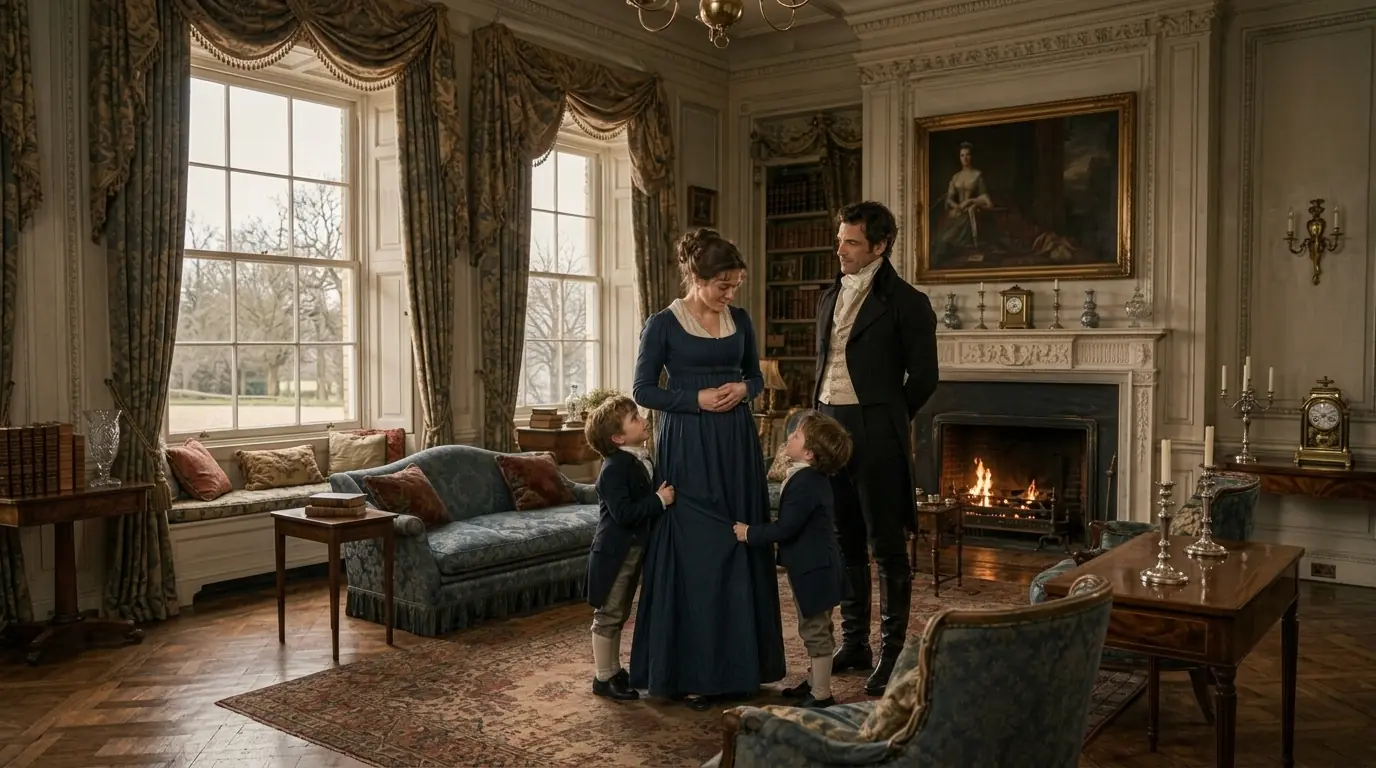
Cesily Vane was not traveling on foot. She was in the hired coach that came twice a week from Ipswich, the one with the cracked leather on the left bench and the window that would not close all the way, the one she had ridden fourteen times in the past six months because it was the cheapest passage between the village and the solicitor's office in town, and there was no other way to manage what needed managing. She was not rich. She was not poor in the way that meant going without meals, but she was poor in the way that meant she counted every shilling before she put it down and did not count on anyone to help her count.
She was five-and-twenty, plain-featured, brown-haired, and the kind of woman a crowded room organized itself around without ever quite noticing her. She had been told this. She had not minded. She had other things to mind. Her one competence was ledgers.
She could hold a column of figures in her head while three people spoke at once, and she could find the single wrong entry in a page of thirty without a ruler and without being wrong. The solicitor in Ipswich, a Mr. Alderton, had hired her twice a week on exactly those terms. He paid her a fair rate, which was not a generous rate, and she had not asked for more.
The coach had reached the low bridge at Heron Ditch when it stopped. Cesily felt the lurch, heard the coachman swear under his breath, and then heard underneath that something smaller, something that did not belong to the road. Two voices. She was out of the coach before the coachman had climbed down from his box.
The bridge was narrow stone, older than memory, and in the middle of it, standing very close together with their backs against the parapet, were two children. Boys, small ones, not more than five or six by the look of them, dressed well enough to mean they had not slept there, but dressed too lightly for the morning air. They were not crying. They were past crying, their faces wearing the set, pale, finished look of children who have been frightened a long time and have used the crying up.
The taller one by perhaps half an inch was holding the smaller one's hand. "Are you lost?" Cesily asked.
"We were told to wait," the taller one said.
"Who told you to wait here?"
"Our man. He said wait on the bridge and do not move."
Cesily looked up and down the road. There was no one. The hedge dripped, and a rook called once from the elm at the field's edge. "How long ago did he say that?"
The smaller boy looked at his brother. The brother said, "Before it was light."
She did not stop to calculate the mathematics of it, which would have told her that two small children had been standing on a wet stone bridge in the dark for at least three hours. She did not weigh the inconvenience. She simply stepped off the coach, told the coachman she would walk the rest of the way and he could charge her accordingly, and opened her coat. "Come off the parapet," she said. "You will fall."
The smaller boy came to her first. She wrapped one side of her coat around him. The taller one watched for a moment and then, as if deciding something, took her hand. She did not know then that she had been watched from the moment the coach stopped.
The man in the wool coat was standing in the gap of the field gate thirty yards back from the bridge. He had been there since before the coach arrived. He had been watching the boys since dawn, which was not a thing he was proud of, and which he had told himself was necessary, and which he had told himself he would explain later when he had found a way to explain it that did not make him sound like a man without a heart.
His name was not the one he had given at the coachman's inn where he was staying. He had given them Whitmore. His name was not Whitmore. He was the Duke of Carne.
He was two-and-thirty, not tall, not broad in the kind of way that announced itself, with a face that had been broken once across the nose and had set a little to the left. It had never much troubled him because he had never much cared about his face. His eyes were brown, not gray. The gray had been his father's, and his father was four years dead.
The title had come down on him with the house and the debts and the two small boys who were his sons, whom he had not known what to do with since their mother had left them at the gate of Carne Park eighteen months ago with a letter that explained nothing he had not already known. He had tried three nurses. He had tried a governess. He had tried a cousin of his wife's who was gentle and timid and whom the boys had looked through as if she were glass.
He had tried for two months doing it himself, and he had been inadequate in the specific way that is not cruelty and is not laziness, but is simply the wrong shape for the task. He had brought them to Suffolk because he had affairs there. That was true. He had also brought them because the park at Carne was very large and very quiet, and the silence in it was a kind he did not know how to fill.
He had stopped the boys on the bridge and told them to wait because there had been a woman on the previous day's road, a woman with a ledger under her arm and mud on her boots, and a way of looking at things that made him want to see what she did when she did not know anyone was watching. He had arranged it badly. He knew that. He had not thought they would be frightened.
He had not thought, and the recognition of this sat in him like a stone. He watched her wrap his smaller son in her coat. He watched her take his elder son's hand. He did not move for a long moment. The rook called again, and he still did not move.
Cesily had known, in the way one always knows, that there was something wrong with the arrangement. Children did not wait on bridges before dawn by coincidence. Someone had put them there. Someone had known they would be safe, which meant someone had been watching, which meant the thing had been designed.
She thought about this while she walked the boys the remaining half mile to the inn at Harwick Cross. She did not say anything about it. The smaller boy had fallen asleep against her side with the bonelessness of young children in the cold, and the elder one was watching her with the particular attention of a child who is deciding whether an adult can be trusted.
"What is your name?" she asked.
"Edmund," he said. "He is Frederick."
"Those are serious names for small people."
Edmund considered this. "We are serious people."
She almost smiled. "I believe you."
The innkeeper's wife took one look at the three of them and made a sound that was not a word, then brought hot milk and bread and stoked the fire up fast. Cesily sat the boys at the table and stayed until they were eating. Then she told the innkeeper's wife that they were waiting for someone, that someone would come, and to please keep them warm, and she would leave two shillings against any trouble. The innkeeper's wife said she would not take two shillings for two small boys and a cup of milk, and Cesily put the coins on the table anyway and left before the argument could finish.
She had a ledger to reach. The man in the wool coat arrived at the inn twenty minutes later. The innkeeper's wife, who had opinions, told him exactly what had happened and who had paid and where the coins were still on the table because she had not touched them. She told him the young woman had not asked anything and had not waited to be thanked.
The Duke of Carne sat down across from his sons. Edmund was eating bread with the focused seriousness of a small person who has been hungry and is not going to say so. Frederick had fallen asleep again with his head on the table.
"Papa," Edmund said.
"Yes?"
"She called us serious people."
"Did she?"
"She did not say it unkindly."
The Duke looked at his son for a moment. Then he picked up Frederick, settled him against his shoulder, and did not say anything else. But he looked at the two shillings on the table for a long time before he stood up.
Three days went by. Cesily did not think about the boys particularly. She thought about them the way one thinks about a thing that has resolved itself, the way she thought about a column that had balanced. She had done what was needed. The need was gone, and she had her work.
She was copying a deed for Mr. Alderton on the third morning when the outer door opened. Mr. Alderton made the small, careful sound he made when a client of rank arrived, and then the door to the inner office opened, and the man in the wool coat was standing in it. He was not wearing the wool coat now. He was wearing the kind of coat that had been made specifically for him by someone who was very good at coats.