In a crowded downtown restaurant, a young college student worked tirelessly, struggling to survive while paying for tuition, rent, and her mother’s medication.
One quiet afternoon, an elderly man in a worn coat stepped through the restaurant doors and ordered the cheapest thing on the menu.
Most people barely looked at him.
Some judged him instantly.
But one waitress treated him with quiet dignity, even though she herself had almost nothing to give.
What she didn’t know was that the old man was secretly the owner of the entire restaurant chain, testing the heart of his staff. And the simple kindness she offered that afternoon was about to change her life forever.
The afternoon sun poured over Brookline Avenue in long golden streaks, warming the crowded sidewalks and bouncing off windows filled with reflections of hurried lives. Car horns echoed between buildings. Coffee shops hissed with steam. People moved fast, shoulders tight, eyes fixed ahead as though the entire city were running late for something important.
Tucked quietly between a laundromat and a tiny flower shop stood Bonito’s Grill, a modest brick restaurant wrapped in creeping ivy and smelling permanently of grilled onions, coffee, and buttered bread. From the outside, it looked ordinary. Inside, during the lunch rush, it felt like controlled chaos.
Servers rushed between tables carrying heavy trays. Plates clattered. Orders were shouted through the kitchen window. Receipts spit endlessly from the printer beside the register. Customers filled every booth, every stool, every corner near the windows. The air buzzed with movement and noise.
Near the back of the restaurant, beneath fluorescent lights that flickered more than they should, worked Anna Lewis.
Anna was twenty-one years old, tall and slim, with dark brown skin and tired eyes that somehow still held warmth. Her tightly curled hair was wrapped in a patterned scarf that didn’t match the restaurant uniform at all, but she wore it anyway because it reminded her of home, of her grandmother, of herself.
She moved quickly through the dining room with the grace of someone who had learned long ago how to survive by staying calm. Her smile was never loud. Never dramatic. Just steady.
Anna was in her final year of college, studying social work while balancing double shifts at the restaurant. Most nights she stayed awake studying until after midnight. Most mornings she woke before sunrise, brewed cheap coffee in her tiny apartment, and told herself the exhaustion was temporary.
The money barely covered tuition.
Barely covered rent.
Barely covered her mother’s prescriptions.
But she never complained.
Her grandmother had raised her with a different philosophy.
“You don’t gotta be loud to make your presence known,” her grandmother used to tell her while shelling peas at the kitchen table. “Just be consistent. Just be kind.”
Anna carried those words everywhere.
Even here.
Especially here.
The lunch rush swelled harder around one in the afternoon. The kitchen sounded like a battlefield. Fryers hissed. A cook cursed after dropping a tray. Customers waved for refills while the manager paced near the register muttering about sales numbers.
Anna moved through it all like music.
She refilled drinks before people asked. She remembered names. She noticed who looked tired. Who looked lonely. Who hadn’t smiled all day.
“Girl, you too nice for this place,” Tina muttered while stuffing straws into dispensers beside the counter.
Tina was older, maybe mid-thirties, sharp-tongued and permanently irritated. Years in the service industry had hardened her into someone who judged customers the second they walked through the door. Expensive watches got fast service. Fancy shoes got smiles. Everyone else got whatever energy she had left over.
“Being decent doesn’t cost anything,” she replied.
Tina rolled her eyes.
“That’s because you still believe people deserve it.”
Anna didn’t answer.
Because deep down, she still did.
The front door opened with a soft creak.
At first, nobody paid attention.
An older man stepped inside slowly, wearing a worn brown coat that looked older than the building itself. His gray hair poked from beneath a faded cap. His shoes were scuffed. His posture slightly bent, like every movement required effort.
In one hand he carried a thin envelope.
In the other, an old wallet bulging more with papers than money.
Tina glanced once and scoffed quietly.
“Great,” she muttered. “Another camper.”
The man paused near the entrance as if unsure whether he belonged there at all.
Anna stepped toward him before anyone else could.
“Hi there,” she said warmly. “Would you like a booth by the window?”
The old man looked surprised by the kindness in her voice.
Then he nodded slowly.
Anna guided him carefully through the crowded dining room to a small booth near the front window where sunlight stretched across the table.
She placed a glass of water in front of him before he even asked.
“Take your time,” she said gently. “No rush.”
The man opened the menu slowly.
Anna noticed his fingers trembling slightly as he studied the prices.
She recognized that hesitation immediately.
You don’t grow up counting coins for groceries without learning what quiet embarrassment looks like.
After several minutes, the man finally cleared his throat.
“Just the vegetable soup,” he said softly. “No bread. Water’s fine.”
Anna smiled.
“The soup’s good today,” she said. “Lots of thyme and carrots.”
He nodded carefully and closed the menu.
When Anna walked back toward the register, Tina leaned over her shoulder.
“Soup only?” Tina whispered. “Don’t waste your energy. He ain’t tipping.”
Anna ignored her.
Instead, she quietly reached into her apron pocket and pulled out a crumpled five-dollar bill — the only tip she’d earned so far that day.
She handed it to the cashier.
“Add a bread roll,” she whispered. “But don’t tell him I paid for it.”
A few minutes later, Anna returned carrying the soup and warm bread basket.
“Chef added this today,” she lied smoothly while setting the bread down. “Said it goes well with the soup.”
The old man looked up at her then.
Really looked at her.
His eyes glistened faintly at the corners, as though something inside him had shifted unexpectedly.
For a second, he looked unable to speak.
Then he nodded once.
Slowly.
Deeply.
Anna smiled and moved on to another table without waiting for gratitude.
But something in the room had changed.
Even if nobody else noticed it yet.
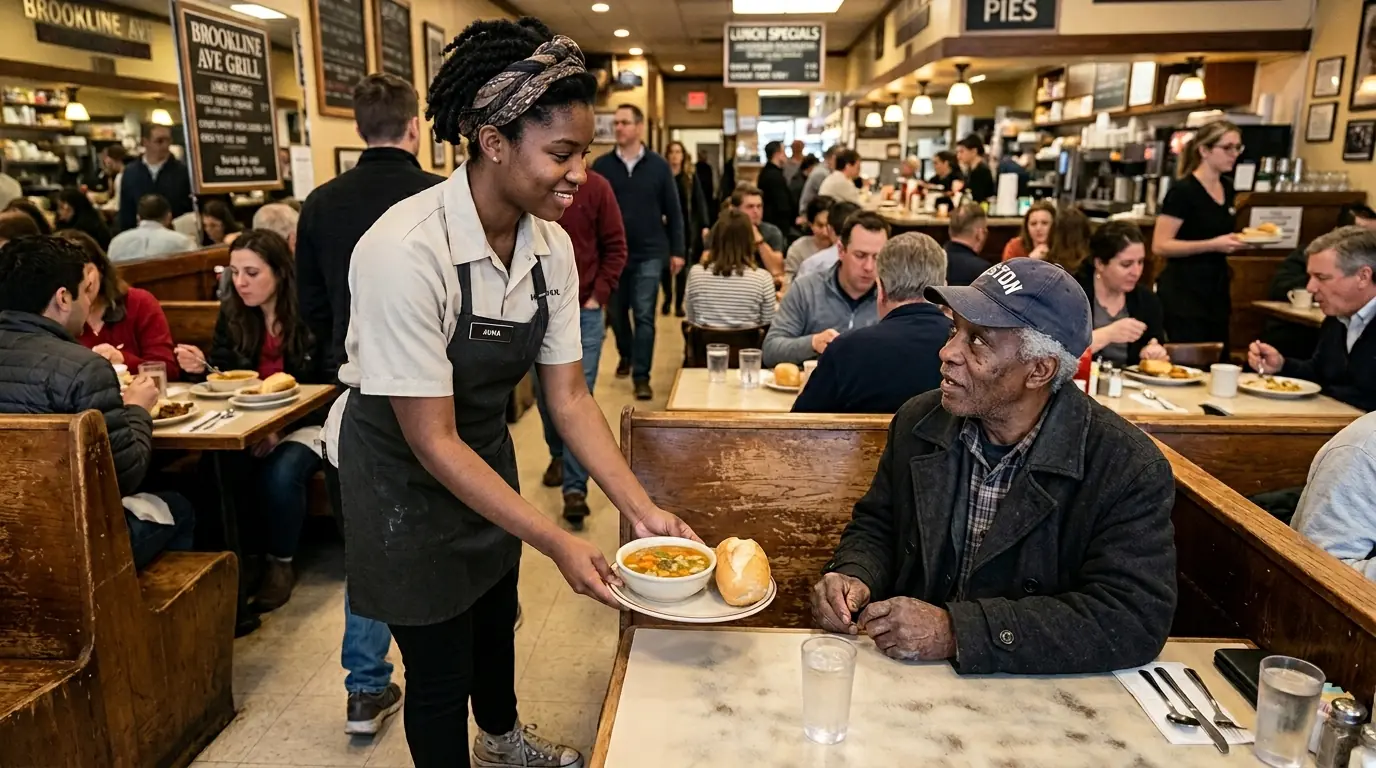
The rest of the afternoon unfolded in its usual blur of noise and movement, but Anna kept noticing the old man sitting quietly by the window. He ate slowly, carefully, as though trying to make the meal last.
He never complained about the draft from the door.
Never demanded attention.
Never asked for anything extra.
He simply sat there quietly, blending into the background the way people often do after the world spends years teaching them that invisibility feels safer than being seen.
Tina kept making comments under her breath.
“Bet he’s trying to stay warm till dinner.”
“That coat probably older than my grandma.”
Anna ignored every word.
Halfway through the shift, she saw the man carefully unfold a few worn bills beneath the table. He counted them twice with nervous concentration.
When she brought the check, he looked embarrassed.
“Could you double-check this?” he asked softly. “Just wanna make sure I have enough.”
Anna leaned closer with a reassuring smile.
“You’re perfectly fine, sir,” she said gently. “Everything’s covered.”
The man looked at her carefully then, not suspicious, just curious. Like he was trying to understand why someone would help him without wanting anything in return.
Finally, he slid a ten-dollar bill toward her.
“Keep the change,” he said quietly. “And thank you.”
Then he slowly stood from the booth.
Before leaving, he pulled a folded piece of paper from his coat pocket and handed it to her.
“If you have time,” he said, “call that number sometime.”
Anna looked down.
Written neatly across the paper was a name.
Edward L. Grant.
Beneath it, a phone number.
And a short handwritten sentence:
“Don’t judge the wrapping. Some gifts are quiet.”
The old man smiled faintly.
Then he walked out the front door and disappeared into the busy flow of afternoon traffic.
Anna stood frozen for a moment holding the note.
Tina spotted it immediately.
“What, he ask you on a date?” she laughed loudly.
Anna folded the paper carefully and slipped it into her apron pocket.
“I don’t think he’s crazy,” she said quietly.
“I think he’s just different.”
Two days passed.
Anna still hadn’t called the number.
Not because she was afraid.
Because something about the moment felt unfinished, like the beginning of a story she didn’t fully understand yet.
Thursday afternoon arrived with another chaotic lunch rush. The restaurant buzzed with gossip about possible surprise inspections from corporate.
Then, at exactly 2:47 p.m., the restaurant doors opened again.
This time, a sharply dressed man in a gray suit stepped inside.
Everything about him looked expensive.
He scanned the dining room until his eyes landed directly on Anna.
“Anna Lewis?” he asked politely.
Manager Chuck immediately rushed over.
“Can I help you, sir?”
The suited man nodded calmly.
“I’m here on behalf of Mr. Edward L. Grant.”
Chuck froze.
The color drained from his face.
“The Edward Grant?” he stammered. “Founder of E.L. Hospitality Group?”
“Yes.”
Suddenly the entire room seemed to stop breathing.
The driver handed Anna a sealed envelope with her name written across the front in elegant ink.
Her hands trembled slightly as she opened it.
Inside was a letter.
Anna Lewis,
You demonstrated something rare this week.
Kindness without performance.
Integrity without reward.
You treated me with dignity when nobody else bothered to look twice.
I would be honored if you would meet with me today.
You served me Tuesday.
I was the man with the soup.
Edward L. Grant.
Anna read the letter twice.
Chuck looked like he might faint.
Tina stood completely speechless.
The suited man smiled gently.
“That was the point,” he said when Chuck began apologizing frantically for not recognizing the billionaire owner sooner.
Anna swallowed hard.
“When does he want to meet?”
The driver glanced toward the window.
“A car is waiting outside.”
Anna slowly untied her apron strings.
She folded the apron neatly and placed it on the counter.
Then she looked once around the restaurant where she had spent years struggling just to survive.
Tina muttered bitterly under her breath.
“Rich people always playing games.”
Anna shook her head softly.
“Maybe,” she replied. “Or maybe some people are just trying to find someone worth believing in.”
Then she followed the driver outside.
The car carried her downtown through streets she had passed a thousand times without ever noticing.
When they arrived, it wasn’t another restaurant.
It was a towering glass office building overlooking the city skyline.
The elevator required fingerprint access to reach the top floor.
Anna stepped into a corporate office unlike anything she had ever imagined. White marble floors. Dark wood walls. Massive framed photographs of restaurants across the country.
And standing near the windows was the old man from the booth.
Only now he wore a charcoal suit tailored perfectly to his frame. His silver hair was neatly combed. His posture confident. Commanding.
Edward L. Grant smiled warmly.
“Anna Lewis,” he said. “You saw me when others didn’t.”
She stood speechless.
Edward gestured for her to sit.
“I built this company decades ago,” he explained. “Not just to serve food. To build a culture.”
He paused.
“But somewhere along the way, many people forgot what hospitality actually means.”
He looked directly at her.
“You reminded me.”
Anna listened quietly as he continued.
“I’ve spent months visiting my restaurants anonymously. Most people treated me according to my appearance. Some ignored me completely.”
Then he smiled softly.
“But you served me with dignity before you knew who I was.”
He opened a folder on his desk.
“I’d like to offer you a position.”
Anna blinked in confusion.
“Not as a waitress,” Edward continued. “As Director of Service Ethics and Training for E.L. Hospitality Group.”
Her breath caught.
The salary alone sounded unreal.
Full benefits.
Leadership role.
Travel opportunities.
Corporate authority.
Anna stared at him in disbelief.
“But I don’t have experience,” she whispered.
Edward smiled.
“I’m not hiring credentials,” he replied gently.
“I’m hiring character.”
Silence filled the room for a moment.
Then Anna nodded slowly.
“I’d be honored.”
And just like that, her life changed forever.
News spread through Bonito’s Grill by the next morning like wildfire.
The quiet college waitress had been personally recruited by the billionaire founder himself.
Nobody could believe it.
Especially Tina.
Chuck spent the entire day pacing nervously through the restaurant pretending he had always valued Anna.
But Anna never returned to pick up her final paycheck.
Instead, she left behind a handwritten note taped gently to the breakroom wall.
“Keep treating people like they matter. Because they do.”
That was it.
No anger.
No revenge.
No bitterness.
Just grace.
A week later, Anna began her new role at corporate headquarters.
At first, the world felt overwhelming.
Executives twice her age sat across from her during meetings. Regional managers studied her curiously. Employees whispered stories about “the soup girl.”
But Anna never pretended to be someone else.
She listened.
She remembered names.
She asked questions.
And slowly, people began listening to her too.
Edward gave her complete freedom to redesign the company’s service training programs.
So she rebuilt everything from the ground up.
Not with corporate slogans.
Not with scripts.
With humanity.
She created training modules called:
“Dignity at the Door.”
“Service Without Judgment.”
“The Table Isn’t Just a Table.”
She traveled across the country visiting restaurants, observing how employees treated customers they considered unimportant.
And every time she spoke to a staff room full of exhausted workers, she told them the same story.
The story of an old man in a worn coat.
The story of being unseen.
The story of kindness given freely.
And people listened because Anna understood their world.
She knew aching feet after twelve-hour shifts.
She knew exhaustion.
She knew what it felt like to be overlooked.
Her compassion wasn’t theoretical.
It was lived.
Three months later, Anna quietly returned to Bonito’s Grill unannounced.
It was another Tuesday.
The restaurant felt different now.
Softer somehow.
Chuck was gone.
A younger manager greeted customers personally near the door.
Tina still worked there, but the sharp bitterness in her voice had faded.
Anna sat in the exact same booth near the window.
She ordered vegetable soup.
A young server approached politely.
No judgment.
No assumptions.
Just kindness.
When the check arrived, there was no bill attached.
Only a handwritten note.
“On the house. Thank you for reminding us why this work matters.”
Anna smiled quietly.
Then she left a tip far larger than the meal itself and stepped back outside into the warm afternoon sunlight.
The city still buzzed around her exactly the same way it always had.
But Anna herself had changed something inside it.
As she walked down Brookline Avenue, she heard her grandmother’s voice in her heart once more.
“You don’t gotta be loud to make your presence known.”
“Just be consistent.”
“Just be kind.”
And somehow, those simple words had traveled farther than either of them ever imagined.