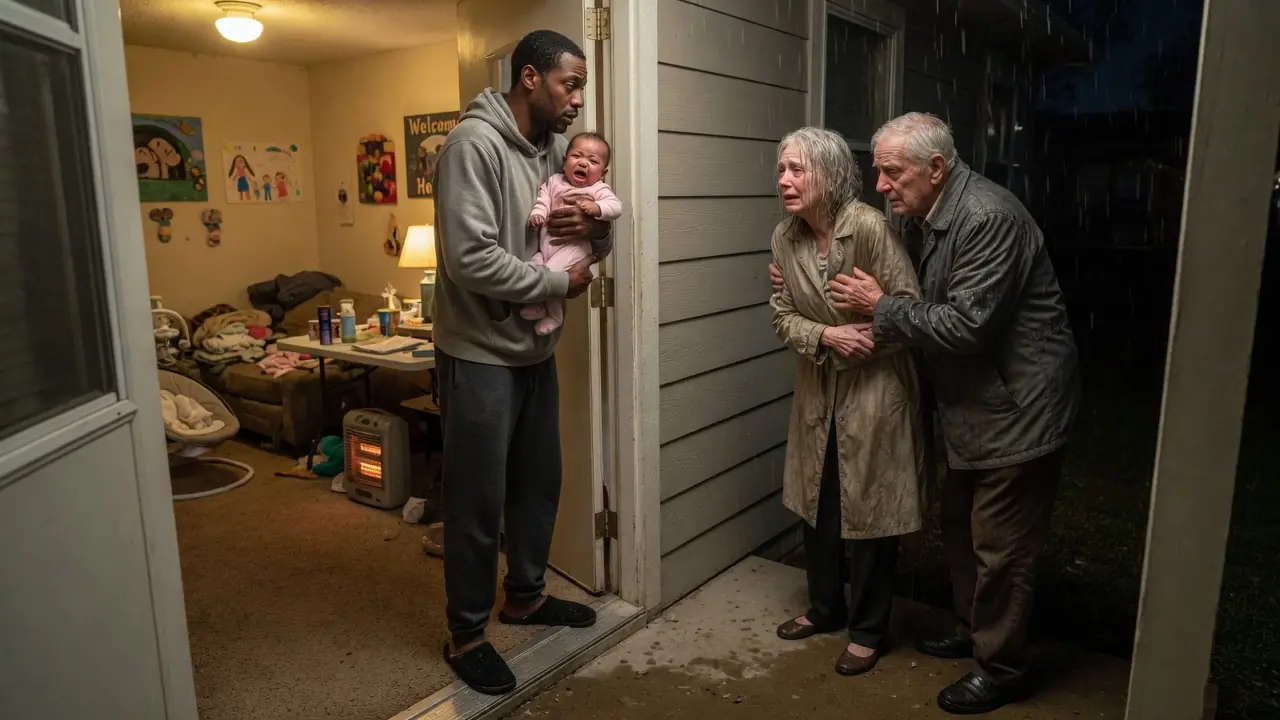
Marcus, a widowed father, was struggling around his tiny house with his sick, screaming infant when a sudden, frantic pounding echoed from the front door. When he opened it, he found an elderly couple huddled on the porch, their thin coats soaked through, their hands shaking uncontrollably from the cold. Even though Marcus was barely scraping by, he still stepped aside, pulled the trembling couple into his warm little living room and gave them hot food. What he didn’t know was that the truth they were about to reveal would change all of their lives forever.
The apartment sat quiet except for the soft whimper of a 5-month-old who’d been crying on and off for the past 2 hours. Marcus Bennett paced the small living room, his daughter Maya pressed against his shoulder, her tiny body rigid with the colic that had been getting worse every night.
“Shh, baby girl. Shh, Daddy’s here. I know it hurts.”
Six months since the accident that took Jennifer. Six months since he’d stopped believing the world was fair.
It was 7:43 on a Friday evening in late November, and Marcus was at the end of his rope. The first real cold snap had hit Austin hard, temperatures dropping into the 30s, unusual for Texas, but not unheard of. Snow had been forecast for later tonight, which was practically apocalyptic for a city that shut down when the thermometer dipped below 50.
Marcus had tried everything with Maya: the bicycle legs the pediatrician recommended, the gas drops that cost too much and did nothing, walking in circles until his legs ached, singing every lullaby he could remember.
Nothing worked.
Maya’s cries escalated to full shrieks, her little face turning red, her body arching in pain.
“I know, sweetheart. I know. I’m sorry. I don’t know how to fix it.”
Then came the knock.
Soft at first, hesitant, then more insistent, urgent.
Marcus froze. Nobody knocked on his door at 7:43 on a Friday night. His neighbors in the aging apartment complex kept to themselves. His brother Kenneth hadn’t spoken to him in three weeks, not since their last argument about Marcus needing to get his life together. The few friends he’d had before Jennifer died had long since stopped checking in.
The knock came again, desperate now, almost frantic.
Marcus’s first instinct was to ignore it, pretend he wasn’t home. He had enough problems: a screaming baby, mounting medical bills, a job at the commercial real estate firm that paid $47,000 a year and barely covered rent and basics, an apartment that still smelled like Jennifer’s shampoo even though he’d washed everything twice.
He had no room in his life for other people’s tragedies.
But Maya was already screaming. Whoever was at the door already knew someone was home. And something about the urgency of that knock, the desperation in it, pulled at something deep in Marcus’s chest.
He walked to the door, still bouncing Maya, who continued to shriek, and looked through the peephole.
An elderly couple stood in the hallway, bundled in thin coats, completely inadequate for the sudden cold. The woman’s silver hair was disheveled, and even through the distorted fisheye view, Marcus could see her eyes were red and swollen from crying. The man beside her, white-haired and stooped, had his arm around her shoulders like he was the only thing keeping her upright.
They looked terrified, desperate, lost, like people who’d reached the absolute end of something.
Marcus’s hand hesitated on the deadbolt.
Mind your business. You’ve got enough problems. They could be dangerous. This could be a scam.
But something about the way they stood there, the woman’s hand clutching the man’s coat like she was drowning, the man’s weathered face carved with desperation and shame, stopped him from walking away.
He knew that look. He’d worn it himself six months ago.
What if they hurt Maya? What if this is a mistake?
But the woman was shivering so hard she could barely stand. Her lips had a bluish tint even through the peephole.
Marcus made a choice.
He opened the door.
The woman’s eyes went immediately to the screaming baby in his arms, then back to his face. Relief and guilt warred in her expression.
“Oh, sweetheart. I’m so sorry to bother you,” she said, her voice rough, like she’d been crying for hours. “I know you have your hands full. We just… we didn’t know where else to go. We need help, please.”
Marcus had to raise his voice over Maya’s cries.
“What kind of help?”
The man spoke, his voice shaking with cold and something else. Fear, maybe. Shame. The kind of shame that comes from having to beg strangers for help.
“We’re lost. We’ve been walking for hours trying to find our house. It’s gotten so cold, and we don’t have a phone that works. And my wife, Catherine, she’s not well. We just need to get warm for a bit, maybe use your phone to call someone. Please, sir, we wouldn’t ask if we weren’t desperate.”
Marcus looked at them. Really looked.
Their coats were thin, decorative, the kind you wore in October. Not when temperatures dropped into the 30s with snow coming. No gloves, no scarves. Catherine’s hands were shaking so violently she could barely stand still, and her lips had that bluish tint that Marcus recognized from basic first aid training.
Early hypothermia.
Maya shrieked louder, her little body convulsing with pain, and Catherine’s expression transformed, shifted from desperate fear to something else. Recognition, concern, the instinct of someone who’d spent decades caring for children.
“That baby’s got colic,” Catherine said with sudden certainty, her voice cutting through Maya’s screams with unexpected strength. “Bad colic. I can hear it in her cry. How long has she been like this?”
“Two hours tonight. Five months in general. The doctor says there’s nothing to do but wait it out. Nothing helps.”
“May I?”
Catherine’s hands were already reaching out. Instinctive, automatic. The muscle memory of decades overriding her own distress.
Every instinct Marcus had screamed. This was a bad idea. Don’t let strangers into your home. Don’t hand your baby to people you don’t know. What if they’re lying? What if this is a setup? What if they hurt her?
But Maya was screaming, and he was failing her. And this woman’s eyes held something that looked like genuine knowledge, genuine concern. And more than that, she looked like she was minutes away from collapsing from hypothermia.
If he closed the door now, they might die out there in the cold.
Marcus hesitated one more heartbeat, looking between the desperate elderly couple and his screaming daughter. Then he stepped aside.
“Come in, please, but I need to be honest. I’m going to keep my phone in my hand. I don’t know you, and I have to protect my daughter. I hope you understand.”
The relief that washed over their faces was profound, almost painful to witness, like he had just thrown them a lifeline when they were seconds from drowning.
“Of course,” the man said quickly. “Of course, you should be careful. We understand. We’re just… thank you. Thank you so much.”
“Oh, thank you,” Catherine’s voice broke. “We won’t stay long. I promise. We just need to get warm.”
Marcus led them into his small living room, acutely aware of how it must look. Baby toys scattered across the floor. His dinner, a sad sandwich, half-eaten on the coffee table. Laundry piled on a chair he’d been meaning to fold for three days. Everything screaming, barely holding it together.
His phone was in his back pocket. He could feel its weight there, ready to dial 911 if needed.
“Sit down,” Marcus said over Maya’s continued screaming. “Let me get you some water, and I’ll turn up the heat.”
He moved to the thermostat first, cranking it up to 75, despite what it would do to next month’s electric bill. Harold and Catherine were shivering so violently their whole bodies shook. While part of him remained wary, kept glancing back at them, kept his phone within reach, another part of him couldn’t ignore the basic humanity of the situation.
These were people who needed help. Whatever else was true, that much was undeniable.
Marcus went to the hall closet and pulled out the thick fleece blanket Jennifer’s mother had given them two Christmases ago. He’d barely been able to look at it since the funeral. But watching Catherine’s blue-tinged lips, watching Harold’s hands shake, he knew what needed to be done.
He brought the blanket to Harold first, draping it carefully over the old man’s shoulders on top of Marcus’s coat.
“Here, you need to warm up slowly.”
“You’re very kind,” Harold said, his voice cracking with emotion and cold.
Marcus nodded, then turned to Catherine.
“Ma’am, I have another blanket. Would you…”
But Catherine was already reaching for the baby, her arms out, her whole body language shifting into something practiced, confident, ancient.
Marcus looked at her shaking hands, at the desperation in her eyes, at the way she was already moving with the instinctive motions of someone who’d cared for infants before.
This could be a terrible mistake, but she’s freezing, and Maya won’t stop screaming.
“Okay,” Marcus said carefully, still keeping his distance. “But I’m staying right here. And if anything seems wrong…”
“We understand,” the old man said firmly. “You’re being kind to let us in at all.”
Marcus placed Maya in Catherine’s arms, watching carefully, ready to snatch his daughter back at the first sign of trouble.
Catherine immediately adjusted the baby’s position, laying her face down along her forearm, Maya’s head resting in Catherine’s palm, her tiny legs dangling on either side. Then Catherine began a gentle but firm rubbing motion along Maya’s back, rhythmic, purposeful, with exactly the right amount of pressure.
“Gas pain,” Catherine murmured, her focus entirely on the baby despite her own shivers. “Pressure on the tummy helps, and this position lets gravity do some work. Had two daughters myself, five grandchildren. Worked seven years in a pediatric clinic before I retired.”
She paused, then added softly, “Colic usually improves on its own from month five or six. I’m just helping the baby get relief faster.”
Marcus stood frozen, watching carefully, his hand still near his phone. But what he saw wasn’t threat. It was expertise. And something in him softened slightly.
This woman was holding his screaming baby while her own hands were still trembling with cold. Whatever her story was, that kind of maternal instinct wasn’t something you could fake.
“Let me make you both something hot to drink,” Marcus said, moving toward the kitchen. “And some food. When’s the last time you ate?”
Marcus glanced at the clock. Almost 8:00 p.m.
Twelve hours.
He moved through his kitchen with purpose, no longer constantly glancing back over his shoulder. He could see them clearly from here anyway. Harold wrapped in the blanket. Catherine focused entirely on soothing Maya.
The soup from three nights ago was still in the fridge. Homemade chicken noodle his neighbor, Mrs. Ramirez, had brought over when she’d heard Maya crying through the walls. Marcus had barely touched it. He poured it into a pot, turned the burner to medium-high.
While it heated, he put the kettle on for tea. He found the chamomile Jennifer had loved.
“It calms the nerves,” she used to say.
He set out two mugs. Found the honey she’d always used. Her handwriting was still on the label.
Jay’s Special Honey. Hands Off, Marcus.
His throat tightened, but he kept moving. He pulled out bread, not stale yet, thank God, and made four slices of toast with butter. Simple, warm, easy to digest. His mother used to say comfort food didn’t have to be fancy. It just had to be made with care.
Maya’s screams began to quiet. First to whimpers, then to hiccuping sobs, then impossibly, miraculously, to silence.
Within seven minutes of entering his apartment, this stranger had accomplished what Marcus hadn’t managed in five months of sleepless nights.
Maya’s eyes fluttered closed.
She slept.
The silence felt surreal, like the world had shifted on its axis. Marcus realized he was holding his breath. His hand moved away from his phone.
“I’ll hold her a while longer,” Catherine said softly, still swaying slightly in that universal grandmother rhythm. “Needs to stay like this at least 15 minutes, or the gas comes right back. Poor little thing. Been suffering a while, hasn’t she?”
“Yes.”
Marcus’s voice came out hoarse.
“Yes, she has.”
The kettle whistled. Marcus poured hot water over the tea bags, added honey to both cups, stirred carefully. The soup was bubbling now, filling the small apartment with the smell of chicken and herbs and something that felt almost like normalcy.
He brought the tea first, setting the mugs on the coffee table within easy reach.
“Careful, it’s hot, but it’ll help warm you from the inside.”
“You didn’t have to do all this,” Catherine said, but her eyes were bright with gratitude.
“You’re cold and hungry,” Marcus said simply. “This is what people do.”
Harold reached for his mug with shaking hands, cradling it like it was precious. The steam rose into his face, and Marcus watched the old man close his eyes, just breathing it in.
“This is chamomile,” Harold said softly. “Catherine’s favorite.”
“Mine, too,” Catherine said. “My mother used to make it for me when I was upset.”
Marcus went back to the kitchen, ladled soup into two bowls, the good bowls, the ones that held heat, and brought them out with the toast on a tray. He set everything on the coffee table carefully.
“I know it’s not much,” Marcus said, “but it’s hot, and it’s real food. Please eat.”
Harold, the old man, had collapsed into Marcus’s armchair, his thin coat still on under the blanket. His weathered hands were shaking. Now that they were inside, under the apartment’s harsh lighting, Marcus could see how exhausted they both looked. Not just tired. Depleted. Hollowed out.
But as Harold took the first spoonful of soup, as Catherine managed a bite of toast while still cradling the sleeping Maya, Marcus saw something else in their faces.
Relief.
Hope.
The kind of hope that comes when kindness appears in the darkness.
“I’m Harold Whitmore,” the man said, managing a weak smile. “This is my wife, Catherine. I’m sorry we had to impose like this. We’ve just… we’ve had a terrible few days.”
Marcus pulled his own coat from the hook by the door and draped it over Harold’s shoulders on top of the blanket. The old man looked up, startled, then nodded gratefully.
“I’m Marcus Bennett. That’s Maya, and you’re not imposing.”
He gestured to the food.
“Eat first, then you can tell me what happened. You said you’re lost.”
“Our son-in-law, Derek Morrison,” Harold began, the words tumbling out like he’d been holding them in for hours. “He’s a financial adviser. About a month ago, he told us he’d found the perfect house for us here in Austin. Said we should move closer to him and our daughter, Rebecca. Said he could handle everything. Selling our house in Houston, buying the new one, all the paperwork. We trusted him. He’s family.”
Catherine shifted slightly, adjusting her hold on the sleeping Maya.
“We’ve lived in Houston for 31 years. Same house on Yale Street in the Heights. Raised both our daughters there. Derek said it was time to downsize. Time to let him take care of things. Said the Austin house was perfect for retirement. Close to parks, quiet neighborhood. He showed us pictures.”
Marcus brought them the water, a sick feeling building in his stomach. He’d worked in commercial real estate for 10 years. He’d seen enough scams to recognize the shape of one forming.
Harold took a long drink of water, then continued.
“Derek drove us from Houston in his car on Tuesday morning. He picked us up around 9:00, and we got to Austin around noon. He dropped us off at a coffee shop downtown, the Blue Owl on 6th Street, around 12:00. He said, ‘Wait here for 20 minutes. I need to run to the bank and sign the final papers. Then we’ll go straight to the house.’ We waited.”
His voice became hollow.
“We waited until after 5:30. The coffee shop closed and asked us to leave. Our cell phone, it’s one of those old flip phones. The screen cracked the day before when Catherine dropped it, and it won’t turn on at all. We don’t have Derek’s number memorized. It was always just saved in the phone. We don’t even remember Rebecca’s address here in Austin. Derek always handled visits, always drove us.”
“We had no money for a taxi,” Catherine added quietly, still swaying with Maya. “Just a few dollars in change. So, we asked people for directions to Willow Creek Estates. That’s where Derek said the house was. People gave us all kinds of conflicting directions. We walked for hours in the cold. It got dark. We kept walking, asking more people, getting more confused directions. By almost 8:00 at night, we couldn’t walk anymore. We saw your apartment lights still on, and we knocked. We had to.”
Marcus sat down heavily on the couch, his investigator instincts already firing.
“What’s the exact address of the house he bought you?”
“56 Mapler Crest Lane,” Harold said immediately. “Willow Creek Estates. Derek drove us past it from a distance about two weeks ago. Said they were repainting the interior, so we couldn’t go inside yet. He even showed us photocopied paperwork. It looked legitimate. We’re old. We didn’t think to check carefully.”
Marcus was already pulling out his laptop, fingers flying across the keyboard. The sick feeling in his stomach was getting worse.
Willow Creek Estates loaded on his screen. Real neighborhood. Developed about five years ago. Nice area.
He searched for Maplerest Lane. The street existed. He pulled up the property records for 56 Mapler Crest Lane.
His stomach dropped.
“Harold. Catherine,” Marcus said carefully, turning the laptop so they could see. “56 Mapler Crest Lane is a real address, but it was sold three weeks ago to a family named the Johnsons for $635,000. They’ve already moved in. Derek couldn’t have bought it for you. It already belongs to someone else.”
“He pocketed the price difference.”
The silence was absolute. Catherine’s hands stilled on Maya’s back. Harold stared at the screen like it might change if he looked long enough.
“How much did Derek say you sold your Houston house for?” Marcus asked, though he already dreaded the answer.
“$340,000,” Harold whispered. “He said the new house cost exactly $340,000. Said it was fate that the numbers worked out perfectly.”
Marcus’s hands were shaking as he pulled up Houston real estate records.
2314 Yale Street, The Heights.
The listing loaded.
Sold three weeks ago.
Sale price: $635,000.
“Your house didn’t sell for $340,000,” Marcus said, his voice tight with rage. “It sold for $635,000. Derek stole $295,000 from you. And the house he supposedly bought you, it belongs to someone else. He never bought you a house at all. He took your money and disappeared.”
Catherine made a sound like she’d been punched. Maya stirred but didn’t fully wake. Harold’s face had gone gray.
“That’s not…” Harold’s voice broke. “Derek wouldn’t. He’s married to our daughter. He’s been handling our finances for eight years. When I had my heart surgery, when Catherine’s mother died, he took care of everything. He’s… he’s family.”
“He’s a thief,” Marcus said flatly. “And he left you to freeze on the street while he ran with your money.”
Catherine was crying silently now, tears running down her face while she automatically continued soothing Maya.
“We gave him power of attorney, full access to our accounts. Our retirement savings was in that house. We were supposed to live there, and when we died, Rebecca and her sister Anne would split what was left. But now…”
“Now there’s nothing,” Harold finished. “We’re 76 years old, and we have nothing. No house, no savings, nothing.”
He looked at Marcus with devastated eyes.
“Where are we supposed to go? We can’t work anymore. We can’t start over. We’re too old. Where?”
“You’re staying here,” Marcus said.
Both of them looked up, shocked.
“What?” Harold said.
“Tonight. You’re staying here tonight. Tomorrow, we’ll call a lawyer, figure out legal options. But tonight, you stay. You’re freezing. You’re exhausted. And you need to sleep. I have a bedroom. I’ll take the couch.”
“We couldn’t possibly,” Catherine started.
“You just got my daughter to sleep for the first time in five months,” Marcus interrupted. “You think I’m going to let you walk back out into the cold? No. You stay.”
“We don’t want to be a burden,” Harold said, but Marcus could hear the desperate hope underneath.
“You’re not a burden,” Marcus’s voice softened. “Six months ago, my wife died in a car accident. I was drowning. I needed help. Needed someone to stay. Nobody did. My brother told me to handle my responsibilities. My friends stopped calling. I know what it feels like to need help and have everyone walk away.”
He looked at both of them directly.
“I’m not walking away. You need help. I can give it. That’s how it’s supposed to work. People are supposed to stay.”
Catherine was crying openly now, but smiling through the tears. Maya slept peacefully in her arms.
“Thank you,” Catherine whispered. “Thank you for not closing the door.”
Morning brought cold November sunlight and the weight of reality. Marcus woke on his couch at 6:30, his back aching, disoriented for a moment before remembering.
Harold and Catherine were in his bedroom. Maya was in her crib. Catherine had put her down last night using some technique involving white noise and precise swaddling. And the baby had slept five straight hours.
Five hours.
Marcus hadn’t slept five consecutive hours since Jennifer died.
He lay there listening to unfamiliar sounds. Harold’s soft snoring from the bedroom. Catherine moving quietly, probably checking on Maya.
What was he doing? He’d invited two complete strangers into his home. Strangers who’d been defrauded, who had nothing, who needed everything. His $47,000 salary barely covered his own expenses. Jennifer’s medical bills had wiped out their savings. He was living paycheck to paycheck with a 5-month-old baby and a brother who’d written him off.
But then he heard it. Catherine’s soft voice from the nursery singing something gentle, and Maya’s responding coo. Not a cry. A happy baby sound.
Marcus got up and found Catherine changing Maya’s diaper with practiced efficiency.
“I hope you don’t mind,” Catherine said. “She woke up, and I heard her. You should turn that monitor up, and I thought I’d handle it so you could sleep.”
“I don’t mind at all.”
Marcus watched this stranger caring for his daughter like family.
“How did you sleep?”
“Better than I have in three days. That bed was heaven. Harold is still out cold. First time he’s really slept since Derek…”
She stopped, composing herself.
“We need to call a lawyer,” Marcus said gently. “Friend of mine, Thomas Davis. He handled my wife’s estate. He’s good, and he’ll do this pro bono.”
“Pro bono means free?” Catherine asked. “Because we don’t have money for anything.”
“He’ll help. Let me call him now.”
Thomas Davis answered on the third ring, listened to the story with increasing anger, and promised to come by at lunch.
“This is elder financial abuse,” Thomas said, his voice tight. “Classic pattern. I’ll need documentation, but if what you’re telling me is accurate, Derek Morrison is looking at serious criminal charges.”
“Can they get their money back?”
Long pause.
“Honestly, probably not. People like this hide assets, move money offshore, declare bankruptcy. We can pursue it, but recovery rates are abysmal. I’m sorry, Marcus. I’ll do everything I can, but they need to be prepared that the money’s likely gone.”
After hanging up, Marcus found Harold in the kitchen struggling with the coffee maker.
“Here, let me,” Marcus said. “It’s temperamental.”
“Everything okay?” Harold asked, looking older in the morning light.
“Lawyer’s coming at noon. Thomas Davis. He’ll help.”
Harold nodded slowly.
“And after that?”
“After we know for sure Derek stole everything, then we figure out next steps.”
“We should start looking at shelters,” Harold said quietly. “Resources for homeless seniors. It’s not your responsibility.”
“You’re not going to a shelter.”
“Marcus…”
“No.” Marcus set down the coffee pot firmly. “I meant what I said. You stay here. We figure this out together.”
“We can’t impose.”
“You’re not imposing.” Marcus’s voice rose. He took a breath. “Harold, yesterday my daughter slept five hours straight for the first time since she was born. Do you understand? I was thinking I couldn’t do this anymore. I was drowning. Catherine walks in, and within seven minutes, Maya is asleep. You think that’s nothing?”
Harold looked at his hands.
“You’re kind, but we’re strangers. You don’t owe us anything.”
“You’re right. I don’t owe you. But I’m choosing to help anyway. That’s what people are supposed to do.”
“Most people don’t,” Harold said softly. “Most people close doors.”
“Then I’m not most people.”
Thomas Davis arrived at noon with a grim expression. They sat around the kitchen table while Maya napped peacefully. Thomas took detailed notes as Harold and Catherine recounted everything: the conversations with Derek, the house sale, the paperwork they’d signed without reading carefully because they trusted family.
“Power of attorney,” Thomas said, shaking his head. “Complete control.”
“We thought…” Catherine’s voice cracked. “He’s our son-in-law. Why would we question it?”
“Because people are sometimes horrible,” Thomas said, then softened. “I’m sorry, but this is textbook exploitation. I need a few hours to pull records and trace the money. I’ll be back by four.”
When he returned, his expression told them everything.
“It’s worse than we thought,” Thomas said, spreading documents across the table. “Derek ran a complex scheme. First, he used his power of attorney to sell your house to a shell company, Morrison Holdings LLC, for only $295,000. Then that same shell company, which he secretly owns, immediately resold it for $635,000 to a legitimate buyer. He pocketed $340,000.”
Catherine’s hands went to her mouth. Harold went completely still.
“And there’s more. Actually, the FBI’s been tracking him for over a year because of offshore transactions. They found at least six other couples in Houston, San Antonio, and Corpus Christi. Same pattern. Elderly clients. Power of attorney. Shell company property sales. He’s been running this for at least four years.”
“So we’re not the only ones,” Harold said numbly.
“No, and that helps the criminal case. I’m contacting the DA Monday morning, but…”
“Can we get our money back?” Catherine asked, though her tone suggested she knew.
Thomas sighed.
“I have to be honest. Recovery is extremely difficult. Derek’s moved the money through multiple LLCs and offshore accounts in the Cayman Islands. Even with a criminal conviction, even with a civil judgment, you might recover 10 to 20 cents on the dollar, and it could take years.”
The crushing silence that followed was broken only by Maya’s soft breathing from the other room.
“So we really have nothing,” Harold finally said.
“You have a criminal case,” Thomas offered. “Derek Morrison is looking at serious federal prison time, and we’ll pursue civil remedies. But financially, in terms of immediate recovery, I’m sorry. Years of litigation at best.”
“Where is he now?” Marcus asked.
“Unknown. Disappeared after dropping you at that coffee shop. I’ll flag him with law enforcement, but until he surfaces…”
“He’s gone,” Catherine said flatly. “He got what he wanted.”
After Thomas left, promising to start proceedings immediately, the three of them sat in silence. Catherine was holding Maya again, finding comfort in the baby’s weight.
“We should go,” Harold said without conviction.
“Where would you go?” Marcus asked directly.
Harold didn’t answer.
“There’s a shelter on the east side,” Catherine said softly. “We saw it yesterday while we were walking. Before we knocked, it looked…”
She couldn’t finish.
Marcus thought about Kenneth telling him to handle his own responsibilities. About friends who’d promised help and disappeared. About being 32 and completely alone except for a screaming baby. About the look on Harold and Catherine’s faces when he’d opened his door.
“You’re not going to a shelter,” Marcus said firmly. “You’re staying here.”
“Marcus, we can’t.”
“Yes, you can, and you will.” Marcus leaned forward. “Here’s what’s going to happen. Catherine, you help with Maya, not as a job, but because you’re good at it, and I desperately need help. Harold, I saw you looking at the leaking faucet this morning. I haven’t had time to fix anything in six months. If you want to help with that, I’d be grateful.”
“That’s not equal,” Catherine protested. “You’d be providing everything.”
“Child care in Austin costs $1,600 a month minimum,” Marcus interrupted. “I was about to have to hire someone, which I can’t afford on my salary, or quit my job, which I also can’t afford. You’re not taking charity. You’re saving my life.”
“What about long-term?” Harold asked. “When we get sick, need medical care.”
“Then we handle it,” Marcus said simply. “Together. Like family does.”
“But we’re not family,” Catherine whispered.
“Yes, we are.” Marcus’s voice was gentle but absolute. “Not by blood. By choice. You’re my family because I choose you, and you can choose me back or walk away. But I hope you choose to stay.”
Catherine started crying. Maya reached up with one tiny hand and touched her face.
“We choose to stay,” Catherine said. “If you’ll have us.”
“Equal partners,” Harold added, his eyes wet. “We contribute what we can. We’re not dependent.”
“We’re family,” Marcus finished. “We’re family.”
The next four months were a revelation in what family could be when built on choice instead of obligation.
Catherine transformed Maya’s care with quiet confidence. She established routines Marcus had been too exhausted to create: consistent nap times at 9:00 and 2:00, specific feeding schedules every three hours, the exact right bath water temperature.
She knew which cry meant what. The colic didn’t disappear. It never completely does. But Catherine managed it. The specific holds, the right pressure on the tummy, the bicycle legs done slowly and rhythmically, the warm baths at 6:30 every evening.
What had been six hours of screaming every night became two hours by January, then one hour by February, then occasional fussiness by March that Catherine could soothe within minutes.
Marcus started sleeping again. Real sleep. Five hours became six, then seven. The fog that had surrounded him since Jennifer’s death began to lift.
At work, his performance improved dramatically. He closed two major deals in January: a warehouse conversion in South Austin and a retail plaza in Round Rock. His boss, Richard Sterling, who’d nearly put him on probation in October, instead started talking about promotions and year-end bonuses.
“Whatever changed,” Richard said one Thursday in early February, “keep it up. You’re like a different person.”
Harold quietly took over apartment maintenance. The leaking faucet was fixed within his first week. Loose floorboards secured. Windows weatherproofed. He fixed the garbage disposal, repainted the moldy bathroom, organized the storage closet, figured out the rattling air conditioner.
Though he occasionally felt tired and had to rest, he went for regular blood pressure checkups. He found purpose in the work.
He also cooked dinner every night. Simple meals. Meatloaf on Mondays, spaghetti on Tuesdays, roast chicken on Wednesdays, but hearty and warm. The apartment stopped smelling like takeout and started smelling like home.
Marcus tried to pay them in early January. He pulled out a checkbook.
“I want to compensate you properly for the child care, the housework.”
“No,” Catherine said firmly.
“But…”
“We’re not employees,” Harold interrupted. “We’re family. You don’t pay family.”
“Then let me…”
“Marcus.” Catherine put her hand over his. “If you pay us, this becomes a transaction. We become hired help. That’s not what this is. We contribute because we want to, because we can, because it gives us purpose. The only payment we need is a roof and knowing we matter.”
Marcus looked at these two people who’d walked into his life four months ago as desperate strangers.
“You matter,” he said quietly. “More than you know.”
But Derek Morrison’s betrayal still haunted them.
Thomas Davis kept them updated. In mid-January, Derek was tracked to Tucson, Arizona, attempting the same scam on an 81-year-old widower named Frank Patterson. The victim’s daughter was a Tucson police officer who immediately recognized the fraud. She called her colleagues.
Derek was arrested January 19th.
“Actually, the FBI had been tracking him for over a year because of offshore transactions,” Thomas explained. “The Tucson case just gave them the excuse to finally arrest him.”
The charges were extensive: 23 federal counts of elder financial abuse across seven victims. Wire fraud, mail fraud, identity theft, forgery. The evidence was overwhelming.
Derek was denied bail. He remained in federal custody in Arizona while prosecutors built their case, but the money remained elusive.
“He moved it through so many shell corporations and offshore accounts,” Thomas explained during a March update. “Cayman Islands, Panama, possibly Singapore. Even with convictions, civil asset recovery is incredibly difficult. Offshore banks won’t cooperate without years of legal pressure. You might never see that money, or maybe five, 10 years from now, only a fraction.”
“We’ve accepted that,” Harold said, though his voice carried the weight of it. “We’re okay.”
And they were. Not healed, but learning to live with it.
By March, Maya was eight months old and thriving. She could sit up unsupported, was starting to crawl, had two bottom teeth. The colic had finally, mercifully, passed. Catherine took her to the park every afternoon. Maya would squeal with joy at the ducks.
Harold had made friends with neighbors, helping Mr. Rodriguez in 314 fix a leaky pipe, teaching Mrs. Park in 312 about winterizing plants, joining weekly domino games in the community room.
Life found a rhythm. A good rhythm.
Until Adult Protective Services came knocking.
The knock came on a Tuesday afternoon in late March. Marcus was at work. Catherine was giving Maya a bath. Harold was in the kitchen starting dinner, chicken and dumplings.
Harold answered the door to find a middle-aged woman with an official badge and a leather portfolio, radiating bureaucratic authority. Gray suit, the expression of someone who’d seen too much suffering.
“Mr. Harold Whitmore?”
“Yes?”
“I’m Patricia Gonzalez with Adult Protective Services for Travis County. I need to speak with you and Catherine Whitmore about your current living situation.”
Harold’s stomach dropped.
“What’s this about?”
“We received a report alleging that you and your wife are being financially and emotionally exploited by Marcus Bennett. May I come in?”
Harold’s hands began to shake.
“We’re not being exploited. Marcus has been…”
“I’d prefer to assess that myself, Mr. Whitmore. May I come in, or do I need to return with law enforcement and a court order?”
Harold stepped aside, mind racing.
An anonymous report.
Later, when Marcus came home and they discussed it, Harold would remember it was probably Mrs. Park from 312.
“She’s kind, but worries a lot,” he said. “A few days ago, she asked Catherine, ‘Are you two renting here or what? You don’t pay rent?’ Catherine explained, ‘We live here like family by choice.’ Mrs. Park kept worrying, said, ‘These days you have to be careful. Let me call Adult Protective Services to check and make sure.’ I told her not to, but she must have called anyway.”
Patricia Gonzalez conducted her investigation with cold efficiency, someone who’d seen too many elder abuse cases to assume innocence. She interviewed Harold and Catherine separately, examined the apartment, checked their bedroom, bathroom, kitchen, asked about sleeping arrangements, finances, daily activities, documented everything in her portfolio with notes that felt ominous.
“You’re living here rent-free,” Patricia said to Harold when it was his turn to be interviewed alone. Her tone made it sound like an accusation. “You receive no compensation for child care and housework. No written agreement, no lease, no legal protections. Mr. Bennett could evict you any time with no notice. You’d have no recourse.”
“He would never do that,” Harold said firmly. “Marcus is family.”
“With respect, Mr. Whitmore, you’ve known him four months. You can’t know what he’ll do. Circumstances change. People change. I’ve seen dozens of cases where elderly individuals thought they were family with someone, only to find themselves on the street when that person’s situation shifted.”
“This is different,” Harold insisted.
“That’s what everyone says.” Patricia made a note. “You were recently victims of significant financial fraud by a family member you trusted. That history makes you vulnerable. Vulnerable people are often targeted by others who exploit that vulnerability under the guise of kindness.”
“Marcus isn’t exploiting us,” Harold said, voice rising. “He saved us. We were freezing and lost, and he opened his door.”
“Or he saw an opportunity,” Patricia interrupted. “Free child care, free housekeeping, free home maintenance, all in exchange for letting you sleep in his spare bedroom. The power imbalance is significant. You’re dependent on his goodwill with no legal protections.”
“We’re not dependent. We’re partners. We contribute.”
“Unpaid labor is not partnership. It’s exploitation, even when disguised as family.”
Patricia closed her notebook.
“I’m also concerned about environmental suitability for elderly individuals. Mr. Bennett is a 32-year-old single parent working full-time with no family support. This is a two-bedroom apartment. What happens in a medical emergency? What if one of you falls and needs extended care? What if Mr. Bennett’s circumstances change, loses his job, wants to remarry, decides this is too difficult?”
“Then we figure it out together,” Harold said, desperation creeping into his voice.
“That’s not a plan, Mr. Whitmore. That’s hope. Hope is not a substitute for proper care and legal protections.”
When Marcus got home at 6:15, Patricia Gonzalez was sitting in his living room, portfolio open, expression professional and disapproving. Harold and Catherine looked terrified and guilty.
“Mr. Bennett, I’m Patricia Gonzalez with Adult Protective Services. We need to talk about your arrangement with Harold and Catherine Whitmore.”
Marcus looked at Harold and Catherine, reading the fear in their eyes. He set down his briefcase carefully.
“What arrangement?”
“The one where two elderly victims of recent financial fraud are living in your home, providing unpaid child care and household services with no formal agreement, no compensation, no legal protections.”
“They’re family,” Marcus said. “Not employees.”
“Mr. Bennett, I’m concerned about several things. First, the power dynamic. You control housing, giving you significant leverage over two people with no other options. Second, environmental suitability. You’re a single father with a demanding job and no support beyond these two elderly individuals. What happens if your circumstances change? What happens in a medical emergency?”
“Then we handle it together,” Marcus said, struggling to keep his voice level. “That’s what families do.”
“That’s not a plan. That’s an aspiration.” Patricia stood, gathering her portfolio. “I’ll be filing a recommendation that Mr. and Mrs. Whitmore be evaluated for placement in an assisted living facility with proper oversight, medical support, and social services. Somewhere they’ll have legal protections and won’t be dependent on the whims of a young man they barely know.”
“You can’t do that,” Marcus said, voice rising. “They’re competent adults making their own choices.”
“They’re vulnerable adults who may not be in a position to recognize exploitation or make fully informed decisions given their recent victimization,” Patricia countered. “My job is to protect them, Mr. Bennett, and I’m not convinced this arrangement does that. You’ll receive formal notification of the evaluation within seven business days.”
After she left, they sat in stunned silence. Maya played with blocks, oblivious to the tension.
“Can they really force us into a home?” Catherine asked, voice small and frightened. “After everything, after we finally found family, they can just take us away?”
Marcus immediately called Thomas Davis.
“They can make things very difficult,” Thomas said after hearing everything. “APS has broad authority regarding vulnerable adults. They can petition for protective arrangements if they believe someone’s being exploited or unable to make informed decisions. With Harold and Catherine’s recent fraud victimization, APS can argue diminished capacity or susceptibility to manipulation.”
“But they’re completely competent,” Marcus protested. “They make their own decisions. They chose to stay here.”
“I know that, you know that, but with their recent trauma and age, APS can build a case that they need protection from themselves. Essentially, it’s paternalistic and often wrong, but it’s legal.”
“So what do we do?” Marcus asked, feeling helpless. “We just built a life together. They’re my family. I can’t lose them.”
Long pause on the other end.
“There is one option,” Thomas finally said. “You could establish a formal supported decision-making agreement. It’s a relatively new option in Texas, recognized since 2015. Basically, Harold and Catherine would retain 100% of their decision-making rights. They’re still fully in control of their lives, but they would formally designate you as their supporter for major decisions. You’d also need durable power of attorney and medical power of attorney documents.”
“What does that mean exactly?”
“It means that when APS comes back, you can show them legal documentation that Harold and Catherine, as competent adults, have formally chosen you as their decision-making supporter. APS can’t intervene when mentally competent adults have voluntarily chosen their support person through proper legal channels. The court will recognize it immediately.”
“Is it complicated?”
“Not really. We draft the documents. Harold and Catherine sign them with witnesses. We file with the county. Takes maybe two weeks. But Marcus, this is still a serious commitment. You’d be their formal supporter for life. You’d be involved in every major decision they make: medical care, living arrangements, finances. It’s not just symbolic.”
Marcus looked across the room at Harold and Catherine holding hands on the couch, looking older and more fragile than he’d ever seen them. Maya crawled over to Harold and pulled herself up on his leg, grinning. Harold absently stroked her hair, tears running down his face.
“I’m already tied to them,” Marcus said quietly. “I’m already making those decisions with them. Let’s just make it legal.”
“Okay,” Thomas said. “I’ll start the paperwork. But Marcus, this is serious. This is forever. You understand that?”
“Yes,” Marcus said. “I understand. They’re my family. Let’s make it official.”
The supported decision-making agreement petition required extensive documentation that took three weeks to compile.
Medical evaluations from Dr. Sarah Rodriguez, their new primary care physician, proving Harold and Catherine were mentally competent but could benefit from support as they aged. Cognitive assessments showing full decision-making capacity. Physical examinations documenting overall health. Harold had high blood pressure controlled with medication. Catherine had early arthritis, but nothing debilitating.
Financial records showing complete destitution: bank statements with a combined balance of $673 from Social Security. No assets, no property, no retirement accounts. Derek had drained those, too.
Character references from neighbors. Mrs. Eleanor Park from 312 wrote a glowing letter about Catherine with Maya every day, the obvious love between them. Mr. James Rodriguez from 314 described Harold helping him fix his garbage disposal, refusing payment, just wanting company.
Home inspection report showing the apartment was clean, safe, well-maintained.
Background checks on Marcus showing no criminal history, stable employment, no red flags.
But the hardest part was confronting what they’d been avoiding.
“What about Rebecca?” Catherine admitted one evening in early April. “She’s been calling.”
They were at the kitchen table after Maya was asleep, legal paperwork spread between them like accusations.
“Every week since we found out about Derek, she leaves messages, says she wants to see us, explain, make it right somehow.”
“Derek’s trial is scheduled for June,” Harold added quietly. “His lawyer contacted her. She knows everything now about the fraud, about us living here, about the legal agreements.”
Rebecca had known everything since the day Derek was arrested. Thomas had told them during an earlier update. She called a few times crying, but Harold and Catherine told her, “When you’re ready to trust your parents more than Derek, call back.”
She had been silent almost a year since then.
“Do you want to see her?” Marcus asked carefully.
Catherine’s expression was complicated. Layers of hurt and longing and anger tangled like barbed wire.
“She’s my daughter,” Catherine said slowly, each word pulled from somewhere deep. “I carried her nine months. Felt her first kick. Held her when she was born. Raised her 18 years. Walked her down the aisle when she married Derek. Loved her 47 years. But when we needed her, when we were scared and confused and telling her something was wrong, she chose him. She looked at us like we were senile, like we were problems to be managed. She chose convenience and trust in Derek over trust in us.”
“She thought she was helping,” Harold said, but his voice lacked conviction.
“She thought we were incompetent,” Catherine corrected, voice hardening. “She looked at her parents, two people who raised her, loved her, never gave her reason to doubt, and decided we were too old to know what was happening. When I called her crying, saying the house address didn’t exist, she told me I was getting the numbers confused. When your father called saying something felt wrong about the sale price, she said we didn’t understand modern real estate. She gaslit us, Harold. Our own daughter gaslit us.”
“People make mistakes,” Harold said weakly.
“And some mistakes break things that can’t be fixed,” Catherine replied. “Or at least can’t be fixed quickly.”
“She’s still your daughter,” Marcus said gently. “And the court will ask about her, why she’s not providing care, why I’m petitioning to be your formal supporter instead of your own child.”
“Because she didn’t stay,” Harold said simply. “You did.”
Thomas arranged the meeting for a Thursday afternoon at his office, neutral territory with legal witnesses.
Rebecca Morrison arrived 10 minutes early. Thomas had briefed them. Rebecca moved back in with her sister Anne in San Antonio right after Derek was arrested. She finalized her divorce, lost the house. She’d been attending therapy weekly. This was the first time her parents had agreed to see her.
Rebecca looked like she’d aged a decade in six months. Forty-seven, but could pass for 60. Expensive clothes hanging loose. She’d lost 20 pounds. Her hands shook when she saw her parents.
“Mom, Dad.”
Her voice cracked immediately.
“I’m so… I’m so sorry. I’m so, so sorry.”
“Sorry doesn’t give us back our house,” Catherine said, voice carefully controlled. “Sorry doesn’t give us back our savings or our security or the 31 years we lived in that home.”
Rebecca’s face crumpled.
“I didn’t know. I swear I didn’t know what Derek was doing. I thought… I thought he was helping. I thought I was helping by supporting him.”
“But you chose to believe him instead of us,” Harold said quietly. “When we told you something felt wrong, you told us to trust Derek. You made us feel crazy for questioning family.”
“I thought you were…” Rebecca’s voice broke. “You were forgetting things, Dad. You couldn’t find your car keys for a week last year. You forgot Mom’s birthday. Mom called me three times in one day asking when Thanksgiving was. I thought you were declining. I thought Derek was helping manage complicated finances so you wouldn’t be stressed.”
“We weren’t declining,” Catherine said firmly, leaning forward. “We were stressed because we knew something was wrong and nobody would listen. We weren’t losing our minds, Rebecca. We were being robbed. And when we reached out to you, our daughter, for help, you sided with the thief.”
“I know that now.” Rebecca was crying openly, mascara running. “I know that now. And I’ll never forgive myself. Derek fooled me, too. He was having affairs, three that I know of. He had gambling debts over $200,000 I didn’t know about. He’d been lying to me for years about everything. I filed for divorce the day he was arrested. I’ve lost everything, too. My marriage, my trust, my faith, and my own judgment.”
“That doesn’t fix what you did to us,” Catherine said, and Marcus could hear how much it cost her to stay firm. “You’re our child. You were supposed to protect us, or at least believe us. You did neither.”
“I thought I was protecting you,” Rebecca whispered.
“No,” Harold interrupted, voice harder than Marcus had ever heard. “You thought Derek was more trustworthy than your own parents. You thought we were too old, too foolish, too mentally diminished to know when we were being manipulated. You chose convenience over difficult truth. You chose not to believe your husband could be a monster, so you decided we were just confused old people instead.”
“I’m sorry,” Rebecca said again helplessly.
“You already said that.” Catherine stood. “We heard you. We believe you mean it. But sorry doesn’t mean we forget. Sorry doesn’t mean you get to be back in our lives like nothing happened. You broke something, Rebecca. You broke trust. Trust takes time to rebuild, if it can be rebuilt at all.”
“Mom, please.” Rebecca reached out, but Catherine stepped back.
“We have a family now,” Catherine said, voice shaking but determined. “People who believed us when we said something was wrong. People who helped us when we had nothing. People who stayed. You didn’t stay, Rebecca. You chose Derek. You chose wrong.”
“Can I ever…” Rebecca looked between her parents, desperate. “Can I ever make this right? Can I ever earn your trust back? I want to. I need to.”
“I don’t know,” Harold said honestly, and Marcus could see how much it hurt. “Maybe someday, maybe years from now, but not today. Today, you’re still the daughter who thought her parents were senile when they were actually being robbed. Today, you’re still the woman who chose her husband over the people who raised her.”
Rebecca turned to Marcus, really seeing him for the first time.
“You’re the one who took them in. The stranger who gave them a home.”
“I opened a door,” Marcus corrected. “They’re the ones who saved my life.”
“Are you…” Rebecca struggled. “Thomas said you’re establishing a formal support agreement. You’ll be their legal supporter?”
“Yes.”
“So you’ll help make medical decisions, financial decisions. You’ll be responsible for them.”
“With them,” Marcus clarified. “Not for them. With them. They’re fully capable of making their own decisions. The agreement just gives us legal protection so no one can separate us.”
“Like Adult Protective Services,” Rebecca said slowly. “Someone reported you to APS. That’s why you’re doing this.”
“Yes.”
Rebecca looked at her parents again, trying to reconcile the elderly, vulnerable parents she’d imagined with the strong, angry people across from her.
“You really found a family,” Rebecca said quietly. “A real family with a stranger who opened his door.”
“He wasn’t a stranger for long,” Harold said. “And yes, we found family. Or maybe family found us.”
“Can I?” Rebecca’s voice was barely audible. “Can I at least know you’re safe? Can I call sometimes, not to push back into your life, just to know you’re okay?”
Harold and Catherine looked at each other, having one of their silent married conversations.
“You can call,” Harold finally said. “Once a month. We won’t promise more than that. We won’t promise forgiveness, but you can call once a month, and we’ll tell you we’re okay.”
“Thank you,” Rebecca whispered. “Thank you. That’s… that’s more than I deserve.”
“Yes,” Catherine said bluntly. “It is.”
After Rebecca left, Catherine sat back down heavily. Her hands were shaking.
“That was harder than I expected,” Catherine said.
“You did well,” Marcus said gently. “You set boundaries. That’s healthy.”
“Did I?” Catherine looked at him with haunted eyes. “She’s my daughter, Marcus. I just told my daughter she can call once a month like she’s some distant acquaintance.”
“She broke your trust,” Marcus said. “Trust has to be earned back. It doesn’t just return because she’s sorry or because she’s your daughter.”
“Is that what you’d tell Kenneth?” Harold asked. “If he showed up, apologized, would you make him earn it back too?”
Marcus thought about his brother. The closed doors, the refused help, the judgment, being called pathetic for helping people who needed help.
“I don’t know,” he admitted. “Part of me wants to say yes, make him earn it. But another part, the part that remembers when we were kids and he was my hero, that part would probably forgive him too quickly.”
“That’s the hard part about family,” Harold said. “The line between love and enabling, between forgiveness and being a doormat. I don’t know if we made the right choice with Rebecca, but it’s the choice we made.”
“She can earn her way back,” Marcus said. “If she really wants to. But she has to do the work. You’re not wrong to make her prove it.”
The hearing for the supported decision-making agreement was set for April 23rd at 2:00 in the afternoon, Judge Maria Santos presiding. In the week leading up to it, Marcus barely slept. He reviewed Thomas Davis’s materials endlessly, rehearsed testimony in the shower, in the car, while walking Maya around the park.
Every worst-case scenario lived in his head.
“You’re going to do fine,” Catherine told him the night before as she rocked 9-month-old Maya. “Just tell the truth.”
“What if the truth isn’t enough?” Marcus paced. “What if the judge decides you need professional care?”
“Then we’ll figure out plan B,” Harold said calmly, fixing a sticky drawer. “Worrying tonight just steals your peace twice.”
“When did you get so wise?”
“Seventy-six years of mistakes,” Harold said with a small smile.
The Travis County Courthouse was imposing: marble columns, vaulted ceilings, the gravity of authority pressing down on them. They arrived at 1:45, Maya in tow because Catherine insisted the judge should see the child she’d been caring for.
Thomas Davis met them in the hallway, composed and confident.
“Remember, this isn’t a trial. It’s a hearing. Just show her who you are. Show her the family you’ve built.”
Inside, Patricia Gonzalez sat with a younger social worker, portfolio open, expression unreadable. Judge Santos entered at precisely 2:00. Her eyes were sharp, taking in everything.
“This is a petition for a supported decision-making agreement,” she began. “Adult Protective Services has concerns.”
Patricia stood.
“Yes, Your Honor. The Whitmores are elderly, recently defrauded by a family member. They now live with Mr. Bennett rent-free, providing unpaid child care and household labor with no compensation or legal protection. We’re concerned this arrangement may constitute exploitation or could easily become so.”
“Do you have evidence of actual exploitation?” the judge asked. “Financial access, control, isolation?”
“No direct evidence,” Patricia admitted, “but the power imbalance is significant. This could become exploitation without safeguards.”
“So your concern is potential exploitation rather than current exploitation?”
“Our concern is vulnerability. Trauma can make victims susceptible to manipulation, even if wrapped in kindness.”
Thomas rose.
“Your Honor, what APS calls exploitation is in fact family. Families share resources. They care for each other without contracts. Medical records show both Whitmores are cognitively sound. We have letters from neighbors, employers, health care providers, all attesting that this household is mutually supportive and beneficial.”
“I want to hear witnesses,” Judge Santos said.
Patricia called Linda Morrison, the social worker who evaluated the home. She described the apartment as small, lacking formal agreements, and potentially unstable long-term.
“In your professional opinion, is this appropriate long-term for elderly individuals?” Patricia asked.
“It’s unconventional and carries risk,” Linda said. “Current conditions are safe, but if Mr. Bennett’s circumstances change, the Whitmores could be left homeless again.”
Thomas cross-examined.
“The apartment is clean, safe, well-maintained?”
“Yes.”
“The Whitmores are well-nourished and groomed?”
“Yes.”
“Maya is thriving?”
“Yes.”
Linda conceded to each point.
“So your concern is not current danger, only hypothetical future changes.”
“Yes.”
Next, Patricia called Dr. James Morrison, a geriatric psychiatrist who had never met Harold or Catherine.
“Can trauma increase susceptibility to manipulation?” she asked.
“Absolutely,” he said. “Elderly victims may trust the wrong people out of need, but I cannot assess these individuals specifically.”
Under cross, Thomas highlighted that the testimony was theoretical and not based on personal evaluation.
Then Thomas called Eleanor Park.
“I’ve seen a family,” Eleanor said. “When they arrived, Harold and Catherine looked defeated. Now they have purpose. Catherine walks Maya every afternoon. Harold helps neighbors. They all care for each other. That’s not exploitation.”
James Rodriguez testified next.
“Harold fixed my sink. Wouldn’t take a penny. They invited me to dinner. Exploiters don’t do that.”
Then Dr. Sarah Rodriguez, Maya’s pediatrician, provided the most impactful testimony.
“When I first saw Maya at six months, she was failing to thrive,” she said. “Underweight, severely colicky, overwhelmed single parent. Hospitalization or foster care was a real possibility.”
“And now?”
“Thriving, healthy, happy. Catherine’s care changed everything. I believe she may have saved Maya’s life.”
Finally, Harold and Catherine were allowed to testify together.
“Mrs. Whitmore,” Judge Santos asked, “do you feel exploited?”
“Absolutely not,” Catherine said. “Marcus didn’t victimize us. He gave us choice, dignity, and purpose. I care for Maya because I want to, not because I have to.”
“Mr. Whitmore,” the judge asked. “Are you concerned that Mr. Bennett might end this arrangement someday?”
“Every relationship carries risk,” Harold said softly. “Our daughter chose someone else over us, but Marcus has proven himself again and again. We trust him.”
“You understand he will be involved in major decisions about your medical care, finances, and living arrangements?”
“Yes,” Harold said.
“And you consent?”
“Absolutely,” Catherine said.
Then Marcus testified.
“Mr. Bennett,” the judge said, “what happens when Harold and Catherine need more care than you can provide?”
“Then I find the resources,” Marcus said. “Home health aides, physical therapy, whatever they need. And if they require nursing care someday, I’ll find the best place possible and visit daily. They will never be abandoned.”
“What if you want to remarry? What if a partner objects to their presence?”
“Then that partner isn’t for me,” Marcus said simply. “Harold and Catherine are part of my family permanently.”
“Those are significant limitations for a 32-year-old.”
“They’re not limitations,” Marcus said. “They’re priorities.”
Judge Santos called a recess.
Ninety agonizing minutes crawled by as they waited in the hallway. Catherine soothed a fussy Maya. Harold sat with his head in his hands.
“There is no other way,” Harold whispered. “If she denies this, APS will separate us.”
“Then we fight,” Marcus said. “We don’t give up.”
When they returned, the judge’s expression was unreadable.
“This court takes exploitation seriously,” she began. “Ms. Gonzalez raises valid concerns about risk. Elderly individuals can indeed be vulnerable.”
Marcus’s heart plummeted.
“However,” the judge continued, “I am persuaded by three things: the extraordinary improvement in Maya’s health due to Catherine’s care, compelling testimony from neighbors describing a household of mutual support, and the clear demonstration that family can be formed through choice and commitment.”
She looked at Patricia.
“Your caution is understandable, but in this case, it risks harming what is evidently a genuine, healthy family.”
Turning to Marcus, she said, “This agreement is a serious responsibility. There will be quarterly reviews for the first year, annual reviews thereafter. If any evidence of exploitation appears, I will revoke it immediately. Are you prepared for that scrutiny?”
“Yes, Your Honor.”
“Mr. and Mrs. Whitmore, do you consent to this agreement?”
“Yes,” they said together.
Judge Santos signed the order.
“The supported decision-making agreement is approved.”
Outside the courthouse, Marcus hugged Harold and Catherine tightly.
“We did it,” Catherine said, crying. “We’re really legally family.”
“We’ve been family since November,” Marcus said. “Now it’s official.”
At that moment, Maya reached for Harold for the very first time and said, clear as a bell, “Pops.”
Harold burst into tears.
“She called me Pops.”
“Of course she did,” Catherine whispered. “Because that’s who you are.”
Derek Morrison’s criminal trial began June 10th in federal court. Marcus, Harold, and Catherine attended every day, listening as 17 victims described the devastation Derek had caused. An 83-year-old widower who’d lost the home he shared with his wife for 40 years. A 79-year-old couple left homeless, sleeping in their car for weeks. A 71-year-old man whose wife died of a heart attack from the shock of losing everything.
Derek showed no remorse. He sat expressionless, occasionally whispering to his lawyer, never reacting to grief, loss, or betrayal. His attorney tried to argue addiction and mental illness, but the jury was unmoved.
After three hours and 40 minutes of deliberation, guilty on all 23 counts.
Sentencing took place June 26th. The courtroom was packed with victims. Harold and Catherine stood together, hands clasped.
“You were family,” Catherine told Derek, voice steady. “We trusted you because you were our daughter’s husband. You stole our home, our savings, our safety. You left us to freeze.”
“But you didn’t win,” Harold continued. “Because we found real family, people who chose to stay when you chose to steal. You taught us who we could truly trust.”
For the first time, Derek reacted. Not remorse, but anger. Jaw tight, fists clenched.
The judge sentenced him to 12 years in federal prison, five years supervised release, and ordered over $2 million in restitution, money that would almost certainly never be paid.
“Mr. Morrison,” the judge said, “you targeted the vulnerable and destroyed lives. This sentence reflects society’s condemnation.”
As bailiffs led him away, Derek looked back at Harold and Catherine, not with regret, but calculation.
Some people never change.
Civil recovery proceedings dragged on two years. Despite relentless work by Thomas Davis and other attorneys, most of Derek’s assets were unrecoverable, hidden offshore, buried in shell corporations, tucked into untraceable crypto.
In the third year in Dallas, the civil case settled.
$87,000 recovered, less than 4% of what was stolen.
Harold and Catherine received $12,400.
“It’s something,” Harold said when Thomas delivered the news.
“What will you do with it?” Thomas asked.
“College fund,” Catherine said instantly. “For Maya and Daniel. Education is one thing no one can take away.”
Marcus protested. “It’s your money.”
But they refused. The funds went straight into a 529 plan for both children.
That same month, August of their second year in Dallas, something unexpected happened.
Marcus received a call from Richard Sterling, his former boss in Austin.
“I’ve been contacted by Hartman Properties,” Richard said. “They want a senior acquisitions manager. I recommended you.”
“I appreciate it, but I’m happy where I am.”
“$98,000 base plus commission,” Richard cut in. “You won’t get that kind of advancement for another decade. At least hear them out.”
Marcus interviewed on a blistering Tuesday in downtown Dallas. The Hartman offices gleamed glass, steel, ambition. He spoke with three partners, impressed them with his market knowledge and vision. They offered him the job on the spot.
“We need someone starting October 1st,” one partner said. “Is that workable?”
“There’s one thing,” Marcus said carefully. “Relocation. My family situation is unconventional.”
“We provide relocation for employee, spouse, children.”
“My immediate family,” Marcus said, “is me, my 17-month-old daughter, and two adults in their mid-70s under my supported decision-making agreement. If you hire me, you’re hiring all of us. Full relocation for four people and written guarantees that future relocations will also accommodate my family structure.”
The partner blinked.
“That’s unusual.”
“My family is unusual,” Marcus replied, “but they’re non-negotiable. I understand if this is a deal breaker.”
“We’ll discuss with HR and the partners. Expect a call within 48 hours.”
Marcus drove home expecting rejection. His request was too large, too complicated.
The next afternoon, his phone rang.
“Mr. Bennett,” the partner said, “we’ve reviewed your situation. We’re prepared to offer full relocation for four individuals, including temporary housing for up to 60 days. We’ll also add contract language guaranteeing future relocations will consider your family structure.”
Marcus sat down, overwhelmed.
“You’re serious?”
“We are. Your work speaks for itself, but your commitment to your family speaks even louder. If family is your priority, we respect that. Is the offer acceptable?”
Marcus swallowed hard.
“Yes. Yes, it is.”
They moved to Richardson in early October, their second October as a family. The relocation package covered a rental house on a quiet street. Three bedrooms, two bathrooms, a small yard with an oak tree already dropping leaves. After the cramped Austin apartment, it felt like a mansion.
Maya was now 16 months old, walking steadily and beginning to string two words together.
“Pops’ garden” meant she wanted Harold to take her outside. “Gamma book” meant she wanted Catherine to read to her. She was a happy, healthy toddler who had no memory of the screaming colicky infant she’d once been.
Harold discovered community gardening within their first week. The Richardson Senior Center had plots available for a nominal annual fee of $25. Harold claimed a 10-by-10 plot and immediately began planning.
“Tomatoes here,” he explained to Marcus one Saturday morning, sketching in a notebook. “Bell peppers here. Maybe some jalapeños if Catherine wants them. Herbs along this edge. I’ll teach Maya about growing things. Every child should know where food comes from.”
He spent his afternoons at the garden. Dirt under his fingernails, sun on his weathered face. He met other retirees: George, a 72-year-old former engineer; Patricia, a 68-year-old retired librarian; Tom, an 80-year-old Korean War veteran. They swapped gardening tips and life stories and occasionally went out for coffee.
Though Harold occasionally felt tired and had to rest, he went for regular blood pressure checkups at the Richardson Clinic. He came home dirty and happy and younger than he’d looked in years.
Catherine found her own community at the Richardson Public Library. She joined a book club that met Thursday mornings, a group of 12 women ranging from 55 to 82 who read everything from literary fiction to mysteries to romance novels. She also started attending the Thursday morning story time with Maya, reading to crowds of toddlers and their caregivers.
Catherine made friends. Sandra, another grandmother raising a grandchild. Lisa, a mother of three who homeschooled and needed adult conversation. Barbara, a retired nurse who became Catherine’s closest friend. They swapped recipes and babysitting tips and occasionally met for lunch while the children played.
“I haven’t had friends in years,” Catherine admitted to Marcus one evening. “After we retired, we spent so much time with just each other. It’s nice to have people again, people who like me for me, not because I’m someone’s wife or mother.”
Marcus threw himself into the new job at Hartman Properties. The work was challenging, managing acquisitions for commercial properties across North Texas, coordinating with investors, evaluating potential deals, traveling occasionally to Austin or San Antonio or Oklahoma City. But it was rewarding.
His salary nearly doubled what he’d been making. For the first time since Jennifer’s death, Marcus wasn’t living paycheck to paycheck. He paid off her medical bills in November. He built up a savings account. He bought Maya new clothes without checking his bank balance first.
In December, his first performance review came with praise from all three partners. By year’s end, Marcus received a substantial bonus, $8,000, and a raise, bringing his base salary to $106,000.
He took Harold and Catherine out to a nice dinner for Thanksgiving to celebrate.
“I never thought I’d feel financially secure again,” Marcus admitted over dessert. “I’d made peace with just scraping by, but this… this is different.”
“You earned it,” Harold said. “You worked hard. You deserve good things.”
In December, Marcus met Elena Rodriguez at a neighborhood holiday party hosted by Sandra, Catherine’s book club friend. Elena was a nurse at Richardson Methodist Hospital. Thirty-five years old, divorced, with no children. She had warm brown eyes, an easy laugh, and the slightly exhausted look of someone who worked too many 12-hour shifts.
They talked for three hours about everything and nothing. She made him laugh for the first time in months. He found himself telling her about Jennifer, about the accident, about grief.
“I’m sorry,” he said eventually. “That’s too heavy for a party.”
“No,” Elena said. “I asked, and I meant it. People always want to pretend grief doesn’t exist, but it does. It’s part of you now.”
“Does that bother you?”
“Why would it? You loved your wife. That’s beautiful. It doesn’t mean you can’t love again.”
On their second date, dinner at a Thai restaurant, followed by a walk through the park, Marcus explained his family situation.
“I need you to understand something before this goes any further,” he said. “My family is complicated. I have Maya, obviously, but I also have Harold and Catherine. They’re under my formal support agreement. I’m their legal decision-making supporter. They live with me. They’re not going anywhere. If that’s too much, if you need something simpler, I understand, but I can’t. I won’t choose between you and them.”
Elena looked at him for a long moment. Then she started laughing.
“You’re serious?”
“Yes.”
“Marcus. You have a toddler and two surrogate grandparents who help with child care and home maintenance and cooking. That sounds like the best possible setup. Most single parents I know are desperate for that kind of support. You’re apologizing for having an amazing family.”
“It’s unconventional.”
“Who cares?” Elena interrupted. “Conventional is overrated. I’d rather have real than conventional any day.”
She meant it. Elena came to dinner the following week, played with Maya, chatted with Catherine about books, talked gardening with Harold. She fit into their lives like she’d always been there.
Eight months later, on a warm July evening in their backyard, Elena proposed. Marcus had been grilling burgers. Harold was teaching Maya the names of different herbs from his garden. She could now identify basil and mint and cilantro. Catherine was setting the picnic table.
Elena walked into the middle of the yard and said, “Can I have everyone’s attention?”
They all turned.
Elena knelt down in the grass and pulled out a ring box.
“Marcus Bennett,” she said, “I’m not asking you to marry just me. I’m asking to marry into all of this, into this beautiful, complicated chosen family. Will you marry me?”
Maya started clapping, not understanding but sensing something important was happening. Catherine had her hands over her mouth. Harold was grinning.
Marcus said yes.
They married the following February, 18 months after meeting, in a small ceremony at a Richardson chapel. Forty people attended, mostly friends from work, the neighborhood, and Catherine’s book club.
Rebecca and her daughter Ashley came, sitting in the back. Rebecca had been slowly, carefully working her way back into her parents’ lives over the past two years. The monthly phone calls had become bimonthly visits, then monthly visits. She would never have the relationship she’d had before Derek. Trust, once shattered, reforms with permanent cracks, but she was building something new, something more honest, if more fragile.
Kenneth had been invited. Marcus had sent a formal invitation to his last known address, but he didn’t respond. Some doors stay closed.
Harold walked Marcus down the aisle. Catherine stood as Marcus’s matron of honor, crying through the whole ceremony. Maya was the flower girl, age two and a half, throwing petals with abandon.
Daniel Harold Bennett, age three months, slept through the ceremony in Catherine’s arms. Marcus and Elena’s son, named for the man who taught Marcus what family really meant.
“Jennifer would have loved you,” Catherine whispered to Elena during the reception.
And Elena cried and hugged her and said, “I hope so. I hope I’m honoring what she started.”
The years that followed were the kind of ordinary happiness that felt extraordinary after everything they’d survived.
Maya started preschool, then kindergarten. She was bright and social and kind. She once spent her entire birthday party money buying books for the classroom because some kids don’t have books at home.
Daniel grew from infant to toddler to little boy. He looked like Marcus but had Elena’s temperament. Calm, observant, slow to anger. He was obsessed with building things, spent hours with blocks and Legos, and eventually Harold’s tools.
Harold taught both children about gardening. Maya had her own plot by age six, growing cherry tomatoes and marigolds. Daniel preferred the tools, learning how to use a hammer and a level and a saw under Harold’s patient guidance.
Catherine read to them every night, classics and picture books, and eventually chapter books. When Maya got older, she taught them both to cook, standing them on stools at the counter, letting them crack eggs and measure flour and stir batter.
Rebecca slowly earned her way back into their lives. It took years. Monthly calls became bimonthly visits. Bimonthly visits became monthly visits. She never regained the relationship she’d had before Derek, but she built something new, something more honest, if more fragile.
Ashley, Rebecca’s daughter, made more consistent effort. She called her grandparents weekly, brought her own children to visit once a month. Maya and Daniel knew their cousins, played with them, saw them as extended family.
Life was good, stable, full.
Then came November, seven years after that desperate knock on Marcus’s door in Austin.
Catherine collapsed while making breakfast.
Heart attack.
Marcus had been getting ready for work upstairs in the bedroom he shared with Elena. He heard the crash, the sound of a body hitting tile, and ran downstairs to find Catherine on the kitchen floor, Harold kneeling beside her, his face gray with terror.
“Call 911,” Marcus shouted to Elena, dropping to his knees beside Catherine.
He checked her pulse. Thready and irregular. Started chest compressions while Harold held her hand and whispered her name over and over.
The ambulance came within seven minutes. The paramedics worked efficiently, asking questions Marcus answered automatically.
“How old?”
“Seventy-eight.”
“Medical history?”
“High blood pressure controlled with medication. Arthritis. No previous heart issues that they knew of.”
They loaded Catherine onto a stretcher. Harold tried to climb into the ambulance, but the paramedics stopped him. Only one person allowed, and Marcus was technically her legal supporter.
“I’ll drive, Pops,” Elena said immediately. “Maya, Daniel, you’re staying with Sandra next door. Go.”
At the hospital, they learned Catherine had been having cardiac issues for months but hadn’t mentioned it. Angina, she dismissed as indigestion. Fatigue, she blamed on age. Shortness of breath, she attributed to being out of shape.
“Didn’t want to be a burden,” she whispered, gripping Harold’s hand, surrounded by tubes and machines.
She looked smaller and frailer than Marcus had ever seen.
“You’re not a burden,” Marcus said, voice breaking. “You saved my life. You saved Maya’s life. You’re everything.”
Catherine smiled weakly.
“I got seven years I never expected. Seven years of purpose and family and joy. Seven years of being Gamma. Of watching you and Elena fall in love. Of meeting Daniel. That’s more than most people get. More than I deserved.”
“You deserved more,” Harold said, tears streaking his weathered face.
“No one gets what they deserve,” Catherine murmured. “They get what they get, and I got you, Harold. For 58 years, I got Marcus when we were drowning. I got Maya and Daniel. I got Elena. I got to be family again. That’s enough.”
She died three days later, November 16th, peacefully and with all of them at her side. Harold held one hand, Marcus the other. Elena stood behind Marcus, her hand on his shoulder. Maya and Daniel were at home. Catherine had insisted the children not see her like that.
Her last words were to Harold.
“Thank you for 58 years. Thank you for not giving up when Derek took everything. Thank you for choosing to stay.”
Harold whispered, “I’ll never stop choosing you.”
The funeral was two days later at the same chapel where Marcus and Elena had married. Over a hundred people came: neighbors, book club friends, gardening buddies, families from story time, church members, Marcus’s colleagues, Elena’s nursing friends.
Rebecca came with Ashley and Ashley’s children, crying through the service. Grief mingled with regret for all the time she’d lost.
After the funeral, Harold seemed to shrink. The light dimmed in his eyes. He moved like a ghost through the house.
“I don’t know how to be without her,” he confessed one December night. “We were together since I was 18. Even in our worst times, I had her. Now I don’t.”
“You have us,” Marcus said. “Me, Elena, Maya, Daniel.”
“I know. But it’s not the same. It’s like half of me is gone.”
“Then we’ll help you walk,” Elena said gently.
Winter dragged by. Harold kept his routines, tending the garden, teaching Daniel about tools, but he seemed to fade like a photograph left in the sun.
Then, on a cold afternoon in late March, a knock came.
Marcus opened the door to find Derek Morrison on the porch.
Rage surged instantly.
Derek looked older, thinner, jaundiced. Three years in federal prison, followed by a medical release that had clearly come too late. Beside him stood a man in a cheap suit with a leather portfolio.
“Mr. Bennett,” the man said. “Officer Peterson, Mr. Morrison’s probation officer. He’s terminally ill. He requested permission to come here. I’m supervising the visit.”
“I don’t care if he’s dying,” Marcus said. “He’s not welcome.”
“I just need to see Harold,” Derek rasped. “I won’t stay long.”
“No,” Marcus began.
But Harold’s voice came from behind him.
“Let him say what he came to say.”
Marcus turned, stunned. Harold stood in the hallway, exhausted but resolute.
“Please, Marcus,” he said softly. “Let him in.”
Against every instinct, Marcus stepped aside, positioning himself protectively between them. Derek entered slowly, holding a small cardboard box.
“I came to apologize,” Derek said, voice rough. “Not the courtroom version. A real apology for what I did to you and Catherine.”
“Sorry doesn’t give us back our money,” Harold said flatly. “Sorry doesn’t bring Catherine back.”
“I know. Nothing will. But this…”
Derek extended the box.
“$22,000. Everything I have. Prison work wages and what my mother left me. Officer Peterson witnessed the withdrawal. It’s not enough. It’ll never be enough. But please take it.”
He swallowed hard.
“I’m dying. Six months, maybe less. They let me out because there’s no point keeping a dying man in prison. I can’t die without trying to make it right.”
Officer Peterson nodded.
“No strings attached. It’s legitimate.”
“We don’t want your money,” Harold said, though his voice wavered.
“I know. But I need you to take it.” Derek’s face crumpled. “Rebecca told me about Catherine, that she died happy, surrounded by family. Real family. I’m glad you found that. I’m glad someone stayed when I ran.”
Harold stared at him for a long, silent moment. Anger, grief, and something else flickering behind his eyes. Then he took the box, and he said, “I forgive you.”
Derek’s knees buckled. Officer Peterson caught him.
“How? How can you? After everything?”
“Catherine’s last words were about not wasting time on hate,” Harold said. “Marcus taught me family is choosing to stay, choosing to forgive when it seems impossible. I had seven beautiful years with people who loved me. I won’t dishonor that by holding on to hate.”
He stepped closer.
“I forgive you, Derek. Not because you deserve it. You don’t. But because I deserve peace.”
Derek collapsed into deep, wrenching sobs. Marcus watched in awe as Harold offered mercy to the man who had destroyed his life.
“This is what you taught me,” Harold said to Marcus. “When someone’s drowning, you don’t close the door, even if they’re the one who pushed you in.”
Derek stayed for an hour. He spoke of getting sober in prison, attending therapy, trying to make amends, though most victims refused to see him.
“I don’t blame them,” Derek said. “I deserve their hate.”
“Hate only destroys the person holding it,” Harold replied. “You destroyed my past, but Marcus gave me a future, and I won’t poison that future with hate.”
As Derek and Officer Peterson prepared to leave, Harold stopped them.
“Rebecca wants to see you. She deserves closure. I’ll tell her you’re willing.”
Officer Peterson handed Marcus a card.
“What you’ve built here is remarkable. I’ve never seen anything like this.”
After they left, Marcus turned to Harold.
“I don’t understand how you did that.”
“He didn’t take everything,” Harold said. “I still had Catherine for seven more years. I still found you. I still got to be Pops to Maya and Daniel. He took things, but not love.”
Derek died three months later in late June. Harold attended the funeral at Rebecca’s request. Marcus and Elena went with him. Rebecca was there, broken, grieving the man she’d divorced but never fully stopped loving. Ashley stood by her side.
“Dad,” Rebecca said. “You came. After everything he did, you came.”
“He was still family,” Harold said. “Broken family, damaged, but family. And you’re my daughter. Both things can be true.”
The funeral was sparsely attended. Harold asked to speak.
“Derek Morrison took everything from me and my wife,” he said at the podium. “Money, security, trust. He left us to freeze on a November night.”
Rebecca wept quietly.
“But in doing so,” Harold continued, “he led me to Marcus Bennett, a stranger who opened his door when he was drowning himself. A man who taught me family isn’t blood. It’s choosing to stay. Choosing to open doors instead of closing them.”
He drew a steady breath.
“Derek died forgiven. Not because he earned it, but because Catherine and Marcus taught me that forgiveness is choosing not to let theft win. Derek stole our past, but Marcus gave us a future, and that future was built on kindness, not revenge.”
He looked at Rebecca.
“Derek’s gone, but you’re still here. You’ve been working your way back into our family slowly, carefully, and the door’s still open. It’s always been open. You just have to choose to walk through it.”
Harold died four months later in October, at 83, peacefully in his sleep, exactly eight years after Marcus had opened his door on that desperate November night. In his final months, he taught Daniel how to measure twice and cut once, cheered at Maya’s soccer games, and carefully rebuilt pieces of relationship with Rebecca and Ashley.
And he left behind a single letter, one he addressed to all of them.
My dear family, if you are reading this, it means my time here has ended. But I want you to know what these eight years meant to me. I want each of you, Maya, Daniel, and Marcus, to hear this together. Because everything I learned, everything I leave behind, belongs to all of you.
On a freezing November night, when Catherine and I had nothing left, your father opened his door to us. He was drowning himself, a widower with a screaming baby, barely keeping his head above water. Yet, he chose to help anyway. That single choice saved our lives and rebuilt everything we lost.
Marcus, you taught me that family isn’t blood or obligation. It’s choosing to stay. You opened your door when you had every reason to close it. The world had taken so much from you, yet you still gave. That’s the truest form of love I have ever known. You became my son in every way that matters.
Maya, by the time you read this, you’ll be old enough to understand how a family like ours was built. You were a colicky baby crying with a grief you couldn’t name. And yet, you were the light that pulled all of us into the same orbit. I hope you remember this. The best things in life come from opening doors, not closing them. Be kind. Stay when others run. That’s the legacy Catherine and I leave for you.
Daniel, you carry my name, something I never expected and will always cherish. I taught you how to build things with your hands, but the strongest things you will ever build are made of love and choice. Use your hands and your heart to build things that last. Remember, family is not who you’re born to. Family is who stays.
To all of you, Catherine and I got seven beautiful years we never expected. We saw Maya grow, helped raise Daniel, watched Marcus find love with Elena. We got to be Gamma and Pops. We got to matter again. The $340,000 Derek stole bought nothing compared to what your kindness gave us. Derek took our past, but Marcus, you gave us a future. So keep the door open.
For Rebecca. She’s trying, and trying matters. For strangers who come knocking in desperation. For anyone drowning. You never know who might save you while you’re saving them.
Thank you for giving two broken people a home, a purpose, and a family.
Love always,
Pops.
Marcus couldn’t get through the letter without crying. Elena held his hand. Maya held the other. Daniel sat in his lap. Rebecca and Ashley stood nearby, part of the family again, scarred but healing.
Five years after Harold’s death, Marcus was 44. Maya wanted to study social work because “Gamma taught me what helping people looks like,” she said, “and Pops taught me what staying means.”
Daniel, seven, loved building things. He talked about being an architect. Elena still worked at Richardson Methodist, still the steady center of their life. Rebecca had become a regular presence: Sunday dinners, shopping trips with Maya, baking Catherine’s cookies with Daniel. Ashley’s kids visited often, learning family history through laughter and stories.
Marcus bought the Richardson house, turning it into a home layered with memory. Catherine’s books on the shelves. Harold’s tools in the garage. Daniel’s tomatoes growing where Pops taught him.
Marcus had been promoted to vice president of acquisitions. He traveled rarely, always choosing family first.
Then one November evening, 14 years after that first desperate knock, a new knock sounded at the door.
Daniel ran to answer it before Marcus could caution him.
A young woman stood on the doorstep holding a sleeping infant, exhausted, desperate, eyes red from crying.
“I’m so sorry,” she said, voice shaking. “My car broke down three blocks away. My phone died. My baby needs his medicine. I saw your lights, and I just…”
She stopped when she saw Marcus.
He knew that expression instantly. He’d seen it on Harold and Catherine’s faces all those years ago. The look of someone drowning.
“Come in,” Marcus said without hesitation. “Please, both of you, come in.”
“I can’t pay you,” she whispered.
“You don’t have to,” Marcus said gently. “You just need help.”
Elena appeared beside him, already calling their mechanic. Maya rushed down the stairs. Daniel watched with wide, knowing eyes.
“I’ll make up the guest room,” Maya said.
The woman’s name was Jessica. Her son was Michael, four months old. Colicky, exhausted from crying.
“Let me try something,” Elena said.
She held him the exact way Catherine once held Maya, face down along her forearm, back rubbed in gentle circles. Seven minutes later, he was asleep.
Jessica broke into tears.
“How did you? Nothing works.”
“Someone taught me,” Elena said softly. “And we pass it on.”
They called a tow truck, got Michael’s medicine, fed Jessica a real meal. Maya entertained her. Daniel showed her his Lego castle, explaining solemnly, “Pops taught me how to build things that don’t fall down.”
Jessica stayed three days. They helped her find an apartment, connected her with resources, gave her space to breathe again.
On the morning she left, she tried to hand Marcus $200.
“For your kindness,” she whispered. “I can’t repay you.”
“You don’t need to pay,” Marcus said. “But someday, when you’re doing better and someone knocks on your door needing help, open it. That’s the only payment.”
Jessica cried again.
“I will. I promise. I’ll teach Michael what you did for us.”
After she drove away, the family sat together in the living room.
“We’re going to keep doing this, aren’t we?” Maya asked.
“Yes,” Marcus said.
Daniel was building again, blocks clicking together.
“When I grow up, I’m going to build houses for people who don’t have one. Like Daddy gave Gamma and Pops a house.”
“That’s a beautiful dream,” Marcus said, pulling him close.
Rebecca’s voice was soft.
“Dad, Harold would be proud of what you’ve built.”
“What we’ve built,” Marcus corrected. “All of us.”
The doorbell could ring again tomorrow or next week or years from now. Someone desperate, someone drowning, someone at the end of everything. And Marcus knew absolutely that he would open that door because family wasn’t blood. It was the choice to stay, the choice to help, the choice to open the door.
And the door would always be open for whoever came next.