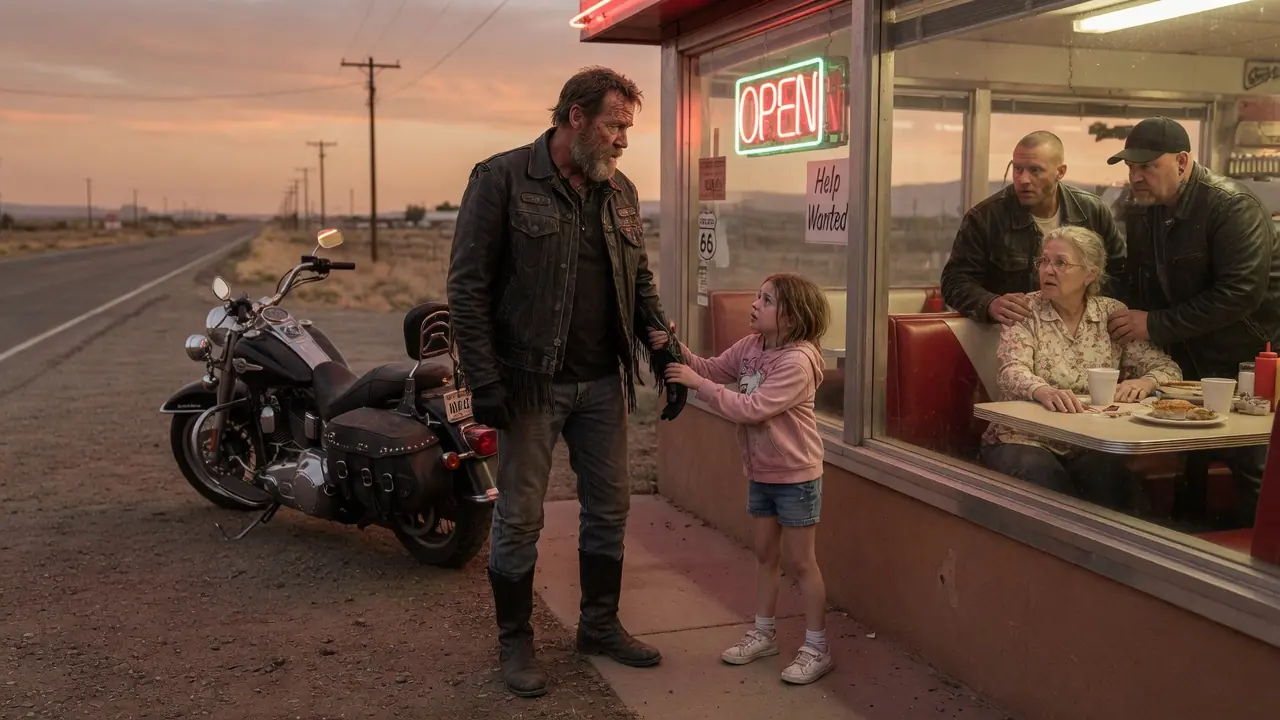
The dust of a 100-mile ride clung to the leather of his jacket like a second skin. He swung a heavy leg over the Harley, the engine groaning into silence with a final satisfying shudder.
The man they called Bear didn’t look for trouble, but he had a face that suggested he knew what to do with it when it found him. A thick gray-streaked beard hid the bottom half of his face, and his eyes, set deep beneath a weathered brow, missed nothing. He was just looking for a cup of coffee that wasn’t brewed in a gas station and a slice of pie that tasted like someone’s grandmother had made it.
The roadside diner, with its flickering neon sign that buzzed, “Eat,” seemed promising enough.
He was halfway to the door when he felt it. Not a sound, not a shout, just a tiny, insistent pressure on the scarred leather of his sleeve.
He stopped.
His hand, which could crush a can without effort, froze mid-swing. He looked down.
A little girl, no older than seven, was staring up at him. Her face was pale, her eyes wide and dark with a fear so profound it seemed to steal all the color from the world around her. Her knuckles were white where she gripped his jacket. Her whole body was a single trembling nerve.
“Please,” she whispered, the words so quiet they were almost swallowed by the wind. “Please help my grandma.”
Bear’s world narrowed to that small, desperate face. He’d seen fear in the eyes of grown men, bar fighters, cornered animals, riders who’d taken a turn too fast. This was different. This was a deep, silent terror that had been brewing for a long time.
He crouched down, moving slowly so as not to startle her further. His knees popped, a reminder that he wasn’t as young as he used to be.
“What’s wrong, little one?”
His voice was a low rumble, like gravel settling.
She just shook her head, her eyes flicking nervously toward the diner’s large plate-glass window. She wouldn’t let go of his jacket.
“They won’t let her have her water,” she said, another whisper. “She needs it.”
It was such a small thing, a glass of water. But the panic in the girl’s eyes spoke of a much larger, darker story.
Bear looked through the window. He saw an elderly woman in a booth, her back straight and rigid. She was staring at a glass of water on the table, her hand hovering near it but never quite touching it.
Across from her sat two men. They were clean-cut, dressed in slacks and polo shirts, looking utterly out of place in the greasy-spoon diner.
They weren’t looking at the woman. They were looking at each other, a silent conversation passing between them. One of them subtly shook his head, and the old woman’s hand retreated from the glass as if it had been burned.
This wasn’t a family outing. This was a hostage situation in plain sight.
“Okay,” he rumbled, his gaze softening as he looked back at the girl. “I’ll help. What’s your name?”
“Lily,” she breathed.
“All right, Lily, you go back inside and sit down. Don’t look at me. Just be a good girl and eat your pancakes. Can you do that?”
She nodded, a quick, jerky motion. She let go of his jacket and scurried back inside, a tiny shadow slipping through the door.
Bear stood up, rolling his shoulders.
He wasn’t a cop. He wasn’t a hero. He was just a man who knew the look of a predator when he saw one. And there were two of them in that diner, circling the weakest members of the herd.
He pushed the door open, a small bell announcing his arrival with a cheerful, ironic jingle. The air inside smelled of stale coffee and hot grease. The waitress, a tired-looking woman with a pen tucked behind her ear, gave him a weary nod.
Bear ignored the empty counter stools and slid into a booth behind the family, one that gave him a clear view of their table in the reflection of the window. He picked up a menu he had no intention of reading. His focus was entirely on the tableau in front of him.
The grandmother, he would later learn, was a fragile-looking woman with fine silver hair and paper-thin skin. Her hands trembled, a constant, faint tremor that she tried to hide by clasping them in her lap.
The two men, who he guessed were in their late 40s, controlled the space around them with an unnerving stillness. They spoke in low, calm tones, but their presence was a suffocating blanket.
The waitress came to their table.
“Can I get you folks anything else? More coffee?”
“We’re fine,” the man on the left said, his voice smooth but with an edge of dismissal.
He didn’t even look at her.
“I… I would like some more water,” the grandmother said, her voice thin and ready.
The second man placed a hand on her arm. It looked like a gesture of comfort, but Bear saw the way his fingers pressed down. Just a little too hard.
“Now, now, Annalara, you know what the doctor said. Not too much liquid. It makes your feet swell.”
Her face fell, a mask of confusion and disappointment. She looked at her empty glass, then back at her lap.
Lily, the little girl, watched this exchange with those same terrified eyes, methodically cutting a single pancake into dozens of tiny perfect squares she never ate.
Bear felt that cold knot in his stomach tighten. He’d spent enough years on the road to develop a finely tuned instinct for danger, a sixth sense that had saved his skin more than once, and every single nerve was screaming at him now.
Something was fundamentally wrong here.
It was in the way the men isolated the woman, the way they spoke for her, the way they used her health as a weapon against a simple request.
Bear flagged down the waitress.
“Coffee,” he said. “Black. And a glass of water.”
When she brought them, he drank the coffee but left the water untouched. He just sat, a silent, leather-clad mountain, watching the reflection in the glass.
He saw the man on the right pull out a sheath of papers from a briefcase. He spread one on the table, pushing it in front of the grandmother along with a pen.
“Just a few more signatures, Lara,” he said, his voice a honeyed poison. “Then we can get you settled. No more worries.”
She stared at the paper, her hand trembling too much to even hold the pen.
“I… I don’t know, Robert. It feels rushed.”
“It’s for your own good,” the other man, Richard, chimed in. “We’re just trying to take care of you.”
Lily looked up from her pancakes, her eyes locking with Bear’s in the reflection. It was a silent, desperate plea.
Do something.
He had a choice. He could drink his coffee, pay his bill, and get back on his bike. He could ride another 100 miles and forget he ever saw them. It wasn’t his business. Getting involved with other people’s families was a messy, dangerous game.
These men were clean, quiet, and professional. They had the cold, dead eyes of people who were used to getting their way, no matter the cost. Confronting them could go sideways in a dozen different ways.
But then he saw the little girl again, her small shoulders slumped in defeat. He saw the grandmother, a prisoner at her own table, being denied a simple glass of water. He thought of his own daughter, taken by sickness too young, and the promise he’d made to himself to never stand by and watch someone suffer if he could help it.
The choice was never really a choice at all.
He stood up. The worn floorboards creaked under his weight. Every eye in the small diner turned to him. The two men, Robert and Richard, looked up, their faces hardening into masks of annoyance.
Bear walked over to their table, moving with a deliberate, unhurried pace. He picked up his untouched glass of water from his booth as he went.
He stopped beside their table, his large frame casting a shadow over them. He placed the glass of water gently on the table directly in front of the old woman.
“Here,” he said, his voice calm but carrying the weight of a final judgment. “Looks like you could use this.”
Ara looked from the glass to his face, her eyes wide with a mixture of fear and a dawning, fragile hope.
Robert, the one with the papers, was on his feet in an instant.
“Excuse me,” he said, his voice tight with controlled fury. “This is a private family matter. I suggest you go back to your seat.”
“Doesn’t look very private,” Bear replied, not moving a muscle.
His gaze was fixed on the grandmother.
“Ma’am, are you all right? You seem distressed.”
“She’s fine,” Richard snapped, his hand once again gripping Allara’s arm. “She’s just a little confused today.”
“She looks thirsty to me,” Bear said.
He nudged the glass a little closer to her.
“Drink,” he said softly, his eyes locking with hers. “It’s just water.”
For a second, nobody moved.
The entire diner was frozen in a thick, humming silence. The only sound was the buzz of the fluorescent lights overhead.
Ara stared at the glass as if it were both salvation and a death sentence. Then, with a shaking hand, she reached for it. Her fingers closed around the cool, slick surface.
Richard’s grip on her arm tightened.
“I don’t think that’s a good idea.”
Bear’s eyes shifted from the woman to Richard’s hand on her arm. He didn’t say a word. He just looked.
It was a look that stripped away the polo shirt and the clean-cut facade. A look that spoke of cracked pavement and broken bones. It was a look that promised consequences.
Slowly, like a snake uncoiling, Richard released her arm.
Allara brought the glass to her lips and drank. She drank it all, a long, desperate series of swallows, as if she hadn’t had water in days. When she was done, she set the glass down and took a deep, shuddering breath.
A little bit of color returned to her cheeks. She looked up at Bear, and for the first time, he saw a flicker of strength in her eyes.
“Thank you,” she whispered.
“That’s enough,” Robert said, stepping between Bear and the table.
He was shorter than Bear but carried himself with an arrogant confidence.
“You’ve had your little moment of charity. Now leave us alone before I call the police.”
“Go ahead,” Bear said, his voice a low growl. “I’m sure the sheriff would be very interested to know why you’re withholding water from an elderly woman, and what’s in these papers you’re so eager for her to sign.”
He nodded toward the legal documents on the table.
Robert’s face paled slightly. He hadn’t counted on this. He’d counted on a silent, compliant victim in a world of strangers who would mind their own business. He hadn’t counted on a 250-pound biker with a spine of steel and a deep-seated sense of justice.
The waitress, who had been watching from behind the counter, now had a phone in her hand. She met Bear’s eyes and gave him a tiny, almost imperceptible nod.
Help was on the way.
He just had to hold the line.
“This is none of your concern,” Richard hissed, rising to stand beside his brother.
They were a united front now. Two wolves trying to stare down a bear.
“We are her nephews. We are her legal caretakers.”
“Caretakers,” Bear repeated the word, letting it hang in the air, thick with sarcasm. “That what you call it? A caretaker makes sure someone gets what they need. You two seem more interested in what you can get.”
He saw the flash of anger in Robert’s eyes, the tightening of his jaw. The man was used to control, to wielding his quiet intimidation like a scalpel. He wasn’t used to being challenged, especially not by someone like Bear.
The situation was escalating, the air crackling with unspoken violence. Bear knew he had to get the woman and the child out of there. He took a step back, creating a small path.
“Ma’am,” he said, his voice gentle again as he addressed Allara. “Why don’t you and your granddaughter come with me? We can wait for the sheriff outside.”
“She’s not going anywhere with you,” Robert snarled, moving to block her.
Bear didn’t even look at him. His focus was on Allara, offering her a choice, a lifeline.
For a moment, she hesitated, fear warring with the newfound spark of defiance in her eyes. She looked at Lily, who was watching her, her small face a canvas of hope.
That was all it took.
Allara began to slide out of the booth.
That’s when Robert made his move. He reached for her, not with the fake gentleness of before, but with a raw, angry desperation.
“You are not leaving.”
Bear’s arm shot out, a piston of muscle and leather blocking Robert’s path. He didn’t grab him, didn’t push him. He just created a wall.
“Don’t touch her.”
The threat was no longer veiled. It was raw and immediate.
The two nephews exchanged a look. They had lost control of the situation inside the diner. Their only option was to reestablish it outside. Richard gave a curt nod, and they both stepped back, their expressions shifting from anger to cold calculation.
“Fine,” Robert said, his voice dangerously calm. “Let’s all go outside and have a chat.”
Bear knew it was a trap, but it was also his only way out. He nodded to Allara and Lily.
“Stay right behind me.”
He turned and walked toward the door, every sense on high alert. He could feel the two men following close behind, their footsteps silent and predatory. Ara held Lily’s hand in a death grip. The little girl didn’t make a sound, her bravery a silent testament to her love for her grandmother.
The moment they stepped out into the harsh sunlight of the parking lot, the atmosphere changed. The enclosed space of the diner had held the violence in check. Out here, under the wide-open sky, the rules felt different.
Robert and Richard flanked them, cutting off their path to Bear’s motorcycle or any other car.
“You’ve made a very big mistake,” Richard said, his voice low and menacing. “You have no idea who you’re dealing with.”
“I’m dealing with two cowards who get their kicks bullying an old woman and a little girl,” Bear shot back, positioning himself between them and his charges. “Now back off.”
“We’re not going anywhere without our aunt,” Robert said, pulling out his phone. “She’s a vulnerable adult. I’m calling the authorities to report that you’re attempting to kidnap her.”
It was a smart move, a way to twist the narrative, to make Bear the aggressor.
But before he could even dial, the distant but unmistakable sound of a siren split the air. The waitress had been true to her word.
Relief washed over Bear, but he didn’t let it show. He had to keep them there.
The nephews’ faces tightened. The sound of the siren was a death knell for their plan. Their clean, quiet little crime was about to get very loud and very public. Panic began to replace their cold confidence.
“We’re leaving,” Robert said abruptly, grabbing his brother’s arm. “This isn’t over.”
They turned and walked quickly toward a nondescript sedan parked at the edge of the lot, their shoulders hunched. They were running.
Bear watched them go, his body still coiled and ready for a fight that never came. He only relaxed when their car peeled out of the parking lot, spitting gravel.
He turned to Allara and Lily. The old woman was leaning against the diner wall, breathing heavily, her face ashen. Lily was crying silently, tears tracking clean paths through the dust on her cheeks.
“It’s okay,” Bear said, his voice softer than he thought possible. “You’re safe now.”
The sheriff’s cruiser pulled in moments later, followed by an ambulance. As the paramedics began to attend to Allara, checking her vitals, Bear noticed her purse. She was clutching it to her chest as if it contained the crown jewels. Her knuckles were white.
“Ma’am,” one of the paramedics said gently. “Do you have any medical information with you? A list of medications?”
Allara seemed unable to speak. Her eyes glazed over with shock and exhaustion. She just shook her head.
But Lily, standing by Bear’s leg, pointed a small finger at the purse.
“It’s in there,” she said. “They took her pills out.”
With trembling, silent permission, the paramedic opened the purse, and what he found inside made Bear’s blood run cold.
It wasn’t just a wallet and some tissues. Tucked into a side pocket was a laminated medical alert card. On it, in stark black print, were the words:
Severe cardiac condition. Hypertrophic cardiomyopathy.
Below that was a list of medications, one of which was circled in red. It was a beta blocker, a drug she needed to take at a precise time every day to keep her heart from failing. An empty, clearly labeled prescription bottle lay beside it.
She was hours overdue for her dose.
But that wasn’t the most shocking part.
Beneath the medical card was the sheath of legal papers Bear had seen inside. It was a durable power of attorney and a revised last will and testament. The documents would grant her two nephews, Robert and Richard, complete control over her finances, her property, and all her medical decisions.
And at the bottom of the last page, there was a wavering, half-finished signature.
Allara’s signature.
The plan became horrifyingly clear.
They weren’t just neglecting her. They were actively engineering a medical crisis. They were withholding her life-saving medication, denying her even water to exacerbate her condition, all while trying to coerce her into signing over her entire life to them.
In her weakened, confused state, she had almost done it.
If Bear hadn’t intervened, she would have signed the papers, and then, very likely, she would have had a tragic accident in a quiet, isolated place where no one was watching.
The paramedic swore under his breath and immediately began administering treatment.
The sheriff, a grim-faced man who’d seen his share of darkness, looked at Bear.
“You did a good thing here today,” he said, his eyes conveying a deep professional respect. “A very good thing.”
Bear just nodded, his throat thick with emotion.
He looked at Lily, who had wrapped her arms around his leg and was refusing to let go. He gently patted her head, the large, calloused hand a stark contrast to her fine hair.
He hadn’t been looking for trouble, but trouble had found him in the form of a small girl with the courage to ask a stranger for help.
The epilogue to that day in the dusty parking lot wasn’t written in a single afternoon. It was written over years.
Robert and Richard were apprehended two states over a week later, trying to cross the border. The evidence against them was overwhelming. The waitress’s testimony, the legal documents, and Allara’s medical records painted a clear and chilling picture of elder abuse, fraud, and conspiracy. They were sentenced to a long time in prison, their greed leading them to a cage of their own making.
Allara, with proper medical care and away from the suffocating presence of her nephews, recovered with remarkable speed. The tremors in her hands subsided. The light returned to her eyes. She and Lily moved to a small, quiet town by the coast, leaving behind the house and the memories that had almost become their tomb.
But they didn’t leave everyone behind.
Bear, or Arthur as they came to know him, became a permanent fixture in their lives. The first time he visited them in their new home, he’d felt awkward and out of place. His dusty leather and rumbling Harley were a strange sight in their peaceful neighborhood.
But Lily had run out the door and thrown her arms around him, and Allara had welcomed him with a pot of coffee and a slice of homemade apple pie that was everything he’d ever hoped a diner pie would be.
He became their guardian, their friend, their family.
His motorcycle club, the Sons of Redemption, unofficially adopted them. Once a year, a dozen rumbling Harleys would descend on the small coastal town, the large tattooed men bringing toys for Lily and spending the day doing yard work for Ara. Their fierce loyalty became a protective shield around the little family.
Years passed, the dust settled, wounds healed.
The final scene of the story took place on a bright sunny afternoon. Lily, now a confident young woman of 18, stood on a stage in a cap and gown, her high school diploma in hand.
In the audience, two figures sat side by side.
Allara, her silver hair shining in the sun, looked the picture of health, her face beaming with pride. Beside her sat Arthur. He wore his leather vest over a clean, pressed shirt, his beard neatly trimmed. He looked less like a bear now, and more like the proudest grandfather in the world.
Later that evening, on the porch of their small house, the three of them raised glasses of lemonade. The setting sun painted the sky in shades of orange and purple.
“I want to make a toast,” Lily said, her voice clear and strong.
She looked at Arthur, her eyes shining with a gratitude that time had only deepened.
“To the heroes who don’t wear capes.”
Arthur smiled, a rare, gentle thing.
“And to the small voices,” he added, his gaze meeting hers, “that have the courage to roar.”
They clinked their glasses together, a small, perfect sound against the backdrop of the evening crickets.
A single act of paying attention, of trusting an instinct, of choosing to get involved, had not just saved two lives. It had created a new one.
A family forged not by blood, but by courage and compassion.
Heroes don’t always wear capes. Sometimes they wear leather and ride a Harley. Sometimes they’re the person who just decides to pay attention when the world is telling them to look away.