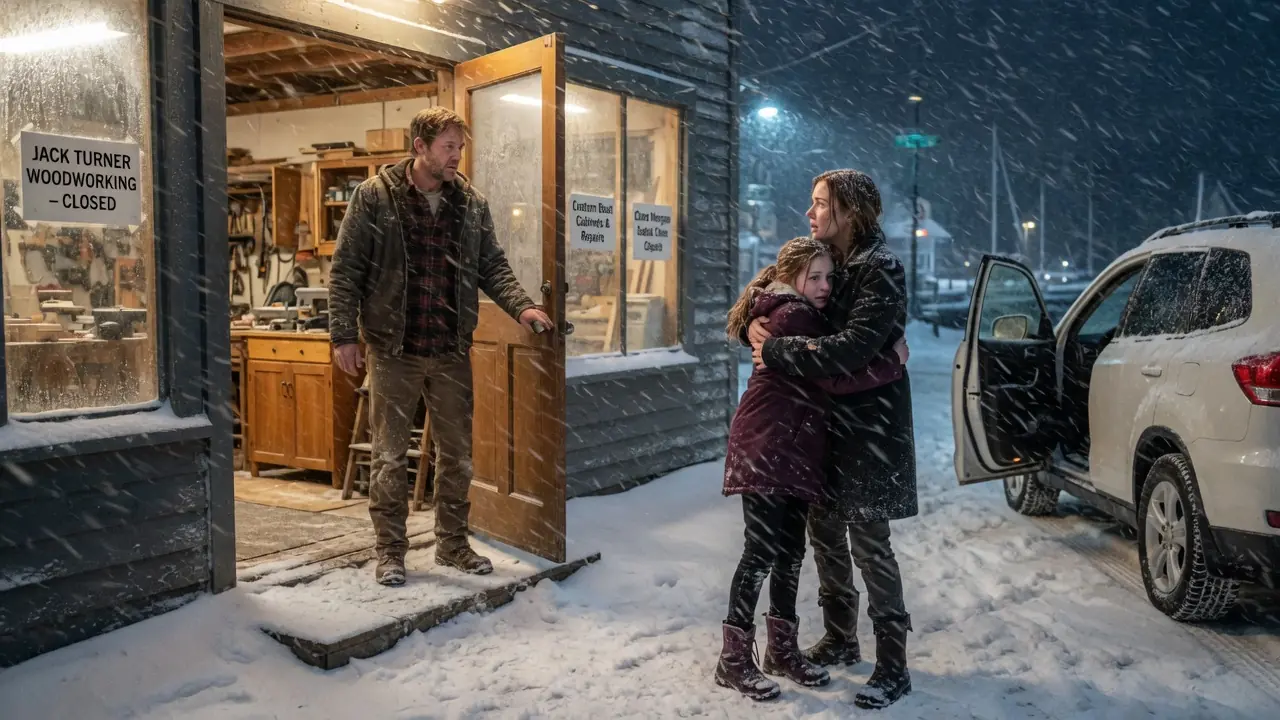
The winter storm hammered the small coastal town with a fury that hadn’t been seen in decades. Jack Turner pulled the workshop door against the howling wind, ready to call it a night, when headlights swept across the frosted windows. A white SUV skidded to a stop outside, engine sputtering through the swirling snow. He saw a woman emerge, clutching a small child against her chest, both of them shivering violently in the Arctic blast.
Jack Turner had learned long ago that life rarely followed the plans you made for it. Five years had passed since cancer took his wife, Sarah, leaving him to raise their son, Eli, alone in this quiet harbor town, where his grandfather had first opened the woodworking shop in 1947. At 36, Jack had the weathered hands of a craftsman and the cautious heart of a widower who’d learned that love could vanish as quickly as morning fog over the harbor.
He knew every grain pattern in the workshop’s old beams, every creak in the floorboards of the apartment above where he and Eli lived, simply surrounded by the scent of cedar and pine. The town’s people respected Jack’s skill with wood and his quiet reliability, though few knew the depth of grief he’d channeled into each piece of furniture he crafted late into the night when sleep wouldn’t come.
Clare Morgan existed in an entirely different world, though fate had brought her to Jack’s door on this brutal night. At 32, she commanded boardrooms with the same natural authority that had propelled her to CEO of Morgan Enterprises before her 30th birthday. Her rise through the corporate ranks had been meteoric, a combination of brilliant strategic thinking and an almost supernatural ability to see market patterns before her competitors.
But power and success hadn’t shielded her from Victor Cain’s calculated cruelty. Their marriage had begun as a merger of equals, two ambitious people who mistook intensity for passion. The divorce had made headlines in the business journals, though the real story, the subtle threats, the financial manipulation, the way he’d used their daughter Sophie as a weapon, remained hidden behind legal documents and non-disclosure agreements.
Clare had spent the last two weeks moving from hotel to hotel, paying cash, staying off the grid, trying to protect seven-year-old Sophie from a father who saw her not as a daughter, but as leverage in his twisted game of control.
They had crossed paths once before at a community fundraiser six months earlier. Jack had been donating a handcrafted rocking chair for the auction, a piece made from reclaimed ship timber that had taken him three months to perfect. Clare had been there representing her company’s charitable foundation, her presence commanding attention even as she tried to blend into the small-town crowd.
Their interaction lasted barely 30 seconds. A polite nod, a murmured appreciation for his craftsmanship, her fingers briefly touching the smooth armrest he’d spent hours sanding before the crowd swept them in different directions. Neither could have imagined that their next meeting would unfold under such desperate circumstances that the memory of that brief encounter would resurface now in the midst of crisis.
Jack opened the workshop door wider, reading the fear beneath Clare’s composed exterior, recognizing the particular terror that came from running, not from something, but from someone.
“Please,” she said, her voice barely audible above the wind. “The roads are blocked. We just need somewhere safe until morning.”
Sophie’s face was buried in her mother’s shoulder, small body trembling from more than just cold. Without hesitation, Jack ushered them inside, knowing that sometimes the universe sends you exactly who you’re meant to help, exactly when they need it most, even if you don’t understand why until much later.
The apartment above the workshop radiated warmth from the old cast-iron stove that had heated the space for three generations. Jack led them up the narrow stairs, each step creaking its familiar welcome. Clare’s designer heels clicked against worn wood that had supported his family’s footsteps for decades. Sophie’s small hand now gripped her mother’s tightly, knuckles white with a child’s instinctive understanding that something was wrong, even if she couldn’t name it.
Eli looked up from his book, one of those adventure stories about kids who solved mysteries and saved the day, surprise flickering across his 10-year-old face at the unexpected visitors.
“This is Miss Morgan and her daughter, Sophie,” Jack said simply, his tone conveying that no further explanation was needed, that sometimes hospitality didn’t require understanding. “They’ll be staying until the storm passes.”
What struck Jack most was how quickly the children adapted to each other’s presence, as if they recognized something kindred in one another. Perhaps the loneliness that comes from being the only child in a single-parent home. Within minutes, Eli had offered Sophie his favorite blanket, the one Sarah had crocheted during her first round of chemotherapy, and was showing her how to toast marshmallows over the stove’s open door, a winter tradition his mother had started years ago when the power would go out during storms.
Sophie’s initial shyness melted away as Eli patiently taught her the perfect distance to hold the stick, how to rotate it slowly for even browning, how to blow out the flame when it inevitably caught fire. Their laughter filled the space that had been too quiet for too long, bringing a lightness Jack hadn’t felt in years, reminding him that joy could still exist even after loss.
Clare perched on the edge of the worn leather sofa, her posture still rigid despite the warm environment, every muscle coiled as if ready to run at a moment’s notice. She kept her phone in her hand, checking it obsessively, even though she’d claimed it had no signal, the screen’s light reflecting off her face in the dim room.
Jack noticed how her eyes tracked every sound from outside, each gust of wind, each creak of the building, each distant rumble that could be thunder or could be something else entirely, as if expecting danger to burst through the door at any moment.
He brought her tea in a handmade mug, one of Sarah’s last pottery pieces before her hands became too weak to work the wheel, and Clare’s fingers wrapped around it gratefully, seeking warmth and perhaps comfort.
“You’re safe here,” Jack said quietly, settling into the chair across from her, the same chair where he’d sat countless nights watching Sarah sleep during her illness, learning that sometimes presence was more important than words. “This building has weathered worse storms than this one.”
“I wish it were just the storm I was worried about.”
The children had moved to the window, Eli pointing out where the harbor usually lay beyond the wall of white, describing the boats that would bob there in summer, the lobster traps stacked on the docks. Sophie pressed her nose to the glass, leaving little fog circles that Eli turned into smiley faces with his finger. And for a moment, she was just a seven-year-old girl enjoying a snow day.
Their innocent joy stood in sharp contrast to the tension radiating from Clare’s body, the way she kept positioning herself to see all exits, the way her hand occasionally moved to her pocket as if checking for something.
“Mom, look,” Sophie called out, her voice bright with wonder. “Eli says sometimes you can see seals from here when it’s not snowing. Real seals, not just the ones in the aquarium.”
“That’s wonderful, sweetheart,” Clare replied, her voice softening for her daughter while her knuckles stayed white around the mug.
The maternal instinct to protect was warring with the exhaustion of constant vigilance. Jack recognized the signs of someone running from something more dangerous than weather. He’d seen it before in a neighbor who’d fled an abusive relationship, the way she jumped at doorbell rings for months afterward. He’d seen it in a friend who’d witnessed something they shouldn’t have, constantly looking over their shoulder, even in the safety of their own home.
The way Clare startled at every unexpected sound. How she positioned herself between Sophie and the door. The careful way she chose her words as if they might be used against her later. All of it spoke of a fear that had nothing to do with the blizzard raging outside.
As the evening deepened and the children began to yawn, their energy finally depleted by excitement and warmth, Jack made up the small guest room that had once been his wife’s craft space. The walls still held faint marks from her design sketches, dreams of quilts she’d never finish.
Clare tucked Sophie in with a gentleness that revealed the fierce love beneath her polished exterior, singing a lullaby so quietly Jack could barely hear it from the hallway. When she returned to the living room, her shoulders finally began to drop, exhaustion winning its battle against hypervigilance.
“Thank you,” she whispered.
And Jack understood she meant for more than just the shelter. For not asking questions, for creating normalcy for Sophie, for offering safety without conditions.
The truth emerged slowly, like ice melting under warm water, each revelation adding another layer to the story. Clare sat with her second cup of tea, the children asleep in their respective rooms, the storm creating a white noise buffer between them and the world that seemed increasingly dangerous with each detail she shared.
Jack had learned patience in his years of working with wood. You couldn’t rush the grain, couldn’t force the joints, had to let the material tell you what it wanted to become. People, he’d found, were much the same, their stories emerging in their own time.
“Victor won’t stop,” Clare finally said, her voice barely above a whisper, as if speaking louder might somehow summon him. “My ex-husband. He’s not used to losing, and the divorce was the first time anyone ever told him no.”
Jack remained silent, letting her words find their own rhythm, understanding that sometimes the most important thing was simply to witness someone’s truth. Outside, the wind had picked up, rattling the old windows in their frames. But the sound seemed distant compared to the weight of Clare’s story.
“He comes from old money, the kind that’s been making rules for so long they’ve forgotten rules apply to them, too. His father is a federal judge. His uncle runs the second-largest investment firm on the East Coast. When we met, I thought his confidence was attractive. His connections were just good business. I didn’t realize until too late that to him, everything is a transaction. Everyone is either useful or disposable.”
Clare’s hands trembled slightly as she set down the mug.
“When I filed for divorce, he laughed. Said I’d never work in business again, that he’d destroy everything I’d built. When the court granted me primary custody of Sophie anyway, he told me I’d regret it. Said he’d make sure I understood what real power looked like.”
“And the police?” Jack asked, though he suspected the answer from the defeat in her shoulders.
“Victor’s golf buddy is the deputy chief. Another friend sits on the state supreme court. His former roommate from Princeton runs the largest private security firm in three states. Every complaint I filed disappeared, got lost in paperwork, or was dismissed as a misunderstanding. One officer actually told me I should be grateful Victor still cared enough to want to be involved in Sophie’s life.”
She looked directly at Jack for the first time since beginning her story, her eyes holding a mixture of anger and exhaustion.
“I have money, influence, run a successful company with 200 employees, and none of it matters. He systematically isolated me from every support system, froze assets through legal challenges, painted me as an unstable mother in the media. There are three different gossip blogs running stories about my supposed mental breakdown, complete with photoshopped images of me at facilities I’ve never been to.”
Jack understood powerlessness, though his had come in the form of medical helplessness, watching Sarah fade despite all their prayers and treatments, despite the specialists and experimental procedures. But this was different. A deliberate cruelty inflicted by someone who’d once claimed to love her, who’d stood beside her at an altar and promised to cherish and protect.
“Two weeks ago, I found a tracking device on my car, hidden inside the rear bumper. Then strange men started showing up at Sophie’s school, claiming to be security consultants evaluating campus safety. The principal called me, concerned. They had legitimate-looking credentials, but something felt wrong. That night, Sophie told me a man at the playground asked her if she’d like to visit her daddy. Said he had a special surprise waiting. That’s when I knew we had to run.”
“How did you end up here?” Jack asked. “This town isn’t exactly on the way to anywhere.”
“That’s precisely why I chose it. Random turns, no pattern, no destination. I’ve been paying cash only, using fake names at motels, switching cars twice, using rental agencies that don’t require credit cards. I thought I’d been careful enough.”
She pulled out her phone, showed him the screen where no bars appeared, the storm having knocked out the cell towers.
“I disabled the GPS, took out the SIM card, even had a friend check for tracking software. But Victor has resources I probably don’t even know about, connections in places I can’t imagine.”
The weight of her situation settled into the room like another presence, heavy and suffocating. Jack thought of Eli, safe and innocent in his bed, of Sophie, who deserved the same peaceful childhood, the same chance to worry about nothing more serious than tomorrow’s homework.
Some fights, he realized, chose you whether you were ready or not.
“You can stay as long as you need,” he said, meaning it. “This town takes care of its own. And right now, that includes you and Sophie.”
Clare’s eyes glistened with unshed tears.
“You don’t know what you’re offering, what he’s capable of. He destroyed my business partner’s career just for supporting me during the divorce. Had him audited, investigated, harassed until he had to leave the state.”
“Maybe not,” Jack agreed, remembering his own battles, different but no less consuming. “But I know what it’s like to protect someone you love. And I know that running only works if you have somewhere to run to.”
The wind outside seemed to pause, as if the storm itself was holding its breath. And in that moment of silence, they both heard it. The low rumble of an engine somewhere beyond the white curtain of snow, too steady to be thunder, too deliberate to be coincidence.
Jack moved to the window first, careful to stay to the side, peering out through the narrow gap between frame and wall, using skills he’d learned in the Navy 20 years ago, before woodworking, before Sarah, before his life became about creating rather than destroying.
The workshop’s exterior floodlight, motion-activated and battery-powered, hadn’t triggered, which meant whoever was out there was staying beyond its range, watching, waiting. Through the dense snowfall, he could make out headlights, stationary but lit, like eyes in the darkness. They weren’t moving, just sitting there about 50 yards away, engine running, patient as predators evaluating prey.
“Eli’s room,” he said quietly to Clare, his voice carrying the calm authority of someone who’d made decisions under pressure before. “Wake Sophie. Keep them together, away from windows. The closet in there is reinforced. Used to be a safe room when bootleggers owned this place during Prohibition.”
Clare didn’t question, didn’t hesitate, recognizing the voice of someone who knew how to handle danger. She moved with the fluid efficiency of someone who’d rehearsed this scenario in their mind dozens of times, probably lying awake in anonymous motel rooms, planning for the worst.
Jack heard her gentle voice rousing the children, Eli’s sleepy confusion mixing with Sophie’s immediate alertness. The child had learned to read her mother’s fear like a barometer.
Jack killed the lights throughout the apartment, plunging them into darkness save for the faint glow from the stove’s dying embers. His eyes adjusted quickly, muscle memory guiding him through the familiar space where he’d navigated countless times in the dark during Sarah’s illness, when he’d check on her without wanting to wake her.
He grabbed his phone, found it dead. The storm had knocked out more than just the cell towers, probably taken down power lines throughout the county. The landline in the workshop might still work, but that would mean leaving them alone up here, vulnerable.
Through the window, he watched a second set of headlights join the first, positioning itself at a different angle, covering more ground. Then a third vehicle arrived, completing a loose triangle formation. Three vehicles for one woman and a child. This wasn’t a rescue party. This was a hunting party.
Clare returned to his side, her breath shallow but controlled.
“I found it,” she whispered, holding up a small device no bigger than a quarter, its tiny LED light still blinking green. “It was sewn into Sophie’s favorite stuffed animal, inside Mr. Buttons. The one thing I never thought to check because she’s had it since she was two. Victor gave her a new improved version for her birthday last month. Said the old one looked worn out. She won’t sleep without it.”
The cruelty of it, using a child’s comfort object as a tracking device, corrupting something innocent into a tool of surveillance, told Jack everything he needed to know about Victor Cain. This wasn’t about custody or even control. This was about winning, about proving that Clare could never escape his reach, that his power extended into every corner of her life, even into their daughter’s bed.
“Is there another way out?” Clare asked, her CEO composure cracking under maternal terror. The executive who’d handled hostile takeovers was facing something far more personal.
“Loading dock in the back of the workshop leads to the old pier road. From there, it’s about 300 yards to the tree line, but in this snow, with the kids…”
Jack trailed off, calculating distances and dangers, wind speed and visibility.
“There’s an old fishing cabin about a quarter mile through the woods. My friend Tom owns it. Keeps it stocked for emergencies. Food, water, emergency radio. If you can make it there, you can wait out the storm. Call for help when the phones come back.”
“What about you?”
Jack was already moving, pulling on his boots, grabbing the emergency kit from the closet, checking the flashlight batteries with practiced efficiency.
“Someone needs to buy you time. Make them think you’re still here. Maybe heading out the front.”
He handed her a flashlight, his workshop keys, and a hand-drawn map he sketched quickly on the back of an envelope.
“The blue key opens the loading dock. Follow the tree line. Keep the wind at your back. Tom’s cabin has a red door. Only one out there. The spare key is under a fake rock by the left corner of the porch.”
“I can’t let you.”
“Yes, you can.”
His voice carried the quiet authority of someone who’d already made peace with his decision, who understood that some stands were worth taking regardless of the cost.
“I know this building like my own heartbeat. I know these woods, every trail and hollow. I know this storm and how it moves. You get the kids to safety. That’s all that matters now.”
The phone in Jack’s pocket suddenly buzzed. Apparently, one carrier service had flickered back to life temporarily, probably bouncing off a tower further inland. Unknown number, but he didn’t need caller ID to know who it would be.
He answered, knowing he was entering a negotiation where the other party held most of the cards.
“Mr. Turner.”
The voice was cultured, cold, completely at odds with the violence of the storm, like hearing a snake speak in a British accent.
“My name is Victor Cain. I believe you have something that belongs to me.”
Jack felt Clare tense beside him, her hand moving instinctively toward the stairs where the children waited, but he squeezed her shoulder gently, signaling her to stay quiet, to let him handle this opening gambit.
“I have two guests who needed shelter from the storm. Last I checked, that’s not a crime, even in this state.”
“Don’t play games with me, Turner. I know exactly who you are. Small-town carpenter. Widower. Struggling to make ends meet. Raising a boy alone. Navy veteran. Honorable discharge. Clean record, except for a few late mortgage payments after your wife’s illness. You have no idea what you’ve stepped into here.”
The casual recitation of his personal information was meant to intimidate, to show the reach of Victor’s resources. Jack recognized the tactic from his military days. Psychological warfare. Establishing dominance through information asymmetry.
“I know enough,” Jack replied, watching the shadows move around the vehicles outside, counting figures, estimating numbers. “I know a bully when I hear one.”
Victor’s laugh was sharp as breaking glass.
“A bully? How quaint. I’m a father trying to protect his daughter from an unstable mother. Did Clare tell you about her mental health issues? The medication she’s supposed to be taking? The psychiatric holds that had to be placed for her own safety?”
“She told me enough to know you’re lying.”
“Did she? Did she mention the incident at Sophie’s school last month? The scene she caused at the board meeting? The restraining order I had to file after she threatened me? I have documentation, Turner. Medical records, police reports, witness statements. I’m trying to help her, to get her the treatment she needs. Just send them out and this all ends peacefully. I have doctors waiting at a private facility. The best care money can buy.”
Jack recognized the tactic. Gaslighting wrapped in concern. Lies dressed as love. The abuser’s playbook of painting the victim as the dangerous one.
“Here’s what’s going to happen, Cain. You’re going to turn those vehicles around and leave. The storm’s getting worse, and I’d hate for you to get stuck out here. Road back to town floods when the tide comes in, and that’s in about an hour.”
“You’re not listening, Turner. I have legal documents giving me emergency custody based on Clare’s mental state. My security team has authorization to retrieve my daughter by any means necessary. You’re harboring a kidnapper, interfering with a custody order. That’s a federal offense.”
“I’m sheltering a mother and child from a storm,” Jack countered, his voice steady as the beams holding up his roof. “And last I checked, your divorce decree doesn’t give you any rights to break into my home in the middle of the night with what looks like a small army.”
“Three minutes, Turner. After that, my security team comes in. They’re all former military like yourself. They’re very good at their job, and unlike you, they’re not emotionally compromised. Don’t make this harder than it needs to be.”
“Two minutes, 59 seconds,” Jack replied. “Plenty of time for me to upload the security footage from my workshop to the cloud. You know, the cameras that have been recording since your vehicles arrived. The ones that will show armed men breaking into a private residence where children are present. I’m sure the media would find that fascinating, especially given your family’s political connections.”
Silence on the line for a moment. Then Victor’s voice returned, harder now, the veneer of civility cracking.
“You have no idea what you’re risking, Turner. Your son, your business, your life in this pathetic little town. I can destroy all of it with three phone calls.”
“Two minutes, 30 seconds,” Jack said.
Then he ended the call. He turned to Clare, pulled her close enough to whisper directly in her ear, feeling her tremble against him.
“Go now. Take the kids through the workshop. Out the back. Don’t stop. Don’t look back. No matter what you hear.”
She gripped his arm with surprising strength.
“What are you going to do?”
“What I do best,” he said, managing a slight smile that he hoped was reassuring. “Work with wood.”
Clare understood. This was his territory, his domain. She pressed something into his hand, a business card, expensive stock, embossed letters.
“When this is over, if you need anything ever, lawyers, money, a new life somewhere else…”
“Just keep Sophie safe. That’s all the payment I need.”
She kissed his cheek, a gesture so unexpected and tender that it momentarily transported him back to better times, to Sarah’s goodbye kiss the morning before her final surgery. Then she was gone, moving toward the children’s room with the determined grace of a mother protecting her young.
Jack gave them 90 seconds, listening to the muffled sounds of their escape down the back stairs, the careful creak of the workshop door, the whisper of wind as it opened and closed.
Then he deliberately turned on the living room light and walked past the window, making sure his silhouette was visible, stretching as if he’d just woken up. He opened the front door to the apartment, letting it bang against the wall as if someone had left in a hurry, then knocked over a chair for good measure. He created a clear trail of disturbance leading toward the front of the building, away from the loading dock, like laying a false scent for hunting dogs.
His workshop was more than just a business. It was a three-dimensional puzzle he’d been solving for 20 years, adding equipment, reorganizing spaces, learning every corner and shadow. Every beam, every tool, every pile of lumber had purpose and potential.
In the darkness, guided by touch and memory, Jack began his preparations, his mind shifting into the tactical mode he’d thought he’d left behind with his uniform. He strung aircraft cable between the main support posts at ankle height, invisible in the darkness, strong enough to trip a running man. He balanced sheets of plywood against door frames, ready to fall at the slightest touch, creating obstacles and noise. He positioned cans of wood stain on high shelves, ready to tip and create slippery hazards.
Most importantly, he positioned himself behind the massive oak workbench his grandfather had built, solid enough to stop bullets if it came to that, though he prayed it wouldn’t.
The front door exploded inward at exactly the three-minute mark. Four men entered in tactical formation, flashlights attached to what looked like military-grade weapons. Their movements professional, coordinated. Not security guards. Mercenaries, private military contractors. The kind of men who’d learned their trade in places where rules were suggestions.
“Clear the building,” Victor’s voice crackled through their radios. “The woman and child are priority. The men are collateral, but I’d prefer no casualties if possible. Too much paperwork.”
Jack waited until the first man passed his position, then pulled the release cord he’d rigged. A hundred pounds of oak planks crashed down from the loft, sending the man sprawling, his weapon skittering across the concrete floor. The sound was tremendous in the enclosed space, designed to disorient as much as disable.
The second man spun toward the noise, caught the trip wire, and went down hard, his head striking the concrete with a dull thud. Jack was on him before he could recover, using a chokehold he’d learned in the Navy, applying just enough pressure to render him unconscious without permanent damage. The man went limp, breathing but neutralized.
The third man was smarter, more cautious. He moved along the walls, weapon sweeping in controlled arcs, using proper room-clearing technique. Jack circled opposite, using the maze of equipment and lumber to stay hidden, becoming one with the shadows he knew so well. The workshop that had been his sanctuary, his place of creation, became a tactical advantage. He knew every blind spot, every acoustic quirk, every loose board that would creak under weight.
“Turner.”
Victor’s voice boomed from outside, amplified now through what sounded like a megaphone.
“This is pointless. We have thermal imaging. We know they’re not here anymore. We tracked them to the tree line.”
Jack’s blood chilled. If they knew Clare and the children had fled, if they had that kind of equipment…
“But you interest me,” Victor continued, entering the workshop himself, expensive shoes crunching on sawdust, seemingly unconcerned about the danger. “The loyal knight protecting the damsel. How wonderfully antiquated. How perfectly naive. Did she promise you money, or perhaps something more personal? Did she play the vulnerable woman, needing a strong man’s protection?”
Jack remained silent, tracking Victor’s movement by sound, noting how the man stayed behind his security team, letting others take the risks. The man was heading toward the back, toward the loading dock, following the trail, but not fast enough to catch up.
“They can’t have gone far in this storm,” Victor mused, his tone conversational, as if discussing a minor business setback. “My men will find them within the hour. Thermal imaging, night vision, satellite phone to coordinate with the helicopter that’s standing by. But you’ve caused me inconvenience, Turner. That requires compensation.”
Jack moved silently, positioning himself between Victor and the rear exit. If Clare had made it to the tree line, she’d need at least 10 more minutes to reach Tom’s cabin in this snow, maybe 15 with the children. He needed to buy them that time.
“I looked you up, you know,” Victor continued, his voice carrying that particular cruelty of someone who enjoyed causing pain. “Sarah Turner died of pancreatic cancer five years ago. Stage four, diagnosed too late. Medical bills must have been crushing. Second mortgage on the house. Loans from friends. Fundraisers that barely covered the chemo. Is that why you’re helping Clare, hoping for a payout? Or is it something else? Does she remind you of your dead wife? Are you trying to save her because you couldn’t save Sarah?”
The mention of Sarah’s name, the casual dissection of his grief, ignited something cold and precise in Jack’s chest. He stepped out from cover, blocking Victor’s path, no longer interested in hiding.
“You want to know why I’m helping her?” Jack’s voice was steady as seasoned oak, carrying across the workshop with quiet authority. “Because I know what it’s like to watch someone you love fight something that’s trying to destroy them. The difference is Sarah’s enemy was disease. It didn’t have a choice in what it was. Clare’s enemy is you. And you’re choosing to be a monster.”
Victor smiled, all teeth and no warmth, the expression of someone who’d never faced real consequences.
“How poetic. How noble. Marcus, eliminate this problem.”
The fourth man emerged from the shadows, weapon raised, laser sight painting a red dot on Jack’s chest. Jack dove behind the industrial saw, heard the crack of gunfire, felt splinters explode above his head.
This had escalated beyond anything he’d imagined, beyond a custody dispute into something darker. But then, cutting through the storm’s howl, came the sound of salvation.
Sirens.
Multiple sirens growing louder. The distinctive wail of police, fire, and emergency services. Victor’s expression shifted from confidence to calculation. The businessman computing odds and outcomes.
“How? The phones are down.”
“Old landline in the basement,” Jack said, which was partly true.
What he didn’t mention was the silent alarm he’d installed years ago after a break-in attempt, connected directly to the sheriff’s personal cell phone through a dedicated cellular backup. His friend Tom wasn’t just a cabin owner. He was also the county sheriff, and the alarm had been triggering since the moment the first man entered the workshop.
“This isn’t over,” Victor snarled, already backing toward the exit as red and blue lights painted the snow outside, the vehicles sliding to stops despite the weather. “Legal custody is still being determined. I have rights. I have judges who owe me favors.”
“And I have witnesses,” Jack replied, gesturing to the security cameras he’d installed last summer, their red recording lights blinking steadily, having captured everything, everything that happened here tonight. “Your threats on the phone, your armed men, your admission that you’ve been tracking them with an illegal device, the gunfire at an unarmed civilian. I’m sure the court will find it fascinating, especially the part where you admitted to fabricating mental health claims.”
Victor’s face contorted with rage, the mask of civility completely gone now.
“You have no idea what you’ve done. I’ll destroy you. I’ll take everything you have.”
“I’ve already lost everything that mattered,” Jack said quietly. “And I survived. That’s the difference between us, Cain. I know what real loss is. You’re just playing games.”
The sirens were too close now. Officers were already taking positions outside. Tom’s voice boomed through a loudspeaker, ordering everyone to exit with hands visible. Victor turned to his men, his voice tight with barely controlled fury.
“We’re leaving now. My lawyers will handle this.”
They retreated into the storm, their vehicles disappearing into the white chaos as the sheriff’s SUVs surrounded the building. Tom himself led the charge inside, taking in the damage, the weapons on the floor, the unconscious men, Jack’s steady stance despite the chaos around him.
“Clare and Sophie?” Tom asked quietly, already knowing the answer from Jack’s earlier signal.
“Safe,” Jack confirmed. “Your cabin?”
Tom nodded, already directing his deputies to secure the scene, gather evidence, document everything.
“We’ll handle this. Go to them.”
“They need time to feel safe first,” Jack said. “Let them know the threat’s contained. But don’t crowd them. Sophie’s been through enough.”
Spring arrived gradually on the coast that year, ice giving way to tentative green shoots, the harbor returning to life after winter’s grip finally loosened.
Jack stood at the workshop window, the same window where he’d first seen Clare’s SUV that night, watching Eli and Sophie race along the beach, their laughter carrying on the salt breeze.
Three months had passed since the storm. Three months of legal battles that had played out in both courtrooms and headlines. Testimony that had finally shifted the narrative from Victor’s carefully crafted lies to the truth of his abuse.
Victor Cain was facing federal charges for conspiracy, assault with a deadly weapon, violating custody orders, and interstate stalking. The security footage from Jack’s workshop, combined with Clare’s documented evidence of years of abuse, had been devastating in court. The tracker in Sophie’s stuffed animal had been the final nail. Judges didn’t look kindly on parents who violated their children’s trust so fundamentally.
More importantly, Sophie was safe. Her nightmares gradually replaced by dreams of tide pools and sailing lessons that Jack had started teaching both children.
Clare had surprised everyone, most of all herself, by not returning to the city immediately. She’d rented a house two streets over, a modest Victorian that needed work. Nothing like her former penthouse life, but somehow more real. She’d opened a small satellite office for her company, running virtual meetings while being present for Sophie in a way she’d never been able to before.
The transformation was remarkable. From the polished executive who’d arrived in designer clothes to a woman who now walked the beach barefoot, who laughed freely, who’d learned to trust again.
“They’re getting along well,” Clare said, joining Jack at the window.
She’d traded her designer suits for jeans and a fisherman sweater she’d bought at the local thrift shop, though she still carried herself with that natural grace that had nothing to do with clothes and everything to do with character.
“Kids are resilient,” Jack replied, though he was thinking how Eli had bloomed since having a friend his age nearby. How Sophie had helped fill a silence in their home that he hadn’t even realized was there. The boy who’d been too serious, too quiet since his mother’s death now laughed daily, planned adventures, acted his age.
They stood together, not quite touching, but aware of each other’s presence in that way that spoke of possibility rather than certainty. Neither was ready for what this might become. Clare was still healing from years of manipulation, learning to trust her own judgment again. Jack was still carrying Sarah’s memory like a warm stone in his pocket, not ready to let go, but beginning to understand that making room for new love didn’t mean erasing old love.
But there was something here, patient and unhurried as wood grain forming over years, strong because it grew slowly.
“I never thanked you properly,” Clare said, her voice soft. “For that night, for everything after. For testifying when you didn’t have to. For facing Victor’s lawyers. For making sure Sophie felt safe.”
“Every single day since, you did,” Jack reminded her. “Every time you walked into that courtroom and told the truth. Every time you stood up to him. Every time you chose to stay here instead of running again.”
She turned to face him fully, and he could see the executive she’d been and the woman she was becoming, both existing in the same person.
“I’m not talking about the legal victory. I’m talking about you showing me that not every man who offers protection expects payment. That strength doesn’t always come with conditions. That sometimes people help simply because it’s right.”
Before Jack could respond, the kids burst through the door, faces flushed with excitement and adventure, bringing the smell of sea salt and sunshine with them. Sophie was clutching a piece of sea glass, green as spring itself, while Eli carried a piece of driftwood that would definitely become part of a fort later.
“Mom, Jack, look what we found!” Sophie’s voice was bright, unguarded, so different from the frightened child who’d arrived in the storm. “Eli says if we collect enough, we can make a window hanging.”
“There’s a seal, a real seal. Can we go back and see?” Eli added, already heading for the door again, his enthusiasm infectious.
“After lunch,” Clare laughed, the sound genuine and free, no longer carrying the edge of anxiety that had defined her for so long. “And only if Jack comes with us.”
“I suppose I could close the shop early,” Jack said, catching Eli’s hopeful grin. “Seems like a good day for seal watching.”
As they gathered jackets and packed sandwiches, Clare working alongside him in the kitchen with an ease that suggested familiarity, Jack caught her eye. She smiled, soft and real, and he felt something shift in his chest. Not the sharp pain of loss he’d carried for so long, but something else. An opening, a beginning, the understanding that hearts could expand rather than replace, that love wasn’t a zero-sum game.
They walked to the beach as a group, but not quite a family. Not yet. That would come later, slowly, built with the same patience and care Jack brought to his craft. For now, it was enough to walk together toward the water, four people who’d found each other in a storm and chosen to stay when the weather cleared, chosen to build something new from the pieces of their broken pasts.
The seals were there, just as the children had promised, sunning themselves on the old pier posts, whiskers twitching in the afternoon light. Sophie slipped her hand into Jack’s as they watched, a gesture so natural and trusting that it took his breath away.
On his other side, Eli was explaining seal facts he’d learned at school, his voice animated, while Clare listened with genuine interest, asking questions that made him beam with pride.
“Did you know they can hold their breath for up to two hours?” Eli said, his knowledge overflowing. “And they can dive really deep, like 300 feet.”
“That’s amazing,” Clare responded, and meant it. “You know so much about them.”
“Mom used to take me to watch them,” Eli said. And for the first time, mentioning his mother didn’t carry only sadness. “She said they always come back to the same places, like they remember where home is.”
This was what Victor Cain, with all his power and money, could never understand. That real strength came from protection freely given, that love grew in safety and patience, that sometimes the most precious things were built not from force, but from choosing again and again to show up for each other.
That healing happened not in grand gestures, but in small moments like this, watching seals on a Tuesday afternoon, building trust one shared experience at a time.
The sun was warm on their faces, spring finally keeping its promise of renewal. Somewhere in Jack’s workshop, the chair he was building sat unfinished, but that was all right. There was time. There was always time for the things that mattered, for the careful work of building something meant to last.
The storm had brought them together, but it was choice that kept them here. Choice that would eventually transform four broken pieces into something whole and strong and beautiful.
As they walked back home, Sophie chattering about the seals, Eli planning tomorrow’s adventure, Clare’s hand briefly brushing Jack’s in a touch that promised without demanding, Jack thought about Sarah, about how she would have loved this moment, these people. He thought she would have understood that love wasn’t diminished by being shared, that hearts could hold multiple truths simultaneously.
The storm had passed, but what it had brought to shore was just beginning to reveal itself, like sea glass polished by waves.