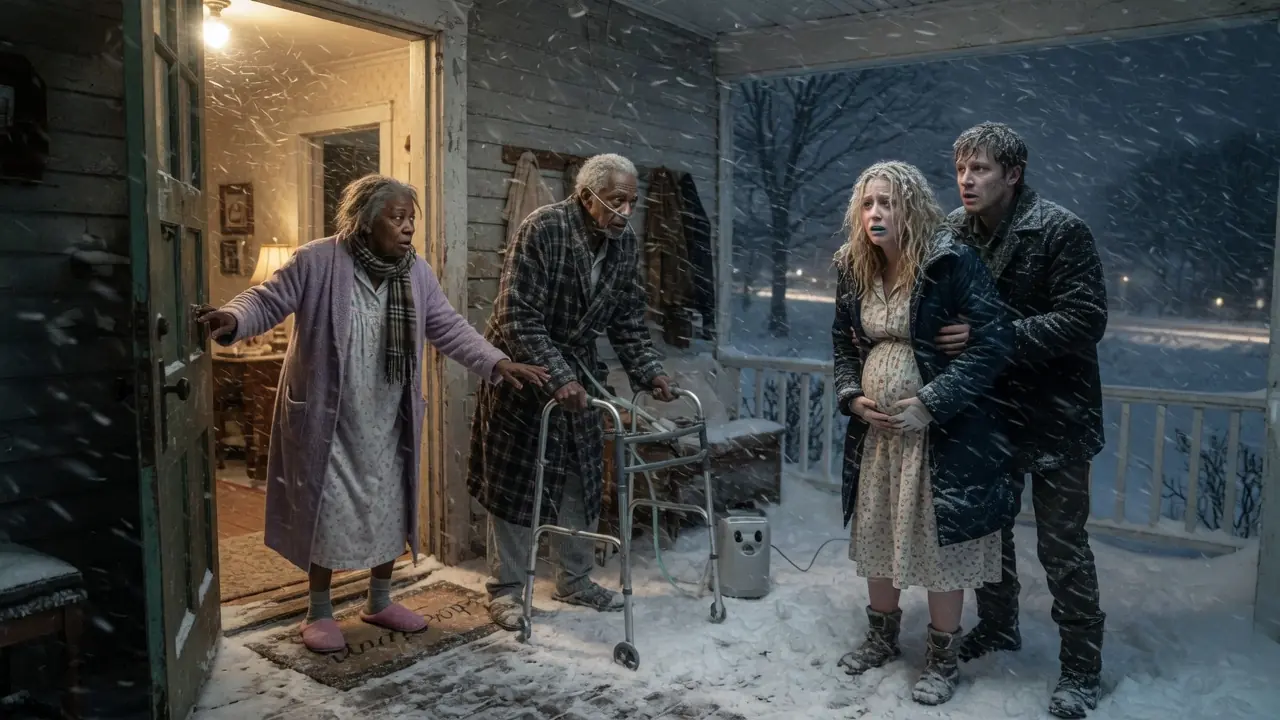
On a brutal blizzard night, inside a tiny cabin, an elderly woman struggled to keep her sick husband warm. Suddenly, she heard frantic knocking. On her doorstep stood a young couple drenched in snow, trembling uncontrollably. Though terrified, her kind heart led her to open the door and bring them inside, offering hot food and a warm place to rest. Little did she know that just a few days later, dozens of luxury cars would pull up to her door, and what happened next would change her and her husband’s lives forever.
The wind screamed through the darkness like something alive and wounded. Evelyn Marshall jerked awake, her heart hammering so hard she could feel it in her throat. For a disorienting moment, she thought the roof might tear off. The blizzard had been building all evening, but now it sounded apocalyptic.
She lay still in the darkness, listening. The power had gone out around nine. The only sounds should have been the howling wind and Marcus’s breathing beside her, raspy, labored, each inhale a struggle that made her own chest ache in sympathy.
Then came another sound.
Faint at first, almost lost in the storm.
Thump, thump, thump.
Someone was at the door.
Evelyn’s breath caught. Her first instinct was pure, gut-deep terror. Nobody came out here at night. Nobody. The farmhouse sat a quarter mile from the nearest neighbor, surrounded by woods and empty fields. In 72 years of living, she’d learned that unexpected visitors in the dark rarely brought good news.
“Marcus,” she whispered, her voice trembling. “Marcus, honey, you awake?”
A groan came from beside her. Then Marcus’s voice, thick with sleep and pain.
“What is it, Evie?”
“Someone’s at the door.”
The pounding came again, louder this time, more desperate. And then a voice, muffled by wind and snow, but unmistakably terrified.
“Please, please, somebody help us. Please.”
Marcus stirred, trying to sit up. Evelyn heard his sharp intake of breath, the pain that came with every movement these days.
“Don’t,” she said quickly, placing a hand on his chest. “Don’t try to get up. I’ll go.”
“Evie, you can’t just open the door.”
“I know. I’ll be careful.”
She grabbed her threadbare robe from the hook by the bed. The good one had worn out three winters ago, and there’d been no money to replace it. Her hands shook as she tied it closed. She picked up the flashlight from the nightstand, tested it. The beam was weak, batteries dying, but it would have to do.
The house was freezing. The wood stove in the living room had burned down to embers, and cold air seeped through every crack and gap in the old walls. Evelyn’s breath misted in front of her face as she shuffled down the short hallway, her worn slippers barely protecting her feet from the icy floor.
Evelyn’s fear shifted, transformed into something else. That wasn’t the voice of someone meaning harm. That was the voice of someone desperate, someone in genuine trouble. She’d heard that tone before in emergency rooms where she’d worked as a nurse’s aid 50 years ago. In the voices of parents with sick children, in the cries of people who’d lost everything.
She approached the door slowly, peering through the small frost-covered window beside it. Two figures huddled on her porch, barely visible through the swirling snow. One was supporting the other, and even through the ice-covered glass, Evelyn could see how the second figure was bent over, clutching their middle.
The pounding came again.
“Please, my wife, she’s pregnant. We need help.”
A man’s voice, young, terrified.
“Who are you?” she called through the door, her voice stronger than she felt.
“My name is David Mitchell. Please, my wife, Jennifer. We got stuck in the storm. Our car died. She’s nine months pregnant. Please, we just need to get warm.”
Evelyn’s mind raced. This could still be a trick. She’d seen enough news stories about criminals who posed as victims. But nine months pregnant in this storm, what kind of person would turn away a pregnant woman?
The answer came instantly.
Not the kind of person Evelyn Marshall was. Not the kind of person her mother had raised her to be. Not the kind of woman Marcus had loved for 53 years.
She made her decision and threw open the door.
The blast of arctic air hit her like a physical blow, stealing her breath. Snow swirled into the house, and the two figures nearly fell across her threshold. Evelyn grabbed the woman’s arm. She could feel the massive swell of pregnancy even through the frozen coat, and helped the man guide her inside.
“Get in. Get in,” Evelyn shouted over the wind. “Quickly now!”
She slammed the door shut behind them, and suddenly the roar of the storm was muffled.
In the weak beam of her flashlight, she could finally see her unexpected guests clearly. They were young, mid-30s at most. The woman’s face was contorted in pain and terror, her lips blue with cold, her whole body shaking so violently her teeth chattered audibly. The man wasn’t much better. His face was gray with exhaustion and hypothermia, his coat stiff with ice and snow.
The woman let out a soft whimper of pain, her knees giving way. Evelyn and the man caught her, lowering her carefully onto the old couch.
“Lord have mercy,” Evelyn breathed. “How long have you been out there?”
“I don’t know,” the man gasped through chattering teeth. “Maybe… maybe an hour, hour and a half. We tried to walk. Saw your light.”
An hour.
Evelyn’s nurse training kicked in automatically. Hypothermia. Severe hypothermia. Both of them.
“We need to get you warm now, miss. Can you hear me? Can you tell me your name?”
The young woman’s eyes fluttered open. They were blue, beautiful, and filled with terror.
“J-Jennifer,” she managed. “I’m so cold.”
“I know, honey. I know. We’re going to warm you up. Are you hurt anywhere? Just cold, or something else?”
“Just cold. So cold.”
Jennifer’s teeth chattered so hard Evelyn worried she might bite her tongue.
“Evelyn?”
Marcus appeared in the doorway from the bedroom, moving slowly, one hand braced against the wall for support. He’d managed to pull on his bathrobe, but the effort alone left him breathing hard, his chest rising and falling with strain. The oxygen tube trailed from his nose to the portable concentrator on his walker. He’d had to bring it with him. Couldn’t make it even this short distance without it.
“What in God’s name?”
“Marcus, we’ve got two people here, both with severe hypothermia. The woman’s pregnant. Nine months. I need you to try to get the fire going again. Get it as hot as you can manage. Can you do that for me?”
Marcus nodded, though they both knew it would cost him. He shuffled toward the wood stove, pushing his walker ahead of him, the oxygen concentrator humming softly. Each movement was deliberate, careful. His emphysema had progressed to stage four this past year. On good days, he could move around the house with the walker and oxygen. On bad days, he was bedbound. Tonight would push him to his limits.
She turned back to their guests.
“All right. Now, first thing, we need to get you out of these wet clothes before you catch your death. You stay hypothermic much longer, and it doesn’t matter what else we do.”
“Thank you,” the man, David, managed. “Thank you so much. I thought… I thought we were going to die out there. I thought my wife and baby were going to die, and it would be my fault.”
“Hush. Now you’re safe. That’s what matters. Now let’s get you sorted.”
Working as quickly as her 72-year-old hands would allow, Evelyn helped Jennifer out of her frozen coat. Underneath was a dress made of soft, delicate fabric, now soaked through and half-frozen. The young woman’s skin was ice cold to the touch, her fingers white and stiff, a bluish tinge creeping into the nails that made Evelyn’s stomach clench with worry.
“Can you stand, honey?” Evelyn asked gently.
Jennifer tried, but her legs wouldn’t hold her. She’d been in the cold too long, her muscles not responding properly.
“All right, that’s okay. We’ll do this sitting down. David, can you help me? We need to get her out of this dress.”
Between them, they managed to strip off Jennifer’s wet clothes, revealing the massive swell of her pregnant belly. The baby was sitting low, very low, full term and then some, Evelyn thought with a flutter of worry.
She wrapped Jennifer immediately in every blanket she could find: worn quilts and afghans that Evelyn had made decades ago, patched in places where they’d worn through, but clean and dry.
“You, too,” she told David firmly. “Those wet clothes come off right now. Marcus, where’s that old sweatshirt of yours? The gray one.”
“Closet by the bathroom,” Marcus called back, his voice strained with effort as he fed wood into the stove.
She could hear him wheezing, hear the pauses as he had to stop and catch his breath between each piece of wood. But he was doing it. Stubborn man.
“Change in there. Everything off, everything dry. Your wet clothes go in the bathtub for now.”
When David emerged a few minutes later, he looked almost comical. Marcus had always been a big man, 6’2” and broad through the shoulders, even now diminished by his illness. The clothes hung oddly on David’s smaller, slighter frame, the pants stopping mid-calf, the sweatshirt baggy in strange places and tight in others, but he was dry.
And slowly, slowly, with the fire building and the blankets wrapped around them, both Jennifer and David stopped shaking quite so violently.
Evelyn fetched more blankets, the last ones she had, and wrapped them around Marcus, too. He’d collapsed into his recliner, having managed to get the fire going, but the exertion had cost him dearly. His face was gray, his breathing harsh and rapid, even with the oxygen. His lips had a slight bluish tinge that made Evelyn’s heart clench with fear.
“You overdid it,” Evelyn said softly, checking his pulse at his wrist. “Too fast, too irregular.”
She adjusted the oxygen flow slightly higher.
“That was too much for you.”
“I’m fine,” Marcus wheezed, but even those two words took effort. “They needed help.”
“And you’ll be no help to anyone if you collapse. You rest now. That’s an order. Don’t you dare try to get up again tonight.”
She turned back to their guests. Jennifer had stopped shaking, but she looked exhausted. Dark circles under her eyes, her face pale with more than just cold. David sat beside her on the couch, holding her hand, and Evelyn could see the fear in his eyes. The terror of how close they’d come.
“How did you end up out here?” she asked, keeping her voice gentle, conversational.
Shock was a real risk with severe hypothermia. Best to keep them talking, keep them present and oriented.
“We were driving from Connecticut to Virginia,” David said, his voice steadier now, though still shaky. “Jennifer’s father, he had emergency heart surgery yesterday morning. We got the call at 6:00 a.m. We left right away, but then the storm warnings came, and we thought we could beat it. The GPS said this was a shortcut off the main highway, and then they closed Route 90, and we thought we could make it through before it got bad. But it got bad fast.”
“So fast,” Evelyn finished.
“One minute we could see the road. The next minute, nothing. Just white. Couldn’t see five feet in front of us. We tried to keep going, following what we thought was the road, but the car… we hit something, a snowbank maybe, went into a ditch, got stuck. We tried for maybe half an hour to get unstuck, but…”
He shook his head.
“The wheels just spun, and Jennifer was getting so cold, and the heat wasn’t keeping up, and the battery was dying. And I realized if we stayed there, if nobody found us…”
He didn’t finish the sentence. He didn’t need to.
“You did the right thing,” Evelyn said firmly. “Staying in that car would have been a death sentence, especially with the battery dying. How far away is it?”
“Maybe a quarter mile. I couldn’t really tell in the storm. We almost didn’t see your light. If Jennifer hadn’t spotted it…”
His voice cracked.
“I thought I was going to lose them both out there. My wife and my daughter.”
Jennifer squeezed his hand weakly.
“But you didn’t,” she whispered. “We made it because of her.”
She looked at Evelyn with naked gratitude.
“Because you opened your door.”
Evelyn felt uncomfortable with the intensity of that gaze.
“Well, you’re here now, and you’re safe. That’s what matters.”
“No,” Marcus said quietly from his chair, each word an effort. “No, Evie. Not everyone would have opened that door. Not anymore.”
There was such sadness in his voice that Evelyn’s heart clenched. He was right. She knew the world had gotten harder, meaner. People were more afraid, more suspicious. She’d been afraid, too, just minutes ago. But fear couldn’t be the thing that ruled you. Not if you wanted to remain human.
“Well, you’re safe now,” she said briskly, pushing away the darker thoughts. “That’s what matters. Now, when did you two last eat?”
David and Jennifer exchanged glances.
“Breakfast,” Jennifer said. “Maybe 8:00 this morning. We were going to stop for lunch, but then the storm got bad, and we just wanted to push through.”
Evelyn checked her watch, one of the few things that still worked without power.
Nearly 2:00 in the morning.
They’d been without food for 18 hours. Spent God knows how long in the freezing cold. And Jennifer was nine months pregnant. Her body was probably running on empty.
“Right then,” Evelyn said, standing. “You need food. Your bodies need fuel to warm up properly and stay warm.”
She went to her small kitchen, barely more than a galley, with an ancient gas stove and a refrigerator that hummed and rattled even on good days. She opened the refrigerator and looked at what she had, her heart sinking.
Not much.
There was never much these days.
Half a gallon of milk, nearly expired. Four eggs. A small package of ground beef she’d been stretching for three days. Maybe half a pound left. Some wilted vegetables. Carrots and celery going soft. An onion. A bit of cheese hard around the edges. Some butter. A few potatoes in the bin under the sink.
The groceries were supposed to last until Friday, three more days. After that, Marcus’s disability check would come, and they could buy more. But these people needed food now, and there was no question in Evelyn’s mind what she would do.
She pulled out what she had and started working. The gas stove still functioned when the power was out. Thank God for small mercies. She lit it with a match and got to work.
Soup.
She could make soup. She always could make something with almost nothing. A skill learned during harder times, honed over decades of making ends meet that refused to meet.
She browned the ground beef with the onion and some garlic from the jar in the cabinet. Added water and the vegetables. Seasoned it with the dried herbs she kept in the cabinet, herbs she’d grown and dried herself last summer when the garden had actually produced something.
Not fancy, but it would be warm and nourishing. It would help.
As she worked, her mind wandered.
These people, David and Jennifer Mitchell, there was something refined about them. She’d sensed it immediately, even through the ice and fear. The quality of their clothes, soft, even when soaked and stiff with cold. The way they spoke, measured, polite, educated. And Jennifer’s jewelry. Evelyn had noticed when removing her wet things, real diamonds, real gold, expensive things.
They lived differently, that much was clear. Lives where you didn’t have to think about stretching half a pound of ground beef across an entire week.
But those questions didn’t matter. What mattered was that they were here. They were in trouble, and she could help.
That was enough.
Twenty-five minutes later, longer than it should have taken, but her arthritis was bad tonight, her fingers stiff and clumsy, she ladled soup into mismatched bowls. The good dishes had broken years ago, replaced one by one with whatever she could find at yard sales. These bowls didn’t match, had chips around the rims, but they were clean, and they held soup. And that was what mattered.
“Here,” she said, handing bowls to David and Jennifer. “It’s not much, but it’s hot, and it’ll help.”
Jennifer took one spoonful, and her eyes widened. For a moment, she couldn’t speak, couldn’t process.
Then, “This is… oh my God, this is incredible.”
Evelyn felt her cheeks warm with pleasure despite everything.
“It’s just soup, honey. Just what I had on hand.”
“No,” Jennifer said, taking another spoonful, closing her eyes as she tasted it. “No, this is… there’s something about it. The flavor, the way everything comes together. How did you do this with such simple ingredients?”
“Practice,” Evelyn said simply. “Lots and lots of practice.”
David was eating, too, and she could see the same amazement on his face.
“Mrs. Marshall, this is extraordinary. I’ve had expensive meals at fancy restaurants that don’t taste this good.”
“Oh, now you’re just being kind,” Evelyn said, but she was pleased. It had been so long since anyone had praised her cooking like this, really appreciated it.
They finished eating in a more comfortable silence, the storm still raging outside, but distant now, held at bay by walls and warmth and unexpected kindness.
After they finished eating, Jennifer insisted on helping with dishes, despite Evelyn’s protests. They worked together at the sink, washing and drying with cold water since the electric water heater wasn’t working, stacking the clean bowls carefully in the cabinet.
“You and Marcus,” Jennifer said quietly. “How long have you been married?”
“Fifty-three years this past June.”
“That’s wonderful. That’s rare these days.”
“We’ve had our share of troubles,” Evelyn said softly. “But we chose each other every day. That’s what marriage is, really. Choosing each other over and over again, even when it’s hard, especially when it’s hard.”
Eventually, Evelyn set up the couch for David, sheets and blankets that smelled faintly of lavender from the homemade sachets she kept in the linen closet. Jennifer would sleep in the bedroom, the only bedroom in the small house. Evelyn and Marcus would make do with chairs, maybe catch a few hours of sleep sitting up.
“I can’t take your bed,” Jennifer protested weakly. She was exhausted, could barely keep her eyes open, but guilt nagged at her.
“Yes, you can, and you will,” Evelyn said firmly. “You’re pregnant. You’ve been through trauma, and you need proper rest. Now, come on. Doctor’s orders.”
“You’re a doctor?”
“Nurse’s aid. Long time ago. Close enough for tonight.”
Once Jennifer was settled in the bedroom, tucked under three quilts, finally warm, finally safe, Evelyn checked on her one more time. The young woman was already half asleep, her hand resting on her swollen belly.
“Thank you,” Jennifer murmured. “You’re like an angel, an angel in the storm.”
Evelyn smiled and smoothed the blanket, an old maternal gesture that came naturally despite the stranger in her bed.
“Just a woman who answered the door, honey. Now you sleep. Everything’s going to be all right.”
“Will you check on me during the night? Just to make sure the baby…”
“I’ll check on you every hour. I promise. You and that baby are safe here.”
Jennifer’s eyes drifted closed. Within minutes, she was asleep.
Evelyn returned to the living room to find David already stretched out on the couch, wrapped in blankets, his eyes closed. Marcus had dozed off in his recliner, the oxygen tube running to his nose, his breathing rough but steady enough. The concentrator hummed softly in the corner.
Evelyn lowered herself into the remaining chair, a straight-backed wooden one that would be murder on her arthritis by morning, and pulled a thin blanket around herself.
She was exhausted, bone tired in a way that went beyond physical. The adrenaline of the past hour was fading, leaving her shaky and emotionally drained.
She looked around her small living room, three strangers sleeping under this roof tonight. She’d given away most of their food for the week, given up their bed, and would probably spend a painful night in this uncomfortable chair.
And yet she felt not regret, not resentment, just a quiet sense of having done the right thing, the necessary thing, the human thing.
“Did good tonight, Evie.”
Marcus’s voice came softly from his chair. She’d thought he was asleep.
“We both did.”
“No, you did. I just… I wish I could do more. Wish I wasn’t so…”
He trailed off, but she knew what he meant. So useless. So weak. So diminished from what he’d been.
“Marcus Thomas, you listen to me.” Evelyn’s voice was fierce but quiet. “You kept that fire going. You found them clothes. You were there, present, steady. That’s not nothing. That’s everything. You think I could have done this alone? Scared as I was? No, I needed you there. I always need you there.”
“I love you, Evie.”
“I love you, too, you stubborn old man. Now go to sleep for real this time.”
She closed her eyes, but sleep wouldn’t come. Her mind kept returning to their guests, to David and Jennifer Mitchell, with their expensive clothes and obvious wealth, stranded in a storm on their way to some family emergency. To the baby, still safe in Jennifer’s womb, unaware of how close they’d all come to disaster.
The wind howled outside, and Evelyn pulled her thin blanket tighter.
Tomorrow, the storm would pass. Tomorrow, David and Jennifer would leave, returning to their lives. Tomorrow, everything would go back to normal. Her and Marcus scraping by, getting through each day, waiting for whatever came next.
But tonight, just for tonight, her house was full. Tonight she’d been needed. Tonight she’d made a difference. And somehow, that had to be enough.
Evelyn woke to pale gray light filtering through frost-covered windows and a pain in her neck that made her gasp. She’d fallen asleep in the wooden chair. God, what had she been thinking? And now every muscle in her back was screaming in protest.
She moved carefully, stifling groans. Seventy-two years old was too old to be sleeping in chairs. Her joints creaked as she stood, her arthritis making its presence known with sharp jabs of pain in her knees, her hips, her fingers.
The living room was quiet. David still slept on the couch, one arm flung over his face, snoring softly. Marcus was awake in his recliner, watching her with concerned eyes. His color was better than last night, thank God, though his breathing was still labored.
“You should have woken me up,” he wheezed quietly. “Could have traded off.”
“And have you sleeping in this torture device? No, thank you.”
Evelyn stretched carefully, wincing.
“How are you feeling?”
“Been better. Been worse.”
The standard answer. But she could see the toll last night had taken. The deep exhaustion in his eyes, the way he winced when he breathed too deeply.
“I’m calling Dr. Patterson today. No arguments.”
“Evie…”
“I said no arguments. You pushed yourself too hard last night, and we both know it. Better to check in with him before it becomes an emergency.”
She went to check on Jennifer and found her still sleeping deeply, her breathing peaceful, one hand protective over her belly. In the gray morning light, Evelyn could see her properly for the first time, a beautiful young woman with delicate features, her blonde hair tangled from sleep. She looked so young to be so close to giving birth.
Evelyn left her sleeping and went to the kitchen to assess their situation. She opened the refrigerator and stared at the nearly empty shelves with a sinking feeling.
Three eggs left. She’d used one in the soup last night. Maybe a quarter cup of milk. A tiny bit of cheese. Some butter. The flour and cornmeal in the cabinet. Two potatoes in the bin under the sink.
Not enough. Not nearly enough to feed four people for however long they’d be snowed in. But she’d figure something out. She always did.
Marcus appeared in the kitchen doorway, moving even more slowly than usual. Both hands on his walker, the oxygen concentrator trailing behind him.
“Let me help,” he said.
“Marcus, you should rest.”
“I can crack eggs, Evie.”
There was hurt in his voice, mixed with stubborn pride.
“I’m not completely useless yet.”
“You’re right. I’m sorry. I’d appreciate the help.”
They worked together in companionable silence, the choreography of 53 years of marriage making words unnecessary. Marcus cracked eggs into a bowl slowly, his hands shaking slightly, having to pause twice to catch his breath, but he managed. Evelyn made pancake batter with the last of the flour, stretching it as thin as she dared to make it go further.
When David emerged from the living room, looking rumpled and disoriented in Marcus’s too-short pajama pants, he stopped in the kitchen doorway and just stared.
“Is that… are you making breakfast?”
“Just pancakes,” Evelyn said. “Nothing fancy.”
“But you’ve already given us so much. Your food, Mrs. Marshall. We can’t keep taking.”
“You need to eat. And so does Jennifer and that baby. Now sit down.”
She poured him a cup of instant coffee. Weak and bitter, but hot. She’d saved one precious packet for their guests. David wrapped his hands around the chipped mug.
“Thank you for everything. I don’t know how to express…”
“You don’t need to. This is just what people do. What they should do anyway.”
Jennifer joined them a few minutes later, moving carefully, one hand supporting her lower back. She braided her hair, and in the morning light, she looked even younger than she had last night.
Evelyn served the pancakes with a small drizzle of maple syrup. She’d been saving the bottle for a special occasion, but these people needed it more.
She cut her own pancakes into tiny pieces, took only three small bites, then claimed she was full. Marcus did the same, though she saw the hunger in his eyes. They both watched their guests eat, taking quiet satisfaction in seeing them nourished.
“Oh my God,” Jennifer said around her first bite, her eyes actually filling with tears. “How do you make even pancakes taste like this?”
Evelyn felt that familiar warmth. Pleasure mixed with something bittersweet.
“It’s about the proportions and letting the batter rest. Little tricks I’ve learned over the years.”
“It’s more than tricks,” Jennifer said softly. “There’s love in this. You can taste it.”
The morning wore on. The snow had finally stopped sometime before dawn, and weak sunlight filtered through clouds, making the white world outside sparkle. Beautiful but deceiving. It was still bitterly cold, maybe five degrees, and the roads wouldn’t be passable for hours yet.
Around 10:00, they heard the distant rumble of snow plows on Route 20, maybe a mile away. David immediately pulled out his phone, hope lighting his face, but then it fell.
Still no signal.
“They won’t get to our road until tomorrow at the earliest,” Marcus said from his recliner, his words coming in short bursts. “We’re always last on the list out here. Secondary roads after main highways.”
“But we need to get to Jennifer’s father,” David said, anxiety clear in his voice. “The surgery was yesterday morning. We should have been there by now. Her mother must be frantic. She hasn’t heard from us since yesterday afternoon before the storm hit.”
“I’m sure they know you’re safe somewhere,” Evelyn said. “The highway patrol would have told them about the road closures. They’ll know you couldn’t get through.”
But she could see the worry in both their faces. Worry about Jennifer’s father. Worry about being cut off from the world. Worry about the baby coming so close to her due date.
Around noon, Evelyn made sandwiches with the last of the bread and cheese. Cutting them small, she gave the larger portions to David and Jennifer, taking barely a quarter sandwich for herself. Marcus waved his away entirely, claiming his appetite was poor, but she knew he was sacrificing so their guests could eat.
After lunch, Jennifer stood to use the bathroom and suddenly gasped, her hand flying to her belly.
“Jennifer.”
David was at her side in an instant.
“What’s wrong?”
“I don’t… I’m not sure. Just a weird feeling, a tightening.”
She pressed her hand to her stomach, her face going pale.
“Oh no. Not now. Please, not now.”
Evelyn was beside her immediately, professional instincts overriding personal fear. She felt Jennifer’s belly gently. It was hard. Contracted.
“Does it hurt?”
“Not really. Just pressure. Tightness. It’s probably nothing. Braxton Hicks. I’ve been having them for weeks.”
“When did this one start?”
“Just now, when I stood up.”
“Okay, that’s probably just your body reacting to all the stress from last night. But I want you to tell me if it happens again, all right?”
“All right.”
But 15 minutes later, it happened again. Jennifer tried to hide it, but Evelyn saw the way her face tightened, the way she gripped the arm of the couch, the way she went very still until it passed.
“Jennifer. Another one?”
Jennifer admitted, fear creeping into her voice. “Maybe 10 minutes apart.”
Evelyn and Marcus exchanged glances.
“Might be false labor,” Evelyn said, keeping her voice calm, though her heart was starting to race. “Brought on by stress and the cold and everything you went through. Or…”
She paused.
“How far along did you say you were?”
“Thirty-nine weeks and five days.”
Full term. More than full term. If this was real labor, it was time.
And they were still stuck here, miles from any hospital, with no phone, no way to call for help.
Dear God, Evelyn thought. Please don’t let this be real. Please let it stop.
“Okay,” she said, keeping her voice steady. “Here’s what we’re going to do. Jennifer, you’re going to lie down and rest. Try to relax as much as you can. Sometimes that stops early labor. The body realizes it’s not ready, and things calm down. We’ll time the contractions. If they get closer together or more intense, then we’ll know it’s progressing.”
“And if it’s real?” Jennifer asked, terror clear in her voice. “Now, if the baby’s really coming?”
Evelyn felt her throat tighten. She’d assisted with deliveries 50 years ago, four of them, maybe five, but she’d never been the primary person. She’d always been helping someone more experienced, someone who knew what they were doing. She’d seen births, yes, but she’d never managed one alone.
And it had been 50 years. Fifty years since she’d even thought about obstetric procedures, since she’d held a newborn still slick from birth.
“Then we deliver this baby,” she said with far more confidence than she felt. “Women have been having babies for thousands of years without hospitals. Jennifer, your body knows what to do. And I’ve helped with deliveries before. We’ll manage.”
But inside, her mind was screaming.
What if something goes wrong? What if the baby’s breech? What if the cord is around the neck? What if Jennifer hemorrhages? What if? What if? What if?
“Oh God,” David said, his face going white. “Oh God, this can’t be happening. We’re in the middle of nowhere. No power, no phone, no ambulance. Jennifer, we need to get you to a hospital.”
“David.” Evelyn’s voice was sharp enough to cut through his panic. “Getting worked up isn’t going to help anyone. We’re going to stay calm. We’re going to time these contractions, and we’re going to hope they stop. That’s all we can do right now.”
Over the next hour, everyone’s tension mounted. The contractions continued. Twelve minutes apart, then 11, then 10 again. Regular. Not stopping.
Jennifer tried to rest on the couch, but fear and discomfort kept her alert. Her hand constantly on her belly, her breathing quick and shallow.
David paced like a caged animal, checking his phone every few minutes, even though there was still no signal, going to the window to look for rescue that wasn’t coming.
Marcus sat quietly in his recliner, and Evelyn knew he was praying. His lips moved silently, his eyes closed, his weathered hands clasped together. He was asking God for help because there was nothing else he could do.
And Evelyn. Evelyn tried to remember everything she’d learned 50 years ago. Tried to picture the deliveries she’d assisted with, what the doctor had done, what she’d been told to prepare, what could go wrong. But the memories were hazy, incomplete. She’d been so young then, just there to help, not expected to know or remember everything.
She gathered supplies with shaking hands. Clean towels, all of them, even the ones with holes. Scissors that she sterilized in boiling water. String she boiled as well. The small first aid kit from the bathroom cabinet.
She wasn’t even sure what she’d need, but she gathered everything she could think of.
At 3:00, Jennifer cried out, a sound of real pain this time.
“That one was different,” she gasped, her face pale and sweating despite the cold. “That one really hurt.”
Evelyn checked her watch.
“Eight minutes since the last contraction. They’re getting closer together,” she said quietly to Marcus. “And stronger.”
“Can you do it?” he asked just as quietly.
Not should you, but can you, because they both knew there was no choice.
“I don’t know,” Evelyn admitted, her voice barely a whisper. “Marcus, I don’t know if I remember enough. What if I do something wrong? What if I hurt them?”
“You won’t. You’re the strongest, smartest, most capable person I know. Trust yourself, Evie. Trust what you learned. Trust your instincts.”
At 4:15, another contraction. Seven minutes.
At 4:35, another. Six minutes.
Jennifer was crying now, gripping David’s hand, fear and pain mixing in her eyes.
At 5:00, Jennifer’s water broke.
She looked up at Evelyn with wide, terrified eyes, and Evelyn saw her own fear reflected back at her.
“It’s happening,” Jennifer whispered. “The baby’s really coming. Oh God, the baby’s coming, and we’re stuck here. And what if something goes wrong?”
“Nothing is going to go wrong,” Evelyn said, taking her hand.
The lie came easily because Jennifer needed to hear it, needed to believe it.
“Your baby has decided it’s time to be born, and we’re going to help that happen. We’re going to get through this together, all of us.”
But as she looked at this young woman, so scared, so vulnerable, Evelyn sent up a desperate prayer.
Please, God, please guide my hands. Please let me remember what I need to know. Please don’t let me fail them. Please.
The bedroom had become a delivery room, though it looked nothing like any hospital. Evelyn had covered the bed with every clean towel she owned, threadbare, some with stains that wouldn’t come out no matter how many times she washed them, but clean. Her meager supplies were laid out on the dresser: the first aid kit, clean string, more towels, a receiving blanket she’d found in the back of the closet, yellowed with age but freshly washed.
Jennifer lay on the bed, her face twisted in pain as another contraction hit. They were coming every four minutes now, each one stronger and longer than the last. Her hand clutched David’s so hard his fingers had gone numb and then beyond numb. But he didn’t complain, didn’t pull away. He just whispered encouragements, stroked her hair, tried to hide his own terror.
“Breathe through it, honey,” Evelyn said, her voice calm despite the fear churning in her gut. “In through your nose, out through your mouth. That’s it. You’re doing beautifully.”
“It hurts,” Jennifer sobbed. “Oh God, it hurts so much more than I thought it would.”
“I know. I know it does, but pain means progress. Your body is working exactly like it’s supposed to.”
From the doorway, Marcus watched, his face gray with exhaustion and worry. He wanted to help somehow, to do something useful, but there was nothing he could do except stay nearby and pray. The excitement and exertion had triggered his emphysema. His breathing was worse than it had been in weeks, even with the oxygen turned up. But he wouldn’t leave, wouldn’t go rest. Not while Evelyn needed him nearby.
The contractions continued, relentless. Four minutes apart, then three and a half, then three. Jennifer’s cries grew louder, more desperate. She was exhausted, not just from labor, but from the trauma of the night before. The cold, the fear, the stress. Her body had no reserves left to draw on.
“I can’t do this,” she gasped between contractions. “I can’t. It’s too hard. I can’t.”
“Yes, you can,” Evelyn said.
But her own confidence was wavering.
What if Jennifer really couldn’t? What if she was too exhausted? What if the baby got stuck?
No, stop it. Focus on what you can see, what you can do.
“Listen to me, Jennifer. You are strong. You are capable. Your body knows exactly what to do. You just have to trust it.”
“But what if something goes wrong? What if the baby’s in trouble and we don’t know? What if…”
“I’m monitoring you closely,” Evelyn interrupted, hoping her voice didn’t betray how little she actually knew about what was happening inside Jennifer’s body.
She had no fetal monitor, no way to check the baby’s heart rate, no way to know if the baby was in distress. She was flying blind, relying on 50-year-old knowledge and desperate hope.
“Everything looks good. You’re doing everything right.”
Another hour passed. The sun was setting, painting the snow outside in shades of pink and gold. Beautiful and completely irrelevant. The contractions were two minutes apart now, lasting longer, coming harder. Jennifer’s screams filled the small house.
Evelyn checked between Jennifer’s legs, her hands gentle, but her heart pounding. She could feel the cervix fully dilated, she thought, though she wasn’t entirely sure. It had been so long. Was it supposed to feel like this? She couldn’t remember.
But then she felt something else.
The baby’s head.
Definitely the baby’s head pressing down.
Relief flooded through her so intensely she nearly cried. The baby was positioned right, not breech, not sideways. Head down, the way it was supposed to be. That was one major complication avoided.
“I need to push,” Jennifer suddenly gasped. “Oh God, I need to push right now.”
Evelyn’s mind raced. Was it time? Should Jennifer push? What if it was too early? But Jennifer’s body was telling her to push. And wasn’t that what she was supposed to trust?
“Okay,” she said, trying to sound confident. “Okay, Jennifer, on the next contraction, you push. Push as hard as you can.”
“I don’t think I have the strength.”
“You do. You have more strength than you know. David, get behind her, support her back, help her sit up more. That’s it. Now, Jennifer, when you feel the next contraction coming, you take the biggest breath you can, and you push with everything you have. Understand?”
Jennifer nodded, tears streaming down her face. She was terrified and in more pain than she’d ever imagined possible. But she trusted this woman, this stranger who’d opened her door in a storm, who’d shared her last food, who was now guiding her through the most terrifying moment of her life.
The contraction came.
Jennifer pushed, screamed, pushed harder.
“Good. That’s good.”
Evelyn stared between Jennifer’s legs, trying to see if anything was happening. Was that more of the head? She thought so, but wasn’t sure.
“Again, just like that.”
Another contraction. Another push, and another, and another.
Thirty minutes passed. Jennifer was weakening. Evelyn could see it. Each push was less forceful than the last. The exhaustion was overwhelming her, draining her of the strength she needed to bring her baby into the world.
“I can’t,” Jennifer sobbed. “I can’t do it anymore. I’m too tired. I can’t.”
“Yes, you can,” Evelyn said, but panic was starting to set in. What if Jennifer really couldn’t? What if she was too exhausted to finish? What if Evelyn had to use forceps? Except she didn’t have forceps. Didn’t know how to use them. Couldn’t.
“Jennifer.”
Marcus’s voice came from the doorway, weak and wheezing, but firm.
“You can do this. You have to. That baby needs you. Your husband needs you. Don’t give up now. Not when you’re so close.”
Jennifer looked at him, this old man struggling to breathe, who’d pushed himself beyond his limits to help them, who was still here supporting them, even though it was clearly hurting him.
And something in his words, in his presence, gave her new resolve.
“Okay,” she whispered. “Okay, I’ll try.”
The next contraction came. Jennifer pushed with everything she had left, every ounce of strength, every bit of determination, every particle of love for this child she hadn’t met yet.
And suddenly, Evelyn could see the top of the head. Actually see it. Dark hair, matted and wet, but there. Real. The baby was coming.
“I can see the head.” Evelyn’s voice cracked with emotion and relief. “I can see your baby, Jennifer. One more big push. Just one more.”
Jennifer gathered herself. One more push. She could do one more push for her baby. For David. For her father lying in a hospital bed in Virginia. For Evelyn and Marcus, who’d saved them. For herself.
The contraction built. Jennifer pushed with a force that came from somewhere beyond herself, somewhere primal and ancient.
And then the head was out.
The whole head in Evelyn’s hands, wet and warm and alive.
“The head’s out,” Evelyn cried. “Wait, don’t push for a second. Let me check.”
Her hands shaking, she checked around the baby’s neck.
No cord.
Thank God. No cord wrapped around. One more major complication avoided.
“Okay, one more push, Jennifer. One more and your baby will be here.”
Jennifer pushed. Evelyn guided the shoulders. First one, then the other.
And suddenly, the entire baby slipped out into her hands in a rush of fluid and blood.
And then crying.
A baby’s cry, thin and reedy, but unmistakably alive, unmistakably healthy.
“It’s a girl.”
Evelyn’s voice was thick with tears. Tears of relief and joy and overwhelming gratitude that it had worked, that they’d done it, that mother and baby were both alive.
“You did it, Jennifer. You have a daughter.”
The baby was tiny, covered in vernix and blood, but perfect.
Ten fingers. Evelyn counted quickly, her hands trembling. Ten toes. Good, strong lungs based on the crying. Pink skin, good color, moving all her limbs, eyes squeezed shut, mouth open in an indignant wail.
Evelyn worked quickly, her hands shaking but functioning. She cleared the baby’s airway with a clean cloth. Remember this? Yes, she remembered this. She clamped the umbilical cord with clean string in two places a few inches apart. Yes, that’s right. And cut between them with the sterilized scissors.
She wrapped the newborn in the old receiving blanket and placed her on Jennifer’s chest.
“Hi,” Jennifer whispered, tears pouring down her face. “Hi, baby. Hi, my beautiful girl. I’m your mama. I’m your mama.”
The baby, screaming moments ago, quieted at the sound of her mother’s voice. Dark eyes opened, unfocused but searching. A tiny hand reached out, fingers spreading.
David leaned over them both, his whole body shaking with sobs.
“She’s perfect,” he choked out. “Jennifer, she’s perfect. You’re perfect. You did it.”
Evelyn backed away quietly, giving them this moment. Her hands were shaking violently now, her legs barely holding her up. The adrenaline crash was hitting hard. She’d done it. By the grace of God and 50-year-old memories and sheer desperate determination, she’d delivered a healthy baby.
But she wasn’t done yet.
In the doorway, Marcus met her eyes. Tears streamed down his weathered face, and he was smiling. Actually smiling, despite the obvious effort it took him to breathe.
“You did it, Evie,” he whispered. “Lord have mercy. You actually did it.”
She went to him, and he wrapped one arm around her. He needed the other on his walker to stay upright, but it was enough.
“I was so scared,” she admitted against his shoulder. “If anything had gone wrong…”
“But it didn’t. You did everything right. You saved them both.”
“We got lucky. We got so incredibly lucky.”
“Maybe. Or maybe you’re better than you give yourself credit for.”
But Evelyn knew the truth. They’d been extraordinarily lucky. If there had been any complications, breech presentation, cord prolapse, shoulder dystocia, hemorrhage, she would have been helpless. Mother and baby could have died, and there would have been nothing she could do.
The thought made her feel sick, but she pushed it away. They were safe. That’s what mattered.
She pulled away from Marcus and got back to work.
Over the next half hour, she delivered the placenta, checking carefully to make sure it was intact, that nothing had been left behind that could cause infection or bleeding. She checked Jennifer for tearing. There was some second degree, she thought, but not severe. Nothing that required stitches she wouldn’t have known how to do anyway. She monitored for hemorrhaging. There was bleeding, but within what seemed like normal limits, slowing as it should.
She checked the baby more thoroughly. Reflexes good. Breathing clear and regular. Temperature stable as long as she stayed skin-to-skin with her mother. A healthy weight, maybe seven pounds, Evelyn estimated, full-term and perfect.
“What will you name her?” Evelyn asked softly once everything had calmed down, once Jennifer had delivered the placenta and the baby was nursing contentedly, her tiny mouth working instinctively.
David and Jennifer looked at each other, something passing between them without words.
“We had names picked out,” Jennifer said, “but they don’t seem right anymore. They don’t fit what happened, what she survived, what you did for us.”
“Take your time. You’ll know when the right name comes.”
“No,” David said slowly. “I think… I think we know now.”
He looked at Evelyn.
“We’d like to name her Grace. Grace Evelyn. Grace for what you showed us. The grace of kindness, of opening your door, of helping strangers when you had every reason not to. And Evelyn, for you, for the woman who brought her into this world. If… if that’s okay with you.”
Evelyn felt tears threaten again and blinked them back hard.
“That’s… that’s beautiful. I’m honored. Truly honored.”
“Grace Evelyn Mitchell,” Jennifer said, looking down at her daughter. “It’s perfect.”
Evelyn left them alone and returned to the living room, where Marcus waited. She sank into her chair, that same uncomfortable wooden one, and closed her eyes, suddenly so exhausted she could barely think.
“You need to eat something,” Marcus said.
“There’s nothing left. We gave them everything.”
“There’s a little soup from last night. Maybe half a cup. I saved it for you.”
“Marcus, you need that more than…”
“I’m not hungry. And you just delivered a baby. You eat. That’s an order.”
She was too tired to argue. She heated up the small portion of leftover soup, barely enough to matter, and ate mechanically, barely tasting it. Her mind kept returning to the bedroom, to Jennifer and baby Grace.
Everything had gone right. But she couldn’t shake the fear of what could have gone wrong.
“Stop it,” Marcus said, reading her mind the way he always could.
“Stop what?”
“Torturing yourself with what-ifs. The baby’s healthy. Jennifer’s healthy. You did good, Evie. Better than good. You did something extraordinary.”
They sat in silence for a while, holding hands across the small space between their chairs. Outside, the night was clear now. The storm had passed completely, leaving behind a world transformed by snow. Inside, a new family was being born, literally and figuratively.
Around midnight, Evelyn checked on Jennifer and Grace one more time. Both were sleeping. Jennifer exhausted but peaceful. Grace swaddled and nestled against her mother’s chest. David sat in the chair beside the bed, unable to sleep, unable to stop staring at his daughter.
“Thank you,” he said when Evelyn entered, his voice rough with emotion. “Thank you doesn’t even begin to cover it. You saved my daughter’s life. You saved my wife’s life. You delivered my child with your own hands when you didn’t have to. When most people would have been too scared to try. I will never, ever forget what you did tonight. Never.”
“You don’t need to thank me,” Evelyn said, though even as she said it, she knew it wasn’t entirely true.
She did need to hear it. Needed to know that this terrifying, overwhelming night had mattered.
“This is just what people should do for each other.”
“But they don’t. Most people don’t.” David’s voice was fierce. “And when we get back home, when everything settles down, I’m going to find a way to thank you properly, to show you what this meant to us.”
“We’ll talk about that when the time comes,” Evelyn said gently. “Right now, just be with your family. That’s what matters. That’s all that matters.”
She left them and went back to the living room. Marcus had fallen asleep in his recliner, his breathing harsh but steady, the oxygen concentrator humming beside him. Evelyn covered him with a blanket and kissed his forehead, feeling how warm he was. Too warm. The exertion and excitement had taken a toll on him. She’d need to watch him carefully over the next few days.
Then she lowered herself into her own chair and finally, finally, let herself cry. Quiet tears of relief and exhaustion and overwhelming emotion.
She delivered a baby.
At 72 years old, with no equipment and no backup and only 50-year-old memories to guide her, she brought a new life safely into the world.
Thank you, she prayed silently. Thank you for guiding my hands. Thank you for making everything go right when so much could have gone wrong. Thank you.
She must have dozed eventually because she woke to the sound of engines outside. Multiple engines, heavy vehicles, chains on tires. Gray light filtered through the windows, dawn or close to it.
She went to the window and saw lights. Flashing lights, red and blue. Emergency vehicles.
She opened the door before they could knock.
A state trooper stood there, bundled against the cold, along with two paramedics carrying equipment.
“Mrs. Marshall?” The trooper looked surprised to see an elderly black woman in a threadbare robe. “I’m Trooper Daniels. We’ve been searching for David and Jennifer Mitchell. Their family reported them missing around 9:00 p.m. yesterday. We’ve been trying to reach this area all night. The road just got cleared. Are they here?”
“They’re here,” Evelyn said. “They’re safe. Both of them. All three of them, actually. Mrs. Mitchell went into labor. The baby was born around 8:00 last night.”
The trooper’s eyes widened.
“You delivered a baby here during the blizzard?”
“Didn’t have much choice in the matter. The baby decided it was time.”
The paramedics moved quickly past her, heading for the bedroom with their equipment. Evelyn followed, watching as they examined Jennifer and baby Grace, checking vital signs, asking questions, making notes. Professional competence in action, making what Evelyn had done seem crude and improvised by comparison.
“Mrs. Marshall,” one of the paramedics said after several minutes, looking up at her with genuine respect, “you did an excellent job. Everything looks perfect. Mother and baby are both healthy and stable. You likely saved their lives by delivering the baby when you did. If Mrs. Mitchell had tried to hold off until we could get here, if she’d been in active labor for hours longer, well, exhaustion and complications become much more likely.”
Evelyn felt her knees go weak with relief. They were really okay. She hadn’t missed anything important, hadn’t made any critical mistakes.
Within an hour, Jennifer and Grace were loaded into the ambulance, just as a precaution to get them checked out at the hospital. David rode with them, but before he left, he pulled Evelyn aside while the paramedics were securing Jennifer’s stretcher.
“Mrs. Marshall,” he said, his voice low and urgent. “I meant what I said. I will never forget this. Never. And I’m going to make sure you know that.”
“You don’t owe us anything.”
“Yes, I do.” His voice was fierce. “I owe you everything.”
And then he was gone, climbing into the ambulance, the doors closing, the vehicle pulling away carefully down the snow-packed road.
Evelyn stood on her porch, watching them go.
Marcus stood beside her. He’d insisted on coming out despite the cold, despite his weakness. The morning air was brutally cold, maybe zero degrees, and it bit through her thin robe, but she didn’t move.
“Think we’ll ever see them again?” Marcus asked quietly, his words coming in short puffs of vapor.
“I don’t know,” Evelyn admitted. “People mean well in the moment, but once they get back to their lives…”
She shrugged.
“It’s all right. We did what we needed to do. That’s what matters.”
They went back inside, back to their quiet house that suddenly felt very empty, back to their life of scraping by and making do.
But something had changed, something Evelyn couldn’t quite name yet.
She’d forgotten in the years since the restaurant closed what it felt like to be truly needed, to use her gifts to make a real difference in someone’s life.
And now she remembered.
And the remembering hurt almost as much as it healed.
Six weeks passed.
Six weeks of returning to the familiar rhythm, the rhythm of poverty and illness and quiet desperation. The disability check came and went. They bought groceries, counting every penny. They paid what bills they could, let others slide another month.
Marcus’s condition had worsened since that night. The exertion of helping during the storm had triggered something, and he’d never quite recovered. He spent most days in his recliner now, the oxygen turned up higher than before. His breathing labored even at rest. His appetite had disappeared almost entirely. He slept more and more, sometimes 16, 18 hours a day.
Evelyn knew what she was watching. She’d seen it before in her years as a nurse’s aid. The slow decline, the body giving up piece by piece. She tried not to think about it, tried to focus on each day, each moment they still had together.
And she tried not to think about David and Jennifer and baby Grace. Tried not to feel disappointed that six weeks had passed with no word, no call, no letter, nothing.
Of course, there’d been nothing. They’d returned to their wealthy lives, their real lives, and the poor old couple in the farmhouse had become a story they’d tell at dinner parties.
Remember that crazy night during the blizzard? Can you believe we actually had to deliver our baby in some random person’s house? Wild, right?
It was Tuesday afternoon, overcast and cold, when Evelyn heard the first vehicle. She was in the kitchen trying to figure out how to make dinner from half a can of beans and two carrots when she heard the engine sound. Not the usual sound of a car passing on the main road, but closer. Coming up their driveway.
She went to the window and saw a black SUV pulling up to the house. Expensive looking. Not a vehicle she recognized.
Her first thought was repo men. Had they finally come for the house? But the mortgage was paid off. One thing they owned free and clear.
Then the driver’s door opened, and David Mitchell stepped out.
Evelyn’s breath caught.
Six weeks, and here he was.
He looked different than he had that night. Dressed in nice clothes, well-rested, healthy. But his face was serious as he approached the house.
Before Evelyn could move, she heard another engine, then another. She looked down the driveway, and her heart stopped.
Cars. So many cars. SUVs, sedans, even a few moving trucks. They were coming up the driveway in a line, one after another.
Five vehicles. Ten. Fifteen. Twenty.
“Marcus,” she called, her voice shaking. “Marcus, wake up. Something’s happening.”
Marcus stirred in his recliner, confused and disoriented.
“What is it?”
“I don’t know. David’s here. And he brought… he brought an army.”
She opened the door just as David reached the porch. Behind him, the convoy of vehicles was pulling up, filling their small yard, parking along the driveway. Doors opened. People got out. Dozens of people, maybe 50 or more, and they were carrying things. Boxes, equipment, medical supplies.
“Mrs. Marshall,” David said, slightly out of breath. “I’m sorry to arrive without warning. I know this must seem…”
“What’s going on?” Evelyn asked, bewildered. “Why are all these people…”
“Mrs. Marshall, Mr. Marshall needs medical attention. Right now, I can see it from here.” David’s voice was urgent. “How long has he been this bad?”
“I… what? How did you…”
“I called your neighbor, Mrs. Henderson, down the road. She told me he’s been declining for weeks. That you’ve been trying to manage on your own. That you can’t afford the hospital.”
David turned and gestured to someone.
“That’s why I brought Dr. Richardson. He’s a pulmonologist, one of the best in the country. And we have a full medical team. They’re going to examine Mr. Marshall right now. And if he needs to go to the hospital, we’re taking him. No arguments.”
“We can’t afford…” Evelyn started.
“You’re not paying for anything,” David interrupted firmly. “Everything is taken care of. Everything. Now, please let my people help him.”
Before Evelyn could process what was happening, a man in his 50s was at the door, professional, carrying a medical bag.
“Mrs. Marshall, I’m Dr. Richardson. May I examine your husband?”
Evelyn stood frozen, overwhelmed. This couldn’t be real. This couldn’t be happening.
“Evie.” Marcus’s voice came from his recliner, weak but steady. “Let them help, please.”
Dr. Richardson moved past her to Marcus immediately, checking vital signs, listening to his breathing, asking questions. His expression grew grave. Two minutes later, he looked up at David.
“We need to transport him immediately. His oxygen saturation is critically low. He’s in respiratory failure.”
“No,” Evelyn said, panic rising. “No, we can’t. The ambulance costs, the hospital. We don’t have insurance that covers…”
“Mrs. Marshall.” David took her hands, his voice gentle but firm. “You saved my daughter’s life. You saved my wife’s life. You gave us everything you had when you had almost nothing. Do you really think I’m going to let your husband die because of money? Do you really think I could live with myself if I did?”
Tears streamed down Evelyn’s face.
“But we’re strangers. You don’t owe us.”
“You’re not strangers. You’re family.” David’s voice broke. “You became family the night you opened that door. Now, please let us help.”
Within minutes, Marcus was on a stretcher. Paramedics, professional ones with proper equipment, were loading him into one of the ambulances. Dr. Richardson was calling ahead to the hospital, arranging for specialists to be ready.
“Mrs. Marshall, you’re riding with him,” David said, guiding her toward the ambulance. “Jennifer’s already at the hospital. We called ahead. She’s setting everything up. Private room, the best care, everything he needs.”
“I don’t understand,” Evelyn whispered. “Why are you doing this?”
David looked at her, his eyes fierce with emotion.
“Because that night, that terrible, terrifying night, you showed me what goodness looks like. Real goodness. Not the kind that’s easy. Not the kind that costs nothing, but the kind that gives everything. The kind that sacrifices. The kind that saves lives.”
His voice broke.
“You gave us everything you had: your food, your bed, your warmth, your skill, your courage. You delivered my daughter with your own hands. When you were terrified, when you hadn’t done it in 50 years, when you had every reason to refuse.”
He gripped her hands tighter.
“How could I not do everything in my power to help you now? How could I possibly do anything less?”
The ambulance ride was a blur. Evelyn sat beside Marcus, holding his hand, watching the oxygen mask over his face, seeing how gray he looked, how weak.
“Stay with me,” she whispered. “Please, Marcus, stay with me.”
His eyes opened slightly. Through the mask, she could barely hear his words.
“Love you, Evie. Always loved you.”
“I love you, too. Much. So much.”
The hospital was ready when they arrived. Dr. Richardson and a team of specialists whisked Marcus away immediately to the ICU, someone said, to stabilize him, to run tests, to figure out exactly what they were dealing with.
Evelyn stood alone in the hallway, lost and terrified, until Jennifer appeared.
“Evelyn,” Jennifer said, and wrapped her arms around her. “It’s going to be okay. We have the best doctors, the best equipment. They’re going to take care of him.”
“I can’t afford this,” Evelyn sobbed against her shoulder. “The ICU, the specialists, the treatment. I can’t.”
“You’re not paying for any of it,” Jennifer said firmly. “Everything is covered. Everything. I’ve already handled it. You just focus on Marcus. That’s all you need to think about.”
Hours passed. Evelyn sat in a private waiting room that Jennifer had arranged. Nothing like the crowded, chaotic public waiting areas she was used to. This room had comfortable chairs, coffee, snacks, a window with a view of the hospital grounds. David came and went, making phone calls, coordinating things. Jennifer stayed, holding Evelyn’s hand, bringing her food she couldn’t eat, coffee she couldn’t drink.
Finally, Dr. Richardson emerged. His face was serious, but not hopeless.
“Mrs. Marshall, your husband is stable for now. We’ve got him on high-flow oxygen and medication to help his breathing. He’s very ill. His emphysema is end-stage, and there’s been some cardiac involvement as well, but he’s not in immediate danger of dying.”
Evelyn felt her knees go weak with relief.
“Can I see him?”
“Of course. He’s awake and asking for you.”
The ICU room was like nothing Evelyn had ever seen. Private, quiet, filled with state-of-the-art equipment. Marcus lay in the bed, oxygen flowing through a mask, monitors beeping softly, but his eyes were open and clear.
“Hey, Evie,” he whispered through the mask.
“Hey yourself.”
She took his hand, careful of the IV line.
“You gave me quite a scare.”
“Sorry about that.” He managed a small smile. “Guess I picked a good day to have a crisis. David showed up just in time.”
“That’s one way to put it.”
Evelyn wiped her eyes.
“Marcus, they won’t let us pay for any of this. David says it’s all covered.”
“Good,” Marcus wheezed. “Don’t argue. Let them help. We helped them. Now they’re helping us. That’s how it should work.”
Dr. Richardson appeared in the doorway.
“Mrs. Marshall, can I speak with you for a moment?”
Out in the hallway, the doctor’s expression was grave.
“Your husband’s condition is serious. End-stage emphysema, congestive heart failure, significant respiratory compromise. Without treatment, he has perhaps weeks, maybe a month or two at most.”
Evelyn’s world tilted. She’d known Marcus was bad, but hearing it stated so clinically made it real in a way it hadn’t been before.
“However,” Dr. Richardson continued, “there are options. With aggressive treatment, medications, oxygen therapy, possibly some procedures, we could extend his life significantly. Give him more time. Maybe six months, maybe a year, possibly even longer with good management.”
“But the cost…”
“Is not your concern,” Dr. Richardson said firmly. “Mr. Mitchell has made it very clear that cost is not a factor. He wants your husband to have every possible treatment, the best possible care. He’s already arranged for everything to be covered, not just this hospitalization, but all future care, medications, equipment, home health aides if needed, everything.”
Evelyn couldn’t speak, couldn’t process.
“The question is not whether you can afford it,” Dr. Richardson said gently. “The question is whether you want us to pursue aggressive treatment, whether your husband wants that.”
“I… I need to talk to him.”
“Of course. Take all the time you need.”
Back in the room, Evelyn sat beside Marcus’s bed and told him everything about the treatment options, about David covering all the costs, about the possibility of more time together.
Marcus listened, his eyes closed, breathing through the mask. When she finished, he was quiet for a long time.
“What do you want?” he finally asked, his voice barely audible.
“I want more time with you,” Evelyn admitted. “I know that’s selfish, but I do. I want more mornings, more conversations, more time.”
“Then that’s what we’ll do,” Marcus said. “Whatever they recommend, we’ll try it, because I want more time with you, too. Whatever time we can get.”
Evelyn kissed his forehead, tasting salt and soap and the smell that was uniquely Marcus.
“I love you.”
“Love you too, Evie. Always have, always will.”
Over the next week, Marcus underwent a battery of tests and treatments. Medications to reduce the fluid around his heart, procedures to improve his oxygen capacity, physical therapy to strengthen his breathing muscles. The doctors worked methodically, addressing each issue, stabilizing him, giving his body the support it needed.
And slowly, impossibly, he improved.
Not back to what he’d been. That was gone, lost to the relentless progression of his disease. But better than he’d been in months. His color improved. His breathing eased. He could stay awake for longer periods, could hold conversations without gasping for air between every word.
“It’s remarkable,” Dr. Richardson told Evelyn a week into the hospitalization. “I won’t lie to you. He’s still very ill. This disease will still progress, but with proper management and care, he could have good quality of life for several more months, possibly even a year or more.”
Evelyn felt tears of gratitude stream down her face.
Time.
They’d bought time.
Throughout the week, David and Jennifer visited daily. They brought baby Grace, now seven weeks old, chubby and alert and beautiful. Marcus held her carefully, his eyes filling with tears as he looked at this child whose life he’d helped save, who’d been born in his bedroom, who carried Evelyn’s name.
“She’s perfect,” he whispered. “Just perfect.”
It was during one of these visits, with Marcus stable and improving in his hospital bed, that David finally brought up what he’d come to say.
“Mrs. Marshall,” he began, “there’s something I need to talk to you about, something I’ve been planning for the past six weeks.”
Evelyn looked at him wearily.
“David, you’ve already done so much. The hospital bills, the treatment…”
“That’s not charity,” David interrupted. “That’s gratitude. That’s the bare minimum of what you deserve after what you did for us.”
He paused.
“But I want to do more. I want to do something that honors not just what you did that night, but who you are, what you’re capable of.”
He pulled out a folder from his bag.
“I’ve been doing research, talking to your neighbors, people in town, your former customers from Evelyn’s Kitchen. Do you know what they all said? They said your food was the best they’d ever tasted. That your restaurant was special, that when it closed, something important was lost from this community.”
“That was a long time ago,” Evelyn said softly.
“It was seven years ago, and you’re 72. Still young enough, still capable enough to do it again.”
David opened the folder.
“I want to help you open a new restaurant, a better one. I want to invest in it, partner with you, help make it everything it should be.”
Evelyn stared at him, unable to process.
“David, I can’t.”
“Please hear me out,” David said. “I’ve already found a location, prime spot on Main Street, good foot traffic, perfect space. I’ve talked to designers, contractors, equipment suppliers. I know what it would cost to do it right. Proper kitchen, quality equipment, good decor, everything you’d need, and I’m prepared to fund all of it.”
He pulled out a check and handed it to her.
Evelyn looked at the number and felt the world tilt.
$500,000.
“I can’t accept this,” she whispered. “It’s too much.”
“It’s not enough,” David said. “Mrs. Marshall, Evelyn, that money is nothing to me. Do you understand? My company is worth hundreds of millions of dollars. Jennifer’s family has more money than we could spend in 10 lifetimes. That check represents less than one percent of my net worth. It’s literally less than I paid in taxes last quarter.”
He leaned forward.
“But to you, it could be everything. It could mean opening a restaurant, using your gifts again, feeding people the way you’re meant to, creating something beautiful that will outlast all of us.”
“Why?” Evelyn asked, tears streaming down her face. “Why would you do this?”
“Because six weeks ago, I was about to lose my family,” David said simply. “My daughter, my wife, both of them could have died in that storm, and the only reason they’re alive is because one woman chose to be kind. Chose to help. Chose to give everything she had to save strangers.”
His voice grew fierce.
“I have all this money, Evelyn. More money than I know what to do with. And what’s the point of having it if I don’t use it to do something good? To help someone who actually deserves it? To create something that matters?”
From the hospital bed, Marcus spoke up, his voice stronger than it had been in weeks thanks to the treatment.
“Take it, Evie. Take it and open the restaurant. Do what you’re meant to do.”
“But Marcus, I should be taking care of you.”
“The best care you can give me is being happy,” Marcus said. “Doing what you love, using your gifts. That’s what I want to see. You cooking again, feeding people again, being who you’re meant to be.”
Evelyn looked at the check in her hands.
$500,000. A fortune. A second chance. A choice.
She could refuse it, could insist she didn’t deserve it, could go back to her small life of scraping by and watching Marcus slowly die. Or she could accept it, could choose to believe that she deserved this grace, could choose to use this gift to create something beautiful.
She looked at Marcus, at David and Jennifer and baby Grace, at the life she’d almost lost and the life she might still have.
“Okay,” she whispered. “Okay, I’ll do it.”
David’s face broke into a huge smile.
“Really?”
“Really.” Evelyn wiped her eyes. “But not alone. You said you wanted to partner, so we do this together. You help me with the business side, the things I don’t understand, and I’ll handle the food, the cooking, the heart of it.”
“Deal,” David said immediately. “Absolutely deal.”
“And one more condition,” Evelyn added. “We have a table, one special table that’s always reserved for people who can’t pay. Anyone who comes in hungry gets fed. No questions asked.”
“I love that,” Jennifer said. “We should call it Grace’s Table, for the baby, for the grace you showed us.”
“Grace’s Table,” Evelyn repeated, testing the name. “Yes. That’s perfect.”
Over the next two weeks, Marcus continued to improve under the doctor’s care. The aggressive treatment was working, giving him energy he hadn’t had in months, giving him time he’d thought he’d lost.
And Evelyn began planning.
David brought architects and designers to the hospital, and they’d gather in Marcus’s room to discuss layouts and equipment and concepts. Marcus participated from his bed, offering opinions, making suggestions, being part of the creation of something beautiful.
“This is good,” he told Evelyn one evening after everyone had left. “This is what I wanted. To see you happy again. To see you using your gifts. To know that even after I’m gone, you’ll have something you love.”
“You’re not going anywhere,” Evelyn said fiercely. “We’re going to have time, Marcus. Real time. And you’re going to see the restaurant open. You’re going to be there. I promise.”
And she meant it.
For the first time in years, she had hope. Real hope. Not just for survival, but for something more. For life. For purpose. For grace.
Eleven months later, on a crisp January morning, Grace’s Table opened its doors.
Marcus was there, sitting in a wheelchair. He’d needed it for the past few months as his mobility declined, but he was there, wearing his best suit, oxygen cannula in his nose connected to a portable concentrator, his eyes bright and clear and filled with joy.
The restaurant was beautiful. Everything Evelyn had dreamed of and more. The walls were painted a soft sage green with vintage photographs covering them, including one of her and Marcus on their wedding day, young and beautiful and full of hope. The tables were mismatched but lovely reclaimed wood, each one unique. The kitchen was state-of-the-art with equipment she’d only seen in magazines.
And Table Seven in the corner by the window, with the best natural light, sat empty, waiting. Waiting for someone who needed it. Someone who would be hungry and scared and in need of kindness.
The line to get in stretched down the block before they even opened. Word had spread through the community and beyond. The local newspaper had run a feature: “Second Chances: How a Blizzard Birth Led to Restaurant Rebirth.”
Food bloggers from across the state had made reservations, but more importantly, the regular people had come. The factory workers and teachers and nurses and mechanics, the people who’d loved Evelyn’s Kitchen all those years ago and had mourned when it closed, they’d come back.
Evelyn worked the kitchen that first day, her hands moving with the muscle memory of 50 years of cooking, creating dishes that were technically perfect and spiritually nourishing all at once. Fried chicken marinated for 24 hours. Collard greens cooked low and slow. Mac and cheese that made people close their eyes and smile. Cornbread that tasted like home. Peach cobbler that had people asking for the recipe.
And new dishes, too. Things she’d been dreaming about for years. Butternut squash soup with sage brown butter. Braised short ribs that fell off the bone. Lemon chess pie that was both tart and sweet.
Marcus sat at his special table near the kitchen, greeting people, talking with customers, being part of the community they were creating. David and Jennifer came with Grace, now 11 months old, crawling everywhere, curious about everything. They sat and ate and marveled.
“This is it,” Jennifer said, tears in her eyes. “This is exactly what it was supposed to be. This is magic.”
The restaurant thrived. Critics came and raved. Within three months, Grace’s Table was being mentioned in state publications. Within six months, it made a national list of best new restaurants. Someone from the Food Network called. Evelyn politely declined. This wasn’t about fame. This was about feeding people, about creating community, about using her gifts the way she was meant to.
She hired staff carefully, young people who needed opportunities, people who’d been overlooked, people who understood that food was more than just fuel. She trained them well, paid them fairly, treated them with respect. They loved her, loved the restaurant, loved what they were creating together.
And Table Seven was never empty.
Word spread through the community’s networks, the shelters, the food banks, the churches. If you were hungry, if you couldn’t pay, you went to Grace’s Table. You sat at Table Seven, and you were fed. No questions, no judgment, just food and dignity.
Marcus lived to see all of it. The successful opening, the rave reviews, the community that formed around the restaurant, the young people Evelyn trained, the people fed at Table Seven. He lived 11 months after that terrible night when David’s convoy had arrived. Eleven months of aggressive treatment and good care, and most importantly, having something to live for.
He saw Evelyn happy again, using her gifts, making a difference.
And on a quiet morning in December, sitting in his special chair at the restaurant, watching Evelyn work the kitchen with joy on her face, Marcus slipped away. Just closed his eyes between one breath and the next, a small smile on his face.
At peace.
The funeral was beautiful. The restaurant closed for three days, the only time it would ever close except for Christmas. Hundreds of people came. The church was packed. Customers who’d met Marcus only once or twice came because he’d made them feel seen, feel valued, feel important.
Evelyn gave the eulogy. She talked about 53 years of marriage, about choosing each other every day, about how Marcus had supported her dreams even when they’d had nothing, about how he pushed her to accept David’s gift, to open the restaurant, to live again.
“He died happy,” she said, her voice steady despite the tears. “He died knowing we’d created something beautiful together, that our story didn’t end in loss and poverty, but in grace and generosity and second chances. He died knowing that one act of kindness, opening our door on a terrible night, had come back to us a hundredfold.”
After the funeral, Evelyn returned to the restaurant. David and Jennifer tried to convince her to take more time off, but she refused.
“This is where I need to be,” she said. “This is what Marcus would want. For me to keep going, to keep cooking, to keep feeding people.”
So she went back to work. And in her grief, she found purpose. In her loss, she found meaning.
Four years after Grace’s Table opened, Evelyn Marshall stood in her restaurant on a snowy December evening and looked around at the controlled chaos of the dinner rush. Every table was full. Laughter and conversation filled the air. The smell of good food and the warmth of community surrounded her.
She was 76 now, moving slower, tiring more easily, but still sharp, still capable, still pouring her heart into every dish.
Grace’s Table had become an institution, more than a restaurant. A gathering place. A source of comfort. A beacon of hope in the community.
And it had inspired something unexpected.
Two years ago, David had created the Grace Foundation, dedicated to helping people like Evelyn, people with talent and drive and goodness who just needed a little support. The foundation gave grants to aspiring restaurateurs, artists, entrepreneurs, community organizers.
To date, it had helped launch 63 restaurants across the country. Each one committed to having a Table Seven. Each one committed to treating staff with dignity. Each one committed to being a force for good in their community.
Jennifer ran the foundation, and she was brilliant at it. She’d found her calling in identifying good people and helping their dreams become reality.
And Grace, not a baby anymore, but a bright, compassionate 5-year-old, was a regular at the restaurant. She’d come in after kindergarten and sit at Table Seven, drawing pictures for the people who ate there, asking them about their lives, making them feel important.
“She’s going to do something extraordinary someday,” Evelyn had told Jennifer recently.
“She already is,” Jennifer had replied. “She’s learning that seeing people, really seeing them, is the most important thing. She learned that from you.”
Tonight, as Evelyn worked the kitchen, she thought about that night five years ago. The knock at the door. The choice to open it. The decision to help strangers when it would have been easier, safer, to turn them away.
One choice. One act of kindness. And look what had grown from it.
The door opened, bringing cold air and snowflakes. A woman entered with two children, thin, worn-looking, nervous. The hostess seated them at Table Seven. Evelyn watched as her staff brought water, bread, menus. Watched the woman’s shoulders relax as she realized she didn’t have to explain, didn’t have to beg. Watched the children’s faces light up.
This was why.
Not for the acclaim or the success, but for this. For the moment when someone hungry found food, when someone scared found safety, when someone lost found grace.
She thought about Marcus, gone four years, but still present in every corner of this place. About how proud he’d be, about how this had been his dream as much as hers.
She thought about David and Jennifer and Grace, who’d brought the resources that made it possible, but had never asked for anything in return except the joy of seeing good things grow.
She thought about the 63 other restaurants that had sprouted from this seed of kindness, about all the people being fed, being employed, being treated with dignity in those places.
One knock at the door.
One choice to help.
Everything that followed.
The kitchen timer dinged. Evelyn turned back to her work. The work she loved, the work she was meant to do. She had food to make, people to feed, grace to give and receive.
And somewhere, she was certain, Marcus was smiling.
Outside, the snow continued to fall. Inside Grace’s Table, people laughed and ate and connected. Strangers became friends. Hunger was satisfied. Grace was multiplied.
And Evelyn Marshall kept cooking, kept loving, kept creating ripples that would touch lives she’d never know in ways she couldn’t imagine.
Because that’s what kindness does.
It multiplies.
It spreads.
It changes everything.
Grace upon grace upon grace.