In a small forgotten town, a weary Black mechanic spent his afternoon fixing an old car in his warm garage. Suddenly, a young drifter walked in, thin, exhausted, with a torn backpack and weary eyes. He didn’t ask for food, only for a job. Moved by compassion, the man offered him a burger and a chance to earn a living. Everything seemed to be getting better until a week later, when a wealthy stranger arrived with an offer that could change the young man’s life, and what happened next left the entire garage in shock.
The afternoon sun hung low over the industrial district, casting long shadows between the weathered buildings. Eli Thompson walked slowly down Parker Street, his thin frame barely filling out the faded denim jacket that had seen better days. His sneakers, worn through at the toes, scuffed against the cracked pavement as he approached another potential workplace. The hand-painted sign read Joe’s Auto Parts.
Eli took a deep breath, pushed his shoulders back, and knocked on the glass door. A heavyset man in grease-stained coveralls looked up from behind the counter. His expression shifted from neutral to cold in an instant.
“We’re not hiring,” Joe said flatly, not even setting down the invoice in his hand.
“Sir, I’m a hard worker. I can…”
“I said we’re not hiring.” Joe’s voice was harder now. “And even if we were, it wouldn’t be you. Word gets around, kid. Don’t want that kind of trouble here.”
The door closed before Eli could respond. He stood there for a moment, feeling the familiar sting of rejection settle into his chest. That made seven places today. Seven doors closed in his face.
Down the street, he tried the hardware store. The owner took one look at him and shook his head.
“Sorry, son. Can’t help you.”
At the lumber yard, the foreman didn’t even let him finish his sentence.
“Get out of here before I call the cops.”
By the time Eli reached Martinez Grocery, his last hope on this block, his hands were shaking, not from fear, from hunger. He hadn’t eaten anything substantial in two days. Mrs. Martinez, an older woman with kind eyes, at least had the decency to look apologetic.
“I’m sorry, mijo. I would help if I could, but my customers, they talk. They say you bring bad luck, that everywhere you go, something breaks. After what happened with the councilman’s nephew…”
She shook her head.
“I have a business to protect. I have grandchildren to feed.”
“I didn’t do anything wrong,” Eli said quietly. “I was trying to help that woman. The guy was robbing her.”
“I believe you,” Mrs. Martinez said, and she seemed genuine. “But it doesn’t matter what I believe. It matters what they believe. And right now, this whole town believes you’re trouble.”
She pressed a small bag into his hands, a sandwich and an apple.
“I can’t give you work, but I can give you this. Now go before someone sees.”
Eli took the bag with trembling hands.
“Thank you.”
As he walked away, he heard voices behind him. Two men stood outside the barber shop watching him.
“That’s the kid,” one of them said, not bothering to lower his voice. “The one who put Tommy Douglas in the hospital. Heard he’s on something. Pills or worse. Someone should run him out of town before he hurts someone else.”
Eli kept walking, his jaw clenched, fighting the urge to turn around and defend himself. What was the point? Nobody would listen. Nobody ever did.
The evening air grew cooler as the sun continued its descent. Neon signs flickered to life. The bar, the pawn shop, the check-cashing place. Places that thrived in the shadows of this forgotten corner of town. Trash skittered across the street, pushed by the wind. Somewhere in the distance, a dog barked.
Eli pulled his jacket tighter and kept moving, searching for somewhere, anywhere, that might offer him a chance.
Night fell quickly, bringing with it a cold drizzle that soaked through Eli’s thin jacket. He found shelter under an old railroad bridge at the edge of town, where the highway overpass created a small dry space among the concrete pillars. He sat with his back against the cold stone, pulled his backpack close, and carefully removed the only thing that mattered: a photograph in a plastic sleeve.
Even in the dim light, he could make out his mother’s face. She was smiling in the picture, standing in front of their old trailer, her waitress uniform crisp and clean. That had been a good day. One of the few.
“I’m trying, Mama,” he whispered to the photograph. “I’m really trying.”
His stomach growled. He’d eaten the sandwich Mrs. Martinez gave him hours ago, saving the apple for tomorrow. Tomorrow, would tomorrow be any different? Would anyone give him a chance?
The rain picked up, drumming against the concrete above. Water began to seep through cracks, dripping onto his shoulders. Eli closed his eyes, but sleep wouldn’t come. His body was too cold, too hungry, too worn down by rejection.
Through the rain, he noticed something he hadn’t seen before, a light in the distance, about two blocks away. It glowed yellow and warm against the darkness, steady and unwavering. Unlike the flickering neon signs he’d passed earlier, this light felt different, almost inviting.
Eli squinted through the rain. It appeared to be coming from some kind of garage or workshop. Even from here, he could hear the faint sound of tools, the rhythmic clang of metal on metal. Someone was working late. Someone who might need help. Someone who might not have heard the rumors yet.
It was probably foolish to hope. Hope had failed him so many times. But what else did he have?
Eli carefully tucked his mother’s photograph back into his backpack, protecting it from the rain. He stood up, his joints stiff and aching, and started walking toward the light.
With each step, the sound grew clearer. Not just tools, but something else, an engine, old and struggling, coughing and sputtering, fighting to stay alive. The sound reminded him of his own heartbeat lately: tired, barely holding on, but still running, just barely.
Henry Carter stood under the hood of a 1967 Chevrolet Impala, his hands black with grease, his back aching from hours of bent-over work. The fluorescent light above buzzed and flickered, casting unstable shadows across the cluttered garage. He adjusted the carburetor one more time and stepped back.
“Come on now,” he muttered, reaching for the ignition.
The engine turned over, coughed twice, then died.
Henry sighed deeply, the sound of a man who’d become accustomed to disappointment. He wiped his hands on a rag that was already too dirty to be useful, and glanced at the old radio on the workbench. The late-night DJ was playing Muddy Waters, the blues guitar filling the empty spaces of the garage.
This car had been his father’s. Then it had sat in this garage for 20 years, waiting, waiting for Henry to have the time, the money, the heart to bring it back to life.
Now he had time, too much of it. Customers had grown scarce. The bigger shops on the other side of town had newer equipment, younger mechanics, better reputations. Henry was just the old Black man with the small garage on the wrong side of the tracks. The man who’d once been turned away from every decent job in town because of the color of his skin. The man who’d built this place with his own hands, only to watch it slowly die.
He looked around the garage, walls lined with tools that had become extensions of his own hands, the smell of oil and metal that had soaked into everything, including his skin. This place was all he had left. After his wife left, after his boy…
Henry closed his eyes, pushing away the memory. Some engines couldn’t be fixed. Some things, once broken, stayed broken.
The radio DJ announced the time: 11:47 p.m. Another day gone.
Henry said to the empty garage that he should close up, go back to the small apartment above the garage where his sister, Louise, kept telling him he was wasting away. But the thought of lying awake in that empty room, staring at the ceiling, listening to his own thoughts, that was worse than staying here with the tools and the oil and the ghost of what this place used to be.
At least here, surrounded by broken things, he felt less alone in his brokenness. Henry picked up a wrench and turned back to the Impala.
“Let’s try one more time, old friend.”
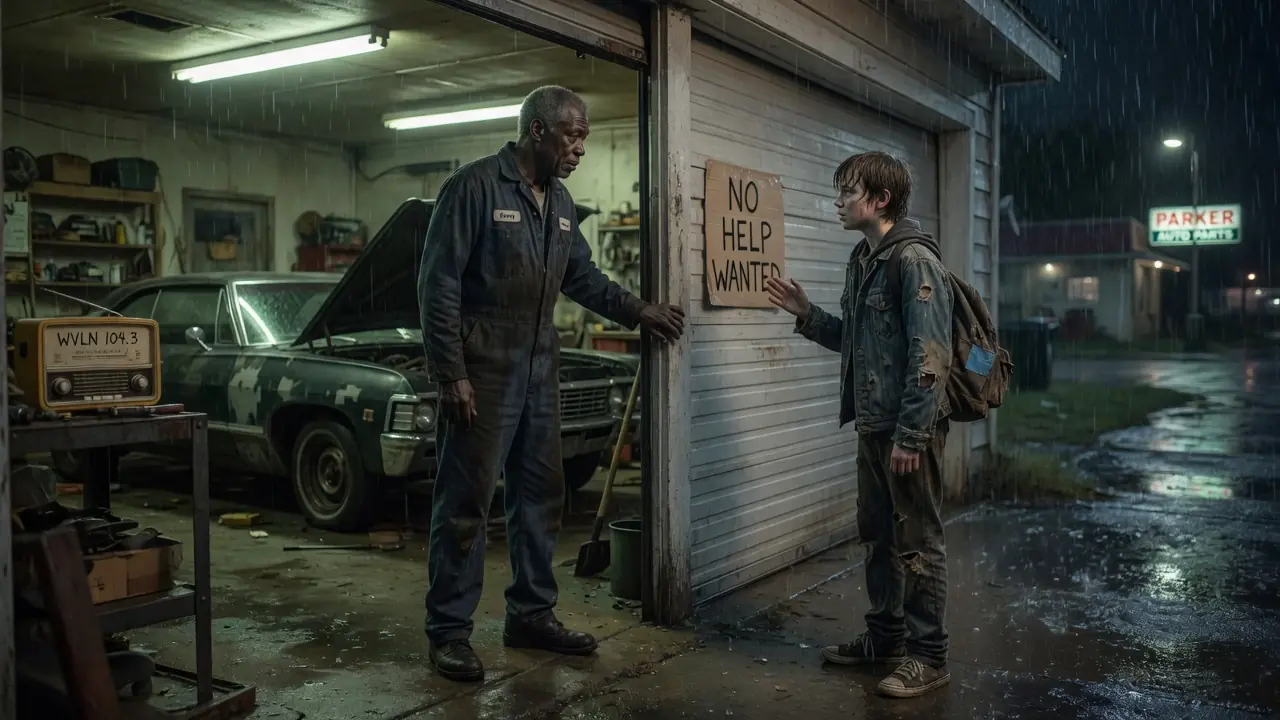
The knock was so soft, Henry almost didn’t hear it over the radio. He looked up, confused. Nobody came by this late. Through the grimy window of the garage door, he could make out a figure, young, thin, soaked from the rain.
Henry’s first instinct was to ignore it. Nothing good came from late-night visitors in this neighborhood, but something made him walk to the door and crack it open.
The kid standing there looked about 18, maybe younger, white, with shaggy brown hair plastered to his forehead, wearing a jacket that was more holes than fabric. His eyes were wide, desperate, but not in a dangerous way. More like a wounded animal, hoping not to be kicked again.
“We’re closed,” Henry said.
“I know, sir. I’m sorry to bother you.” The kid’s voice shook from cold or fear or both. “I was just… I’m looking for work. Any kind of work. I can clean. I can organize. I can…”
“No.”
“Please, sir. I’m a fast learner. I won’t cause any trouble. I just need…”
“I said no.”
Henry started to close the door.
“I’ll work for free.”
The desperation in the kid’s voice made Henry pause.
“Just for a few days. For food. I won’t ask for money. I just… I need somewhere to…”
The kid’s voice broke. He looked down, clearly fighting tears. Henry should close the door. He should tell this kid to go to the shelter on Fifth Street. He should protect himself from whatever trouble this stranger might bring. The last thing he needed was more problems.
But there was something in the way the kid stood there, shoulders hunched, trying to make himself smaller, less threatening, something familiar.
“What’s your name?” Henry found himself asking.
“Eli, sir. Eli Thompson.”
Recognition flickered in Henry’s mind.
“You’re the one they’ve been talking about. The one who…”
He stopped, realizing he was rambling.
Henry studied him for a long moment. The kid was shaking now, and not just from the cold.
“Come inside,” Henry heard himself say. “Out of the rain.”
Eli’s eyes widened in disbelief.
“Really?”
“Before I change my mind.”
Eli practically stumbled into the garage, water dripping from his clothes onto the concrete floor. He looked around with a mixture of awe and relief, like he had just entered a sanctuary.
“There’s rags over there,” Henry pointed. “Dry yourself off. Then start with that corner. Needs sweeping.”
“Yes, sir. Thank you, sir. I’ll do a good job. I promise.”
But as Eli hurried toward the corner, his hands shaking from cold and hunger and nervous energy, he knocked over a container of motor oil. It spilled across the floor in a dark puddle, spreading toward the toolbox.
“Damn it,” Henry snapped.
Eli froze, staring at the spreading oil with horror.
“I’m sorry. I’m so sorry. I’ll clean it up. I’ll…”
His hands were shaking so badly he could barely hold the rag Henry thrust at him. As he bent down to start cleaning, his movements clumsy and panicked, he only seemed to spread the oil further.
“Stop! Just stop!” Henry’s voice was sharp with frustration.
Eli stopped, still crouched on the floor, and Henry saw the kid’s shoulders start to shake. Not from cold this time, from trying not to cry.
“I’m sorry,” Eli whispered. “I’m sorry. I always mess things up. I’ll leave. I’m sorry.”
Henry stood there looking down at this kid kneeling in motor oil, shaking and apologizing for existing, and something cracked inside his chest.
He saw himself at 23, standing outside the Peterson manufacturing plant, being told they didn’t hire his kind. He saw himself at 25, turned away from job after job, watching his mother get sicker, unable to afford her medicine. He remembered what hunger felt like, what desperation felt like, what it felt like when the whole world treated you like you were nothing.
“Stay here,” Henry said quietly. “Don’t touch anything.”
He walked out of the garage, letting the door close behind him. Eli remained on the floor, convinced he had just ruined his last chance, ready to gather his backpack and disappear into the night.
Ten minutes passed. Then 15. The rain drummed steadily on the garage roof. Eli slowly stood up, preparing to leave.
The door opened. Henry walked back in carrying a paper bag. He didn’t say anything, just set it on the workbench and gestured toward it. Eli approached cautiously.
Inside the bag was a burger, cold from the 24-hour gas station down the road, but it might as well have been a five-star meal. Next to it, a bottle of water.
“Eat,” Henry said simply.
Eli’s hands trembled as he picked up the burger. He tried to eat slowly, to have some dignity, but his body had other ideas. He wolfed down half of it before he even realized what he was doing. Then he stopped, embarrassed.
“It’s okay,” Henry said, his voice softer now. “Finish it.”
Tears started rolling down Eli’s cheeks as he ate. He couldn’t stop them. The food, the warmth of the garage, the simple fact that someone, anyone, had shown him kindness. It all came crashing down on him at once.
“Thank you,” he managed between bites. “Thank you so much.”
Henry said nothing. He just pulled up an old stool and sat down, his body language no longer defensive. He let the silence stretch out, broken only by the sound of rain, the distant blues on the radio, and Eli’s quiet eating.
When Eli finished, he wiped his eyes with the back of his hand, smearing grease and tears across his face.
“When’s the last time you slept?” Henry asked.
“I’m not sure. Two days, maybe.”
Henry nodded slowly, as if confirming something he already knew. He stood up, walked to a storage room in the back, and returned with an old blanket and a rolled-up sleeping bag.
“Floor’s hard, but it’s dry. You can stay tonight. Tomorrow, we’ll talk.”
Eli stared at him in disbelief.
“I don’t… I don’t know what to say.”
“Don’t say anything. Just sleep. We’ll figure out the rest in the morning.”
As Henry turned off the main lights, leaving only a small lamp glowing in the corner, Eli spread out the sleeping bag on the cleanest patch of floor he could find. He lay down, his body finally beginning to relax. For the first time in weeks, he felt safe.
Morning light filtered through the grimy windows, turning the dust motes into floating specks of gold. Eli woke to the smell of coffee and the sound of tools being organized. Henry was already at work arranging wrenches by size on the pegboard wall. He glanced over when Eli stirred.
“There’s coffee on the workbench, black. Hope that’s okay.”
“That’s perfect. Thank you.”
Eli stood up, folded the sleeping bag carefully, and reached for the chipped mug Henry had set out. The coffee was strong and bitter, but it was warm, and that was enough.
“You said you wanted to work,” Henry said, not looking at him. “That still true?”
“Yes, sir. Absolutely.”
“Then start with that corner. Tools need organizing. Everything has a place. You put it back where it belongs. Understand?”
“Yes, sir.”
For the next hour, Eli worked in silence, sorting through boxes of bolts, organizing socket sets, sweeping oil stains that had probably been there for years. Henry watched him out of the corner of his eye, noting the careful way the kid handled each tool, how he paused to figure out where things belonged before putting them away.
“Come here,” Henry finally said, gesturing toward the Impala. “You know anything about cars?”
“Not really, sir, but I want to learn.”
Henry handed him a wrench.
“First thing you need to know, a car isn’t just metal and parts. It’s got a heartbeat. You listen to the engine. You can hear what it’s trying to tell you, where it hurts, what it needs.”
He started the Impala. The engine turned over but ran rough, coughing and sputtering.
“You hear that?” Henry asked. “That irregular rhythm. Engine’s telling us something’s off. Could be timing. Could be fuel mixture. Could be a dozen things. But you don’t just start replacing parts. You listen first. You pay attention.”
Eli leaned closer, his ear almost touching the hood, his eyes closed in concentration.
“It sounds sad,” he said quietly. “Like it’s trying really hard, but something’s holding it back.”
Henry looked at the kid with surprise. Most people heard noise. This kid heard emotion.
“Yeah,” Henry said softly. “That’s exactly what it sounds like.”
For the first time in longer than he could remember, Henry felt something other than emptiness. Something small, fragile, but undeniably real.
Hope.
That afternoon, Henry walked to Martha’s Corner Store, the small shop two blocks from the garage. Martha Rodriguez had run the place for 30 years, and she knew everyone’s business.
“Well, well,” she said when Henry walked in. “Henry Carter in the daylight and before closing time, no less. What miracle is this?”
“Just need some sandwiches, Martha. Two.”
Martha raised an eyebrow.
“Two? You got company?”
“Got someone helping out at the garage.”
“Helping out?” Martha leaned on the counter, her eyes sharp with curiosity and concern. “Henry, you know I heard about that Thompson kid. People are saying…”
“People say a lot of things,” Henry interrupted. “Most of it’s none of their business.”
Martha studied his face for a long moment. Then her expression softened.
“You’re different today. Your eyes, they’re clearer. When’s the last time you smiled, Henry?”
“What are you talking about? I smile.”
“No, you don’t. Haven’t seen you really smile in five years. Not since…”
She trailed off, not wanting to mention his son.
“But today, right now, the corners of your mouth went up. Just a little.”
Henry touched his face, almost surprised.
“Sandwiches, Martha. That’s all I came for.”
But as he walked back to the garage, the paper bag warm in his hands, he realized Martha was right. Something inside him had shifted. The weight he’d been carrying felt just a little bit lighter.
Over the next few weeks, a routine developed. Eli arrived before sunrise, swept the garage, organized tools, and watched Henry work. Gradually, Henry let him do more, handing him tools, teaching him how to check oil levels, how to identify different engine sounds.
One morning, they stood together over the open hood of the Impala. Henry’s father’s car, the project that had consumed him for months.
“This car meant everything to my dad,” Henry said, his hands resting on the fender. “He bought it new in ’67, right after the riots. Said he wanted something beautiful in the world, something that ran smooth and true, even when everything else was falling apart.”
Eli listened, not interrupting.
“He died when I was 12. Left me this car and this garage and a lot of debt.”
Henry picked up a wrench, turned it over in his hands.
“I tried to make it work. Got married young, had a son, but this neighborhood… people with money don’t come here for repairs. And people here, they don’t have money to spend.”
“But you kept going,” Eli said quietly.
“What else was I going to do? This is all I know.” Henry’s jaw tightened. “But knowing how to fix things doesn’t mean you can fix everything. My wife, she left after our boy died. Said I cared more about strangers’ cars than my own family. Maybe she was right.”
Eli looked down at his oil-stained hands.
“My dad left, too. Different reason, same result. He drank until there was nothing left of him. One day, he just didn’t come home. Mom tried to hold things together, but it was too much. She worked herself to death, literally. Heart attack at 46, behind the counter of a truck stop diner.”
“How old were you?”
“Sixteen. After that, I just drifted. Tried to find work, but nobody trusts a kid with no family, no references, no address.”
His voice cracked slightly.
“I just wanted someone to give me a chance. Just one chance to prove I wasn’t worthless.”
Henry looked at Eli, really looked at him, and saw past the dirty clothes and the too-thin frame. He saw himself, the younger version before the years had worn him down.
“You’re not worthless,” Henry said firmly. “And you’re not drifting anymore. You’re here. You’re learning. That counts for something.”
Eli’s eyes shone with unshed tears.
“Why are you helping me? Everyone else in this town wants me gone.”
Henry was quiet for a long moment.
“Because somebody should have helped me when I needed it. Nobody did. I’m not going to be that person who turns away when someone’s drowning.”
They stood in silence, the morning sun streaming through the garage door, dust dancing in the light. Two broken people finding something like family in the space between wrenches and engine parts.
“Now come on,” Henry said, clearing his throat. “This carburetor is not going to rebuild itself. Time I taught you how to do this right.”
By afternoon, they’d made progress. Eli’s hands, now confident with tools, moved with purpose as he carefully cleaned each component Henry handed him. The radio played softly in the background, B.B. King singing about better days.
“My son would have been about your age now,” Henry said suddenly, breaking the comfortable silence.
Eli looked up, sensing this was important.
“Jacob. We called him Jake. He was three when…”
Henry’s voice caught. He cleared his throat, started again.
“I was working late, always working late, trying to keep this place afloat. My wife called, said Jake had a fever. I told her I’d be home soon. Just had to finish one more car.”
Henry’s hands stilled on the wrench.
“By the time I got home, she’d taken him to the emergency room, borrowed the neighbor’s car, old piece of junk with bad brakes. On the way back from the hospital…”
He couldn’t finish.
“I’m sorry,” Eli whispered.
“My wife blamed me. Said if I’d been home, she would have used my truck. Better brakes might have made a difference.” Henry’s eyes were distant, trapped in the past. “She left a month later. Couldn’t stand to look at me. Couldn’t stand to be in this garage where I’d chosen to spend time instead of with our family.”
“It wasn’t your fault,” Eli said.
“Wasn’t it?” Henry’s voice was hollow. “Every choice we make, it ripples out, touches other people’s lives. I chose this garage over my family, and my son paid the price.”
Eli set down his tools and sat on the stool across from Henry.
“My mom used to say that guilt is like rust. It eats away at you from the inside until there’s nothing left but holes. She said the only way to stop it is to forgive yourself, to do better next time.”
“And did she forgive herself?”
“For what?”
“For not being able to give you more. For working herself to death.”
Eli’s breath caught. He’d never thought about it that way.
“I don’t know. I hope so.”
“What would you say to her if you could?”
“I’d tell her…” Eli’s voice broke. “I’d tell her that she was enough. That she didn’t have to prove anything. That I knew she loved me, even when we had nothing, especially when we had nothing.”
Henry nodded slowly.
“Maybe that’s what Jake would say to me if he could.”
The two men sat in silence, both carrying their ghosts, both trying to figure out how to set them down.
Finally, Henry stood up, returning to the engine.
“Let me show you something. This engine, when it runs right, it purrs smooth as silk. But right now it’s rough. You hear that knocking sound?”
Eli listened.
“Yeah.”
“That’s the past rattling around. Old damage that hasn’t been fixed. But here’s the thing about engines. You can rebuild them. Clean out the old damage. Replace what’s broken. Make it run like new again.”
Henry looked at Eli meaningfully.
“People are like that, too. Just need someone willing to do the work.”
Eli understood. Henry wasn’t just talking about the car.
“Will you teach me?” Eli asked. “Everything you know?”
“Yeah, kid. I’ll teach you.”
As they bent over the engine together, their hands working in synchronized rhythm, something profound happened in that cluttered garage. Two damaged souls began the slow, painful, beautiful process of healing.
The engine’s rough idle suddenly smoothed out. Henry had adjusted something, and now it purred just like he’d promised.
Eli grinned.
“That sound, that’s what peace sounds like,” Henry said softly. “Remember it.”
But peace, like a fragile engine, could be disrupted easily.
It started with whispers. Mrs. Patterson from the hardware store told Mrs. Chen at the post office, who told her husband, who told everyone at the bar.
By the end of the week, the whole neighborhood was talking.
Henry Carter’s got that Thompson kid working for him. The one who put Tommy Douglas in the hospital. I heard he’s on drugs. That’s why his hands always shake. My cousin won’t take her car there anymore. Doesn’t feel safe. Someone should warn Henry. That kid’s bad news. Trouble follows him everywhere.
The parking lot of Martha’s store became the unofficial gathering place for these conversations. Three men stood outside one afternoon watching Eli walk past carrying parts for Henry.
“There he goes,” said Bill Morrison, arms crossed. “Kid looks like a stiff wind would blow him over.”
“Don’t let that fool you,” replied Jack Peters. “Mean streak a mile wide. You heard what he did.”
“He was defending that old woman,” Martha called out from the doorway of her shop. “That’s what I heard.”
“That’s what he says,” Jack shot back. “But Tommy Douglas is still in physical therapy. His family’s got money, got lawyers. They’re saying assault.”
“They’re saying a lot of things,” Martha said. “Doesn’t make them true.”
“Where there’s smoke, there’s fire,” Bill said. “And that kid, he’s brought nothing but smoke since he got here.”
Inside the garage, Eli was oblivious to these conversations. He was focused on replacing spark plugs, following Henry’s careful instructions. He was finally good at something, finally useful, finally home.
But the poison was spreading.
By the following week, three regular customers had stopped coming. The phone, which used to ring a few times a day, went silent. When Henry went to Martha’s store, conversation stopped when he entered.
He knew what that meant. He’d experienced it before, years ago, for different reasons. He knew the weight of community judgment, how it could crush a business, a reputation, a life.
But this time, he wasn’t the target. This time, it was the kid who’d started to smile again. The kid who hummed along to the radio while he worked. The kid who was learning to believe in himself. And Henry wasn’t sure he could protect him from what was coming.
Louise Carter arrived at the garage just after sunset, her sensible shoes clicking sharply against the concrete floor. She was a woman who believed in tough love, practical decisions, and protecting her younger brother from his own soft heart.
“We need to talk,” she said, not bothering with greetings.
Henry looked up from the engine he was working on. Eli, sensing tension, quietly moved to the far corner of the garage, pretending to organize tools.
“About what, Louise?”
“Don’t play dumb with me. About him.”
She jerked her head toward Eli.
“About what you’re doing to yourself.”
“I’m running my garage. Same as always.”
“No, you’re running it into the ground.” Louise’s voice was sharp. “Do you know how many customers you’ve lost this month? Do you know what people are saying?”
“I know what people say. People always have something to say.”
“They’re saying you’re harboring a criminal, that you’re so desperate for company, you’ll take anyone in no matter how dangerous. They’re saying…”
Louise lowered her voice, but it still carried in the quiet garage.
“They’re saying you’ve lost your mind since Jake died.”
Henry’s jaw tightened.
“Don’t bring Jake into this.”
“Why not? That’s what this is about, isn’t it? You see some lost kid and you think you can save him. Make up for not being there for your own son.”
“That’s not…”
“Isn’t it?” Louise stepped closer. “Henry, I love you. You’re my baby brother, and I’ve watched you hurt for five years. But this isn’t healing. This is self-destruction. That boy is going to take everything from you. Your business, your reputation, maybe even…”
“He’s not taking anything,” Henry said firmly. “He’s working. He’s learning. He’s not what they say he is.”
“How do you know? How do you really know? Because he seems nice? Because he said he’s innocent?” Louise’s voice cracked with frustration. “You’re running yourself into the ground trying to help someone who might not even deserve it. The electric bill is overdue. You’re eating one meal a day. I see the receipts, Henry. I know you’ve been buying him food, buying him supplies, buying him tools. You can’t afford this.”
In the corner, Eli’s hand stilled on the wrench he was holding. He could hear every word.
“I know you’re trying to be kind,” Louise continued. “But kindness without wisdom is just foolishness. You can’t save everyone. You couldn’t save Jake. You couldn’t save your marriage. And you won’t save this kid. You’ll just destroy yourself in the process.”
After Louise left, the garage felt oppressively quiet. Henry stood motionless, staring at the floor where his sister had stood, her words still echoing. Eli remained in the corner, head down, hands trembling.
“You heard all that?” Henry said. Not a question.
“Yes, sir.”
“She’s wrong about you.”
“Is she?” Eli’s voice was barely a whisper. “Everyone I try to help ends up worse off. Maybe I am bad luck. Maybe I should…”
“Don’t.” Henry’s voice was firm. “Don’t run. Not yet.”
“But your business…”
“My business was failing before you got here. Been failing for years. That’s not on you.”
Henry walked over to the Impala, ran his hand along the hood.
“You know what I see when I look at this car? I see something worth fixing. Something that’s been broken for a long time but still has life in it.”
He turned to look at Eli.
“Same thing I see when I look at you.”
Eli’s eyes filled with tears.
“I don’t want to be the reason you lose everything.”
“Then don’t be. Stay. Work. Learn. Prove them all wrong.”
Henry picked up a wrench, held it out to Eli.
“You with me?”
Eli looked at the wrench. A simple tool, but in that moment it represented everything. Trust, partnership, family. He took it.
“I’m with you.”
They worked side by side until midnight, not talking much, just the sound of tools and the old radio playing blues. The Impala’s engine began to sound smoother, healthier. Outside, the town slept, unaware that inside this small garage, two men were building something stronger than reputation, more valuable than money.
They were building hope. And hope, once it starts running, is hard to stop.
Three days later, everything fell apart.
Eli woke before dawn as usual, but this morning was different. He couldn’t sleep. Louise’s words kept playing in his head like a broken record.
“You’ll just destroy yourself in the process.”
He thought about Henry, the way the man had started to smile more, to hum along with the radio, to seem lighter. But he also thought about the empty garage, the silent phone, the worried looks Henry tried to hide when he paid bills.
Eli sat up on his sleeping bag and looked around the garage. This place had become home. The smell of oil and metal, the cluttered workbench, the old Impala that was slowly coming back to life. All of it felt safe. Felt right. But safety at Henry’s expense.
He pulled out his backpack, removed his mother’s photograph. In the dim predawn light, he studied her face.
“What should I do, Mama?” he whispered.
But he already knew the answer. His mother had sacrificed everything for him, working herself to death so he could eat. She would never want him to let someone else suffer for his sake.
With shaking hands, Eli found a piece of paper and a pencil. He stared at the blank page for a long time before he could bring himself to write.
“Mr. Henry, thank you for everything. You gave me food when I was hungry, shelter when I had nowhere to go, and something more important than both. You made me feel like I mattered. You made me feel human again. But I can’t stay. Not if it means destroying what you’ve built. Your sister is right. I’m costing you customers, money, peace. You deserve better than that. I’ll never forget what you taught me. Not just about engines, but about kindness. About seeing people for who they are, not what others say they are. You’re the best man I’ve ever known. That’s why I have to go. Thank you for believing in me even when I couldn’t believe in myself. Eli.”
He folded the note, placed it on the workbench where Henry would find it, and carefully rolled up his sleeping bag. He took one last look around the garage at the tools he’d learned to use, at the Impala that was almost running perfectly, at the space where he’d felt, for a brief moment, like he belonged somewhere.
Then he walked out into the cold morning darkness, leaving the only home he’d known in years behind.
Henry woke at seven, later than usual. Something felt wrong. The quality of silence was different. He came downstairs to find the note on his workbench, Eli’s sleeping bag neatly folded beside it. His heart sank as he read the words.
“Damn it, kid,” he muttered.
He grabbed his jacket and keys and headed for his truck. The sky was already darkening with the promise of rain. Where would Eli go? He had no money, no connections, nowhere safe.
Henry drove through the neighborhood, scanning the streets, past Martha’s store, past the abandoned factory, past the railroad bridge where he suspected Eli might have slept before. Nothing.
The rain started, light at first, then heavy, pounding against his windshield like accusations. Henry’s hands gripped the steering wheel tighter. He thought about turning around, going home. Maybe it was better this way. Maybe Eli was right to leave, but he kept driving.
He found himself at the edge of town near the old abandoned gas station that had closed down five years ago. The place was a hollowed-out shell, pumps removed, windows broken, but the overhang still provided some shelter from the rain.
There, huddled against the wall, soaking wet and shivering, was Eli.
Henry parked the truck and got out, rain immediately soaking through his clothes. Eli looked up, eyes wide with surprise and shame.
“I’m sorry. I had to…”
“Shut up,” Henry said, not unkindly.
He shrugged off his jacket and draped it over Eli’s shoulders.
“You’re freezing.”
“I’m sorry,” Eli repeated. “I didn’t want to hurt you. I thought if I left…”
“You thought wrong.”
Henry sat down beside him on the wet concrete, not caring about the rain, the cold, the indignity of it all.
“You think running away solves anything? You think that makes my life better?”
“Your sister said…”
“My sister says a lot of things. She’s not always right.”
Henry looked at the kid, really looked at him, soaking wet, shaking from cold and emotion, trying to be brave.
“You know what you remind me of?”
Eli shook his head.
“That Impala in my garage. When I first opened it up, the engine was a mess. Corroded, seized up, barely turning over. Previous owner had let it sit for years, let it rust, let it break down. Everyone said it wasn’t worth fixing. Told me to junk it. Get something newer.”
“But you didn’t.”
“No, I didn’t. You know why?” Henry’s voice was intense now. “Because I could hear what it could be. Under all that rust and damage, there was still an engine worth saving. Still something that could run strong and true if someone was willing to do the work.”
He put a hand on Eli’s shoulder.
“You’re not broken, kid. You’re just rusted. Just need someone to help you get running again.”
“But what if I can’t? What if I really am bad luck?”
“What if you’re not?” Henry interrupted. “What if every person who gave up on you was wrong? What if you’re exactly where you need to be, learning exactly what you need to learn?”
The rain poured down around them. Thunder rumbled in the distance. And in that moment, sitting in the ruins of an abandoned gas station, two broken people made a choice.
“Come home,” Henry said. “Please come home.”
Eli nodded, tears mixing with rain on his face.
“Okay.”
They drove back through the storm in silence. But it wasn’t an empty silence. It was the silence of understanding, of commitment, of two people who decided not to give up on each other or themselves.
The next morning, they worked together on the Impala with renewed purpose. Everything Henry had taught Eli over the past weeks came together. The careful listening, the patient diagnosis, the precise adjustments.
“Try it now,” Henry said, stepping back from the engine.
Eli turned the key. The engine turned over once, twice, then caught. But this time, it didn’t sputter. It didn’t cough. It purred, smooth, strong, perfect.
Eli’s face lit up with joy.
“We did it.”
“You did most of it,” Henry said.
And there was pride in his voice. Real pride.
They stood together listening to the engine’s song. No longer broken, no longer struggling, just running the way it was meant to run. Sunlight streamed through the garage door, cutting through the oily air, illuminating the dust motes like stars. The radio played softly, Etta James singing “At Last.”
“This sound,” Eli said quietly. “This is what you meant about listening to the heartbeat.”
“Yeah,” Henry said. “That’s what I meant.”
They didn’t say anything else. Didn’t need to. The engine said everything. That broken things could be fixed. That patience and care could transform rust into music. That two people working together could create something beautiful.
Martha walked past the garage on her way to open her store. She stopped, surprised to hear laughter coming from inside. Real laughter. Henry’s laugh, deep and genuine, mixed with Eli’s younger voice.
She smiled to herself. Maybe Henry’s sister was wrong. Maybe kindness wasn’t foolishness after all. Maybe sometimes the bravest thing you could do was believe in someone when the whole world said you shouldn’t.
Inside the garage, the engine continued to purr, and two men who’d been running on empty finally felt full.
Two months later, life had found a rhythm. The garage wasn’t thriving, but it was surviving. A few brave customers had returned, curious about the kid everyone talked about, and had been impressed by his growing skill.
Eli had changed, too. He’d put on weight, his hands no longer shook, and there was a confidence in his movements that hadn’t been there before. More importantly, he smiled easily and often.
On a Tuesday afternoon, a silver Mercedes-Benz pulled up to the garage, the kind of car that didn’t belong in this neighborhood, expensive, pristine, completely out of place.
A man in his 60s stepped out wearing a suit that probably cost more than Henry made in a month. He had silver hair, sharp eyes, and the bearing of someone accustomed to being in charge.
“Are you open?” he asked, his tone suggesting he already knew the answer.
“Depends on what you need,” Henry said carefully.
He’d learned to be cautious with people like this. They usually wanted something specific and weren’t patient with delays.
“My car is making a sound. I’ve taken it to three dealerships. They’ve replaced parts, run diagnostics, charged me thousands, but the sound persists.” The man’s frustration was evident. “I was passing through, heard the engine acting up again, and saw your garage. Thought I’d try one more place before I give up and buy a new car.”
“What kind of sound?” Henry asked.
“A clicking. Intermittent. Only when the engine is warm, only at certain RPMs. The dealerships say everything checks out electronically, but I know something’s wrong.”
Henry walked around the Mercedes.
“Pop the hood. Mind if I start her up?”
“Please.”
The engine came to life with the smooth purr of German engineering. Henry listened, his trained ear searching for the anomaly. After a moment, he shook his head.
“I’m not hearing it. But if it only happens when warm…”
“I can diagnose it,” Eli said suddenly.
Both men turned to look at him. He’d been quietly watching from the workbench.
“Eli,” Henry said carefully. “This is a Mercedes. Computer-controlled everything. We don’t have the diagnostic tools.”
“I don’t need them,” Eli said, walking over.
There was no arrogance in his voice, just quiet confidence.
“May I?”
The man in the suit studied Eli, the young mechanic with grease-stained hands and secondhand clothes. Then he nodded.
“Why not? Everyone else has failed. Your turn.”
Eli leaned into the engine bay, his eyes closed, just listening. Henry had taught him this. To listen, not just with ears, but with everything. To feel the vibrations, to sense the rhythm, to hear what the machine was trying to say.
After a full minute, Eli opened his eyes.
“Rev it to 2,500 revolutions per minute.”
The man did. Eli listened.
“There. Did you hear it? Very faint clicking right before it smooths out.”
“I didn’t hear anything,” the man admitted.
“It’s the variable valve timing actuator,” Eli said. “The solenoid is sticking. Not enough to throw a code. Not enough to cause problems most of the time. But when the oil is hot and thin, there’s a split second where it catches. That’s your click.”
The man raised his eyebrows.
“The dealership said…”
“The dealerships were looking for big problems. This is small, but small problems get bigger if you ignore them.”
Eli looked at Henry.
“We don’t have the part here, but I can clean the solenoid. Might solve it temporarily.”
“Do it,” the man said.
For the next hour, Eli worked with the focused intensity of a surgeon. Henry supervised but didn’t interfere, recognizing that the kid had found his element. This wasn’t about following instructions anymore. This was about understanding, about intuition, about that rare gift of knowing how machines think.
Finally, Eli straightened up.
“Try it now.”
The man started the car. He revved the engine, held it at different RPMs, let it idle. His expression transformed from skepticism to amazement.
“The click is gone.”
“Should stay gone for a while,” Eli said. “But eventually, you’ll need to replace that actuator. Don’t let a dealership talk you into replacing the whole timing chain. Just the actuator.”
The man shut off the engine and turned to face Eli directly.
“What’s your name, son?”
“Eli Thompson, sir.”
“How long have you been doing this?”
“About three months, sir.”
“Three months.”
The man looked at Henry.
“You taught him.”
“I showed him the basics,” Henry said. “The rest, that’s all him.”
The man reached into his jacket and pulled out a business card.
“My name is Richard Douglas. I own Douglas Automotive Group, 12 dealerships across three states. I’m always looking for talent, real talent, not just people who can follow a computer’s instructions.”
He handed the card to Eli.
“I want to offer you a position, a real position. I’ll send you to training, pay for certifications, give you access to equipment and mentors that could take your skill to the next level. You have a gift, son. A rare one. You shouldn’t waste it in…”
He gestured vaguely at the garage.
Henry felt his stomach drop. Eli stared at the card like it might burn him.
“I don’t know what to say.”
“Say you’ll think about it. Here’s what I’m offering: starting salary of $45,000 a year, full benefits, housing assistance for the first six months while you get settled. Our main training facility is in Atlanta. Six months of intensive education with some of the best technicians in the country. After that, a position at any of our locations you choose.”
“Mr. Douglas,” Henry said, finding his voice. “That’s a generous offer, but…”
“But nothing.”
Douglas looked at Henry with respect, but also finality.
“Sir, I can see you’ve done a good job with this young man. You should be proud. But he has potential that extends beyond this neighborhood. You know it. I know it. And I think he knows it, too.”
He turned back to Eli.
“Take a few days. Think it over. But opportunities like this don’t come around often. I’ll be in town until Friday. The number on that card reaches me directly.”
Douglas paid Henry double the usual rate for the repair and drove away in his perfectly silent Mercedes.
The garage felt very quiet after he left. Eli stood holding the business card, not looking at Henry.
“You should take it,” Henry said finally, the words like gravel in his throat.
“What?”
“The offer. You should take it.”
Henry turned back to his workbench, started organizing tools that didn’t need organizing.
“That’s the opportunity of a lifetime. Real future, real money, everything I can’t give you here.”
“But…”
“No buts. This is what we’ve been working toward, isn’t it? Getting you skilled enough to make something of yourself.” Henry’s voice was rough. “Well, mission accomplished. You’re good enough for the big leagues. Can’t ask for better than that.”
Eli opened his mouth to respond, but Henry cut him off.
“Go home. Think about it. We’ll talk tomorrow.”
“I don’t have a home,” Eli said quietly. “This is my home.”
“Just go, Eli. Please.”
Eli left, and Henry stood alone in the garage he’d spent his whole life building. The garage that had never been enough. Not for his wife, not for his son, and now not for the kid he’d come to think of as what? A second chance.
He looked at the Impala, sitting silent and perfect.
“Everyone leaves eventually,” he told the car. “Should have learned that by now.”
Three days later, Eli accepted the offer. He didn’t tell Henry right away. He couldn’t find the words. But on Thursday evening, as they were closing up the garage, Eli finally spoke.
“I called Mr. Douglas. I’m… I’m going to take the job.”
Henry’s hand stilled on the tool he was putting away.
“Good. That’s good.”
“Is it?” Eli’s voice was anguished. “Because it doesn’t feel good. It feels like I’m abandoning you.”
“You’re not abandoning anyone. You’re moving forward. That’s what you’re supposed to do.”
Henry forced himself to turn and face Eli.
“I’m proud of you, kid. You hear me? I’m proud.”
“Then why won’t you look at me?”
Henry met his eyes then, and Eli saw something there that made his chest tighten. Not anger, something worse. Resignation. Like Henry had expected this all along, like he’d been preparing for it.
“When do you leave?” Henry asked.
“Monday. Mr. Douglas is arranging transportation. He said I should pack light. They’ll provide everything I need.”
“Monday. That’s soon.”
“Yeah.”
They stood in awkward silence, all the words they should say locked behind fear and pride.
“I’ll finish up here,” Henry said finally. “You go get some rest.”
“Henry…”
“Go on now.”
Eli wanted to argue, to say something that would fix this, but he didn’t know what. So he left, climbing the stairs to the small apartment above the garage where Henry had let him stay.
He didn’t sleep. He lay awake staring at the ceiling, clutching his mother’s photograph, wondering if she would be proud of him or disappointed.
On Monday morning, a car arrived to take him to Atlanta. Henry was already in the garage working on a different car, pointedly not watching as Eli loaded his single backpack into the trunk.
“Thank you,” Eli said from the doorway. “For everything.”
Henry didn’t turn around.
“You’re welcome. Do good, kid.”
“I will. I promise.”
The car pulled away. Henry finally looked up, watched through the grimy window as the vehicle disappeared down the street. Then he went back to work, alone again, with only the sound of tools and his own breathing to keep him company.
The Impala sat in the corner, perfect and complete, with no one to appreciate it. Just like Henry himself.
Five years passed. The garage survived, barely. Henry took whatever work came his way, no longer caring about the quality of the jobs or the customers. He fixed what broke and collected what he could. The light in his eyes, briefly rekindled, had gone out again.
Louise visited every Sunday, bringing groceries, cleaning the apartment above the garage that Henry had stopped maintaining. She didn’t say “I told you so,” but it hung in the air between them anyway.
“You should retire,” she said one Sunday, surveying the dusty, cluttered space. “Sell this place. Come live with me.”
“And do what?” Henry asked.
He looked older now, his hair fully gray, his movements slower.
“Rest. Enjoy your life. You’ve worked hard enough.”
“This is all I know, Louise.”
“No,” she said gently. “It’s all you have left. That’s different.”
She was right, of course. The garage had become less a business and more a museum of memories. The Impala still sat in the corner, covered now with a tarp. Henry couldn’t bear to look at it. It reminded him too much of the brief period when he’d felt alive again.
Eli never called, never wrote. Henry told himself it was for the best. The kid was busy building a life, a real future. Why would he want to look back at this run-down garage and the old man who’d given him a temporary home?
Still, on slow days, Henry found himself listening for the sound of footsteps, watching the door, hoping. But hoping, he’d learned, was just another engine that eventually ran out of fuel.
One evening, as he was closing up, Henry stood in front of the covered Impala. Slowly, he pulled off the tarp. The car gleamed, still perfect, maintained by muscle memory, even when his heart wasn’t in it.
He got in the driver’s seat, turned the key. The engine started immediately, that perfect purr that he and Eli had created together.
Henry sat there listening. And for the first time in five years, he let himself cry. For his son, for his failed marriage, for the kid who’d briefly made him believe in second chances. For all the broken things he tried to fix and all the broken things he couldn’t.
The engine purred on, indifferent to his grief. Perfect and alone.
That night, Henry couldn’t sleep. He went down to the garage at two in the morning, turned on a single work light, and sat on his stool. Surrounded by the tools of his trade, the radio still worked. He turned it on, and like a gift from the universe or a curse, it was playing an old blues song, the same one that had been playing the night Eli had first arrived, soaking wet and desperate.
“Sometimes I feel like a motherless child.”
Henry looked around the garage. Every tool, every corner, every stain on the concrete held a memory. His father teaching him how to gap spark plugs. His son at three years old, toddling around, helping by handing him the wrong tools. Eli, careful and eager, learning to listen to the heartbeat of engines.
“I’m tired,” he said aloud to the empty room. “I’m so damn tired.”
He thought about Louise’s offer. Retirement, peace, an easy chair and television, and waiting to die. It sounded awful, but it also sounded like relief. Maybe it was time to admit defeat. Time to accept that some engines can’t be saved, and some people are meant to be alone.
He stood up, walked to the Impala, placed his hand on the hood. The metal was cool under his palm.
“Sorry, Dad,” he whispered. “I tried.”
A sound outside made him look up. Footsteps on the gravel. Probably someone looking for directions or worse, someone looking to rob the place. Henry didn’t even have the energy to care.
But then he saw the shadow in the doorway, and his breath caught in his throat. It couldn’t be.
A figure stepped into the dim light. Tall now, filled out, wearing nice clothes, but with the same gentle eyes.
“Hi, Henry,” Eli said quietly.
Henry couldn’t speak, couldn’t move. His brain couldn’t process what his eyes were seeing.
“I know,” Eli continued, taking a tentative step inside. “I know it’s been five years. I know I should have called, should have written. I…”
“Get out.”
Henry’s voice was cold, foreign even to his own ears.
Eli flinched.
“I deserve that. But please let me…”
“I said get out. You made your choice five years ago. Don’t come back here trying to ease your guilty conscience.”
“It’s not like that.”
“No?” Henry’s pain transformed into anger, a protective shell. “Then what is it like? You left. Didn’t look back. I was good enough when you needed something, but once you got your big break, I was just the old man in the forgotten garage. Well, congratulations on your success. Now leave me alone.”
“Henry, please.”
“What do you want from me? Forgiveness? Absolution? You want me to tell you it’s okay that you disappeared? That I didn’t spend five years wondering if I’d failed another kid?”
Henry’s voice cracked.
“You got everything you wanted. What the hell are you doing here?”
Eli’s eyes were wet with tears, but his voice was steady.
“I came back to fix something.”
“Nothing here needs fixing. Everything’s broken beyond repair, including me.”
“I know you think that,” Eli said softly. “But you’re wrong.”
The door opened wider, and Louise stepped in. She’d been standing outside listening. Her face was red, her expression fierce.
“You have some nerve,” she told Eli. “Showing up here after all this time. My brother trusted you, cared about you, and you just…”
“I know,” Eli interrupted. “I know I hurt him. I hurt you both. But I had a reason, a good reason. If you’ll just let me explain.”
“No explanation is good enough,” Louise said. “You should leave now.”
But Henry held up a hand, stopping her. Because despite everything, the anger, the hurt, the years of silence, he could see something in Eli’s eyes. Determination, purpose, and something else. Something that looked like love.
“Talk,” Henry said. “You’ve got five minutes.”
Eli took a deep breath and pulled out a chair, sitting down slowly like he was afraid of spooking a wild animal.
“The day Mr. Douglas offered me the job,” he began. “I was excited. Of course, I was. It was everything I’d never dared to dream about. But I was also terrified. Terrified of leaving you. You were the first person who’d shown me kindness in maybe ever.”
“So you expressed your gratitude by vanishing,” Louise said sharply.
“Let him finish,” Henry said quietly.
Eli nodded.
“That night, I couldn’t sleep. I came down here to the garage around midnight. I was going to tell you I wasn’t going to take the job, that I wanted to stay here with you, building something together.”
He paused, his hands twisting together.
“But before I could come in, I heard voices. You and Louise were in here talking.”
Henry’s expression shifted. Understanding began to dawn.
“I didn’t mean to eavesdrop,” Eli continued. “But I heard everything. Louise, you told Henry that he was destroying himself by helping me, that he’d been taking losses to give me work, to teach me, that he’d been deliberately breaking things so I could practice fixing them so I wouldn’t feel useless.”
Louise looked away, her jaw tight.
“You told him that he couldn’t even pay his electric bill because he was spending money on me, on food, on supplies, on tools.” Eli’s voice thickened with emotion. “And Henry, you said you were trying to be the person your mother would have wanted you to be. The person who didn’t turn away from someone in need, even if it cost you everything.”
“You shouldn’t have heard that,” Henry said.
“But I did, and it changed everything.”
Eli leaned forward, his eyes locked on Henry’s.
“You were sacrificing yourself for me, your business, your financial security, maybe even your health. Louise was right. I was destroying you just by being here, and I couldn’t… I couldn’t do that to you.”
“So you left,” Henry said.
“So I left. Not because I didn’t care, because I cared too much.” Eli’s voice broke. “I thought if I took Douglas’s offer, worked hard, became successful, I could come back one day and fix things. Actually fix them. Not just broken engines, but your business, your life, everything you’d given up for me.”
“It’s been five years,” Louise said, her voice softer now, but still hurt. “Why didn’t you call? Why didn’t you write?”
“Because I had nothing to offer yet. Every time I thought about reaching out, I asked myself, what can I give him that would make the sacrifice worth it? A phone call? An update on my life? That wasn’t enough. Not even close.”
Eli reached into his jacket and pulled out a rolled-up set of papers.
“So, I worked. I saved. I learned everything I could. And I built this.”
He unrolled the papers on the workbench. They were architectural plans, detailed, professional, beautiful.
“This is Henry’s Hope Garage,” Eli said. “A full-service automotive training center and repair shop. Five bays, modern equipment, classroom space, everything needed to teach young people, especially kids like I was, how to fix engines and fix themselves.”
Henry stared at the plans, unable to speak.
“The building two blocks from here, the old warehouse that’s been empty for years, I bought it. Or rather, my company bought it. I own 30% of a successful specialty repair business in Atlanta. Douglas helped me get started, and I built it from there. Every dollar I saved, I put aside for this.”
Eli pointed to different areas of the plans.
“This is your workshop, separate from the training area, so you can still work on what you love. This is the classroom where you’ll teach. This is the waiting area with comfortable chairs and decent coffee. And this…”
He pointed to a corner of the plan.
“This is where the Impala will sit, displayed as a reminder that broken things can be restored.”
Louise’s hand was covering her mouth. Tears ran down her face.
“The funding is secure,” Eli continued. “Construction can start next month. It’ll take six months to complete, and when it opens, it’ll be yours to run. I’ll be a silent partner. But this is your garage, your legacy. Henry Carter’s place where people learn that everyone deserves a second chance, that kindness isn’t weakness, that fixing broken things, engines or people, is the most important work anyone can do.”
Henry still couldn’t speak. He looked at the plans, at the careful details, at the love evident in every line.
“I know I hurt you by leaving,” Eli said, his voice thick with tears. “I know I hurt you by staying silent, but I couldn’t come back until I had something to give you. Something that matched what you gave me. You gave me hope when I had none. You gave me a future when I couldn’t see past the next day. You gave me…”
His voice broke completely.
“You gave me back my life.”
He stood up, walked to Henry, and knelt down in front of him, the way someone might kneel before a father.
“I’m sorry it took so long. I’m sorry I caused you pain. But I’m here now, and I want to build this with you if you’ll let me. If you’ll forgive me.”
Henry looked down at this young man. No longer the scared kid who’d knocked on his door five years ago, but a man who’d made something of himself and come back to share it. Slowly, his hands shaking, Henry reached out and placed them on Eli’s shoulders.
“You damn fool,” he whispered. “You beautiful, stupid damn fool.”
And then he pulled Eli into a hug, holding on like he was afraid to let go, tears streaming down his face. Louise watched them, her own face wet with tears, and for the first time in five years, she smiled at the sight of her brother’s joy.
When they finally separated, Louise walked over and sat down across from them. Her face was serious, her eyes red from crying.
“Eli,” she said. “I owe you an apology.”
“You don’t.”
“Yes, I do. Let me say this.”
She took a deep breath.
“Five years ago, I stood in this garage and called you trouble. I told my brother he was destroying himself by helping you. I said terrible things, cruel things, because I was scared. Scared of seeing Henry hurt again. Scared of watching him give away pieces of himself to someone who might not appreciate it.”
She looked at her hands, worn and lined from years of practical work.
“But I was wrong. Not about Henry hurting. That part was true. He was sacrificing a lot for you. But I was wrong about you. I judged you based on what other people said, on fear and rumors, instead of seeing who you really were.”
“You were trying to protect him,” Eli said. “I understand that.”
“Understanding doesn’t make it right.”
Louise met his eyes.
“You were a kid who’d been dealt a bad hand. You were trying your best with nothing and no one to help you. And when my brother, bless his stubborn heart, finally did help you, I tried to tear it down. I’m ashamed of that.”
“Louise,” Henry started.
“Hush. I’m not done.”
She turned back to Eli.
“When I heard you at the door tonight, I was ready to tear into you. Ready to protect Henry one more time from being hurt. But then I saw these plans, and I realized something. You left to protect him, too. We were both trying to save him in our own ways. The difference is, you succeeded.”
She reached across and took Eli’s hand.
“Thank you for caring about my brother enough to sacrifice your own happiness. For working five years to give him something real. For coming back when it would have been easier to just send money and stay away.”
“I could never stay away,” Eli said simply. “This is home.”
“He’s family,” Louise finished. “He’s family, and so are you, whether you know it or not.”
She stood up, walked to Henry, and put her hand on his shoulder.
“You were right all along, little brother. I thought you were being foolish, wasting your kindness on someone who didn’t deserve it. But Eli deserved every bit of kindness you gave him and more. I should have seen that. I should have trusted your judgment.”
Henry covered her hand with his.
“You were trying to take care of me. You always do. I know that.”
“Well, maybe I should try being more like you, more willing to see the good in people instead of just the risk.”
She smiled through her tears.
“Though I’m still going to worry about you. That’s what big sisters do.”
“I wouldn’t have it any other way.”
Louise looked at the plans spread out on the workbench.
“Henry’s Hope Garage. It’s perfect. When you open this place, this whole neighborhood is going to change. Kids who need a chance will finally get one. And maybe…”
She paused, emotional.
“Maybe some other scared kid will find their way here just like Eli did. And you’ll be able to help them, too.”
“That’s the idea,” Eli said. “To build something that lasts, something that keeps giving chances to people who need them.”
Louise nodded.
“I want to help with the business side, permits, accounting, whatever you need. Consider me officially invested in Henry’s Hope.”
“You don’t have to,” Henry started.
“I want to. Let me do this. Let me be part of something good.”
She looked between the two of them.
“Let me be part of this family you two have built.”
The three of them stood in the old garage, the place where it all began. And for the first time in years, the space felt full. Not of cars or tools or work, but of something more important.
Love. Forgiveness. Hope.
The Impala sat nearby, its engine perfect and silent, a testament to what patience and care could accomplish. Tomorrow, they would start building the new garage. Tonight, they were just three people who’d found each other in the darkness and chosen not to let go.
Six months passed in a blur of construction, planning, and anticipation. The old warehouse transformed. Where there had been broken windows and rotting beams, now there were clean glass panes and solid steel. The five repair bays gleamed with new equipment. The classroom had whiteboards, comfortable seating, and a library of repair manuals. The waiting area looked more like a community center than a garage. Warm, welcoming, human.
Henry worked alongside the construction crew most days, unable to believe what was taking shape. Eli split his time between Atlanta and home, and it was home now, undeniably, managing both businesses, making sure every detail of the new garage was perfect.
Louise handled the administrative work with fierce efficiency. She secured grants for training programs, established partnerships with local high schools, and spread the word through community organizations. By the time construction finished, they had a waiting list of young people who wanted to learn.
The grand opening was set for a Saturday in October, when the weather was perfect and the whole neighborhood could come. That morning, Henry stood in the main repair bay, looking around in wonder. The walls were painted bright white. The floors were spotless. Tool chests lined one wall, each labeled and organized.
In the corner, visible through glass walls that separated the display area from the workspace, sat the Impala, polished until it gleamed, a plaque beneath it reading, “Broken things can be made whole again.”
“You ready for this?” Eli asked, walking up beside him.
“I don’t know. It still doesn’t feel real.”
“It’s real, and it’s yours.”
“Ours,” Henry corrected. “I never could have done this without you.”
“You did it first,” Eli said quietly. “Five years ago, when you let a stranger into your garage, when you fed him and taught him and believed in him. This…”
He gestured around.
“This is just bigger. But the heart of it, that was always yours.”
People started arriving. Martha from the corner store, carrying a homemade banner that read, “Congratulations, Henry.” Carlos, the truck driver who’d been one of Henry’s few loyal customers, brought his whole family. Mrs. Martinez from the grocery store came with her grandchildren. Former customers, curious neighbors, and even some of the people who’d once spread rumors about Eli. They all came, drawn by the transformation they’d witnessed.
Louise stood at the entrance, greeting everyone, her face bright with pride. She’d printed programs that explained the garage’s mission: to provide automotive training and career opportunities to young people in need, regardless of their circumstances or past.
The mayor showed up, impressed by the partnership between Henry’s local expertise and Eli’s business success. Several local reporters came to cover the story of the young man who’d made good and came back to help his community.
But the most important arrivals were the 12 young people who’d been accepted into the first training program. They ranged from 16 to 22. Some had dropped out of school. Some had been in trouble with the law. Some were simply poor, with no clear path forward.
All of them were nervous, hopeful, and trying not to show either. They reminded Henry of Eli on that rainy night years ago. They reminded Eli of himself.
“Welcome,” Henry said to them, his voice carrying across the garage. “Welcome to Henry’s Hope. You’re here because someone saw potential in you. Maybe you don’t see it in yourself yet, but we do. This place exists to teach you a trade, yes, but more than that, it exists to teach you something I learned from a very wise young man. That broken things, engines, lives, hearts, can all be fixed if someone cares enough to try.”
He paused, emotion thick in his throat.
“I care enough. We all care enough. So let’s get to work.”
The crowd dispersed after the ceremony, leaving the 12 new students standing in the main bay, looking uncertain. They were rough around the edges, baggy clothes, suspicious eyes, the defensive posture of people who’d learned to expect disappointment.
Eli stepped forward, holding a wrench. The same wrench Henry had handed him five years ago.
“My name is Eli Thompson,” he said. “Five years ago, I was exactly where you are now. Actually, I was worse off. I was homeless, hungry, and everyone in this town had decided I was worthless. I believed them. I thought I was cursed. That everything I touched would break, that I was meant to fail.”
He walked among them, making eye contact with each student.
“Then I met Mr. Henry. He didn’t see a curse or a failure. He saw someone who needed a chance, just one chance, and he gave it to me. Even though it cost him customers, money, and respect in this community.”
One of the students, a thin girl with a scar on her cheek, spoke up.
“But you’re different. You’re successful now. You got out.”
“You’re right. I did get out. But not because I was special or talented or lucky. I got out because someone taught me how to listen. Not just to engines, but to the voice inside that said I was worth saving.”
Eli held up the wrench.
“This is a simple tool. Probably costs five dollars. But in the right hands, with the right knowledge, this tool can take something broken and make it whole again.”
He walked to a car they’d positioned in the center bay, an old Honda Civic donated with a mysterious engine problem.
“Today, I’m going to teach you what Mr. Henry taught me. We’re going to listen to this engine and figure out what’s wrong. Not with computers or fancy equipment, with our ears, our hands, and our hearts.”
The students moved closer, intrigued despite themselves. Eli started the car. The engine ran rough, coughing and misfiring.
“What do you hear?”
“Sounds like it’s dying,” one student said.
“Good. What else?”
“It’s not smooth,” another offered. “Like it’s fighting itself.”
“Excellent. Now close your eyes.”
Eli moved among them.
“Don’t just hear the sound, feel it. Every engine has a rhythm, a heartbeat. This one’s heartbeat is wrong. Can you feel where?”
They stood in silence. A dozen young people with their eyes closed, listening to a broken machine trying to run. Some looked self-conscious. Others looked genuinely focused.
Henry watched from the doorway of his private workshop, his heart full. This was what he’d always wanted to pass on. Not just knowledge, but the philosophy behind it. The belief that fixing things mattered, that patience mattered, that people mattered.
“The timing’s off,” the girl with the scar said suddenly. “It’s like… it’s like the beats are coming too fast in some places and too slow in others.”
Eli smiled.
“What’s your name?”
“Jasmine.”
“Jasmine just diagnosed the problem. The timing chain is stretched. The engine’s trying to run, but all the parts aren’t synchronized. They’re working against each other instead of together.”
He looked at each student.
“That’s what happens when we’re broken, too. All our parts, our thoughts, our fears, our hopes, they work against each other. We misfire. We run rough. We think we’re beyond fixing.”
He placed his hand on the hood.
“But we’re not. With the right help, the right tools, the right patience, we can get all our parts working together again. We can run smooth. We can be whole.”
Henry stepped forward then.
“That’s what we’re going to teach you here. Yes, you’ll learn how to fix cars. That’s important. But more than that, you’ll learn how to fix yourselves, how to believe you’re worth the effort, how to listen to your own engine and know when something needs adjusting.”
He picked up a wrench and handed it to Jasmine.
“Let’s get started.”
For the rest of the afternoon, those 12 students worked on that Honda Civic under Eli and Henry’s guidance. They made mistakes. They got frustrated. But they also learned, and more importantly, they began to hope.
Evening came, painting the sky in shades of orange and gold. The students had left, promising to return Monday. The garage was quiet now, just Henry and Eli remaining. They walked together to the display area where the Impala sat, gleaming under soft lights.
Henry ran his hand along the fender the way he’d done thousands of times over the years.
“Your dad would be proud,” Eli said. “Of this car. Of this place. Of you.”
“Maybe.” He always said, “The work we do matters, not because of what we fix, but because of who we become while we’re fixing it.”
Henry smiled.
“I didn’t understand that when I was young. Thought he was being philosophical, but he was right. Every broken thing you repair teaches you something about yourself.”
“What did fixing me teach you?” Eli asked.
Henry turned to look at him, this young man who’d arrived broken and desperate, and had somehow fixed both of them in the process.
“That I was wrong,” Henry said. “I spent five years after my son died believing I was meant to be alone. That I’d failed at being a father, failed at being a husband, failed at everything that mattered. I thought maybe I deserved loneliness.”
His voice grew thick.
“But then you knocked on my door, and you were so scared, so lost, so much like I’d been at your age. And I had a choice. I could turn away and prove to myself that I really was the failure I believed I was. Or I could try one more time, one more chance to be the man my parents raised me to be.”
“You saved my life,” Eli said quietly.
“No.” Henry shook his head. “You saved mine. You reminded me why I do this work. Why I get up every morning. Why any of it matters.”
He gestured to the garage around them.
“This place exists because you believed I was worth coming back for. Because you saw value in an old man who’d given up on himself.”
“I saw a father,” Eli said, his voice breaking. “I saw the father I never had. The one who teaches you, believes in you, doesn’t give up on you, even when you mess everything up.”
Henry’s eyes filled with tears.
“And I saw my son. A second chance to get it right, to be present, to teach what matters.”
They stood in silence for a moment, both overcome with emotion.
“Can I?” Eli hesitated. “Can I call you that? What I’ve wanted to call you for five years but didn’t think I had the right?”
Henry knew what he was asking. He nodded, unable to speak.
“Thank you, Dad,” Eli whispered. “For everything.”
Henry pulled him into a tight hug, and they stood there in the fading light, surrounded by tools and dreams made real. Two men who’d found family in the least likely place.
When they finally separated, Henry wiped his eyes and smiled.
“Come on, son. Let’s take the Impala for a drive. Time to see what she can do.”
They got in the car together, Henry behind the wheel, Eli in the passenger seat. The engine started with that perfect purr they’d created together five years ago. As they pulled out onto the street, the setting sun turning everything golden, the engine sound filled the car, smooth, strong, exactly right.
The sound of something broken made whole.
The sound of an old engine still running true.
The sound of hope.