Lily Torres had cleaned blood from a bathroom mirror once, cigarette burns from a bedspread more times than she could count, and a full jar of pickles spilled inside a motel nightstand drawer for reasons she still did not want explained.
But she had never been afraid of a guest until the Black Vultures arrived at Sundown Pines Motel.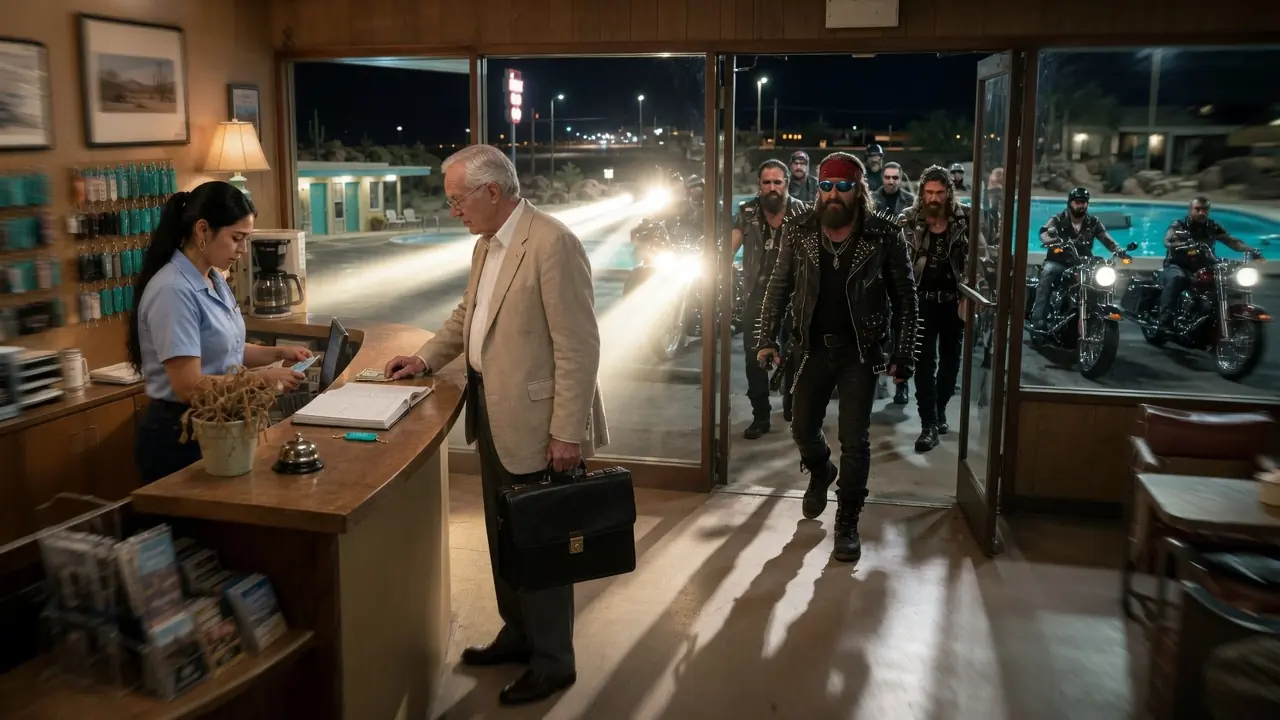
It was 10:37 on a Thursday night, and the motel sign outside buzzed in the desert wind.
SUNDOWN PINES
VACANCY
CABLE TV
ICE
Only half the letters still worked. At night, the sign glowed in broken red pieces, making the place look lonelier than it was. Sundown Pines sat beside a two-lane highway outside Yuma, Arizona, where the desert stretched wide and black beyond the parking lot, and passing headlights disappeared as if the road swallowed them whole.
The motel had twelve rooms, one office, two ice machines that fought harder than they worked, and a swimming pool that had been empty for eight years. The outside walls were faded beige stucco. The doors were painted turquoise. The parking lot had cracks running through it like old scars.
Lily had worked there for five years.
She knew every sound the place made.
The ice machine behind room four groaned before it dropped cubes. The office air conditioner rattled twice before kicking on. The vending machine clicked every seven minutes even when nobody touched it. The pipes in room seven knocked if someone turned on hot water too fast.
At twenty-seven, Lily had the kind of tired beauty people noticed only after she stopped moving. She was small, with dark hair tied in a low ponytail, brown eyes that had learned to watch before trusting, and hands always smelling faintly of bleach no matter how much lotion she used. She wore black jeans, sneakers, and the motel’s pale blue housekeeping shirt with TORRES stitched above the pocket.
She had not planned to work the front desk that night.
But Mrs. Evelyn Mercer, the motel owner, had died three weeks earlier, and everything at Sundown Pines had become uncertain after that.
The day clerk had quit.
The maintenance man had stopped answering calls.
The owner’s nephew, Clay Mercer, had shown up twice in shiny boots and sunglasses, talking loudly about “liquidating useless property” and “getting real money out of this dump.” He had not asked Lily how payroll worked, how taxes were handled, which rooms needed wiring, or where the emergency cash was kept.
He had asked where the safe was.
Lily had lied and said she did not know.
Mrs. Mercer had trusted Lily with the safe code two years earlier, after Lily found the old woman sitting on the office floor at midnight, one hand pressed against her chest, too stubborn to call an ambulance because “hospitals charge you for breathing.” Lily had called anyway. Mrs. Mercer complained for three days afterward, then quietly gave Lily a raise and the safe code.
Now Mrs. Mercer was gone.
The motel felt like it was holding its breath.
Lily sat behind the office desk, balancing a stack of receipts, when the first motorcycle turned into the lot.
She heard it before she saw it.
A low engine growl rolled through the glass.
Then another.
Then another.
Lily looked up.
Headlights swept across the office window, bright and harsh. Seven motorcycles rolled into the parking lot, tires crunching over gravel at the edge of the cracked asphalt. They parked in a crooked line beneath the broken sign, engines rumbling long after they had stopped moving, as if the riders wanted the whole motel to feel them arrive.
Lily did feel it.
In the desk.
In the window.
In her ribs.
The engines shut off one by one.
The sudden silence was worse.
Boots hit pavement. Men laughed. Leather creaked. A cigarette lighter sparked in the dark.
Lily glanced at the room board behind her.
Rooms three, five, eight, and eleven were occupied.
Room eleven belonged to Mr. Walter Crane, an elderly man who had checked in that afternoon wearing a linen jacket, wire-rimmed glasses, and a hat that looked too formal for the desert. He had asked for the quietest room, paid cash for one night, and requested extra towels with the politeness of someone who had spent a lifetime choosing his words carefully.
Lily had put him in eleven.
Farthest from the road.
Closest to the dry pool.
He had smiled and said, “That will do perfectly, Miss Torres.”
She had not told him her name. He had read it from her shirt.
Outside, the riders moved toward the office.
Lily stood.
She did not like the way they walked.
Not drunk exactly. Not stumbling. Worse than that. Comfortable. Like men who had already decided no one inside the building mattered enough to resist them.
The office door opened.
The bell above it gave a weak ring.
The first man inside was tall and broad, with a shaved head, a black beard, and a leather vest darkened by road dust. On his back was a patch of a vulture with its wings spread over a red moon. Beneath it were the words BLACK VULTURES.
His name patch said: RAZOR.
Behind him came six others, all wearing the same patch, all too loud for the small office.
The room filled with the smell of gasoline, sweat, leather, and hot pavement.
Razor looked around slowly.
His eyes passed over the postcards, the cracked plastic plant, the rack of brochures no one had updated since 2009, then settled on Lily.
“Well,” he said. “There she is.”
Lily kept her hand near the desk phone.
“Evening,” she said. “Do you need rooms?”
One of the bikers laughed.
Another leaned against the soda machine and tapped the glass with a ringed finger.
Razor smiled. “That depends.”
“On what?”
“On whether you still work here.”
Lily’s stomach tightened.
“I do.”
“That’s funny.” Razor stepped closer to the desk. “Because Clay said everybody was supposed to be gone by now.”
Lily’s face did not change, but her pulse quickened.
Clay.
Of course.
“Mr. Mercer doesn’t own the motel,” she said.
Razor’s smile widened. “He will.”
“That isn’t the same thing.”
The bikers made low sounds, amused by her answer.
Razor placed both hands on the desk and leaned forward. He had pale eyes, almost gray, and a voice that slid between friendly and dangerous without warning.
“You always correct men you don’t know?”
“When they’re wrong.”
The office went quiet.
One of the bikers, a narrow-faced man with a scar above his lip, chuckled. “She’s got a mouth.”
Razor did not laugh.
He looked at Lily’s name stitched on her shirt.
“Torres,” he said. “Clay said there was a maid still hanging around.”
Lily’s jaw tightened.
“I’m the night manager.”
“Sure.” He looked around the office. “And I’m the governor.”
A biker near the door laughed too loudly.
Lily reached for the registration cards. “If you want rooms, I need IDs and payment.”
Razor straightened. “We’re not paying.”
“Then you’re not staying.”
The words left her before caution could stop them.
She knew it was a mistake the instant the room changed.
The bikers stopped smiling.
Razor stared at her.
Then he slowly took off his gloves and set them on the desk.
“You know what this place is worth?” he asked.
Lily did not answer.
“Nothing,” he said. “A dead woman’s bad investment baking beside a dead highway. Clay understands that. He made a deal.”
“He has no authority to make any deal.”
Razor’s eyes sharpened. “You a lawyer now?”
“No.”
“Then maybe stop saying lawyer words.”
Lily lifted the phone receiver.
Before she could dial, the scarred biker reached across the desk and pressed one finger down on the cradle, ending the line.
Lily froze.
He smiled.
“Office phone’s for business,” he said.
“This is business,” Lily replied.
Razor laughed softly. “Not anymore.”
He reached into his vest and pulled out a folded paper.
He slapped it on the desk.
Lily looked down.
It was not a legal document. Not really. It was a printed letter with Clay Mercer’s name at the bottom, giving “temporary access and control” of Sundown Pines Motel to Razor Kincaid and associates for “security inspection and asset protection.”
It was nonsense.
But nonsense could still become dangerous in the hands of men willing to enforce it with fists.
“Clay gave us permission,” Razor said.
“Clay can’t give permission to property he doesn’t own.”
Razor leaned closer. “You keep saying that.”
“Because it keeps being true.”
The scarred biker laughed again. “Damn, boss. Maid’s going to make you read a book.”
Razor turned his head slowly toward him.
The man stopped laughing.
Then Razor looked back at Lily.
“I don’t like being embarrassed.”
Lily swallowed.
She wished she had locked the office door when she heard the engines. She wished she had called the sheriff when Clay first came by. She wished Mrs. Mercer were still alive, standing behind the desk in her flowered cardigan, telling these men she had buried two husbands and would not be bullied by boys with patches.
But Mrs. Mercer was not there.
Lily was.
She stood behind the desk with bleach on her hands, thirty-eight dollars in her wallet, and a motel full of rooms she had cleaned too many times to let strangers destroy.
“What do you want?” she asked.
Razor smiled again.
That was worse.
“Keys.”
“To what rooms?”
“All of them.”
“No.”
He stared at her.
The biker by the soda machine whistled. “She really likes that word.”
Razor tapped the paper. “Clay says we get access.”
“Guests are in rooms three, five, eight, and eleven.”
“They can move.”
“No.”
Razor’s hand came down hard on the desk.
The bell on the counter jumped.
Lily flinched before she could stop herself.
The bikers noticed.
Razor noticed most of all.
His smile returned, slow and satisfied.
“There she is,” he said. “I was wondering when the brave part would run out.”
Lily hated that her hands were shaking.
She moved them beneath the desk.
Razor walked around to the side of the counter.
Lily stepped back.
“You’re not allowed back here.”
He looked amused. “No?”
“No.”
He came anyway.
Lily backed into the key rack behind her. Metal keys clinked softly against their tags.
Razor reached past her and took the key to room twelve.
It was empty.
He weighed it in his hand.
“See?” he said. “Easy.”
“Put that back.”
“Make me.”
The words were quiet.
The office air seemed to thicken.
Lily looked toward the front window. The parking lot was dark except for the motorcycles beneath the sign. No cars were passing on the highway. Rooms three and five had their curtains drawn. Room eight’s light was off.
Room eleven’s curtain moved slightly.
Mr. Crane.
Lily saw the narrow gap, then the curtain fall back into place.
Razor saw her eyes shift.
He turned toward the window. “Somebody watching?”
“No.”
He smiled. “Liar.”
He walked to the door and looked out into the parking lot.
“Rooms occupied, huh?”
Lily moved quickly to the desk and reached for her cell phone in the drawer.
The scarred biker caught her wrist.
Not crushing.
Just holding.
That was enough.
“Careful,” he said.
Lily looked at his hand on her.
“Let go.”
He did not.
Razor turned back from the doorway. “What did she reach for?”
“Phone.”
Razor sighed theatrically. “Miss Torres. We were having such a nice conversation.”
“She asked you to leave,” Lily said.
“No.” He walked toward her. “She told me no. There’s a difference.”
The scarred biker released her wrist only after giving it one last squeeze.
Lily pressed her hand against her side, hiding the red marks his fingers left.
Razor saw.
He seemed pleased.
“You live here?” he asked.
“No.”
“Apartment in town?”
Lily said nothing.
“You got family nearby?”
Silence.
His smile thinned. “A daughter, maybe?”
Lily’s stomach dropped so fast she nearly forgot to breathe.
She had not mentioned Maya.
Her six-year-old daughter was with Lily’s sister in town, asleep under a pink blanket with stars on it, safe for now. Lily had worked hard to keep her daughter separate from the motel, separate from late-night guests, separate from men who looked at a woman and searched for what could hurt her most.
Razor leaned close.
“There it is.”
Lily forced her voice steady. “You don’t know anything about me.”
“I know Clay talks.” He tilted his head. “Single mom. Cleaning rooms. Acting like this dump is yours.”
One biker laughed. “Maybe she thinks if she scrubs hard enough, she’ll inherit it.”
Lily’s face went hot.
Razor took the motel key from the wall.
Room eleven.
Lily reached for it before thinking.
“No.”
Razor lifted it out of reach.
“Why not this one?”
“It’s occupied.”
“By who?”
“A guest.”
“What kind of guest?”
“The kind who paid.”
The scarred biker chuckled. “You hear that? Paying customers matter now.”
Razor studied Lily’s face.
Then he turned to the others.
“Let’s meet the guest.”
Lily stepped into his path.
“No.”
Razor looked down at her.
This time, no one laughed.
The word had become something else now. Not customer service. Not policy. Not stubbornness. Protection.
Razor’s eyes cooled.
“You got ten seconds to move.”
Lily’s voice came out quieter than she wanted. “Please don’t bother him. He’s an old man.”
Razor smiled.
“An old man.”
The bikers reacted exactly as she feared. A new kind of amusement moved through them. Easier. Meaner. Old men were even better targets than women when men like Razor wanted to feel large.
Lily knew she had made it worse.
She also knew she would say it again.
Razor stepped closer.
“You protecting him?”
“Yes.”
“With what?”
The question hung between them.
He wanted her to understand the answer.
Nothing.
She had no weapon, no backup, no legal authority he cared about, no man beside her, no crowd in the parking lot, no sheriff pulling in at the perfect moment.
Just herself.
Razor reached out and flicked the plastic name tag clipped beneath the embroidery on her shirt.
TORRES.
The small tap made her flinch again.
“You’re not built for this,” he said.
Lily’s eyes stung, but she refused to lower them.
“No one is built for being bullied,” she said. “That’s why bullies choose it.”
For one moment, something like surprise crossed his face.
Then anger.
Razor grabbed the front of her housekeeping shirt and pulled her forward just enough that the keys behind her clattered against the wall.
“Careful,” he whispered.
The office door opened.
The bell rang.
Everyone turned.
Walter Crane stood in the doorway wearing the same linen jacket he had checked in with, though now he held a black leather briefcase in one hand. He looked older under the fluorescent light than he had in the afternoon: thin, silver-haired, slightly stooped, with wire-rimmed glasses and a calm face.
But his eyes were sharp.
Very sharp.
“Take your hand off Miss Torres,” he said.
His voice was mild.
Almost conversational.
Razor kept his grip on Lily’s shirt. “You room eleven?”
“I am.”
“Then go back to it.”
Mr. Crane stepped inside and closed the door behind him.
“I believe I gave you an instruction.”
The bikers stared.
Then the scarred one laughed.
“You believe,” he repeated. “Boss, old man believes.”
Razor released Lily’s shirt, but not because he was afraid. He did it slowly, with a smile, as if granting mercy.
Lily stepped back, breathing hard.
Mr. Crane’s eyes flicked once to her wrist.
Then to her shirt.
Then to the paper on the desk.
He set his briefcase on the counter.
Razor watched him. “You got business here?”
“Yes.”
“Then it can wait.”
“No,” Mr. Crane said. “It has waited long enough.”
He opened the briefcase.
One of the bikers near the door moved his hand toward his belt.
Mr. Crane looked at him over his glasses.
“You may want to keep that hand visible, Mr. Danton.”
The biker froze.
The room changed.
Razor’s eyes narrowed. “You know him?”
“I know all seven of you.”
Silence.
Lily stared at Mr. Crane.
He removed a thick folder from the briefcase and placed it on the counter. Then he took out a small black device, no bigger than a deck of cards, and set it beside the folder.
A blinking red light flashed on it.
Razor looked at it.
“What is that?”
“A recorder.”
The word landed flatly.
No drama.
No shouting.
Just a fact.
The scarred biker stopped smiling.
Razor’s jaw tightened. “You recording us?”
“Yes.”
“That’s illegal.”
“No,” Mr. Crane said. “Arizona is a one-party consent state for audio recording when one party to the conversation consents. I consented.”
Razor’s eyes flicked to Lily.
Mr. Crane added, “Additionally, you are in a commercial office with visible security cameras, and you walked in under posted notice.”
Lily looked toward the top corner of the office.
The old camera above the brochure rack had not worked in two years.
Mr. Crane followed her glance.
“That one is decorative,” he said. “The new one is in the smoke detector.”
Razor looked up.
For the first time that night, he seemed uncertain.
Mr. Crane opened the folder.
“Now,” he said. “Let us stop pretending Clay Mercer owns anything.”
Razor’s face hardened. “Who the hell are you?”
“My name is Walter Crane. I am an attorney licensed in Arizona since 1979. I represent the estate of Evelyn Mercer, deceased.”
Lily’s breath caught.
Estate.
Razor looked at the folder, then back at Crane.
“Clay said the estate was his.”
“Clay says many things,” Mr. Crane replied. “Most of them become less impressive when placed under oath.”
One biker muttered, “Boss.”
Razor ignored him. “Clay is next of kin.”
“True.”
“Then he inherits.”
“False.”
Mr. Crane pulled one document from the folder and placed it on the desk, turning it so Razor could read the heading.
Last Will and Testament of Evelyn Grace Mercer.
Lily stared at the name.
Her throat tightened unexpectedly.
Mrs. Mercer had never used her middle name. She always said Grace sounded like a woman who embroidered pillows, and she had no patience for pillows unless they could survive motel guests.
Mr. Crane tapped the document.
“Mrs. Mercer disinherited Clay Mercer in 2018 after he attempted to use this motel as collateral for a loan she never authorized.”
Razor said nothing.
“Again in 2021,” Mr. Crane continued, “he tried to pressure her into transferring the property through a quitclaim deed while she was hospitalized. That document was rejected, challenged, and voided.”
Razor’s eyes darkened. “This has nothing to do with us.”
“Oh, it does. Especially because the man who witnessed that fraudulent 2021 attempt was you.”
The room went silent.
Lily looked at Razor.
His expression did not change much, but something behind his eyes shifted.
Mr. Crane removed another sheet.
“Razor Kincaid. Legal name Raymond Kincaid. Previously charged with coercion, assault, and unlawful debt collection. Currently under investigation for intimidation of small business owners along county highway routes.”
Razor smiled slowly. “That supposed to scare me?”
“No,” Mr. Crane said. “The next part is.”
He turned another document.
“This is a temporary protective order issued this morning against Clay Mercer, Raymond Kincaid, and known associates, prohibiting contact with employees, tenants, guests, and business records of Sundown Pines Motel.”
The office became so quiet Lily could hear the soda machine humming.
Razor looked at the paper.
Then at Mr. Crane.
“You’re lying.”
“No.”
“I would’ve been served.”
“You were.” Mr. Crane looked toward the biker near the door. “At 4:12 p.m., at Alvarez Auto Yard. You refused to sign acknowledgment, then threw the papers into a trash barrel. That was witnessed.”
The biker near the door lowered his eyes.
Razor turned on him. “Danton.”
Danton said nothing.
Mr. Crane closed the folder halfway.
“You walked into this office tonight already subject to a court order. You then interfered with the employee on duty, prevented her from using the phone, touched her without consent, threatened access to occupied rooms, and attempted to use a fraudulent letter from Clay Mercer as authority.”
He paused.
The red light on the recorder blinked again.
“You have been remarkably efficient.”
The scarred biker whispered, “We should go.”
Razor snapped, “Shut up.”
Mr. Crane looked at Lily.
“Miss Torres, are you injured?”
Lily’s mouth was dry.
She looked at Razor, then at the red mark on her wrist.
“My wrist,” she said.
“Did he grab you?”
“The one with the scar did.”
Mr. Crane looked at the scarred biker. “Mr. Colby Raines.”
The man’s face went pale with anger. “Don’t say my name.”
“You brought it into my client’s office.”
My client.
Lily’s mind caught on the phrase.
Mr. Crane had said it without looking at her.
Razor heard it too.
“Your client?” he asked. “Old lady’s dead.”
“Yes,” Crane said. “But the property is not.”
He opened another document.
“Effective upon Evelyn Mercer’s death, Sundown Pines Motel transferred into the Mercer-Torres Operating Trust.”
Lily stopped breathing.
“What?” she whispered.
Mr. Crane turned toward her now.
His voice softened.
“Mrs. Mercer intended to tell you herself after her last hospital stay. She did not have the chance. I came tonight to deliver the documents privately and make arrangements with you tomorrow morning.”
Lily stared at him.
“I don’t understand.”
“Mrs. Mercer left the motel business in trust. You are named managing trustee and primary beneficiary.”
The words made no sense.
Not because they were complicated.
Because they were impossible.
Razor laughed once, harshly. “The maid?”
Mr. Crane’s expression chilled.
“The woman who kept this business alive for five years while Clay Mercer circled it like a buzzard,” he said. “Yes.”
Lily gripped the edge of the desk.
The room seemed to tilt.
Mrs. Mercer had left her the motel?
No.
Not possible.
Lily cleaned rooms. Checked in truckers. Fixed toilets with YouTube videos. Repainted doors when the sun peeled them. Sat with Mrs. Mercer during late-night chest pain. Balanced receipts when the old woman’s hands shook. Hid overdue notices from guests. Stretched towels between busy weekends.
She had done all that because someone had to.
Because Sundown Pines had been falling apart, and Mrs. Mercer had looked at Lily like she was capable when most people looked at her and saw a tired single mother with a housekeeping cart.
Razor stared at Lily with new hatred.
Not because she had power.
Because power had appeared where he had decided none existed.
“You expect me to believe Evelyn Mercer left this dump to the help?”
Lily flinched at the phrase.
Mr. Crane did not.
“I expect nothing from you,” he said. “The court expects compliance.”
Razor stepped closer to him. “You think papers stop men?”
Mr. Crane looked up at him.
“No. I think consequences do.”
He picked up his phone from the briefcase and turned the screen toward Razor.
A call was active.
Duration: 14:22.
Razor’s jaw tightened.
On speaker, a woman’s voice came through clearly.
“Mr. Crane, Sheriff Barlow has units three minutes out.”
Lily’s heart slammed once.
Razor stared at the phone.
Mr. Crane said, “Thank you, Deputy Harris. Please note that Mr. Kincaid is still present and still threatening.”
Razor stepped back.
“You son of a—”
“Careful,” Mr. Crane said. “We are still recording.”
The office door opened behind the bikers.
Not from outside.
From the back hallway.
A tall woman in a dark security uniform stepped in, one hand resting calmly near her belt. Lily recognized her from earlier that afternoon, though she had not been wearing a uniform then. She had checked into room five under the name Paula Dean, which Lily had thought sounded fake but not worth questioning.
The woman showed a badge.
“State licensing investigator,” she said. “And before anyone gets clever, I am also armed.”
The bikers froze.
Lily looked at Mr. Crane.
He adjusted his glasses.
“Mrs. Mercer was thorough,” he said.
Razor’s face flushed with rage. “This was a setup.”
“No,” Mr. Crane said. “This was a legal meeting. You chose to become evidence.”
The line hit the room harder than a shout.
Outside, sirens finally appeared in the distance.
Not loud at first.
Then growing.
Red and blue light flickered against the broken motel sign.
The bikers looked at the window.
Their motorcycles sat exposed beneath the sign. No easy exit. No crowd to hide inside. No empty highway anymore.
Razor turned toward Lily.
His voice dropped.
“You think you won because some old man has paperwork?”
Lily’s hands were still shaking.
Her wrist hurt.
Her shirt collar was stretched where he had grabbed it.
But something inside her had shifted.
Not because she suddenly felt fearless.
Because fear had lost its authority.
She looked at him and said, “No. I think you lost because you walked into a place you thought nobody owned and put your hands on the owner.”
Razor’s face changed.
The word owner did not feel real yet.
But saying it did.
The first patrol car pulled into the lot.
Then the second.
The red and blue lights washed across the office walls.
Razor looked toward the back hallway, then the front door, calculating.
The security investigator shook her head once.
“Don’t.”
He stopped.
Sheriff Barlow entered with two deputies moments later.
He was a heavyset man in his fifties with a gray mustache and the weary expression of someone who hated paperwork but loved catching fools who created it. He took in the room quickly: Lily behind the desk, Mr. Crane with his folder, the blinking recorder, the bikers, the state investigator, the phone still connected.
“Well,” he said. “Raymond Kincaid. Again.”
Razor lifted both hands slightly. “This is civil.”
Sheriff Barlow looked at Lily’s wrist. “That isn’t.”
Lily looked down.
The red marks had darkened.
The sheriff’s face hardened.
“Miss Torres, did he hurt you?”
The office went quiet.
For years, Lily had made things smaller.
Customers were not drunk; they were difficult.
Men did not harass; they joked.
Clay did not threaten; he pressured.
Guests did not scare her; they made her uncomfortable.
Smaller words made life easier for everyone else.
But Mr. Crane had placed documents on the desk and named things exactly. Protective order. Coercion. Fraud. Threat. Consent. Evidence.
Maybe that was what rescue was, sometimes.
Not a fist.
Not a crowd.
A correct name at the correct moment.
Lily looked at Sheriff Barlow.
“Yes,” she said.
The word did not shake.
“He grabbed my shirt. His man grabbed my wrist. They blocked the phone. They threatened occupied rooms.”
Sheriff Barlow nodded. “All right.”
Razor laughed bitterly. “All right? That’s it?”
“For now,” the sheriff said. “Hands on the counter.”
The deputies moved in.
The bikers obeyed, but not quietly.
Colby Raines cursed under his breath. Danton kept saying he did not touch anyone. Another biker insisted Clay had promised them keys. Razor stared at Lily while the deputy cuffed him.
“You’ll lose this place in six months,” he said.
Lily met his eyes.
“Maybe,” she said. “But not to you.”
The deputy guided him toward the door.
Razor stopped beneath the bell, looking back one last time.
“You’re still just a maid.”
Mr. Crane’s voice cut in before Lily could answer.
“And you are currently trespassing in her motel.”
The sheriff pushed Razor out into the flashing lights.
The bell rang behind him.
For a long moment, no one spoke.
The office felt smaller after the bikers left. Too bright. Too hot. The air conditioner rattled twice, then started blowing cold air through the vent above the desk.
Lily leaned against the key rack.
Her knees felt weak.
Mr. Crane closed his briefcase halfway and turned to her.
“Miss Torres?”
She stared at the documents on the desk.
“Is it true?”
“Yes.”
“She left me the motel?”
“Technically, she left the business and property to the trust, with you as managing trustee and primary beneficiary. Her instructions were specific.”
Lily laughed once, but it came out broken. “I don’t know what that means.”
“It means you control it.”
“I clean rooms.”
“You do more than that.”
“You don’t know what I do.”
“I know Mrs. Mercer documented it in fourteen pages of handwritten instructions.”
He removed a small envelope from the folder.
Lily recognized the handwriting instantly.
Sharp, slanted, impatient.
For Lily, when Walter finally stops talking.
Her eyes filled before she opened it.
Mr. Crane looked away politely.
Lily unfolded the letter with trembling fingers.
Lily,
If Walter is reading legal nonsense at you, tell him to slow down. He talks like courtrooms charge rent by the sentence.
I know you are probably angry. You should be. I should have told you sooner, but old women are cowards in private ways. I kept waiting for the right time, then my body decided it was done waiting.
This motel is not worth much to people like Clay. That is why he wanted it. Men like him only value things they can sell, strip, or ruin.
But you saw what I saw.
A place for tired people to sleep. A place where a woman with a kid and a bad week can get clean sheets without being judged. A place that still has bones, even if the paint is peeling.
You kept it alive when I could not.
So now it is yours to keep alive, sell, burn down, repaint pink, or turn into whatever future you and Maya deserve. Do not let anyone tell you that you were given charity. You were given the keys to the thing you already carried.
The safe code is still your birthday because I am not creative.
Do not trust Clay.
Do trust Walter, even if he dresses like a funeral for a bank.
And for God’s sake, replace the ice machine behind room four.
Evelyn
Lily pressed the letter to her chest.
She cried then.
Not loudly.
Not dramatically.
Just enough for the fear, anger, grief, and shock to leave her body all at once.
The state investigator stepped back into the hallway to give her privacy.
Sheriff Barlow finished speaking with a deputy outside.
Mr. Crane remained near the desk, looking at the motel keys instead of at her.
“She liked you,” Lily whispered.
“She insulted me for thirty-two years,” Mr. Crane said. “So yes.”
Lily laughed through tears.
Then she wiped her face with both hands.
“I don’t know how to run a motel.”
Mr. Crane glanced around the office. “Miss Torres, you have been running this motel for years.”
“That’s different.”
“Only legally.”
She looked at the key rack.
Room eleven’s hook was empty.
The key still lay on the desk where Razor had dropped it.
She picked it up slowly.
The metal tag was old, turquoise paint chipped around the edges.
That little key had almost become a doorway to more cruelty.
Instead, it had become the room where the deed waited.
Outside, the deputies were searching the bikers’ saddlebags. One found the torn pieces of the protective order in Danton’s pocket. Another found a small stack of motel room key copies that did not belong to Sundown Pines but likely belonged to other businesses.
Sheriff Barlow came back inside.
“Miss Torres, I’ll need a full statement.”
Lily nodded. “Okay.”
“You want to sit first?”
She almost said no.
Then she said, “Yes.”
Mr. Crane pulled the guest chair over.
Lily sat.
Her wrist throbbed.
Her shirt collar was stretched.
Her whole life had changed in less than an hour, and still the office looked exactly the same: stained counter, buzzing light, broken brochure rack, coffee maker with a cracked lid, keys hanging behind her.
That was the strange thing about reversal.
The world did not always announce it with thunder.
Sometimes it happened under fluorescent lights with paperwork, a recorder, and a motel key in your palm.
Lily gave her statement carefully.
She told the sheriff about the letter Clay had sent through Razor. About the phone. About Colby grabbing her wrist. About Razor taking room eleven’s key. About the threat to occupied guests. About Maya being mentioned.
Her voice trembled once when she said her daughter’s name.
Mr. Crane noticed but did not interrupt.
When she finished, Sheriff Barlow closed his notebook.
“You did well,” he said.
Lily looked at him. “I was terrified.”
“Most people who do well are.”
After the sheriff left, the state investigator, whose real name was Dana Whitlock, asked Lily to walk the property with her.
They checked the empty rooms, the back hallway, the utility closet, and the old laundry shed. No other bikers were hiding. No damage beyond a cracked office drawer and a broken plastic brochure holder Razor had knocked over.
Room three’s guest cracked the door and asked if everything was okay.
Lily heard herself answer, “Yes, sir. Everything is handled.”
Handled.
The word felt new in her mouth.
At 1:12 a.m., the patrol cars left with Razor and two of his men in custody. The other four were cited and escorted off the property under orders not to return. Clay Mercer had not shown up. Sheriff Barlow said a deputy was already looking for him.
The motel became quiet again.
But not the same quiet.
Lily stood in the parking lot with Mr. Crane while the desert wind moved through the dry pool fence.
The broken sign buzzed overhead.
SUNDOWN PINES.
The P flickered twice and went dark.
“I should fix that,” Lily said automatically.
Mr. Crane smiled faintly. “Put it on the list after the ice machine.”
She looked at him.
“How much debt?”
He did not pretend not to understand.
“Some. Less than Clay wanted you to believe. Mrs. Mercer paid off the land years ago. Operating costs are behind. Taxes are manageable if handled quickly. Insurance needs review. Several rooms need renovation before summer.”
“That sounds like a lot.”
“It is.”
“Can I sell?”
“Yes.”
“Would Mrs. Mercer be angry?”
“Furious,” he said. “But she would be dead and therefore legally overruled.”
Lily laughed despite herself.
Then she looked across the rooms she knew by smell, by damage, by history.
Room two had a cracked sink but the best morning light.
Room four’s air conditioner only worked if you kicked the bottom panel.
Room six had once housed a family escaping a wildfire for three nights, and Mrs. Mercer had refused to charge them full rate.
Room nine had a stain on the carpet shaped like Texas.
Room twelve had the strongest shower pressure and the worst mattress.
This place was not beautiful.
But Lily understood it.
Maybe that was a beginning.
“What if I fail?” she asked.
Mr. Crane adjusted his hat against the wind.
“Then you will fail while making your own decisions. That is still better than being pushed out by men who mistake volume for authority.”
Lily looked toward the highway.
Somewhere in town, Maya was asleep at her sister’s apartment, not knowing her mother had almost been dragged into something ugly and had somehow come out owning turquoise doors and an empty pool.
“What happens tomorrow?” Lily asked.
“Tomorrow, you read documents until you hate me. Then we file Clay’s attempted interference with the court. Then you decide whether to keep operating.”
“And tonight?”
“Tonight,” Mr. Crane said, “you lock the office door.”
Lily did.
The click sounded small.
But final.
By morning, the story had already begun moving through town, but not the way Lily feared.
Sheriff Barlow kept details quiet because of the ongoing case. Mr. Crane refused to speak to anyone who called for gossip. Dana Whitlock filed her report. Clay Mercer was found at a bar forty miles west, telling anyone who would listen that he had been cheated by “a cleaning girl and a corpse.” He was served in the parking lot before he finished his drink.
Lily picked up Maya from her sister at seven-thirty.
Maya ran to her wearing mismatched socks and a yellow dress, holding a drawing of a house with a giant sun over it.
“Mommy, Aunt Carina burned toast.”
“I did not burn it,” Carina called from the kitchen. “I toasted it aggressively.”
Lily hugged her daughter too tightly.
Maya squirmed. “Mommy, ribs.”
“Sorry.”
“Why are you crying?”
Lily wiped her face quickly. “I’m just tired.”
Maya studied her with six-year-old suspicion. “Grown-ups always say that when it means something else.”
Carina appeared in the doorway, eyes narrowing when she saw Lily’s wrist.
“What happened?”
Lily looked down.
The marks were still visible.
For a second, the old instinct rose.
Make it smaller.
Say it was nothing.
Say she bumped into a door.
Say work was difficult.
Instead, she said, “Some men came to the motel. They tried to scare me.”
Carina’s face changed.
Maya went very still.
Lily crouched in front of her daughter.
“They’re gone now,” she said gently. “The sheriff came. Mr. Crane helped. I’m safe.”
Maya touched her wrist carefully. “Bad men did that?”
“Yes.”
“Did you tell them no?”
Lily swallowed.
“Yes.”
“Did they listen?”
“Not at first.”
“Then what?”
Lily looked into her daughter’s worried face and realized this answer mattered.
“Then someone helped me make them listen.”
Maya nodded seriously. “Good.”
Carina drove them back to Sundown Pines because Lily’s old Honda had refused to start again. On the way, Lily told her the rest. The will. The trust. The motel. Mrs. Mercer’s letter.
Carina pulled into the motel lot and parked without speaking.
Then she turned off the engine and stared at the broken sign.
“You own a motel,” she said.
“I think technically the trust owns—”
“Lily.”
“What?”
“You own a motel.”
Lily looked at the turquoise doors, the cracked parking lot, the dead pool, the faded office curtains.
“I own problems.”
Carina laughed softly. “You already had problems. Now yours have doors.”
Maya pressed her face to the window. “Do we live here now?”
“No,” Lily said quickly.
Then she paused.
Maybe not.
Maybe someday.
Maybe room twelve could become a small apartment if the back wall was repaired. Maybe the office could be repainted. Maybe the empty pool could become a patio with string lights. Maybe the motel could be something other than a place men like Razor thought they could take.
Mr. Crane was waiting in the office with coffee, documents, and a stack of sticky notes.
He had changed from the linen jacket into another linen jacket that looked exactly the same.
Carina whispered, “He dresses like a funeral for a bank.”
Lily nearly laughed out loud.
Mrs. Mercer’s letter had been accurate.
The next weeks were ugly in practical ways.
Legal forms. Insurance calls. Tax notices. Clay’s angry voicemails. Contractors who tried to overcharge. Guests who heard there was “new management” and tested boundaries. A plumbing leak behind room five. The ice machine behind room four finally dying with a sound like an animal surrendering.
But Lily changed too.
Not all at once.
At first, she still answered the phone with the old uncertainty. She still apologized before asking people to pay. She still said “I just work here” twice before remembering that was no longer true.
Mr. Crane corrected her every time.
“You do not just work here.”
“I know.”
“Say it correctly.”
“I manage the property.”
“You own the beneficial interest.”
“Mr. Crane, no normal person talks like that.”
“Then say you are in charge.”
That was harder.
But she learned.
When a guest shouted about being charged for a ruined towel, Lily said, “You damaged motel property. The charge stays.”
When Clay came by with sunglasses and a lawyer he clearly could not afford for long, Mr. Crane met him in the parking lot and said, “Your appointment is with the court, not my client.” Clay left furious.
When a man from a repair company called her “sweetheart” three times while explaining basic electrical work incorrectly, Lily hired someone else.
Maya watched all of it.
One afternoon, while Lily painted the office walls a soft desert green, Maya sat on the floor drawing a new sign.
“What does that say?” Lily asked.
Maya held it up proudly.
Mommy’s Motel.
Lily laughed. “Maybe not.”
“Why?”
“Because it sounds like a place with too many cats.”
Maya considered that. “Sundown Pines is okay. But it needs more colors.”
“It does.”
“Can we make the doors yellow?”
“No.”
“Purple?”
“No.”
“Rainbow?”
“Maya.”
“One rainbow door?”
Lily looked at room eleven.
The room where Mr. Crane had waited with the deed, the recorder, and the strange legal courage that had saved her.
“One door,” she said.
Maya cheered.
Room eleven became the rainbow door.
Mr. Crane disapproved until Maya told him it was the “lawyer room.” After that, he said nothing, though Lily once caught him photographing it when he thought nobody was looking.
Razor Kincaid’s case moved slowly.
The recording mattered.
So did the protective order.
So did the state investigator’s presence.
So did Lily’s statement.
Clay’s fraudulent letter became part of a larger investigation into intimidation around roadside properties. It turned out Sundown Pines was not the first business the Black Vultures had tried to pressure. A small towing yard, a storage facility, and an old mobile home park had all received visits from men with patches and papers that looked official enough to scare people who could not afford lawyers.
This time, they had walked into a trap they had built for themselves.
Lily did not attend every hearing.
She attended the one where Razor’s attorney tried to imply she had exaggerated because she was “emotionally overwhelmed.”
Mr. Crane stood beside her afterward in the hallway, looking more offended than she was.
“Emotionally overwhelmed,” he said. “A phrase used by weak advocates when facts become inconvenient.”
Lily smiled faintly. “You’re angry.”
“I am professionally irritated.”
“That means angry in lawyer?”
“Precisely.”
When Lily testified, she wore a dark blazer Carina had found at a thrift store and a necklace Maya made from plastic beads. Razor sat at the defense table, clean-shaven now, wearing a collared shirt that made him look like a man pretending to be less dangerous.
The prosecutor asked what happened when Razor entered the office.
Lily told the truth.
Not smaller.
Not softened.
Not wrapped in apologies.
“He said I was just a maid,” she said. “He used that to mean I had no authority and no protection.”
The prosecutor asked, “Did you believe you had protection at that moment?”
Lily looked at Razor.
Then at Mr. Crane.
Then back at the prosecutor.
“No,” she said. “But I had rights even before I knew how to prove them.”
The courtroom went quiet.
Mr. Crane looked down at his notes very quickly.
Lily suspected he was emotional.
He later denied it.
Months passed.
By spring, Sundown Pines looked different.
Not new.
New was too expensive.
But cared for.
The sign had been repaired. The doors were painted fresh turquoise, except room eleven, which had a rainbow stripe along the edge. The office walls were green. The brochure rack had been replaced with a shelf of used books. The empty pool had been cleaned, filled with gravel, and turned into a courtyard with desert plants and cheap solar lights that glowed at night like small promises.
Lily added a sign behind the desk.
HOUSEKEEPING IS MANAGEMENT. RESPECT BOTH.
Maya liked to point it out to guests.
Some laughed.
Some looked embarrassed.
The good ones nodded.
One evening in June, a motorcycle pulled into the lot just before sunset.
Lily was behind the desk, showing Maya how to sort key tags by number, when the engine stopped outside.
Maya looked up.
Lily’s hand paused.
The old fear rose.
Not as strong as before.
But present.
A rider stepped into the office.
Not a Black Vulture.
A woman in her fifties wearing a dusty brown jacket, jeans, and tired eyes. Her motorcycle helmet was tucked under one arm. She looked around the office and smiled politely.
“Evening,” she said. “You have a room?”
Lily breathed out slowly.
“Yes. One bed or two?”
“One. Quietest you have.”
Lily glanced at the room board.
Room eleven was open.
For a second, she hesitated.
Then she smiled.
“I have just the room.”
The woman noticed the rainbow stripe on the key tag.
“Special room?”
Lily looked toward the door.
Outside, the courtyard lights were coming on. Maya was taping a drawing behind the desk. Mr. Crane’s car was pulling into the lot for his monthly paperwork visit, which he pretended was not also an excuse to bring pastries.
Lily handed over the key.
“Yes,” she said. “Very special.”
The rider paid, signed the card, and took the key without causing trouble.
Just a guest.
Just a motorcycle.
Just a room.
After the woman left, Maya leaned on the counter.
“Mommy?”
“Yes?”
“Were you scared?”
Lily looked at her daughter.
She could have said no.
But she did not want Maya growing up believing courage required lying.
“A little,” she said.
Maya nodded. “But you still gave her the room.”
“Yes.”
“Because not all motorcycle people are bad.”
“That’s right.”
“And because this is our motel.”
Lily smiled.
“Yes,” she said. “Because this is our motel.”
Mr. Crane entered just then with a paper bag from the bakery.
“I hope someone here appreciates bear claws,” he said.
Maya ran to him. “The lawyer room has a biker in it.”
Mr. Crane stopped mid-step.
Lily laughed. “A guest. A perfectly polite guest.”
He adjusted his glasses. “I see.”
“Do not start drafting anything.”
“I had no intention.”
“You absolutely did.”
He set the pastry bag on the counter with injured dignity.
“Preparedness is not paranoia.”
Maya looked at him seriously. “That sounds like lawyer for scared.”
Lily laughed so hard she had to sit down.
Mr. Crane looked at Maya, then at Lily.
Finally, he said, “Your daughter is becoming formidable.”
Lily pulled Maya close.
“She already was.”
That night, after Maya fell asleep on the office couch and the highway quieted under a sky full of stars, Lily stepped outside and stood beneath the repaired sign.
SUNDOWN PINES glowed steady red above her.
No missing letters.
No flicker.
She looked at the parking lot where Razor had once stood with seven motorcycles and a paper he thought could turn lies into ownership. She remembered his hand on her shirt, Colby’s fingers around her wrist, the key to room eleven lifted out of reach, the old fear telling her she was alone.
Then she looked at the motel as it was now.
Not perfect.
Not safe from every storm.
But hers to protect.
Hers to repair.
Hers to decide.
A cruel man had tried to make Lily Torres feel small by calling her a maid.
He had not understood that cleaning rooms teaches a person more about ownership than stealing ever could. She knew what broke. She knew what lasted. She knew which doors stuck, which pipes knocked, which guests needed quiet, which lights made the parking lot safer, which corners people forgot to check.
She knew the motel because she had served it.
And because she had served it, Mrs. Mercer had trusted her with it.
That was the part Razor never could have understood.
Power was not always loud.
Sometimes it wore a housekeeping shirt.
Sometimes it carried a ring of keys.
Sometimes it waited in room eleven with a recorder, a folder, and the law written clearly enough to stop men who thought paper could only belong to them.
Lily touched the key ring at her waist.
Room eleven’s key rested there, the turquoise tag bright under the motel lights.
A car passed on the highway without slowing.
The desert wind moved softly through the courtyard plants.
Behind her, Maya mumbled in her sleep from the office couch.
Mr. Crane sat inside at the desk, pretending to review tax documents while secretly eating the last bear claw.
Lily smiled.
Then she turned the VACANCY sign on.
Not because the future was easy.
Because she was open for it.
And because the next time someone walked into Sundown Pines thinking no one there had power, Lily Torres would not need to wait for fear to leave before she spoke.
She had learned something better.
Fear could stay.
But it no longer got the keys.