Clara Whitcomb arrived at Red Dirt Storage with eighty-six dollars, a cracked phone screen, and the only key her father had left behind.
The key hung from a blue ribbon around her neck, tucked under the collar of her faded denim jacket. It was small and ordinary, the kind of key that opened a padlock or a forgotten drawer, but Clara had worn it like a promise for nineteen days.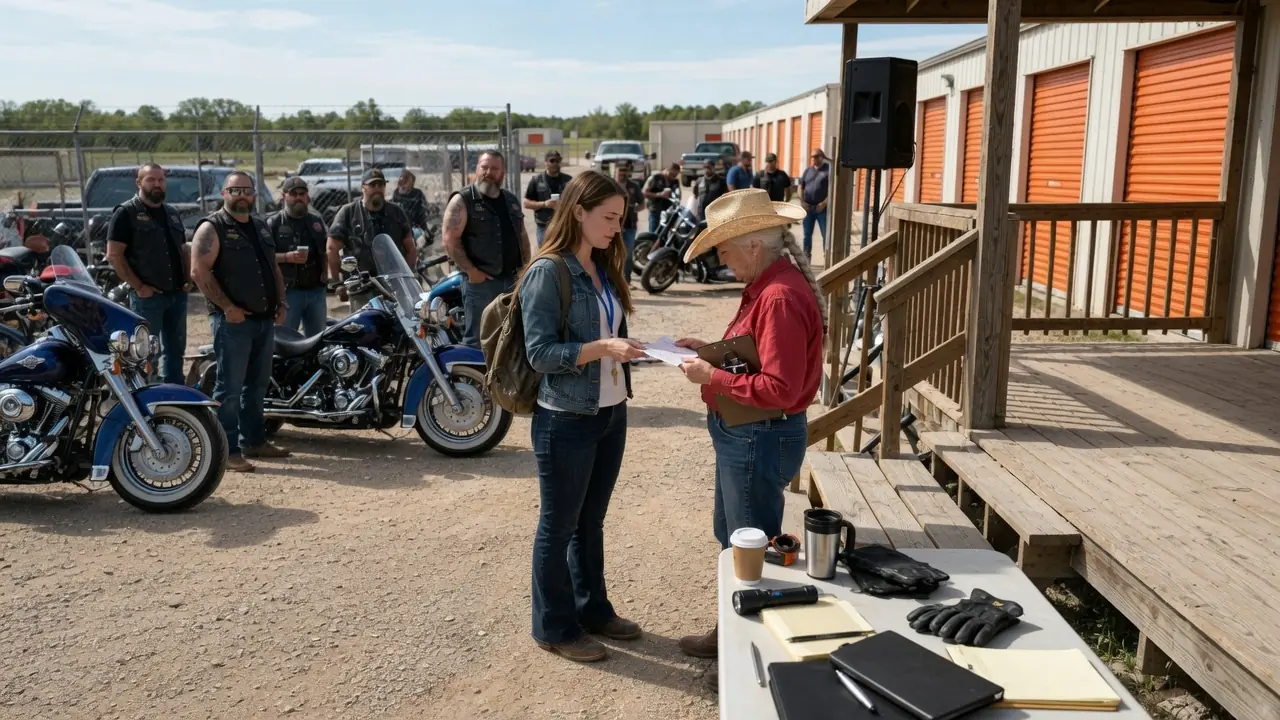
Nineteen days since her father died.
Nineteen days since the hospital called her aunt first because Clara did not hear the phone vibrating beneath her pillow.
Nineteen days since people began speaking about Daniel Whitcomb in soft, useless sentences.
He was a good man.
He worked too hard.
At least he went quickly.
Clara hated that last one most.
There was nothing “at least” about a man collapsing alone beside a tow truck at the edge of a highway, one hand still holding a wrench, his lunch unopened on the seat.
Her father had been fifty-two. He was not old. He was not ready. He had unpaid bills, unfinished repairs, a half-built kitchen table in the garage, and a daughter who still needed him to stand between her and a world that talked too fast.
Now Clara stood alone outside the chain-link gate of Red Dirt Storage on a hot Saturday morning in Oklahoma, staring at a yellow sign taped to the office window.
PUBLIC STORAGE AUCTION
10:00 A.M.
CASH ONLY
ALL SALES FINAL
A dry wind moved dust across the gravel lot.
Rows of storage units stretched behind the fence, orange doors sun-faded and dented from years of weather. A few trucks were parked near the office. A white van. A pickup with lawn equipment in the back. A dusty sedan with one missing hubcap. People had gathered near the gate holding flashlights, notebooks, and coffee cups.
Storage auction people always looked like they had come hoping to find gold inside someone else’s heartbreak.
Clara had not come to buy.
She had come to stop them from selling unit seventeen.
Her father’s unit.
Inside were his tools, his winter coats, boxes of old receipts, her mother’s sewing machine, two chairs he had been meaning to fix, and the cedar chest he had built when Clara was nine. The cedar chest mattered most. He had told her, three days before he died, “If anything happens, that chest goes to you. Don’t let anybody toss it.”
She had laughed then because people say things like that when they do not know how close death is standing.
Now she was here because the storage company claimed the rent had not been paid in four months.
That was impossible.
Clara had the receipts in her backpack.
Her father paid everything in cash, every month, at the same window. He kept receipts because he trusted paper more than people. Clara had found them in a coffee can under his sink, rubber-banded by year.
The most recent receipt was dated six weeks ago.
Paid in full.
Unit 17.
Signed by a man named Clay Bender, the storage manager.
Clara had emailed twice.
No answer.
She had called once, but phone calls were useless when people did not text back and when automated voices spoke like bullets. She had gone to the office yesterday, but the door was locked and the handwritten note said, “Closed for auction prep.”
So now she stood at the gate with the receipts, the key, and eighty-six dollars in case somebody demanded a fee she could barely pay.
Clara was deaf in her left ear and had limited hearing in her right with a hearing aid. She read lips well when people faced her, slowly enough, in decent light, without mustaches hiding half the words. In real life, people did not speak that way. They turned away, covered their mouths, shouted as if volume fixed clarity, then grew annoyed when she asked them to repeat.
Her father had learned sign language after her diagnosis when she was five.
Not perfectly.
But stubbornly.
He signed with mechanic’s hands, big and scarred and sometimes clumsy, but Clara loved every crooked sentence.
You hungry?
Truck broken again.
Proud of you.
World too loud. We make our own quiet.
That last one was their private joke.
Now the world felt louder than ever.
Clara adjusted the strap of her backpack and walked toward the office.
A woman stood on the front step with a clipboard. She was in her late sixties, tall and thin, with silver hair braided down her back and a straw hat shading a face carved by sun and patience. She wore jeans, boots, and a red shirt that read PARRISH AUCTIONS across the pocket.
Clara recognized her from the notice online.
Mabel Parrish.
Licensed auctioneer.
The woman was speaking to a group of buyers. Her mouth moved quickly. Clara caught only pieces.
Cash only.
No entering units.
Bids final.
Do not touch merchandise until sold.
Clara waited for the woman to finish, then stepped forward and lifted one hand slightly.
“Excuse me,” Clara said.
Her own voice sounded different to her than to other people. She knew that. Too flat sometimes. Too careful. She had spent years watching people’s faces change when she spoke, their surprise followed by pity or impatience.
Mabel Parrish turned to her.
Unlike most hearing people, she did not immediately look confused.
She looked directly at Clara’s face and said slowly, clearly, “Can I help you?”
Clara felt a small wave of relief.
She pulled the receipts from her backpack.
“I’m Clara Whitcomb. Unit seventeen belongs to my dad. It should not be in the auction.”
Mabel’s eyes sharpened.
“Daniel Whitcomb’s daughter?”
Clara nodded.
Mabel glanced toward the office window, then back at her. “I’m sorry for your loss.”
Clara watched her mouth.
The sentence landed cleanly.
Not soft.
Not messy.
Just sorry.
“Thank you,” Clara said.
Mabel took the receipts and studied them.
Her expression changed almost instantly.
“Where did you get these?”
“My dad kept them.”
“These show payment.”
“Yes.”
Mabel looked toward the storage rows.
“Did Clay Bender see these?”
“I tried. He was closed.”
Mabel’s jaw tightened.
Before she could answer, the sound came.
Motorcycles.
Clara felt the vibration first through the soles of her shoes.
Then she heard the low, uneven thunder rolling down the road behind her.
Several heads turned.
The motorcycles came around the bend in a tight pack, seven of them, sunlight flashing off chrome and black helmets. They pulled into the lot too fast, tires spitting gravel. Dust lifted behind them, drifting across the gate and the waiting buyers.
The engines kept running.
People stepped back.
Clara did too, not because she was afraid of motorcycles, but because the men riding them wanted everyone to step back. She could feel it before they even climbed off.
The lead rider killed his engine last.
He removed his helmet and hung it from one handlebar.
He was broad, maybe forty-five, with a thick neck, a sunburned face, and a black beard threaded with gray. His leather vest hung open over a sleeveless shirt. On his back was a patch of a rust-colored jackal with metal teeth. Beneath it were the words:
RUST JACKALS.
A name patch on his chest read: GRAZE.
Clara did not know the club, but she knew the way the men around him looked at him before moving.
Leader.
Graze looked across the lot.
His eyes passed over the buyers, the office, Mabel, then stopped on Clara.
Not because he knew her.
Because she was young, alone, and standing where he wanted to stand.
The other riders spread out, boots crunching gravel, laughing too loudly. One kicked at an empty soda can. Another leaned against the office wall beneath the auction sign. A third spat near the gate.
Mabel Parrish’s face went still.
Graze walked toward the step.
“You Mabel?” he asked.
Mabel looked at him over the top of Clara’s receipts. “I am.”
“Clay said auction starts at ten.”
“It does.”
Graze glanced at his watch. “It’s ten-oh-two.”
“We had a question about a unit.”
His eyes moved to Clara.
“What unit?”
Mabel did not answer.
Clara held the key beneath her shirt.
Graze smiled slowly. “Seventeen?”
The air changed.
Mabel noticed.
Clara noticed too.
“How do you know that?” Mabel asked.
Graze did not look at her. He kept looking at Clara.
“Everybody knows lot seventeen is the good one.”
One of the riders laughed. He had a shaved head, narrow eyes, and tattoos running down both arms. “Old mechanic unit. Tools. Parts. Maybe cash stuffed in coffee cans.”
Clara’s fingers tightened around the backpack strap.
Her father had kept receipts in a coffee can.
The detail was too specific.
Mabel folded the receipts once and held them against her clipboard. “Lot seventeen is under review.”
Graze’s smile vanished. “No, it isn’t.”
“It is now.”
He stepped closer.
Mabel did not move.
Clara wished she could hear everything around her. She hated moments like this most, when danger had a shape but sound came to her in broken pieces. She watched mouths, shoulders, hands. She saw one biker nudge another. She saw buyers move away from the office. She saw Clay Bender finally appear in the doorway behind Mabel.
Clay was short, round, sweating already despite the morning wind. His face tightened when he saw Clara.
“You,” he said.
Clara read that easily.
She turned toward him. “My father paid. I have receipts.”
Clay’s eyes flicked to Graze.
Then away.
That tiny movement told Clara more than his mouth ever could.
Clay wiped his forehead. “Those are old.”
Clara pulled another copy from her backpack and held it up. “Six weeks ago.”
Clay’s lips moved fast.
She missed most of it.
Mabel spoke before Clara could ask him to repeat.
“Slow down and face her.”
Clay blinked. “What?”
“She reads lips. Face her and speak clearly.”
A few bikers chuckled.
Graze looked at Clara with new interest. “Reads lips?”
The shaved-head rider tapped one finger against his ear and grinned. “What, she deaf?”
Clara’s face warmed.
She was used to the word.
She hated the way he used it.
Mabel’s eyes hardened. “That has nothing to do with this auction.”
Graze turned his head toward the others. “Boys, we got ourselves a quiet bidder.”
The riders laughed.
Clara looked down at the receipts.
Do not react, she told herself.
Her father used to say that cruel people threw hooks. You did not have to bite every one.
The shaved-head rider stepped closer and exaggerated his mouth movements.
“Can. You. Hear. Me?”
Laughter again.
Clara kept her eyes on his face, then signed without thinking.
I can see you are stupid.
The sign moved through her hands before caution could stop it.
Mabel’s mouth twitched.
Graze’s eyes narrowed. “What did she say?”
Mabel looked at him calmly. “She said she understands.”
Clara looked at Mabel in surprise.
The auctioneer’s hands shifted slightly near the clipboard.
I sign, Mabel signed.
Clara froze.
Mabel’s face remained calm, but her fingers moved again.
My son is Deaf. Stay near me.
A wave of emotion hit Clara so suddenly she almost looked away.
Graze watched the exchange.
His expression changed.
He did not understand the signs, but he understood being excluded from meaning.
Men like him hated that.
“No hand dancing,” he said.
Clara looked at his mouth.
The words were ugly even in silence.
The shaved-head rider stepped closer and flapped both hands mockingly.
“Look at me,” he said in a high voice Clara barely heard. “I’m talking with my fingers.”
One of the buyers laughed nervously, then stopped when Mabel turned toward him.
Clara’s throat tightened.
She had been mocked before. School hallways. Grocery lines. A boy at the DMV who asked if she could “hear in subtitles.” A landlord who spoke louder and louder until her father stood up and said, “She reads lips, not thunder.”
But this felt worse because her father was not there.
Because the men were standing between her and the last pieces of him.
Graze reached out and plucked the receipts from Mabel’s hand.
Mabel’s voice sharpened. “Those are not yours.”
He looked at the papers, then at Clara.
“These prove anything?”
“Yes,” Clara said.
He tilted his head, pretending not to understand her speech.
“What?”
Clara knew the game.
Her voice sounded different. He wanted her to repeat so the others could laugh.
Mabel reached for the papers. “Return them.”
Graze lifted them out of reach.
“Maybe Clay made a mistake,” he said. “Maybe her daddy made fake receipts. Maybe little quiet girl here doesn’t know how auctions work.”
Clara’s eyes stung.
“My father did not fake anything.”
Graze leaned closer. “What was that?”
The shaved-head rider cupped a hand behind his ear. “Speak up.”
The bikers laughed again.
Clay looked at the ground.
That hurt more than Clara expected.
Clay had taken her father’s money. Had smiled through the office window. Had said, “Daniel, you’re good through next month.” Clara had been there once, waiting in the truck, watching her father return with a receipt and a peppermint from Clay’s candy bowl.
Now Clay would not even meet her eyes.
Mabel spoke, each word clear. “Auction is paused.”
Graze looked at her. “No.”
Mabel raised one eyebrow. “Excuse me?”
“We came for seventeen.”
“You came to bid like everyone else.”
“No,” Graze said. “We came because Clay promised us first look.”
The buyers murmured.
Clay’s head snapped up. “I didn’t say that.”
Graze turned slowly.
Clay went pale.
The mistake hung there, visible to everyone.
Mabel’s gaze moved from Graze to Clay.
“Interesting.”
Graze realized he had said too much. His expression hardened.
He turned back to Clara.
“You got a key?”
Clara’s hand moved toward the ribbon at her neck before she could stop it.
Graze saw.
“So you do.”
He stepped toward her.
Mabel moved between them.
“No.”
He looked down at the old auctioneer. “Move.”
“No.”
“This is business.”
“This is intimidation.”
The word was clear.
Even Clara caught it without needing sound.
Graze smiled without warmth.
“You always use big words when you’re scared?”
Mabel’s answer came fast.
“I use accurate words.”
The shaved-head rider moved around Mabel’s side toward Clara.
Clara stepped back.
He reached for the ribbon at her neck.
She slapped his hand away.
The sound cracked across the gravel lot.
People went quiet.
The rider stared at her.
Then smiled.
“Oh,” he said. “Quiet girl’s got claws.”
He grabbed her wrist.
Clara twisted away, but he held tight.
Pain shot up her arm.
Mabel struck his forearm with the edge of her clipboard.
Not hard enough to injure.
Hard enough to surprise him.
He released Clara and cursed.
Graze turned on Mabel. “You touch him again—”
“You are on camera,” Mabel said.
Graze looked toward the office.
“Security camera’s dead,” Clay blurted.
Everyone turned to him.
Mabel’s eyes narrowed.
Clay realized his second mistake too late.
Graze’s jaw tightened. “Clay.”
Mabel looked almost satisfied.
“That camera is dead,” she said. “The auction cameras are not.”
She touched the small device clipped to her shirt pocket.
Clara had thought it was a microphone.
Mabel lifted her clipboard and tapped the corner.
A tiny lens pointed outward.
“Body camera,” she said. “State licensing requires recording for disputed lien sales. I also run online bidding for verified buyers. This auction has been livestreaming since 9:55.”
The buyers looked at one another.
Clay turned gray.
Graze stared at the lens.
For the first time, Clara saw uncertainty on his face.
Not fear.
Not yet.
But calculation.
Mabel continued, “You have mocked a disabled claimant, interfered with lien dispute documentation, admitted to a preferential access arrangement, and your associate put hands on her.”
She turned slightly toward Clay.
“And you just stated the facility camera was dead before anyone asked.”
Clay’s mouth opened.
Nothing came out.
Graze stepped closer, voice low. “Turn it off.”
“No.”
“I said turn it off.”
“I heard you.”
The shaved-head rider looked at Clara’s hearing aid, visible where her hair had shifted.
“Maybe she didn’t.”
He reached toward Clara’s ear.
Clara jerked back.
Too late.
His fingers brushed the hearing aid.
It slipped loose and fell to the gravel.
The world dropped into deeper silence.
Not total.
But close.
Clara gasped and crouched immediately, searching the ground.
The hearing aid was beige, tiny, and suddenly impossible to see among dust and pebbles.
The rider laughed.
“Oops.”
Clara’s hands shook as she searched.
The buyers stepped away awkwardly.
No one helped.
Maybe they did not know how.
Maybe they were afraid.
Maybe people became stupid when cruelty gave them an audience.
Clara found the hearing aid near a boot.
Graze’s boot.
Before she could reach it, he placed his sole over it.
Lightly.
Not crushing yet.
Just enough.
Clara froze.
Mabel’s voice cut through the air.
“Move your foot.”
Clara could barely hear it, but she saw the shape of the words.
Graze looked down at Clara.
“You want it?”
She stared at him.
His mouth moved slowly now, exaggerated.
Ask.
Nice.
The shame hit her so hard her vision blurred.
Her hearing aid was not just a device. It was not just plastic and circuits. It was the difference between catching warnings and missing them. Between understanding a cashier and guessing. Between hearing her father’s rough laugh and watching only the movement of his shoulders.
It was expensive.
It was fragile.
It was hers.
“Please,” Clara said.
Her voice cracked.
Graze smiled.
“What?”
Mabel stepped forward. “Do not make her repeat herself.”
Graze pressed his boot slightly harder.
Clara’s whole body went cold.
“Please,” she said again.
The shaved-head rider laughed. “That’s better.”
Graze lifted his boot.
Clara snatched the hearing aid from the gravel.
It was scratched but not broken.
She held it in both hands like a wounded thing.
Mabel looked at the body camera lens, then at Graze.
“You just ended your own morning,” she said.
Graze’s face hardened.
He grabbed the body camera from her shirt and ripped it free.
The clip tore fabric.
Mabel stepped back, but did not fall.
Graze threw the camera onto the ground.
It bounced once in the dust.
Clay whispered, “Stop.”
Graze turned toward him. “Shut up.”
Mabel looked down at the camera.
Then back at Graze.
“You think the recording lives inside the camera?”
The sentence landed slowly.
Graze stared at her.
Mabel pointed toward the sky.
At the corner of the office roof, bolted beneath the rusted gutter, was a small black box with a blue light blinking.
“Cellular uplink,” she said. “Cloud storage. Two remote bidders, one attorney, and a county civil clerk have already seen enough.”
Clay sat down on the office step like his legs had failed.
One of the bikers muttered, “Boss, we need to leave.”
But Graze was not looking at Mabel anymore.
He was looking at Clara.
The hatred in his face had sharpened into something more desperate.
“Give me the key,” he said.
Clara backed up.
Mabel signed quickly without turning her head.
Behind me. Now.
Clara moved behind her.
Graze stepped forward.
Mabel reached into her back pocket and pulled out a small orange card.
She held it up.
The card read: AUCTION PAUSED - LEGAL REVIEW.
Then she turned to the gathered buyers.
“This auction is suspended.”
People began muttering. A man near a pickup groaned. A woman with a flashlight protested that she had driven two hours.
Mabel’s voice cracked like a whip.
“Leave through the north gate. Now.”
Most obeyed.
Not because they were brave.
Because they did not want to be part of whatever this had become.
Within two minutes, the lot had emptied of nearly everyone except Mabel, Clara, Clay, and the seven Rust Jackals.
That should have made Clara more afraid.
Strangely, it did not.
The audience leaving stripped something from Graze.
He no longer had strangers to perform for.
Only evidence.
Mabel opened the office door and stood in the doorway. “Clara, inside.”
Graze moved fast.
He seized Clara’s backpack strap and yanked her backward.
Clara stumbled, dropping the receipts.
The key swung out from her collar on the blue ribbon.
Graze caught it.
“No!” Clara shouted.
Her own voice sounded far away without the hearing aid in place.
She grabbed the ribbon with both hands.
For one awful second, they pulled against each other, the ribbon cutting into the back of her neck.
Mabel shouted something Clara could not hear.
The shaved-head rider laughed.
Graze leaned close, his mouth clear and cruel.
Your dad owed us.
Clara stopped struggling.
Not because she believed him.
Because the words hit a locked door inside her.
My dad owed us.
Her father had been worried before he died. She remembered that now. The way he kept checking the window. The way he told her not to open the garage if men came asking about a green toolbox. The way he said, “If something happens, unit seventeen first. Cedar chest. Bottom drawer.”
She had thought grief had made those memories strange.
Now they made sense.
Graze pulled harder.
The ribbon snapped.
The key came loose in his hand.
Clara gasped.
Mabel struck him again with the clipboard, this time across the wrist.
The key fell.
Clara kicked it beneath the office step before anyone else could grab it.
Graze turned on Mabel with murder in his eyes.
But before he moved, a loud metallic sound split the air.
The north gate slammed shut.
Then the south gate.
Both chain-link gates rolled closed on automatic tracks and locked with heavy clicks.
Clara felt the vibration through the ground more than heard it.
Graze spun around.
“What did you do?” he shouted.
Mabel held up the office remote.
“I secured the facility.”
“You locked us in?”
“No,” she said. “I locked the evidence in.”
A siren wailed in the distance.
Only one.
Not a swarm.
Not a crowd.
One vehicle.
Graze looked toward the road.
Mabel signed to Clara.
Stay inside when I move.
Clara shook her head.
Mabel’s eyes snapped to hers.
Trust me.
The siren grew closer.
The Rust Jackals shifted uneasily.
Clay spoke from the step, voice shaking. Clara could barely follow his mouth.
“I didn’t know it was evidence. I swear. Graze said Daniel owed money.”
Graze turned toward him.
Clay flinched.
Mabel looked at Clay with cold contempt.
“You falsified a lien sale.”
Clay’s lips trembled. “He said they’d burn the place.”
The shaved-head rider cursed. “Idiot.”
Mabel’s face did not change. “That confession is also streaming.”
Clay buried his face in both hands.
The sheriff’s SUV pulled up outside the locked gate.
One deputy stepped out.
Then another.
Only two.
But they moved with the calm of people who had been listening long before they arrived.
The first deputy was a woman with gray-streaked hair and a hard face beneath her hat. She walked to the gate and looked through the chain links.
“Mabel.”
“Deputy Shaw.”
“You always make auctions exciting.”
“I try to provide value.”
Deputy Shaw’s eyes moved over the bikers, Clay, Clara, the broken body camera, the scattered receipts, and the hearing aid still in Clara’s hand.
“Open the gate.”
Mabel pressed the remote.
The north gate slid open.
Graze looked toward his motorcycles.
Deputy Shaw drew her sidearm halfway, not pointing it yet.
“Do not make me finish that motion.”
He stopped.
The second deputy came through with one hand near his belt.
“Hands visible,” he said.
The Rust Jackals obeyed slowly.
All except Graze.
His fingers curled.
Deputy Shaw looked at him. “Graze Larkin, you are already being investigated for extortion, intimidation, and interference with a lawful auction. Add resisting if you are bored.”
Mabel signed to Clara as the deputies moved in.
Put hearing aid in. Slowly.
Clara did.
The world came back unevenly: gravel under boots, radios crackling, Clay crying, a biker cursing under his breath, Mabel’s steady breathing beside her.
Deputy Shaw approached Clara.
She faced her directly.
“Clara Whitcomb?”
Clara nodded.
“I’m Deputy Shaw. Mabel sent us the lien dispute yesterday after you emailed the receipts to the auction address. We opened a civil review this morning.”
Clara stared.
“I emailed Mabel?”
Mabel looked at her. “The auction notice listed my office email. You sent scans last night at 11:42.”
“I thought nobody answered.”
“I answered by calling the county clerk.”
Clara looked at the storage rows.
“Then why did you start the auction?”
“To let Clay and whoever was pushing him step into the record.” Mabel’s mouth tightened. “I did not expect them to put hands on you. I am sorry.”
Clara did not know what to say.
Deputy Shaw’s voice stayed clear. “Did they hurt you?”
Clara looked at Graze.
His hands were now on the hood of a deputy SUV. Another deputy searched him.
The old instinct rose.
Make it smaller.
Say no.
Get out.
Go home.
But her wrist hurt. Her neck stung where the ribbon had snapped. Her hearing aid was scratched. Her father’s key was still under the step because men had tried to take it by force.
“Yes,” Clara said.
Mabel nodded once.
Not proud exactly.
Approving.
The deputies separated the bikers.
Graze argued that he came to bid.
Mabel played the livestream clip from her tablet.
His own voice answered him.
Clay said we get first look.
Your dad owed us.
Give me the key.
The words sounded worse when played back.
Even to Clara.
Especially to Clara.
Clay Bender broke completely after that. He told Deputy Shaw that Graze had been coming by for weeks, demanding access to Daniel Whitcomb’s unit. He said Daniel had repaired bikes for the Rust Jackals years ago and had kept a green metal toolbox when they refused to pay. He said Graze claimed the toolbox belonged to the club.
Mabel asked one question.
“Why falsify the lien?”
Clay wiped his face.
“Because Daniel wouldn’t let them in. After he died, Graze said if I auctioned it, they could buy it clean. No break-in. No warrant problem. Just a sale.”
Deputy Shaw looked toward unit seventeen.
“What is in the toolbox?”
Clay shook his head. “I don’t know.”
Graze shouted from the SUV, “He’s lying!”
Deputy Shaw ignored him.
She turned to Clara.
“Do you consent to opening the unit?”
Clara touched the broken ribbon at her neck.
“Yes.”
Mabel bent and retrieved the key from beneath the office step. She wiped dust from it with her thumb, then held it out.
Clara took it.
For a second, she could not move.
The key looked smaller now.
Or maybe her hand felt different.
Mabel walked beside her to unit seventeen. Deputy Shaw followed. The second deputy stayed with the bikers. Clay remained on the office step, watched by guilt and a body camera.
Clara stopped in front of the orange roll-up door.
The number was painted in black, peeling at the edges.
She had been here with her father many times.
When she was little, he stored Christmas decorations here. Later, tools. Then boxes after they lost the house and moved into the rental duplex. He always said storage units were like stomachs. People put things in them when their lives could not digest everything at once.
Clara placed the key in the padlock.
Her hand shook.
Mabel noticed but did not offer to do it for her.
That was kindness too.
Clara unlocked it.
The metal door rattled upward.
Dust and heat rolled out.
Inside were shelves, boxes, a rolled rug, two wooden chairs, a tire, tool chests, and the cedar chest beneath a canvas tarp near the back wall.
Clara’s throat tightened.
Dad.
The thought hit so hard she almost stepped back.
Then she saw the green metal toolbox on the middle shelf.
It had a dented lid and a padlock through the latch.
Deputy Shaw took out gloves.
“May I?”
Clara nodded.
The deputy photographed the toolbox before touching it. Mabel recorded from the doorway. Clara stood beside the cedar chest, one hand resting on its smooth wooden lid.
The cedar chest smelled faintly of her father’s garage.
Saw dust.
Oil.
Orange soap.
Deputy Shaw cut the small padlock.
Inside the toolbox were not tools.
There were envelopes.
A flash drive.
Two motorcycle plates.
A stack of printed photographs.
And a small notebook wrapped in a shop rag.
Deputy Shaw’s expression changed as she lifted the first photograph.
Clara saw only part of it.
A motorcycle frame.
A VIN number ground down.
A man in a Rust Jackals vest loading parts into a trailer behind Daniel Whitcomb’s garage.
Mabel exhaled quietly.
“Daniel knew.”
Clara looked at the notebook.
Her father’s handwriting covered the first page.
If Clara has this, call Deputy Shaw. Do not let Graze near it.
Clara’s knees weakened.
Mabel touched her elbow lightly.
“Sit.”
Clara sat on the cedar chest because her legs had stopped being reliable.
Deputy Shaw looked at her. “Your father was gathering evidence.”
Clara stared at the notebook.
“He never told me.”
“He may have been protecting you.”
Clara’s eyes burned.
That sounded like him.
Infuriating, loving, and exactly like him.
Outside, Graze began shouting again as the deputy carried the toolbox toward the SUV.
Now there was fear in his voice.
Real fear.
Not because someone had threatened him.
Because the thing he had tried to bury had finally come into daylight.
Clara remained in the unit, hand on the cedar chest, while the deputies arrested Graze and two of his riders on outstanding warrants connected to vehicle theft and intimidation. The others were detained for questioning. Clay was not arrested immediately, but Deputy Shaw made it clear he was not leaving until he gave a complete statement.
The buyers were gone.
The auction was canceled.
The lot was quiet except for radios, wind, and the distant buzz of highway traffic.
No crowd cheered.
No one gave a speech.
Nothing about it felt like victory.
Clara sat among her father’s things and shook so hard her teeth clicked.
Mabel stood in the doorway, blocking the sunlight without blocking the air.
After a while, she signed.
Do you want me to stay?
Clara looked up.
Her eyes filled again.
Yes.
Mabel stepped inside and sat on an overturned bucket across from her.
For a long time, they said nothing.
Then Clara signed because speaking felt impossible.
My dad knew they were dangerous.
Mabel nodded.
Yes.
He did not tell me.
Maybe he wanted you safe.
Clara wiped her face angrily.
I was not safe.
Mabel looked toward the open door, where the deputies were sealing evidence.
No. But now you are not alone with it.
Clara’s hands trembled.
I hate that they made me beg for my hearing aid.
Mabel’s face softened.
They did not make you small. They showed themselves small.
Clara shook her head.
It felt small.
Mabel waited.
Then she signed slowly.
Feeling small is not the same as being small.
Clara looked down at the scratched hearing aid in her palm.
She wanted to believe that.
Not today.
Maybe not tomorrow.
But someday.
Deputy Shaw returned to the doorway.
“We’re going to secure the evidence. Unit seventeen is removed from lien status pending full review. No one touches it without your consent.”
Clara nodded.
“What about my father’s things?”
“They are yours, unless probate says otherwise. Mabel can help document everything before you move it.”
Mabel gave a single nod.
Clara looked at the cedar chest.
“Can I open this?”
Deputy Shaw’s face softened. “Of course.”
Clara knelt and lifted the lid.
Inside were folded quilts, her mother’s sewing box, old photographs, and a small envelope with her name written across it in her father’s blocky handwriting.
CLARA.
Her hands stopped.
Mabel looked away.
Deputy Shaw stepped outside.
Clara opened the envelope.
The letter inside was short.
Her father had never been a long writer.
Clara,
If you are reading this from the cedar chest, I either got sentimental or stupid. Probably both.
The men from the Rust Jackals may come looking for the green toolbox. Do not give it to them. Take it to Deputy Shaw. I should have done that sooner, but I kept thinking I could fix it myself. Mechanics are bad about thinking everything is a repair job.
You do not owe anyone silence.
Not them.
Not me.
Not the world when it refuses to slow down enough to understand you.
I know I hid too much. I told myself I was protecting you. Maybe I was also protecting myself from seeing you scared.
I am sorry.
You are stronger than people notice because you do not waste strength making noise.
The cedar chest is yours. So are the hand planes in the bottom drawer. Keep the small one. It fits your hand.
I love you more than engines, coffee, and old country songs, and you know that is saying something.
Dad
Clara pressed the letter to her mouth.
The grief came differently this time.
Not like the hospital call.
Not like the funeral.
Not like sorting his shirts or seeing his empty chair.
This grief had anger in it. And love. And relief. And the terrible knowledge that her father had been frightened too.
He had not been a wall.
He had been a man.
A good one.
A flawed one.
Hers.
By late afternoon, Red Dirt Storage was closed under county order. Clay’s office was sealed. The auction company packed its equipment. Deputy Shaw gave Clara a case number, a direct text line, and instructions not to answer unknown calls.
Mabel drove Clara home because Clara’s aunt had dropped her off and was at work until evening.
They loaded the cedar chest into Mabel’s pickup with help from the second deputy. Clara insisted on carrying the small hand plane herself.
During the drive, Mabel did not fill the silence.
That made Clara trust her more.
At a red light, Clara looked at her.
“How did you learn sign?”
Mabel kept her eyes on the road. “My son, Peter. Born Deaf. He is forty now and still tells me my grammar is bossy.”
Clara smiled faintly. “It is.”
“I suspected.”
The light turned green.
Mabel continued, “When Peter was young, people treated him like understanding was his responsibility alone. I became difficult about it.”
“You were difficult today.”
“Yes.”
“Thank you.”
Mabel’s hands tightened slightly on the wheel.
“You should not have needed me.”
“I know.”
“But I am glad I was there.”
Clara looked out the window at the open fields passing by.
“Did you really plan the livestream because of my email?”
“Yes.”
“You knew something was wrong?”
“I knew paperwork was wrong. I did not know why.” Mabel glanced at her. “Auctions are strange. People think they are about abandoned things. They are usually about people who ran out of time, money, help, or luck. I take the rules seriously because the rules are the only dignity some people get at the end.”
Clara watched her mouth.
The words stayed with her.
Rules as dignity.
Her father would have liked that.
The case widened after that.
The green toolbox connected the Rust Jackals to a stolen motorcycle operation spanning three counties. Daniel Whitcomb’s notebook had dates, names, plates, payment amounts, and photographs. He had been quietly documenting what he repaired, what he refused to repair, and who threatened him after he refused.
Deputy Shaw told Clara that her father’s evidence mattered.
Clara hated that he had died before knowing it.
Graze’s lawyer tried to argue that the storage auction confrontation was only a misunderstanding.
Mabel’s livestream destroyed that before it grew legs.
The clip of Graze demanding the key, putting his boot on Clara’s hearing aid, and admitting Clay had promised first look became part of the state’s case. Clay Bender, facing charges of fraudulent lien filing and conspiracy, accepted a plea agreement and testified that Graze had threatened to burn Red Dirt Storage if he did not force unit seventeen into auction.
Clara testified once.
Only once.
It was enough.
In the courtroom, she requested an interpreter even though she could speak and read lips.
Not because she could not manage without one.
Because she was tired of managing for everyone else.
Graze watched from the defense table as the interpreter signed the prosecutor’s questions.
Clara answered in sign.
Her interpreter voiced for the court.
“When he put his boot over my hearing aid, I understood that he wanted me to feel helpless.”
The prosecutor asked, “Did you feel helpless?”
Clara’s hands paused.
Then moved.
“Yes. But feeling helpless did not make him right.”
The interpreter’s voice trembled slightly on the last sentence.
Graze looked away first.
After the hearing, Mabel waited in the hallway with two cups of terrible courthouse coffee.
“I brought you poison,” she said.
Clara smiled. “Thank you.”
They sat on a bench beneath a portrait of a judge nobody recognized.
Clara looked at her hands.
“I thought I would feel better.”
Mabel nodded. “People expect truth to feel clean. It usually feels like dust first.”
Clara sipped the coffee and made a face.
“This is awful.”
“I did warn you.”
Months passed.
Clara moved her father’s tools into the small garage behind her aunt’s house. The cedar chest went into her bedroom. The hand plane sat on her desk where she could see it every morning.
At first, she could not touch it without crying.
Then one evening she picked up a piece of scrap cedar and tried shaping the edge.
The motion was awkward.
The shaving curled badly.
She tried again.
Her father had always made it look easy, but that was the trick of skilled hands. They hid all the years.
Clara kept practicing.
She enrolled in a community woodworking class taught by an old woman named Denise who had no patience for self-pity or dull blades. Mabel drove her the first week, then made her drive herself the second.
“Rescue is not supposed to become a leash,” Mabel said.
Clara hated that.
Then appreciated it.
By spring, Clara had restored one of the broken chairs from unit seventeen. It wobbled slightly, but only if you looked for it. She placed it beside the cedar chest and told herself her father would have claimed the wobble gave it character.
The hearing aid company repaired the scratched shell at reduced cost after Mabel wrote them a letter so sharp Clara asked if it was legal.
“Mostly,” Mabel said.
Clara laughed for the first time in days.
Red Dirt Storage changed ownership after Clay’s conviction. The new manager sent Clara a formal apology and offered to waive six months of rent on unit seventeen. Clara declined the free rent but accepted one month, because Mabel reminded her that refusing all help was not the same as dignity.
“Sometimes dignity is choosing the terms,” she said.
Clara kept the unit for three more months while sorting everything slowly.
On the last day, she stood inside unit seventeen alone.
The shelves were empty now. The cedar chest gone. Tools moved. Papers boxed. Dust swept into a neat pile near the door.
She held the blue ribbon in her hand.
The broken one.
The ribbon Graze had snapped when he tried to take her key.
For a long time, Clara had kept it in the cedar chest drawer because she did not know what else to do with it. Throwing it away felt like pretending. Keeping it felt like letting him own a corner of the chest.
So she brought it back.
She tied the ribbon around the inside handle of the empty storage unit door.
Not as a memorial.
As a marker.
This happened here.
And it ended here too.
Mabel found her a few minutes later.
“All set?”
Clara nodded.
Mabel looked at the ribbon but did not comment.
They rolled the door down together.
The metal rattled shut.
Clara locked it one last time, then handed the key to the new manager.
Her neck felt strangely light without it.
Outside, a motorcycle passed on the county road.
Clara stiffened.
The sound faded.
Mabel did not tell her not to be afraid.
She only stood beside her until the sound was gone.
That was better.
One year after the auction, Parrish Auctions held a charity sale for a community workshop program. Clara donated the chair she had restored from unit seventeen.
The listing read:
Restored cedar chair, handmade repair, donated by C. Whitcomb.
No tragic backstory.
No mention of bikers.
No inspirational label.
Just the chair.
It sold for four hundred dollars to a retired teacher who said it had “good bones.”
Clara nearly cried when she heard that.
Mabel pretended not to notice.
After the sale, Clara stood near the loading area, watching the teacher carry the chair away.
“You know,” Mabel said, “you could sell more work.”
Clara looked at her. “I fixed one chair.”
“You fixed one chair well enough for someone to pay four hundred dollars.”
“That was charity.”
“Partly. Skill helped.”
Clara looked down at her hands.
They were beginning to look more like her father’s.
A small scar near her thumb. Dry skin from sanding. A faint line where wood dust settled beneath her nails.
“I want to build a table,” she said.
Mabel smiled. “Then build one.”
“What if it wobbles?”
“Then call it character.”
Clara laughed.
The Rust Jackals case was still moving through court, but Graze remained in custody on related charges. Clay Bender was no longer managing anyone’s property. Deputy Shaw said Daniel Whitcomb’s notebook had done more than open one case. It had closed several doors men like Graze had used for years.
Clara visited her father’s grave that evening.
She brought no flowers.
Instead, she brought a smooth cedar shaving from the chair repair and tucked it beneath a small stone at the base of the marker.
Daniel Reyes Whitcomb
Beloved Father
Mechanic
Builder
1959 - 2026
She stood there under a pale evening sky, hands in her jacket pockets.
“I opened unit seventeen,” she said aloud.
The cemetery wind moved softly.
“I found your letter.”
She swallowed.
“You should have told me.”
Silence.
“I’m still mad.”
More silence.
“I love you.”
That part came easier.
She touched the top of the stone, then signed the words too.
Love you.
Always.
On her way back to the car, her phone buzzed.
A text from Mabel.
Auction coffee tomorrow? Unfortunately terrible.
Clara smiled.
She typed back.
Yes. I will bring real coffee. You are banned from choosing.
Three dots appeared.
Then Mabel replied.
Bossy grammar.
Clara laughed alone in the cemetery parking lot.
A motorcycle passed on the road beyond the trees.
She heard it through her repaired hearing aid, low and distant.
Her body still remembered fear.
But memory was not command.
The sound moved past.
Clara got into her car.
On the passenger seat lay the small hand plane, a notebook of table designs, and a folded copy of her father’s letter. She placed one hand over the notebook and took a slow breath.
The bikers had tried to take her key because they thought a deaf girl alone at an auction would be easy to silence.
They were wrong.
They mistook quiet for weakness.
They mistook paperwork for decoration.
They mistook a storage unit for abandoned property.
They mistook a daughter’s grief for confusion.
And most of all, they mistook Mabel Parrish’s calm voice and straw hat for harmlessness.
The rescue had not come as a crowd.
It had come as a rule enforced at the exact right moment.
A camera streaming.
A gate locking.
An old auctioneer signing, Stay near me.
A deputy arriving because evidence had already begun speaking before anyone could lie over it.
Clara started the car.
The engine turned over.
She looked once more at the cemetery, then toward the road home.
Her father had written that she did not waste strength making noise.
For the first time, she understood that as a gift instead of a wound.
The world was still loud.
People still talked too fast.
Cruel men still tried to make others bend.
But Clara Whitcomb had learned something at Red Dirt Storage, standing between her father’s unit and men who wanted to steal what he died protecting.
Silence could be broken without shouting.
Truth could have a witness.
And a key, once nearly taken by force, could open more than a lock.
Sometimes it opened the record.
Sometimes it opened a case.
Sometimes it opened the rest of your life.