Noah Ellis arrived at the Millstone bus station at 11:22 p.m. with one backpack, one paper ticket, and thirty-seven dollars folded inside an envelope marked For Mom.
He had counted the money six times on the walk there.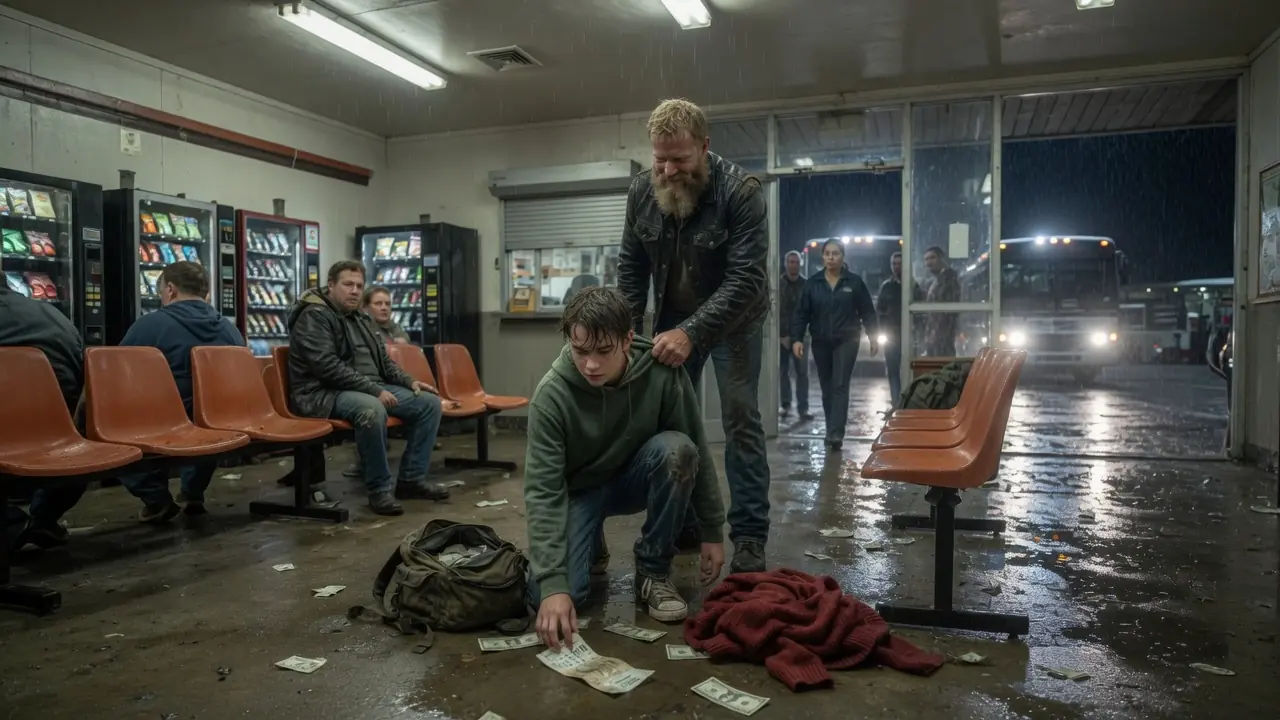
Not because he thought the number would change.
Because counting gave his hands something to do when his chest felt too tight.
Millstone, Tennessee, was the kind of town buses passed through but rarely remembered. The station sat beside an old freight road, between a closed pawn shop and a twenty-four-hour vending warehouse that hummed behind a chain-link fence. Its sign was missing two letters, so at night, beneath the flickering light, MILLSTONE COUNTY TRANSIT looked like MILL TONE COUNTY RANSIT.
Noah noticed things like that.
He noticed broken signs, loose buttons, cracked tiles, quiet exits, and the exact distance between himself and strangers who looked angry. At fourteen, he had already learned that paying attention could save trouble before trouble learned his name.
That night, he wore a faded green hoodie, jeans too short at the ankle, and sneakers with white glue along one sole where he had tried to fix them himself. His hair was dark and messy from the wind. A small scar cut through his left eyebrow, barely visible unless light hit it right.
His backpack was old.
His ticket was damp from being held too tightly.
His mother was in Nashville.
That was the important part.
Everything else was just a path toward her.
Three days earlier, his mother, Dana Ellis, had collapsed during her shift at a nursing home. Nothing dramatic, his aunt had said over the phone. Nothing to panic about. Low blood pressure, exhaustion, a fall against a metal cart, a night in the hospital for observation.
Adults always said do not panic after giving you reasons to panic.
Noah had not slept much since.
His aunt worked nights and could not drive him. His grandmother did not drive after dark. His mother told him to stay home, that she would be fine, that she did not want him spending money.
So Noah sold his old game console to a boy from school, bought the cheapest late-night bus ticket to Nashville, packed crackers, a water bottle, and his mother’s red sweater because hospital rooms were always cold.
The envelope held what remained.
Thirty-seven dollars.
Not much.
But he had written For Mom on it because money felt more serious when it had a purpose.
Inside the station, fluorescent lights buzzed overhead. A row of orange plastic chairs lined the wall. A vending machine blinked beside the restrooms. The ticket counter was closed, with a metal grate pulled down over the glass. Behind it, a night clerk sat in a small office with the door cracked open, watching something on his phone.
A woman in a navy bus driver’s jacket stood near the far wall, arguing quietly with the coffee machine.
“Come on,” she muttered. “I put in two dollars.”
The machine hummed.
Nothing came out.
She slapped the side once, not hard, just tired.
Noah paused near the entrance.
The woman looked about thirty-five, with black hair pulled into a low ponytail and a face that looked like it had been awake too long. Her name patch read: VEGA. A silver cross hung from a chain at her neck, and she held a clipboard under one arm.
Noah knew drivers by their jackets. Long-distance drivers had a different kind of tired than everyone else. It sat behind their eyes, steady and patient.
The machine clicked.
Still nothing.
The woman sighed.
Noah looked down at his envelope, then at the vending machine.
He should have kept walking.
He needed every dollar.
But the woman pressed two fingers against her temple and closed her eyes for one second too long.
Noah knew that look too.
His mother looked like that when she said she was fine.
He walked to the machine and looked through the glass. The coffee cup had jammed sideways inside the dispenser slot. He crouched, tapped the lower edge of the flap, and reached two fingers carefully into the side gap.
The cup dropped into place.
Coffee began pouring.
The woman blinked. “How did you do that?”
Noah stood quickly. “It gets stuck if the cup tilts.”
“You work here?”
“No, ma’am.”
She smiled despite herself. “You just know vending machines?”
“My apartment has one downstairs. It steals from people.”
“That sounds personal.”
“It is.”
She took the coffee when the machine finally released it. “Thank you.”
Noah nodded and started to leave.
“Hey,” she said. “You waiting for the Nashville bus?”
He looked back. “Yes, ma’am.”
“I’m driving the Memphis route tonight, but Nashville should roll in around twelve-fifteen. Maybe late. Storms north of here.”
Noah tried not to show disappointment. “Okay.”
“You traveling alone?”
He hesitated.
Adults asked that question in different tones. Some tones meant concern. Some meant judgment. Some meant they were about to make something harder.
The driver seemed to understand and softened her voice.
“I only ask because this station gets strange after midnight.”
“My mom’s in the hospital,” Noah said. “I have to go.”
Her expression changed.
“I’m sorry.”
“She’s okay,” he said too fast. “They said she’s okay.”
The driver nodded as if she understood the difference between what people said and what fear heard.
“My name is Elena Vega,” she said. “If anything feels wrong, you come find me. My bus is parked out back for another twenty minutes.”
Noah nodded. “Thank you.”
He moved to the row of orange chairs and sat under the buzzing light. He placed his backpack between his feet, pulled the envelope from his pocket, counted the money again, and tucked it deep inside the front compartment.
At 11:48, the station clerk announced through the old speaker that the Nashville bus was delayed by forty minutes.
Noah closed his eyes.
Forty minutes was not forever.
He could wait forty minutes.
He had waited longer for worse things.
A man in a suit slept across three chairs near the restroom. An elderly woman with a knitted hat read a paperback by the window. A college student in a gray hoodie charged his phone beside the vending machine. The night clerk remained in his office.
The station felt almost safe.
Then the motorcycles came.
The sound began outside as a low vibration beneath the concrete floor.
Noah opened his eyes.
The elderly woman lowered her book. The college student unplugged his phone. The sleeping man stirred but did not wake.
The engines grew louder.
One motorcycle turned into the bus station lot.
Then another.
Then another.
By the time the sixth bike rolled beneath the cracked canopy light, the windows were shaking in their frames. Headlights swept across the waiting room, making the orange chairs flash white, then dark, then white again.
Noah’s hands tightened around his backpack straps.
The riders parked crookedly near the entrance, blocking the walkway to the bus bays. They killed their engines one at a time, and the sudden silence felt like a door being locked.
Boots hit pavement.
Laughter followed.
Noah looked toward the clerk’s office.
The clerk had stopped watching his phone.
He stared at the front windows, face pale.
The station door opened.
Cold air rushed inside.
Six men entered wearing wet leather vests over denim and dark shirts. Their boots were heavy, their beards rough, their patches black and silver. On the back of each vest was a jackal skull with a chain between its teeth. The words beneath it read: IRON JACKALS.
The man in front was broad and tall, maybe forty-five, with close-cut blond hair, a thick beard, and pale blue eyes that moved around the room like he was searching for the weakest beam in an old house. A name patch on his vest read: HATCH.
He stopped just inside the door.
“Well,” Hatch said, “look at this fine establishment.”
One of the bikers behind him sniffed loudly. “Smells like old socks and bad choices.”
The men laughed.
Noah looked down at his shoes.
He knew better than to stare.
The bikers spread through the waiting room. One kicked a loose candy wrapper across the floor. Another shook rainwater from his vest near the elderly woman’s chair, making her flinch. A third slapped the side of the vending machine and cursed when it did not give him anything for free.
Hatch walked toward the row of orange chairs.
His eyes landed on Noah.
Noah felt the moment it happened.
A cruel person choosing you has a temperature.
The air seems to drop.
Hatch stopped in front of him. “You running away from home, kid?”
Noah looked up just enough to be polite. “No, sir.”
“No, sir,” Hatch repeated, mocking the careful tone.
The other bikers chuckled.
Noah kept both hands on his backpack. “I’m waiting for the Nashville bus.”
“Nashville.” Hatch leaned closer. “You got big plans in Nashville?”
“My mom is there.”
“Your mom know you’re out this late?”
Noah swallowed. “Yes.”
That was almost true.
She knew he wanted to come.
She did not know he had actually bought the ticket.
Hatch smiled. “You don’t lie well.”
Noah said nothing.
One biker with a shaved head and a chain around his wallet sat beside him, close enough that Noah had to shift away. The man smelled like rain, cigarettes, and motor oil.
“What’s in the bag?” the biker asked.
“Clothes.”
“For Nashville?”
“Yes.”
The biker reached for the backpack.
Noah pulled it against his chest.
The movement was small.
But everyone saw it.
Hatch’s smile widened. “Protective.”
The biker beside Noah laughed. “Maybe he’s got treasure.”
“No,” Noah said quickly. “Just clothes.”
Hatch crouched in front of him, forcing eye contact. “Then you won’t mind showing us.”
Noah’s heart began to hammer.
His ticket was inside.
The envelope was inside.
His mother’s sweater was inside.
“No, thank you,” he said.
The bikers laughed again.
Hatch’s eyes sharpened. “No, thank you?”
The night clerk stepped out of his office. “Gentlemen, if you need tickets, I can help from the counter.”
Hatch turned slowly. “Do we look like we need tickets?”
The clerk froze.
The sleeping man in the suit woke, saw the bikers, and sat up carefully.
The elderly woman clutched her book.
The college student slipped his phone into his pocket and looked toward the exit, which was blocked by two riders standing near the door.
Noah tried to stand.
Hatch placed one hand on his shoulder and pushed him back into the chair.
Not hard enough to injure.
Hard enough to make the room understand.
“Sit,” Hatch said.
Noah sat.
Heat rushed up his neck.
He hated that.
He hated being smaller.
He hated that his body obeyed before his pride could object.
The biker beside him grabbed the zipper of the backpack and pulled.
Noah lunged for it. “Please don’t.”
“Please don’t,” the biker mimicked in a high voice.
Another biker laughed. “He sounds like a little church mouse.”
Noah’s throat tightened.
He had always spoken softly. Loud voices in his apartment building usually meant someone was about to throw something, so he learned early that quiet was safer. But men like Hatch did not see quiet as discipline. They saw it as permission.
The biker opened the backpack.
He pulled out the red sweater first.
“Look at this,” he said. “Kid packed grandma clothes.”
Noah reached for it. “That’s my mom’s.”
The biker held it away. “Your mom wears this?”
“She gets cold.”
Hatch took the sweater, held it up, and inspected it. “A mother in Nashville. A kid traveling alone. Money in the bag, I bet.”
Noah went still.
Hatch noticed.
“There it is.”
The biker dug into the front compartment.
Noah grabbed his wrist.
He did not think.
He just moved.
The room froze.
Hatch looked down at Noah’s hand on his friend’s wrist.
The biker’s face darkened.
“You touching me?”
Noah released him at once. “I’m sorry.”
“Too late.”
The biker shoved him back against the chair.
The orange plastic cracked loudly behind his shoulder.
The elderly woman gasped.
The clerk took one step forward, then stopped when Hatch looked at him.
The biker reached into the backpack and pulled out the envelope.
For Mom.
The words in Noah’s own handwriting looked childish under the fluorescent lights.
Hatch took it.
Noah’s breath caught. “Please.”
Hatch opened the envelope and counted the money slowly.
“One, two, three. Thirty-seven dollars.” He looked amused. “Big spender.”
Noah stood again, shaking. “I need that.”
“For Mom,” Hatch read.
The shaved-head biker laughed. “Maybe Mom needs a better kid.”
The words hit like a fist.
Noah’s face changed.
He could handle being mocked.
He could handle the backpack, the sweater, even the fear.
But his mother had worked double shifts for years, come home with swollen feet, still made pancakes on his birthday, still told him he was the best thing she had ever done. She was lying in a hospital bed because she had given too much of herself to everyone else.
And this man had turned her into a joke.
“Give it back,” Noah said.
His voice shook, but it was louder than before.
Hatch raised his eyebrows. “What was that?”
Noah looked at the envelope in his hand. “Give it back.”
One of the bikers whistled. “Mouse got teeth.”
Hatch stepped closer. “You giving orders now?”
Noah’s courage flickered.
But he thought of his mother cold in the hospital room.
He thought of the red sweater.
He thought of how she always said, You do not have to win every fight, baby, but do not help people steal from you by calling it nothing.
“It’s not yours,” Noah said.
Hatch smiled without warmth.
Then he dropped the envelope on the floor.
A few bills spilled out.
“Pick it up,” he said.
Noah stared at the money.
“Go on,” Hatch said. “Pick it up.”
Noah bent quickly.
Before his fingers reached the bills, Hatch put one boot on top of the envelope.
Noah froze.
The bikers laughed.
Hatch leaned over him. “Say please.”
Noah stayed crouched, one knee on the dirty floor, his face burning.
“Please,” he whispered.
“Louder.”
“Please.”
“Please what?”
Noah closed his eyes.
The station was silent except for the buzz of the lights and the soft rustle of the elderly woman’s trembling hands on her paperback.
“Please give me my money back.”
Hatch smiled. “That wasn’t so hard.”
He lifted his boot.
Noah gathered the bills with shaking hands.
The shaved-head biker snatched his bus ticket from the open backpack.
Noah lunged again. “No!”
The biker held it above his head. “Relax, little man. Just reading.”
Hatch took the ticket and looked at it. “Nashville. Seat fourteen. Departing twelve-fifteen.” He glanced at the clock. “Delayed, though.”
Noah swallowed hard.
Hatch folded the ticket once.
Noah’s eyes widened. “Don’t.”
Hatch folded it again.
“Please don’t.”
Hatch held the folded ticket between two fingers. “This little piece of paper important?”
“Yes.”
“Then maybe you should learn how to keep important things safe.”
He walked toward the trash can near the vending machine.
Noah followed. “Please, sir. I have to see my mom.”
Hatch stopped by the trash can.
The other bikers grinned.
The college student lifted his phone halfway.
A biker by the door saw him and pointed. “Put it down.”
The student put it down.
Hatch looked back at Noah. “You really want this ticket?”
“Yes.”
“Then bark.”
Noah stared at him.
The word seemed impossible.
“What?”
“You heard me.” Hatch pointed to the jackal patch on his vest. “Iron Jackals. You want our help? Bark.”
The bikers erupted.
Noah stood very still.
The humiliation entered his body before the tears did. His hands went cold. His ears rang. He could feel everyone watching, and somehow the worst part was not the bikers laughing. It was the other people not knowing what to do.
The clerk behind the counter.
The man in the suit.
The college student.
The elderly woman.
All frozen.
All ashamed.
All waiting for someone else to become the first moving thing.
Noah looked at the ticket.
His mother was in Nashville.
The bus would come.
Without that paper, he might not get on.
His mouth trembled.
Hatch’s smile sharpened. “Come on, puppy.”
Noah’s voice came out broken.
“Woof.”
The bikers laughed so loudly the station seemed to tilt.
Hatch cupped one hand behind his ear. “Didn’t hear you.”
Noah stared at the floor.
His face was wet now.
He hated that too.
“Woof,” he said again, louder.
Hatch threw the ticket.
Not into the trash.
Onto the floor beside the trash can, where a puddle of rainwater had formed from the bikers’ boots.
The paper landed in the water.
Noah dropped to his knees and grabbed it.
The ink had begun to smear, but the barcode still looked readable.
He pressed it carefully against his hoodie, trying to dry it without tearing it.
Hatch looked down at him.
“Good boy.”
Something changed then.
Not in Hatch.
In the room.
The elderly woman stood.
Slowly.
She was small, with a knitted hat, a blue coat, and hands spotted with age. But she stood.
“Shame on you,” she said.
Her voice shook.
But it was clear.
Hatch turned toward her. “Sit down, grandma.”
“No,” she said.
The clerk stepped out from behind the counter, pale but moving. “You need to leave.”
One biker laughed. “Now everybody’s brave.”
The man in the suit stood too. “He’s a child.”
The college student lifted his phone again. This time, he did not lower it.
Hatch looked around, and Noah saw irritation move across his face.
The silence had broken.
That made him angrier.
He grabbed Noah by the front of his hoodie and pulled him to his feet.
The red sweater fell from the biker’s hand onto the floor.
“Maybe the kid needs a lesson outside,” Hatch said.
Noah grabbed at Hatch’s wrist. “Let go.”
The clerk shouted, “Hey!”
Then the station door opened.
The bell above it rang.
Elena Vega stepped inside.
She was no longer holding coffee.
She was holding a tire iron.
Behind her, through the glass, headlights filled the bus lot.
Not motorcycles.
Buses.
Three long buses had pulled into the bay area with their hazard lights blinking. Behind them were two county transport vans, a mechanic’s truck, and a sheriff’s cruiser.
Elena’s eyes went first to Hatch’s hand gripping Noah’s hoodie.
Then to Noah’s wet ticket.
Then to the bills on the floor.
Then to the red sweater lying near the chairs.
Her face went still in a way more frightening than anger.
“Take your hand off him,” she said.
Hatch looked at the tire iron, then at the buses outside, then back at her.
“You the driver?”
“Yes.”
“This ain’t your business.”
Elena stepped farther inside. “That boy made it my business when he helped me before any of you walked in here.”
Noah blinked through tears.
The coffee machine.
The stuck cup.
That tiny thing.
Hatch laughed. “He fixed your coffee, so now you’re his bodyguard?”
“No,” Elena said. “I’m the adult in the room who came back.”
The words struck the station hard.
The clerk lowered his eyes.
The man in the suit looked ashamed.
The college student kept recording.
Elena pointed the tire iron down, not raised, but ready enough. “Let him go.”
Hatch released Noah with a shove.
Noah stumbled backward.
Elena caught him by the shoulder before he fell.
Her hand was steady.
“You hurt?” she asked.
Noah shook his head quickly.
She looked at his face and did not believe him, but she nodded once.
Outside, more people were getting out of the buses. Drivers in uniform. Mechanics in reflective jackets. A woman in a dispatch vest. Two deputies. Even the Memphis route passengers had come to the front windows, watching from inside their bus.
The Iron Jackals suddenly looked too large for the small station and too small for the attention gathered around them.
A deputy entered first, followed by a second.
The first deputy looked at Elena. “Which one?”
Elena pointed at Hatch. “He put hands on the boy. They took his money and ticket. Threatened him. Made him bark to get the ticket back.”
The deputy’s face hardened.
Hatch scoffed. “That’s dramatic.”
The elderly woman spoke. “It is true.”
The clerk said, “I saw it.”
The man in the suit added, “So did I.”
The college student lifted his phone. “I recorded the last part.”
A murmur moved through the station.
Hatch looked at each witness, and for the first time, Noah saw uncertainty in him.
Cruel people liked empty rooms.
This room was no longer empty.
The deputy turned to Noah. “Son, is that what happened?”
Noah tried to answer.
His throat locked.
Hatch stared at him with a threat in his eyes.
Elena crouched slightly so her face was level with his.
“You do not have to make it sound smaller,” she said quietly. “Tell it the size it was.”
Noah gripped the wet ticket with both hands.
He looked at the ticket.
At the envelope.
At the red sweater.
At the people waiting.
Then he looked at the deputy.
“Yes,” he said. “That’s what happened.”
The deputy nodded. “All right.”
Hatch lifted both hands. “Over a joke?”
Elena stood. “A joke ends when everyone gets to laugh.”
One of the other bus drivers, an older man with gray hair and a heavy coat, stepped inside. “That boy wasn’t laughing.”
The dispatcher pointed toward the bikes outside. “They’re blocking the bus lane too.”
The second deputy spoke into his radio.
The Iron Jackals were ordered to place their hands on the wall.
Some protested. One said he had not touched anything. Another claimed Hatch was “just messing around.” The shaved-head biker tried to step toward the door and was stopped by a mechanic built like a refrigerator, who simply stood in the way with both arms crossed.
Noah watched as the bikers obeyed one by one.
Hatch was last.
At the wall, he turned his head toward Noah.
“You think this makes you brave?”
Noah flinched.
Elena stepped between them.
“No,” she said. “It makes him believed.”
The deputy moved Hatch’s hands back to the wall.
The station became a blur of voices after that.
Statements.
Questions.
The clerk repairing his own courage one sentence at a time.
The elderly woman telling the deputy about the boot on the envelope.
The college student sending the video.
The man in the suit apologizing to Noah in a voice so low Noah almost missed it.
Elena stayed beside him.
She did not crowd him. She did not ask him to stop crying. She picked up the red sweater from the floor, shook it once, folded it carefully, and handed it back.
“Your mom’s?” she asked.
Noah nodded.
“She’ll want this.”
He looked down at the wet ticket. “Will they let me on?”
Elena took it gently, inspected the barcode, and frowned.
“It might scan.”
“Might?”
She looked toward the dispatcher.
The dispatcher, a stout woman with silver glasses and a no-nonsense expression, came over and held out her hand.
“Give it here.”
Noah gave her the ticket like it was a wounded bird.
She studied it, then looked at him.
“You Noah Ellis?”
“Yes, ma’am.”
“Nashville?”
“Yes, ma’am.”
She took a radio from her vest. “Dispatch to Bay Two. Reissue passenger ticket for Noah Ellis, Nashville connection. Seat fourteen if available. If not, give him mine and I’ll stand in the aisle before I leave him here.”
Noah stared.
Elena smiled faintly. “That means yes.”
The dispatcher looked at him over her glasses. “You got ID?”
Noah’s face fell.
“I only have my school card.”
“That’ll do.”
He fumbled through his backpack and handed it over.
The dispatcher looked at the card, then at him.
“You look younger in this picture.”
“I was twelve.”
“That is how time works.”
He gave a tiny, unexpected laugh.
It came out broken, but real.
Elena’s eyes softened.
The bikers were escorted outside soon after. Their motorcycles were moved from the bus lane. Hatch and the shaved-head biker were placed in the sheriff’s cruiser because of the physical contact and theft. The others were cited and banned from the station, pending review of the video.
When Hatch passed near Noah, he did not speak.
He did not need to.
His look carried enough.
Noah stepped back automatically.
Elena noticed.
She turned to the deputy. “He threatened the boy with his eyes on the way out.”
The deputy paused, then looked at Hatch. “Add that to the report.”
Hatch’s face twisted. “You’ve got to be kidding.”
“No,” the deputy said. “People like you count on every small thing being ignored. Tonight we are writing down small things.”
The door closed behind them.
For a moment, the station was quiet.
Then the elderly woman walked over to Noah.
She held out the damp envelope. “You dropped this, honey.”
Noah took it. “Thank you.”
The man in the suit came next, holding three bills. “These are yours too.”
The college student brought the crackers and lollipop from under a chair.
The clerk brought a new bottle of water from behind the counter.
One by one, the scattered pieces of Noah’s trip returned to him.
Not magically.
Not perfectly.
The ticket was ruined. The envelope was wet. His hoodie collar was stretched. The humiliation remained hot beneath his skin.
But people were placing things back in his hands.
That mattered.
Elena guided him to a chair near the front, away from the spot where Hatch had stood.
“Sit,” she said.
He obeyed because his legs suddenly felt weak.
She sat beside him.
For a while, neither spoke.
Outside, the bus engines idled low and steady. The sound was completely different from motorcycles. Not aggressive. Working. Patient. Ready to carry people somewhere else.
Noah wiped his face with his sleeve.
“I barked,” he whispered.
Elena did not answer too quickly.
She seemed to understand the danger of easy comfort.
After a moment, she said, “You did what you thought would get you to your mother.”
His eyes filled again. “It was stupid.”
“No.”
“It was.”
“Noah.” Her voice was firm now. “Stupid is six grown men needing to humiliate a child to feel powerful. Stupid is mistaking fear for respect. Stupid is thinking nobody will come back through the door.”
He looked at her.
She pointed to the wet envelope in his hand. “You were trying to protect what mattered.”
His mouth trembled. “I still feel small.”
“I know.”
“I hate it.”
“I know.”
“How do I stop?”
Elena looked toward the buses outside, their hazard lights blinking orange in the dark.
“You do not stop all at once,” she said. “You let the truth sit beside the memory until the memory has less room to lie.”
Noah frowned. “What truth?”
“That you were scared, but you still spoke. That they made you kneel, but you got back up. That they tried to make you alone, and they failed.”
He swallowed.
The dispatcher returned with a fresh ticket, printed clean and dry.
She handed it to Noah.
“Seat fourteen,” she said. “Nashville bus arrives in twelve minutes. Driver’s been told to wait until you are boarded.”
Noah took the ticket carefully.
“Thank you.”
The dispatcher nodded once. “Next time someone messes with you in a station, you go straight to a uniform.”
“I tried not to cause trouble.”
The dispatcher’s expression softened. “Baby, trouble had already arrived. Reporting it is not causing it.”
Noah nodded, though he knew it would take time to believe.
The clerk approached next.
His name tag said LUCAS.
He looked about twenty, too young to feel as ashamed as he looked.
“I’m sorry,” Lucas said.
Noah looked down. “It’s okay.”
“No, it isn’t. I should have called sooner. I should have come out faster.”
Noah did not know what to say.
Lucas placed a paper bag on the chair beside him. “Sandwich. Chips. Apple juice. No charge.”
Noah touched the edge of the bag. “I have money.”
“I know.” Lucas swallowed. “Let me do this anyway.”
Noah looked at Elena.
She gave the smallest nod.
So he said, “Thank you.”
Lucas looked relieved, then returned to the counter.
At 12:51, the Nashville bus pulled into Bay Two.
Its brakes hissed.
Noah stood with his backpack on one shoulder, the red sweater folded safely inside, the envelope tucked into his inner pocket, and the new ticket held flat in his hand.
Elena walked him to the door.
“You do not have to,” he said.
“I know.”
Outside, the air smelled of rain and diesel. The Iron Jackals were gone, but their tire marks remained near the curb. Noah stepped over one without meaning to.
The bus driver waiting by the open luggage door was an older Black man with a gray mustache and kind eyes.
“You Noah?” he asked.
“Yes, sir.”
“Ms. Vega said you’re my VIP tonight.”
Noah blinked. “I am?”
“Very important passenger.”
Noah almost smiled.
Elena looked at the driver. “Make sure he makes the Nashville handoff.”
The driver nodded. “I’ll put him right behind me. Nobody bothers him.”
Noah climbed the steps.
At the top, he turned back.
Elena stood beneath the station lights, hands in her jacket pockets, hair loose from the wind. Behind her stood Lucas, the dispatcher, the elderly woman, the college student, the mechanic, and two bus drivers who had no reason to know him but had stayed anyway.
Noah raised one hand.
Not a big wave.
Just enough.
Elena raised hers back.
He found seat fourteen, by the window.
As the bus pulled away, he looked out at the station shrinking behind him. The place where he had been humiliated. The place where he had been believed. The place where a woman came back through the door because he had once fixed her coffee without asking for anything in return.
He pressed his forehead to the cool glass.
His reflection looked tired.
Younger than he wanted.
Older than he had been that morning.
He opened the envelope and counted the money again.
Thirty-seven dollars.
Still there.
Then he took out his mother’s red sweater, held it against his chest, and finally let himself cry quietly as the bus carried him toward Nashville.
The hospital room was colder than he expected.
His mother was asleep when he arrived just after four in the morning, pale under a thin blanket, one hand resting near an IV line. His aunt was in the chair beside the bed, mouth open, sleeping hard. The television was muted. A nurse moved quietly in the hall.
Noah stood in the doorway for a long time.
Then he walked to the bed and laid the red sweater across his mother.
Her eyes opened slowly.
For a second, she looked confused.
Then she saw him.
“Noah?”
He tried to smile.
“I brought your sweater.”
Her face crumpled.
“Oh, baby.”
He went to her carefully, afraid of the IV, afraid of hurting her, afraid of crying again.
She pulled him close anyway.
“What happened?” she whispered into his hair.
“Nothing,” he said automatically.
She leaned back and looked at him.
Mothers knew the word nothing better than anyone.
“Noah.”
He looked down.
His hands tightened.
Then he told her.
Not all at once. Not perfectly. He skipped parts, then came back to them. He told her about the bikers. The envelope. The ticket. The barking. He could barely say that part, but he did. His mother held his hand through it and cried silently, which made him want to stop, but she said, “Keep going, baby.”
So he told her about Elena.
The buses.
The new ticket.
The people giving his things back.
His mother listened to every word.
When he finished, she pulled him close again.
“I’m so sorry,” she whispered.
He shook his head against her shoulder. “I should’ve been stronger.”
She held him tighter.
“You got on the bus,” she said. “You came to me. You told the truth. That is strong.”
He did not believe it right away.
But he wanted to.
Two weeks later, Dana Ellis came home from Nashville with doctor’s orders, a medical bill she did not know how to pay, and a new habit of sitting down before pretending she was fine.
Noah returned to school.
The story had not spread there, and he was grateful. He did not want to be known as the boy who barked. He wanted to be known as nothing for a while. Just Noah. Quiet. Passing math. Drawing comic book characters in the margins of his notebook.
But the station remembered.
Lucas sent a card through Dana’s aunt, signed by everyone working that night.
The elderly woman mailed him a paperback with a note inside: Brave people are often scared in the middle.
The dispatcher sent two free bus vouchers, “for family emergencies only, and no arguments.”
Elena Vega came by one Sunday afternoon in her bus driver’s uniform, carrying a grocery bag with soup, bread, and coffee for Dana.
Noah opened the door and froze.
Elena smiled. “Coffee machine expert.”
His mother came from the kitchen. “You must be Ms. Vega.”
“Elena, please.”
Dana hugged her before Elena could prepare for it.
Noah watched Elena’s face change, surprised and then gentle.
“Thank you for bringing my son back to me,” Dana said.
Elena shook her head. “He was already coming. I just helped clear the road.”
They sat in the small living room while rain tapped against the window. Dana made tea. Noah showed Elena the vending machine scar on his knuckle from the night he fixed her coffee. Elena told him she had once been fifteen at a bus station in Texas with no money, no ticket, and nobody coming until a stranger bought her soup and told her she still had somewhere to go.
“Did you ever find the stranger again?” Noah asked.
“No.”
“Do you remember her name?”
“No.” Elena looked at him. “But I remember that she came back after seeing me alone near the vending machines. She could have walked away. She didn’t.”
Noah understood then that rescue sometimes moved through people like a passed note.
A stranger helped Elena.
Elena helped him.
Maybe someday, he would help someone else.
A month later, Noah returned to the Millstone bus station with his mother.
Not because they needed to travel.
Because he wanted to see it in daylight.
The station looked smaller than it had that night. The orange chairs were still ugly. The vending machine still blinked. The ticket counter still had scratches in the glass. But the broken sign outside had been repaired, and a new sign hung near the waiting area.
Harassment of passengers or staff will be reported immediately.
Another sign, handwritten in blue marker, sat near the coffee machine.
If the cup gets stuck, ask Lucas.
Noah laughed when he saw it.
Lucas came out from behind the counter, grinning. “You’re famous.”
“No, I’m not.”
“Only with the vending machine crowd.”
Dana bought three coffees from the machine just to test it. The cup jammed on the second one.
Everyone looked at Noah.
He sighed, crouched, tapped the lower flap, and freed it.
Lucas clapped once.
Noah tried not to smile and failed.
At 3:15, Elena’s bus pulled into the bay.
She stepped down, saw Noah, and raised both eyebrows. “Station inspection?”
“Something like that,” Noah said.
Dana stood beside him, one hand on his shoulder.
Elena nodded toward the waiting room. “How does it feel?”
Noah looked around.
He remembered Hatch’s boot on the envelope. The ticket in the puddle. His own voice making a sound he never wanted to remember. But he also remembered the door opening. Elena with the tire iron. The buses outside. The elderly woman standing first. The deputy writing down small things.
“It still feels bad,” he said honestly.
Elena nodded.
“But not only bad,” he added.
“That is progress.”
Outside, a motorcycle passed on the road.
Noah stiffened.
It did not turn in.
The sound faded.
His mother’s hand stayed on his shoulder, warm and steady.
He breathed out.
Six months later, Noah was waiting at that station again, this time for his aunt coming in from Knoxville. He was taller by then, not much, but enough that his jeans finally fit differently. His mother was back at work, fewer shifts now, because everyone in the family had learned the hard way that love did not require a person to collapse.
The station was busy that afternoon.
A young girl sat near the vending machine, maybe eleven, clutching a ticket and looking close to tears. Her suitcase was tipped sideways, and the wheel had broken off. People moved around her without noticing.
Noah noticed.
He looked toward the counter.
Lucas was busy with a line of passengers.
Elena’s bus was not there.
Noah stood.
He walked to the girl slowly, careful not to scare her.
“Your suitcase wheel broke?” he asked.
She nodded, embarrassed. “My dad’s going to be mad.”
Noah looked at the wheel. The plastic bracket had cracked, but the axle pin was still inside.
“I can fix it enough to roll,” he said.
“You can?”
“Maybe.”
He crouched, pulled a paper clip from his backpack, bent it through the bracket, and twisted it until the wheel held.
The girl tested it.
The suitcase rolled badly, but it rolled.
She looked at him like he had done something enormous.
“Thank you.”
Noah shrugged. “It gets you to the bus.”
“What do I owe you?”
He thought of a woman in a navy driver’s jacket holding coffee. An elderly woman standing with shaking hands. A dispatcher reprinting a ticket. A whole row of buses arriving like a wall of light.
“Nothing,” he said. “Just notice someone else later.”
The girl frowned, not fully understanding.
That was all right.
Noah had not understood everything the first time either.
Across the station, Lucas saw him and smiled.
Noah returned to his seat.
He still carried the memory of that night. He suspected he always would. Some humiliations do not disappear. They become part of the map. A place marked dangerous. A place marked survived.
But the memory had changed.
It no longer ended with him kneeling.
It ended with people coming back.
It ended with his mother warm beneath the red sweater.
It ended with him fixing a stranger’s suitcase in the same station where someone had tried to make him believe he was powerless.
When Elena’s bus pulled in just before sunset, Noah was standing near the window.
She stepped down, saw him, and pointed toward the coffee machine.
“Still stealing?”
“Always,” he said.
“Good thing you’re here.”
He smiled.
Outside, buses idled beneath the repaired sign. People hugged, argued, hurried, waited, and carried bags toward places they needed to go. The station was not perfect. No place was. But it was brighter now. More awake. Less willing to confuse silence with peace.
Noah touched the strap of his backpack.
Inside was a new envelope.
This one had no money in it.
Only a folded note his mother had written and made him keep.
You are not what cruel people tried to make you feel.
He had read it many times.
He believed it more often now.
The bus engines rumbled low and steady.
Not like a threat.
Like a promise.
And Noah Ellis, who had once been cornered by bikers at midnight and forced to feel small for wanting to reach his mother, stood a little taller beneath the fluorescent lights.
Not because he was never afraid.
Because he had learned the truth Elena had given him that night.
They tried to make him alone.
They failed.