Rachel Kim was three minutes from freedom when the first motorcycle rolled into the hospital parking garage.
It was 1:17 in the morning.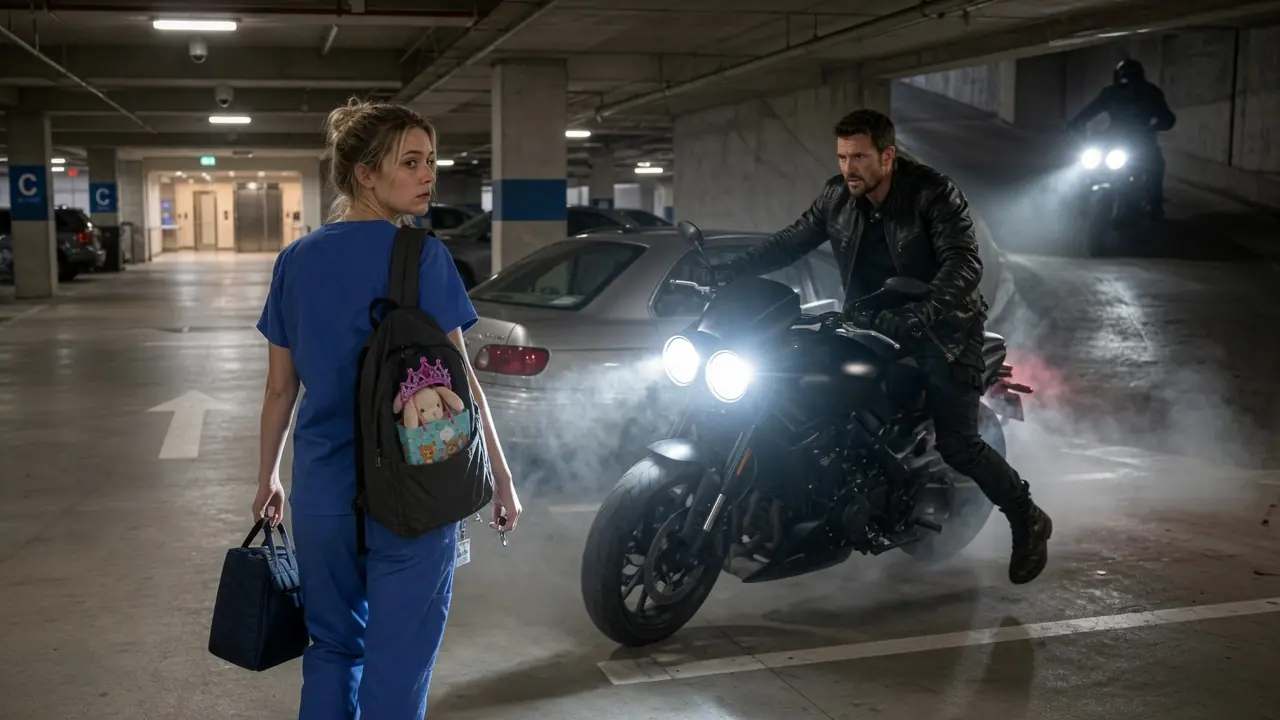
St. Agnes Regional Medical Center was never truly quiet, but the hour had a strange kind of stillness to it. The emergency room glowed on the south side of the building. Ambulance doors opened and closed beneath white lights. Somewhere above the garage, a helicopter pad blinked red against the night sky.
But Level C was almost empty.
Rachel walked between the concrete pillars with her backpack over one shoulder and her lunch bag in one hand. Her blue scrub top was wrinkled from a fourteen-hour shift in the pediatric unit. Her hair had escaped its bun in loose black strands around her face. Her shoes squeaked faintly from something sticky she had stepped in near room 412 and had been too tired to identify.
She was twenty-nine years old, five foot three on a good day, and so tired that the painted arrows on the garage floor seemed to swim when she looked at them.
All she wanted was her car.
Then home.
Then five hours of sleep before returning for another shift.
She had almost reached the employee parking row when the motorcycle engine echoed through the garage.
Rachel stopped.
The sound bounced between concrete walls, deep and uneven, rolling down the ramp from Level B. One engine became two. Then three. Then four.
Her fingers tightened around the lunch bag.
Motorcycles did not belong on Level C at this hour. Visitor parking was on Level A. Emergency drop-off was outside. Staff parking required a badge. The gate at the ramp should have stopped them.
Unless someone had tailgated another car.
Or forced the barrier.
Rachel looked toward the elevator lobby.
Too far.
Her car was closer.
She started walking faster.
The first bike appeared around the curve, headlight sweeping across the concrete pillars. Three more followed, engines growling low as they descended into the staff section. Their lights caught Rachel for one blinding second.
She raised one hand against the glare.
The motorcycles slowed.
Then stopped.
Not in marked spaces.
Across the driving lane.
Blocking the path between Rachel and her car.
The engines died one by one.
Silence fell hard.
Rachel could hear the fluorescent lights buzzing overhead.
The riders climbed off their bikes.
Four men. Heavy boots. Wet leather vests. Dark jeans. Road-worn faces. Their patches showed a steel wolf biting through a chain. Beneath it were the words: Chain Wolves.
Rachel knew the patch.
Everyone on the trauma floor knew it now.
Three nights earlier, a Chain Wolves rider named Travis “Ledger” Holt had been brought into St. Agnes after a motorcycle crash on County Road 18. He had not crashed alone. A passenger had died at the scene. A second rider had disappeared before police arrived. Ledger had survived, barely, and had been placed under restricted visitor status after deputies found evidence that the crash was not an accident.
Since then, men in leather had appeared near the emergency entrance, outside the ICU desk, and once near the cafeteria elevators. Security had chased them away each time.
Rachel had heard the charge nurse say, “They are not here to visit. They are here to make sure he doesn’t talk.”
Rachel had not been involved.
She worked pediatrics.
She gave antibiotics to children with pneumonia, held hands during IV starts, sang badly when toddlers cried, and charted until her wrists ached. She knew nothing about motorcycle crews, crash investigations, or witness intimidation.
But the men did not know that.
Or maybe they did not care.
The biggest rider stepped forward.
He had a thick beard, a shaved head, and pale eyes under heavy brows. His vest hung open over a black shirt. A name patch on his chest read: BRIGGS.
He looked Rachel up and down.
“Evening, nurse.”
Rachel kept walking, angling toward the left, trying to give them space without looking like she was fleeing.
“Excuse me,” she said.
Briggs moved into her path.
The other three spread out without a word.
Not surrounding her completely.
Not yet.
Just enough.
Rachel stopped ten feet from them. Her badge clipped to her scrub pocket felt suddenly heavy. Her phone was in the outer pocket of her backpack. Her keys were in her right hand, tucked between her fingers, but she knew the stupid little self-defense trick would not help much against four grown men.
“I’m off duty,” she said.
Briggs smiled. “Good. Then you got time.”
“No, I don’t.”
The rider to his left laughed. He was younger, maybe thirty, with a narrow face and a chain wallet hanging from his belt.
“She talks like a supervisor.”
Rachel’s heart began to pound.
She glanced toward the nearest security camera.
A black dome in the corner above the elevator lobby.
Too far away.
Maybe it saw them.
Maybe it didn’t.
Briggs noticed her eyes move.
“No one’s watching that close,” he said.
Rachel looked back at him.
“What do you want?”
“Access.”
“To what?”
“The building.”
“Use the main entrance.”
“Main entrance has a bored guard who thinks a badge makes him important.”
“Then talk to him.”
Briggs stepped closer. “We’re talking to you.”
Rachel took one step back.
A mistake.
All four men noticed.
The younger one smiled wider.
Briggs pointed to her badge. “You can open the staff door.”
“No.”
His expression barely changed, but the air around him did.
“No?”
“No.”
“You didn’t even ask why.”
“I don’t need to.”
One of the bikers behind him spat on the concrete. “Ledger’s upstairs.”
“That isn’t my unit.”
“He’s our brother.”
“You need to speak to security or the nurse manager.”
“We did.” Briggs’s voice hardened. “They told us visiting hours were over.”
“Then visiting hours are over.”
The narrow-faced rider laughed again. “Little nurse thinks she runs the hospital.”
Rachel’s mouth went dry, but anger helped her stand straighter.
“I don’t run the hospital,” she said. “But I do know you’re not allowed in through employee access.”
Briggs looked at her for a long moment.
Then he smiled.
Not because she amused him.
Because she had given him a reason to stop pretending.
He walked toward her.
Rachel backed up until her shoulder nearly touched a concrete pillar.
“Listen carefully,” Briggs said. “You’re going to swipe us through that door. You’re going to keep your mouth shut. You’re going to go home and sleep like nothing happened.”
“No.”
The word came out quieter this time.
Briggs leaned closer. “You keep using that word like it protects you.”
Rachel looked toward the elevator lobby again.
No movement.
No security guard.
No other staff.
The hospital felt impossibly close and impossibly far, full of people saving lives while she stood trapped in concrete shadows with men who wanted her badge.
“I can’t help you,” she said.
“You can.”
“I won’t.”
The narrow-faced rider stepped around behind her and kicked lightly at the front tire of her car.
Rachel turned sharply. “Don’t touch my car.”
He looked at the old silver Corolla and laughed. “This yours?”
She did not answer.
He dragged one finger through the dust on the hood. “Nurse money not what it used to be.”
The others laughed.
Rachel’s face flushed.
Her car had 184,000 miles on it, a cracked passenger-side mirror, and an engine that coughed when the weather changed. It was paid off. That made it precious. Men like this could not understand the dignity of something ugly that still got you home.
Briggs noticed her face.
“You got kids?” he asked.
Rachel’s body stiffened.
“No.”
“Boyfriend?”
Silence.
“Family?”
Rachel said nothing.
Briggs smiled. “Everybody’s got somebody.”
The words slipped under her skin.
She thought of her mother sleeping two towns away with a blood pressure machine beside the bed. Her younger brother in community college because Rachel helped with tuition. The pediatric patients upstairs who sometimes called her “Nurse Rae” and cried when her shift ended.
Everybody had somebody.
That was exactly why men like Briggs asked.
Not because they cared.
Because they hunted for handles.
Briggs reached for her badge.
Rachel slapped his hand away before she could think.
The sound cracked through the garage.
For one second, everyone froze.
Then Briggs’s face changed.
The younger biker whispered, “Damn.”
Rachel’s pulse roared in her ears.
“I’m sorry,” she said automatically.
She hated herself for it immediately.
Briggs looked at her hand, then at her face.
“You hit me?”
“You grabbed my badge.”
“You hit me.”
“I said I’m sorry.”
“No.” He stepped closer. “You said it too fast.”
Rachel backed into the pillar.
The cold concrete pressed against her shoulder blades.
Briggs reached again, slower this time, and took hold of the badge clipped to her pocket.
Rachel grabbed the plastic reel.
“Don’t.”
He pulled.
The clip tore loose from her scrub top with a sharp snap.
Her badge swung in his hand.
The photo on it showed her smiling on orientation day, three years younger, hopeful and rested.
Briggs looked at the photo.
Then at her.
“You smile better in pictures.”
“Give it back.”
He turned it over, reading. “Rachel Kim. Pediatric nursing. Level four access.”
The narrow-faced rider whistled. “Level four gets us the side elevator.”
Rachel’s stomach dropped.
“How do you know that?”
Briggs looked up.
His smile vanished.
For the first time, Rachel understood that this was not random.
They had not simply found a nurse in the garage and improvised.
They had been watching staff entrances.
They knew badge colors.
They knew enough about hospital access to be dangerous.
Briggs tucked the badge into his vest.
“You’re going to walk with us.”
“No.”
The rider by her car opened the driver’s door.
Rachel had forgotten to lock it.
He leaned inside and hit the trunk release.
The trunk popped.
Rachel moved instinctively. “Stop!”
The fourth rider, quiet until now, grabbed her backpack strap and yanked it off her shoulder.
Rachel stumbled.
Her lunch bag fell, spilling an apple, a granola bar, and a plastic container of leftover rice across the concrete.
The men laughed.
The fourth rider opened her backpack.
“Phone,” he said.
He pulled it out and tossed it to Briggs.
Rachel lunged for it.
Briggs lifted it out of reach.
“Passcode?”
“No.”
“Passcode.”
“No.”
The narrow-faced rider returned from her trunk holding a small gift bag with cartoon animals printed on it.
Rachel froze.
Not that.
He pulled out the contents.
A stuffed rabbit.
A folded card.
A small plastic tiara.
“What’s this?” he said. “Nurse got a birthday party?”
Rachel’s throat tightened.
The gift was for Marisol, a six-year-old patient on the pediatric floor who had been admitted for complications after chemotherapy. Her birthday was tomorrow. Her parents could not afford decorations. Rachel had bought the tiara and rabbit after her shift the night before, planning to bring them in before rounds.
It was not expensive.
That was not the point.
“Put it back,” Rachel said.
Her voice shook.
The rider held up the tiara. “Boss, look.”
Briggs glanced at it. “Cute.”
The rider placed it on his own head, crooked above his greasy hair.
The others burst out laughing.
Rachel’s face burned.
“Please,” she said. “It’s for a child.”
Briggs turned his attention back to her.
“A child upstairs?”
She said nothing.
“Pediatrics, right?”
Rachel realized the mistake too late.
The rider took off the tiara and tossed it into the air. It hit the concrete and cracked.
Rachel flinched.
Something in her chest gave way.
“You don’t have to do that,” she whispered.
The narrow-faced rider bent, picked up the broken tiara, and held it out.
“You want it?”
Rachel reached.
He dropped it at her feet.
“Pick it up.”
The words were soft.
Almost bored.
Rachel stared at the cracked plastic tiara on the concrete beside her spilled rice and apple.
She saw herself from outside her body: a nurse in wrinkled scrubs, badge stolen, phone taken, backpack opened, gift ruined, four men waiting for her to bend.
She had told patients all week to be brave.
She had told a twelve-year-old boy to breathe during an IV start.
She had told Marisol that birthdays still counted in hospitals.
Now she could barely move.
Briggs leaned close.
“Pick it up, Rachel.”
Her name sounded wrong in his mouth.
She crouched.
Not because she accepted the humiliation.
Because the tiara was for Marisol.
Even broken, maybe she could fix it with tape.
Maybe she could still make the child smile.
Her fingers touched the plastic.
Then Briggs put his boot on it.
The tiara cracked completely beneath his sole.
Rachel stopped breathing.
The garage lights buzzed.
Somewhere above them, an elevator chimed, but no one came out.
Briggs smiled down at her.
“Now,” he said. “You’re going to swipe us in.”
Rachel remained crouched for one second longer.
Then she looked up at him.
“No.”
The word was quiet.
But different.
Not brave exactly.
Empty of bargaining.
Briggs stared at her.
She stood slowly.
“You can break a toy,” she said. “You can take my badge. But you are not getting through that door with me.”
The narrow-faced rider groaned. “I’m tired of her.”
Briggs grabbed her by the upper arm.
Pain shot through her shoulder.
“You think we’re asking?”
Rachel tried to pull away.
His grip tightened.
Then the lights went out.
All of Level C dropped into darkness.
Rachel gasped.
The bikers cursed.
A second later, red emergency lights flickered on along the walls. The garage became a strange, pulsing place of concrete, shadows, and sharp red angles. A mechanical voice came through the overhead speakers.
“Security lockdown. Level C access suspended. Remain where you are.”
Briggs froze.
“What the hell?”
The elevator lobby doors opened.
A man stepped out alone.
He wore black surgical scrubs, a white coat open over them, and a hospital ID clipped to his chest. He was tall, in his early forties, with dark hair going gray at the temples and the stillness of someone who did not waste motion. A smear of dried antiseptic marked one sleeve. His face looked tired enough to be human and calm enough to be dangerous.
Rachel knew him.
Everyone in the hospital knew him.
Dr. Adrian Vale.
Trauma surgeon.
Director of emergency surgery.
The kind of doctor nurses either trusted completely or avoided entirely because he saw everything and tolerated very little.
He walked into the red light without hurrying.
Briggs still held Rachel’s arm.
Dr. Vale looked at the hand first.
Then at Rachel’s face.
Then at the broken tiara on the ground.
His expression did not change.
“Release her,” he said.
Briggs turned his head slowly. “Doctor, go back upstairs.”
“No.”
The word landed with quiet precision.
Rachel felt Briggs’s grip tighten for half a second.
Then he let go.
Not because he was obeying.
Because he needed both hands free.
Rachel stepped away, holding her arm.
Dr. Vale stopped six feet from Briggs.
Behind him, the elevator doors closed.
No security guard followed.
No police.
No crowd.
Just one surgeon under red emergency lights.
Briggs laughed once. “You shut the lights off?”
“Yes.”
“You think that scares us?”
“No,” Dr. Vale said. “It keeps the cameras in infrared mode and locks every badge reader on this level.”
Rachel looked up at the camera dome.
A tiny green light blinked beside it now.
The narrow-faced rider looked at the stolen badge in Briggs’s vest. “Boss.”
Dr. Vale held up a small tablet.
On the screen was a live security feed.
Rachel saw herself on it. Briggs. The motorcycles. Her open trunk. The broken tiara. The stolen badge being tucked into his vest.
Her humiliation, captured without mercy.
But also without lies.
Dr. Vale turned the screen toward Briggs.
“You have been recorded from the moment you entered Level C.”
Briggs’s jaw tightened. “Hospitals record everything. Doesn’t mean anything.”
“It means quite a lot when four men under investigation for witness intimidation steal an employee badge and attempt forced access to a restricted medical unit.”
The garage went very still.
Rachel stared at him.
Witness intimidation.
The Chain Wolves knew exactly why they were there.
Dr. Vale continued, calm as a scalpel.
“You came for Ledger Holt.”
Briggs said nothing.
“You believe he is conscious enough to speak with detectives.”
The quiet rider near Rachel’s car shifted.
Dr. Vale’s eyes moved to him.
“He is.”
The words hit the bikers harder than any threat.
Briggs’s face changed.
Dr. Vale noticed.
“He woke up forty-three minutes ago,” the surgeon said. “He has already spoken.”
“No,” Briggs said.
“Yes.”
“You’re lying.”
“I save lives for a living, Mr. Briggs. I don’t need to lie to men who ruin them.”
The narrow-faced rider took a step toward Dr. Vale.
The surgeon did not move.
“Take one more step,” Dr. Vale said, “and the charge becomes assault during an active hospital lockdown.”
The rider stopped.
Rachel’s breath trembled.
“How do you know their names?” she whispered.
Dr. Vale answered without looking away from Briggs.
“Because your badge reel has a duress sensor.”
Rachel blinked.
“My what?”
“New staff safety trial. Activated when the reel is pulled past twelve inches with force.” His eyes flicked briefly to her torn scrub pocket. “You were one of the test units.”
Rachel remembered the staff email she had skimmed at 3 a.m. and forgotten. Security upgrade. Pilot program. Badge distress alerts. Training module to follow.
She had never completed the module.
Dr. Vale seemed to read the thought on her face.
“Do not worry,” he said. “No one completed the module.”
Under any other circumstance, she might have laughed.
Briggs looked toward the ramp.
“You think locking us in here helps?”
“No,” Dr. Vale said. “It keeps you from reaching the ICU before the deputies arrive.”
“Deputies?”
Dr. Vale tapped the tablet.
Another camera feed appeared.
Outside the garage entrance, two sheriff’s vehicles pulled in silently, lights off.
“Hospital security is sealing Level B,” Dr. Vale said. “Deputies are entering from the west stairwell. You have about ninety seconds to decide whether you want your hands visible or your faces on the floor.”
The quiet rider cursed under his breath.
Briggs stared at Dr. Vale with hatred.
“You had this planned.”
“No,” Dr. Vale said. “You did. We adapted.”
The line settled into the red-lit garage.
Rachel held her injured arm and tried to understand how quickly the room had changed.
Minutes ago, Briggs had owned the space because he was willing to make fear larger than everything else.
Now every exit was locked.
Every movement recorded.
Every lie already behind schedule.
The narrow-faced rider dropped Rachel’s backpack.
It hit the concrete beside the spilled rice.
The quiet rider placed both hands on the hood of Rachel’s car.
The one by the trunk did the same.
Briggs did not move.
He looked at Rachel.
“You think you’re safe because a doctor pushed buttons?”
Rachel felt the old fear rise again.
But this time Dr. Vale spoke before she could answer.
“She is safe because you misjudged the building.”
Briggs’s eyes shifted to him.
“This hospital has armed deputies, security cameras, badge logs, panic protocols, and thirty-seven nurses on night shift who have been warning us about men in vests for three days.” Dr. Vale stepped slightly closer. “You saw one tired woman in a garage and assumed she was alone.”
He paused.
“She was never alone. You were just poorly informed.”
Footsteps echoed from the west stairwell.
Briggs heard them.
His jaw clenched.
For a moment, Rachel thought he might run.
Instead, he slowly removed her badge from his vest and tossed it onto the concrete at her feet.
“There,” he said. “No harm.”
Dr. Vale looked at the broken tiara.
Then at Rachel’s red arm.
Then at her open trunk.
“No,” he said. “There is harm.”
The stairwell door opened.
Two deputies entered with hospital security behind them.
“Hands visible!” one deputy shouted.
The red lights kept pulsing.
The garage filled with commands, boots, radios, and the sharp click of restraints. Briggs obeyed last, smiling as if he could still turn the moment into something he controlled.
But when a deputy pulled Rachel’s badge, her phone, and Marisol’s broken tiara into evidence bags, his smile began to fade.
Small things mattered when someone wrote them down.
Rachel gave her statement sitting on the low concrete barrier beside her parking space.
Her voice shook.
She hated that.
Dr. Vale stood nearby but did not speak for her. He answered only when the deputy asked technical questions about the badge alert, the lockdown, and Ledger Holt’s restricted status.
Rachel told the deputy about the motorcycles.
The badge.
The phone.
The trunk.
The tiara.
When she reached the part where Briggs put his boot on it, she stopped.
The deputy waited.
No rushing.
No sighing.
No “Is that all?”
Rachel looked at the evidence bag holding the broken plastic pieces.
“It was for a child upstairs,” she said.
The deputy’s face softened. “I understand.”
Rachel looked down. “It sounds stupid.”
“No, ma’am. It sounds specific.”
That word stayed with her.
Specific.
Not dramatic.
Not emotional.
Not overreacting.
Specific.
After the deputies took the bikers away, security restored the lights. The garage returned to its ordinary ugliness: stained concrete, painted arrows, old oil spots, humming fixtures, Rachel’s open trunk, rice on the floor, her apple bruised near a tire.
The world never looked more normal than after something terrible.
That was the part that always bothered her.
Dr. Vale picked up her backpack and placed it gently on the hood of her car.
“Your arm needs to be checked.”
“I’m fine.”
“No.”
Rachel looked at him.
He did not soften the word.
“You are not fine. You are standing. There is a difference.”
She almost argued.
Then she looked at the red marks forming on her arm and the torn fabric near her badge clip.
“I need to go home.”
“You need an incident exam first.”
“I have another shift tomorrow.”
“No, you don’t.”
She frowned. “I’m scheduled.”
“I am removing you from the schedule.”
“You can’t just—”
“I can.”
The certainty annoyed her enough to bring some life back into her voice.
“Doctors don’t control nursing schedules.”
“Usually no. Tonight, yes.”
She stared at him.
He looked tired now. The calm had not disappeared, but she could see what it cost him.
“You were assaulted in a hospital garage because we did not secure staff parking well enough after a known threat,” he said. “You are not using your sick time. You are not finding your own coverage. You are not apologizing to anyone for being unavailable.”
Rachel’s throat tightened.
She looked away quickly.
Kindness from people with authority felt dangerous in a different way. It made the fear spill.
“I just wanted to go home,” she whispered.
“I know.”
“I kept thinking if I gave them the badge, maybe they would let me go.”
“But you didn’t.”
“They broke the tiara.”
“I saw.”
Her eyes filled.
“It was for Marisol.”
“I know.”
“You know Marisol?”
“I removed her port infection last month.”
Rachel gave a shaky breath that was almost a laugh. “Of course you did.”
Dr. Vale picked up the evidence receipt the deputy had left and held it out to her.
“Security photographed the tiara before bagging it. I’ll send someone to the gift shop when it opens.”
“She wanted purple.”
“Then purple.”
Rachel wiped her face with her sleeve. “You’re very bossy.”
“Yes.”
“You know that’s not always comforting?”
“I have been informed.”
This time she did laugh, but it broke halfway.
Dr. Vale said nothing.
He simply stood there while she cried under the restored fluorescent lights beside her old Corolla, with spilled rice drying on the concrete and her badge hanging loose from its torn clip.
No speeches.
No crowd.
No easy lesson.
Just a doctor, a nurse, and the ugly aftermath of a thing that should not have happened.
At 3:04 a.m., Rachel sat in an exam room in the emergency department while a resident documented bruising on her upper arm and wrist.
At 3:40, she signed her statement.
At 4:10, Dr. Vale handed her a new temporary badge with a reinforced clip.
At 4:12, she stared at it and said, “I don’t want to wear that.”
He nodded.
“I understand.”
“I know I have to.”
“Yes.”
“I hate that.”
“That is also understandable.”
He had a way of speaking that did not rush past discomfort. Most people tried to patch pain with words. Dr. Vale seemed willing to let silence do some of the work.
Security walked her to her car.
Dr. Vale followed, though she told him he did not need to.
He ignored that.
At the Corolla, Rachel paused.
The broken tiara was gone.
The rice was gone.
Someone had cleaned the concrete while she was upstairs.
The car door was closed.
The trunk was shut.
Her lunch container sat empty on the hood, rinsed clean.
She looked at it for a long moment.
“Who did that?”
“Environmental services,” Dr. Vale said.
“They didn’t have to.”
“No.”
“Then why?”
He looked toward the hospital tower.
“Because they heard what happened.”
Rachel did not answer.
The idea that people had quietly cleaned up the mess without making her watch it happen almost hurt.
She got into the driver’s seat.
Before closing the door, she looked up at him.
“Did Ledger really talk?”
Dr. Vale’s expression changed slightly.
“Yes.”
“About the crash?”
“And more.”
“Were they really coming to silence him?”
“That will be for detectives to prove.”
“But you think so.”
“I think four men do not steal a pediatric nurse’s badge at one in the morning because they miss visiting hours.”
Rachel looked at her temporary badge on the passenger seat.
“What happens now?”
“To them? Charges. Protective orders. Likely federal involvement if witness intimidation connects across state lines.”
“To us.”
That question seemed to land harder.
Dr. Vale looked toward the camera dome.
“Now the hospital decides whether staff safety is a memo or a promise.”
Rachel nodded slowly.
“Good night, Dr. Vale.”
“Good morning, Nurse Kim.”
She drove home with both hands gripping the steering wheel.
For two days, she did not return to St. Agnes.
She slept badly.
She woke at every motorcycle sound from the road outside her apartment. She checked her door lock three times. She cried when she found a grain of dried rice stuck to the side of her lunch bag. She ignored three calls from coworkers, then finally answered the fourth because it was her charge nurse, Denise, and Denise did not do emotional nonsense unless the situation was serious.
“You alive?” Denise asked.
“Yes.”
“Good. I’m coming over with soup.”
“I don’t need soup.”
“I didn’t ask.”
Denise arrived twenty minutes later with soup, bread, and a purple tiara from the hospital gift shop.
Rachel stared at it.
Denise set it on the kitchen table.
“Marisol’s birthday is still happening.”
Rachel sat down slowly.
“Did someone tell her?”
“That you were attacked? No. That the first tiara broke in a tragic parking garage incident? Also no. She thinks Dr. Vale is bad at shopping.”
Despite herself, Rachel smiled.
“He bought it?”
“He sent a resident, which is doctor for buying.”
Rachel touched the tiara.
“Is Marisol okay?”
“She asked where Nurse Rae was.”
Rachel swallowed.
“What did you say?”
“That Nurse Rae had to rest because superheroes have union rules.”
Rachel laughed and cried at once.
Denise sat across from her.
Then, for once, said nothing.
The hospital meeting happened the following Monday.
Rachel did not want to attend.
Dr. Vale insisted.
So did Denise.
The conference room on the second floor was full of people who usually did not sit together: nursing leadership, hospital security, risk management, emergency department staff, environmental services, two union representatives, and the chief operating officer, who looked deeply uncomfortable under the collective stare of night-shift nurses.
Rachel sat near the back.
Dr. Vale stood at the front, arms folded, eyes cold.
The security director began with a phrase Rachel hated immediately.
“We understand an unfortunate incident occurred—”
Dr. Vale interrupted him.
“No.”
The room went silent.
The security director blinked. “Excuse me?”
“It was not an unfortunate incident. It was a predictable breach after repeated reports of threats from an organized group. Nurse Kim’s assault was not bad luck. It was system failure.”
Rachel stared at him.
The chief operating officer cleared his throat. “Dr. Vale, perhaps we can frame this constructively.”
“That was constructive. I identified the frame.”
Denise muttered, “I love him a little.”
The meeting changed after that.
No vague language survived.
Not “incident.”
Assault.
Not “visitor concern.”
Threat.
Not “parking discomfort.”
Security vulnerability.
Rachel was asked to speak.
She almost refused.
Then she stood.
Her hands shook, but she placed them flat on the table.
“They knew the badge level,” she said. “They knew the side elevator. They knew staff parking was accessible if they followed someone through the gate. They knew I was alone because people leave night shift alone every night.”
No one spoke.
She continued.
“I don’t want applause. I don’t want an email calling me resilient. I want escorts available without begging. I want the garage gate fixed. I want badge duress training that people actually receive before they need it. I want security to respond when nurses report men waiting near entrances. And I want the hospital to stop pretending night shift is safe because nothing happened yesterday.”
The room remained quiet.
Then one of the environmental services supervisors raised her hand.
“My team leaves at midnight,” she said. “We walk out through Level D. No cameras near the east stairwell.”
A respiratory therapist spoke next. “We’ve been telling security about that stairwell for months.”
A cafeteria worker added, “The loading dock door doesn’t latch.”
The meeting became something larger than Rachel.
Not a crowd rushing to save her.
A structure being forced to admit where it had failed.
That felt different.
More useful.
Within two weeks, St. Agnes changed its night protocols. Escorts became available through a direct number. The garage gate was repaired. Cameras were repositioned. Badge duress training became mandatory and paid. Restricted visitor alerts appeared on unit dashboards instead of staying buried in security emails. A policy was created that staff reports of intimidation triggered automatic security review.
Rachel returned to work on a Thursday.
She parked on Level A because she could not yet bring herself to use Level C.
No one teased her.
That helped.
On the pediatric floor, Marisol wore the purple tiara over a knit cap and waved from bed 418.
“Nurse Rae!” she called. “Look! I’m a queen.”
Rachel stopped in the doorway.
The child grinned, thin and bright and alive.
Rachel smiled back.
“A very powerful queen.”
“Dr. Vale picked purple wrong first,” Marisol said seriously. “But Denise fixed it.”
“I heard.”
Marisol held out the stuffed rabbit. “This one is named Sir Hops.”
Rachel walked in and adjusted the blanket around her.
The room smelled of hand sanitizer, crayons, and hospital lunch.
Not the garage.
Not leather.
Not gasoline.
Not fear.
A different place.
A place where her hands knew what to do.
Later that shift, Rachel saw Dr. Vale at the nurses’ station reviewing a chart.
He looked up.
“You came back.”
“I work here.”
“Yes.”
She clipped a medication scanner to her cart.
He looked at the reinforced badge on her scrub pocket. “How does it feel?”
“Like a tiny plastic hostage.”
“That is colorful.”
“I’m working through it.”
He nodded.
After a pause, she said, “Thank you for cutting the power.”
“You activated the alert.”
“I didn’t know I did.”
“You still did.”
“That doesn’t count.”
“It counted to the system.”
She gave him a tired look. “You argue like you operate.”
“Successfully?”
“Relentlessly.”
He almost smiled.
Then Rachel asked the question that had been sitting in her mind since that night.
“Why did you come alone?”
His expression sobered.
“I was in the security office reviewing Ledger’s restricted status with the deputy when your alert came in. Security wanted to wait for officers to reach Level C.”
“And you didn’t?”
“No.”
“Why?”
Dr. Vale looked down the hallway toward the pediatric rooms.
“Because I have seen what ninety seconds can cost.”
Rachel did not ask more.
She understood enough.
The case against Briggs and the Chain Wolves moved slowly.
Ledger Holt’s statement connected the crash to insurance fraud, stolen motorcycle parts, and intimidation across two counties. The attempt to steal Rachel’s badge turned out to be the cleanest piece of evidence prosecutors had: timestamped, recorded, tied to restricted access, and connected to a witness who had awakened less than an hour earlier.
Briggs tried to claim he only wanted to visit a friend.
The video made that difficult.
Especially the part where he crushed a child’s tiara under his boot.
People in court reacted to that more than Rachel expected.
Maybe because a badge could seem official, a phone replaceable, a nurse’s fear too easy for strangers to underestimate.
But a plastic tiara bought for a sick child was simple.
Cruelty had stepped on it.
No one needed a legal degree to understand.
Rachel testified three months later.
She wore black slacks, a white blouse, and the reinforced badge clipped to her purse strap because she had forgotten to remove it after work. Briggs sat at the defense table in a suit that did not fit his shoulders. He did not look at her while she described the garage.
When the prosecutor asked how she felt when he took her badge, Rachel answered honestly.
“Like the hospital became locked away from me,” she said. “I could see the doors, the cameras, the elevator. I knew help existed, but I could not reach it.”
The prosecutor asked, “And when Dr. Vale arrived?”
Rachel looked down at her hands.
“I did not feel brave,” she said. “I felt believed. That was the first thing that helped.”
The courtroom was silent.
Briggs pleaded guilty before the trial fully began.
Several others did too.
Ledger entered protective custody after giving testimony that reached beyond the crash. The Chain Wolves did not disappear, but the local chapter broke apart under arrests and indictments. The hospital added Rachel’s case to staff safety training, though she demanded they remove her name and stop calling it “The Nurse Kim Incident.”
The final training title became: Garage Level C: Restricted Access Breach and Staff Protection Review.
Boring.
Accurate.
Rachel approved.
Months later, she parked on Level C again.
It was early evening, not night. Her shift had ended on time for once. The garage was brighter now, cameras visible at every angle, emergency call boxes glowing blue near the pillars. A security cart rolled past every fifteen minutes.
She stood by her Corolla and looked at the spot where the rice had spilled.
Nothing marked it.
No stain.
No sign.
Just concrete.
Dr. Vale’s voice came from behind her.
“You okay?”
She turned.
He stood near the elevator lobby in scrubs, holding a paper cup of coffee.
“Do you always appear dramatically in garages?” she asked.
“Only when coffee fails me upstairs.”
She looked at the cup. “That’s from the bad machine near radiology.”
“It has character.”
“It has lawsuits waiting to happen.”
He walked closer but kept a respectful distance.
Rachel looked back at the floor.
“I thought I’d feel something big coming back here,” she said.
“And?”
“I mostly feel annoyed that my parking space is farther from the elevator now.”
“That is healthy.”
She smiled faintly.
A motorcycle engine sounded outside the garage entrance.
Rachel stiffened.
Dr. Vale noticed but did not speak.
The engine passed on the street without turning in.
Rachel breathed out.
“Still happens,” she said.
“It may for a while.”
“I hate that too.”
“I know.”
She touched the badge clipped to her scrub pocket.
“Marisol went home today.”
“I heard.”
“She wore the tiara out.”
“Good.”
“She made me bow.”
“Did you?”
“Of course. I know my place in royalty.”
Dr. Vale smiled for real then.
It changed his face enough that Rachel almost forgot he was terrifying in committee meetings.
She looked around Level C one more time.
“I used to think rescue meant somebody stopping the bad thing before it got to you,” she said.
“That would be ideal.”
“But sometimes it gets to you first.”
“Yes.”
“And then rescue is somebody naming it right.”
Dr. Vale nodded slowly.
“That is one kind.”
“Or recording it.”
“Also useful.”
“Or fixing the system after.”
“The rarest kind.”
Rachel looked at him. “You really are bossy.”
“Yes.”
She opened her car door, then paused.
“Dr. Vale?”
“Yes?”
“Thank you for not making it a hero story.”
He looked at her carefully.
“You were the one who refused to open the door.”
“I was terrified.”
“I know.”
“I almost gave them the badge.”
“But you didn’t.”
“I might have.”
“But you didn’t.”
The words were not inspirational.
They were factual.
She liked them better that way.
Rachel got into the car and started the engine. It coughed once, then settled. Dr. Vale stepped back as she reversed.
At the ramp, she paused and looked in the rearview mirror.
Level C stretched behind her, lit and watched and no longer empty.
The fear had not disappeared.
But it had changed size.
It no longer filled the garage.
It fit inside her memory now, beside other things: the red emergency lights, the camera feed, the deputy writing down small details, Denise bringing soup, Marisol wearing purple, the hospital meeting where vague words were not allowed to survive.
The Chain Wolves had cornered Rachel Kim because they saw one tired nurse walking alone and thought fear would open any door.
They were wrong.
Fear had been there.
But so had policy.
So had evidence.
So had one surgeon unwilling to wait ninety seconds.
So had Rachel’s own voice, shaking but still saying no.
And in the end, the door they wanted never opened.
Not to the ICU.
Not to Ledger Holt.
Not to silence.
Rachel drove out of the garage and into the evening light, her badge clipped firmly to her pocket, her hands steady on the wheel.
Behind her, the hospital stood bright against the darkening sky.
A place still imperfect.
Still busy.
Still full of people too tired, too brave, and too necessary to be left unprotected.
The next morning, a new sign appeared beside the Level C elevator.
Staff safety is not an individual responsibility. Report threats. Use escorts. Pull badge alert if needed. You will be believed.
Rachel stood in front of it before her shift and read it twice.
Then she adjusted her badge, picked up her patient list, and walked toward pediatrics.
Marisol’s room was empty now.
The bed made.
The tiara gone.
The hallway smelled like disinfectant and breakfast trays.
A new patient cried somewhere near the nurses’ station.
Rachel took a breath and followed the sound.
Because fear did not get the keys.
Because cruelty did not get the door.
And because a nurse who had once been cornered in the dark still had work to do in the light.