Ten-year-old Caleb Foster noticed the old woman because she was standing in the rain without moving.
It was late October in Portland, Maine, and the evening had turned cold faster than anyone expected. Wind pushed wet leaves along the sidewalk. Rain tapped against shop windows and ran in silver lines down the glass. People hurried past with umbrellas low over their faces, their coats pulled tight, their eyes fixed on home.
Caleb did not have an umbrella.
He had a school backpack, a thin jacket, and a folded blanket tucked under one arm.
The blanket was not for him.
It belonged to the little shelter bed he sometimes used at St. Mark’s Community Center when his mother’s overnight cleaning shifts ran too late and their apartment building locked the side entrance before she could return. The director, Mrs. Lynn, had let him borrow it that afternoon because the rain was coming hard and Caleb’s jacket had a tear near the shoulder.
“Bring it back tomorrow,” she had said gently.
“I will,” Caleb promised.
Caleb always tried to keep promises.
His mother, Marissa Foster, worked almost every hour she could. She cleaned offices downtown, stocked shelves at a small grocery store on weekends, and took laundry jobs from neighbors when someone needed extra help. She smiled often for Caleb, but he had learned the difference between a real smile and a tired one.
Their life was not terrible.
That was what Marissa always said.
“We’re still together. We still have food most days. We still have tomorrow.”
But Caleb knew how carefully she counted coins. He knew their apartment heat did not always work. He knew the landlord had stopped fixing things quickly after they fell behind. He knew his mother sometimes sat on the edge of her bed after midnight with her head in her hands, whispering numbers like prayers.
So Caleb helped in the ways a ten-year-old could.
He carried groceries. He swept hallways for Mrs. Lynn. He watched younger children at the community center while their parents filled out job forms. He gave away half his snack when someone looked hungrier than he felt.
His mother told him often, “You don’t have to carry the world, baby.”
But Caleb had already learned that sometimes people dropped parts of the world right in front of you, and walking around them felt wrong.
That was why he stopped when he saw the old woman.
She stood near the corner of Brighton Avenue and Maple Street, under the broken awning of a closed flower shop. She was small, with pale skin, silver hair pinned loosely beneath a damp blue hat, and a long beige coat buttoned crookedly. One hand gripped a cloth purse against her chest. The other held a paper bag that had already begun to tear from the rain.
Her eyes moved from one side of the street to the other.
Not like someone waiting for a ride.
Like someone who did not know where she was.
People passed her.
A man in a business coat stepped around the puddle near her feet.
A woman with two shopping bags glanced at her, then looked away.
A teenager laughed into his phone and walked past without slowing.
The old woman’s lips moved silently, as if she was repeating something she could not remember.
Caleb slowed.
The rain soaked through the shoulder of his jacket.
He looked down the street toward home.
Then he looked back at the woman.
She took one step forward, then stopped. A bus roared past, sending dirty water over the curb. The old woman flinched and backed into the awning.
Caleb walked toward her.
“Ma’am?”
The old woman turned quickly.
Her eyes were green and frightened.
“Oh,” she whispered. “I’m sorry. Am I in your way?”
“No,” Caleb said. “Are you okay?”
She looked at the street again.
“I was going to… I was supposed to…”
Her voice faded.
Caleb stepped closer but not too close. His mother had taught him to be careful with strangers, but she had also taught him that fear should not make a person cruel.
“What’s your name?” he asked.
The old woman blinked.
“My name?”
“Yes, ma’am.”
She looked embarrassed.
“Eleanor,” she said finally. “Eleanor Hayes.”
Caleb nodded. “I’m Caleb Foster.”
“That’s a nice name.”
“Thank you.”
Eleanor looked down at the paper bag in her hand. The bottom was tearing. A small orange prescription bottle had nearly slipped through the wet paper.
Caleb noticed immediately.
“Your bag’s ripping.”
“Oh.”
She stared at it as if surprised to see it there.
Caleb opened his backpack and pulled out an old plastic folder from school. He removed his worksheets, tucked them into the front pocket, and offered the folder.
“We can put your things in here so they don’t fall.”
Eleanor looked at him with sudden tenderness.
“You don’t have to do that.”
“It’s okay. My homework already got wet anyway.”
That was only partly true.
He helped her transfer the prescription bottle, a small loaf of bread, a banana, and a box of tea into the plastic folder. Then he zipped it into his backpack to keep everything dry.
Eleanor watched him carefully.
“You’re very kind.”
Caleb shrugged.
“My mom says people should help before asking too many questions.”
Eleanor’s face trembled at that.
“I think I asked someone where I was,” she whispered. “But I don’t remember what they said.”
Caleb felt something cold move through his chest.
“You’re lost?”
Eleanor looked ashamed.
“I think so.”
The rain grew harder. Water dripped from the awning onto the sidewalk. Caleb glanced toward the bus stop across the street. There were people there, but nobody seemed interested.
“Do you have a phone?” he asked.
Eleanor opened her purse with shaking hands. Inside were tissues, a coin pouch, a pair of glasses, and a small address book. No phone.
“I don’t like carrying one,” she said softly. “My son bought me one, but I forget to charge it.”
“Do you know your address?”
She pressed her fingers to her forehead.
“I live on…” She closed her eyes. “There are roses near the mailbox.”
Caleb waited.
“And a white porch.”
He waited longer.
“No,” she whispered. “That was the old house.”
Her breathing quickened.
“I don’t know.”
Caleb’s heart began beating faster.
He was ten. He did not know how to fix this.
But he knew she could not stay there.
He took the folded blanket from under his arm and held it up.
“You should put this around you.”
Eleanor shook her head.
“No, dear. You’ll be cold.”
“You’re shaking.”
“So are you.”
“I’m younger,” Caleb said, as if that settled it.
Eleanor gave a small laugh that nearly became a sob.
Caleb wrapped the blanket around her shoulders carefully. It was gray and rough, but it was dry enough to help. Eleanor pulled it close, and her trembling slowed a little.
“Thank you,” she whispered.
“We should go somewhere with people who can help,” Caleb said. “The community center is two blocks away. Mrs. Lynn knows everybody.”
Eleanor looked frightened again.
“I don’t want trouble.”
“You’re not trouble.”
The words came out firmly.
Caleb had heard adults use that phrase with people who needed help, and he hated it. Trouble was a broken window or a fire alarm. An old woman lost in the rain was not trouble.
Eleanor stared at him.
Then she nodded.
Caleb offered his arm because he had seen men in old movies do that for elderly ladies. Eleanor looked surprised, then placed her hand lightly on his sleeve.
They walked slowly through the rain.
Caleb matched her pace. Twice, she stopped and looked around as if something almost made sense. Twice, he waited quietly until she was ready to move again.
At the corner, a car splashed through a puddle, and Eleanor tightened her grip on his arm.
“It’s okay,” Caleb said. “I’ve got you.”
She looked down at him with tears in her eyes.
“My husband used to say that.”
Caleb did not know what to say, so he simply kept walking.
St. Mark’s Community Center glowed warmly through the rain. It sat inside an old brick building beside a church, with wide steps, a blue front door, and a bulletin board covered in flyers about food pantry hours, job fairs, coat drives, and free tutoring.
Inside, the lobby smelled like coffee, soup, wet coats, and floor cleaner.
Mrs. Lynn stood near the front desk talking to a young mother with a toddler on her hip. She was a strong woman in her fifties with short gray hair, kind eyes, and a voice that could be gentle or sharp depending on what the situation required.
When she saw Caleb enter with Eleanor, her face changed immediately.
“Caleb?”
“She’s lost,” Caleb said.
Mrs. Lynn came around the desk at once.
Eleanor looked embarrassed and tried to remove the blanket.
“I’m sorry. I didn’t mean to cause a fuss.”
“No fuss,” Mrs. Lynn said warmly. “Come sit down, sweetheart.”
She guided Eleanor to a chair near the heater while Caleb stood beside her, still holding the backpack with Eleanor’s things inside.
Mrs. Lynn asked gentle questions.
Name.
Age.
Family.
Address.
Eleanor remembered her name. She remembered she had a son named David. She remembered she had gone to pick up medicine. She remembered a dog she owned when she was a girl.
But she did not remember where she lived.
Mrs. Lynn called the non-emergency police line, then local hospitals, then asked Eleanor if she could look in her purse for identification. Eleanor nodded, cheeks red with shame.
Inside the purse, Mrs. Lynn found a medical alert card.
Eleanor Hayes
Early-stage memory loss
Emergency contact: David Hayes
Mrs. Lynn called the number.
No answer.
She called again.
Still no answer.
Then she left a message.
Caleb sat in the chair beside Eleanor while she held a cup of tea with both hands. Her fingers looked fragile around the paper cup.
“I’m sorry,” she said again.
Caleb frowned.
“You keep saying that.”
“I must be making everyone’s evening difficult.”
“You’re not.”
She smiled faintly.
“You say that like you’re certain.”
“I am.”
Mrs. Lynn returned and looked at Caleb.
“Your mother called. She’s on her way here after work.”
Caleb looked guilty.
“Is she mad?”
“Worried.”
“That’s worse.”
Mrs. Lynn almost smiled.
“Yes. Usually.”
Eleanor looked stricken.
“Oh, dear. I’ve made your mother worry.”
Caleb shook his head.
“She worries a lot anyway.”
Mrs. Lynn gave him a look.
He added quickly, “Because she loves me.”
A little while later, Marissa arrived soaked from the rain, her work shirt visible beneath an old coat. She pushed through the door with panic in her eyes.
“Caleb.”
He stood immediately.
“I’m okay.”
She crossed the lobby and pulled him into her arms so tightly that he could barely breathe.
“You were supposed to come home.”
“I know. I’m sorry.”
Mrs. Lynn explained what happened before Marissa could scold too much.
Marissa listened, one arm still around Caleb’s shoulders. Her expression softened when she looked at Eleanor wrapped in the gray blanket.
Eleanor rose shakily.
“Mrs. Foster, I am so sorry. Your son helped me when I was confused. I didn’t mean to keep him.”
Marissa’s face changed.
She walked over and took Eleanor’s hands.
“You don’t need to apologize. I’m glad he was there.”
Caleb looked up, surprised.
His mother glanced at him.
“We’re going to talk about safety later,” she said.
“Yes, ma’am.”
“But I’m glad he helped.”
That made Caleb stand a little taller.
Two hours passed before Eleanor’s son arrived.
David Hayes burst into the community center like a man who had been holding his breath for far too long. He was in his forties, wearing a suit jacket over a loosened tie, his hair damp from rain, his face pale with fear.
“Mom?”
Eleanor looked up.
For one bright second, her face cleared completely.
“David.”
He rushed to her and knelt in front of the chair, taking her hands.
“I’ve been looking everywhere.”
“I got turned around,” she whispered.
“I know. It’s okay.”
“I forgot the street.”
“It’s okay.”
“I’m sorry.”
David closed his eyes, pain crossing his face.
“Mom, please don’t apologize.”
Caleb watched quietly.
He saw David’s hands trembling the same way Eleanor’s had trembled earlier.
Adults were strange that way. They spent so much time pretending they were not scared, but fear still showed up in their fingers.
Mrs. Lynn explained where Caleb had found Eleanor and how he had brought her in from the rain.
David turned toward Caleb.
“You found my mother?”
Caleb nodded.
“She was cold.”
David swallowed hard.
“You brought her here?”
“Yes, sir.”
David stood and walked to him. For a moment, Caleb thought the man might hug him, but David stopped himself and simply crouched to meet his eyes.
“Thank you,” he said, his voice breaking. “You may not understand this yet, but you did something very important tonight.”
Caleb looked down.
“I just didn’t want her standing alone.”
David’s face crumpled slightly.
“That is exactly why it was important.”
He tried to offer Marissa money for Caleb’s help. Marissa refused immediately.
“No,” she said. “Please.”
David looked confused.
“At least let me—”
“No,” Marissa repeated, gentler but firm. “He helped because someone needed help. I don’t want him learning to charge people for kindness.”
David stared at her for a moment.
Then he nodded slowly.
“Your son is the way he is because of you.”
Marissa’s eyes filled, but she looked away.
Before leaving, Eleanor took Caleb’s hand.
“I remember your name,” she said.
Caleb smiled.
“Caleb.”
“Caleb,” she repeated. “Like the boy who gave me a blanket.”
“You can keep it tonight.”
“No, no. It belongs to the center.”
Mrs. Lynn waved a hand.
“We have more blankets.”
Caleb looked at her.
“We do?”
Mrs. Lynn gave him a tiny wink.
“We do tonight.”
Eleanor held the blanket to her chest.
“Thank you.”
The next morning, Caleb expected the day to return to normal.
It did not.
At school, he could barely focus. He kept thinking about Eleanor standing under the broken awning, trying to remember where home was. He wondered if she was scared again. He wondered if David had made her breakfast. He wondered what happened to people when memories became slippery.
After school, he went straight to the community center like he had promised his mother.
David Hayes was waiting there.
Caleb stopped in the doorway.
David stood beside Mrs. Lynn, holding a brown paper bag and a folded coat.
“Hi, Caleb.”
“Hi.”
Marissa was there too, which made Caleb nervous. She had come early from work and stood with her arms folded, though her expression was not angry.
David stepped forward.
“My mother wanted you to have something.”
Caleb stiffened.
“I can’t take money.”
“It isn’t money.”
David held out the paper bag.
Inside were oatmeal cookies wrapped in wax paper, a small carton of milk, and a note written in shaky handwriting.
For Caleb, who helped me remember I was not alone.
Caleb read it twice.
His throat tightened.
“She wrote this?”
“With some help,” David said softly. “But those are her words.”
Caleb held the note carefully.
Then David offered the folded coat.
“And this was mine when I was younger. It’s been in my mother’s closet for years. She asked if you might use it.”
Marissa’s face tightened slightly.
David noticed immediately.
“It’s not charity,” he said quickly. “She said the boy who gave her a blanket should not have rain coming through his sleeve.”
Caleb looked down at his torn jacket.
Marissa closed her eyes for a moment.
When she opened them, they were wet.
“Thank you,” she whispered.
Caleb tried on the coat. It was a little big, but warm. Really warm. The kind of coat that made him realize how cold he had been before.
Mrs. Lynn clapped once.
“Looks like it has a few good winters left.”
David smiled.
“My mother would be happy to hear that.”
From that day on, David and Eleanor began visiting St. Mark’s Community Center every Wednesday.
At first, David said it was because Eleanor wanted to return the blanket properly. Then because she wanted to bring cookies. Then because she enjoyed sitting near the window while Caleb helped younger kids with homework. Eventually, nobody bothered pretending there needed to be a reason.
Eleanor liked the center.
She liked the noise, though sometimes it overwhelmed her. She liked the children. She liked folding donated clothes into neat stacks. She liked helping Mrs. Lynn label food pantry bags. She liked hearing Caleb read aloud from his library book because, she said, his voice “made words stand still.”
Caleb did not know what that meant, but it sounded nice.
Some days, Eleanor remembered everything clearly.
Other days, she asked Caleb the same question three times.
“Are you in fourth grade?”
“Fifth,” he would say gently.
“Oh, fifth. Such a big year.”
Five minutes later, she would ask again.
Caleb always answered like it was the first time.
Mrs. Lynn noticed.
“You’re patient with her,” she said one afternoon.
Caleb shrugged.
“She doesn’t mean to forget.”
“No, she doesn’t.”
“My mom forgets things when she’s tired.”
“We all do.”
“But people get mad faster when old people forget.”
Mrs. Lynn looked at him thoughtfully.
“That is true.”
“It doesn’t seem fair.”
“No,” she said. “It doesn’t.”
One Wednesday in November, Eleanor arrived upset.
She had misplaced a small silver locket that contained a photo of her late husband, Thomas. David had searched her apartment, her purse, his car, and the hallway of their building. Nothing.
Eleanor kept touching the empty space at her neck.
“I had it,” she whispered. “I know I had it.”
David looked exhausted.
“We’ll find it, Mom.”
“You think I lost it because I’m getting worse.”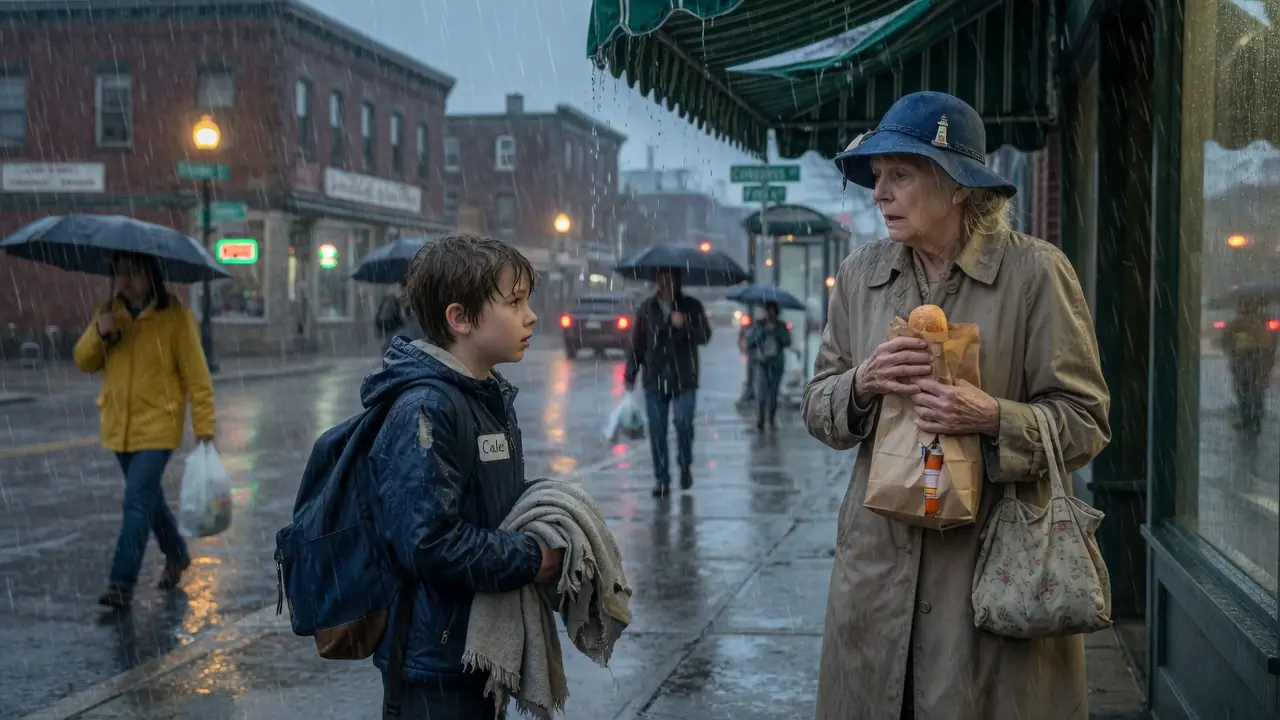
“No, I don’t.”
“You do.”
David’s face filled with pain.
Caleb watched from the homework table.
Then he stood.
“Where did you go today?”
Eleanor looked at him.
“What?”
“Before here. Where did you go?”
David answered. “Pharmacy, bakery, then the center.”
Caleb picked up his backpack.
“Maybe it fell in one of those places.”
David shook his head. “I called them.”
“Calling isn’t looking.”
Marissa, who had just arrived to pick Caleb up, gave him a warning look.
But David looked at him carefully.
“You want to search?”
Caleb nodded.
“It matters to her.”
That settled it.
Marissa sighed but agreed to come with them.
The four of them retraced Eleanor’s route through the cold afternoon. At the pharmacy, no locket. At the bakery, no locket. On the sidewalk, nothing but wet leaves and cigarette butts near the curb.
Eleanor grew quieter with every stop.
Finally, Caleb looked at the bus bench outside the bakery.
There was a narrow gap between the bench and the brick wall. He crouched down, ignoring the damp pavement, and reached carefully behind it.
His fingers touched something cold.
He pulled out the silver locket.
Eleanor gasped.
David covered his mouth.
Caleb stood and held it out.
“It probably slipped when you sat down.”
Eleanor took the locket with both shaking hands. For a moment, she could not speak.
Then she opened it.
Inside was a tiny photograph of a smiling man with kind eyes.
“My Thomas,” she whispered.
She held the locket to her chest and began to cry.
David turned away, wiping his face.
Marissa looked at Caleb with an expression he did not often see.
Not just pride.
Wonder.
That night, David drove them home because rain had started again. When the car stopped outside their apartment building, he looked up at the cracked windows and broken entrance light. He did not say anything, but Caleb saw him notice.
Adults always thought children missed those little looks.
They didn’t.
The next week, David asked Marissa if they could talk privately at the community center.
Caleb sat nearby pretending to read.
He heard only pieces.
“My mother owns…”
“Too much house for her now…”
“Caregiver schedule…”
“Safe tenant…”
“Not charity…”
Marissa’s voice was firm.
“We can’t accept something just because Caleb helped her.”
David answered quietly.
“I’m not asking you to accept a reward. I’m asking you to consider a situation that might help both families.”
Caleb looked up.
Mrs. Lynn gently took the book from his hands and turned him toward the art table.
“Let adults finish adult talk.”
That evening, Marissa explained.
Eleanor had moved into a smaller apartment in David’s building so he could check on her every day. Her old house, a small two-bedroom home near the park, was empty. David did not want to sell it because Eleanor still loved it. But it needed someone living there, caring for it, keeping it from becoming another sad, locked-up place.
David had offered Marissa and Caleb the chance to rent it for a very low amount, far less than their apartment.
Marissa kept saying no.
Then Mrs. Lynn had gently pointed out that their apartment heat had failed twice already, that the entrance light had been broken for months, and that Caleb deserved a home where rain did not come through the window frame.
Marissa cried when she told him.
“I don’t want you thinking kindness is something people buy from you,” she said.
Caleb sat beside her on the old couch.
“I don’t.”
“And I don’t want to feel like we’re taking advantage of Eleanor.”
“She likes us.”
“I know.”
“She gets happy when we come.”
“I know that too.”
“Maybe houses get lonely like people do.”
Marissa looked at him.
That was the sentence that changed her mind.
They visited the house on Saturday.
It was small, painted pale yellow, with a white porch, a narrow garden bed, and roses near the mailbox. Caleb recognized the roses immediately from Eleanor’s confused memory that rainy night.
Inside, the house smelled faintly of lemon polish and old books. There was a bright kitchen, two bedrooms, a living room with built-in shelves, and a small backyard with a maple tree.
Marissa stood in the doorway, unable to move.
Caleb walked from room to room slowly.
His bedroom would face the tree.
There was heat.
There were working windows.
There was a kitchen table big enough for homework, bills, and dinner all at once.
David watched quietly.
“No pressure,” he said.
Marissa wiped her eyes.
“There is pressure. Just not from you.”
David nodded.
“I understand.”
Eleanor sat in the living room holding the silver locket Caleb had found. Her memory was clear that day.
“This house raised my son,” she said softly. “It should not sit empty while another mother is wearing herself thin.”
Marissa knelt in front of her.
“Mrs. Hayes, I don’t know how to accept this.”
Eleanor placed one hand over hers.
“Then accept it as care for the house. Homes need footsteps. They need soup smells and schoolbooks and someone laughing too loudly in the kitchen. I cannot give this house those things anymore.”
Caleb stood near the window.
“I can laugh loudly.”
Everyone turned toward him.
For a second, the room was silent.
Then Eleanor laughed.
A real laugh.
The kind that made her whole face brighten.
“Yes,” she said. “I believe you can.”
They moved in before Christmas.
Not with many things.
Two suitcases, three boxes, a mattress, kitchen supplies, and Caleb’s school backpack. Mrs. Lynn and several volunteers from St. Mark’s helped carry furniture donated from the center’s storage room. David fixed the porch railing. Marissa scrubbed the kitchen until it shone. Caleb unpacked books onto the built-in shelves as if he had been waiting his whole life to have shelves of his own.
The first night, snow fell lightly outside.
The heat worked.
Marissa made spaghetti.
Caleb set the table.
After dinner, they sat together in the living room without coats on.
That alone felt like a miracle.
Marissa looked around and began crying silently.
Caleb moved beside her.
“Are you sad?”
She pulled him close.
“No, baby. I think I’m resting.”
He did not fully understand then.
Later, he would.
Winter passed.
Eleanor visited often with David. Sometimes she remembered the house perfectly. Sometimes she asked where the bathroom was. Sometimes she sat in the kitchen and told stories about Thomas planting the roses, David breaking a window with a baseball, the year squirrels got into the attic, the Christmas she burned the turkey and everyone ate pancakes instead.
Caleb listened to every story.
When she repeated one, he listened again.
In January, Marissa began working part-time at St. Mark’s Community Center. Mrs. Lynn needed help coordinating donations, food pantry schedules, and after-school programs. David quietly funded the position through a community grant from his company, but Mrs. Lynn made sure it was real work with real responsibilities.
Marissa was good at it.
She knew which parents were too proud to ask for food directly. She knew which children took extra crackers because dinner at home was uncertain. She knew how to speak to people without making them feel small.
For the first time in years, she came home tired but not defeated.
Caleb noticed.
He noticed everything.
One afternoon in March, Eleanor came to the center with a notebook. Its cover was blue, worn at the corners, and tied shut with a ribbon.
She handed it to Caleb.
“What is it?” he asked.
“My memory book,” she said. “Or one of them. David says writing things down helps.”
Caleb opened it carefully.
Inside were names, places, reminders, photographs, recipes, addresses, and little notes.
Thomas loved lemon pie.
David’s birthday is June 4.
The yellow house has roses.
Caleb gave me a blanket.
Marissa makes good soup.
I am not alone.
Caleb stopped at that last line.
His eyes burned.
“You wrote this?”
Eleanor nodded.
“So I remember on days when I forget.”
Caleb touched the page gently.
Then Eleanor said, “I want to start something at the center.”
Mrs. Lynn looked over from the desk.
“What kind of something?”
“A memory table,” Eleanor said. “For older people. And children. We can write things down together. Recipes. stories. names. lessons. Things that should not disappear.”
The idea started small.
One table.
Wednesday afternoons.
A few notebooks.
Eleanor, Caleb, and two other elderly women from the neighborhood.
At first, children came because Mrs. Lynn told them to try it. Then they came because they liked it. They asked seniors about childhood games, old jobs, favorite songs, first homes, family recipes, and neighborhood stories. In return, children helped write the memories down, draw pictures, organize photos, and make simple memory books.
Caleb became Eleanor’s main helper.
He wrote when her hand got tired.
He labeled photographs.
He asked questions gently.
“What did Mr. Thomas laugh like?”
“What color were the roses first?”
“What was David scared of when he was little?”
Sometimes Eleanor remembered. Sometimes she didn’t. But when she did, the room seemed to glow.
The memory table became a program.
Then a community project.
Then a local newspaper story.
The headline read:
BOY WHO HELPED LOST WOMAN NOW HELPS SENIORS SAVE THEIR STORIES
Caleb was embarrassed by the photo, but Eleanor carried a copy in her purse for weeks.
By spring, St. Mark’s received funding to expand the program. Marissa became full-time coordinator for family and senior outreach. Mrs. Lynn said she had never seen a program bring generations together so naturally.
“It started with you,” she told Caleb.
He shook his head.
“It started with Mrs. Hayes.”
Eleanor smiled.
“It started with rain.”
David laughed softly.
“Maybe it started with a blanket.”
That summer, Eleanor’s memory worsened.
Some days she knew Caleb immediately.
Other days, she called him Thomas.
Once, she looked at Marissa and asked if David had finished his homework.
Marissa never corrected her harshly. She simply answered with kindness.
“He’s all grown now, Mrs. Hayes. He’s doing well.”
Eleanor would nod as if that relieved her.
Caleb learned that helping someone with memory loss was not about forcing the present on them every second. Sometimes it was about stepping gently into whatever room their mind had entered and making sure they did not feel alone there.
One afternoon, Eleanor seemed especially clear.
She asked Caleb to walk with her to the rose bushes by the mailbox.
David stood nearby, ready in case she needed support, but she waved him back.
Caleb walked beside her.
The roses had bloomed pale pink.
Eleanor touched one carefully.
“I remembered them that night,” she said.
Caleb looked up.
“The roses?”
“Yes. I could not remember the street. Or the house. Or David’s number. But I remembered roses.”
She smiled sadly.
“The mind is strange. It drops important things and holds flowers.”
Caleb stood quietly beside her.
Eleanor looked at him.
“You were very small that night.”
“I’m still small.”
“No,” she said softly. “You are young. That is different.”
He smiled a little.
She reached into her coat pocket and pulled out a small brass key.
Caleb stared at it.
“What’s that?”
“A copy of the house key.”
“I already have one.”
“This one is special.”
She placed it in his palm.
“This house once meant safety for my family. Now it means safety for yours. I want you to remember that homes are not only owned. They are cared for. And sometimes, the person who cares for a thing becomes part of its story.”
Caleb closed his fingers around the key.
“Thank you.”
Eleanor looked toward the porch where Marissa and David were talking.
“You gave me back my story,” she whispered.
Caleb shook his head.
“I just helped you get out of the rain.”
She smiled.
“Dear boy, sometimes that is how stories are saved.”
Years passed.
Eleanor eventually moved into a memory care residence nearby when David could no longer safely manage her needs at home. It was a hard decision, and David cried when he told Caleb and Marissa. But they visited every week.
Caleb brought memory books from the center.
Sometimes Eleanor recognized him.
Sometimes she did not.
But she always liked holding the gray blanket, the same one Mrs. Lynn had eventually given her to keep. It stayed folded at the end of her bed, labeled in large letters:
CALEB’S BLANKET
A KIND BOY HELPED ME
On good days, she would touch the label and smile.
“I remember him,” she would say.
Caleb would sit beside her and answer, “I remember you too.”
The memory table at St. Mark’s grew into the Hayes-Foster Story Project. It helped seniors record memories, families preserve histories, and children learn patience by listening. Marissa became its director. The project partnered with schools, nursing homes, shelters, libraries, and churches across Maine.
Caleb grew taller.
At twelve, he trained younger children to ask respectful questions.
At fourteen, he helped record audio stories.
At sixteen, he created a digital archive for the project with help from a volunteer teacher.
At eighteen, he received a scholarship to study social work and community history.
On the day he left for college, David handed him a small box.
Inside was Eleanor’s blue memory notebook.
Caleb looked up, startled.
“I can’t take this.”
David’s eyes were wet.
“She wanted you to have it. She wrote that down on one of her clear days.”
Caleb opened the first page.
There, in Eleanor’s shaky handwriting, were the words:
For Caleb, who found me when I lost myself.
Caleb sat down because his knees felt weak.
David placed a hand on his shoulder.
“My mother forgot many things near the end,” he said. “But she never forgot kindness. Not really.”
Caleb turned the pages slowly.
There were memories of Thomas, David, the yellow house, the roses, the rainy night, the community center, the memory table.
And near the back, one line stood alone:
A blanket can be a door if love is holding it.
Caleb did not fully understand that sentence.
Not then.
Years later, he would.
Eleanor passed away during Caleb’s first year of college. The memorial was held at St. Mark’s Community Center because David said that was where her last important chapter had begun.
People came carrying notebooks instead of flowers.
Children brought drawings. Seniors brought recipes. Families brought photographs. Mrs. Lynn spoke. Marissa spoke. David spoke.
Caleb spoke last.
He stood beside the memory table, now worn smooth from years of elbows, notebooks, tea cups, and stories.
“When I was ten,” he said, “I found Mrs. Hayes standing in the rain. I thought she was lost because she could not remember her address. But later, I learned people can be lost in other ways too. They can be lost in grief. In exhaustion. In loneliness. In fear. Sometimes all they need is someone to stop and say, ‘You are not trouble. You are not invisible. Come inside.’”
Marissa wiped her eyes.
Caleb held up the brass key Eleanor had given him.
“Mrs. Hayes gave my mother and me a safe home. She helped my mom find work that mattered. She helped create a project that saved stories all over this city. But before all that, she reminded me of something simple.”
He looked around the room.
“Helping someone does not always mean fixing everything. Sometimes it means sharing warmth until the next door opens.”
Years later, Caleb Foster returned to Portland after college and expanded the Hayes-Foster Story Project into a statewide program. It helped children and teenagers connect with elderly people, record their life stories, and build relationships across generations. It taught young people how to listen. It taught families how to preserve memory. It taught lonely seniors that their lives still mattered.
The yellow house with roses stayed in Caleb and Marissa’s life for many years.
Eventually, David sold it to Marissa at a price she could afford, and the paperwork was handled quietly, respectfully, without making her feel small. Caleb kept Eleanor’s brass key even after the locks changed.
He wore it on a chain during important days.
Graduation.
His first job.
The opening of the first official Story Project office.
Every time children asked about it, he told them the story.
About a rainy evening in Portland.
A lost old woman under a broken awning.
A ten-year-old boy with a borrowed blanket.
A mother working too hard.
A son searching in panic.
A yellow house with roses.
And a small act of kindness that became a home, a job, a program, and a thousand rescued memories.
He always ended the story the same way.
“I thought I was just helping her get out of the rain,” Caleb would say. “But she helped us find our way home.”