The red and blue lights shattered the quiet stillness of the suburban morning, splashing frantic color across the polished lawns and expensive driveways of Oakridge Estates. The neighborhood was the kind of place where people paid extra for silence. Sprinklers whispered across perfectly trimmed grass. Luxury SUVs gleamed beneath the autumn sun. Even the wind seemed careful not to disturb the peace.
Then the police cruiser came roaring around the corner like a predator hunting prey.
The younger officer stepped out first, nervous fingers hovering near his holster. But the older cop moved with loud confidence, slamming the cruiser door hard enough to echo through the street.
“Step off the porch and show me your ID right now.”
The man standing on the porch did not move.
He leaned casually against the mahogany railing with a steaming mug of black coffee in his hand. His expression remained calm, unreadable, almost detached. The kind of calm that only came from years of surviving dangerous situations without panic.
Special Agent Curtis Vaughn already knew exactly how this encounter was going to unfold.
What Officer Trent Harlan did not know was that the man he had chosen to threaten in broad daylight was one of the highest-ranking agents in the FBI’s Violent Crimes Task Force.
And before the morning was over, Harlan’s entire life was going to collapse.
Oakridge Estates sat just outside the city limits, tucked behind stone entrance signs and rows of old maple trees. The homes were enormous. Colonial architecture. White pillars. Expensive landscaping. The kind of neighborhood where people cared deeply about appearances.
Curtis Vaughn had spent fifteen years earning his place there.
He had worked violent gang investigations, interstate fugitive operations, and federal takedowns most officers only saw in training videos. He had kicked down doors in neighborhoods where gunfire was more common than traffic. He had buried coworkers. Survived ambushes. Spent nights sleeping inside federal vehicles during long investigations.
This house was supposed to be peace.
A fresh start.
A reward.
The four-bedroom property on Maplewood Drive had enough space for him and his daughter Riley, who had just finished her sophomore year in college. The move had only happened days earlier. Half the house still looked like a warehouse of cardboard boxes and packing tape.
And that was enough.
Curtis stood there in faded sweatpants and a worn white T-shirt, breathing in the crisp autumn air while the neighborhood slowly woke around him. Fallen leaves drifted along the curb. Somewhere nearby, a dog barked lazily behind a fence.
Across the street, hidden behind tightly closed blinds, Vivian Hargrove watched him like he was a threat.
Vivian considered herself the protector of Oakridge Estates. She treated HOA rules like federal law and had spent years calling the police over barking dogs, landscaping disputes, and cars parked too close to property lines.
When she saw Curtis standing on the porch that morning, something ugly twisted inside her immediately.
In her mind, he did not belong there.
She did not see the moving trucks from earlier that week. She did not see the unpacked boxes near the front windows. She did not see a homeowner drinking coffee on his own porch.
She saw a black man in an expensive neighborhood.
And that was enough for her to pick up the phone.
“There’s a suspicious man outside the new house across the street,” she whispered dramatically to dispatch. “The owners aren’t home yet. I think he might be trying to break in.”
Minutes later, the cruiser arrived.
Now Officer Trent Harlan stood at the bottom of Curtis’s porch steps with one hand resting near his weapon.
“Step down here,” Harlan barked again.
Curtis raised an eyebrow slowly.
“Is there something I can help you with, officer?”
Harlan’s face tightened immediately. He was the kind of man who confused authority with intimidation. Thick-necked. Red-faced. Built more from ego than discipline.
“We got a call about a suspicious individual loitering on private property.”
Curtis took another slow sip of coffee.
“I’m drinking coffee on my porch.”
“You don’t live here.”
“That so?”
“The owners aren’t home.”
Curtis looked directly into Harlan’s eyes then, and something about the stare unsettled the younger officer standing nearby. Curtis’s gaze carried the weight of someone used to command. Someone who had seen men panic in interrogation rooms.
But Harlan was too arrogant to notice.
“I need your ID right now,” he snapped.
Curtis remained calm.
“I’m under no legal obligation to provide identification. You have no reasonable suspicion that I committed a crime.”
The legal terminology caught Harlan off guard for half a second.
Then his ego took over.
“Oh, we got a lawyer now?”
The loud snap of Harlan unclipping his holster cut through the neighborhood air like a warning shot.
“Last chance.”
Behind him, rookie Officer Bryce Langford shifted uncomfortably.
“Maybe just show him your ID, sir,” Langford muttered quietly.
Curtis could have ended everything right there.
Inside his wallet sat a gold FBI shield that could have stopped the entire encounter in seconds. One flash of credentials and Harlan would have immediately turned respectful.
But Curtis made a different choice.
Because he knew this wasn’t really about him.
Men like Harlan did this to people every day. The only difference was most people didn’t have federal credentials in their back pocket.
So Curtis let the moment continue.
“I’m not giving you my ID,” he said calmly.
The rage that crossed Harlan’s face was instant.
“Hands behind your back.”
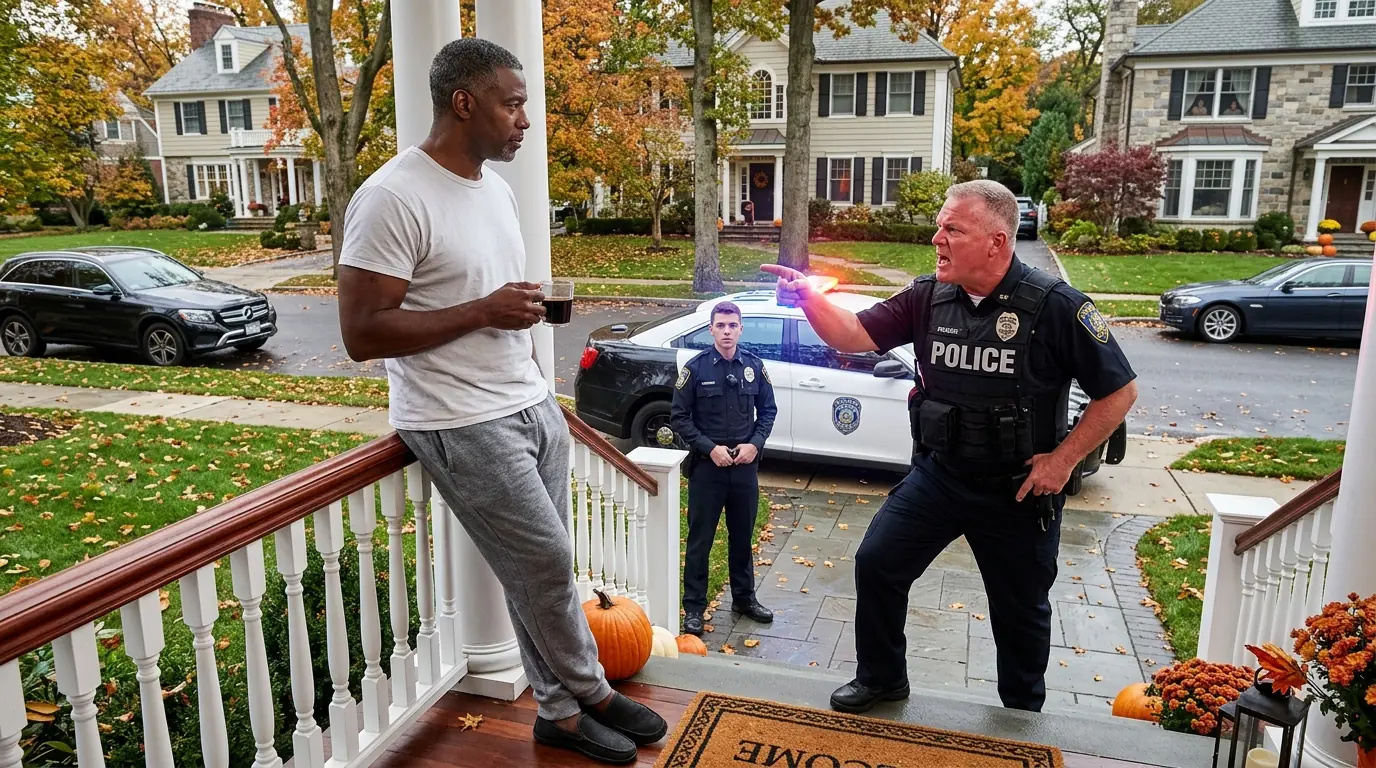
Harlan lunged forward aggressively, grabbing Curtis’s arm and wrenching it behind him. Curtis did not resist. Years of federal training and painful experience told him exactly how dangerous resistance could become.
“I am not resisting,” Curtis said clearly.
The metal cuffs snapped painfully around his wrists.
Across the street, Vivian watched through her blinds as Curtis was marched down his own driveway in handcuffs. Suddenly the scene did not look heroic anymore.
It looked wrong.
Very wrong.
Still, it was too late now.
Harlan shoved Curtis into the back of the cruiser and slammed the door.
Inside the car, Curtis sat silently while Harlan laughed up front.
“Thought he was smart,” Harlan sneered.
Langford didn’t laugh.
Something about Curtis’s calmness bothered him deeply.
Meanwhile Curtis sat quietly in the back seat, memorizing everything.
Badge numbers.
Cruiser designation.
Exact wording.
Every violation.
The ride to the precinct lasted less than ten minutes.
The consequences would last years.
Inside the station, Sergeant Brooks looked up lazily as Harlan dragged Curtis through booking.
“What’ve we got?”
“Trespassing. Failure to ID. Resisting.”
Curtis spoke calmly from the bench.
“For the record, none of that is true.”
Something about the man’s voice made Brooks pause.
This was not how criminals behaved.
“Name?” Brooks asked carefully.
“He wouldn’t give it,” Harlan interrupted.
He tossed Curtis’s wallet onto the counter carelessly.
Brooks opened it.
And nearly stopped breathing.
The gold FBI badge gleamed beneath the fluorescent lights.
Federal Bureau of Investigation.
Special Agent in Charge Curtis Vaughn.
The blood drained from Brooks’s face so quickly he looked physically ill.
Across the room, Harlan was still pouring himself coffee.
“What’s wrong with you?” he laughed.
Brooks slowly turned the wallet around.
Harlan looked down.
Then everything inside him collapsed.
The confidence vanished first.
Then the color in his face.
Then his legs nearly gave out beneath him.
“Oh my God…”
The words barely escaped his mouth.
Curtis sat calmly on the bench, handcuffs still cutting into his wrists.
“Sergeant,” he said evenly. “Remove these cuffs. Officer Harlan is not to come within ten feet of me.”
Brooks nearly tripped over himself rushing to comply.
The entire room changed instantly.
Only minutes earlier, Harlan had controlled everything.
Now he looked like a man watching his own funeral.
Curtis stood slowly after the cuffs came off. Angry red bruises marked his wrists, but his expression remained composed.
Then he turned toward Harlan.
“Under federal law,” Curtis said coldly, “depriving a citizen of constitutional rights under color of law is a felony.”
Harlan tried to speak.
“This was a misunderstanding—”
“Do not insult my intelligence.”
The words cracked through the station like thunder.
Captain Warren Fletcher stormed into booking moments later, only to find half his department standing frozen while an FBI commander explained exactly how one of his officers had committed unlawful detention, assault, and civil rights violations before breakfast.
The captain understood immediately how catastrophic the situation truly was.
Curtis demanded body camera footage secured immediately. Dashcam recordings preserved. Dispatch audio archived.
And then he demanded something else.
Vivian Hargrove.
Because the woman who weaponized the police with a false call was just as responsible.
Less than an hour later, two officers stood on Vivian’s porch while she smiled proudly, expecting praise.
Instead, they handed her a criminal citation.
“The man across the street is an FBI Special Agent,” one officer informed her flatly.
Vivian’s face turned ghost white.
“No… no, that can’t be right…”
But it was.
And for the first time that morning, Vivian realized her fear and prejudice had nearly gotten someone killed.
Months later, the courtroom remained silent as Judge Arthur Pendleton sentenced Trent Harlan to federal prison.
Forty-two months.
Loss of pension.
Permanent termination from law enforcement.
Everything gone.
The bodycam footage destroyed him completely. Every threat. Every illegal escalation. Every second of ego-driven abuse played before the court in brutal clarity.
Harlan lost his career, his marriage, his home, and eventually his entire reputation.
Vivian lost something too.
The neighborhood turned against her after the story reached the media. Friends disappeared. Invitations stopped coming. The woman who once controlled the homeowners association quietly sold her house and moved away in humiliation.
And Curtis Vaughn?
Months later, he finally got the peaceful morning he had originally wanted.
The porch had been refinished beautifully. Riley sat on the porch swing beside him during summer break while the two shared coffee beneath the warm morning sun.
A patrol cruiser rolled slowly down Maplewood Drive.
This time the officer simply nodded respectfully as he passed.
Curtis nodded back.
No confrontation.
No suspicion.
Just peace.
The kind he had earned long ago.
And as the quiet morning settled once more over Oakridge Estates, Curtis stood on his porch knowing something important had changed.
Not just for him.
For everyone who came after him.
Because sometimes standing your ground calmly is more powerful than fighting back loudly.
And sometimes the people who underestimate you end up exposing themselves instead.