For several weeks now, Elena Ruiz had been using her own tip money to buy breakfast for the old man in booth six. This morning, she was already late on rent. Her mother’s insulin needed refilling today, and her nephew was still waiting on school money she didn’t have. Then the old man walked in again, counting a few coins with shaking hands and ordering only coffee while the smell of eggs and bacon filled the diner.
Everyone else at Mabel’s Diner looked away.
Elena didn’t.
She saw the frayed coat, the hollow hunger in his eyes, and the expensive watch that didn’t belong on a man who couldn’t afford toast. If she helped him again, her family would pay the price.
She still carried the plate to his table.
She had no idea everything was about to change.
The morning darkness pressed against Elena’s bedroom window as her alarm buzzed at 4:30 a.m. She blinked away exhaustion, muscles aching from yesterday’s double shift. The apartment stayed quiet except for the familiar hum of her mother’s oxygen machine down the hall.
Elena’s bare feet touched the cold floor as she padded into the kitchen. The linoleum was peeling at the corners, but she kept it scrubbed clean. Opening the refrigerator, she took stock of their dwindling supplies. Half a gallon of milk. A few eggs. Bread turning stale.
She would have to stretch it until payday.
First things first.
Elena gathered Rosa’s glucose meter and medication supplies, then moved quietly past Isaac’s room. Her nephew slept curled beneath superhero blankets, his backpack waiting beside the desk with patches covering the worn spots.
“Mama,” Elena whispered as she entered her mother’s dim bedroom.
Rosa was already awake, propped against her pillows.
“Mija,” Rosa murmured softly. “You should sleep more.”
“Let me check your sugar first.”
Elena sat carefully beside her and took her mother’s hand with practiced gentleness. The meter beeped.
“One forty-two,” Elena said with relief. “Better today.”
The new insulin was helping, even if it cost nearly a week’s worth of tips.
“Don’t worry so much about me,” Rosa whispered.
“That’s like telling the sun not to shine.”
Rosa smiled faintly while Elena helped her take the morning medication. Afterward, Elena returned to the kitchen and packed Isaac’s lunch with careful attention. A peanut butter sandwich. Crackers saved from her own work meals. The last apple, carefully turned so the bruise wouldn’t show.
Then she tucked twenty dollars into the front pocket of Isaac’s backpack.
The field trip money.
But Isaac’s face had glowed for days talking about the science museum, and Elena couldn’t bear to disappoint him.
Some sacrifices mattered more than numbers.
At the kitchen counter, she opened the drawer holding the stack of bills. Final notice stamped across the electric company envelope in angry red ink. Medical balances. Rent due in ten days.
She shoved them back inside before the panic could fully settle in her chest.
By 5:45 a.m., Elena was walking the six blocks to Mabel’s Diner through the pre-dawn cold. Her breath drifted in pale clouds while the neon OPEN sign flickered alive ahead of her, casting pink light across cracked pavement.
Inside, coffee and griddle grease wrapped around her like something familiar and steady.
Mabel was already counting register money behind the counter.
“Morning,” Mabel muttered. “Coffee’s fresh. Jerry called in sick again.”
Elena tied on her apron.
“Sick meaning hungover?”
“You know Jerry.”
“I’ll cover his section.”
The breakfast rush arrived right on time. Truckers stopping off the highway. Factory workers grabbing quick meals before first shift. Retirees lingering over coffee because loneliness hurt worse than silence.
Elena moved between tables with practiced ease, balancing plates and remembering orders without writing anything down.
“More coffee, Mr. Patterson?”
“You’re an angel, Elena.”
At booth six, a tired father ordered only coffee while his little boy stared longingly at plates passing by. Elena “accidentally” brought toast with the order. Later, she slipped the child an apple from her own lunch.
The gap-toothed smile made the hunger in her own stomach easier to ignore.
Between refills and breakfast orders, Elena’s mind drifted toward the dream she rarely spoke aloud anymore.
A café of her own.
Warm lighting. Mismatched mugs. Affordable meals. A place where teenagers could learn job skills and elderly neighbors could gather without feeling rushed out the door. Somewhere nobody would need to count coins beneath the table before ordering breakfast.
The dream felt impossibly far away now.
Buried beneath bills and prescriptions and survival.
The morning wore on. Elena handled spilled coffee, mixed-up orders, and impatient customers with the same steady kindness that had become second nature. Even while worry gnawed constantly at the edges of her thoughts.
Then she saw him.
Through the diner window, an unfamiliar elderly man approached slowly through the cold.
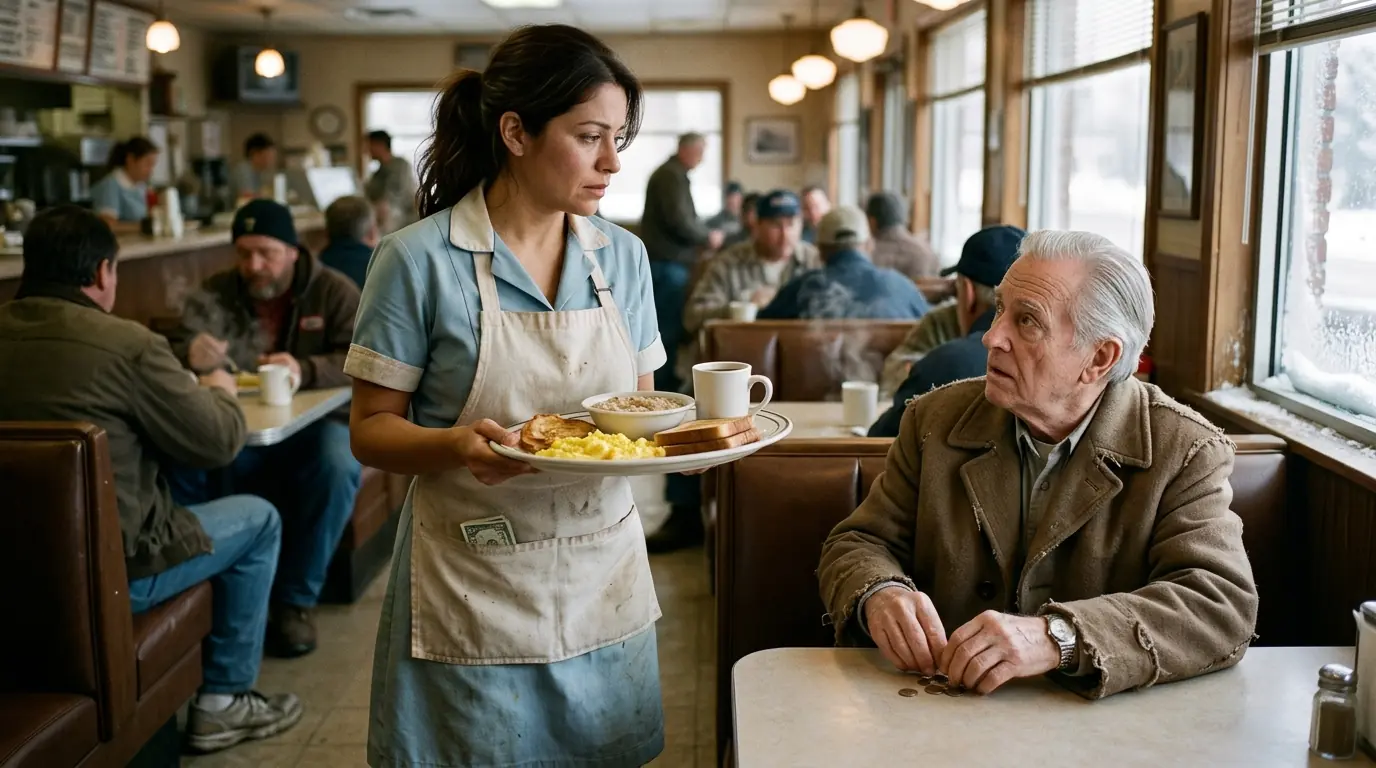
He entered quietly, the bell above the door chiming softly as he stepped inside. His coat was faded brown and carefully brushed despite its age. His shoes were worn but polished. His posture remained proud even through obvious exhaustion.
Elena watched him settle into the smallest booth by the window where morning sunlight touched the tabletop.
She reached for her notepad.
“Good morning,” she said warmly as she approached. “Can I start you with some coffee?”
“Just coffee, please.”
His voice surprised her. Refined. Educated. Gentle.
“Black.”
As Elena poured the coffee, she noticed his hands remained hidden beneath the table edge. Then came the soft metallic clinking.
Coins.
Counting them carefully.
The smell of bacon drifted from the kitchen, and Elena saw him inhale deeply before looking away toward another table receiving full breakfast platters.
Her fingers tightened around the tip money in her apron pocket.
Twelve dollars and thirty-five cents.
Rosa’s medication needed sixty-eight dollars by tonight.
Isaac needed shoes.
The electric bill was overdue.
Every practical reason told her to walk away.
But she couldn’t.
She simply couldn’t let him sit there hungry.
Back in the kitchen, Mike glanced up from the grill.
“What do you need?”
“Standard breakfast platter,” Elena replied. “Scrambled eggs, wheat toast, oatmeal with raisins.”
“Ticket?”
“Kitchen mistake.”
Mike paused only briefly before nodding.
A few minutes later, Elena carried the loaded plate carefully to the old man’s booth.
“I’m so sorry to bother you, sir, but we had a mix-up in the kitchen. This order was made by mistake and it’ll go to waste otherwise. Would you mind helping us out?”
The man looked up sharply.
“I only ordered coffee.”
“I know,” Elena said gently. “But food waste is such a shame.”
He studied her carefully, those pale blue eyes far sharper than she expected.
“Young lady…”
“Please,” Elena whispered softly. “You’d really be doing us a favor.”
For a moment, neither of them spoke.
Then the old man gave one slow nod.
“Very kind of you.”
Elena smiled quickly and walked away before gratitude could embarrass him further.
Throughout the shift, she quietly kept his coffee full while pretending not to notice the way he cleaned every crumb from the plate. When he finally stood to leave, Elena charged him only for the coffee.
She watched him count coins twice before laying them carefully on the table.
As he passed her on the way out, he gave the smallest nod of respect.
Afterward, Elena took seven dollars from her tips and rang up the breakfast properly so inventory would balance.
Her stomach growled as she wiped the empty booth clean.
She ignored it.
That night, Elena counted her earnings at the kitchen table while Rosa and Isaac slept nearby.
Forty-three dollars in tips.
Minus seven for the breakfast.
Thirty-six dollars left.
Still not enough for Rosa’s insulin refill.
Tears burned behind her eyes as exhaustion settled heavily into her bones.
Tomorrow she would try again.
Tomorrow she would figure something out.
But even then, she couldn’t regret feeding him.
Some kinds of hunger went deeper than food.
And some forms of dignity mattered more than money.
The next morning, Walter returned.
Then the next.
And the next after that.
Every day at exactly 7:45 a.m., he entered through the diner door wearing the same carefully brushed coat and carrying the same quiet pride.
Every morning, Elena found another gentle excuse to place breakfast before him.
“Kitchen made extra oatmeal.”
“Wrong order.”
“Health code says we can’t reserve this fruit once plated.”
Walter accepted each offering with increasing understanding. Neither acknowledged the truth directly, but something unspoken passed between them anyway.
Trust.
Respect.
Recognition.
Over the following weeks, their conversations slowly deepened.
Walter asked about the town. About the regular customers. About Isaac’s school projects and Rosa’s old garden before illness stole her strength.
Elena found herself sharing pieces of her abandoned culinary school dreams without really meaning to.
Walter listened closely.
Always closely.
Sometimes Elena caught him watching the diner itself. The cracked booths. The leaking ceiling tile. Mabel rubbing her aching knee behind the register.
“This place has history,” Walter observed quietly one morning.
“Fifty-two years,” Elena replied proudly. “Mabel’s mother opened it when the mills were still running.”
“And now?”
“Now we take care of whoever’s left.”
Walter nodded thoughtfully.
“Places survive because someone keeps choosing them.”
The words stayed with Elena long after he left.
Then one morning, Walter didn’t come.
At first Elena tried convincing herself he was simply running late.
By 8:15, worry twisted painfully in her chest.
During a quiet moment, she wrapped a warm biscuit and banana in napkins and tucked them into her apron pocket. Maybe she could search nearby streets during break.
Then the SUVs arrived.
One after another.
Black. Massive. Expensive.
Ten of them filled the parking lot in precise formation.
The diner fell silent.
Men and women in tailored suits stepped out carrying leather briefcases and tablets. Security personnel scanned the area with practiced attention.
Mabel whispered behind the register, “Sweet Jesus…”
The door opened.
A silver-haired woman in an immaculate charcoal suit stepped forward.
“We’re looking for Elena Ruiz.”
Elena swallowed hard.
“I’m Elena.”
The attorney beside the woman adjusted his glasses carefully.
“Ms. Ruiz, we’re here regarding Walter Hail.”
Elena’s heart dropped.
“Is he okay?”
“Mr. Hail suffered a medical emergency this morning. Before being transported to the hospital, he left explicit instructions to locate…” the attorney glanced down at his notes, “…the waitress from Mabel’s Diner who fed me when she had no reason to.”
The room spun slightly around Elena.
Then came the revelation.
Walter Hail.
Founder of Hail Industries.
Billionaire.
Corporate titan.
The quiet old man counting coins beneath the table had known exactly what she was doing the entire time.
And everything changed after that.
The hospital meetings.
Vivian Hail’s cold accusations.
Walter confessing he had been testing whether genuine kindness still existed in the world.
The shocking proposal to save Mabel’s Diner and transform it into a community initiative serving struggling families and young people.
Then came the backlash.
The lawsuits.
The accusations.
The social media cruelty.
The diner shut down under sudden inspections.
Elena lost her job.
Walter’s family tried isolating him completely while board members questioned his competency and painted Elena as a manipulative opportunist chasing money.
The entire town turned into whispers.
Gold digger.
Thief.
Fraud.
Yet through all of it, Elena kept showing up for people.
Even after losing everything.
When a winter storm knocked out power across town, Elena organized emergency meals from the darkened diner kitchen for dozens of stranded elderly residents sheltering at the church.
Neighbors who had judged her hours earlier now stood beside her serving soup and coffee under battery-powered lanterns while snow buried the streets outside.
That night, Walter’s young paralegal secretly delivered a letter.
And inside that letter lived the truth.
Decades earlier, Walter had once been a hungry little boy sitting in the very same diner while his widowed mother counted coins for coffee.
Mabel’s mother had quietly fed them both through “kitchen mistakes.”
That simple mercy had changed the course of Walter’s entire life.
The fortune. The company. The empire.
All of it began because one diner waitress protected a struggling family’s dignity instead of turning them away hungry.
Walter returned to Mabel’s Diner to see if that spirit still existed.
And Elena proved it did.
At the courthouse hearing days later, Elena stood before cameras, lawyers, and townspeople and spoke plainly.
“Yes, I broke diner policy,” she admitted quietly. “I used my own tips to cover meals I gave away. If that’s wrong, I’ll accept the consequences. But I won’t apologize for feeding someone who was hungry.”
The room fell silent.
Then Walter himself arrived unexpectedly, frail but determined, and publicly defended her character.
The judge ruled completely in Walter’s favor.
The trust stood.
The diner would survive.
Months later, spring sunlight poured across newly refinished hardwood floors inside the transformed Mabel’s Diner.
Fresh paint brightened the walls. New equipment gleamed in the kitchen. Scholarship applications filled folders beside the counter. Young trainees learned cooking skills under Chef Mike’s patient guidance.
But the heart of the place remained exactly the same.
Elena still arrived before dawn.
Still brewed coffee.
Still remembered everyone’s names.
And on the wall beside the register hung a plaque that read:
Meals Given In Quiet.
Beneath it hung four framed photographs.
Mabel’s mother in the original diner.
Walter as a little boy beside his exhausted mother.
Walter during his anonymous mornings in booth six.
And Elena herself, caught unaware while sliding a free breakfast toward a homeless teenager sleeping in his car.
One bright morning, Elena noticed another man sitting alone in the smallest booth near the window.
His clothes were clean but worn.
His eyes stayed fixed on the coffee prices while his hands counted coins beneath the table.
“Just coffee, please,” he said softly.
Elena smiled gently.
“The kitchen made extra breakfast skillets during training this morning,” she replied. “Would you mind helping us out? Otherwise Chef Mike gets grumpy about food waste.”
The man’s shoulders tightened.
“I don’t want to be any trouble.”
“No trouble at all.”
She returned moments later carrying eggs, toast, potatoes, and fruit.
Then she placed the plate before him with the same quiet grace that had once changed Walter Hail’s life.
And as the diner hummed warmly around her, Elena finally understood something beautiful.
The miracle wasn’t that someone rich had noticed her kindness.
The miracle was that kindness kept moving forward.
One meal.
One person.
One quiet act of mercy at a time.