The notice was pinned to the green baize board in the servants’ hall, its ink still stark and unforgiving. It was a list of new regulations, penned in the housekeeper’s precise, narrow hand. A tightening of the reins. A reassertion of an order that had, in the past months, felt adrift. Meg, her hands still damp from scrubbing the morning’s flagstones, read it with the same quiet stillness she applied to all things.
Most of the rules were mundane. No talking in the upper corridors after ten. A new schedule for the polishing of the silver. But the final point was different. It stood alone, separated by a hard, dark line.
Under no circumstances is any member of the household staff to approach, touch, or address the Duke’s wolfhound. Its care is the sole province of the head groom. Infringement will result in immediate dismissal. Meg read the words twice. She felt the eyes of the other maids on her back, a mixture of pity and a certain sharp-edged satisfaction.
They all knew who the rule was for. It was not for Mary, who shrieked if the beast so much as rounded a corner. It was not for young Agnes, who crossed herself when its great gray head appeared at a window. It was for her. Meg, the quiet one who seemed to attract the ghost that haunted Raventhorne.
The wolfhound’s name was Cinder. He was a creature of mythic proportions, a giant of shaggy, iron-gray fur with eyes the color of winter twilight. He had belonged to the Duke’s younger brother, Lord Edward. Since Edward’s death in a reckless riding accident six months prior, the dog had become a living monument to grief. He ate little, obeyed no one, and stalked the halls and grounds like a specter.
His presence was a constant, unnerving reminder of the laughter that no longer echoed in the stone corridors. He was feared, a four-legged embodiment of the sorrow that had settled over the great house. Everyone feared him. Except, it seemed, he did not fear or despise Meg, and that was the problem. She did not seek him out.
She did not call to him or offer him scraps from the kitchens. She simply went about her duties, a small, slight figure in a drab gray gown. Her movements were economical, and her face was habitually composed. Yet Cinder found her. The first time had been in the long gallery.
She had been dusting the grim portraits of the Duke’s ancestors, her cloth moving in silent, practiced circles. She had felt a change in the air, a weight, and had turned to find him standing there, his massive form filling the doorway. He was as tall as a pony, his head lowered, his gaze fixed upon her. The other maid with her, Sarah, had dropped her feather duster with a gasp and fled. Meg had simply stood still.
One second. Two seconds. Three. She had not moved. She had not spoken.
She had merely watched him, her heart beating a slow, steady rhythm in her chest. He took a hesitant step forward, then another. He padded across the polished floor, his claws making no sound, and came to a stop a few feet from her. He lay down, not with a crash, but with a slow, deliberate folding of his long limbs, until he was a mountain of gray fur at her feet. He rested his great head on his paws and emitted a low rumbling sound.
It was not a growl. It was something else, something deeper and more weary. He watched her, his ancient eyes never leaving her face, as she finished her dusting and quietly left the room. Since then, it had become a pattern. In the library, as she carefully wiped dust from the leather-bound spines, he would appear and lie by the cold fireplace.
In the gardens, as she weeded the rose beds, he would settle in the shade of a yew hedge nearby. He never demanded anything of her. He simply attended, a silent, immense, and gentle shadow. The other staff saw it as witchcraft, a bad omen. The housekeeper, Mrs. Finch, saw it as an intolerable breach of discipline.
“He is not a pet, girl,” she had hissed at Meg just last week, her face pinched with displeasure. “He is the Duke’s sorrow. You will not meddle with it.” Meg had simply inclined her head. “I do not, Mrs. Finch. He comes to me.”
“Then see that he does not,” the housekeeper had snapped, her black eyes like chips of jet. And now, this notice. A public declaration. A line drawn in the sand. Meg was being warned, and the entire household was witness.
She lowered her gaze from the board, smoothed her apron, and turned to fetch the pails for washing the front steps. She would obey the rule. She had to. Her position here was too precarious. Her true purpose was too vital to risk over a dog, no matter how lonely he seemed.
Her name was not Meg. Her name was Margaret Whitley. She had come to Raventhorne not for a maid’s wages, but for justice. This house, this grand, cold, grieving house, held the key to her past and the only hope for her future. Her father, a respected classicist and scholar, had died two years ago, leaving her, his only child, with a modest but secure inheritance.
A small property in Devon and a collection of annotated first editions so valuable they represented a fortune. But she had never seen a penny of it. A distant cousin of her mother’s, a man named Finch, had produced a revised will, one that left everything to him. He had swept in, sold the books, claimed the property, and cast her out with nothing but a few pounds and a warning to make no trouble. Her father’s solicitor had been conveniently replaced.
The witnesses were Finch’s cronies. She was left adrift, her name and standing erased. Mrs. Finch, the housekeeper of Raventhorne, was that man’s sister. Margaret had spent a year in destitution before a letter from her father’s old friend, a retired academic, had found her. He believed her story.
He remembered her father speaking of his work, of his prized collection, and of his intention to leave everything to his daughter. He also remembered something else. Her father had been consulting on the cataloging of the extensive library at Raventhorne for the old Duke, Philip’s father. He had suspected some of her father’s most valuable books, and perhaps even the original deed to the property, might have been stored there for safekeeping, away from prying eyes. It was a long shot, a desperate hope.
So Margaret Whitley had vanished, and Meg, a quiet, capable girl with forged references and a story of being orphaned, had secured a position as a junior housemaid at Raventhorne. She had spent the last three months learning the geography of the house, the rhythms of the staff, and the cold, distant habits of its master, the Duke of Whitchurch. She had waited for an opportunity to search the one place she believed held the answers: the library. The library was the Duke’s sanctuary. He spent most of his hours there, buried in estate papers, a formidable and unapproachable figure.
Philip, the ninth Duke of Whitchurch, was a man carved from the same granite as his ancestral home. He was tall and severe, with raven-black hair and a face that seemed incapable of a smile. He had inherited the title, the grief, and the ghost hound all at once. He moved through his home with a heavy silence, his presence as chilling as the ever-present Northumbrian damp. Meg knew him only as a pair of polished boots passing her in a corridor, a curt nod of acknowledgment, a deep voice giving a low command to a footman.
He had never truly looked at her. To him, she was just another part of the household machinery, silent and invisible. It was how she needed it to be. The new rule about the dog made her task harder. Cinder’s strange affinity for her had been, in its own way, a form of camouflage.
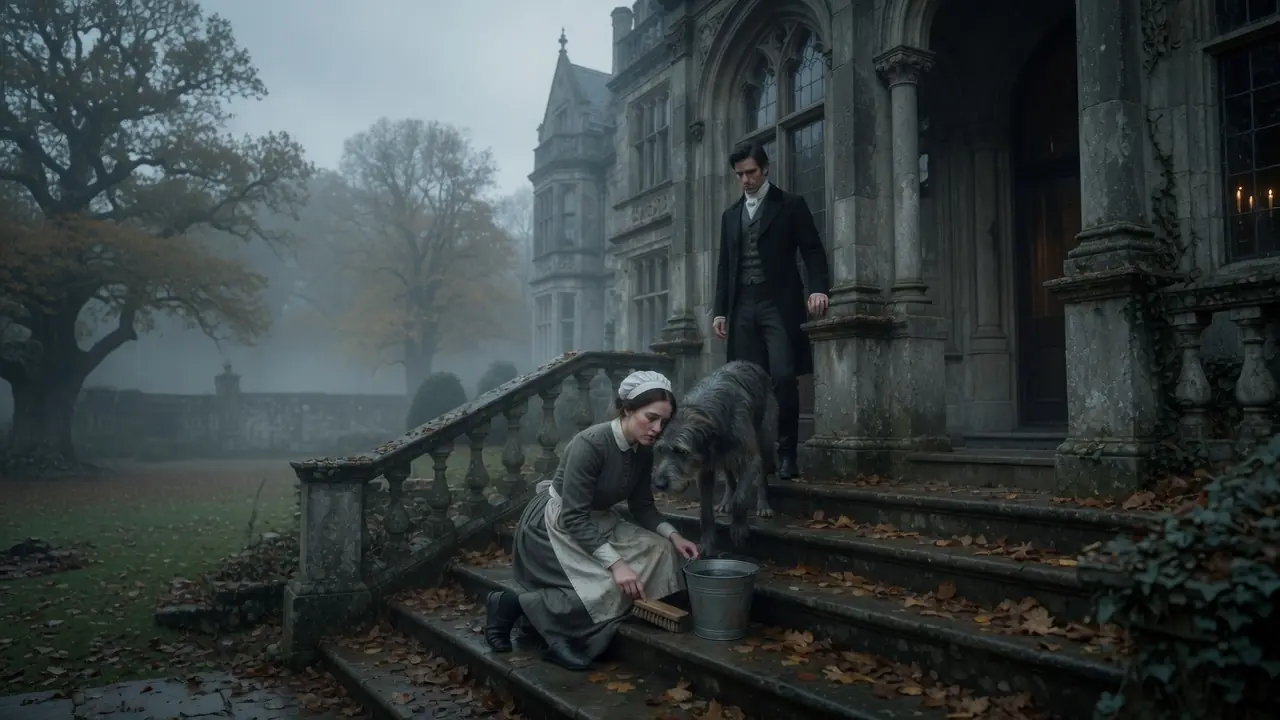
While he was near, the other staff kept their distance, leaving her blessedly alone to observe and plan. Now, she would be watched. Every interaction, every moment, would be scrutinized by Mrs. Finch. She carried the heavy buckets of water to the grand entrance. The autumn air was sharp, carrying the scent of woodsmoke and wet leaves.
She knelt on the cold stone, her brush biting into the grime. She worked methodically, her mind focused. The library. She had to find a way in. A time when the Duke was absent and the room was empty.
Late at night, perhaps, after the house was asleep. A shadow fell over her. She did not need to look up to know who it was. The sheer size of the silhouette, the faint musky scent of dog and moorland. Cinder.
“You must not be here.” The dog whined again, a more insistent note this time. He took a step down, then another, until his huge head was level with hers. He nudged her shoulder with his wet nose. It was a gentle, imploring gesture.
She could feel the warmth of his breath, the solid, living presence of him. A profound loneliness radiated from the animal, a grief so vast it seemed to sink into her own bones. He was asking for something: comfort, acknowledgment, a touch. Her hand ached to reach out, to stroke the shaggy fur between his ears. It would be so easy, a small kindness, but the housekeeper’s words, sharp and cold, echoed in her mind.
Immediate dismissal. “I cannot,” she whispered, shaking her head. She picked up her brush and began to scrub with renewed, almost desperate energy. “Please, go.” For a long moment, the dog remained, a silent, hopeful statue.
Then, with a sigh that seemed to gust the dead leaves across the terrace, he turned. He padded slowly back up the steps and disappeared around the corner of the house. Meg did not stop scrubbing until her knuckles were raw. She did not look up, but she felt it, the weight of a gaze from an upper window. Not the housekeeper this time.
A different presence. Colder. Heavier. The Duke. He had been watching.
Philip stood back from the library window, his hands clasped behind his back. He had seen the entire exchange: the dog’s quiet approach, the girl’s bowed head, and the final dejected retreat of the animal. He had heard her whisper. Not the words themselves. He had seen her refuse the dog.
It was unexpected. For months, Cinder had been a shade, a vessel of misery. He tolerated the groom who fed him, but offered no affection. He ignored Philip completely, as if in judgment. The dog had loved Edward with fierce, singular devotion.
Now that Edward was gone, Cinder seemed to be fading with him. He was a worry. Another weight on Philip’s already burdened shoulders. Then, weeks ago, the reports had started. Whispers among the staff.
The dog was following one of the new maids. A quiet, plain little thing. He dismissed it as nonsense, the kind of gothic fantasy servants invented to pass the tedious hours. But then he had seen it for himself. The giant beast lying peacefully at the girl’s feet in the long gallery.
He had felt a flicker of something then. Not anger, but a sharp, probing curiosity. The dog had never been gentle with anyone but Edward. With strangers, he was aloof, even intimidating. Yet with this girl, this Meg, he was docile.
Submissive, even. His housekeeper, Finch, had been incensed. She saw it as a breakdown of order, a familiarity that was unseemly. A woman of rigid principles, Mrs. Finch had run Raventhorne for his father for twenty years, and now for him. Her efficiency was legendary.
Her loyalty was unquestionable. Philip trusted her judgment in all household matters. When she had suggested the formal notice, he had agreed without much thought. It was a problem, and Mrs. Finch was proposing a solution. It seemed simple enough.
But watching the scene on the steps, it no longer felt simple. The girl had not encouraged the dog. She had actively sent him away. There was no slyness in her posture, no coquettish bid for attention. There was only a small, determined figure doing her work and obeying a rule that was manifestly aimed at her.
And the dog’s reaction. That great, mournful sigh. Philip had felt an answering pang in his own chest. A familiar ache. He knew that brand of sorrow.
He turned from the window and walked over to his desk, a vast expanse of mahogany covered in ledgers and maps of the estate. Work. Work was the only antidote. Rents to be collected, tenants to be placated, a coal seam to be surveyed. He was the Duke.
He had duties. He had no time for the strange relationship between a housemaid and his dead brother’s dog. He sat down, picked up his pen, and stared at the page. The numbers blurred. Why had she refused him?
Not out of fear. He had seen her with the dog before. She was not afraid of him. She had done it out of obedience. A simple, straightforward act.
It was this that struck him as so unusual. In his experience, people were rarely simple or straightforward. They were driven by a complex machinery of self-interest. A housemaid who had captured the attention of the tragic, talked-about wolfhound might see it as an opportunity. A way to distinguish herself.
Perhaps even to curry favor with the master of the house. This girl had not. She had chosen invisibility. She had chosen to obey a harsh rule, even when it cost her a moment of kindness. She did not look guilty.
That was what he noticed most sharply. A memory surfaced: Edward laughing, wrestling with Cinder as a pup on this very library rug. “He’s a fine judge of character, you know,” Edward had said, ruffling the dog’s fur. “Hates fools and flatterers. Only likes honest souls.”
Philip pushed the thought away. It was sentimental nonsense. It was a dog. An animal. Its instincts were not evidence of anything.
Still, he found himself looking around the library. It was his favorite room, a haven of silence and order. Two stories high, walled with books from floor to ceiling, with a gallery running along the upper level. It smelled of leather and old paper and beeswax. The girl, Meg, was often in here dusting.
He was usually so absorbed in his work, he barely registered her presence. A flicker of gray in the corner of his eye. The soft whisk of a cloth. She was utterly silent, unobtrusive. He realized now he had come to find her quiet industry calming.
He stood up and walked to the fireplace, resting his arm on the marble mantelpiece. Cinder often lay on the rug here when she was in the room. Now the rug was empty. The whole room felt emptier, colder. A thought, unwelcome and persistent, lodged in his mind.
Mrs. Finch had described the girl as meddling, sly. He had accepted the description. Now he questioned it. What he had witnessed on the steps was not slyness. It was dignity.
A quiet dignity that had chosen to obey, even at the cost of turning away a grieving animal. He returned to his desk, the ledgers forgotten. He was the Duke of Whitchurch, the master of Raventhorne. It was his duty to ensure his household was run with fairness and justice. For the first time, he felt a sliver of doubt about the justice of Mrs. Finch’s new rule.
The days that followed were harder for Margaret. The invisible shield that Cinder’s presence had provided was gone. Now she was just another maid, and one who had been singled out for censure. The other servants, taking their cue from Mrs. Finch, either ignored her or spoke to her with cool disdain. Her tasks became more arduous.
She was sent to scrub the floors in the dampest, coldest corridors, to polish the brass in the unused north wing, and to sort mildewed linens in the cellar. It was a campaign of isolation designed to make her life so miserable she would leave of her own accord. Margaret understood the strategy perfectly. She endured it with the same outward calm she did everything else. She ate her meals alone, her gaze fixed on her plate.
She performed her duties without complaint. She did not cry. She had learned a long time ago that tears were exactly what people like Mrs. Finch wanted. But the work kept her from her true purpose. The library.
Her evenings were now filled with mending tasks assigned by the housekeeper, keeping her in the servants’ hall until she was too exhausted to think of clandestine searches. She felt time slipping away. What if the Duke decided to clear out his father’s old papers? What if Mrs. Finch, suspecting something, removed the very documents Margaret was looking for? She saw Cinder only from a distance now.
A gray shape moving through the dusk-shrouded gardens. The glimpse of a tail disappearing down a corridor. He no longer approached her. He seemed to understand the new order of things. Each time she saw him, the ache in her chest sharpened.
They were two lonely creatures in a house full of secrets, forbidden from offering each other the smallest comfort. One evening, nearly a fortnight after the notice was posted, she was tasked with taking a tray of tea to the Dowager Duchess. The Duke’s mother, Lady Mariella, had arrived for one of her infrequent visits from the dower house. She was a formidable old woman with eyes as sharp and intelligent as her son’s, but hers held a warmth his lacked. Margaret entered the small, elegant drawing room to find Lady Mariella seated by the fire, a book in her lap.
The Duke stood by the window, staring out into the deepening twilight. The room was tense with a silence that was more than just quiet. Margaret curtsied, her eyes downcast, and set the tray on a low table. “Thank you,” the Dowager said. Her voice was clear and unexpectedly kind.
“What is your name, child?” “Meg, Your Grace.” “Meg,” Lady Mariella repeated, tasting the name. “You are new here.” “I have been at Raventhorne for three months, Your Grace.”
“Ah. And you are the one the dog has taken a fancy to.” Margaret’s breath caught. She could feel the Duke’s attention shift from the window to her. His gaze was a palpable weight on the back of her neck.
“The dog keeps to himself now, Your Grace,” she said carefully. “Yes, because of Philip’s foolish rule,” the Dowager said, her sharp gaze moving to her son. “I saw the notice. Finch’s handiwork, I assume. The woman has the subtlety of a blacksmith.”
The Duke turned fully from the window. His face was a mask of cold composure. “Mrs. Finch manages the household. I do not interfere in her methods.” “You should, when her methods are cruel,” his mother retorted.
She looked back at Margaret. “The animal is grieving, child, as is my son, though he would rather die than admit it. Cinder saw something in you. A gentleness, perhaps. And you were forced to rebuff him.
Is that not so?” Margaret did not know how to answer. A direct contradiction of the Duke was unthinkable. But to agree felt like a betrayal of her own quiet integrity. She chose her words with immense care.
“I follow the rules of the house, Your Grace.” The Dowager Duchess smiled, a small, knowing expression. “A very diplomatic answer. You may go, Meg.” Margaret curtsied again and backed out of the room, closing the door softly behind her.
She did not run. She walked at her usual, measured pace down the corridor, but her heart was hammering against her ribs. Inside the drawing room, Philip faced his mother. “You should not have involved her. She is a servant.”
“She is a human being,” Mariella said tartly. “And one who has shown more sense and compassion than anyone else in this house. Did you see her face? The care she takes not to give offense. That is not the face of a sly, meddling girl, Philip.
That is the face of someone with character.” “You know nothing about her.” “I know what the dog knows,” his mother said, her voice softening. “Edward always said Cinder was a fine judge of character. Perhaps we should listen to him.
Perhaps instead of posting rules to keep the girl away from the dog, you should be asking why the dog seeks her out in the first place.” She picked up her teacup. “Grief needs an outlet, Philip. For dogs and for men. You have sealed yourself away in this library, and you have ordered that poor beast to be sealed away in his own sorrow.
Look what it has done to you both. You are becoming as much of a ghost as he is.” Philip had no answer for her. Her words struck too close to a truth he did not want to examine. He had managed his grief through denial and relentless work.
He had thought it was strength. But seeing the quiet maid, hearing his mother’s words, he felt the first crack in his formidable armor. Later that night, unable to concentrate on his papers, he left the library and walked the silent corridors of the house. He found himself on the upper floor, in the wing where the female servants slept. He did not know why he had come.
He stood in the shadows, listening to the profound quiet of the sleeping house. A door at the far end of the hall opened a crack. A sliver of candlelight appeared. It was her. Meg.
She was fully dressed, a dark shawl around her shoulders. She carried a single candle, its flame making her face seem pale and watchful. She looked down the corridor, first one way, then the other. Then, moving as silently as a moth, she began to walk, not toward the main staircase, but in the opposite direction. Toward the narrow winding stairs that led down to the service areas, and eventually, the back of the house.
Where was she going? A dark suspicion planted by Mrs. Finch bloomed in his mind. A clandestine meeting? A theft? His first instinct was to stride down the hall and demand an explanation.
But he checked himself. His mother’s words echoed in his memory. That is not the face of a sly, meddling girl. He decided to follow. He stayed in the shadows, his soft leather slippers making no sound on the runner.
He kept a careful distance, watching the small flame of her candle as it descended into the darkness of the house. Margaret’s destination was the library. It was a risk, a terrible one, but the Dowager’s words had spurred her. Time was running out. She had to act.
She knew the Duke often worked late, but she also knew he sometimes took long, restless walks through the estate before retiring. She was gambling on his absence. She reached the ground floor and moved through the darkened service corridors, her heart a frantic drum against her ribs. The great house felt different at night. A sleeping giant, its secrets held close in the shadows.
She eased open the baize door that separated the servants’ world from the family’s. The great hall was a cavern of darkness. The moonlight through the high windows painted ghostly patterns on the flagstones. The library door was unlocked. She slipped inside, closing it silently behind her.
For a moment, she just stood, letting her eyes adjust. The room smelled of him. Of leather and ink, and a faint, clean scent of the outdoors. The embers in the fireplace cast a low red glow. Her candle was a tiny island of light in the vast darkness.
She knew where she had to look. Her father had once described the section to her as a child, a story he told her about his work. The heart of the house, he had called it. A collection of Roman and Greek philosophy, personally curated by the Duke’s grandfather, a noted scholar himself. It was on the upper gallery.
She found the narrow spiral staircase hidden behind a curtained alcove and began to climb. The iron steps were cold beneath her thin slippers. The gallery was a narrow walkway lined with yet more books. She held her candle high, searching the spines. Plato.
Aristotle. Marcus Aurelius. This was it. According to her father’s old friend, he had suspected her father might have used a technique he was fond of: hiding documents within a hollowed-out book or behind a loose panel on the shelf itself. It was the work of minutes to check, but minutes she might not have.
Her hands trembling slightly, she began to move along the shelves. She ran her fingers over the spines, gently pushing each volume. Was there one that was lighter than it should be? A space behind? Her candle flame flickered, casting dancing shadows that seemed to mock her.
A floorboard creaked below. Margaret froze, her blood turning to ice. She flattened herself against the bookshelves, extinguishing her candle with her fingers, plunging the gallery into absolute darkness. She held her breath, straining to listen. Silence.
Had she imagined it? Then, a low sound, the scrape of a log shifting in the grate. Someone was in the room. It had to be the Duke. She had miscalculated.
He had not gone for a walk. He had been here all along, sitting in the darkness. Her foolish, desperate gamble had failed. She was trapped. Discovery meant instant dismissal, disgrace, the end of all hope.
It could even mean being handed over to the magistrate, accused of breaking and entering, of theft. She pressed herself further into the shadows, trying to make herself smaller, to merge with the books. She prayed for invisibility. Down below, Philip sat in his wing-back chair, hidden in the deep shadows near the fireplace. He had returned to the library only moments before she entered.
His restless walk had led him back here. He had been about to light a lamp when he heard the door open. He had remained still, his curiosity overriding his anger. He had watched her slip in like a wraith. He had watched her cross the room and ascend the spiral stairs.
He knew exactly which section she had gone to: the philosophy collection. An odd choice for a thief. A thief would go to his desk, to the silver cabinet. And now she was up there, frozen in the darkness, thinking she was alone. He did not move.
He did not speak. The hunter’s instinct in him, the part of him that was master of this domain, wanted to call her out, to trap her, to demand an accounting. But another part, a newer, more hesitant voice, urged him to wait, to watch, to understand. What was a housemaid doing in his library in the dead of night, heading straight for a collection of obscure Greek philosophy? He sat in the darkness, a statue of patient inquiry, and waited.
Up on the gallery, Margaret’s terror slowly subsided, replaced by a cold, sharp clarity. She could not stay here all night. Sooner or later, he would light a lamp. He would see her. Her only chance was to get back down, to get to the door, while the room was still dark.
But the spiral staircase was on the other side of the gallery. She would have to pass the open space above the main room to reach it. She began to move, one agonizingly slow step at a time. She slid her feet along the floor, not daring to lift them. She kept one hand on the bookshelves, guiding herself, her palm sliding over the cool leather of the book spines.
The scent of old paper filled her nostrils. The scent of her father. Of a life that had been stolen from her. The proximity of her goal, so close, and yet so impossibly far, was a physical pain. She reached the head of the staircase.
She could see the faint outline of the library door, a pale rectangle in the gloom. She had to descend. She took the first step. The old iron groaned, a loud protesting sound in the absolute silence. Down below, Philip’s head snapped up.
The sound was unmistakable. He rose from his chair, his own movements now as silent as hers had been. He crossed the rug, his eyes fixed on the staircase from which she would emerge. Margaret’s heart leaped into her throat. The game was up.
He knew. She descended the rest of the steps in a rush, her pretense of stealth abandoned. She reached the bottom and practically ran for the door. Her hand was on the cold brass handle when his voice came out of the darkness, stopping her dead. “Stop.”
It was not a shout. It was a low, quiet command, but it held the absolute authority of a man who had never been disobeyed. Margaret froze, her back to him. She squeezed her eyes shut. It was over.
She heard him move across the room. He did not light a lamp. He stopped a few feet behind her. She could feel his presence, the heat and the height of him. “Turn around,” he said, his voice still quiet, but now with a hard, dangerous edge.
Slowly, she forced herself to obey. She turned, keeping her head bowed, her hands clasped in front of her. She could not see his face in the darkness, only his tall, imposing silhouette against the faint glow of the embers. “What were you doing in my library?” he asked. She said nothing.
What could she say? The truth was impossible. A lie seemed futile. “Were you looking for something to steal?” “No, Your Grace,” she whispered.
Her voice was steady, to her own surprise. “Then what? A midnight stroll? A desire for literature?” The question was laced with cold, cutting sarcasm.
Still, she was silent. She had failed. Mrs. Finch would have her victory. She would be thrown out, and the truth of her father’s legacy would be buried in this room forever. A wave of despair, so powerful it almost buckled her knees, washed over her.
But on its heels came something else. A spark of defiance. She had been silent for too long. She had endured too much. If this was the end, she would not go cowering.
She lifted her chin and met his unseen gaze in the darkness. “I was looking for a book,” she said, her voice clear and without a tremor. His silence was more unnerving than his questions. He took a step closer. “A book?” he repeated, his tone flat.
“At two in the morning? Which book?” She had to give him something. A title. Something plausible.
Her mind raced, sifting through the titles she had scanned just moments before. “The Meditations of Marcus Aurelius,” she said. It was the first name that came to her. She waited for the scorn, the disbelief. Instead, he was silent for a long moment.
When he spoke again, the sarcastic edge was gone, replaced by something else. A genuine, cold curiosity. “Why that one?” “Because,” she began, and the truth, or a version of it, tumbled out. “Because it is about enduring what you cannot change, about maintaining one’s own character when the world is unjust.”
The silence stretched. One second. Two. Ten. She could hear the quiet ticking of the mantel clock, the whisper of the dying fire.
He moved past her, his sleeve brushing her arm. He went to a table and struck a match. A lamp flared to life, flooding the room with a soft, golden light. Margaret blinked, her eyes adjusting. He was standing by the table, watching her.
His face was stark in the lamplight, all sharp angles and shadows. His tawny-brown eyes were narrowed, his expression unreadable. He was not looking at her with the rage she had expected. He was looking at her as if he had never seen her before. “You read Latin?” he asked.
The question was quiet, almost conversational. Margaret’s carefully constructed world tilted on its axis. This was not the interrogation she had prepared for. “And Greek,” she said, her voice barely a whisper. He nodded slowly, as if she had just confirmed something he had begun to suspect.
He looked from her face to her hands, clasped in front of her. They were a maid’s hands, red and chapped from lye soap and cold water. But they were also slender and well-shaped. Scholar’s hands, his mother had said. “Who are you?” he asked.
It was not a question to a servant. It was a question to an equal. The truth, the real truth, was on the tip of her tongue. My name is Margaret Whitley. But fear, ingrained by two years of hardship and humiliation, held her back.
The power he held over her was absolute. A word from him could ruin her forever. “I am a housemaid, Your Grace,” she said, dropping her gaze to the floor. He watched her for another long moment. “Mrs. Finch will say you are a thief.
She will demand your dismissal. What do you expect me to do?” “I expect you to do what you think is just, Your Grace,” she said quietly. His mouth tightened. It was the perfect answer.
It was deferential, yet it threw the burden of judgment squarely back onto him. It challenged him to be the man he was supposed to be. He walked over to the bookshelf and pulled down a volume. It was not the Aurelius. It was a slim volume of poetry.
He opened it and held it out to her. “Read,” he commanded. She took the book. Her hands were trembling again. The page was a blur of Greek verse.
She took a breath, steadied herself, and began to read. Her voice, at first hesitant, grew stronger as she found the rhythm of the language. The beautiful ancient words filled the silent room. She read the entire page. When she finished, she looked up at him.
He was staring at her. His expression was one of dawning, reluctant astonishment. He had expected her to stumble, to be revealed as a fraud. He had not expected the pure academic fluency, the perfect accent, the clear understanding of the text. He took the book from her hands, his fingers brushing hers.
The touch was electric, a brief, shocking moment of contact. “You will go back to your room,” he said, his voice strained. “You will speak of this to no one. I will deal with Mrs. Finch.” He turned away from her, a clear dismissal.
Margaret curtsied, her mind reeling. She hurried from the room, her heart pounding not with fear now, but with a wild, terrifying hope. She had not been dismissed. She had been seen. For the first time in two years, someone had looked past the maid’s uniform and seen the person underneath.
And that, she realized, was a danger far greater than any she had faced before. Philip did not go to bed. After Margaret fled the library, he stood motionless for a long time, the book of Greek poetry still in his hand. The silence of the room was different now. It was not empty.
It was filled with the echo of her voice, with the weight of an impossible revelation. A housemaid who read classical Greek. A girl with the hands of a laborer and the mind of a scholar. A thief who crept into his library not to steal silver, but to find a book on Stoic philosophy. It was a contradiction, a puzzle that his orderly, logical mind could not solve.
He thought of her face in the lamplight. Pale, frightened, but with an unbreakable core of dignity in her eyes. “I expect you to do what you think is just.” She had not pleaded. She had not wept.
She had challenged him. He thought of Cinder, the great grieving beast who had shown no warmth to anyone, yet followed this girl like a shadow. “He’s a fine judge of character,” Edward had said. Philip had dismissed it. Now he was not so sure.
The dog had seen what he had not. The dog had recognized something true and worthy in her, something that had nothing to do with her station. Mrs. Finch. He would have to deal with her. His first instinct was to protect the girl, to simply forbid the housekeeper from dismissing her.
But that would only increase the woman’s suspicion and hostility. It would make Margaret’s life in the servants’ hall unbearable. And it would not answer the fundamental question. Who was she? He needed information.
He walked to his desk and sat down, but not to work on the estate ledgers. He pulled a clean sheet of paper toward him and began to write a letter. It was to an old acquaintance in London, a man who owed him a favor, a man who had a reputation for being able to find out anything about anyone, quietly and discreetly. He described her as best he could: her approximate age, her appearance, the name she used, Meg. He mentioned her fluency in classical languages.
He asked the man to look for any record of a young woman of that description, likely a gentlewoman fallen on hard times. He sealed the letter and set it aside to be sent with the morning post. Only then did he allow himself to think about what this meant. If she was who he was beginning to suspect she was, a lady forced into service by some misfortune, then her presence here was an indictment of his entire world. A world built on order and station, where such things were not supposed to happen.
And he, by his blindness, had been complicit in her degradation. A new feeling began to stir beneath his grief and his relentless sense of duty. A protective instinct, sharp and fierce. He had told her he would deal with Mrs. Finch, and he would. But he would do it his way.
The next morning, the housekeeper requested a meeting. Philip received her in the library, the scene of the previous night’s drama. Mrs. Finch entered, her back ramrod straight, her face a mask of grim satisfaction. “Your Grace,” she began without preamble, “I am here to report a serious breach of conduct.” The maid, Meg, was discovered attempting to steal from the house last night.”
Philip remained seated behind his desk, his fingers steepled. He did not invite her to sit. “Indeed,” he said, his voice cool. “Discovered by whom?” “By myself, Your Grace.
I have had my eye on her for some time. Her behavior has been irregular. I saw her leave her room after midnight and followed her. She broke into this very library.” Philip’s eyes narrowed.
A lie. A blatant, foolish lie. He had been the one in the library. He had been the one to follow her. Mrs. Finch had been sound asleep in her bed.
“You followed her yourself?” he asked, his voice dangerously soft. “I did, Your Grace. I caught her in the act.” She was confident, assured of her authority, of his trust in her. “And what was she attempting to steal?”
“I did not have the chance to ascertain. I confronted her, and she fled back to her room. But her intent was clear. She is a thief. For the good of the household, she must be dismissed immediately.
Perhaps even handed over to the constable.” Philip let the silence hang in the air for a moment. He looked at the woman who had served his family for two decades. He had always seen her as the bedrock of his household. Efficient, loyal, incorruptible.
Now, looking at her through the lens of his new knowledge, he saw something else. He saw a petty tyrant. A woman so protective of her small domain that she would lie to her master’s face to get rid of a perceived threat. “Your dedication to the security of this house is commendable, Mrs. Finch,” he said slowly. “However, in this instance, you are mistaken.”
The housekeeper’s thin lips parted in surprise. “Your Grace?” “I was in the library last night,” Philip said, his voice dropping to an icy calm. “I was here all night. The girl, Meg, did not break in.
I was working late, and I summoned her.” Mrs. Finch stared at him, her composure cracking. Disbelief warred with confusion on her face. “You summoned her? A housemaid?
To the library? In the middle of the night?” “I did. I required a book from the upper gallery and did not wish to climb the steps myself.” He lied, the falsehood coming easily to him.
He was beating her at her own game. “She fetched the book as commanded and then returned to her room. There was no theft. There was no irregular behavior. There was only a servant obeying an order.”
The color drained from the housekeeper’s face. She understood immediately what was happening. She was not being believed. Her authority was being publicly, devastatingly undermined. Her word was being challenged, and she was losing.
“But, Your Grace, her presence—” “Her presence was at my request,” Philip cut in, his voice like flint. “Is that clear?” “Yes, Your Grace,” she whispered, her eyes falling to the floor. “Then the matter is closed.
The girl will not be dismissed. She will not be punished. She will continue with her duties. And you, Mrs. Finch, will not trouble her again. My orders are to be respected both by her and by you.”
He paused, letting the weight of his words sink in. “You may go.” For a moment, she stood frozen, as if she might argue. But one look at the Duke’s implacable face told her it was useless. She had overplayed her hand and lost.
She gave a stiff, jerky curtsy and left the room, her humiliation a palpable aura around her. Philip watched her go, feeling no triumph. Only a cold sense of disappointment. He had trusted her. He had relied on her, and she had lied to him for no better reason than to persecute a quiet, lonely girl.
His mother was right. He had been blind. He knew his actions would have consequences. The household was a delicate ecosystem of gossip and hierarchy. The story would be all over the servants’ hall by luncheon.
The Duke had personally intervened to save a housemaid from the housekeeper’s wrath. It would set Margaret even further apart, making her an object of intense speculation and resentment. He had saved her from dismissal, but he had thrown her into a different kind of fire. He found himself walking to the window that overlooked the front steps. The place where he had seen her send the dog away.
He felt a powerful, unfamiliar urge to see her. To assure himself that she was all right. To speak with her again. But what would he say? He could not reveal his suspicions.
Not yet. He could not treat her as an equal. It would destroy what little peace she had. He was trapped by the same rigid social structure that had trapped her. For now, all he could do was watch from a distance and wait for the letter from London.
The shift in the household was immediate and profound. Margaret felt it the moment she entered the kitchens that morning. The usual buzz of conversation died. People stopped and stared. The whispers followed her as she collected her cleaning supplies.
She was no longer just Meg, the quiet maid. She was now a mystery, a person of interest, the Duke’s interest. Mrs. Finch did not speak to her at all. She issued her orders through a junior housekeeper, her face a frozen mask of fury. The arduous punitive tasks ceased.
Margaret was assigned to the regular rotation, mostly in the upper floors, in the family’s wing. It was a subtle but significant change. She was being kept close. Whether this was the Duke’s order or the housekeeper’s way of keeping an eye on her, she did not know. She worked with her head down, her expression unreadable.
But inside, her thoughts were in turmoil. The Duke had saved her. He had lied for her. Why? What did he suspect?
The memory of his eyes on her in the library, his quiet question, “Who are you?” haunted her. He had created a space for her, a fragile bubble of protection. But it was a gilded cage. She was now more visible than ever, more isolated, and her clandestine searches were impossible. She was watched constantly by the other staff and by Mrs. Finch.
Her only solace was Cinder. The day after her confrontation with the Duke, the notice on the green baize board was gone. No one spoke of it. It had simply vanished. That afternoon, as she aired out the linens in the morning room, a great gray head pushed the door open.
Cinder padded in and lay down by her feet, letting out a soft sigh of contentment. Margaret’s hand stilled. She looked at him, her heart swelling with painful gratitude. She knelt and, for the first time, reached out. Her fingers sank into the thick, coarse fur of his neck.
He leaned into her touch, his eyes closing. “You knew, didn’t you?” she whispered to him. “You knew I wasn’t what I seemed.” The dog just rumbled, a deep, peaceful sound.
From that day on, he was her constant companion once more. His presence was a comfort, but it was also a statement. In the silent language of the house, the dog’s choice was the Duke’s choice. The staff, seeing the animal back at her side, understood that she was, for now, untouchable. The Duke himself remained a distant figure.
He and Margaret did not speak again of that night. When he passed her in the corridor, he would give a curt nod, his face as unreadable as ever. But his eyes would linger on her for a fraction of a second longer than they should. Sometimes, when she was dusting the library and he was at his desk, she would look up and find him watching her. A question in his tawny-brown gaze.
These silent, charged encounters became the new rhythm of their days. An unspoken conversation was taking place between them in the spaces between their prescribed roles. He was seeing her, and she knew it. One afternoon, the Dowager Duchess summoned her again. This time, there was no pretense of needing tea.
Lady Mariella was in her favorite drawing room, arranging flowers in a vase. Cinder was asleep on the rug. “Come in, child. Close the door,” she said, not looking up from her task. Margaret did as she was told.
“My son has taken an interest in you,” the Dowager stated, snipping the end of a rose stem. “His Grace has been fair to me,” Margaret said carefully. Lady Mariella finally looked at her, her eyes sharp. “Philip is many things. He is dutiful.
He is intelligent. He is far too serious. But he is not fair. He is just. There is a difference.
Fairness is giving people what they deserve. Justice is giving them what they are owed. He seems to think you are owed something.” She paused, her gaze intense. “Is he right?”
Margaret’s throat went dry. This was the most dangerous question she had yet been asked. The Dowager was not her son. She was a woman, and her instincts were far more acute. “I am a housemaid, Your Grace.
I am owed my wages.” The Dowager smiled faintly. “You are a very poor liar, my dear. Your mouth says one thing, but your eyes say another. You have the eyes of a woman who has lost a great deal.”
She set down her shears. “I am not your enemy. I have seen how Mrs. Finch looks at you. I have known that woman for twenty years. She is a good housekeeper, but a possessive one.
She resents any change to her authority. And you, for some reason, represent a profound change.” She walked over to Margaret and took one of her hands. She turned it over, looking at the calloused palm. “These are not your hands,” she said softly.
“Any more than that gray dress is your gown. Who are you protecting by this silence?” Tears pricked at Margaret’s eyes. It was the first direct, open kindness she had been shown in years. It was harder to resist than any cruelty.
“I cannot say,” she whispered, her voice thick. “Very well,” the Dowager said, releasing her hand. “But know this. When you are ready to speak, there are those in this house who will listen. He is one.”
She gestured to the sleeping wolfhound. “I am another. And I believe my son may be the third.” The letter from London arrived a week later. Philip took it to the library and broke the seal, his hands not quite steady.
He read it quickly, then again, more slowly. The investigator had been thorough. He had found no record of a Meg fitting the description. But he had widened his search. He had found the story of a Miss Margaret Whitley, daughter of the late, respected scholar Alister Whitley.
A young woman of good family and education, fluent in classical languages, who had been left destitute after her father’s death two years prior. A contested will. A usurping relative by the name of Finch. The solicitor who had handled the affair had since been struck off for malpractice in other cases. Miss Whitley had, by all accounts, simply vanished.
The letter included a physical description. Slender, with dark hair and gray-green eyes. Quiet, dignified, intelligent. Philip let the letter fall to his desk. Whitley.
It was all there. The scholarship, the injustice, the name Finch. Mrs. Finch was the sister of the man who had stolen her life. It was worse than he could have imagined. She had come here, into the lion’s den, to her enemy’s own family, and placed herself under the authority of the very woman whose brother had ruined her.
The bravery of it, the sheer, desperate courage, staggered him. He looked around the library. This was not just his sanctuary. It was her goal. She believed the proof she needed was here.
She had risked everything to get into this room. A cold rage, deeper than any he had ever felt, settled in his chest. A rage on her behalf. At the injustice of it all. At his own blindness.
He had been master of this house, and under his roof, a gentlewoman had been forced to scrub floors and endure the petty cruelties of the woman who had profited from her ruin. His mother’s words came back to him. Justice is giving them what they are owed. He knew what he had to do. He stood up and began to search.
Not for a specific book, but for a section of the library that would have been of interest to a visiting scholar like Alister Whitley. He started, as she had, with the philosophy collection. He took down books. He ran his hands along the shelves. He tapped the wooden panels.
He worked with a grim, methodical focus. Hours passed. The light outside began to fail. He found it on the upper gallery, not far from where she had been standing that night. A section of the shelving that seemed fixed was, in fact, a cleverly disguised door.
A hidden cabinet. It was locked. He did not have the key. He went downstairs, fetched a heavy iron poker from the fireplace, and returned. With a single, sharp blow, he splintered the lock.
The cabinet door swung open. Inside, covered in a fine layer of dust, was a small leather portfolio and a single, thick, leather-bound book. He took them down to his desk. He opened the portfolio first. It contained a sheaf of letters in a clear, academic hand, signed Alister Whitley.
Underneath them was a deed. A deed of title for a property named Rosewood Cottage in Devon, with the sole beneficiary listed as my beloved daughter, Margaret Helen Whitley. Then he opened the book. It was a rare first edition of Homer. Tucked inside the front cover was another letter.
This one was from Whitley to Philip’s own father, the late Duke. My Lord Duke, it began. I fear my health is failing. I have enclosed the deed and some private papers for safekeeping with you, as I have come to distrust my wife’s relatives, particularly her cousin, Mr. Finch. Should anything befall me, I beg you to see that this portfolio is delivered into my daughter Margaret’s hands.
She is all I have. The book is a small token of my immense gratitude for your friendship and patronage. It was all there. The proof. The motive.
The betrayal. His own father had been entrusted with her future, and with his death, the trust had been broken. The documents had been forgotten, hidden away behind a secret panel. He sat at his desk as the room grew dark, the papers spread before him, and felt the full weight of his family’s failure and his own. He knew he could not simply give her the papers.
That would be charity. It would not restore what had been taken from her. Her name. Her standing. Her dignity.
That had to be reclaimed, not given. And it had to be done in the presence of the one who had tried to deny it. He rang the bell for a footman. “Find Mrs. Finch,” he said, his voice quiet and hard. “And then fetch the maid, Meg.
Bring them both to me. Here.” The summons felt like a death knell. When the footman found Margaret, his face was pale and old. “The Duke requires you in the library.
And Mrs. Finch, too.” The walk to the library was the longest of her life. Cinder, sensing her distress, padded silently beside her. A great, warm presence in the terrifying quiet. Mrs. Finch was already there, standing before the Duke’s desk.
Her face was rigid, but a flicker of triumph showed in her eyes. She clearly believed this was the final reckoning. The moment Margaret would be exposed and cast out. Then Margaret saw the papers on the desk. The portfolio.
The familiar, heavy binding of her father’s Homer. Her breath caught in her throat. The Duke stood as she entered. He did not look at Mrs. Finch. His eyes were on her.
They were filled with an expression she had never seen before. A deep, profound remorse. “Come here,” he said. His voice was gentle. She walked forward until she stood beside the housekeeper, Cinder taking up a position at her heels.
A low growl rumbled in his chest as he looked at Mrs. Finch. The Duke looked at the housekeeper, his face hardening into granite. “Mrs. Finch, you told me you caught this girl attempting to steal from this room. You lied.” Mrs. Finch’s mouth opened, but no sound came out.
“She was not stealing,” the Duke continued, his voice low and cutting. “She was searching. Searching for what was stolen from her. Searching for what your brother took from her. Her home.
Her fortune. Her name.” He picked up the deed from the desk. He did not hand it to Margaret. He held it up for the housekeeper to see.
“Do you recognize the name Alister Whitley?” he asked. The last vestiges of color drained from Mrs. Finch’s face. She stared at the papers, her composure shattering like glass. “He was a scholar,” the Duke said, his voice relentless. “A friend of my father’s.
He had a daughter. A daughter who was cheated of her inheritance by your brother. A daughter who was cast out with nothing.” He let the silence hang in the air, thick and damning. Then he turned his gaze fully on Margaret.
For the first time in front of another, he spoke her name. Her real name. “Is that not so, Miss Whitley?” The sound of it spoken aloud in this room was like a key turning in a lock deep inside her. Miss Whitley.
She was no longer Meg, the maid. She was herself. Tears she had held back for two years filled her eyes and spilled down her cheeks. She could not speak. She could only nod.
Mrs. Finch made a small choked sound. It was all over. Her lies, her petty cruelties, her brother’s grand theft. All of it laid bare in the lamplight. “I—I didn’t know,” she stammered.
Her voice was a pathetic whisper. “My brother. He said the girl was no good. That the father had debts.” “He lied,” Philip said.
His voice was flat and devoid of pity. “And you chose to believe him. You chose to persecute a young woman in your care because you feared she was a threat to your position. You saw her dignity, and you mistook it for arrogance. You saw her grief, and you called it insolence.”
He looked from the cowering housekeeper to the weeping young woman beside her. His expression softened as his gaze rested on Margaret. “This house has failed you, Miss Whitley,” he said, his voice thick with emotion. “My father failed you, and I have failed you. That is a debt that can never be fully repaid.”
He gestured to the papers. “These are yours. They always were.” Mrs. Finch finally broke. A dry, racking sob escaped her.
It was not the sound of remorse. It was the sound of defeat. The sound of a woman who had built her life on a foundation of rigid control, only to see it all crumble to dust. “What will you do with me?” she whispered, her eyes fixed on the floor.
Philip looked at her for a long time. Vengeance would be easy. To cast her out as she had intended to do to Margaret. But he looked at Margaret’s face, at the tears of relief, not triumph. He saw the quiet dignity that had captivated him from the very beginning.
And he knew that vengeance was not what she would want. It was not justice. “You will pack your things,” he said, his voice weary. “A carriage will take you to the dower house. My mother will find a place for you on a remote holding.
You will have a cottage and a small pension. You will live out your days in quiet obscurity. It is more than you deserve. And it is more than you showed Miss Whitley.” He did not need to say more.
He had taken her power, her position, her pride. He had left her with nothing but her life. It was a ruin as complete as the one she had helped inflict on Margaret. The footman was summoned. The housekeeper, a stooped, broken figure, was led away.
The Duke and Margaret were left alone in the library with the sleeping dog and the silent, waiting truth between them. She finally found her voice. “Thank you,” she whispered, wiping her tears with the back of her hand. “It is I who should be thanking you,” he said. He came around the desk and stood before her.
“You came into this house of grief and silence, and you reminded me what character looks like, what integrity is. You did not complain. You did not despair. You endured, and you taught me. You taught me to see again.”
He reached out, not to touch her, but to gently push the portfolio on the desk toward her. “This is the proof of who you are, but you never needed it. You were always Margaret Whitley. I was simply too blind to see it.” He wanted to say more.
He wanted to tell her that the thought of her leaving Raventhorne was now unbearable. He wanted to ask her to stay, not as a maid, not even as a guest, but as something more. But the words would not come. It was too soon. The gulf between their stations, which had just been bridged by the truth, was still a terrifying chasm.
So he said the only thing he could, the only thing that mattered. “Welcome home, Miss Whitley.”
Epilogue
Six months later, summer had come to Raventhorne. The bleak, gray landscape had been transformed into a tapestry of greens and golds. The sun streamed through the tall library windows, illuminating the motes of dust that danced in the air. But it was a happy dust now, the dust of activity and restoration.
Margaret stood on a rolling ladder, carefully placing a book back onto a newly polished shelf. She was no longer in a maid’s drab gray. She wore a simple gown of pale green muslin that brought out the color of her eyes. Her hair was no longer hidden under a cap, but was coiled neatly at the nape of her neck. She was not the mistress of Raventhorne, not yet.
She was something quieter and perhaps more important. She was its curator. After the terrible night in the library, she had not left. The Duke had made her an offer. Her property in Devon had been recovered, and the funds from her father’s stolen books were being pursued by his solicitors.
She was a woman of independent means again, but he had asked her to stay. “My father left this library in a state of chaos,” he had said, his customary formality a shield for the deeper emotion in his eyes. “And my own interests are in agriculture. It needs a scholar’s hand. Your father’s hand, or his daughter’s.
Would you consider taking on the project? As a salaried curator, of course. There is a suite of rooms in the east wing. You would be your own mistress.” It was a perfect solution.
It gave her a purpose, a place, and most importantly, it gave them time. Time to navigate the fragile, unspoken thing that was growing between them. She had accepted. Her days were now spent in the room she had once feared, surrounded by the books she loved. She was bringing her father’s work and the Duke’s grandfather’s collection back to life.
Under her care, the library was no longer a mausoleum of grief. It was becoming the heart of the house once more. The door opened, and Philip came in. He, too, had changed. The severe black coats had been replaced by more relaxed country attire.
The lines of grief around his eyes had softened. He even smiled on occasion. A rare, slight tilting of his lips that she had come to treasure. “The new shelving has arrived from the village,” he said. “I saw it,” she replied, smiling down at him from the ladder.
“Thomas the carpenter has done a fine job.” “He works well under your direction,” Philip observed. “The entire staff does. You command more loyalty than Mrs. Finch ever did with all her rules.” They never spoke of the former housekeeper.
The Dowager had arranged her quiet banishment, and the house had healed. A new, kinder woman now ran the household. One who had been recommended by Margaret. He came to the foot of the ladder and looked up at her. “Will you walk with me?
The light is perfect by the lake.” “Of course.” She descended the ladder, and he offered her his hand to help her down the last step. His touch was warm and firm. It was a small, simple gesture, but it sent a tremor through her.
Their relationship was built of these small gestures. These quiet moments. A shared look across a dinner table. A book left open for her to find. A walk in the gardens.
They left the house, Cinder rising from his favorite spot on the rug to join them. The great hound was transformed. His coat was glossy. His gait energetic. He trotted happily beside them.
No longer a ghost, but a guardian. They walked in comfortable silence for a while, following the path that wound down through the parkland toward the shimmering lake. “The solicitors believe they will have a final settlement from the Finch estate within the month,” Philip said, breaking the silence. “You will be a wealthy woman, Margaret.” He had started using her given name a month ago in the quiet of the library.
The first time he had said it, it had felt as momentous as a formal declaration. “I have all the wealth I need,” she said softly, looking at the great house, at the peaceful landscape, at him. He stopped and turned to face her. “Do you? Are you happy here?”
“I have never been happier,” she said. And it was the simple truth. She had her name back. She had her father’s legacy. She had found a home in the most unlikely of places.
“I am a slow and methodical man, Margaret,” he said, his voice low. His tawny-brown eyes were serious, intense. “I do not rush into things, not in farming, not in other matters. But I find my patience has reached its limit.” He took both of her hands in his.
“I have grown accustomed to your presence in my house, to your voice in the library, to your shadow walking alongside mine. The thought of them being absent is intolerable.” He took a breath. “I am asking you to stay, not as my curator, but as my wife, as the Duchess of Whitchurch.” Margaret’s heart, which she had thought was already full, seemed to expand.
This was the moment all the quiet conversations, all the shared glances, had been leading to. She did not feign surprise. She did not look away. She met his gaze with the same quiet dignity that he had first seen in her. “Philip,” she said, speaking his name for the first time.
“I have been waiting for you to ask.” A slow smile spread across his face. The almost-smile was gone, replaced by a genuine, breathtaking warmth that transformed his severe features. “Then my reputation for being methodical is undeserved,” he said. “I have been a fool to wait so long.”
He did not kiss her then. It was not his way. Instead, he simply held her hands, his gaze full of a love that was as deep and steadfast as the ancient stones of his home. Cinder, sensing the shift, the final peaceful resolution, came and rested his great head against their joined hands. Looking at the man before her, the grieving Duke who had learned to see, and the great gentle dog who had seen her all along, Margaret knew that the silence of Raventhorne had finally been filled, not with laughter or loud celebration, but with a quiet, enduring love that had been patiently sought and justly found.