The old man noticed the boy because the café went quiet before anyone spoke.
That was how people like him always knew something unwanted had entered the room. Not by looking up first. Not by listening to words. By the change in air around people who were comfortable until poverty came too close.
Arthur Bellamy sat beside the front window of The Gilded Spoon, a marble-floored café on Harrington Avenue where businessmen discussed contracts over poached eggs and old women wore diamonds to lunch because they had no other battles left to win.
He was seventy-two years old, wealthy enough to be feared, proud enough to be lonely, and confined to a polished black wheelchair that cost more than some families paid in yearly rent.
His breakfast sat half-finished before him.
One slice of buttered toast.
Two soft-boiled eggs.
Black coffee going cold in a porcelain cup.
Arthur had been reading the financial section when the door opened and three children stepped inside.
The first was a boy, maybe eleven years old, though hunger had sharpened his face into something older. He wore a coat with one missing button, shoes that looked too large, and a knitted cap damp from rain. In his arms, wrapped in a faded blue blanket, was a baby girl.
Behind him stood a younger girl around eight, thin and silent, with dark hair tangled beneath a torn hood. Her eyes moved across the room without hope, only calculation. Behind her hovered a smaller boy, no more than five, clutching a paper bag against his chest like treasure.
They smelled of rain, cold streets, and the kind of exhaustion clean people call unfortunate because the real word makes them uncomfortable.
The hostess froze.
A waiter stopped with a tray in his hands.
At three tables, people looked away in the precise manner of those who wanted to appear merciful without becoming involved.
Arthur lowered the newspaper.
The boy saw him at once.
Not because Arthur looked kind.
He did not.
Arthur Bellamy had a face made stern by years of winning arguments and losing everyone who might have softened him. His hair was silver, combed neatly back. His suit was charcoal and expensive. A gold watch sat on his wrist, useless now except to remind him that time still moved even when his legs did not.
The boy walked toward him.
Every eye in the café followed.
Arthur’s mouth tightened.
“If you’re begging,” he said before the child reached the table, “the church is two blocks over.”
The boy stopped.
The baby stirred in his arms.
The little girl behind him lowered her eyes.
But the boy did not leave.
“My mother told me to find you,” he said.
His voice was rough, but steady in the way children become steady when no adult has been steady for them.
Arthur’s expression barely changed.
“Many people say many things when they want money.”
“I don’t want money.”
“That would make you the first.”
A few people nearby laughed softly.
Not fully.
Just enough to show which side of the table they thought power sat on.
The boy’s jaw trembled, but he held it firm.
“My name is Jonah.”
Arthur reached for his coffee.
“Congratulations.”
“And this is Ruth.”
He nodded toward the silent girl behind him.
The girl did not look up.
“The little one is Samuel.”
The five-year-old pressed closer to her side.
Arthur glanced toward the baby.
“And that?”
The boy looked down at the infant in his arms.
His whole face changed.
“This is Lily.”
The name reached Arthur before the meaning did.
Lily.
For one fraction of a second, something moved behind his eyes.
Then he hardened again.
“Leave,” he said.
The boy flinched.
Arthur hated that he noticed.
The baby made a small sound, hungry or cold or both.
The waiter finally moved closer.
“Sir, should I call someone?”
Arthur did not answer at first.
He was looking at the baby now.
Not with tenderness.
With irritation at being forced to see.
The boy shifted the infant carefully, like someone who had learned how to hold what mattered most even while his own hands shook.
“We walked all night,” Jonah said. “Mom said if anything happened, we should come to you.”
Arthur’s hand closed around the handle of his cup.
“What was your mother’s name?”
The boy swallowed.
“Clara.”
The cup slipped from Arthur’s hand.
It did not fall.
It struck the saucer hard enough to spill coffee across the marble table.
No one laughed now.
Arthur stared at the boy.
His voice came out quieter.
“What did you say?”
“Clara Bellamy.”
The café became still.
A woman at the next table slowly covered her mouth.
Arthur’s daughter had been gone for twelve years.
Not dead, as far as he had known.
Gone.
Banished by pride, or wounded by pride, depending on who told the story. Arthur preferred the first version because it allowed him to remain right. His daughter had run away at twenty-two after he forbade her from marrying a musician with kind eyes, empty pockets, and dreams Arthur believed would starve them both.
She had shouted that she would rather be poor and loved than rich and owned.
He had replied that if she walked out, she should not return until she had learned the cost of foolishness.
She had walked out.
He had waited for her to return.
She never did.
Over the years, he told people she was stubborn.
Then misguided.
Then ungrateful.
Then, eventually, he stopped speaking of her at all.
But he had kept her room untouched.
Not because he missed her.
He told himself that.
Because servants could not be trusted to rearrange valuable things.
That was what pride sounded like when it was afraid to call grief by its name.
Arthur’s eyes moved from Jonah’s face to the baby, then to the silent girl and the small boy clutching the paper bag.
“You are lying,” he said.
It was not conviction.
It was panic wearing a colder coat.
Jonah shook his head.
“I’m not.”
“Where is Clara?”
The boy’s lower lip trembled.
“She died three days ago.”
The sentence landed with no ceremony.
No thunder.
No dramatic music.
Just a child speaking a fact too large for the room.
Arthur stared at him.
Rain tapped against the café windows.
A spoon fell somewhere near the counter and rang against the floor.
The old man’s hand shook once against the table.
“Died,” he repeated.
Jonah nodded.
“She was sick.”
Arthur’s throat moved.
“What sickness?”
“I don’t know. She coughed for a long time. Then she got worse after Lily was born.”
The baby stirred again, her tiny face tightening.
Ruth, the silent girl, reached into her torn coat and pulled out a folded envelope.
She stepped forward.
Arthur looked at her.
For a moment, she looked as if she might run.
Then she placed the envelope on the marble table.
Her fingers were red from cold.
Arthur stared at the paper.
The handwriting on the front was faint, uneven, and unmistakable.
Dad.
He stopped breathing.
The café around him blurred slightly.
He did not pick it up at first.
Because some things, once opened, cannot be shut again.
Finally, he reached for it.
His fingers trembled so badly that the envelope tore at the corner before he could unfold the paper.
The letter was written in Clara’s hand.
Thinner than he remembered.
Weaker.
But hers.
Dad,
If Jonah is standing in front of you, then I am gone.
I do not know if you will want to hear my name after all these years, but I am asking because my children have no one else. I was angry when I left. You were angry when I left. Maybe we both thought the other would come first.
I waited too long.
Please do not punish them for my pride or yours.
Jonah is brave and tries to act older than he is. Ruth has not spoken much since her father died, but she understands everything. Samuel is little and frightened. Lily is only six weeks old. She has your mother’s eyes.
They are your grandchildren.
If there is any love left in you for me, let it become shelter for them.
Clara.
Arthur’s vision went gray at the edges.
The letter shook in his hands.
No amount of wealth could prepare a man for handwriting from the dead.
No fortune could buy back the moment before a sentence changed everything.
He read it again.
Then again.
Your grandchildren.
His eyes lifted slowly.
Jonah stood before him, dirty, exhausted, soaked through, holding a baby wrapped in a blanket too thin for October rain.
Ruth stood behind him, silent and watchful.
Samuel clutched the paper bag against his chest and looked at the half-finished toast on Arthur’s plate as if hunger were a secret he was trying to hide badly.
Arthur looked down at his own meal.
Eggs barely touched.
Coffee wasted.
Toast cooling under a silver butter knife.
He had been sitting beside a half-eaten breakfast while his daughter’s children had walked through the rain looking for blood that might not reject them.
Something inside him bent.
Not broke.
Bent first.
Pride resists until the last possible second.
“Mom said you hated her,” Jonah said.
Arthur closed his eyes.
There it was.
The judgment he had earned.
“I was angry,” he whispered.
Jonah’s voice shook.
“She said you were waiting for her to apologize.”
Arthur opened his eyes.
The boy’s stare was not accusing.
That made it worse.
“She waited too,” Jonah said.
The words broke him.
Not loudly.
Not all at once.
But something that had been holding him upright for years gave way.
Arthur lowered the letter to the table.
A tear slipped down the deep lines of his face.
Then another.
The café remained silent around him.
He looked at the baby.
“May I hold her?”
Jonah immediately stepped back.
Instinct.
Protection.
Arthur deserved that.
He swallowed.
“I will not take her from you.”
The boy stared at him.
Ruth’s small hand touched Jonah’s sleeve.
Not a push.
A permission.
Slowly, carefully, Jonah placed the baby in Arthur’s arms.
The moment Lily settled against his chest, the old man began to sob.
Not dignified tears.
Not controlled grief.
Deep, broken sounds pulled from somewhere beneath the ribs, the kind of crying men like Arthur spend their whole lives avoiding because they know if it begins, it may carry away the person they pretended to be.
Lily opened her eyes.
They were blue-gray.
His mother’s eyes.
Clara’s eyes when she was born.
Arthur bent over the child, shaking.
“I’m sorry,” he whispered. “I’m so sorry.”
Jonah looked at the wheelchair.
Children, even starving ones, notice impossible things.
“Can you really not walk?”
Arthur looked down.
His legs had been useless for almost five years after a stroke took strength from his left side and pride took patience from his recovery. Doctors had told him he might regain partial movement with consistent therapy. Arthur had fired three physical therapists, insulted two nurses, and decided it was better to be rich and seated than weak and trying.
He had not tried to stand in months.
Then Lily’s tiny hand moved against his chest.
Arthur’s left foot twitched.
Just once.
He stared at it.
The room followed his gaze.
His foot moved again.
A fraction.
Barely anything.
But enough.
A woman at the next table gasped.
The waiter froze with a tray halfway to his chest.
Jonah’s eyes widened.
Arthur gripped the edge of the marble table.
His entire body trembled.
He had not felt that foot respond to him in so long that sensation itself felt like a voice returning from exile.
“Sir,” the waiter said softly, “please don’t—”
Arthur did not hear him.
He held Lily close with one arm and placed his other hand flat on the table.
Slowly, painfully, he leaned forward.
His knees shook.
His breath tore.
The wheelchair creaked beneath him.
For the first time in years, Arthur Bellamy tried to rise not because a doctor commanded him, not because pride demanded proof, but because his daughter’s child was in his arms and he could not bear to greet his lost blood from a throne of bitterness.
He pushed.
His body resisted.
Pain shot through his hip and back.
His hand slipped on spilled coffee.
Jonah moved instantly, bracing the table.
Ruth reached out and steadied the baby blanket.
Even little Samuel stepped closer, still clutching the paper bag.
Arthur pushed again.
And stood.
Not straight.
Not strong.
Not for long.
But he stood.
The café inhaled as one.
Arthur’s face twisted with pain, grief, disbelief, and something dangerously close to hope.
Lily made a small sound against his chest.
Arthur laughed once through tears.
It was not joy yet.
It was the sound of a locked room opening.
He sank back into the wheelchair after only a few seconds, breathing hard.
No one in the café spoke.
Then the hostess began crying.
The woman at the next table lowered her head.
A businessman who had looked away when the children entered now stared at his untouched croissant as if it had accused him.
Arthur wiped his face with the back of his hand.
It was an undignified gesture.
The first honest one the room had seen from him.
He looked at Jonah.
“You have eaten?”
Jonah hesitated.
The answer was on all three children’s faces.
“No,” Ruth said.
It was the first word she had spoken.
Her voice was small but clear.
Arthur turned toward the waiter.
“Bring everything.”
The waiter blinked.
“Sir?”
“Everything hot. Soup. Bread. Milk. Eggs. Whatever children eat. And a bottle for the baby if the kitchen has milk.”
The waiter moved quickly.
Arthur looked at Samuel.
“What is in the bag?”
The little boy clutched it tighter.
Jonah answered for him.
“Clara’s things.”
Arthur flinched at the name.
“May I see?”
Samuel shook his head.
Arthur nodded.
“That is all right. You keep it.”
The boy’s grip eased slightly.
Food arrived fast.
Not elegantly.
Fast.
The staff pushed two tables together. Warm soup, bread rolls, butter, scrambled eggs, roasted potatoes, milk, and soft cakes appeared in front of the children. Jonah waited for permission out of habit. Ruth did too. Samuel stared at the food like he was afraid it might vanish if he touched it.
Arthur could barely stand it.
“Eat,” he said.
Jonah glanced at him.
“For free?”
Arthur’s eyes filled again.
“Yes. For free.”
Samuel grabbed a roll with both hands and began eating so quickly Ruth had to touch his wrist.
“Slow,” she whispered.
Arthur watched them.
Each bite was an indictment.
Every hollow cheek.
Every wet sleeve.
Every careful glance toward the door as if they expected to be thrown back into the rain.
A man can build empires to avoid one truth.
Arthur had built three.
A shipping company. A real estate trust. A chain of private hotels.
None of them had taught him how to look at a hungry child who belonged to him.
“Where have you been staying?” he asked.
Jonah swallowed soup.
“Church basement first. Then the room over Mr. Donnelly’s repair shop until Mom couldn’t pay. Then the women’s shelter wouldn’t take us because I’m too old to stay with Ruth and Lily.”
Arthur’s grip tightened on the letter.
“And after Clara died?”
Jonah looked down.
“The nurse said they might separate us.”
Ruth’s face went blank in the practiced way of a child who has already imagined the worst and stored it somewhere.
“I took them before morning,” Jonah said. “Mom said find you.”
Arthur closed his eyes briefly.
Of course he had.
An eleven-year-old boy carrying an infant through rain because adults had made separation sound official.
Arthur turned his chair slightly toward the window.
Outside, Harrington Avenue moved as usual. Umbrellas. Cabs. Polished shoes avoiding puddles.
The world had the audacity to continue.
When the children finished eating, Arthur called his driver.
Then his lawyer.
Then his housekeeper.
Then a pediatrician whose children attended the same charity functions Arthur had once used to feel generous without being inconvenienced.
By the time he finished, the café had resumed breathing, though no one pretended not to listen.
Jonah watched every call suspiciously.
Arthur did not blame him.
“Are you sending us away?” the boy asked.
Arthur turned.
“No.”
“To an orphanage?”
“No.”
“Then where?”
Arthur’s voice broke on the answer.
“Home.”
The word startled all of them.
Even him.
Jonah stared.
“Your home?”
Arthur shook his head slowly.
“Our home, if you will allow me the chance to earn that word.”
Ruth looked at him carefully.
“You’re rich.”
“Yes.”
“Then why was Mama poor?”
The question struck cleanly.
No adult cruelty.
No theatrical accusation.
Just arithmetic.
Arthur’s face went pale.
“Because I let pride become more important than love.”
Ruth did not blink.
“That’s stupid.”
Jonah sucked in a breath.
“Ruth.”
But Arthur lifted a hand.
“No,” he said quietly. “She is right.”
Ruth looked surprised.
Perhaps no one had allowed her anger to be accurate before.
Arthur looked at the children.
“I cannot make your mother alive again. I cannot give back the years I wasted. I cannot undo the rain you walked through or the hunger you carried into this room.”
His voice trembled.
“But I can promise you this. You will not beg for your place with me.”
Jonah’s eyes filled, but he fought the tears hard.
“Mom said family can hurt you worse than strangers.”
Arthur bowed his head.
“She was right about that too.”
His driver arrived in a black car that looked too formal for children with wet coats and torn shoes.
Arthur had the staff wrap the leftover food. Samuel refused to let go of three rolls until Jonah promised no one would take them.
At the door, the hostess brought towels.
Ruth accepted hers silently.
Then, after a pause, whispered, “Thank you.”
The hostess cried again.
Arthur, who once hated public emotion, found he no longer had the energy to judge it.
The car ride to Bellamy House took twenty minutes.
The children sat opposite him in the back seat, Lily asleep in the crook of Jonah’s arm again. Samuel finally opened the paper bag and checked its contents every few minutes.
Inside were a hairbrush, a small photograph, a cracked wooden rosary, a baby sock, and a folded scarf that smelled faintly of lavender and medicine.
Arthur looked at the photograph when Samuel allowed him.
Clara stood in sunlight, younger than when she died, holding Jonah as a toddler. She was laughing at whoever took the picture.
Arthur touched the edge of it.
He had missed her whole life after him.
Marriage.
Motherhood.
Grief.
Poverty.
Sickness.
He had been alive for all of it.
Available for none of it.
Bellamy House stood behind iron gates on a quiet street lined with old trees. It was large enough to intimidate visitors and empty enough to echo after sunset. Arthur had once been proud of that. The house showed success. Taste. Permanence.
Now, as the children stared up at it through the car windows, he saw it differently.
Too many rooms.
Too few voices.
A monument to winning the wrong things.
Mrs. Langford, the housekeeper, met them in the foyer with three maids behind her.
She had worked for Arthur for twenty-six years and possessed the rare ability to be shocked without appearing shocked.
“Sir,” she said carefully.
“These are my grandchildren,” Arthur said.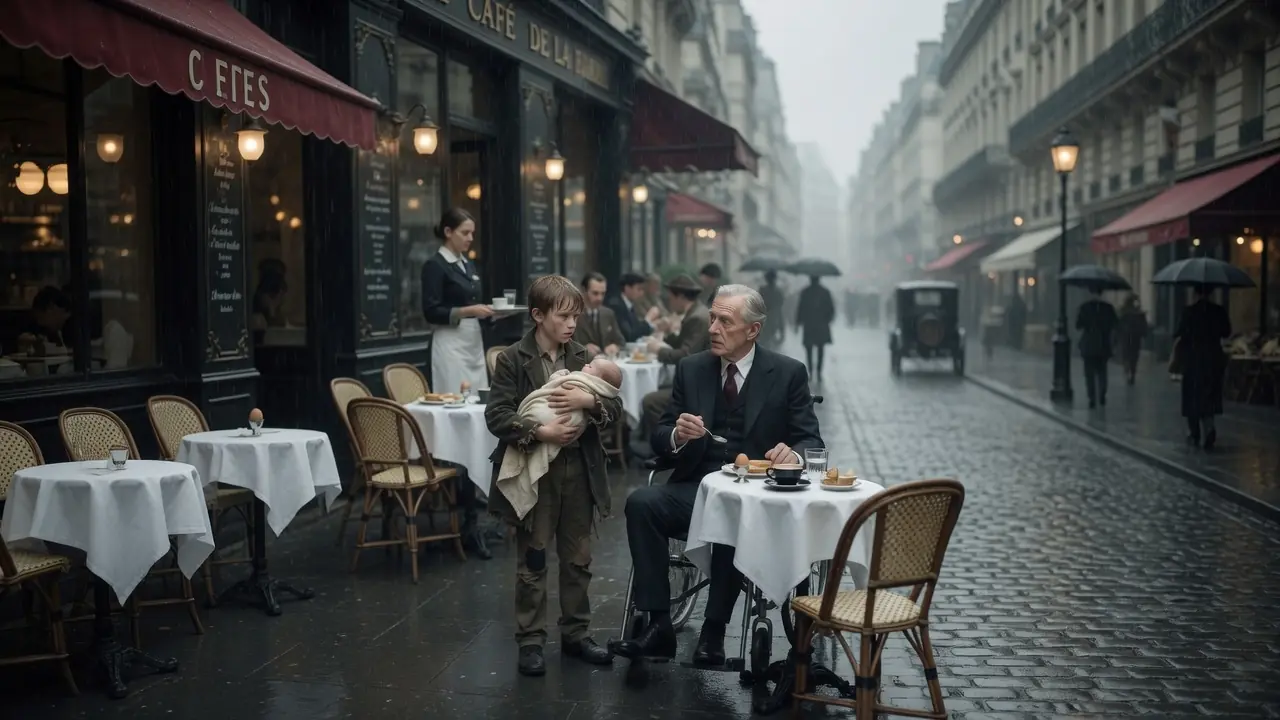
The word shook slightly.
Mrs. Langford’s eyes moved to the children.
Then softened.
“Welcome home,” she said.
Jonah looked at Arthur as if testing whether this was allowed.
Arthur nodded.
The children were bathed that afternoon.
Not all at once.
Not without fear.
Ruth refused to let Lily out of sight, so Mrs. Langford arranged a warm basin in the nursery and let Ruth sit nearby while the baby was washed. Samuel cried when a maid tried to take his coat, until Arthur realized the paper bag was still in the pocket.
He retrieved it himself and placed it in Samuel’s lap.
“No one will touch it without asking.”
Samuel stopped crying.
Jonah refused new clothes at first.
“I can work,” he said. “If that’s what you want.”
Arthur stared at him.
“What?”
“For food. For the beds.”
Arthur’s hand shook on the arm of his wheelchair.
“No child pays rent in his grandfather’s house.”
Jonah looked away.
“People say that kind of thing before they change their mind.”
Arthur swallowed.
“Then I will have to become the kind of person whose promises survive your doubt.”
That evening, Dr. Miriam Vale arrived.
She examined each child in the nursery while Arthur waited in the hall like a man awaiting sentencing.
Lily was underweight but stable.
Ruth had signs of malnutrition and untreated bronchitis.
Samuel had a mild fever and bruises on his knees from too much walking.
Jonah was the worst.
He had a sprained wrist, infected blisters on both feet, and exhaustion so deep the doctor looked at Arthur with visible anger when she stepped into the hall.
“How long were they outside?”
Arthur closed his eyes.
“Too long.”
“Mr. Bellamy, I’m not asking as your physician. I’m asking as a person. Are they safe here?”
The question offended him for half a second.
Then he realized it should be asked.
“Yes,” he said.
Dr. Vale studied him.
“From whom?”
Arthur opened his eyes.
“From everyone. Including me.”
The doctor’s expression shifted.
Not trust.
Not yet.
But acknowledgment.
That night, the children slept in the nursery suite Clara had once used.
Arthur had not entered it in years.
Mrs. Langford opened the windows to clear the stale air. Maids brought blankets, nightclothes, and broth. Ruth refused the bed until Jonah lay down first. Samuel slept with the paper bag under his pillow.
Lily slept in the old cradle.
Clara’s cradle.
Arthur sat in the doorway long after everyone else left.
He watched them sleep and felt the full weight of being late.
Not a little late.
Not pardonably late.
A lifetime late.
At midnight, Mrs. Langford found him there.
“You should rest, sir.”
Arthur did not look away from the children.
“I told Clara she would come back.”
Mrs. Langford said nothing.
“I believed it so completely that I made waiting feel like punishment.”
His voice was raw.
“She did come back,” Mrs. Langford said softly.
Arthur looked at Lily in the cradle.
“Yes.”
The next morning, Arthur began physical therapy.
He did not announce it.
He did not make vows.
He simply asked Mrs. Langford to call the last therapist he had fired, a patient man named Mr. Halden, and offered double his fee if he would return.
Mr. Halden arrived that afternoon with a medical bag and very little visible satisfaction.
“You called me useless last time,” he said.
Arthur nodded.
“I was wrong.”
“You threw a cushion at me.”
“I have regretted the cushion.”
Mr. Halden looked past him at Jonah standing in the hall.
The boy pretended not to listen.
The therapist understood more than Arthur said.
“Then let’s begin.”
The work was humiliating.
Arthur hated every minute.
Standing for three seconds.
Then five.
Moving the left foot.
Shifting weight.
Failing.
Trying again.
Sweating through a shirt while an eleven-year-old boy watched from the doorway pretending he did not care.
On the fourth day, Jonah stepped into the room.
“You’re doing it wrong.”
Arthur, gripping parallel bars, looked at him.
“Am I?”
“You keep looking at your foot like it’s going to betray you.”
Mr. Halden coughed to hide a laugh.
Arthur raised an eyebrow.
“And where should I look?”
Jonah shrugged.
“Forward.”
Arthur stared at the boy.
Then slowly faced ahead.
He took one step.
It was ugly.
Painful.
Barely a step at all.
But Jonah nodded.
“Better.”
Arthur almost smiled.
Almost.
Days became weeks.
The house changed in ways no renovation had ever managed.
There were toys in the west parlor. Crayon marks on a library table. A nurse’s schedule pinned beside Arthur’s investment calendar. Lily’s bottles drying near imported china. Samuel’s laughter echoing down a hallway that had not heard anything that honest in years.
Ruth began speaking in small pieces.
At first only to Lily.
Then to Jonah.
Then to Mrs. Langford.
Then, one cold afternoon, to Arthur.
She found him in Clara’s room holding the old photograph.
“You miss her now,” Ruth said from the doorway.
Arthur looked up.
“Yes.”
Ruth entered slowly.
“She missed you then.”
The sentence did not accuse.
It informed.
Arthur nodded.
“I know.”
“She kept your letters.”
Arthur frowned.
“I never wrote.”
Ruth reached into Clara’s paper bag and pulled out a bundle of envelopes tied with string.
Arthur’s breath caught.
They were not letters from him.
They were letters to him.
Unsent.
Some addressed in Clara’s careful handwriting.
Some never sealed.
Ruth placed them on his lap.
“Mama wrote them when she was sad. She said sending them would hurt too much if you didn’t answer.”
Arthur untied the string with trembling fingers.
Dear Dad, Jonah was born today.
Dear Dad, I made soup the way Mother used to, but I burned it.
Dear Dad, I saw a man in the market who walked like you and cried behind the bread stall.
Dear Dad, Ruth does not speak much, but she sings to the baby when she thinks no one hears.
Dear Dad, I am tired.
Dear Dad, if pride is what kept you from me, I hope it was warmer than I was.
Arthur pressed the letters against his chest.
Ruth watched him cry.
This time, she did not look frightened by it.
“Are you going to be mean again?” she asked.
Arthur laughed once through tears.
It hurt.
“No.”
“People can say no and still do yes.”
“You are right.”
She studied him.
“Then I’ll watch.”
Arthur nodded.
“That would be wise.”
In December, Arthur held a memorial service for Clara.
Not the small, hidden thing he might once have arranged to protect his reputation.
A public service.
At St. Anselm’s Church, full of flowers, music, and the people who had known Clara when Arthur had refused to.
Her former neighbor spoke. The nurse from the clinic spoke. Mr. Donnelly from the repair shop spoke, voice breaking as he described Clara sewing buttons onto coats for other tenants even when her own hands shook from fever.
Jonah stood at the front holding Lily.
Ruth stood beside him.
Samuel stood close to Arthur’s wheelchair with one hand on the armrest.
Arthur rose when it was his turn to speak.
With help.
But he rose.
He stood behind the lectern, one hand gripping its edge, and looked at the church full of people who had loved his daughter in the years he had wasted.
“My name is Arthur Bellamy,” he said.
His voice trembled.
“I was Clara’s father. I failed her.”
No one moved.
“I called my pride principle. I called my anger discipline. I called my silence waiting. But it was cowardice.”
Jonah looked up at him.
Arthur continued.
“My daughter died believing I hated her. I will carry that sentence until my last breath. But she also sent me her children, and with them, one final chance not to be the man I was.”
He looked at the front pew where Ruth sat, eyes wide.
“I cannot repay the dead. But I can answer the living.”
After the service, people approached him.
Some with forgiveness he did not deserve.
Some with anger he did.
Arthur accepted both.
That was new too.
By spring, the children no longer flinched when doors opened suddenly.
Samuel stopped hiding bread under his pillow.
Ruth began lessons with a tutor and discovered she loved maps. Lily grew round-cheeked and loud, with a laugh that startled Arthur every time because Clara had laughed just that way as a baby.
Jonah remained cautious.
He loved the house despite himself but kept part of his heart packed, ready to leave if safety proved temporary.
Arthur understood.
Trust is not granted by blood.
Blood had failed these children before.
So Arthur built trust the only way it can be built.
Slowly.
Breakfast at the same time.
Promises kept.
Doctors paid.
No shouting.
No locked doors.
No using gratitude as a leash.
He also walked.
First with Mr. Halden.
Then with a cane.
Then across the nursery while Lily clapped from her blanket.
The first time he made it from the window to the crib without sitting, Samuel cheered like Arthur had won a race.
Jonah watched silently from the door.
Then said, “Forward.”
Arthur smiled.
“Yes. Forward.”
One year after the day the children walked into The Gilded Spoon, Arthur returned to the café with all four of them.
The hostess recognized him and began crying before he even reached the table.
Arthur did not sit by the window this time.
He chose a round table in the center of the room.
Jonah, now taller and healthier, carried Lily on his hip. Ruth wore a blue coat and held a book of maps. Samuel brought the paper bag, now carefully repaired and folded inside a leather satchel Arthur had given him, because some treasures should not be replaced just because better materials exist.
People looked.
Arthur let them.
When the waiter arrived, Arthur ordered breakfast for the children first.
Everything hot.
Everything sweet.
Everything they wanted.
Then he looked toward the entrance where a boy in a threadbare coat stood hesitating, one hand pressed to his stomach.
Arthur saw the staff tense by habit.
He lifted one hand.
“Bring him in.”
The waiter paused.
“Sir?”
Arthur looked at him.
“Bring him in. Feed him.”
Jonah smiled faintly.
Ruth watched Arthur with careful approval.
Samuel waved the boy over like a host welcoming a guest.
Arthur sat back and felt Clara’s letter inside his coat pocket.
He carried it always now.
Not as punishment.
As direction.
Later that afternoon, Arthur took the children to Harrington Park. Lily slept in her carriage. Samuel chased pigeons. Ruth read beneath a tree. Jonah sat beside Arthur on a bench, watching everything.
“You’re different now,” Jonah said.
Arthur looked at him.
“I hope so.”
“Do you think Mom knows?”
Arthur’s throat tightened.
“I do not know.”
Jonah considered that.
“I think she does.”
Arthur looked at the boy.
For a moment, he saw Clara’s stubborn chin.
Her eyes.
Her impossible mercy.
“I hope she forgives me,” Arthur said.
Jonah did not answer quickly.
Then he said, “I think she wanted to.”
That was not the same thing.
Arthur knew it.
But it was enough for one afternoon.
Years later, people in the city would tell the story of Arthur Bellamy as if it were about a miracle.
They would say grief made a paralyzed man stand.
They would say a baby healed him.
They would say blood called to blood in a crowded café.
Arthur never corrected them harshly.
But he knew better.
His foot moved because nerves and muscles remembered what arrogance had abandoned.
He stood because love arrived too late and still demanded an answer.
The true miracle was not that he rose from the wheelchair.
The true miracle was that four hungry children walked into a room prepared to reject them and still had enough courage to say his name.
Arthur kept the wheelchair.
Even after he no longer needed it every day.
It sat in the corner of his study beside Clara’s letters.
A reminder.
Not of weakness.
Of the years he chose not to move.
And on the wall above it, he hung a framed copy of the first letter Jonah had brought into the café.
Dad, if you’re reading this, I’m gone.
Please don’t punish them for my choices.
They are your grandchildren.
Every morning, Arthur read those words before going downstairs.
Some days, he walked with a cane.
Some days, with pain.
Some days, slowly enough that Samuel, older now but still impatient, would say, “Forward, Grandfather.”
And Arthur would smile.
“Yes,” he would answer.
“Forward.”
Because the child he was meant to find had not been only Lily.
Not only Jonah, Ruth, or Samuel.
It had been Clara too.
The daughter he had lost.
The daughter who, even in death, had found a way to lead him back to the part of himself still capable of standing.