Black CEO humiliated with cake by white heiress. Minutes later, she kills a $4.9B deal.
“Look at her covered in cake, acting like she belongs here.”
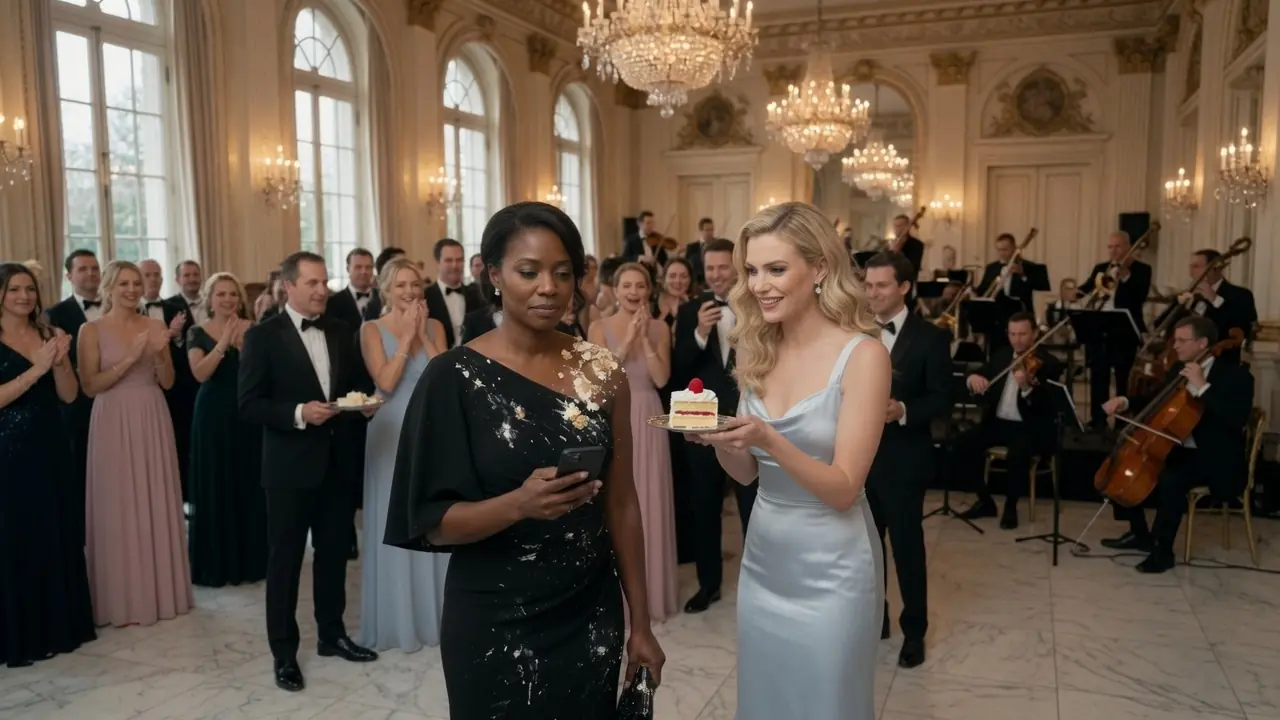
The words rang out loud, sharp, and unapologetic, slicing cleanly through the orchestral hum of the ballroom. Laughter followed immediately, bright, careless, cruel. It bounced off crystal chandeliers and marble columns like applause at a private execution.
The woman stood frozen at the edge of the room. Her black evening dress, once simple, elegant, intentional, was now soaked in white frosting and crushed sponge. Thick streaks clung to her shoulder, her neckline, her sleeves. A smear of cream traced her collarbone like a deliberate mark.
Someone had aimed carefully. Someone had wanted the room to see. Across from her, the white heiress laughed hardest, young, radiant, wrapped in champagne silk and inherited confidence. One manicured hand rested on the cake knife.
The other pointed openly at the woman in black. Her friends, men in tuxedos and women in pastel gowns, leaned in close, faces lit with delight, mouths open in synchronized amusement. Phones were already raised, recording, zooming, preserving the moment.
“Relax,” the heiress added, her voice syrupy with mock innocence. “It’s just cake. Don’t be so dramatic.”
More laughter, louder this time. No one stepped forward. No one asked if the woman was okay. The staff pretended not to see.
The band kept playing, uncertain but obedient. In this room, humiliation was entertainment, and silence was consent. The woman lowered her gaze briefly, watching a drop of frosting slide from her sleeve to the polished floor. It landed softly, almost politely.
Then she inhaled, slow and controlled. She did not cry. She did not shout. She did not rush to explain herself or defend her presence.
Instead, she reached into her clutch with steady hands and pulled out her phone. That small movement changed the air. She turned slightly away from the crowd, not in retreat, but in choice, and lifted the phone to her ear.
The heiress scoffed, already bored, already searching for the next laugh.
“Who is she calling?” someone whispered.
The woman spoke quietly, calmly, as if ordering coffee. “Yes,” she said. “It’s me.”
A pause. Then, with no change in tone, no heat in her voice, she delivered the sentence that would fracture the night.
“Cancel the $4.9 billion deal. Now.”
Silence fell like a dropped glass. The laughter stuttered. Phones wavered midair. A man near the bar frowned at his screen as a notification lit up.
Another guest checked his watch, suddenly unsure of the time, the place, the rules. The heiress’s smile faltered just for a second. Not fear yet. Confusion.
“What did she say?” someone murmured.
The woman ended the call. She slipped the phone back into her clutch and finally looked up. Her eyes moved slowly across the room, meeting faces one by one. The ones that had laughed, the ones that had filmed, the ones that had looked away.
There was no anger in her expression, only certainty. And in that moment, before anyone understood who she was, before the consequences began to unfold, the room realized something fundamental had shifted. They hadn’t humiliated a nobody. They had made a very public mistake.
For a few seconds after the call ended, nothing happened. Music continued to drift through the ballroom, strings soft, polished, obedient. Glasses clinked. Someone laughed a beat too late, then stopped, embarrassed by the sound of their own voice.
The moment hovered in uncertainty, like a chandelier trembling before it falls. The white heiress tilted her head, squinting at the woman in black as if trying to decode a joke that hadn’t landed.
“Did you hear that?” she asked her friends, still smiling. “She’s dramatic. I swear people love pretending they matter.”
A ripple of laughter followed, thinner now, less confident. The group leaned closer together, instinctively forming a circle of comfort. Old habits, old money, old certainty. In rooms like this, consequences belonged to other people.
The woman in black said nothing. She stood exactly where she was, frosting drying on her dress, hands relaxed at her sides. Her stillness felt deliberate, almost architectural, like a column placed there on purpose. She wasn’t waiting for permission.
“What’s wrong?” the heiress snapped, noticing the shift. “Why does everyone suddenly look like they swallowed a ghost?”
No one answered her, because something had changed, and not in a way that could be laughed off. This room had rules. Everyone here understood them. Status protected cruelty.
Wealth softened behavior. Apologies were optional. Accountability rare. Mistakes were smoothed over with champagne and press releases.
And people like the woman standing in cake-stained black dresses, they were never supposed to be the ones holding the pen. That was the assumption. It was why the heiress hadn’t hesitated, why the cake had flown so easily, why humiliation had felt safe.
She took a step closer now, lowering her voice, smile sharpening into irritation. “You made your point,” she said. “But let’s not pretend you’re important enough to ruin my night.”
The woman finally looked at her, not with anger, not with defiance, but with assessment. It was the look of someone reviewing a balance sheet, calculating exposure, identifying liabilities. The heiress felt it and recoiled slightly, though she didn’t know why.
“Who even invited you?” she demanded. “Do you know whose party this is?”
The woman in black glanced around the ballroom, taking in the marble floors, the sponsor logos projected softly along the walls, the donors whose names funded hospitals and bought absolution. Her gaze lingered for half a second on one familiar insignia before returning to the heiress.
“I do,” she said calmly.
That answer unsettled more people than it should have. At the edge of the room, a senior banker excused himself abruptly and stepped into the hallway, phone already to his ear. Near the stage, a board member whispered, “That deal, wasn’t it supposed to close Monday?”
Another replied, “It can’t just disappear. Not like that.”
But it already had. Not on paper, not publicly yet. The woman in black shifted her weight, frosting flaking from her sleeve onto the floor. She didn’t brush it off.
She let it fall. A quiet trail marking the moment the room lost control of its own narrative.
The heiress laughed again, louder, brittle. “You people are unbelievable,” she said to her friends. “She says one line on a phone and everyone panics.”
But the panic wasn’t coming from her circle. It was coming from the people who understood what a call like that actually meant. Across the ballroom, eyes met in recognition. Not recognition of her face, but of authority.
Of the kind that doesn’t need introductions, the kind that doesn’t argue. The woman in black turned slightly, preparing to leave the center of attention she had never sought. Behind her, the heiress was still talking. She had no idea that the room she thought she owned had already stopped belonging to her.
Long before the cake, long before the laughter, the mistake had already been made. The woman in black had not wandered into that ballroom by accident. She hadn’t slipped past security. She hadn’t been invited out of charity or curiosity.
She was there because the night required her presence, because signatures were supposed to follow champagne. Because alliances were meant to be sealed under chandeliers. She was there for business. Her name was Naomi Carter.
Most people didn’t know it, and the ones who did rarely spoke it out loud. At 46, Naomi Carter had built a reputation not on visibility, but on outcomes. She didn’t attend panels. She didn’t sit for interviews.
She didn’t post victory photos or stage philanthropy for cameras. In an economy addicted to noise, she operated in silence. And that silence was intentional.
Naomi was the founder and CEO of Carter Helios Group, a private investment firm with controlling interests spread quietly across energy infrastructure, fintech platforms, logistics corridors, and sovereign-backed real estate. She didn’t chase headlines. She acquired leverage. Her portfolio didn’t announce itself.
It moved markets anyway. The deal scheduled to close that night, $4.9 billion, wasn’t a gamble for her. It was a calculated rescue. The kind that kept legacy families afloat when the numbers no longer loved them back.
The kind that turned quiet desperation into public confidence. The kind Naomi had agreed to until 15 minutes ago. What no one in that ballroom understood was simple and devastating. They hadn’t humiliated a guest.
They had humiliated the last line of support. Naomi had arrived alone because she preferred it that way. No entourage, no legal team, no visible assistance hovering nearby. She believed in watching people before committing to them, in seeing how they treated those they believed were powerless.
This party had been her final evaluation, and they had failed it spectacularly. The white heiress, laughing, posturing, dripping with inherited certainty, had never met Naomi before. She had negotiated through lawyers, intermediaries, faceless email chains. Naomi’s privacy was legendary, deliberate, protective.
It was why the heiress hadn’t recognized her. It was why she had felt safe. Across the room, a senior partner from one of the underwriting banks stared at his phone, jaw tight. He knew that number.
He knew that name, and he knew exactly what cancel meant when it came from Naomi Carter. It didn’t mean delay. It meant erasure.
The woman in black moved toward the exit now, heels quiet against marble. No one stopped her. No one dared. The frosting on her dress had begun to crack and flake, white against black like evidence.
As she passed a mirrored column, Naomi caught her own reflection, composed, controlled, marked, but unbroken. She thought briefly of her mother, who had cleaned office buildings at night while men in suits talked loudly about deals they’d never invite her into. Of the first bank that had laughed at her pitch. Of the long memory that had taught her one unshakable rule.
Power never announces itself. It reveals itself.
Behind her, the party continued to fracture in small, invisible ways. A sponsor excused himself. A donor left early. A board member whispered into a phone, voice urgent.
The systems were already responding, gears grinding toward consequences that couldn’t be undone with apologies. The heiress was still talking, still laughing, still convinced the night belonged to her. She had no idea that Naomi Carter had just walked away from saving her family’s future. And Naomi, stepping into the quiet corridor beyond the ballroom doors, didn’t look back.
She didn’t need to. The building already knew who owned the room.
Naomi had taken no more than three steps toward the exit when the white heiress realized something was wrong. Not wrong like embarrassment. Not wrong like regret. Wrong like loss of control.
“Wait,” the heiress called out, her voice sharp now, stripped of its playful gloss. “You don’t just get to walk away.”
A few heads turned. Conversation stalled mid-sentence. The band softened instinctively, as if sensing tension it hadn’t rehearsed for. Naomi stopped.
She didn’t turn around yet. Behind her, the heiress crossed the space with quick, irritated strides, heels clicking too loudly on marble. The crowd parted without thinking, creating a narrow path that felt uncomfortably like a stage.
“You ruined the mood,” the heiress snapped, coming to a halt just a few feet away. “Do you have any idea how much tonight costs?”
Naomi turned slowly. The heiress flinched just slightly. Up close, the frosting didn’t make Naomi look small. It made her look deliberate, marked, but unmoved.
The contrast unsettled something primal in the heiress, who was used to people shrinking when confronted.
“This is a private event,” the heiress continued, louder now, projecting for witnesses. “You embarrassed yourself, and now you’re embarrassing everyone else. Security should have removed you already.”
A murmur rippled through the room. Security guards near the entrance glanced at each other. Uncertain. No one moved.
The heiress felt the hesitation and pressed harder. “Did you hear me?” she barked. “I said remove her.”
Naomi spoke then, her voice low, level, unhurried. “Do you always double down?” she asked calmly. “Or only when you realize you’ve gone too far?”
The question landed badly. The heiress laughed, but there was no humor in it.
“Too far?” she scoffed. “Please, you people love playing victim when you don’t get your way.”
Several guests shifted uncomfortably. A woman near the bar looked away. A man who had been filming lowered his phone, suddenly aware of how this might age.
Naomi tilted her head slightly, not in submission. “In consideration, you didn’t throw cake,” she said. “You tested a boundary.”
The heiress bristled. “Don’t psychoanalyze me. You’re not important enough.”
That word again. Important. Naomi’s lips curved not into a smile, but into something closer to recognition.
“That’s where you’re wrong,” she replied softly.
The heiress’s phone buzzed in her hand. She ignored it. It buzzed again, longer this time, insistent. Still, she waved it off, eyes locked on Naomi.
“You think one phone call scares me?” she said. “My family doesn’t answer to people like you.”
Behind her, a man in an expensive suit leaned toward another and whispered, “Her father’s online, too.”
Again, the heiress’s jaw tightened. “Excuse me,” she snapped, finally glancing at her screen. Her expression changed. Not fear, calculation.
She turned away briefly, answering in a hushed but tense voice. “Yes, I know. I’m handling it. No, she’s nobody.”
She stopped mid-sentence. Across the room, Naomi watched her, not with satisfaction, not with vengeance, but with the same detached focus she applied to underperforming assets. The heiress’s face flushed. She glanced back, eyes narrowing.
“You did this?” she hissed, lowering her phone. “You think you can sabotage my family and just walk away?”
Naomi stepped closer now, closing the space deliberately. “I didn’t sabotage anything,” she said. “I withdrew my consent.”
The words cut deeper than shouting ever could. Consent, choice, power. The heiress opened her mouth, then closed it. Her confidence faltered just enough for the room to notice.
Around them, whispers grew. A sponsor slipped out quietly. A board member checked his watch, then his phone. The systems were aligning, the consequences organizing themselves.
Naomi straightened her shoulders, frosting still visible, unbothered. “You mistook access for immunity,” she continued. “That’s a common error.”
She turned then, decisively, and resumed walking toward the exit. This time, no one followed. The heiress stood frozen at the center of the room, phone buzzing endlessly in her hand, realizing too late that she hadn’t humiliated a stranger. She had challenged a boundary she was never meant to see.
The first confirmation arrived before Naomi reached the elevator. Her phone vibrated once, short, precise. She glanced at the screen, already knowing what it would say.
Done.
No exclamation point, no commentary, just the word. That was how her team operated. When Naomi gave an order, it wasn’t debated. It wasn’t delayed.
It was executed cleanly, quietly, without spectacle. Power didn’t need witnesses to function.
Behind the ballroom doors, the music was still playing. A string quartet attempting optimism, a tempo meant to reassure donors that nothing was wrong. Everything was wrong.
In a glass-walled conference room three floors below the gala, a legal director removed her glasses and closed a binder she’d hoped never to reopen.
“Proceed,” she said.
Across the city, a private banking terminal went dark.
Access revoked.
In another building, a compliance officer flagged an account for immediate review. In a third, a junior associate stared at his screen as a pending transfer reversed itself in real time, digits snapping back like a recoiling wire. The $4.9 billion deal didn’t collapse.
It was withdrawn. That distinction mattered. Collapsed deals could be renegotiated. Withdrawn ones were final.
Back upstairs, the ripple finally reached the room. A man near the bar excused himself abruptly, face tight, phone pressed to his ear. A donor whispered, “That funding line, wasn’t it tied to Carter Helios?”
Another replied too quickly, “No, I don’t think so.”
The lie didn’t hold. At the head table, the father read the same notification three times before understanding it hadn’t been sent in error.
Strategic partner withdrawal confirmed. Effective immediately.
His hand trembled slightly as he set the phone down. “That’s not possible,” he murmured more to himself than anyone else.
But it was, because Naomi Carter didn’t bluff.
She reached the elevator as her phone vibrated again, then again, messages stacking neatly, one beneath the other.
Legal exit clauses activated.
Finance exposure contained.
PR holding statement drafted. Standing by.
Naomi stepped inside and pressed the lobby button. As the doors slid shut, she caught a glimpse of her reflection in the mirrored panel. The frosting on her dress had begun to harden, edges cracking, flaking away with each movement.
She didn’t bother wiping it off. Let it be seen.
Upstairs, the heiress was no longer laughing. “What do you mean withdrawn?” she demanded, pacing near the center of the room. “Withdrawn from what?”
Her father didn’t answer immediately. He was still calculating, running numbers, imagining conversations, mapping damage control. But some equations had no solution.
“It means,” he said finally, voice low, controlled with effort, “that the deal is gone.”
The words landed badly.
“Gone?” the heiress repeated. “You’re joking.”
No one laughed. Around them, phones buzzed like insects. Sponsors glanced at exits. A woman from the board excused herself, citing a headache no one believed.
The illusion of celebration thinned, stretched to transparency.
“Fix it,” the heiress snapped. “Call them back. Offer more. Apologize if you have to.”
Her father looked at her then. Really looked.
“They didn’t ask for an apology,” he said quietly. “They asked for character.”
Across the room, someone whispered Naomi’s name for the first time. Not loudly, reverently.
The elevator doors opened in the lobby. Naomi stepped out into the quiet marble echoing beneath her heels. The chaos above felt distant now, contained, inevitable.
She checked her phone once more. One final message blinked into view.
All positions closed. No residual exposure.
Naomi slipped the phone back into her clutch and walked toward the exit, unhurried. Behind her, in a room full of people who thought humiliation was harmless, the consequences were finally catching up. And they were irreversible.
The realization didn’t arrive all at once. It crept in, quiet, methodical, unforgiving. Upstairs, the gala had lost its rhythm. Conversations fractured into half sentences.
Laughter evaporated before it could land. People kept checking their phones, then pretending they weren’t. The chandeliers still glowed, but the light felt interrogative now, less celebratory, more exposing. This was the phase wealthy rooms feared most.
The moment after denial. Before explanation. The heiress stood near the center, shoulders squared, chin lifted, still performing confidence out of habit. But the performance was slipping.
Her phone vibrated again and again. She didn’t answer. Around her, people began to move. Not dramatically, not openly, but with purpose.
A donor slipped out through a side door. A couple murmured excuses about early flights. A board member made eye contact with no one as she collected her coat. Power always sensed danger before pride did.
“Someone tell me what’s happening,” the heiress demanded, her voice rising just enough to betray strain. “This is ridiculous.”
A man she had known since childhood, someone who usually laughed at her jokes and backed her instincts, didn’t meet her eyes. “It’s complicated,” he said.
That word landed harder than an insult. Complicated meant lawyers. Complicated meant exposure. Complicated meant the kind of silence money couldn’t smooth over.
At the bar, a senior financier whispered to his colleague, “Carter Helios doesn’t withdraw unless they’ve already replaced you.”
“Replaced us with who?” the colleague asked.
The financier swallowed. “That’s the problem.”
The heiress’s father stood apart now, phone pressed to his ear, voice low and controlled. He nodded slowly as someone on the other end spoke. Once, twice.
“No,” he said finally. “I understand.”
He ended the call and stared at the screen long after it went dark. She watched him, unease tightening in her chest.
“Dad.”
He looked up. In all her life, she had never seen that expression on his face. Not anger, not fear. Calculation, followed by loss.
“They’ve already reallocated the capital,” he said quietly. “The partners, the banks, they moved fast.”
“That’s impossible,” she snapped. “Deals don’t just disappear.”
“They do,” he replied, “when the person holding them decides you’re a liability.”
The word echoed. Liability.
The heiress shook her head, grasping for ground. “Because of a joke? A cake?”
Her father didn’t answer immediately. “No,” he said at last. “Because of judgment.”
Across the room, whispers grew bolder. That was her. The woman in black. She’s the one.
Someone pulled up a profile. Private, sparse, devastating. Numbers instead of photos. Results instead of press.
Naomi Carter’s name moved through the room like a confession. Eyes shifted, spines straightened, faces recalibrated. The same people who had laughed minutes earlier now avoided mirrors because the humiliation hadn’t gone the way they’d expected.
It had reversed direction. The heiress felt it fully then, the pivot. The room no longer belonged to her. Attention wasn’t on her outfit, her family, her social gravity.
It had moved to the absence, to the woman who had walked away without raising her voice.
“Find her,” the heiress said suddenly. “Get her back here.”
No one moved. Security pretended to be busy. Staff avoided her gaze. Even her friends looked uncertain, suddenly aware of the cost of proximity.
Because this wasn’t a misunderstanding. It was a verdict. Downstairs, Naomi stepped into the night air, the city humming around her, indifferent and vast. She paused beneath the awning, breathing in the cool, letting the noise of the gala fade behind glass and stone.
Her phone remained silent now. The work was done. Back upstairs, the heiress stood alone at the center of a room that had finally learned the truth.
They hadn’t been powerful. They’d just been loud. And loud had never been enough.
By midnight, the story had escaped the room. It always did. What began as whispers at linen-covered tables became frantic calls, then confirmations, then silence. The kind that precedes damage control.
Someone leaked the withdrawal notice. Someone else confirmed it. A third added context no one wanted attached to their name.
Strategic partner withdraws $4.9B from legacy family deal, effective immediately. No explanation, no apology, no path back.
Inside the ballroom, the collapse unfolded without theatrics. It didn’t need them. A sponsor’s logo vanished from the projection wall, replaced by a neutral placeholder. The band stopped playing altogether, citing technical issues.
Staff began clearing glasses that were still half full. People left in clusters, murmuring excuses that fooled no one. The heiress watched it happen as if from underwater.
“What are you doing?” she snapped at an event coordinator who was already rolling up cables. “The night isn’t over.”
The coordinator hesitated, then chose honesty. “I’m sorry, ma’am. We were instructed to conclude early.”
“Instructed by who?”
The coordinator glanced away. “The board.”
The word landed like a gavel. Across the room, the heiress’s father sat heavily, shoulders rounded for the first time in his life. His phone lay face down on the table.
He didn’t need to look at it anymore. “It’s spreading,” he said quietly. “The banks, the press, they’re all calling.”
“Then answer them,” the heiress insisted. “Say something.”
He shook his head. “There’s nothing left to say.”
Because every explanation sounded like an excuse, and excuses only traveled one direction in rooms like this. The guests who remained kept their distance now. Conversations shifted away from her table. Eyes flicked toward her, then away quick, calculating, relieved it wasn’t them.
The same people who had laughed earlier now treated her like a contagion. Reputation moved faster than sympathy. A man she’d once dated crossed the room without acknowledging her. A woman she’d humiliated last summer nodded politely and walked past, expression unreadable.
The hierarchy had inverted.
“What about the photos?” the heiress demanded suddenly. “People were recording.”
Her father closed his eyes. “They’re already online.”
Her breath caught. “Take them down.”
“You can’t,” he replied. “They don’t belong to us anymore.”
Screens lit up around the room as guests checked the same feed. A still image circulated first. Naomi Carter, face calm, dress stained with white frosting, phone in hand. The caption beneath it was brutal in its simplicity.
You mocked the wrong woman.
Another followed, then another. Clips, reactions, commentary. The narrative locked in. The heiress lunged for her phone, scrolling frantically, thumbs shaking.
Each refresh made it worse. Names she recognized were commenting. Names she needed silent. Her reflection stared back at her from the darkened screen.
Perfect makeup, flawless dress, eyes unraveling.
“This isn’t fair,” she whispered.
Her father looked at her then, long and hard. “No,” he said. “It’s accurate.”
Across town, Naomi sat in the back of a quiet car, city lights sliding past the window. She didn’t look at her phone. She didn’t need to. The consequences were no longer hers to manage.
Upstairs, the ballroom emptied completely. Staff worked quickly now, dismantling the illusion. Tablecloths stripped, flowers removed, the room reduced to architecture. The heiress stood alone at the center, heels sinking slightly into the carpet, frosting still visible on the floor where Naomi had stood.
A stain that would be cleaned by morning, but the damage would linger, because humiliation was never harmless. And tonight, it had finally chosen the right target.
Naomi was halfway to the car when she heard her name. Not shouted, not pleaded, spoken carefully, as if volume itself might worsen the damage.
“Miss Carter.”
She stopped. The city breathed around them, traffic murmuring, glass towers reflecting a night that didn’t care who had fallen inside them. Naomi turned slowly.
The white heiress stood a few steps away, no longer radiant, no longer framed by laughter or followers. Her posture was stiff, rehearsed composure barely holding. The confidence that had filled the ballroom had drained, leaving something raw beneath it.
“I need a moment,” the heiress said, glancing back toward the building. “Just a moment.”
Naomi considered her. Not as an enemy, not as a victim, but as a variable.
“Make it quick,” Naomi replied.
The heiress swallowed. “I didn’t know who you were.”
Naomi didn’t respond.
“That night,” the heiress continued, words tripping now, “it was stupid. It got out of hand. People expect things from me. I was trying to keep control of the room.”
Naomi’s gaze stayed steady. “You already had control,” she said. “You just misused it.”
Silence stretched. The heiress exhaled sharply, frustration bleeding through. “You didn’t have to destroy everything.”
Naomi tilted her head slightly. “I didn’t destroy anything.” She paused, letting the distinction land. “I declined to save it.”
The heiress’s jaw tightened. “Do you know what this will cost us?”
“Yes,” Naomi said. “That’s why I did it.”
The words weren’t cruel. They were precise. The heiress laughed once, brittle.
“So this is about punishment?”
Naomi shook her head. “It’s about precedent.”
She took a step closer. Not invading, not threatening, just close enough that the truth couldn’t be avoided.
“You thought dignity was decoration,” Naomi said quietly. “Something optional, something you could strip away for entertainment.”
The heiress looked down, then back up, eyes flashing. “You’re acting like I’m a monster.”
“No,” Naomi replied. “I’m acting like you’re accountable.”
That word hung heavier than any insult. Accountable.
The heiress’s shoulders sagged slightly. “What do you want?”
Naomi didn’t answer immediately. She looked past her at the building, the lights still on, staff moving like ants inside a dismantled illusion. She thought of every room she had entered where someone assumed she was there by mistake. Of every smile that sharpened into condescension the moment they felt safe.
“I want you to remember this moment,” Naomi said finally. “Not because it hurts, but because it ends something.”
“Ends what?”
“The belief that power is inherited,” Naomi replied. “It isn’t. It’s maintained.”
The heiress stared at her, eyes glassy now. “And you’re just going to walk away?”
Naomi nodded once. “I already did.”
She turned then, decisively. Behind her, the heiress spoke again, softer this time.
“If I apologize…”
Naomi stopped but didn’t turn. “Apologies are for people,” she said. “This was about position.”
She stepped forward, opening the car door. As she slid inside, she added one last thing. Not as a threat, not as triumph, but as truth.
“You’ll recover,” Naomi said. “You’re wealthy. You always do.”
She looked directly at the heiress through the open door. “But you won’t forget.”
The door closed. The car pulled away smoothly, tail lights dissolving into the city. The heiress stood alone on the curb, night air cutting sharper than the ballroom ever had. For the first time, there was no audience, no shield, no inherited echo to hide behind.
Only memory, and the knowledge that some rooms don’t reject you. They expose you.
By morning, the city had already moved on. Markets opened, traffic snarled, headlines refreshed. The gala, once meant to celebrate legacy and power, was reduced to a cautionary paragraph buried beneath financial analysis and social commentary.
Deal withdrawn. No further comment.
That was all Naomi allowed. No interviews, no statements, no victory laps. Because power that explains itself loses its edge.
In the days that followed, the consequences settled into place with clinical precision. The family at the center of the collapse issued a carefully worded announcement about strategic realignment. Their stock dipped, then slid. Board members resigned quietly.
A foundation event scheduled for the following month was postponed indefinitely. No one mentioned the cake. They didn’t have to.
The footage lingered anyway, passed between phones, embedded in timelines, dissected in think pieces, and whispered about in rooms where people suddenly measured their words more carefully. It became shorthand: don’t do a cake moment.
Naomi watched none of it. She returned to her routine: early mornings, secure calls, decisions that shifted weight without sound. Her team handled the noise the way they handled everything else, efficiently, invisibly.
One afternoon, her assistant placed a thin folder on her desk.
“Redirected funds,” she said. “Per your instruction.”
Naomi opened it. Inside were approvals for community redevelopment projects, minority-owned manufacturing grants, scholarships tied not to names but to outcomes. The money that had been meant to prop up arrogance would now build something quieter, something useful.
That was Naomi’s version of closure. Across town, the white heiress sat in a glass office she no longer controlled, staring at a screen filled with numbers that refused to behave. Invitations slowed. Calls went unanswered.
The room had not turned against her. It had simply stopped responding. That silence was worse.
She replayed the night over and over, searching for the moment she could have stopped. The laugh, the knife, the cake, the assumption that no one who mattered would ever push back. She had been wrong. And wrong, she learned, had a long memory.
Weeks later, Naomi attended another event. Smaller, quieter, intentional. No photographers, no spectacle. She moved through the space unremarked, as she preferred.
A woman near the bar glanced at her, hesitated, then nodded once in recognition. Not awe, respect. Naomi returned the nod and kept walking. Because dignity didn’t need applause.
As the evening wound down, she stepped outside, the city stretching before her in steel and light. She paused for a moment, breathing in the calm that followed consequence. Somewhere behind her, in rooms still learning the lesson, people would talk about power as if it were something you inherited.
Naomi knew better. Power wasn’t the room. It wasn’t the guest list. It wasn’t who laughed loudest when someone fell.
Power was choice. And once you understood that, you never needed to belong to their room again.