Nobody in Caldwell Creek could say exactly when Harley Thornwell stopped being a man and became something closer to a ledger. He owned 400 acres of the best grazing land in the territory, a timber operation that ran like clockwork, and a house so large it echoed when he walked through it alone. He had built all of it himself, deal by deal, acre by acre, and somewhere in the building, something quieter in him had gone dark. People respected him. Nobody particularly liked him.
He had stopped noticing the difference years ago. The night everything changed, he almost didn’t go. It was a Thursday in late October, the kind of night where the wind came down off the ridge with an edge to it, and the town of Caldwell Creek pulled itself indoors early. The saloon on the main street, a place called Decker’s, was half full when Harley stepped through the door.
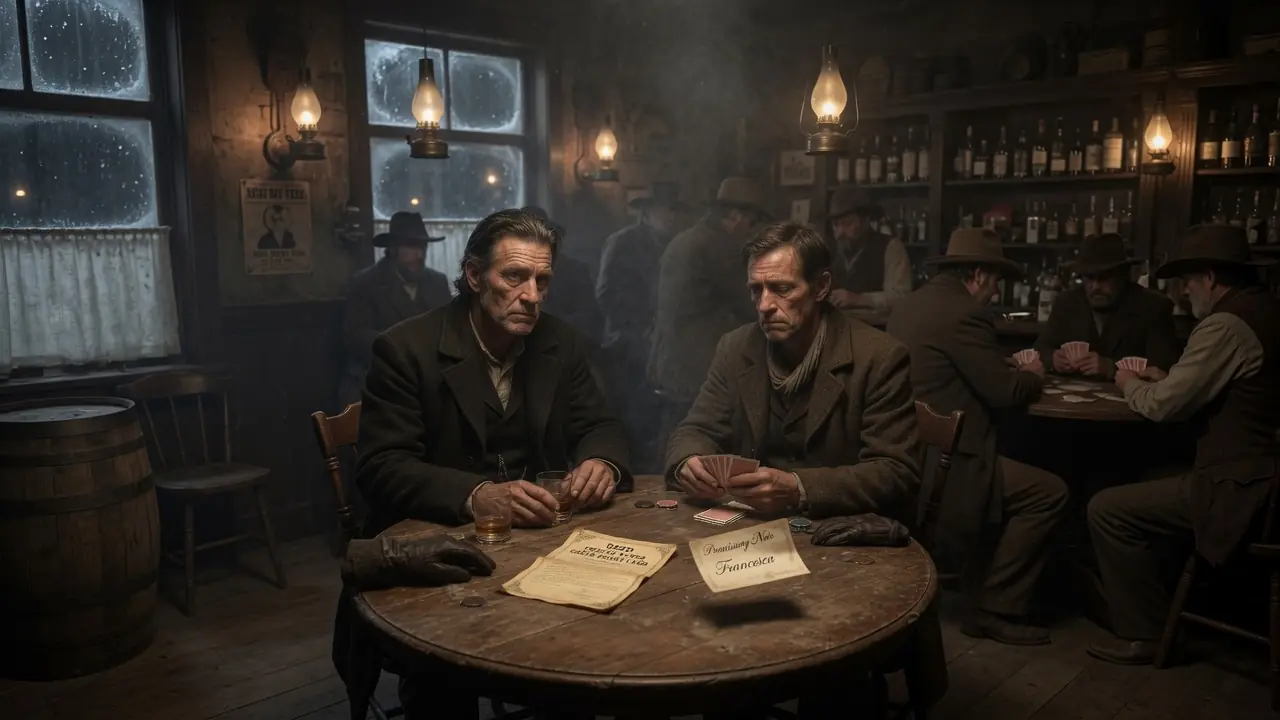
He hadn’t come for company. He rarely did. He had come because a man named Lavon had sent word that he was holding a deed to 12 acres of creek-front land that Harley had been trying to acquire for two years, and that he was willing to put it on the table. That was the only reason Harley sat down.
Lavon was already at the table when he arrived, a lean, restless man with quick eyes and unsteady hands. He smiled too easily, the way men do when they are already losing and haven’t admitted it yet. There were two other players at the table: a cattle buyer from out of town, and a local man whose name Harley never bothered to learn. The game began simply enough.
Whiskey was poured. Cards were dealt. The wind pressed against the saloon windows like something trying to get in. Harley played the way he did everything: quietly, patiently, without emotion.
He folded when it cost him nothing to fold. He bet when the numbers justified it. He watched Lavon the way a man watches a river he knows is going to flood, not with alarm, just with certainty. By midnight, the cattle buyer had gone home, and the other man had lost enough to excuse himself with whatever dignity he had left.
It was just the two of them now, and Lavon’s pile of chips had shrunk to something embarrassing. The deed to the creek land sat in the center of the table. Harley was one good hand away from walking out with everything he had come for. Then Lavon did something strange.
He reached into his coat slowly, the way a man moves when he knows what he is about to do is going to cost him, and he set something on the table beside the deed. It was a folded piece of paper. He smoothed it flat with his palm and pushed it toward the center without meeting Harley’s eyes. “I’m light,” Lavon said quietly, “but I’m good for it. That paper covers the difference.”
“It’s a promissory note,” he said. “My daughter, Francesca. She’s 22. She’s capable. She can cook and keep house, and she’s got more sense than most men I know.” He paused. “You’ve been needing someone to run that big house of yours. Everybody knows it.”
The saloon had gone very quiet. Even the barkeep found something to do at the far end of the counter. Harley looked at the paper for a long moment. Then he looked at Lavon, really looked at him.
And what he saw wasn’t a villain. It was something worse. It was a man who had run out of options and had chosen the wrong one anyway. “You understand what you’re putting on this table,” Harley said.
It wasn’t a question. Lavon’s jaw tightened. “I understand I owe more than I have.” The hand was dealt.
Harley won it without drama, a pair of kings against nothing worth mentioning. He gathered the deed, folded the promissory note, and tucked it into his coat. He stood, put on his hat, and walked out into the cold night air without looking back. He told himself it was a labor arrangement, nothing more.
He told himself he would be fair, that she would be compensated, that it was no different from hiring on a housekeeper. He told himself all of this on the ride home, the wind cold against his face, the dark house waiting on the hill above the creek. He almost believed it. What he did not know, what he had no way of knowing as he rode through that dark, was that Francesca had been awake when her father left for Decker’s that night.
She had stood at the window and watched him go with the particular stillness of someone who already knew something was wrong. She had sat in the kitchen until nearly 2:00 in the morning with her hands folded on the table, waiting. And when Lavon had finally come through the door, when he couldn’t meet her eyes, she didn’t cry. She just looked at him for a long moment, and then she asked one question very quietly.
“How much did you lose me for?”
Francesca arrived at the Thornwell property on a Friday morning, which struck her later as an odd detail to remember, but she remembered it. The sky was the color of cold ash, and the road leading up to the house was lined with bare-limbed cottonwoods that rattled softly in the wind. She had one trunk. She had packed it herself, alone, the night before, while her father sat in the next room and said nothing useful.
She had not cried then, either. The house was larger than she had expected. It sat on a low rise above the creek, built from dark timber and stone, with a wide porch that wrapped around two sides and windows tall enough to let in real light. It would have been beautiful if anyone had thought to make it feel lived in.
Instead, it looked exactly like what it was: a house that had been built to impress and then promptly forgotten. Harley was standing on the porch when the wagon pulled up. He looked at her the way he might look at a fence line that needed assessing, not unkindly, but without warmth, either. He was taller than she had pictured, with dark hair going gray at the temples, and a face that had been weathered into something angular and closed.
He wore no expression she could read. “Miss Francesca,” he said. “Mr. Thornwell,” she replied. That was the entirety of their first conversation.
He showed her the house himself, briefly, efficiently, the way a man gives directions to a place he assumes you’ll figure out on your own. The kitchen. The pantry. The back room where linens were kept.
He told her she would have Sundays to herself. He told her meals were expected at 6:00 in the morning and 6:00 in the evening. He told her the previous housekeeper had left in the spring, and that things had fallen behind. He did not apologize for the circumstances that had brought her there.
She did not ask him to. What she did, while he walked her through each room, was look at everything carefully, not with resentment, but with attention. The dust along the window ledges. The unwashed curtains.
The kitchen that had clearly not been organized by anyone who actually cooked. The parlor with its fine furniture arranged in a way that made it impossible to sit comfortably. A house full of expensive things that nobody had ever learned how to use. By the end of the tour, she had already begun, quietly, to make a list in her head.
The first week was mostly silence. Harley left early and came back late. He ate what she prepared without comment, not rudely, simply without acknowledgement, the way a man eats when food is fuel and nothing else. He moved through the house like someone who had trained himself not to need it.
She began to understand that he wasn’t cold so much as he was careful. There was a difference, she decided, even if the surface looked the same. She cooked well. She always had.
It was one of the things she was quietly proud of, though she had never said so out loud. By the third morning, she noticed that he had eaten everything on his plate, which the first two mornings he had not. She said nothing about it, but she noticed. The shift, the first real one, happened on a Wednesday evening, nine days after she arrived.
She had been reorganizing the parlor, moving the furniture into an arrangement that actually made sense, when she came across a small wooden box on the bottom shelf of the bookcase. It was unlocked. She wasn’t looking for anything private. She simply picked it up to move it, and the lid came open in her hands.
Inside was a photograph: a woman, young, seated very straight in the formal way photographs demanded back then. On the back, in faded ink, were two words: May, 1871. Francesca closed the box carefully and put it back exactly where she had found it. She rearranged everything else in the room.
She left the box alone. That evening at supper, Harley came in later than usual. He sat down, looked at the parlor through the open doorway, and went still for just a moment. Something shifted in his expression, not dramatically, just a small tightening around the eyes.
“You moved things,” he said. “I did,” she said. “I left the shelf as it was.” He looked at her then, really looked at her, for what she realized was the first time since she had arrived.
Not assessing. Something else. Something less certain. He picked up his fork and said nothing more, but he didn’t look away immediately, either.
And that small hesitation stayed with Francesca longer than she expected it to. She found herself thinking about it while she washed the dishes, the window above the sink dark, and the creek audible somewhere below the house. She wasn’t sure what the look meant. She wasn’t sure she wanted to examine it too closely.
What she was sure of was this: she had come here expecting a man who would make her feel like a possession. Instead, she had found something she hadn’t prepared for. A man who seemed, underneath all that stone and silence, to be just as lost as she was. That realization did not comfort her.
If anything, it made everything more complicated. Because it is far easier to hold a wall against someone you can clearly see as your enemy. It is much harder when you begin, against your better judgment, to see them as a person. And Francesca, whatever else she was, had never been able to stop herself from seeing people clearly.
That was the thing about her that Harley Thornwell had not accounted for. He had won her at a table. He had told himself it was a transaction. But transactions don’t leave you standing in a doorway, looking at a rearranged room, feeling something you buried in 1871 move quietly in your chest like a coal you were certain had gone cold.
Winter came to Caldwell Creek the way it always did, without announcement, without apology. One morning the creek was running clear, and the next it was edged with ice. And the cottonwoods along the drive stood bare and pale against a sky that had forgotten how to be blue. The house, which had always felt too large for one person, began to feel like something different with two people in it.
Not smaller, exactly, just less empty. Harley noticed it the way a man notices a change in weather, not all at once, but gradually, in small details that accumulate before you’ve thought to track them. The kitchen smelled like something worth coming home to. The parlor had stopped feeling like a room in a hotel.
There were small things on the windowsills now: a dried sprig of something, a smooth stone from the creek, that he didn’t remember being there before, and found he didn’t want to remove. He said nothing about any of it. But he started coming home earlier. He told himself it was the cold, that riding after dark in winter was hard on the horse.
He was a practical man, and practical men had practical reasons for everything. He held on to that explanation for about two weeks before he admitted, privately and without comfort, that it had nothing to do with the horse. Francesca, for her part, was trying very hard not to think about Harley Thornwell any more than the situation required. She had made herself a set of rules in those first weeks, sensible rules, the kind a woman in her position needed.
She would do her work well. She would be civil. She would not ask about the photograph. She would not wonder about the year 1871, or what had happened in it, or who May had been.
She would keep the distance between them exactly as wide as it needed to be, and she would not, under any circumstances, allow herself to be confused by small kindnesses. The rules lasted until the morning she found him in the barn before dawn. She had gone out early to fetch eggs from the coop beside the barn, and heard something that stopped her at the door. Not a sound of distress, just a voice, low and even.
She looked through the gap in the barn door, and saw Harley standing beside one of the older mares, his hand moving slowly along the horse’s neck, talking to it quietly. Not giving instructions, just talking, the way a person talks when they think no one is listening, and the words are for themselves more than anything else. She couldn’t hear what he was saying. She didn’t try to.
She collected the eggs and went back to the house and started breakfast, and did not mention it. But something about the image stayed with her in a way she couldn’t organize into anything sensible. A large, guarded man standing alone in a cold barn before daylight, talking to a horse because there was no one else. It was the loneliest thing she had ever seen, and somehow the most honest.
The conversation that changed everything happened on a Sunday, her day off, in early December. She had stayed close to the house because the cold was serious by then, sitting at the kitchen table with a book she had brought in her trunk. Harley came in mid-morning, which surprised her. He poured himself coffee, stood at the counter for a moment, and then, instead of leaving, sat down at the other end of the table.
He had never done that before. They sat in silence for a while, which was not uncomfortable the way silence used to be between them. Then he said, without looking up from his cup, “You never asked me about the box.” Francesca kept her eyes on her book.
“It wasn’t mine to ask about.” A long pause. The wind moved against the window. “Her name was May,” he said.
“We were married for 14 months. Fever took her in the spring of ’72.” He said it the way a man recites something he has memorized in order to survive it. Flat. Careful.
“I built this house for her. She never got to live in it.” Francesca set her book down slowly. She looked at him, at the line of his jaw, the way his hands were wrapped around the cup, the particular stillness of a man who has just said something out loud that he has only ever said inside his own head. “I’m sorry,” she said, not elaborately, just that.
He nodded once, the way men do when they don’t trust themselves to say more. What happened over the following weeks was not dramatic. There was no single moment, no declaration, no sudden collapse of every wall at once. It was quieter than that, and more real for being so.
It was two people eating breakfast without the silence feeling like a barrier. It was Harley stopping in the kitchen doorway to say something small and ordinary about the weather, about a fence that needed mending, and Francesca answering, and the conversation going on longer than either of them had planned. It was the evening she was reaching for something on a high shelf, and he crossed the kitchen without thinking, and reached it for her. And then neither of them moved for just a moment, standing closer than they had ever stood.
Something unspoken passed between them that was too honest to pretend away. He stepped back first. He cleared his throat. He went back to whatever he had been doing.
But that night, after supper, he asked her, looking at the table rather than at her, whether she found the work here agreeable, whether she was, and he chose the word carefully, comfortable. It was the closest he knew how to come, right then, to asking something larger. She understood that. So she answered the question he was actually asking.
“I find it more than agreeable,” she said. “I find I don’t think much about leaving.” He looked up at that. And for the first time since she had arrived at the Thornwell property on that cold Friday morning, Harley Thornwell smiled.
It was small and unpracticed, the smile of a man who hadn’t used it in some time, and wasn’t entirely sure he was doing it right. But it was real. Spring came slowly that year, the way it does after a hard winter, reluctant, tentative, arriving in pieces rather than all at once. The ice on the creek pulled back from the edges first.
Then the cottonwoods put out their first cautious green. And somewhere in the middle of all that gradual thawing, something between Harley and Francesca quietly finished becoming what it had been moving toward all along. He asked her on an April evening, on the porch, with the creek running full below the house, and the last of the daylight still caught in the tops of the trees. He didn’t make a speech.
He was not a man for speeches. He simply told her that the house had been built for someone to live in it. And that he had come to understand these past months that he didn’t want to live in it alone anymore. He told her she was the most honest person he had ever known.
He told her he was aware he was not the easiest man, and that he was not going to pretend otherwise. Francesca listened to all of it without interrupting. Then she said, “I didn’t come here to be owned, Harley. I want you to understand that clearly.”
“I know that,” he said. “I’m not asking to own you. I’m asking if you’ll stay.” She was quiet for a moment. Not uncertain, just taking the time the moment deserved.
“Yes,” she said. “I’ll stay.” They were married in June in a small ceremony at the church in Caldwell Creek with more of the town in attendance than either of them had invited. Because news travels in small towns, whether you send it or not.
Lavon sat in the back pew. Harley had sent him an invitation. Not because everything was forgiven, but because Francesca had asked him to. And because he was learning, slowly, that some things matter more than being right.
Francesca wore her mother’s dress, altered to fit. Harley wore a suit that didn’t look like it had ever been worn before, because it hadn’t. When the reverend finished and Harley took her hand, he held it the way a man holds something he knows the value of and has no intention of losing. Francesca looked at him, at this closed, careful, quietly lonely man who had won her at a card table, and had no idea at the time what he was actually taking home.
And she felt something she had not felt in a long time. Safe. Not because he was powerful, because he was, finally, present. By the following spring, the house on the rise above the creek was no longer echoing.
There was a child’s noise in it now, small and insistent and alive. And Harley Thornwell, who had once moved through his own home like a man passing through somewhere he didn’t belong, could be found most mornings in the kitchen drinking his coffee, listening to it with an expression that people who had known him before would not have recognized. It looked unmistakably like contentment. He had sat down at that table in Decker’s Saloon to win 12 acres of creek-front land.
He had walked away with something that couldn’t be measured in acres. And not once, not for a single morning of the rest of his life, did he think he had gotten the worst end of that deal.