He had not come to rescue her reputation. He had come because she had nothing left, and he had three motherless boys no woman in the county wished to govern. Rosamund's fingers tightened around the back of the chair. Your Grace, I have no dowry. I know.
I have no references anyone will trust. I know that as well. And after today, I have no reputation worth attaching to your name. For the first time, his expression changed, not with disgust. Not with surprise, only attention.
"I am not seeking society's ideal duchess," he said. I had one. She is dead. My sons do not need perfection. They need steadiness.
The bluntness should have offended her. Instead, it steadied her. He named the boys as though naming wounds. Lionel, eleven, angry enough to drive tutors from the house. George, nine, clever enough to make fools of every adult placed over him.
Peter, six, still waking in the night for a mother who would never answer. Rosamund looked down at her worn gloves. This was not the proposal any woman dreamed of. It was colder than rejection because it did not pretend to be love. "Do you care for me?" she asked. "No," the answer struck cleanly. "Then hear me clearly," she said. "I will not enter your house as decoration. I will not be ignored until needed, and I will not be treated like hired help dressed in a duchess's title." The Duke did not smile, but something in his eyes shifted.
Respect. I would expect nothing less, Miss Finch. Only then did Rosamund understand the true danger of his offer. It was not that he wanted too much from her. It was that, for the first time since her ruin, someone believed she still had something worth giving.
3 days earlier, Lady Creswell had destroyed her with one sentence. "You have encouraged my son." Rosamund had stood in the schoolroom with ink on her fingers, a half-corrected exercise book open on the desk, and every servant in the corridor pretending not to listen. Lady Creswell's eldest son had been spoiled since birth. He had mistaken Rosamund's politeness for invitation, her patience for admiration, and her refusal for insult.
By luncheon, his wounded pride had become his mother's accusation. Rosamund could have begged. She could have wept. She could have sworn before God that she had done nothing wrong. But disgraced governesses were rarely believed, especially when the accuser wore silk and the accused earned wages.
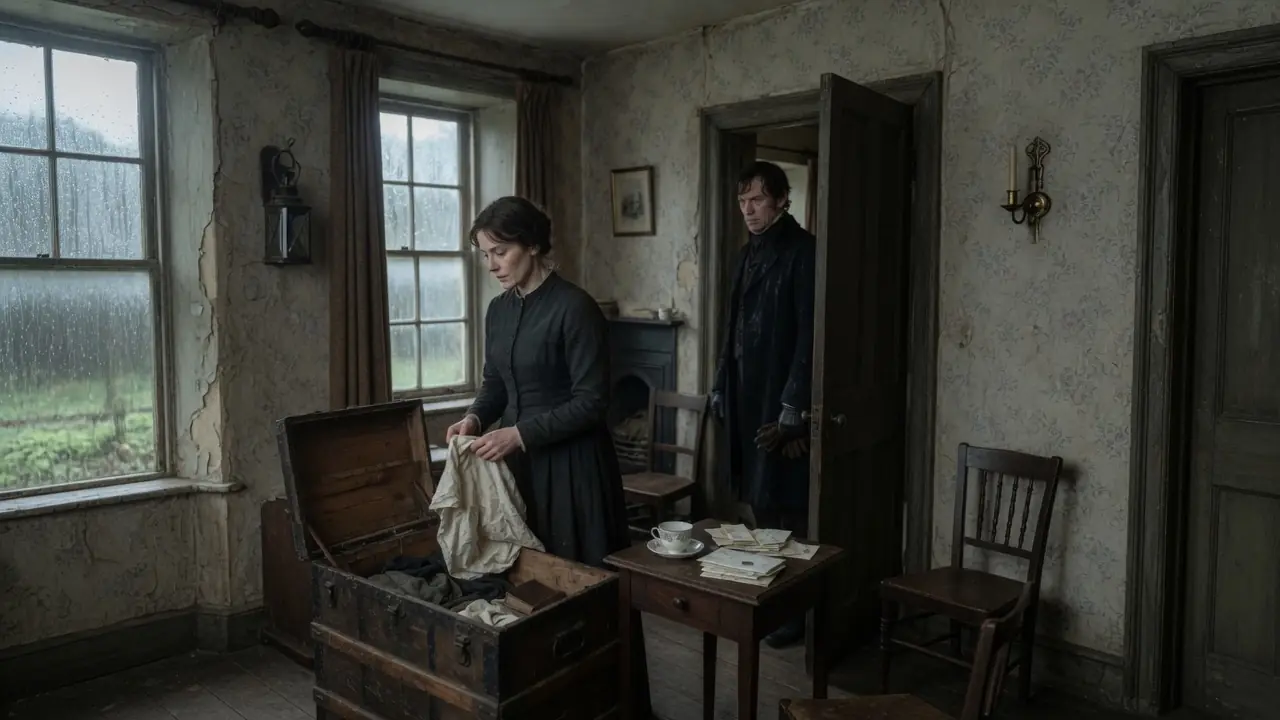
So she said only, "I will leave before evening." Lady Creswell's mouth tightened as though Rosamund had denied her the pleasure of seeing her collapse. "No wages," she said. "No reference. That was how a life ended without a funeral. By nightfall, Rosamund's trunk was half packed.
The lodging housekeeper had already begun looking at her room as though it belonged to someone else. Ladies who had once praised her manners would not answer her letters now. Mothers would hide their sons. Fathers would look too long. Every respectable door had closed before she reached it.
And now the Duke of Dover stood before her, offering a name powerful enough to silence some whispers and a house large enough to hide in. But winter was coming. Dignity would not pay rent. Pride would not buy coal. And hunger had a way of making even humiliation look survivable.
Rosamund lifted her chin. If I agree, Your Grace, I will have authority in the nursery and schoolroom. Yes. I will not pretend affection where there is none. Nor will I.
And I will not replace their mother. At that, the Duke went still. For one moment, grief crossed his face so quickly she almost missed it. "No," he said quietly. "You will not." That single answer decided her.
Not because it was tender, but because it was honest. "Then I accept." The words left her mouth before courage failed. The Duke gave one firm nod as though sealing an estate agreement. "We leave at dawn." Dover House did not look like a home.
It rose from the gray morning like a stone judgment, broad and cold, with windows that reflected the winter sky but revealed nothing inside. The carriage wheels crunched over the long drive. Rosamund watched bare trees pass one after another, each one black against the mist. The Duke had said little during the journey. That silence told her more than conversation would have.
This was a house where grief had become habit. When the doors opened, servants lined the entrance hall. Not warmly, not rudely, just watching. Their eyes moved from Rosamund's plain traveling dress to the Duke's face, then back again. So they knew.
Of course they knew. By tea, every servant below stairs would know the Duke had brought home a ruined governess and called her Duchess. Then came the boys Lionel entered first, tall for eleven, pale, straightbacked. His eyes were his father's, but harder, sharpened by anger, he was too young to carry. He looked Rosamund over once, and decided against her.
George came next, 9 years old, with a clever face and a smile that was not friendly. He seemed amused, as though she were a puzzle he intended to break. Peter lingered behind them both. Six. Small, silent.
His little hand gripped the edge of the doorway as if the room itself might betray him. The Duke removed his gloves. "Boys," he said. "This is Rosamund Finch." A pause. "She is your mother now." The word struck the room like shattered glass.
"Peter flinched." George's smile vanished. Lionel's hands curled at his sides. No, she is not. The Duke's jaw tightened, but Rosamund stepped forward before he could answer. I am not here to erase anyone.
She said gently. Lionel looked directly at her. Then his eyes were too old for his face. They all say that. The servants lowered their gazes.
George looked away. Peter stepped farther behind the door. Rosamund felt the shape of the truth. There had been others, governesses, nurses, perhaps women brought in with hope and sent away in defeat. Lionel's voice dropped.
She will leave like the others. No one corrected him. Not even the Duke. That frightened Rosamund more than the boy's anger. Her first days at Dover House were a quiet disaster.
Lionel did not shout. That would have been easier. He simply refused to obey in ways that made obedience impossible to demand. He arrived late to lessons. He answered questions with silence.
He stood whenever Rosamund sat and left whenever she began. George was worse because he smiled. He ruined his Latin copybook with perfect ink blots placed exactly where correction became useless. He mistranslated sentences on purpose, then offered explanations too clever to be accidental. When Rosamund gave him arithmetic, he completed half the page correctly and the other half with deliberate nonsense.
Peter did not misbehave. He disappeared under tables behind curtains in the corner of the nursery where no fire had been lit until Rosamund ordered it. He would not take her hand. He would not let her help with buttons. When she spoke softly, he watched her as though kindness were only another trick adults used before leaving.
The nursery itself hurt to enter. The late Duchess's portrait still hung above the mantle. Her embroidery basket remained beside the window. A ribbon, faded blue, lay tucked under a cushion, as if someone had hidden it quickly, and returned for it often. No one had cleared the room.
No one had restored it either. It was not remembrance. It was paralysis. The servants watched Rosamund with careful pity. They had seen this before.
They expected the slam door, the packed trunk, the pale-faced woman asking for the carriage before the week ended. and the Duke. He watched from a distance in doorways across dining tables from the foot of the stairs when Lionel brushed past her without bowing. He did not interfere. He did not comfort.
He seemed to be waiting to discover whether his bargain had been foolish. On the fourth morning, George tipped sand into the inkstand. On the fourth afternoon, Lionel told the footmen he did not answer to governesses. On the fourth night, Peter cried behind a locked nursery door and would not let anyone in. Rosamund stood in the hallway listening to that small broken sound and understood why every woman before her had left.
The boys were not merely difficult. They were guarding a grave. On the fifth day, Rosamund stopped trying to win. That was the first thing that changed anything. She entered the nursery after breakfast, walked to the mantle, and looked up at the late Duchess's portrait.
She had kind eyes, Rosamund said. Every boy froze. Lionel's head lifted first. You do not get to speak of her. I will speak respectfully, Rosamund replied.
Or not at all, if you prefer. George narrowed his eyes. "Most people avoid mentioning her." "Most people are afraid of grief," Rosamund said. "I am not." Peter's gaze moved to the blue ribbon half hidden beneath the cushion. Rosamund saw it, but did not touch it.
Instead, she sat at the table and opened no lesson book. "What did she like?" she asked. No one answered. Then George, too clever to resist correcting ignorance, muttered, she liked the nursery curtains open in the morning. Rosamund rose at once and opened them.
Cold light entered the room. Peter stared at the windows as though something impossible had happened. She sang after prayers, George added, then looked angry with himself for speaking. Lionel said nothing, but he did not leave. Later, Rosamund found Peter sitting with the faded ribbon clutched in both hands.
She did not ask him to put it away. She only sat nearby, far enough not to frighten him, close enough that he would not be alone. By evening, George completed three Latin lines without sabotage. Lionel still refused to call her anything at all, but when Peter dropped the ribbon, Lionel picked it up and placed it carefully beside him. Rosamund saw then what do house had hidden beneath silence, cold rooms, and defiance.
The Duke had not brought her into a house full of wicked children. He had brought her into a house where three boys were drowning, each in his own way, and no one knew how to reach them. The proposal had been practical. The marriage had been survival. But as Rosamund watched Lionel pretend not to listen while Peter whispered one small memory of his mother, she felt something far more dangerous than fear.
She felt responsibility and perhaps if she were not very careful, the beginning of love. Rosamund Finch did not punish the boys the way Dover House expected her to. That was the first thing the servants noticed. When George spoiled his copybook on purpose, she did not send him supperless to bed. She placed a harder book before him, one written in Latin too advanced for 9-year-old mischief, and said, "If you are clever enough to ruin an easy lesson, you are clever enough to survive a difficult one." George stared at her, offended for precisely 3 seconds, then bent over the page as if she had challenged him to a duel.
When Lionel refused to attend lessons, Rosamund did not chase him through the halls. She gave him charge of Peter's morning walk, the nursery fire, and the younger boy's punctuality. "You dislike being treated as a child," she told him. "Then show me the steadiness of someone older." Lionel scowled. But the next morning, Peter's boots were found by the hall, dry and ready.
and Peter, who flinched from every new kindness, received no commands at all, unless necessity demanded them. Rosamund sat beside him without crowding him. She let him keep the faded blue ribbon in his pocket. She never pulled him from beneath the table. She only placed a cup of warm milk nearby and said, "I shall be here when you are ready." By the end of the week, the nursery changed in ways no one could quite explain.
The curtains were opened each morning because George had once said their mother liked them. So the lessons began on time because Lionel hated being caught failing at his responsibility. Peter stopped hiding before breakfast, though he still sat close to the wall. Below stairs, the housemaids whispered that the new duchess had not packed her trunks. The footman noticed fewer crashes from the nursery.
Even Mrs. Vale. The housekeeper paused outside the door one afternoon and heard something Dover House had not heard in months. George arguing over a translation, Lionel correcting him and Peter listening. It was not peace. Not yet.
But it was order. And in Dover House, order felt almost dangerous because it suggested hope. Hope made Lionel. Rosamund saw it before anyone else did. The more Peter trusted her chair beside the nursery fire, the colder Lionel became.
The more George answered her difficult questions, the sharper Lionel's silence grew. One afternoon, after Rosamund praised Peter for reading three short lines without trembling, Lionel shut his book with a sound hard enough to make the little boy jump. "You think this is working?" he said. George looked up. Peter's hand closed around his ribbon.
Rosamund kept her voice even. I think Peter read very well. That is not what I meant. Lionel stood. His face had gone pale, which Rosamund was beginning to understand meant he was more hurt than angry.
You open her curtains. You ask about her songs. You sit in her chair. You want him to forget. Peter made a small sound.
George whispered, "Lionel." But Lionel's eye stayed fixed on Rosamund. "You want us to call you mother so everyone can pretend she was never here." The accusation struck harder because it came from fear, not cruelty. Rosamund rose slowly. "No," she said. "No one replaces someone loved." Lionel blinked.
She stepped no closer. Your mother was your mother before I entered this house, and she will remain your mother if I live here 50 years. Love is not a chair someone else can sit in and own. It is not a title that vanishes when another woman enters the room. Lionel looked as though he wanted to hate the answer and could not find where to begin.
"Then why are you here?" he asked. "Because grief does not cook breakfast. It does not teach Latin. It does not hold Peter when he is afraid, and it does not tell an 11-year-old boy that he may be wounded without becoming unkind. That silenced him.
He left the room without permission, but he did not slam the door. Later that evening, Rosamund found him alone by the nursery window while rain tapped softly against the glass. For a long moment, neither spoke. Then Lionel said barely above a whisper. She sang during storms.
Rosamund turned her head. Your mother. He nodded once. A hymn. Peter does not remember all of it.
Do you? Lionel's mouth tightened. Then, without looking at her, he hummed the first broken line. The storm came two nights later, and Dover House seemed to hold its breath beneath it. Rain lashed against the windows.
Wind moved through the chimneys with a low, mournful sound that made old doors tremble in their frames. Rosamund had only just extinguished her candle when the cry came from the nursery. Not loud, not dramatic, worse. A small, terrified sound quickly swallowed as though Peter had learned not to wake a house that had grown tired of grief. She was out of bed before she thought.
By the time she reached him, Peter was sitting upright, both hands clutched around the blue ribbon, his face wet with tears. George stood beside the bed, trying to appear annoyed and failing. "It was thunder," he said too quickly. "He is being foolish." "No," Rosamund said softly. "He is frightened." Peter shook his head, ashamed even through his terror.
Mama used to come. The words opened something in the room. George looked away. Rosamund sat on the edge of the bed, careful not to touch him until he chose it. Lionel told me she sang.
Peter's eyes lifted. He did. Yes. Rosamund took a breath, praying she remembered the melody correctly, and began the hymn in a voice barely stronger than the rain. The first line trembled.
The second steadied. By the third, Peter's fingers loosened around the ribbon. George sat on the rug, pretending he had done so only because standing was tiresome. Rosamund sang the verse again, softer this time, until Peter leaned against her sleeve. She did not pull him closer.
She let him come as far as he could bear. At the doorway, Lionel stood unseen by his brothers, one hand on the frame, his face stripped of defiance. Rosamund noticed him only when the candle light shifted over his shoulder. She did not stop singing. She did not expose him.
She simply finished the hymn the way he had given it to her, carefully, respectfully, without claiming it as her own. In the morning, Peter came to breakfast, pale but calm. George mocked the thunder before anyone else could. Lionel entered last. He looked at Rosamund, then at his plate.
Duchess, he said quietly. Not mother. Not affection, but not the governess either. And everyone heard the difference. After that night, the Duke began appearing less like a master of the house and more like a man uncertain how to enter his own family.
At first, he came to the nursery under practical excuses. Had Lionel attended his riding lesson? Was George's tutor sufficient? Did Peter still wake in the night? Rosamund answered each question plainly, and each time the Duke remained a little longer than necessary.
One morning he found her rearranging the boys' schedule with three sheets of paper, two broken quills, and George arguing from the window seat. "He should have mathematics before Greek," Rosamund said without looking up. "His mischief is worst when his mind is underfed." "George looked offended." "I am present. Then you may profit from the truth." The Duke's mouth moved almost into a smile. Lionel was to ride earlier in the day before restlessness spoiled his temper.
Peter was to read after breakfast, never after storms, and never with an audience unless he asked for one. The tutor was to stop treating all three boys as if grief had made them identical. They are not one sorrow divided into three bodies, Rosamund said. They are three children grieving differently. The Duke grew still at that.
She expected him to object to her certainty. Instead, he said, "You see them clearly. Someone must." The answer was not meant to wound, but it landed between them. For a moment, the room held silence. Then he nodded, accepting both the truth and the rebuke.
Soon, Rosamund's influence reached beyond the nursery. She noticed that estate accounts had been delayed because letters from tenants sat unopened in the study. She reminded the housekeeper that Peter ate better when served before the older boys began quarreling. She asked why the east corridor remained unheated when the children passed through it each morning. Small things, domestic things, necessary things.
And the Duke watched, not with desire, not yet, not with the softness of a man in love. He watched as a man seeing competence where he had expected gratitude. He had married her because his sons needed care. But now he was beginning to understand that care was not gentleness alone. Sometimes it was structure.
Sometimes it was courage. Sometimes it was a woman standing in the heart of his neglected house and quietly putting everything back in order. The change became impossible to deny at dinner. Rosand had not planned anything grand. She had only insisted that the boys dining with their father twice a week instead of being hidden in the nursery as though grief were poor manners.
The first attempt had been stiff. The second had ended with George correcting the footman's pronunciation of a French dish and Lionel pretending not to laugh. But on the third evening, something broke open. Peter dropped a pea into his glass by accident. George whispered that it had drowned nobly.
Peter made a sound halfway between a gasp and a laugh. Lionel tried to stop himself, failed, and covered it with a cough so unconvincing that George laughed too. Rosamund lowered her eyes to her plate, but her mouth betrayed her. The Duke looked up from the head of the table. For one suspended moment, he seemed not to recognize the sound.
Laughter in his dining room from all three of his sons. Not forced, not polite, real. Peter, encouraged by the miracle of not being scolded, whispered, "The pee was very brave." George said solemnly, "A soldier of great vegetable courage." Lionel laughed, then truly laughed, and the sound changed the room. The servants at the wall looked startled. Mrs. Vale, passing the open door, stopped as if she had heard music from a locked room.
The Duke said nothing for several seconds. His gaze moved from Peter's small smile to George's bright eyes, then to Lionel's loosened shoulders, and finally to Rosamund. She was not performing triumph. She was not waiting to be praised. She was simply there, steady as a candle that had refused to go out.
Later, when the boys had gone upstairs, the Duke remained standing beside the dining room hearth. They laughed, he said, as though the words were difficult to believe. Yes, Rosamund replied. Children often do when they are not afraid it will be taken from them. He looked at her then, and something in his expression shifted again.
Not love, not yet, but less distance, less emptiness. He had married her for practical reasons. He had brought her to Dover House because his sons needed a mother and she needed a home. Yet for the first time since his wife died, the great cold house did not feel entirely abandoned. It felt as though someone had opened a door and let life enter quietly.
The storm rose without warning, a wall of black clouds sweeping across the cliffs, tossing rain and wind across the tenant cottages and farmland. Horses shied, fences snapped, and the low-lying fields flooded as the sea spilled into the meadows. The Duke of Dover mounted his horse with no hesitation, boots soaked, coat plastered to him, face pale but resolute, he rode straight into the chaos to inspect the property, check on tenants, and ensure the land survived the tempest. Lionel, 11, could not bear to stay behind. I am coming with you, he shouted, his voice sharp with equal parts fear and pride.
Rosamund intercepted him in the hall, hands on his shoulders. Lionel, you are not my son. You are his. You are safe here. I will not let you risk yourself.
His fists clenched. You are not my mother. The accusation struck like a whip, hot and cruel. Rosamund remained calm, her voice steady against the howl of the wind. No, but I still intend to protect you.
He shoved her lightly, testing, furious, frustrated, helpless, and she did not flinch. She simply held her ground. In that single moment, the boy saw for the first time that authority did not have to mean cruelty, that care could be firm without being fearsome. He could not follow, and yet he could not hate her. He only watched, powerless, as she carried out the protection he could not claim for himself.
The storm outside was violent, but the storm within the boy, the ache of grief and anger, met something steadier than he had known. By nightfall, the Duke returned, drenched, mud spattered across his boots, cloak heavy and dripping. His hands were scraped from brambles, his face pale, jaw tight from exhaustion, eyes dark with strain. Rosamund met him at the door and quietly set to work, removing the wet coat, cleaning the cuts, dressing the scrapes, offering warm water to wash the grime of the day from his face. He did not speak at first, only leaned against the door frame, silent, watching her hands move.
When she wrapped a dry cloak around him, he studied her as though he had never noticed her before. "I trust you," he said quietly, almost reluctantly, not fully knowing he had just spoken aloud what he had felt since the morning. And he realized with a start that he had begun to rely on her, not merely for the boys, but for the estate, the household, and himself. loneliness, the companion he had carried like armor since his wife's death, showed itself in his eyes. Rosamund only stood there, calm, a steadying presence.
She did not lecture. She did not scold. She simply existed as a constant, as someone reliable. That silence became intimacy. He saw the weight of trust, the dangerous burden of allowing another person into the gaps of grief he had long ignored.
He had expected a governess, perhaps a competent household manager, someone to obey orders and maintain order. Instead, he saw a woman quietly taking responsibility for everything he feared could crumble, and she did it without asking for thanks, without pretense. He did not yet call it love, but he understood that care, quiet and unwavering, could plant roots in hearts long barren. The house felt smaller now, tighter, because the walls held less isolation and more quiet strength. For the first time, he recognized that someone could stand beside him and not collapse under grief.
Meanwhile, the world beyond Dover House whispered with sharpened tongues. At Sunday service, eyes followed Rosamund across the aisle, lips curling into faint, condescending smiles. She trapped him, a woman muttered, clutching her prayer book too tightly. A ruined governess and now a duchess, another said softly, letting the words linger. By Tuesday, merchants, churchgoers, and neighbors were repeating the tale in harsh tones.
Lionel overheard one insult aimed at her, hurled casually in the schoolyard by a boy, unaware of the storm it would unleash. Without thinking, he struck him, fists tight, voice trembling with fury. She is not that. You do not know her. George, nine, hovered behind, carefully observing, quietly, siding with her in his own subtle way, lips pressed into a thin line.
Peter, small and six, hid behind Lionel, blue ribbon clenched like a talisman. Rosamund arrived in time to steady Peter without speaking, her calm presence enough to quell his shaking hands. She allowed Lionel's anger to exist, did not scold George for his quiet support, and acknowledged Peter's instinct to protect her, no words needed. In this moment, the boys were no longer merely pupils or charges. They were actively choosing her, defining her place in their lives.
And Rosamund, watching their reactions, realized the danger of what she had built. She could lose them, not to scandal, not to gossip alone, but to the fragile uncertainty of trust, which could be broken by rumor, by fear, or by her own misstep. This household, already recovering from grief, had begun to shape around her authority, and every whisper beyond its walls was a threat to that careful balance. The Duke began to intervene publicly, subtly at first, then unmistakably. At the next social gathering in town, whispers trailed them, but he stood beside her, erect and firm, voice clear.
This is Rosamund, Duchess of Dover. He spoke as though he were daring anyone to question her, his eyes scanning the crowd with quiet command. The boys, witnessing the moment, stiffened, then relaxed. Lionel's shoulders uncoiled. George smirked faintly, acknowledging her authority with silent approval, and Peter, cautious but brave, stayed near her side.
Blue ribbon held close. Rosamund felt fear twist in her stomach. She could lose more than her own reputation. Every glance she caught between father and sons, sons and herself, carried meaning. The house, long cold, seemed to inhale for the first time in months, responding to the small but deliberate claim she made of her place.
Practical marriage, survival. But this this was subtler, fragile, dangerous. A family forming not by necessity, but by quiet choice, by trust, by moments she did not force, but earned. Each moment in public reinforced what she had begun to learn in the nursery. Authority paired with compassion could create a home even from grief.
Then one late afternoon, Lady Mabel Ashkam arrived. She stepped from her carriage with icy elegance, gloves white, posture straight, eyes sharp and calculating. The moment she entered Dover House, tension vibrated through walls, servants and children alike. Rosamund, she said, voice low and smooth. The replacement, the words landed like blows.
Every child stiffened. George's jaw tightened. Peter gripped his ribbon with white knuckled hands. Lionel's eyes flared, chest rising and falling. Rosamund turned, meeting her gaze.
Mabel moved with the certainty of power. elegant, cold, and dangerous, deliberately ignoring the Duke's presence and the boy's shocked expressions. I intend to claim what is rightfully mine, Mabel continued. Each word was deliberate, each step measured. The children, the estate, they are not for negotiation.
The Duke immediately stepped forward, hand resting lightly on Rosamund's shoulder, a silent claim of his authority and their bond. The boys tightened around her instinctively, protective, wary, small shields of loyalty. Rosamund understood clearly that the storm had returned, not from the sea, but from the drawing room itself. This was no longer about obedience or lessons. It was about her place, her authority, and her right to protect the boys she had begun to love.
and she knew in that instant with the chill of certainty that nothing in Dover House would ever be simple again. Lady Mabel Ashkam arrived at Dover House like a storm without warning, carrying elegance sharp enough to cut through the household. Her eyes scanned the rooms cold and calculating, landing on Rosamund with a thin smile that promised judgment. A governess made duchess, she said, her voice carrying easily to the servants and children, each word dripping with disdain. I never thought I'd see such audacity.
Rosamund remained composed, but every nerve in her body tightened. Mabel did not pause. She questioned her upbringing, her family, her education, all insinuations layered with insult. Surely you do not imagine yourself fit to govern three noble boys," she asked, arching a perfectly shaped brow. She weaponized the practical nature of Rosamund's marriage as if the bargain itself were a crime.
"Your Grace acted irrationally in marrying beneath your station," Mabel said, turning to the Duke, her word sharp as a blade. "Do you not see the danger you've allowed into your household? Every syllable hit with precision, designed to make the household doubt, to make the children tremble, to make Rosamund question herself. She held her gaze steady, refusing the urge to flinch, but the words landed nonetheless. Dover House, long accustomed to cold formality, seemed to shrink in response, holding its breath as the elegant enemy circled like a hawk, testing defenses, testing loyalty, testing courage.
She was the first real threat Rosamund had faced, a threat built not on violence, but on reputation, societal expectation, and the sharpness of words. And yet, beneath the fear, Rosamund felt the stirrings of resolve. She had entered this house to protect these children, and she would not yield because a woman in silk and pearls believed herself superior. The first battle was psychological, and Mabel was merciless. The boys reacted as one might expect when a storm of gossip and accusation hits young hearts unprepared.
Peter, small, timid, and six, clutched the blue ribbon that had become his talisman of comfort, shaking as if the very air had turned against him. His eyes, wide, and frightened, followed Mabel as she moved through the hall. George, clever but impulsive, pounded the floor with his fist, muttering angry words under his breath, plotting imagined retribution. Lionel, older and more guarded, hid himself in the shadows near the library doorway, listening intently as the house whispered legal conversations he was not meant to understand. Words like custody, petition, and removal carried weight beyond his age, setting his mind spinning with fear, anger, and the faintest flicker of hope that he could somehow intervene.
Rosamund, feeling the tension ripple through each child, drew them close, even as her own chest tightened with worry. She held Peter's trembling hands, whispered quietly to George to breathe, and allowed Lionel the small space to witness her resolve without fear of overreaction. She did not promise safety. She promised attention, presence, and steadfastness. The boys clung to that assurance in their own ways.
Rosamund realized that fear was contagious, but so too was calm courage. She had not yet spoken in defense, had not yet faced the threat directly, but simply by being present, she became their anchor. The house was no longer merely walls and furniture. It was a crucible in which loyalty, courage, and love were tested daily. The children were learning quickly what she had known from the start.
She would not leave them, and her presence was neither convenient nor pretense. She would fight in her own way. Late that evening, when the house had settled into uneasy quiet, and Peter slept with his ribbon clutched, the Duke sought Rosamund in the study. He entered silently, removing his gloves, mud still clinging to the edges of his boots. For a moment, neither spoke.
Finally, he admitted with a tone that surprised even himself. I did not expect to care whether you stayed. Rosamund paused, letting the words linger, aware that every pause was weighted with vulnerability. She stepped closer, her voice calm but firm. Do not mistake gratitude for affection, she said softly.
You may be relieved, I remain, and that relief may feel like warmth, but it is not love. He did not argue. He only looked at her, eyes darkened with exhaustion and emotion, recognizing her honesty for the first time as a challenge rather than a comfort. Emotional tension thickened between them, unspoken yet palpable. A quiet storm echoing the one that had struck the coast days before.
They spoke then of the children, the household, the storm's impact on tenants and the land, sharing responsibilities and burdens that until now had rested solely on the Duke's shoulders. In admitting his loneliness, he allowed her entry into a world he had sealed off. She did not flinch. She accepted the trust with steady hands and careful words. In that silence between confessions and reassurances, the first real intimacy emerged, unacknowledged and fragile, yet undeniable.
Preparation for the legal hearing began quietly but with growing tension. Rosamund reviewed letters, took careful notes, and considered leaving entirely to spare the boys the attention and humiliation Mabel's petition would bring. She imagined over a house without her, a cold, orderly, bereff place. She pictured Peter trembling under the scrutiny of strangers. George frustrated and silent, Lionel angry and defiant, but vulnerable in ways only she could understand.
Unbeknownst to her, Lionel had overheard fragments of discussion between lawyers and house staff, the mention of her name in conjunction with custody, the words unsuitable and practical marriage. his chest tightened. Anger, fear, and a fierce protective impulse combined. He approached her later, voice sharp, trembling slightly. You cannot leave.
Rosamund looked at him, caught off guard by the intensity, yet her expression softened. "I had considered it," she admitted. "To save trouble. To shield you from gossip." Lionel's eyes narrowed, unwavering. No, I do not care what trouble it brings.
You cannot leave us. She reached for his hand, firm but gentle. I am not going anywhere, Lionel. Not for storms, not for gossip, not for her. The quiet rebellion in the boy, the fierce claim of loyalty reminded Rosamund that this was no longer merely a household she managed.
It was a family she protected with children who would fight as much as she would. The day of the court hearing arrived cold and clear. Dover House felt smaller than usual, tense, and anticipatory. Mabel's lawyers struck first, their voices sharp, words clipped and polished to attack Rosamund's reputation. They questioned her motives, insinuated she had manipulated the Duke, and suggested the marriage was purely practical, unworthy of her new title.
Rosamund listened without interruption, head held high, eyes calm, letting their accusations hang in the air. The boys, under her careful guidance, stayed near, tense and protective. Lionel's hands curled, George's jaw tightened. Peter clutched his ribbon as if it could anchor the fragile home they had built. The Duke remained silent at her side, standing as witness and shield.
Questions of morality, propriety, and intent were fired like arrows. Yet Rosamund remained steady. Every word, every movement a quiet declaration. She would not be removed. The courtroom seemed to hold its breath as she waited for her turn to speak, knowing the eyes of society were upon her, judging every inflection, every glance.
At the chapter's close, no verdict had been delivered, but the tension was unbearable. Every whispered accusation, every icy glare, every protective glance from the children reinforced the stakes. Dover House hung in balance, and Rosamund understood clearly that this battle was not yet won. The woman who sought to remove her had begun, but the fight, the war for her place and her family had only just begun. Rosamund Finch stood in the courtroom with every eye fixed upon her, and for the first time since her disgrace, she did not try to hide the truth.
Mabel's solicitor had asked the question with triumph in his voice, as though one honest answer would destroy her. Did you marry the Duke of Dover because you needed shelter? The room went utterly still. The Duke turned slightly toward her, but Rosamund did not look at him. She looked at the judge.
"Yes," she said. A murmur passed through the room at once, sharp and hungry, the sound of society preparing to enjoy a woman's ruin. Mabel's mouth curved in satisfaction. Lionel stiffened. George's eyes flashed.
Peter clutched the faded blue ribbon so tightly his knuckles paled. But Rosamund did not retreat. Yes, she repeated, "Stronger now. I needed shelter. I needed protection.
I had been dismissed without wages and without reference. A lie had damaged my name, and there was no respectable door left open to me." The solicitor leaned forward. Then the marriage was a bargain. It began as one. Rosamund answered.
His grace needed stability for his sons, and I needed a place where I could survive. Neither of us pretended otherwise. The room stirred again, but this time the sound was different. It was not triumph. It was uncertainty.
Rosamund lifted her chin. But I did not stay because of shelter. Mabel's smile faded. I stayed because three boys were grieving in a house where everyone had grown afraid of their sorrow. I stayed because Lionel's anger was not wickedness.
George's mischief was not cruelty. Peter's silence was not disobedience. They were children who had lost their mother and then watched every other woman leave. Her voice softened but did not break. I did not come to replace the late Duchess.
I kept her portrait in the nursery. I opened the curtain she loved. I let Peter keep her ribbon. I learned the hymn she sang during storms. I honored her because they loved her.
And because no child should have to bury his mother twice, once in death and again in silence. By then no one in the courtroom was whispering. Rosamund looked once at the boys. I needed a home, but I stayed because I love them. For one suspended moment after Rosamund's words, the courtroom seemed afraid to breathe.
Even Mabel's solicitor hesitated, as though the answer he had hoped would shame her had instead exposed something he could not touch. Then Lionel stood. No one had called him. No one had asked him to speak. He rose from the bench beside his brothers with his shoulders rigid and his face pale, and the Duke moved as if to stop him.
But Rosamund only turned slightly, watching him with quiet trust. "May I speak?" Lionel asked. His voice was not loud, but it carried. The judge studied him for a moment, then nodded. Lionel stepped forward.
Every inch the son of a duke and every inch a frightened boy trying not to show it. She stayed, he said. That was all at first. Two words. But they struck harder than any argument.
He swallowed and continued. I tried to make her leave. I ignored her. I insulted her. I told her she was not my mother.
His eyes flicked toward Rosamund and quickly away. She never said she was. She never took Mama's portrait down. She never told Peter to stop crying. She stayed.
George rose next, unable to remain silent now that truth had become permitted. "She understood me," he said, chin lifted with angry dignity. "Everyone thought I was difficult because I like making trouble. She knew I was bored. She gave me harder work.
She noticed. The words were simple, but George spoke them as if being understood was a greater inheritance than land. Then Peter, small and trembling, slipped from the bench with the blue ribbon in his hand. The room softened before he even spoke. He walked to Rosamund's side and looked up at the judge.
She sings Mama's hymn, he whispered. A sound moved through the courtroom then. Not gossip, not judgment, but feeling. Women lowered their eyes. Men shifted uncomfortably.
Even the clerk stopped scratching his pen across the paper. Peter added very quietly, but she says it still belongs to Mama. Rosamund's breath caught. Lionel came to stand beside her. George followed, pretending he did not care that his eyes were bright.
The three boys placed themselves around her without instruction, without permission, without fear. And in that moment, before any verdict was spoken, the courtroom understood what Mabel had failed to understand from the beginning. Rosamund had not stolen her family. She had been chosen by one. The judgment, when it came, was almost quiet after such a storm.
The judge folded his hands, looked first at Mabel, then at the Duke, then at Rosamund, and the three boys gathered near her as if they had always belonged there. This court finds no sufficient cause to remove the children from their father's care, he said. Mabel went still. Nor does it find evidence that her grace, the Duchess of Dover, has acted with improper influence, neglect, or harm toward the children. The word duchess landed heavily, publicly beyond Mabel's reach.
Lionel exhaled as though he had been holding his breath for weeks. George's mouth twitched, triumphant and nearly indecent for a courtroom. Peter pressed himself against Rosamund's side. The judge continued, the custody petition is dismissed. The room erupted, not loudly, not chaotically, but with the unmistakable shift of society reversing itself.
The very people who had whispered against Rosamund now looked at Mabel with new caution. Her victory had depended upon proving that a practical marriage was shameful, that a governess could not be a duchess, that love born after necessity was somehow false. Instead, she had forced three grieving boys to declare before witnesses exactly where their hearts belonged. Worse still for Mabel, the hearing loosened another truth. A letter was produced from a former servant in the Creswell household, one who admitted Lady Creswell had dismissed Rosamund not because she had behaved improperly, but because Lady Creswell's son had pursued her and been refused.
The old scandal did not vanish in an instant. Society rarely surrendered cruelty so cleanly, but it weakened. It cracked. People who had enjoyed Rosamund's humiliation now had to consider whether they had been accomplices to a lie. Lady Mabel Ashkam left the courtroom with her back straight, her face cold, and her pride visibly wounded.
No one stopped her. No one followed. That was her punishment. Not ruin, not drama, but the silence of a room that no longer believed her. Outside the Duke stood beside Rosamund where everyone could see.
He did not hide her behind title or duty. He offered his arm and when she placed her hand upon it, Lionel took Peter's hand. George fell into step beside them, and together they left as a family. Not perfect, not untouched by grief, but no longer divided by it. Back at Dover House, the silence felt different.
It was not the old silence of grief, the one that had once settled over the halls like dust. This silence was tender, exhausted, almost disbelieving. The boys had been sent upstairs with warm supper and strict instructions to rest, though George argued that surviving a custody hearing surely entitled him to cake. Peter would not release Rosamund until she promised to come to the nursery before sleep, and Lionel, after pretending indifference, paused at the stairs, and looked back at her with something close to trust. Only when the children were gone, did the Duke turn to Rosamund in the drawing room.
The fire burned low. Rain tapped softly against the windows, gentler now than the storms that had brought them to this point. For a long moment, he said nothing. Then he spoke with a quietness that made the words more powerful. I once thought I needed a mother for my sons.
Rosamund's hands tightened together. That is what you asked of me. No, he said. It is what I thought I asked. He stepped closer, not as a duke commanding his household, but as a man finally stripped of every defense grief had taught him to wear.
I thought I needed someone competent, someone steady, someone who would not be frightened away by anger, cleverness, or sorrow. I thought I was offering protection in exchange for service. His voice roughened. But you became the heart of this house. Rosamund looked away, afraid of how much she wanted the words to be true.
"Your Grace..." Rosamund began. "Alistair," he said softly. The name changed the room. He had never sounded less like a duke. You became Peter's comfort, George's challenge, Lionel's courage. You became the person I looked for whenever the house began to feel empty again.
And I love you, Rosamund. Not as duty, not as convenience, not because my sons need you. He paused. Because I do. The confession left her trembling more than Mabel's accusations ever had.
Do not say it if it is only gratitude, she whispered. It is not. His answer came at once. Rosamund searched his face and found no bargain there, no calculation, no cold necessity, only a man who had been lonely too long and had finally chosen to stop pretending he was not. "Then I love you, too," she said.
"Not because you saved me, because you let me belong." Months later, Dover House no longer seemed like a monument to loss. The curtains were opened every morning. Fires burned in the rooms the children used. The nursery rang with voices, quarrels, lessons, laughter, and the occasional crash that George always insisted had been caused by gravity rather than by him. Peter no longer hid beneath tables when visitors came.
He still carried the faded blue ribbon sometimes, especially during storms. But now he brought it to Rosamund, not as a shield, but as a treasure to be guarded between them. George had become more difficult in a better way, forever demanding harder books, harder sums, harder questions, and pretending he had never once needed anyone to notice his mind. Lionel changed most quietly. He still argued.
He still carried his pride like armor, but he no longer used anger to keep everyone at a distance. Some evenings he stood near Rosamund in the nursery without speaking, and that was enough. The Duke watched all of it with a wonder he rarely confessed aloud. His house had not forgotten the late Duchess. Her portrait remained in its place.
Her hymn was still sung when thunder crossed the cliffs. Her memory had not been erased by happiness. It had been given room to breathe. One evening after prayers, Peter leaned sleepily against Rosamund's knee while George tried to correct Lionel's recitation, and Lionel told him to mind his own scripture. Rosamund hushed them both, though she was smiling.
Then Peter, half asleep and entirely unguarded, whispered, "Good night, Mama." The room stopped. George looked down at his hands as if the carpet had become fascinating. The Duke went utterly still. Lionel's face changed just for a moment. With shock, then tenderness he tried to hide.
Rosamund did not move at first. Then she bent and kissed Peter's hair. "Good night, my darling," she whispered. George sniffed and muttered that he was tired, but his voice was suspiciously thick. Lionel said nothing.
During the final prayer, however, his hand slipped into Rosamund's, small enough still to be a child's, strong enough to choose. She held it gently, not claiming more than he gave. Rosamund had come to Dover House needing a home.
The Duke had needed a mother for his sons. But what they built became something neither bargain nor duty could have created. It became a family chosen by love.