Elira had spent most of her life learning how to become invisible.
In the palace of Raventhorn, invisibility was not magic. It was survival. It meant walking close to the walls, lowering her eyes before noblewomen passed, swallowing hunger before it showed on her face, and apologizing for things she had not done because servants who defended themselves were called insolent.
She was eighteen years old, though no one in the palace ever celebrated the day she was born.
The oldest cook guessed she had been found as an infant after the great nursery fire and taken in “out of pity,” which was a cruel sort of kindness because pity in Raventhorn always came with a bucket, a broom, and a corner beside the kitchen hearth. Elira had no family name. No inheritance. No ribboned portrait in the Hall of Bloodlines.
She had only her work.
And her work began before sunrise.
Every morning, Elira scrubbed ash from the kitchen stones until her hands went numb. She polished silver candlesticks for feasts she would never attend. She carried baskets of linen heavier than her shoulders should have borne and cleaned fireplaces in rooms where royal cousins slept beneath embroidered blankets.
By dusk, her knees ached from kneeling.
By night, she slept in a narrow alcove beyond the pantry, where flour dust softened the air and mice sometimes rustled behind the sacks of grain.
She told herself it was enough.
A roof was enough. Bread ends were enough. A blanket, even thin and scratchy, was more than some had. That was what the head housekeeper told her whenever Elira looked too long at the warm light spilling from the royal chambers.
“You should be grateful,” Mistress Veyra would say. “A girl like you could have been left outside the gates.”
A girl like you.
Elira had heard those words so many times they had become part of her name.
The girl with no family.
The girl with no place.
The girl with no right to ask.
But deep inside, in a place she was ashamed to admit still existed, Elira sometimes felt something else.
Not pride exactly.
Not memory.
A strange ache, as if some forgotten part of her knew she had once been held gently.
It made no sense.
So she buried it.
The palace did not make room for impossible feelings.
On the morning of the Winter Ascension Ball, the entire palace woke before dawn.
Raventhorn’s greatest nobles were arriving from every province to honor King Aldric’s twenty-fifth year on the throne. Carriages rolled through the front gates before breakfast, their wheels crushing frost into glittering mud. Servants ran through corridors with garlands of white roses, silver trays, crystal goblets, and folded banners bearing the royal symbol: a golden phoenix rising from blue flame.
Elira had polished that phoenix so many times she could draw it with her eyes closed.
It was carved into the ballroom doors.
Woven into the king’s cloak.
Stamped into the wax seals on royal decrees.
Painted across the ceiling above the throne platform, where its wings spread wide as if guarding the kingdom.
Elira used to stare at it when she was small.
She liked the idea of a creature that could burn and still return.
Then Lady Seraphine caught her looking one day and slapped her hard enough to split her lip.
“Servants do not admire royal symbols,” Seraphine had said. “They clean beneath them.”
Elira never looked up for long after that.
Lady Seraphine Vael was the king’s niece, twenty years old, beautiful in the sharp, polished way of a dagger kept in velvet. Her hair was pale gold, her gowns always chosen to make others feel underdressed, and her smile never reached her eyes unless someone else was suffering.
Everyone in the palace knew Seraphine was likely to inherit favor if the king never named another heir.
King Aldric had no living child.
At least, that was what the kingdom believed.
His queen had died eighteen years earlier in the fire that consumed the royal nursery. The infant princess had vanished in the flames, presumed dead. For years, the king had searched the lands for traces of his daughter, then searched more quietly, then finally stopped speaking of it at all.
People said grief had hollowed him.
Elira had seen him only from a distance.
A tall man now silver at the temples, with tired blue eyes and a face that seemed built to carry sorrow without complaint. He passed through halls surrounded by advisers, guards, nobles, petitions, and duties. Servants bent low whenever he appeared.
Elira bent lower than most.
Not because she feared him.
Because some strange trembling always entered her chest when he walked near.
She hated herself for it.
Kings did not look at kitchen girls.
And if they did, it was to ask why the floor had not been swept.
By late afternoon, the palace was glowing.
Hundreds of candles burned in mirrored sconces. Musicians tuned violins near the ballroom dais. Noblewomen moved through the corridors like living jewels, their gowns whispering silk and their perfume crowding the air.
Elira wore a plain gray servant’s dress mended at both elbows.
Mistress Veyra had ordered her to help carry wine into the ballroom, then return immediately below stairs.
“Do not linger,” the housekeeper warned. “Do not stare. Do not embarrass the household by looking hungry.”
Elira lowered her head.
“Yes, Mistress.”
She carried two crystal decanters on a silver tray, her wrists aching beneath the weight.
The ballroom doors stood open.
For one moment, as she entered, she forgot to breathe.
The room was a sea of gold and candlelight. Velvet curtains framed tall windows frosted white at the edges. The marble floor reflected chandeliers like stars caught under ice. The nobles shimmered in blue, emerald, ivory, and crimson.
At the far end of the room, King Aldric stood beneath the phoenix crest.
Beside him stood Lady Seraphine.
Her gown was silver threaded with pearls, and around her throat rested a necklace shaped like the royal phoenix. She was laughing at something a duke had said, tilting her head just enough to show the line of her neck.
Elira looked away quickly.
Too late.
Seraphine saw her.
The lady’s smile sharpened.
Elira felt it before she heard her name.
“You there.”
The room did not go silent, but the air around Elira seemed to shrink.
She stopped with the tray still in her hands.
Seraphine lifted one gloved finger.
“Come here.”
Elira obeyed.
Every step across the marble felt too loud.
When she reached the edge of the royal platform, she lowered her gaze.
“My lady.”
Seraphine looked her over slowly.
“What a sight. Did they send you from the kitchens or from the ash pit?”
A few nobles nearby laughed softly.
Elira’s face burned.
“I was told to bring the wine, my lady.”
“Were you told to drip misery across the ballroom too?”
Elira glanced down.
Her hem was damp from melted snow near the servants’ entrance. A dark line had formed where the wet cloth touched the marble.
“I’m sorry,” she whispered.
Seraphine took one of the decanters from the tray and held it to the light.
“Sorry. Servants are always sorry after making themselves seen.”
King Aldric turned slightly at the sound of Seraphine’s voice, but another adviser leaned close to speak into his ear. He did not intervene.
Elira told herself she did not care.
She had become very skilled at surviving moments no one stopped.
Seraphine set the decanter down on a nearby table and stepped closer.
“You know,” she said, loud enough for the nearest nobles to hear, “this girl has always had a strange way of looking at royal things. The crest, the gowns, the throne. As if she believes she belongs in the room.”
Elira’s stomach tightened.
“I don’t, my lady.”
“Don’t what?”
“I don’t believe that.”
“Good.” Seraphine smiled. “Because you do not.”
The tray trembled in Elira’s hands.
One of the goblets chimed softly against the decanter.
Seraphine’s eyes flashed.
“Careful.”
Elira steadied it.
“I’m sorry.”
There it was again.
The only shield she was allowed.
Seraphine’s gaze drifted toward a silver basin near the refreshment table, filled with ice water meant to chill bottles of winter wine. A thought formed behind her eyes.
Elira saw it and felt fear move coldly down her spine.
“My lords and ladies,” Seraphine said lightly, “perhaps our little ash girl needs a lesson in remembering her place.”
Elira took one step back.
“My lady, please. I’ll return below stairs.”
“No.” Seraphine’s voice softened. “You will stay.”
The nobles near them quieted now.
Some looked amused.
Some uncomfortable.
None moved.
Seraphine took the silver basin with both hands.
The ice shifted inside it with a glassy clatter.
Elira froze.
For reasons she did not understand, terror seized her more sharply than humiliation. The sight of the water made her skin prickle. Her left shoulder, just below the collarbone, began to ache with a heat that made no sense.
Seraphine noticed.
Her smile faltered for one small instant.
Then widened.
“Look at her,” she said. “Afraid of a little water.”
Elira whispered, “Please.”
That was all.
Not a speech.
Not a defense.
Just a plea.
Seraphine poured the basin over her.
The cold struck like a blade.
Ice water crashed over Elira’s head, down her hair, across her face, beneath the collar of her dress. The shock stole her breath. The tray slipped from her hands and hit the marble with a violent crash, crystal shattering around her bare feet.
The ballroom fell silent.
Elira stood drenched and shaking, wet hair clinging to her cheeks.
A few nobles gasped.
Someone laughed once, then stopped.
Because something had begun to glow.
At first, Elira thought the light came from the broken glass at her feet.
Then she saw the faces around her.
They were not looking at the floor.
They were looking at her shoulder.
Slowly, trembling, Elira looked down.
Through the soaked gray cloth, beneath the torn edge where the dress had slipped, a golden mark shone on her skin.
A phoenix.
Small, perfect, radiant.
Its wings spread across her upper chest in lines of light, the same shape as the crest above the throne.
The same phoenix carved into every royal seal.
The same phoenix that had watched over her while she scrubbed floors beneath it for eighteen years.
The king went completely still.
The adviser beside him stopped speaking.
Seraphine’s basin fell from her hands and rang against the marble.
“No,” Seraphine whispered.
But the word did not sound like disbelief.
It sounded like recognition.
King Aldric descended from the platform as if in a dream.
Each step was slow.
Careful.
His face had gone pale, and his eyes fixed on the glowing mark with such naked pain that Elira wanted to hide from it.
She wrapped her arms around herself.
“No,” she whispered. “No, I’m nobody.”
The king’s expression broke.
“That is what someone wanted you to believe.”
The room seemed to tilt.
Elira shook her head harder.
“I clean the kitchens. I sleep beside the pantry. I have no name.”
“You do,” the king said.
His voice trembled.
He reached beneath his cloak and removed a pendant from a chain around his neck. The gold was old, worn at the edges from years of being held. Engraved on its surface was the royal phoenix, its wings matching the mark now shining on Elira’s skin.
“When my daughter was born,” he said, tears filling his eyes, “the palace healer placed a royal blessing upon her. A mark of blood and flame. It appears only beneath freezing water.”
A whisper moved through the nobles.
“No impostor could claim it,” he continued. “No paint could mimic it. No jewel could cast it.”
Elira stared at the pendant.
Something inside her lurched.
Not memory.
Something beneath memory.
A warmth from long ago. A lullaby without words. A hand brushing her cheek. A voice calling her little flame.
Her knees weakened.
“This is my home?” she asked.
Her voice was barely more than breath.
She looked around the ballroom.
The gold walls.
The velvet curtains.
The crystal chandeliers.
The noble faces that had laughed while she shivered in rags.
“This is my home?” she repeated. “Then why was I sleeping beside the kitchens?”
The king stopped.
The question hit him harder than any accusation could have.
His lips parted.
No answer came.
Because there was none.
He had searched the kingdom for a princess while a servant girl scrubbed ash inside his own palace. He had mourned a child in portraits while the living child carried coal past his council chamber. He had trusted systems, advisers, relatives, servants’ rolls, old reports, official accounts.
And all the while, his daughter had been beneath his roof.
Unseen.
Unnamed.
Unprotected.
King Aldric lowered his head.
“I failed you.”
The words stunned the room.
Kings did not speak that way.
Not in public.
Not before nobles.
Not before servants.
Elira stared at him, dripping water onto the marble floor.
“You don’t even know me,” she whispered.
His eyes lifted, full of grief.
“No. But I should have.”
The honesty was worse than denial.
It gave her nothing to fight.
Then Seraphine laughed.
It was a sharp, ugly sound.
Everyone turned.
She stood near the fallen basin, her silver gown untouched by water, her face twisted with fear trying to become contempt.
“How touching,” she said. “The lost princess appears in rags and everyone bows.”
The king turned slowly.
“Seraphine.”
She looked at him, and for the first time, the mask cracked fully.
“She should have died in the fire.”
The ballroom froze.
A noblewoman gasped.
Someone dropped a glass.
Elira stopped shaking.
Not because she was warm.
Because the words had struck so deep that even fear had gone quiet.
The king’s voice turned hollow.
“What did you say?”
Seraphine realized too late that rage had spoken before strategy.
For a second, she looked like a child caught with blood on her hands.
Then her pride rose to rescue her.
“I said what everyone was thinking.”
“No,” the king whispered. “No one was thinking that but you.”
Elira stared at Seraphine.
“You knew me?”
Seraphine’s mouth tightened.
“My mother knew.”
The king took a step toward her.
“Your mother?”
Seraphine’s mother had been Lady Orielle, the queen’s sister. She had died twelve years ago, mourned as a loyal member of the royal family.
Seraphine’s voice sharpened.
“She knew what your birth meant. She knew that with the princess alive, I would never be more than a cousin smiling beside a throne that should have had room for me.”
The king’s face filled with horror.
“Orielle started the nursery fire.”
Seraphine smiled bitterly.
“She started it. She thought smoke would do what poison could not. But one servant woman carried the baby out through the lower passage.”
The king’s hands curled into fists.
“What servant?”
“How should I know? My mother said she vanished. Maybe guilt killed her. Maybe fear. It hardly matters now.”
“It matters,” Elira said.
Her voice surprised everyone.
Even herself.
Seraphine turned toward her.
Elira stood drenched, barefoot among broken glass, the phoenix still glowing beneath the soaked cloth.
“It matters to me.”
For one moment, Seraphine looked almost amused.
Then Elira asked, “What did you do?”
Silence.
Seraphine’s eyes narrowed.
Elira held her gaze.
“All these years,” she said. “The dirtiest work. The punishments. The locked pantry. The nights without supper. You knew.”
Seraphine’s breathing quickened.
“You were supposed to stay nothing.”
The words cut the room open.
Elira flinched.
The king looked as if he had been struck.
Seraphine pointed at her.
“My mother failed because one servant had more courage than sense. So when I was old enough to understand, I made sure the palace saw you as what you looked like. A stray. A kitchen rat. A girl with no history and no claim.”
Elira’s arms tightened around herself.
“You poured the water because you knew about the mark.”
“No,” Seraphine snapped. “I poured it because I wanted them to see you humiliated.”
Her eyes flashed toward the glowing phoenix.
“I did not think the mark would return. I thought it had faded. I thought years of dirt and rags had buried whatever was left of you.”
The words sank into Elira slowly.
All her life, she had wondered why Seraphine hated her.
Why one broken plate meant no supper.
Why a noble’s dropped glove became Elira’s fault.
Why the one maid who once gave her a ribbon was dismissed the next morning.
It had never been because Elira was worthless.
It had been because Seraphine knew she was not.
That realization did not make the pain smaller.
It made it heavier.
The king lifted one hand.
Guards entered at once.
Seraphine backed away.
“You cannot arrest me.”
King Aldric’s voice was quiet.
“I can.”
“You need me.”
“No,” he said. “I needed truth.”
The guards moved closer.
Seraphine laughed, frantic now.
“You will put her on the throne? Look at her.”
She pointed at Elira.
“She is dripping on the floor in a servant’s dress. She cannot read court law. She cannot dance a proper measure. She does not know which fork to use at a diplomatic supper. She is mud dressed in royal light.”
Elira looked down.
At the soaked gray dress.
At the reddened wrists from years of scrubbing.
At the bare feet cut by crystal.
For a moment, shame rose by habit.
Then she looked up.
“The rags are not my shame,” she said quietly. “They are proof of yours.”
No one laughed.
Not even those who had laughed before.
The guards took Seraphine by the arms.
She twisted against them.
“You will regret this,” she hissed. “The nobles will never accept her. She belongs below stairs.”
The king’s voice hardened.
“Then the nobles will learn to bow lower.”
Seraphine was dragged past the shattered glass, past the spilled ice, past the very spot where she had meant to make Elira small.
Elira watched her go.
She expected triumph.
She felt none.
Only cold.
Only exhaustion.
Only the terrible weight of being seen too late.
King Aldric removed his royal cloak.
It was deep blue velvet lined with white fur, clasped with gold at the throat. The same cloak Elira had once been ordered to brush clean after a winter procession, kneeling on the floor while Seraphine complained that she breathed too loudly.
The king approached slowly.
Elira stiffened.
He stopped immediately.
That mattered.
Not enough to heal anything.
But enough to notice.
“I will not touch you unless you permit it,” he said.
Elira looked at him.
This man was her father.
The word made no sense.
Father.
She had said it only in prayers she never finished.
He held the cloak out.
“You are cold.”
After a long moment, Elira nodded.
He placed it gently around her shoulders.
The warmth swallowed her.
The velvet smelled faintly of cedar, smoke, and winter air.
Elira’s hands gripped the edge.
She did not thank him.
He did not ask her to.
Instead, King Aldric did something no one in Raventhorn had ever seen a king do.
He lowered himself to one knee.
Before the court.
Before the nobles.
Before the servants lining the walls.
Before the drenched girl in rags who had cleaned his palace while he searched the horizon for her ghost.
A sound moved through the room.
Shock.
Disbelief.
Shame.
The king bowed his head.
“Elira,” he said, though he had never spoken her name before. “No. That was the name they gave you. You were born Princess Ameliane Rosethorn, daughter of Queen Isolde and King Aldric, heir of Raventhorn.”
Elira’s breath caught.
Ameliane.
The name entered her like a key turning in a door she had not known existed.
She did not remember it.
And yet something in her wept.
The king looked up.
“I do not ask you to forgive me. I do not ask you to call me father. I do not ask you to become what was stolen from you in one night.”
His voice broke.
“I ask only that you let me spend whatever life remains to me making the palace answer for what it allowed.”
Tears filled Elira’s eyes.
She tried to stop them.
Servants who cried were mocked.
Princesses, perhaps, were allowed.
She did not yet know.
So she cried like someone standing between two lives, belonging fully to neither.
Then she whispered the question that had lived inside her longer than language.
“Was I loved before they took me?”
The king’s face crumpled.
“Oh, my child.”
His tears fell freely now.
“More than this entire kingdom. Your mother held you for three days after you were born and refused to let any nurse take you unless she could still see your cradle. She sang to you. She called you her little flame.”
Elira closed her eyes.
Little flame.
There it was.
The warmth beneath memory.
The lullaby without words.
A mother’s hand.
A voice.
The king continued, voice shaking.
“When the fire took the nursery, I thought I lost both of you. I buried an empty cradle because there was nothing else to bury.”
Elira pressed a hand over the glowing phoenix.
“I was here.”
The king bowed his head again.
“Yes.”
The words carried no excuse.
Only guilt.
Around them, nobles began lowering themselves.
First one.
Then another.
Then more.
Some out of reverence.
Some out of fear.
Some because they realized every laugh they had given Seraphine now had witnesses.
At the edge of the ballroom, the servants bowed last.
Not because they were slow.
Because many of them were crying.
Mistress Veyra stood rigid near the side door, her face pale as bone.
Elira saw her.
The woman who had told her to be grateful.
The woman who had locked food away.
The woman who had watched every humiliation and called it order.
Mistress Veyra dropped to her knees.
Elira felt nothing at first.
Then sorrow.
Not pity.
Not forgiveness.
Sorrow that she had once been so desperate for that woman’s approval.
King Aldric rose slowly.
He turned to the guards.
“Seal the palace. No one who served in the royal household for the last eighteen years leaves until questioned. No record is to be destroyed. No servant dismissed. No noble excused.”
A murmur moved through the room.
His eyes swept over them.
“For eighteen years, my daughter was hidden in plain sight. That required more than one person’s cruelty. It required silence.”
The nobles looked down.
Elira’s throat tightened.
Silence.
She knew that servant well.
Silence had slept beside her in the pantry.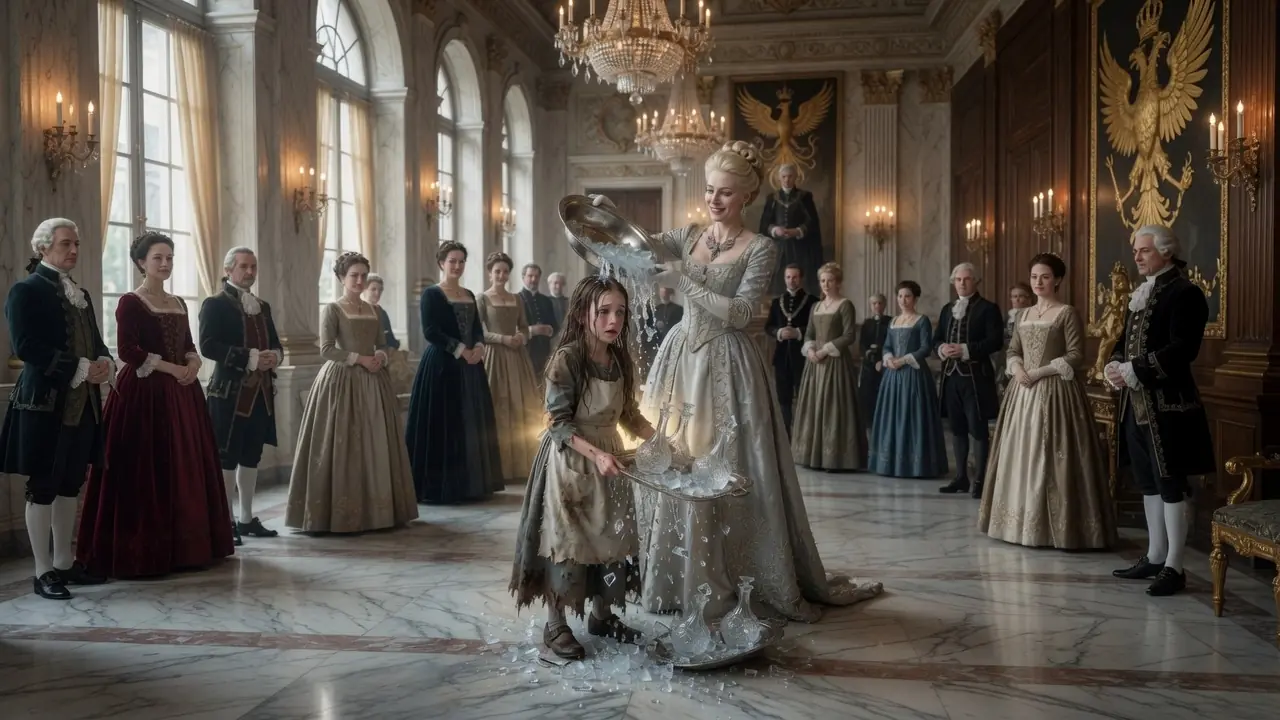
Silence had stood with nobles while Seraphine mocked her.
Silence had watched hunger, bruises, frostbite, and fever.
Silence had kept its hands clean while others struck.
The king looked at Elira.
“Will you come with me?”
“Where?”
“To the queen’s chamber.”
Elira froze.
“I can’t.”
“You can refuse.”
That startled her.
No one had ever said that to her.
You can refuse.
The words felt more royal than the cloak.
She looked down at the marble floor. Broken crystal glittered around her feet. The ice water had spread in a thin pool, reflecting the chandeliers like shattered stars.
“I don’t want to leave by the servants’ door,” she said.
The king’s eyes filled again.
“No.”
He turned toward the great central doors.
The doors used for monarchs, ambassadors, dukes, and brides.
Elira had polished them that morning on her knees.
Now the guards opened them for her.
The hallway beyond was lined with candles.
Elira took one step.
Her foot hurt where glass had cut it.
A young maid gasped and moved forward with a cloth.
Then stopped, unsure if she was allowed to approach a princess.
Elira saw the fear.
She knew it too well.
“What is your name?” Elira asked.
The maid blinked.
“Liora, Your Highness.”
Your Highness.
Elira almost stepped back from the words.
Instead, she held out her hand.
“Liora. May I have the cloth?”
The maid hurried forward and gave it to her.
Elira pressed it to her cut foot.
“Thank you.”
Liora began to cry.
Elira understood why.
Sometimes being thanked by someone who had every right to ignore you could undo a person.
The king watched this quietly.
Then they walked.
Not quickly.
Not triumphantly.
Elira walked through the halls she had cleaned for years, wrapped in the king’s cloak, water still dripping from her hair, phoenix still glowing beneath velvet.
Servants lined the walls.
Some bowed.
Some wept.
Some stared in horror as if the palace itself had risen to accuse them.
When they reached the queen’s chamber, the king paused before opening the door.
“No one has slept here since your mother died,” he said.
Elira’s hand tightened in the cloak.
The door opened.
The room smelled of lavender and old wood.
Gold curtains hung beside tall windows overlooking the winter garden. A cradle stood near the fireplace, covered by a white cloth. On the mantel rested a painted portrait of a woman with dark hair, warm eyes, and a smile that seemed to contain both strength and tenderness.
Elira stepped toward it.
“My mother?”
“Yes.”
Queen Isolde looked back at her through paint and time.
Elira searched the face for resemblance.
The eyes.
The curve of the mouth.
The same small tilt of the head.
She touched her own cheek.
“I look like her.”
The king’s voice softened.
“Very much.”
Elira looked at the cradle.
The white cloth trembled under her hand as she lifted it.
Inside lay a folded blanket, pale blue embroidered with tiny golden flames. Beside it rested a carved wooden bird worn smooth at the edges.
The king came no closer.
“That was yours.”
Elira picked up the bird.
For a moment, the room vanished.
Not completely.
Just enough.
A flash of warmth.
A woman humming.
A baby’s hand closing around smooth wood.
Then smoke.
Then running.
Then darkness.
Elira dropped the bird and stumbled back.
The king moved instinctively, then stopped himself.
“Elira?”
She pressed both hands to her head.
“I remember smoke.”
He closed his eyes in pain.
“There is no need to force it.”
But the memories came in fragments.
Firelight under a door.
Someone coughing.
A woman’s arms holding her tight.
A voice whispering, “Live, little flame. Live.”
Elira looked up.
“The servant who saved me.”
The king nodded, tears shining.
“We will find her name.”
“No,” Elira said. “We will honor it.”
The king bowed his head.
“Yes.”
For the first time, he sounded like a father obeying his child.
Not a king granting permission.
The days that followed did not become a fairy tale.
That was the first lesson Elira learned about truth.
Truth could open a door.
It could not rebuild a childhood overnight.
The palace erupted into investigations. Old records were pulled from locked archives. Servants were questioned. Former nurses were summoned from distant villages. Lady Seraphine was confined in the east tower under guard while the full web of her mother’s crime unfolded.
Mistress Veyra confessed first.
Not out of remorse.
Out of fear.
She had known Elira was “important,” though not exactly who she was. Lady Orielle had paid her mother years earlier to ensure the foundling remained low, unnamed, and overworked. After Orielle’s death, Seraphine continued the threats.
Others confessed smaller sins.
Looking away.
Destroying a birth cloth.
Changing a ledger.
Moving an infant record into the servant rolls.
Silencing a maid who had once noticed Elira’s resemblance to the queen.
The maid who saved the princess had been named Nerys.
She had been a laundry servant.
She carried the infant from the nursery through a smoke-choked passage and hid her near the old kitchens, intending to return after finding help. But she was found the next morning dead from burns near the lower stair.
She had died without anyone knowing what she had done.
Elira stood in the old laundry court when they told her.
Snow fell softly through the open archways.
“She saved me,” Elira said.
King Aldric stood beside her.
“Yes.”
“And she was buried as a servant?”
“Yes.”
Elira looked toward the ground.
“Then the kingdom will remember her as more.”
Three weeks later, a monument was raised in the winter garden.
Not to a general.
Not to a noble.
To Nerys of the Lower Laundry, who carried the heir of Raventhorn through fire and died before hearing the child breathe safely.
Elira insisted the monument be placed where every noble would pass on their way to court.
Some disliked that.
She was glad.
Discomfort, she decided, was sometimes the first honest feeling in a palace.
Seraphine’s trial came at the end of winter.
She wore black and stood straight, refusing to lower her eyes.
The evidence was overwhelming. Witnesses. Letters. Payments. Servant records. The confession she had made in front of the ballroom. Her own pride had done what no investigator might have managed.
When judgment came, the king did not execute her.
Many expected it.
Some wanted it.
Elira did not know what she wanted until the moment arrived.
Death felt too simple.
Too quick.
Too clean for a life built on forcing others to live with consequences.
Seraphine was stripped of rank, title, inheritance, and royal protection. She was sent to the northern abbey, where noble criminals lived in silence, labor, and prayer under guard. Her wealth was seized and used to establish protections for palace servants, orphaned children, and wards of the crown.
As guards led her away, Seraphine looked at Elira with hatred.
“You will never be one of them.”
Elira, dressed in a simple blue gown with the royal cloak clasped at her shoulders, answered quietly.
“I know.”
Seraphine smiled, thinking she had wounded her.
Elira continued.
“That is why I may become better than them.”
The smile died.
In spring, King Aldric formally acknowledged Elira before the kingdom.
The ceremony took place not in the ballroom, but in the palace courtyard, where commoners could attend. Elira had requested it. The council objected. The king overruled them.
She stood on the stone steps beneath a pale sky, wearing no crown.
Only the phoenix pendant.
The same one her father had worn for eighteen years.
Thousands gathered below.
Nobles near the front.
Merchants behind them.
Servants not hidden at the edges, but standing openly throughout the crowd.
Elira looked out at the kingdom that was hers by blood and not yet hers by trust.
She was frightened.
She did not hide it.
“I was raised in this palace,” she said, her voice carrying across the courtyard, “but not as a daughter of the crown.”
The crowd quieted.
“I was raised as a servant. I scrubbed floors, carried coal, slept beside kitchens, and learned how easily people look past suffering when they benefit from not seeing it.”
King Aldric stood behind her.
His face was pale, but he did not interrupt.
“I cannot stand before you today and pretend joy has erased pain. It has not. I have found my name, but I am still learning what it means to have one.”
A murmur moved through the crowd.
Elira’s hands trembled.
She let them.
“Some will say I am unfit because I was not trained in court. They may be right about that. I do not know every law, every dance, every polite deception. But I know hunger. I know cold. I know what power looks like from the floor.”
She lifted her head.
“And if I am to learn to rule, I will not forget the view from there.”
This time, when the crowd reacted, it was not murmuring.
It was something deeper.
Something like belief beginning carefully.
King Aldric stepped forward and placed the crown before her, not on her head.
“Princess Ameliane of Raventhorn,” he said, voice thick with emotion, “rightful heir of the phoenix bloodline.”
Elira looked at the crown.
Then at the crowd.
Then at the servants standing near the courtyard wall, many of them crying openly.
She did not lift the crown.
Not yet.
Instead, she turned to Liora, the young maid who had given her the cloth in the ballroom.
“Come here,” Elira said.
Liora froze.
Then walked forward, trembling.
The court watched, confused.
Elira took Liora’s hand and brought her to stand beside her.
“This kingdom did not fail me only because one woman hated me,” Elira said. “It failed me because too many people were taught that some lives matter less when they wear aprons.”
She looked back at the nobles.
“That ends under my name.”
Only then did she lift the crown.
King Aldric placed it on her head.
The phoenix pendant warmed against her skin.
No magic flashed.
No golden light filled the sky.
The true miracle was quieter.
A former servant stood crowned before the kingdom, and the kingdom did not vanish from the shock of it.
That evening, after the ceremony, Elira returned alone to the ballroom.
The candles were unlit.
Moonlight silvered the marble floor.
She stood where Seraphine had poured the ice water.
No stain remained.
Of course not.
Palaces were very good at cleaning floors.
Elira knelt and touched the marble anyway.
For years, her knees had known this room as labor.
Now everyone expected her to know it as power.
She wondered if she could do both.
The door opened behind her.
King Aldric entered quietly.
“I thought I might find you here.”
Elira did not stand.
“I used to clean this floor.”
“I know.”
“You walked across it many times.”
His voice broke slightly.
“I know.”
She looked over her shoulder.
“Did you ever see me?”
He did not lie.
“No.”
Elira nodded.
It hurt.
But the truth no longer surprised her.
He came closer, then stopped several paces away.
“May I sit?”
She almost smiled at that.
A king asking permission to sit on his own ballroom floor.
“Yes.”
He lowered himself beside her with effort.
For a while, they sat in silence.
Then Elira said, “I don’t know how to be your daughter.”
King Aldric looked at his hands.
“I don’t know how to be your father after failing you for eighteen years.”
“That is not comforting.”
“No,” he said softly. “But it is true.”
She appreciated that more than comfort.
After a long moment, she asked, “Will you tell me about my mother?”
His face softened in grief.
“As often as you wish.”
“And Nerys?”
“Yes.”
“And me? Before the fire?”
The king’s eyes filled.
“You had a laugh like a bell. You hated being wrapped too tightly. Your mother said you would be impossible to control.”
Elira let out a small, broken laugh.
“That part stayed.”
The king smiled through tears.
“Yes. I believe it did.”
She leaned against the base of the dais, exhausted.
He did not reach for her.
Not yet.
That restraint meant more than any embrace he could have demanded.
Outside, the kingdom slept beneath spring stars.
Inside, a father and daughter sat on the ballroom floor where she had once been humiliated, beginning not with forgiveness, but with truth.
And that, Elira thought, might be enough for one night.
Years later, people would tell the story badly.
They would speak of the servant girl revealed as a princess by a glowing mark. They would describe the ballroom gasp, the villain’s confession, the king kneeling, the nobles bowing. They would make it sound like magic had fixed everything in one glittering moment.
Elira never liked those versions.
Magic had only revealed what cruelty had hidden.
The rest took work.
Laws changed. Servant rolls were reviewed. Children taken into palace care received names, records, schooling, and advocates. No noble household was permitted to employ orphaned minors without royal inspection. Every winter, the kingdom honored Nerys with a day of service and remembrance.
And in the Hall of Bloodlines, beside portraits of kings and queens, Elira hung a new painting.
Not of herself.
Of Nerys carrying a bundled infant through smoke.
When advisers objected that a laundry servant did not belong among royal blood, Elira answered, “She carried royal blood when the rest of you let it burn.”
No one objected again.
The phoenix mark remained on Elira’s skin, though it rarely glowed.
Only under freezing water.
Only when truth demanded witness.
But she no longer needed magic to prove who she was.
The kingdom learned her in other ways.
In petitions heard fully.
In kitchens inspected personally.
In nobles corrected publicly.
In servants thanked by name.
In a crown worn by a woman who remembered the weight of a broom.
And on quiet nights, when the palace slept, Elira sometimes walked down to the old pantry alcove where she had spent her childhood.
It had been cleaned and left empty by her order.
No one slept there now.
No one ever would again.
She would stand in the doorway and remember the girl she had been.
The girl who thought she was nobody.
The girl who scrubbed beneath phoenix crests and never knew one lived beneath her own skin.
Then she would touch the pendant at her throat and whisper the same words every time.
“The rags were not my shame.”
And somewhere in the darkness of the old palace, the truth would answer.
They never were.