Ezekiel Thornfield stood on the train platform with the wind cutting through his coat and a folded notice in his pocket. The paper said the bank would take his ranch in 30 days if he could not pay $800. The afternoon train pulled away from the little town of Copper Creek. When the steam cleared, he saw a woman sitting by herself on a wooden bench.
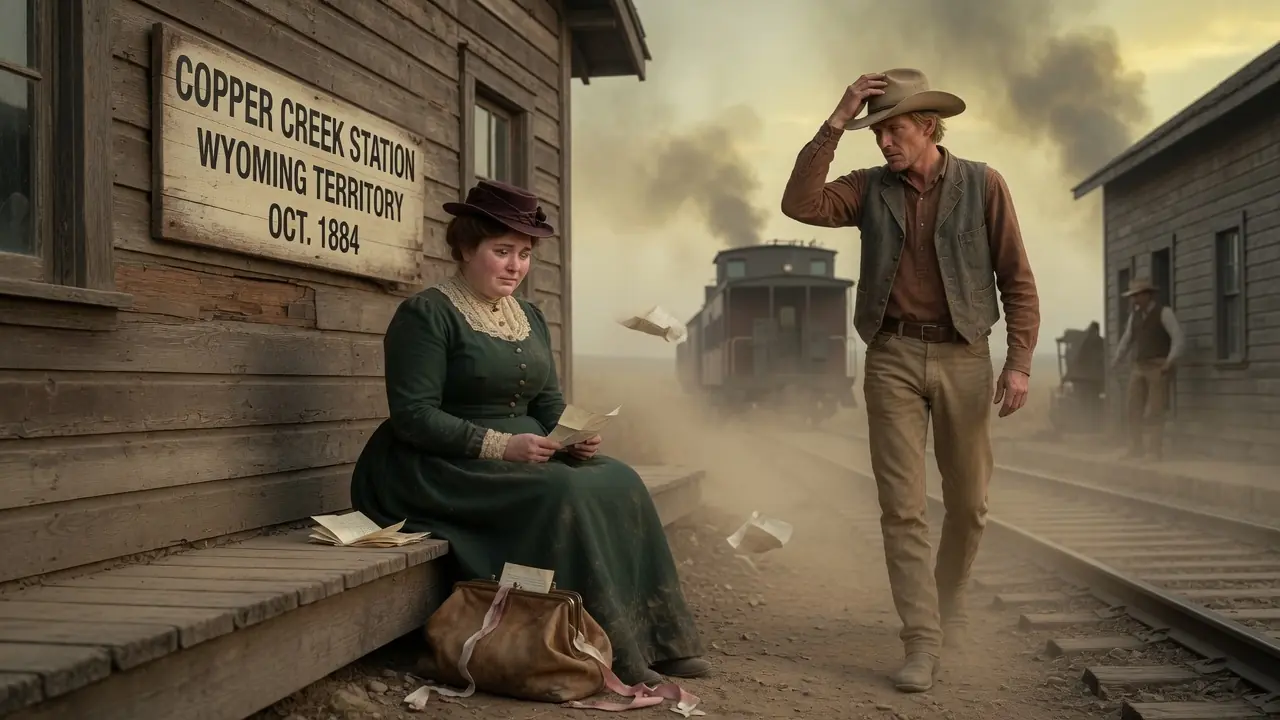
She wore a torn white dress that had clearly been a wedding dress that morning. Mud stained the hem. A worn carpetbag sat at her feet, its side split so letters lay scattered around her boots. The station master twisted his hat and tried to sound firm.
“Ma’am, you cannot stay here. Next train is not until Thursday.”
The woman lifted her head. Her face was soft and round, streaked with dust and tears. Her eyes looked empty and tired. “I have nowhere to go,” she said quietly.
The words hit Zeke hard. His boots carried him forward before he could stop himself. One moment he was 30 feet away. The next he was standing in front of her with his hat in his hand.
“What happened, ma’am?” he asked.
She straightened her back like she refused to fall apart in front of strangers. “I was supposed to marry a man here. He took one look at me and decided I was not what he ordered.”
The station master shook his head. “Shame, that, but rules are rules. You cannot camp on this platform.”
She bent and gathered her letters one by one, sliding each back into the broken bag. When she finished, she closed the bag and held the handle with both hands. “Where will you go?” Zeke asked.
“Boston, I suppose, if they will take me back.”
The wind swept along the tracks, sharp with the smell of coming snow. October in these hills did not offer second chances. Zeke felt the notice in his pocket press against his ribs. Thirty days, no hired hand, no family.
In his other pocket lay his last $50, meant for winter feed. “Ma’am,” he said slowly, “I know this is strange, but I need a wife. The ranch will not run itself. I cannot afford help, and you need somewhere to go.”
The station master’s eyebrows jumped. The woman studied Zeke’s face like she was trying to see if there was any meanness in him at all.
“You are proposing to a stranger?” she asked.
“Yes, ma’am. I reckon we are both in a tight corner.”
She stood and set the carpetbag at her feet. “What is your name, sir?” she asked.
“Ezekiel Thornfield. Folks call me Zeke.”
“No, ma’am.”
“Do you strike women?”
“Never have, never will.”
She gave a small nod. “I can cook, clean, and keep books. I am not afraid of work.”
“That is more than I deserve,” he said.
“You are both touched in the head,” the station master muttered.
Magnolia lifted her chin. “Maybe so, but we are also both stranded. What exactly are you offering, Mr. Thornfield?” she asked.
“Marriage today, if you will have it. We can sort the rest out together.”
“Why today?”
He pulled the foreclosure notice from his pocket and handed it to her. “Because I am about to lose everything I have. Maybe together we can save some of it.”
She read the page quickly, eyes moving with the ease of someone used to ink and paper. “Is there a preacher in town?” she asked.
“Yes, ma’am. Reverend Hayes.”
“Then let us go see him.”
They walked down the dusty main street side by side, a worn rancher and a ruined bride with a broken bag. Faces filled the windows as they passed. The wedding took 10 minutes. Magnolia’s voice stayed steady as she spoke her vows.
Zeke’s hand shook when he slid his mother’s plain ring onto her finger. It fit as if it had been waiting for her. Magnolia held her carpetbag. Zeke offered his arm.
“Ready to see your new home, Mrs. Thornfield?” he asked.
She took his arm with a firm grip. “Lead the way, husband.”
They climbed into his wagon and turned toward the mountains. For a long stretch of road, neither of them spoke. The wheels rattled over frozen ruts. The horses’ breath steamed in the cold air.
As they rode, Zeke watched her from the corner of his eye: torn dress, veil hanging in ribbons, chin still high. Near sunset, the ranch came into view. The house sat low against the hillside, roof patched, porch sagging a little. Fences leaned.
The barn door hung crooked. The corral held more dust than cattle. Zeke pulled the wagon to a stop. “It is not much,” he said.
Magnolia climbed down, freed her skirt from a splinter, and stood in the middle of the yard. She turned slowly, taking in every broken post and empty corner. “It is honest land,” she said. “That is more than some people ever get.”
Something eased in him at those words. They carried her bag inside together. The house was small with bare walls and a cold stone fireplace. Dust lay on the table, and the cupboards held more empty space than food.
Still, when Magnolia walked across the floor, Zeke felt the rooms change just a little, as if the ranch itself was waiting to see what this new wife would do with the broken pieces of his life. Magnolia set her carpetbag by the wall and walked straight to the kitchen. She rolled up the torn sleeves of her wedding dress and worked the pump until clean water splashed into the basin. “Good water,” she said. “That is something.”
Zeke stood in the doorway, aware of every bare shelf and dusty corner. Magnolia opened the cupboards one by one. Three cans of beans, a tired sack of flour, a little salt, a slab of salt pork with the edges turning bad. “It has been a hard year,” he said, ashamed.
She did not pity him or complain. She tied on an old apron she found on a nail and said she would see what she could do. She trimmed away the spoiled meat and cut what was left into tiny pieces. She sifted the flour, shook out the bugs, and mixed the rest with water and salt.
Outside, she quickly found wild onions near the back step and brought them in. Soon the house smelled warm and rich instead of empty. She set a plate in front of him: beans cooked slow with onion and bits of pork, small biscuits hot from the Dutch oven. “You are not eating,” he said.
“I will,” she answered. “After you.”
The first bite stopped his protest. The food was simple, but it loosened the knot of fear and shame inside him. For the first time in months, he felt something close to comfort. After supper, she washed every dish, scrubbed the table, and swept the floor.
Only then did she turn to him. “Where do you keep your accounts?” she asked.
“In the desk,” he said. “Front room.”
She found the ledger, brought it back to the table, and sat by the fire. Zeke added wood to the hearth and watched her. Magnolia moved a fingertip down each column of numbers. She checked dates and headcounts.
Feed bought and cattle sold. Slowly, her brow creased. “You have cattle missing,” she said.
“Everybody loses a few,” he answered. “Wolves, bad fences, storms.”
“This is not a few,” she said. “According to this, you should have 62 head. You told the station man you had around 40.”
Zeke stared. “I never added it up like that.”
“Nineteen head in two months is not weather,” she said quietly. “Someone is stealing from you.”
The word theft sat heavy between them. “Who would do that?” he asked.
“Someone who knows this land and your habits,” she said. “Someone who gains when you fail.”
The wind rattled the loose shingles. The fire snapped in the hearth. “Why did you leave Boston?” he asked after a moment.
She closed the ledger. “My father died,” she said. “He left everything to my stepmother. She decided I cost too much to keep and answered an ad for a wife out west. One ticket was cheaper than feeding me.”
Zeke looked at her torn dress and straight back. He knew what it felt like to be treated as a burden instead of a blessing. “You deserve better,” he said.
“Maybe,” she answered, “but I have this ranch and this marriage now.” Her hand rested on the ledger. “These troubles belong to me, too.”
She took the small bedroom off the kitchen that night. Zeke went up to the loft. Lying there, he heard her moving softly below and felt the house change around them. Three days passed.
Magnolia patched curtains from flour sacks, swept out corners Zeke had forgotten, and mended his shirts by lamplight. She kept asking questions. How many cattle in each pasture? How far to town? How often the bank wrote?
Who owned the land beside theirs? Every answer went into her mind like another number to be added. On the third morning, she found the foreclosure notice tucked inside an old seed catalog. The paper was worn.
The date at the bottom made her chest tighten. “You were not going to tell me,” she said when he stepped in from the barn.
He froze when he saw the notice on the table. “Did not see the point,” he muttered. “No use worrying you when I cannot fix it.”
“I am your wife,” Magnolia said. “Your troubles are mine now.”
He rubbed his neck. “$800 might as well be $8,000. We do not have it.”
“Not yet,” she said. She spread her own sheets beside the notice. Neat columns, rough maps, short notes about feed and pasture. “If we stop whoever is taking your cattle and get every head we still own to market, we might reach that number,” she said. “It will be tight, but not hopeless.”
Before he could answer, hoofbeats rolled into the yard. Three horses, three men. Zeke stepped onto the porch with Magnolia right behind him. Bartholomew Ashford slid down from a fine bay horse.
His coat was clean wool. His boots were polished. Two hard-faced men stayed mounted behind him.
“Heard you took yourself a wife, Thornfield,” Ashford said in a smooth voice.
Zeke’s jaw went hard. “Ashford.”
Ashford tipped his hat toward Magnolia. “Ma’am.”
Magnolia met his gaze without blinking.
“What do you want, Ashford?” Zeke asked.
“To make you an offer,” Ashford said. “I hear your cattle keep slipping away. I hear the bank wants its money. I will give you $400 for this place, cash today.”
“This land is worth twice that,” Zeke said.
“Not to the bank,” Ashford answered. “To them, it is just bad numbers. To you, it is a rope around your neck. Take my money, and you and your wife can start over somewhere easier.”
His eyes went back to Magnolia, running over her torn dress and round face. “Some land is too rough for certain folks,” he added.
Magnolia’s fingers tightened on the porch rail, but her voice stayed calm. “We are not selling,” she said.
Ashford’s brows lifted. “The little wife has opinions.”
“This wife can read a deed and count cattle,” Magnolia said. “She knows the difference between help and a man trying to pick a place clean.”
One of Ashford’s men shifted, hand brushing his gun belt. The air went tight.
“You are making a mistake,” Ashford said softly.
“Maybe,” Magnolia answered. “Time will show who is wrong.”
Ashford swung back into the saddle. “Think on my offer, Thornfield. Out here, land has a way of changing hands, willing or not.”
They watched the riders disappear down the trail in a cloud of dust. When the sound faded, Zeke let out a breath. “You just made an enemy,” he said.
Magnolia looked at him. “I made him an enemy the day I married you,” she said. “The question is what we do about it.”
That afternoon, they rode to the North Canyon with Jeremiah Crow, Zeke’s gray-haired foreman. The red rock walls rose high on both sides. Grass grew thick at the bottom. A clear stream ran along one edge.
Magnolia slid from her saddle and knelt by the wet sand. “Here,” she said. Zeke and Jeremiah joined her. In the soft ground lay clear tracks: several horses, a long line of cattle, hoof marks going in and out of the canyon.
“This is not wandering,” Magnolia said. “Someone is driving your herd through here, heading south for the main trail. Once they hit that road, they vanish.”
Jeremiah’s mouth went tight. “Rustlers,” he said.
Zeke stared down the canyon, feeling years of work hanging by a thread. “We cannot outgun a whole gang,” he said.
“No,” Magnolia answered. “But maybe we can outthink them.”
That night, she spread a rough map on the kitchen table, marking canyons and ridges with steady strokes. Zeke cleaned his rifle while the fire burned low. “They believe you are already beaten,” she said. “That is their weak spot.”
Zeke watched his new wife planning battles she had not started, but meant to finish, and something warm rose in his chest. For the first time in a long time, hope felt real. Four days after Ashford rode away, a buggy pulled into the Thornfield yard with a clatter of wheels on frozen ground. Magnolia wiped her hands on her apron and stepped to the door.
The preacher’s wife climbed down, cheeks red from the cold, and held out an envelope of thick cream paper. “Harvest dance this Saturday,” she said. “Whole town will be there. Thought you and Mr. Thornfield might like to come.”
When the buggy rolled off toward the next ranch, Magnolia turned the envelope over in her fingers. “Copper Creek Harvest Social,” the neat letters read. Music, supper, fellowship. Zeke came in from the barn, brushing straw from his shoulders.
“What is it?” he asked.
“An invitation,” she said. “The town wants to see the strange pair that married in 10 minutes.”
“We do not have to go,” Zeke answered. “Folks will only stare and whisper.”
“They already stare and whisper,” Magnolia said. “If we stay away, they let Ashford tell our story for us. I would rather they look me in the eye.”
He studied her face, then nodded once. “Then we will go.”
Saturday came gray and cold with a wind that cut straight through wool and skin. Magnolia spent the morning baking bread for the next day and pressing the one fine dress she had brought from Boston, a simple blue that had seen better days but still fit her curves. In the small mirror, she braided her hair smooth and pinned it up with her mother’s worn silver combs. The glass showed a round face, tired green eyes, and a body no fashion plate would praise.
She stared at her reflection until her jaw settled. “You are a wife,” she told herself. “You are not a shameful secret.” Zeke waited in the yard, newly shaved and wearing a clean shirt Jeremiah had loaned him. When he helped her climb into the wagon, his hand was warm around hers, steady and solid.
“You look nice,” he said simply.
“So do you,” she answered.
Lanterns burned bright in the church windows when they reached town. Fiddle music drifted out into the chill, mixed with the smells of coffee and roasting meat. Inside, sawdust had been spread on the floor. Every family in Copper Creek seemed to be there, dressed in their best.
Conversation slowed when Zeke and Magnolia walked in. Heads turned, fans paused, eyes slid over Magnolia’s round figure and plain dress, then moved to the tall rancher at her side. The whispers started in the corners like rustling paper. Mrs. Henderson, the banker’s wife, glided over in black silk and bright jewels.
Her smile shone, but her eyes stayed cool. “Magnolia,” she said. “What a pleasure to finally meet you. Such a story. Married the same day you stepped off the train. So sudden.”
“Some folks know a good thing when they see it,” Zeke said, standing close enough that his sleeve brushed Magnolia’s.
Mrs. Henderson’s gaze drifted slowly up and down Magnolia as if measuring cloth. “And what exactly did you see, Mr. Thornfield?” she asked lightly.
Magnolia felt the room lean in. Zeke did not hesitate. “I saw a woman who can work,” he said. “A woman who makes a house warm and a table full with almost nothing. A woman who stands straight when trouble comes. That is what I saw.”
The banker’s wife tipped her head, then turned her polite knife toward Magnolia. “And you, dear, what did you see in Mr. Thornfield?”
Magnolia’s cheeks burned, but her voice stayed calm. “I saw a man who keeps his word,” she said. “A man who earns what he owns with his own hands, and does not judge folks by their size or their past.”
For a heartbeat, the hall went quiet. Then the fiddle started again, rough at first, then stronger. People turned away, pretending not to listen, while still watching from the corners of their eyes. The evening crawled by in small, careful cuts.
Women with tight smiles asked where she came from, why she had no family with her, whether it was true another man had turned her away at the station. Men made half jokes about quick weddings and desperate measures. Magnolia answered with few words and straight shoulders. Every question hurt, but she refused to bend.
Zeke stayed near, his presence a steady wall. When a remark went too sharp, his jaw clenched, and the speaker suddenly remembered something to do across the room. Still, the weight of eyes and whispers pressed heavy. Near midnight, when the air inside was hot and the punch bowl mostly empty, young Tommy Morrison staggered toward them.
The sheriff’s son had his father’s badge in his blood and more liquor than sense in his veins. He stopped in front of Zeke and looked Magnolia up and down with a sloppy grin. “Heard you got yourself a real bargain, Thornfield,” he said loudly. “Mail-order bride nobody else wanted. Fat little package on sale.”
The word struck the room like a thrown rock. Music stopped, boots stilled, faces turned. Magnolia’s stomach twisted, but she kept her hand light on Zeke’s arm and lifted her chin. Zeke’s voice came out low and even.
“Tommy,” he said, “you are drunk. Go home.”
Tommy spread his arms, pleased with his audience. “Just telling the truth,” he bragged. “Whole town knows it. I am the only one honest enough to say it.”
Zeke moved before the last word finished. One step forward, one sharp swing. His fist met Tommy’s jaw with a crack that echoed off the rafters. Tommy hit the floor hard, blood already running from his split lip, eyes wide with shock and fear.
Zeke stood over him, fists clenched, chest lifting with each breath. “Here is the truth,” he said to the silent hall. “My wife is worth 10 of this boy. Any man who thinks different can say it to me.”
No one spoke. No one moved. Tommy’s father shoved through the crowd to drag his son away. Anger was hot in his eyes, but his hand never touched his gun or his badge.
Zeke turned back to Magnolia and offered his arm. “Ready to go home, Mrs. Thornfield?” he asked quietly.
She took it. Together they walked through the parted crowd, heads high, as if the whispers slid off them like rain off a coat. Outside, the night was cold and clear. Stars burned sharp above the dark line of the mountains.
Their breath smoked as they climbed into the wagon. They rode home in silence, the wheels crunching over frozen ruts. The quiet between them felt different now, full of something new and warm that had not been there before. At the ranch, Zeke helped her down from the wagon.
They stood close in the dark yard while the horses shifted in their traces, and the house waited behind them. “Thank you,” she said at last.
“I only spoke what I know,” he answered.
He brushed a loose strand of hair back from her face and let his hand rest against her cheek. When she did not pull away, he bent his head and kissed her slow and sure. She leaned into him, fingers curling in his shirt, heart pounding against his chest. When they parted, both were breathing harder, the cold forgotten.
“Tomorrow we fight,” Magnolia said softly.
“Tomorrow we fight,” Zeke agreed.
The next morning, a buggy from the bank rolled into the yard. Zeke opened the door to Mr. Payton, who held a leather folder and would not quite meet his eyes. “The foreclosure date has moved up,” Payton said. “Fourteen days from today.”
Magnolia stepped beside her husband. “That is not help,” she said. “That is a noose pulled tighter.”
Payton muttered that the bank must protect itself and hurried away. “Fourteen days,” Zeke said.
“Then we use everyone,” Magnolia answered. “Sitting still will not save us.”
That night, she spread the ledger and her rough maps on the kitchen table. Jeremiah sat with them while the wind shook the windows. “Market in Denver pays near double what Ashford offers,” Jeremiah said. “If we drive every animal we have and nothing goes wrong, we might make $800.”
“Forty-one head,” Zeke said. “That is all that is left.”
“Then we bet everything,” Magnolia replied. “Waiting only lets them take it from us piece by piece.”
Two days later, they were in the saddle before dawn, driving every cow they owned into the narrow passes toward Denver. Frost smoked in the cold air as Magnolia rode one flank with a rifle while Zeke and Jeremiah covered the rest of the herd. By noon, the sky had gone flat gray.
“Storm coming,” Jeremiah warned.
“We keep moving,” Magnolia said. “Turning back will not pay the bank.”
They made a hard camp in a shallow hollow. Before dawn, the storm dropped on them. Wind screamed down from the mountains, throwing snow into their faces. The cattle bawled and bunched together.
Zeke and Jeremiah rode among them, trying to keep them steady. Magnolia circled the outside. Then four riders appeared out of the white to the south, coming fast like men following a plan. One fired into the air on the left of the herd, another on the right.
Gunshots cracked through the storm. The cattle exploded into a stampede, surging straight toward a gorge Zeke knew ended at a cliff. He spurred for the front, trying to bend the leaders aside. Magnolia pushed along the flank while Jeremiah fought the other side.
The gunmen kept pace, firing over the herd to drive it faster. In the chaos, Magnolia’s horse hit a hidden washout and went down. She flew sideways and hit the ground so hard the world went dark. When she dragged herself upright, pain burned in her ankle, and her horse was gone with the running herd.
The roar faded until the valley lay silent. A crack in the rock face ahead caught her eye. Limping, she slipped inside. The storm vanished the moment she stepped into the cave.
Still air, rough timbers, rusted tools, and fresh picks met her. She lit a pine torch and followed a low tunnel to a small chamber where chunks of stone lay piled. Gray metal veins ran through them, heavy and dull, until she turned the light just right. Silver ore.
“So this is what Ashford wants,” she said.
She stuffed her pockets and scarf with the richest pieces, then walked the tunnel again, counting steps and turns until she could see it like a map. When the torch burned low, she went back to the entrance. By pure blessing, her horse stood shivering near the opening. Magnolia climbed into the saddle and rode straight to town.
Her ankle throbbed when she reached the sheriff’s office, but her voice was steady as she spread the ore and a rough sketch on his desk and told him everything. Sheriff Morrison listened, asked a few sharp questions, then locked the evidence away and said she had done right. Only then did she turn her horse toward home. Three days after the stampede, she rode into the ranch yard.
Zeke stood by the empty corral, thinner and older than before. For a heartbeat, he only stared. Then he caught her as she slid from the saddle and held on like he would never let go. In the kitchen, she laid the ore and her map on the table.
Zeke traced the tunnel with one finger. “Under our north pasture,” he said.
“All of it,” Magnolia replied. “He has been stealing cattle to break you and silver to make himself rich. He expects the bank to finish us tomorrow.”
Hooves sounded in the yard. Ashford stood on the porch with two men at his back, coat neat, but eyes tight. “Foreclosure is tomorrow,” he said. “One last offer, $400.”
Magnolia stepped into the doorway with a piece of ore in her hand. “Better than you will get when the sheriff is done,” she said.
Ashford’s gaze fixed on the stone. She told him she had found it in a tunnel under their land with fresh tools and beams carved with his initials, and that the sheriff had liked seeing them. Hoofbeats sounded again. Sheriff Morrison and three deputies rode into the yard, badges bright in the thin sun.
“Bartholomew Ashford,” the sheriff called, “you are under arrest for cattle theft and illegal mining.”
Ashford’s hand twitched toward his gun, but the deputies had theirs out first. At a sharp command, he let the weapon fall and iron cuffs closed around his wrists. Months later, the silver under their pasture was legal on paper. The bank had eased its grip, and Zeke and Magnolia were slowly rebuilding the herd.
One spring day, Magnolia stood again at the Copper Creek station. When the train pulled away, it left a young woman on the bench with a carpetbag and tears on her cheeks. Magnolia knew that look. She sat beside her, listened to how a groom had refused her, then told her about a decent farmer they knew who judged by character, not by shape or past, and invited her to come home with them.
Soon after, Magnolia rode in the wagon beside Zeke, while the young woman settled in the back. The road curved toward the mountains and the ranch that had almost been lost, and they faced it together.