The Texas Panhandle wind doesn’t carry the promise of rain. It carries the sting of red dust, the ghost of diesel, and the particular loneliness of a place that forgot to have a future. When a 17-year-old girl with grease under her fingernails and nobody’s name to call her own pulled a dead Harley out of the dirt, she didn’t just wake a seized engine. She dragged a broken old soldier back from the edge of disappearing forever.
Amarillo, Texas, was a town that existed the way old scars do. Quietly, permanently, without apology. The heat pressed down on the cracked earth like something with a grudge, and the air tasted of iron, exhaust, and distance. On the ragged western edge of town sat Hector’s Salvage and Scrap, a sprawling graveyard of crushed steel, shattered windshields, and everything the world had decided wasn’t worth saving.
For most people, it was invisible. For 17-year-old Lyra Mae Carter, it was the only home she’d ever had. Lyra was built from hard and harder silences. Her hands were permanently stained with grease no industrial soap could touch.
She didn’t do small talk. She didn’t do trust. She did engines. It was a Wednesday in late August when she found the tomb.
Working alone in the far corner of the yard, dragging corrugated tin off a collapsed shelf rack, sunlight caught something beneath the debris. Dull, scratched, unmistakably chrome. Lyra stopped breathing. She spent the next two hours excavating by hand.
What she uncovered stole the words right out of her. It was a motorcycle, or what was left of one. Lyra Mae Carter had been named by a social worker who’d never met her mother and never would. The name stuck the way junkyard names do, not because it fit, but because nobody bothered changing it.
She’d aged out of the foster system at 16 with a garbage bag of clothes, $40, and a referral to a shelter she never used. Instead, she found Hector’s Salvage, talked Hector Ybarra into letting her sleep in a gutted Airstream trailer in the back corner, and made herself useful before he could think of a reason to say no. Hector was 63, bad-kneed, and tired. He paid her cash on Fridays and looked the other way the rest of the week.
Lyra didn’t do conversation. She did carburetors. She did torque sequences and timing chains and the specific patient language of machines that had given up but hadn’t yet decided to die. She understood broken things.
She just didn’t know she was one of them. It started with a shelf giving up. The far corner of the yard, section D, where Hector hadn’t sent anyone in years, collapsed on a Tuesday afternoon under its own accumulated weight. Lyra heard the crash from across the lot.
A long metallic groan followed by the flat percussion of corrugated steel meeting hard Texas ground. She went to investigate because that’s what she did. She moved things. She sorted wreckage.
She made order out of collapse. She almost walked past it, but the August sun caught something beneath the debris at a particular angle. A dull, stubborn glint of chrome refusing to stay buried, and Lyra stopped. Two hours later, her arms aching and her knuckles bleeding from the sheet metal edges, she stood over a 1989 Harley-Davidson Sportster 1200.
The engine was seized solid. The tank was dented deep and scorched black along one side. The frame had been warped by years of pressure and Texas heat into something that looked like a spine that had taken too many hard falls. Hector shuffled over, squinted, shrugged.
“You can keep whatever you can carry.”
Lyra crouched to drag it free and stopped. Hanging from the ignition was a small leather key ring, cracked and sun-bleached. Stamped into the hide in faded letters: “For Tommy. Ride free.”
She didn’t know who Tommy was. She couldn’t stop reading it. She built the workspace herself. Four canvas tarps lashed between a dead refrigerator truck and a rusted fence post.
A single work light on an extension cord running back to the Airstream. Not pretty. Functional. Lyra’s kind of architecture.
She pulled parts from every wrecked bike in the yard. A carburetor off a junked ’91 Sportster. Brake lines from a crushed Kawasaki nobody wanted. She found a water-damaged Harley service manual in a dumpster behind the auto parts store on 6th Street.
Its pages swollen and stuck together. She dried it page by page on the Airstream roof and read it like scripture. The physical cost was honest and relentless. Skinned knuckles that never fully healed before she skinned them again.
A sprained left wrist she wrapped in electrical tape and ignored. Weeks of three-hour nights, her eyes burning under the work light while Amarillo went silent around her. But something about this bike was different from every other machine she’d touched. With the others, she worked.
With this one, she talked. Quiet, under her breath, in the private language of someone who’d stopped expecting to be heard. “Come on. Give it up. I’ve got time.”
She didn’t know why this one felt like it was listening. It just did. Deputy Ryan Holt came by on a Thursday, the way he always did. Slow roll through the gate, window down, one arm resting on the door like he had nowhere better to be.
He was fair enough, as lawmen went. Suspicious the way all fair men eventually become when they’ve seen enough. He noticed the Sportster immediately. Lyra watched his expression change from 20 feet away.
Something tightening behind his eyes, a recognition he didn’t want to have. He climbed out, walked over, crouched beside the frame without touching it.
“Where’d you find this?”
“Section D,” Lyra said. “Collapsed shelf.”
“Who else knows you have it?”
“Hector.”
Holt looked at her for a long moment, then stood up, adjusted his hat, and drove away without another word. He didn’t tell her to stop. He didn’t tell her anything. That bothered her more than a direct warning would have.
That night at Martha Lou’s, Lyra pushed. Martha Lou set down her coffee cup slowly. She looked at the window toward the flat dark edge of town, and when she spoke, she kept her voice low, like the name itself carried weight. “Jack Callahan. They called him Grave.”
She told Lyra just enough. Vietnam, the Angels, a son named Tommy, a tragedy nobody in Amarillo discussed anymore. A man who’d walked away from everything and never walked back. “He’s not mean, honey,” Martha Lou said, picking up her cup again. “He’s something worse. He’s broken all the way down.”
Six weeks of split knuckles and stolen hours brought her to a Wednesday evening in late September. The sun bleeding out across the flat horizon in shades of copper and dying red. Lyra stood over the Sportster, wiped her hands on her jeans, and kicked the starter. Nothing.
She kicked it again. The engine coughed once, a wet, phlegmatic sound, then went silent like it was embarrassed by the attempt. She reset her weight and kicked it a third time with everything she had. The engine caught.
It ran ragged at first, misfiring in an uneven, lurching rhythm that rattled the canvas tarp overhead. Then something inside it found its footing. The misfires smoothed. The rhythm deepened.
And the Sportster settled into a rolling, chest-level thunder that filled every corner of the junkyard and pushed out through the chain-link fence and carried itself flat across the Texas plain on the evening wind. Lyra sat down on the bike, both hands on the bars, not going anywhere. She just let it run. It was the loudest silence she had ever sat inside.
Three miles away, on the ragged edge of town, an old man in a battered recliner went completely still. His eyes opened and fixed on the trailer ceiling. He hadn’t heard that sound in 11 years. He came at dawn two days later, when the light was still thin and the yard smelled of cold iron and overnight dew.
Lyra was on her back beneath the Sportster, adjusting the drive chain by feel, when the shadow fell across her. Long, still, unhurried in the way that only very large or very certain men can manage. She slid out from under the bike and stood up. He was massive, 6’3” at least, white-bearded, built like something the years had compressed rather than diminished.
His arms were covered in ink that had blurred and bled with age into something that looked less like tattoos and more like weather. He wore a faded leather vest over a dark flannel shirt. No patches, just the ghost outlines of where patches had been. Pale shapes in the leather like scars where insignia had been cut away.
He didn’t introduce himself. He didn’t look around the yard. He looked only at the Sportster and then at Lyra, and his eyes held the particular flatness of a man who had already survived everything he was afraid of. When he spoke, his voice was gravel dragged slow over broken pavement.
“That bike killed my son. Step off it.”
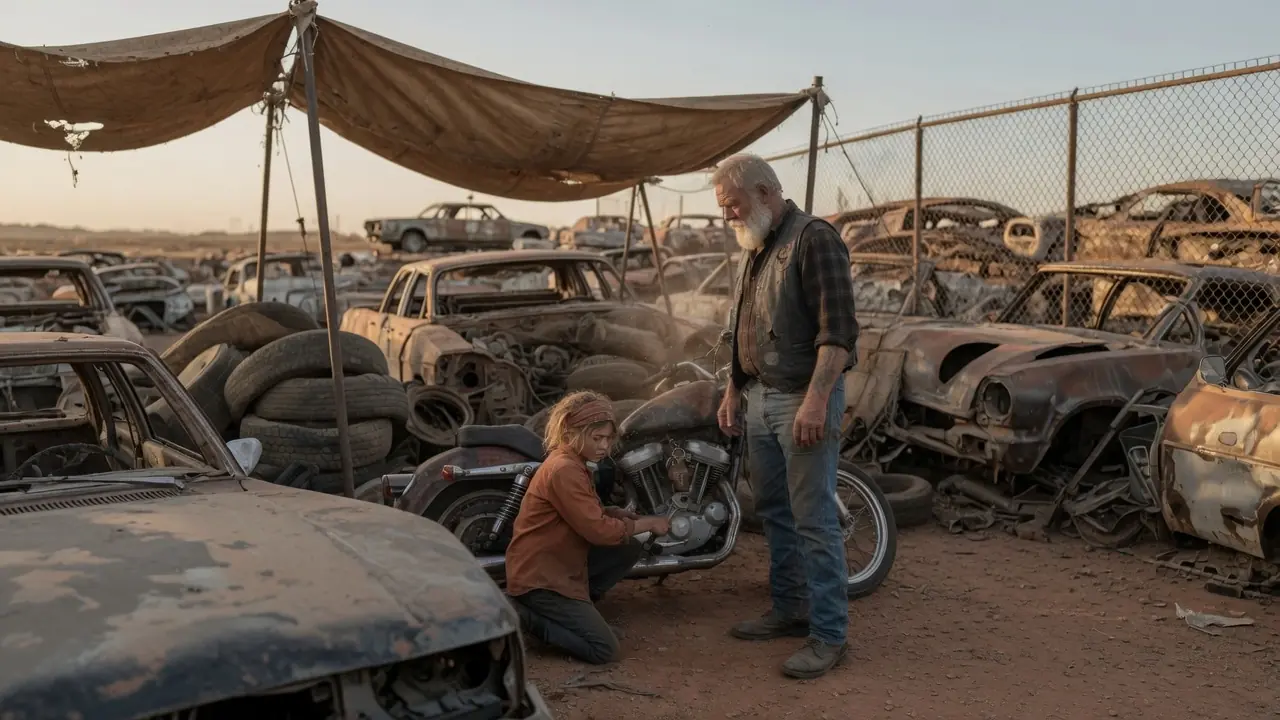
Lyra didn’t move. She held the wrench in both hands and looked back at him without flinching. “Then why does his keychain say ride free?”
The silence between them lasted long enough to become its own kind of conversation. Jack spoke first. The bike belonged to him. He wanted it back.
Those were the facts as he presented them. Flat, final, requiring no discussion. Lyra didn’t raise her voice. She never did.
She simply began talking in the only language she fully trusted, the precise, sequential language of mechanical work. She told him about the seized pistons and the six-week soak in diesel and transmission fluid, the sourced carburetor, the re-machined rotors, the cracked service manual she’d read until the pages softened. She accounted for every hour, every part, every morning she’d shown up before sunrise and every night she’d worked past the point where her hands stopped cooperating. Jack stood with his jaw set and his arms crossed and his eyes giving away nothing until she got to the keychain.
“It was in the ignition when I found it,” Lyra said. “Not in a pocket. Not in a box. In the ignition.”
She paused. “Like whoever left the bike here wanted someone to find it. Like he wanted it found by the right person.”
Jack looked away. It was the first time since he’d walked through the gate that his eyes had moved off her face. The wrench was still in Lyra’s hands. Neither of them mentioned it.
Nobody invited him to sit. Jack simply folded himself down onto the dirt beside the Sportster like his legs had finally settled a long argument with the rest of him. He talked slowly, the way men do when they’ve kept something compressed for so long that releasing it requires deliberate, careful pressure. Tommy had grown up watching his father ride, had idolized the life the way kids idolize things they’re told are dangerous, completely, stubbornly, without room for reason.
He’d begged to prospect at 19. Jack had refused twice, then spent a year trying to build a wall high enough. Tommy climbed it anyway. The night it ended was a club dispute that turned into something worse than anyone had planned.
Tommy was in the wrong place, standing next to the wrong man when the situation stopped being manageable. Jack got the call 40 minutes too late. He’d driven the Sportster to the junkyard the morning after the funeral, left it in section D, and walked the three miles home because he couldn’t bear to destroy it and couldn’t bear to look at it and couldn’t figure out a third option. Lyra listened to all of it without moving or speaking.
When he finished, the yard was completely quiet. “He sounds like he was worth grieving,” she said.
Jack put his face in his hands. His shoulders moved once, then again. It was the first time he had cried in 11 years. He came back the next morning with a folded piece of paper and no explanation.
He held it out. Lyra took it and opened it. The Sportster’s title signed over to Lyra Mae Carter in handwriting that moved across the line like a man who hadn’t held a pen in a long time but had decided to mean it anyway. “Tommy would have wanted it to go,” Jack said. “Not sit still and rust.”
Lyra stood with the title in both hands for a long moment. She looked at the bike, her knuckles in every bolt, his grief in every weld, Tommy’s name in the leather tag still hanging from the ignition. She understood that what she was holding couldn’t be converted into dollars or measured in hours. It was something else entirely.
The word for it sat just outside her vocabulary, in territory she hadn’t let herself enter before. She took it. She packed one bag. It didn’t take long.
It never does when you’ve never owned much. Before she rolled the Sportster through the gate for the last time, she reached back and pulled Tommy’s keychain from the ignition. She walked over and pressed it into Jack’s palm and closed his fingers around it. “So you have something to hold on to,” she said.
He watched her go. The Sportster’s thunder carried flat across the Texas morning until distance swallowed it whole. The silence that followed was the same silence as always, wide, absolute, pressing in from every direction. But for the first time in 11 years, it didn’t feel like grief.
It felt like the beginning of something.