Derbyshire, August 1816. The estate looked better than it had any right to. Edward Sedley, Duke of Ashworth, had not been to Whitmore Park in 3 years. He knew this. He also knew from Drove's quarterly reports, from the state of the accounts, from the general principle that neglected things declined, that he should arrive to find the place in the early stages of respectful deterioration.
Roof holding, tenants paying, land producing enough to justify the word productive without inviting scrutiny of what the word concealed. He did not expect the North Field to be re-drained. He did not expect the tenant cottages along the eastern boundary to have new thatch. He did not expect the kitchen garden to be in full and organized production, or the home farm accounts to be 3 years current and cross-referenced, or Thomas Garrett, who had refused to speak civilly to the previous two stewards on the grounds that they were, in his assessment, ornamental, to raise a hand in greeting as the Duke's carriage passed. Edward noted all of this from the window with the careful attention of a man who has learned that unexpected good news generally has an explanation, and that the explanation is not always comfortable.
Drove met him on the steps. He was a tall man, thin, with the permanently slightly aggrieved expression of someone who believed the world owed him more precise appreciation than it had thus far delivered. He had been steward at Whitmore for 11 years. His paperwork was immaculate. "Your Grace."
He bowed correctly. "We are very glad to have you." "The North Field." Edward said, stepping down from the carriage. "When was it re-drained?"
A pause, brief but present. "Two summers ago, Your Grace. I oversaw the project personally." "It must have cost." "A modest outlay.
The returns have been considerable." Drove smiled the smile of a man presenting someone else's work as his own, which requires a particular quality of confidence Edward had not previously identified in him. "Shall I prepare a full account of recent improvements?" "Yes." Edward said.
"Tonight." He went inside. The house smelled of beeswax and cut flowers, and the particular cleanness of a place that had been managed, not merely maintained. He stood in the entrance hall and looked at it, at the floors and the light and the quietly ordered evidence of competence, and felt the specific unease of a man whose assumptions are beginning to ask questions of themselves. He found the ledgers in the estate office at 7:00 that evening, before Drove had delivered his account.
He found them because he had always done his own books in every property, regardless of what his steward told him. This was a habit his father had considered excessive, and his solicitor considered eccentric, and Edward considered basic. Numbers did not flatter. Numbers did not have agendas. Numbers were, in his experience, the only thing in the management of a large estate that could be trusted to tell the truth without being asked twice.
The ledgers at Whitmore were extraordinary. Not in their figures. The figures were solid. The kind of solid that comes from years of careful, unglamorous work. What was extraordinary was the system.
Three years ago, when Edward had last reviewed them, they had been Drove's standard format, functional, somewhat opaque, the accounting equivalent of a man who answered every question correctly without quite answering what was asked. Now they were something entirely different. Cross-referenced, indexed, annotated in a hand that was not Drove's, smaller, faster, with the decisive strokes of someone who wrote quickly because their mind moved faster than the pen, and they had long since stopped waiting for it to catch up. The annotations were, without exception, correct. Edward checked six of them against the underlying figures and found not a single error.
He sat back in the chair and looked at the ceiling, which was plain plaster and offered no useful information, and thought about the North Field and Thomas Garrett's raised hand, and the new thatch on the eastern cottages. Then he rang for Drove. Drove arrived looking like a man who had been expecting a different conversation and was rapidly recalibrating. "The ledgers." Edward said.
"Who annotated them?" Drove was quiet for a moment. Edward had learned, over 14 years of managing people and property, that the length of a pause before an answer was inversely proportional to the comfort of the truth being considered. "Miss Prentice." Drove said at last.
"Eleanor Prentice, the late manager's daughter. She has assisted with certain administrative matters in the absence of more formal arrangements." "Assisted?" "She has some knowledge of estate management. Her father was, Drove chose his next word with visible care, thorough in his instruction."
"The North Field." Edward said. "The drainage project." Another pause. "Miss Prentice identified the problem.
I directed the solution." Edward looked at him. "And the tenant cottages?" "A collaborative effort." "And the home farm accounts?"
Drove said nothing. "How long?" Edward said. "Has Miss Prentice been managing this estate?" "She has not been managing it, Your Grace.
She has been a helpful "Drove." Edward said it quietly, which was more effective than volume. "How long?" A silence that was its own answer. "Two years."
Drove said. "It's since her father died." Edward looked at the ledger open on the desk, at the small, rapid hand in the margins, at 3 years of corrections and improvements and the kind of systematic thinking that did not arrive by accident and could not be faked. "Send word to Miss Prentice." he said. "I will see her tomorrow morning, 9:00."
Drove inclined his head and left. Edward returned to the ledgers and read for another 2 hours and found nothing that was not exactly right, which was its own kind of problem. She arrived at 8:55. He knew it was her before Drove announced her, because he heard the footsteps in the corridor, not hurried, not deliberately measured, simply purposeful, the walk of a person who knew where they were going and saw no reason to perform the journey. He had stood at the window with his coffee and watched the morning light on the North Field and told himself he had no particular expectations, which was not true.
She was younger than he had expected, perhaps 26 or 27, dark-haired, with the kind of face that was not conventionally pretty and was more interesting for it. Precise features, direct eyes, the expression of a person who had decided some time ago that a pleasant, neutral expression was more useful than an unpleasant, honest one and had not revised this decision. She was dressed practically, good wool, well kept, without ornamentation. She carried nothing. She did not wait to be addressed.
"Your Grace." She said. "I understand you wish to speak with me about the estate." "I did." He set down his coffee.
"Sit down, Miss Prentice." "Thank you." She sat not at the edge of the chair in the manner of someone uncertain of their welcome, but squarely, as though the chair were a reasonable place to be and she had every right to occupy it. "I imagine you have questions." "Several."
He looked at her. "The ledgers." "Yes." "The annotations are yours." "They are."
"The drainage project in the North Field." "I identified the problem in the spring of 1814." she said, with the ease of someone reciting facts they have no reason to dress up. "The water table in that section had been poorly managed for at least a decade. Three harvests had been affected. Mr.
Drove arranged the contracting." "He tells me he directed the solution." A pause, not long. "Mr. Drove engaged the contractors and managed the payments." she said, with the precision of someone choosing their words to be accurate rather than comfortable.
They are not now." "And the tenant cottages?" "Thomas Garrett's recommendation, which I supported. The thatch on the eastern boundary was 30 years old. It was a fire risk as much as a comfort issue."
She paused. "He brought it to Mr. Drove twice. Mr. Drove did not act.
I advised the tenants to document the issue and resubmit it with supporting figures." "Mr. Drove acted on the third submission." This was, Edward recognized, a very precise way of saying that Drove had not acted until the paperwork made inaction impossible. "He filed it."
"Miss Prentice." he said. "You are the daughter of the late estate manager." "I am." "You have no formal appointment here." "No."
"No salary, no official capacity." "No." "And yet you have been managing this estate for 2 years." She looked at him with the expression of a woman who has been asked to confirm something she considers self-evident. "Someone had to."
She said. "The land does not wait for formal appointments." Edward was quiet for a moment. Outside, the North Field caught the morning light, green and productive and re-drained at considerable effort by the woman sitting across his desk, who had done it without salary or appointment or, apparently, permission. "I appreciate what you have done here." he said.
"The estate is in considerably better condition than I had any right to expect. However." He paused. "It cannot continue as it has been. I intend to appoint a proper estate manager, someone with formal qualifications and a proper arrangement.
The current situation is" He chose the word carefully. "irregular." Something moved across her face, gone quickly. "Of course." she said. "Very sensible."
"In the interim, I would ask that you" "That I step back." she said. "Yes, understood." She rose. The movement was smooth, unhurried. "Will there be anything else, Your Grace?"
"No, thank you, Miss Prentice." "Very well, Your Grace." She inclined her head correctly, with the precise degree of deference the situation required and not a fraction more, and walked to the door. She paused with her hand on the frame. "The contract with Garrett for the autumn harvest," she said without turning.
"He will want to renegotiate the threshing terms. He does every year. His opening position is aggressive, but his actual requirement is modest. He wants the smaller barn available from the second week of October. If your new manager agrees to that without argument, Garrett will be cooperative for the entire season.
If he argues it, Garrett will be difficult until Christmas." She turned and briefly "I thought you should know." She left. The footsteps retreated down the corridor, purposeful, unhurried, exactly as they had arrived. Edward stood at his desk for a moment, then he sat down, pulled the ledgers toward him, and read the same page three times without retaining a word of it.
Thomas Garrett came to the house on Monday. Edward had not sent for him. He arrived at the estate office at half-past nine with his hat in his hands, and the expression of a man who has decided something and intends to say it, which Edward had learned in his years of managing tenant farmers, was an expression that generally preceded either a complaint or an ultimatum. And occasionally both. "Your Grace," Garrett said.
"Mr. Garrett." Edward gestured to the chair. "Sit down." Garrett sat.
He was a solid man, 50 or so, weathered with the hands of someone who had spent 30 years doing the thing himself rather than directing others to do it. He looked around the estate office with the frankness of a man who had been in it many times and was noting what had changed. "I heard," Garrett said, "that you've asked Miss Prentice to step back. Word travels quickly. Always does on a working estate."
He turned his hat in his hands. "I wanted to speak to you about her." "Did you?" "She saved three harvests," Garrett said. "Mine and two others.
She walked that North Field in February of '14, in the mud, in the cold, and she told me exactly what was wrong and exactly how to fix it, and she was right on every point. In 30 years of farming that land, no one had ever bothered to walk it with me and look at what I was looking at." He paused. "I've had two stewards and a land agent and a parade of men from the house who came and nodded and wrote things down and did nothing with what they wrote. Miss Prentice listened and then she acted.
That's not common." Edward said nothing. "I'm not telling you your business," Garrett said with the tone of a man who was in fact telling Edward his business. "I'm telling you what she is in case it's useful." He stood.
"Good day, Your Grace." He replaced his hat and left with the unhurried dignity of a man who has said what he came to say and requires nothing further. Edward sat in the estate office and looked at the ledgers and thought about a woman walking a field in February mud and thought about the word irregular and found that it was beginning to feel less like an accurate description and more like a convenient one. He encountered her three days later at the home farm. He had gone himself without Drove, which Drove had not liked, but Edward had been managing Drove's dislike of things for three years and was practiced at it.
The home farm was a mile from the house, past the re-drained North Field, through a gate that needed attention. He noted the gate. He noted the field. He noted the way the drainage channels ran and understood, walking it, that the design was elegant, not merely functional, but genuinely considered, the work of someone who had thought about the water and the land and the relationship between them rather than simply digging trenches and hoping. He was examining the second channel when he heard her.
She was on the far side of the field in conversation with one of the farm laborers, a young man, perhaps 18, who was holding a tool incorrectly and listening to her with the focused attention of someone receiving instruction they knew they needed. She was not raising her voice. She was demonstrating, taking the tool, showing the angle, returning it, watching him repeat it. The boy did it correctly on the second attempt, and she said something that made him straighten with the particular pride of someone who has just been told they have done a thing well by someone whose opinion they have reason to respect. She had not seen Edward.
He stayed where he was. She finished with the laborer, sent him back to work, and turned and saw him. A beat. Something moved through her expression, too quick to name, and then she was walking toward him with her practical boots and her practical dress and the expression that gave nothing. "Your Grace," she said.
"I was not told you were coming to the home farm today." "I didn't inform anyone." He looked at her. "You are still here." "I live a quarter mile from this field," she said.
"I've been coming here for 10 years. I did not think stepping back from administrative matters precluded walking." "It doesn't," he said. "I was not criticizing." She looked at him with the expression of a woman who has learned to wait and see whether that is true before accepting it.
"The drainage channels," he said, "you designed them." "Yes." "They are well done." He said it plainly because flattery was not the word and he did not traffic in it. "The angle of the second channel is particularly good.
Most people would have run it straight. Running it at the gradient you chose moves three times the water." She looked at him for a moment. "You know drainage engineering." "I know enough to recognize good work."
"Most people do not," she said. "Most people see a field and either it is wet or it is not." "Most people," he said, "have not spent 14 years managing estates that varied from well-run to actively disastrous." She considered him. He had the sense of being examined with some thoroughness, which was not a sensation he often experienced.
People generally looked at him with deference or with calculation. She looked at him the way she would look at a drainage channel, assessing what was there. "You have more than one estate," she said. "Four. Whitmore is the smallest and the most neglected."
He looked at her steadily. "Yes." "Why?" It was not an impertinent question. She asked it the way she would ask about a ledger discrepancy because the answer was relevant to understanding the situation.
He found, unexpectedly, that this made him want to answer it honestly. "Because the others needed more urgent attention when I inherited," he said. "Whitmore was functional, the others were not. I triaged." "And Whitmore declined while you triaged."
"Whitmore," he said, "appears to have been preserved by an unofficial arrangement." She did not smile exactly, but something in her face acknowledged the point. "The land does not triage well," she said. "It has no patience for being the second priority." "No," he agreed.
"It doesn't." They stood in the field in the August morning, the drainage channels running quietly between them, and Edward had the strange and specific sensation of talking to someone who was not performing anything, not deference, not ambition, not the slightly elevated register people adopted when speaking to a duke. She was simply speaking to him about drainage and land and the patience of things that grew. He found it against all reasonable expectation restful. "The laborer," he said, "the boy, you were correcting his grip."
"His angle was wrong. He would have done himself an injury by October." She looked back across the field. "He is Garrett's nephew. Garrett asked me to keep an eye on his technique."
"Garrett trusts you." "Garrett trusts competence," she said. "He extends it to me because I have given him reason to. It is not personal." "He came to the house on Monday."
She looked at him. "Did he?" "He told me what you are," Edward said, "in case it was useful." A pause. Something passed through her expression that was not quite unguarded, but was close to it, the flash of a woman who was not accustomed to people doing that and did not immediately know what to do with the information.
"That was kind of him," she said. Her voice was even. "He is a good man." "He is a good farmer," Edward said, "which is, I suspect, the higher compliment in his own estimation." She looked at him again, that assessing look.
"Yes," she said. "It is." She inclined her head. "Good morning, Your Grace." "Miss Prentice."
He watched her go back across the field, through the gate, unhurried. He stood a moment longer looking at the drainage channels, thinking about Drove's immaculate paperwork and Garrett's 30 years and an unmarried woman of 27 who had walked this field in February mud because someone had to. "Irregular," he had said. He was beginning to understand that the word described his response to her more accurately than it described the situation. He made the mistake of mentioning the conversation to Drove, not the whole of it, only that he had spoken with Miss Prentice at the home farm and found her knowledge of the drainage work considerable.
He said it in passing, in the context of a broader conversation about estate improvements, as a simple factual observation. Drove received it with the expression of a man who has just been handed information he intends to use. "She is very knowledgeable," Drove said in the tone of someone agreeing with a thing while quietly undermining it. Her father saw to that, rather extensively, some felt, not entirely appropriate for a young woman, one might argue, to be so thoroughly involved in agricultural matters, but Mr. Prentice was devoted to her education."
"Her knowledge of the estate is evident," Edward said. "Oh, certainly." A pause. "Of course, knowledge and judgment are not always the same thing. She is, I'm enthusiastic.
Her intentions are entirely good. There have been one or two instances where her confidence somewhat exceeded her accuracy, the business with the Hartley tenancy, for example." "What business?" "Her misunderstanding," Drove said smoothly, "resolved. I would not trouble you with it.
It was some time ago and she has been more careful since. She is a young woman of great energy. One simply has to manage the enthusiasm occasionally." Edward looked at him. What was the nature of the misunderstanding?
As I say, it was resolved. Drove smiled. I would not wish to color your impression unfairly. She has been genuinely helpful within her limitations. Edward did not pursue it.
He made a note of the word limitations and the care with which it had been placed and returned to the accounts and thought about drainage channels and a boy holding a tool incorrectly and the specific way a man smiled when he was building something. He asked Garrett about the Hartley tenancy the following afternoon. Garrett was at the eastern boundary inspecting the new thatch with the proprietary satisfaction of a man whose recommendation had finally been acted upon. He listened to the question without expression. There was no misunderstanding, he said.
"Drove said..." "Drove says what Drove says," Garrett replied, "which is generally whatever is convenient." He looked at the thatch. The Hartley tenancy. William Hartley was behind on his rent for eight months.
Drove's position was to pursue recovery through legal process, which would have taken two years, cost the estate more than the debt and ended with a family of five turned out of a cottage they'd worked for 20 years. He paused. Miss Prentice proposed a payment arrangement, 3 years with a reduction in the third year tied to the harvest yield. William Hartley has been current for 14 months. His eldest son signed on as a day laborer last spring.
Edward said nothing. The misunderstanding, Garrett said with the precise inflection of a man who understood exactly what word he was using, was Drove's. He wanted it handled his way. She handled it better. He has not forgiven her for it.
Edward looked at the thatch. Why did you not write to me? Garrett turned to look at him with the frank appraisal of a man who has had this conversation before in his head and knows what he thinks. I did. Twice.
Both times through Drove. The sentence required no completion. Edward heard the end of it clearly. He rode back to the house. He went directly to the estate office.
He pulled Drove's correspondence files for the past 2 years and read them for 3 hours and found two letters from Thomas Garrett filed unopened marked resolved in Drove's hand. He sat with this for a long time. Then he rang for Drove. The conversation with Drove was not comfortable for either of them, though it was uncomfortable in different ways. Drove arrived with the careful expression of a man who has been managing his own conscience and is finding the management increasingly laborious.
Edward set the letters on the desk between them. Drove looked at them, said nothing. The Hartley situation, Edward said. Your Grace. The letters from Garrett.
I intended to bring them to your attention at the appropriate Drove. He said it the same way he had said it before, quietly. I am not interested in the intended. I am interested in the actual. Drove was silent.
He was not Edward observed a man without conscience. He was a man whose conscience had been arguing with his fear for 2 years and whose fear had won incrementally by the accumulated weight of small compromises. This was not an uncommon story. It was not for that reason an excusable one. Miss Prentice, Edward said, how many of her recommendations did you implement without acknowledgement?
A pause that was itself an answer. Several. And how many did you actively obstruct? I would not say obstruct. How many?
Drove looked at the desk. Three or four instances where I felt her involvement was creating an impression that might prove difficult to He stopped, started again. She is a young woman without formal standing, Your Grace. Her involvement in estate matters is unusual. I was concerned about the perception.
You were concerned, Edward said, about your position. Drove said nothing. You will prepare a full accounting, Edward said. Every recommendation she made, every action taken or not taken, every correspondence filed without my knowledge. I want it on this desk by Friday.
Your Grace. And you will not interfere with Miss Prentice's access to this estate in the interim in any form. Drove left. Edward sat in the office as the evening came in through the windows and felt the specific cold discomfort of a man who has just discovered that his neglect created the conditions for someone else's misuse, which is a more implicating kind of wrong than simple ignorance and considerably harder to dismiss. He had called her irregular.
He had thanked her for her work and suggested a proper arrangement would replace it. He had been in the precise language of the situation a fool. He went to find her the next morning. She was not at the home farm. She was not at the estate office, which she had not entered since their first conversation.
She was, he discovered after asking the housekeeper, who knew, as housekeepers always do, where everyone on a property was at any given moment, at the old walled garden on the estate's south side, which was used for kitchen produce and which had apparently a problem with the irrigation channels. The walled garden was warm, heat held by the old brick, the late August sun doing what it did in the last weeks of summer, the smell of it green and ripe and specific. She was at the far end, crouched beside a channel that had silted up, examining the blockage with the concentrated attention she gave to all problems, which was the attention of someone who expected to solve them. She heard him come through the gate and looked up and did not stand immediately, which he found he did not mind. Your Grace.
She straightened. Something in her expression was careful. She had heard about Drove, he suspected. Word traveled on working estates. Miss Prentice, he said, I owe you an apology.
She looked at him. You do not I do. He said it directly because apologies that hedge their own necessity were not apologies. I arrived here with an assumption about the situation. I called your involvement irregular and suggested it would be replaced.
I did this without adequate understanding of what you had done or why it mattered. I was wrong and I am sorry for it. She was quiet for a moment. The garden was very still around them. The warm brick, the green smell, the silted channel waiting for attention.
You were not unreasonable, she said at last. An unofficial arrangement with no formal standing is irregular. Your instinct to establish proper management was not wrong. My execution of it was. Yes, she agreed.
It was. She said it without cruelty, simply as fact, the way she said everything. You assumed the irregularity was the problem. The irregularity was the solution to a different problem. Drove.
Drove, she confirmed. And before Drove, 2 years of no attention at all. She looked at him directly. I did not begin managing this estate because I wished to exceed my station. I began because the Hartley children needed their father's tenancy secured and the North Field was losing water and no one with authority to act was acting.
I know, he said. Garrett told me and Drove has given me a full accounting. I expect that was not a comfortable conversation for either of us. He looked at her steadily. I would like to ask you something.
Ask. Would you be willing to continue? Formally this time with a proper appointment and a salary and whatever authority the position requires. He paused. I have four estates.
Whitmore is the smallest and has been the most neglected because I believed it was the most stable. I was wrong about that also. It is stable because of you and it should have you officially with everything that entails. She looked at him for a long moment. He could not read her expression, not because it was closed, but because it was doing several things at once, which was, he was beginning to understand, characteristic of her.
You have not advertised the position, she said. I am asking you first. Why? Because you are the most qualified person for it, he said. And because Garrett trusts you and because He stopped, started again.
Because the work that has been done here is good work and I do not see the logic of replacing it with someone less capable simply because they would come with a formal letter of appointment. She was quiet. There will be talk, she said. A woman in an official estate management role is not common. No.
Some of your peers will find it eccentric. My peers, he said, are welcome to find it whatever they like. The North Field produces, the Hartley tenancy is current, the home farm accounts are 3 years clean. I find I am more interested in those facts than in the opinions of people who have not walked this land. Something crossed her face, not quite a smile, the precursor of one, the moment before the decision to permit it.
That is a very pragmatic position for a duke. I have found pragmatism more useful than the alternative. She looked at the silted channel, looked back at him. I will need to think about it. Of course.
And I will need the terms in writing, properly written. Obviously. And I will not be managed by Drove. Drove's role will be revised significantly, Edward said. He will handle correspondence and ledger administration.
The practical management will be yours. She nodded once with the decisive quality of a woman who has made a decision and filed it. I will give you my answer by Friday. Thank you, Miss Prentice. Ashworth, she said, and then caught herself a fraction of a second too late.
It was the first time she had used his name without the title. She did not apologize for it. She simply returned her gaze to the silted channel and said evenly, the irrigation blockage is 3 ft into the second channel. It will need clearing before the end of the week or the autumn production will suffer. I'll send someone today.
Send me, she said. I know where it runs. He looked at her. She was already crouching back down to the channel, practical and direct and entirely herself, and he was struck, standing in the walled garden with the warm brick and the green smell, by the very specific quality of a person who did not require anything from him, not protection, not permission, not approval, who was simply completely there. He walked back to the house and found that the word irregular had entirely lost its meaning.
She accepted on Friday in a letter of three paragraphs that was precise, professional, and contained in the final line a single sentence that he read twice. "I am grateful for the appointment and I intend to justify it. And I would ask only that you extend to the position the same directness you showed in offering it." He wrote back nothing less. She came to the estate office on Monday morning at 9:00 and sat across the desk from him, the same chair, the same directness, and they went through the terms and the scope and the immediate priorities.
And it was the most efficient meeting Edward had conducted in three years of managing four estates, which he noted without comment, and she appeared not to notice, being focused entirely on the substance of what was being discussed. Drove was present for the first part of the meeting. He said very little. He was, Edward observed, recalibrating, a man who had been the primary authority in a particular domain finding that the domain had been reorganized and his place in it reduced. He was not gracious about it, but he was not overtly difficult, which was the most Edward had expected and enough to proceed on.
When Drove left, Eleanor, who was Miss Prentice to him formally and Eleanor in his head, which he was not examining, spread the autumn priorities across the desk with the organized efficiency of someone who had been thinking about this for three days. "The Garrett contract first," she said. "He will come on Wednesday. Let me lead the negotiation. He will find that unusual."
"He will find it entirely natural," she said. "He has been negotiating with me for two years. What he will find unusual is you being in the room. I suggest you are present but not leading. It will be instructive for you and comfortable for him."
Edward looked at her. "You're directing how I should behave in a meeting on my own estate." She met his look directly. "Yes, is that a problem?" He considered it.
"No," he said, "it isn't." Something shifted at the corner of her mouth, not quite the smile. "Then we are agreed." Garrett came on Wednesday. He arrived looking at Edward with the wary respect of a man who has recently said several frank things to a duke and is waiting to discover whether this was wise.
He sat down. He saw Eleanor at the desk with the autumn figures in front of her and his posture changed entirely, became easy, familiar, the posture of someone among known quantities. "Miss Prentice," he said, "heard you'd taken the formal role." "As of Monday," she said, "congratulations are not required." "Wasn't going to offer them," he said.
"Was going to say it was about time." She did not smile. "The threshing terms, the barn, second week of October." "Second week? And I want the east doors cleared.
Last year they had equipment stored against them." "I'll see to it." She made a note. "The yield share from the south acre, 8%." "Six."
"Seven." "Done." She made another note. "The field access arrangement, same as last year. I want to change the Tuesday access to Thursday.
There is a repair scheduled on the south lane in October that will affect the Tuesday route." Garrett considered this. "Thursday works. What time?" "After 10:00."
"Fine." The whole negotiation took 11 minutes. Edward sat slightly to the left of the desk and watched Garrett and Eleanor work through the season's terms with the specific efficiency of two people who trusted each other's word and thought about the two letters filed unopened in Drove's correspondence and the two years of informal management and a woman crouched in the mud of a walled garden because the work needed doing. When Garrett stood to leave, he looked at Edward with the expression of a man revising an opinion he had already substantially revised. "She told you about the barn," he said.
"She did." "Took three years of telling Drove." He put on his hat. "Good day, Your Grace." He left.
Eleanor was already making notes on the next item. Edward watched her for a moment, the quick hand, the focused attention, the complete absence of any awareness of how she appeared to him, which was, he was finding, the most disarming thing about her. "You knew he would agree to 6%," he said. "I knew he would settle between six and eight. His opening position is always aggressive."
She did not look up. "He told you that himself." "Yes." A pause. "He trusts you considerably."
"I have given him reason to." She looked up then. "That is how it works, Ashworth. You give people reason. You do not ask for trust and expect it to appear."
He looked at her. She returned to her notes apparently unaware that she had used his name again without the title, or aware and unconcerned, which amounted to the same thing. He did not correct it. He found he did not want to. The difficulty with Drove arrived in the third week of September, which was also the week the weather turned, cold and wet, the first proper autumn rain driving in from the north, the estate settling into its harvest preparations with the particular focused energy of land that knows what is coming.
Eleanor had been in the role three weeks. In three weeks she had renegotiated four tenant contracts, reorganized the home farm schedule, identified a problem with the western boundary fence that would become critical by November if not addressed, and written Edward a report on the state of the drainage across the full estate that was the most comprehensive document he had received about any of his properties in 14 years. He had read it twice and filed it under essential and sent her a note that said, "The western fence begin immediately, whatever it costs." She had written back, "Already begun. I quoted the cost in section four."
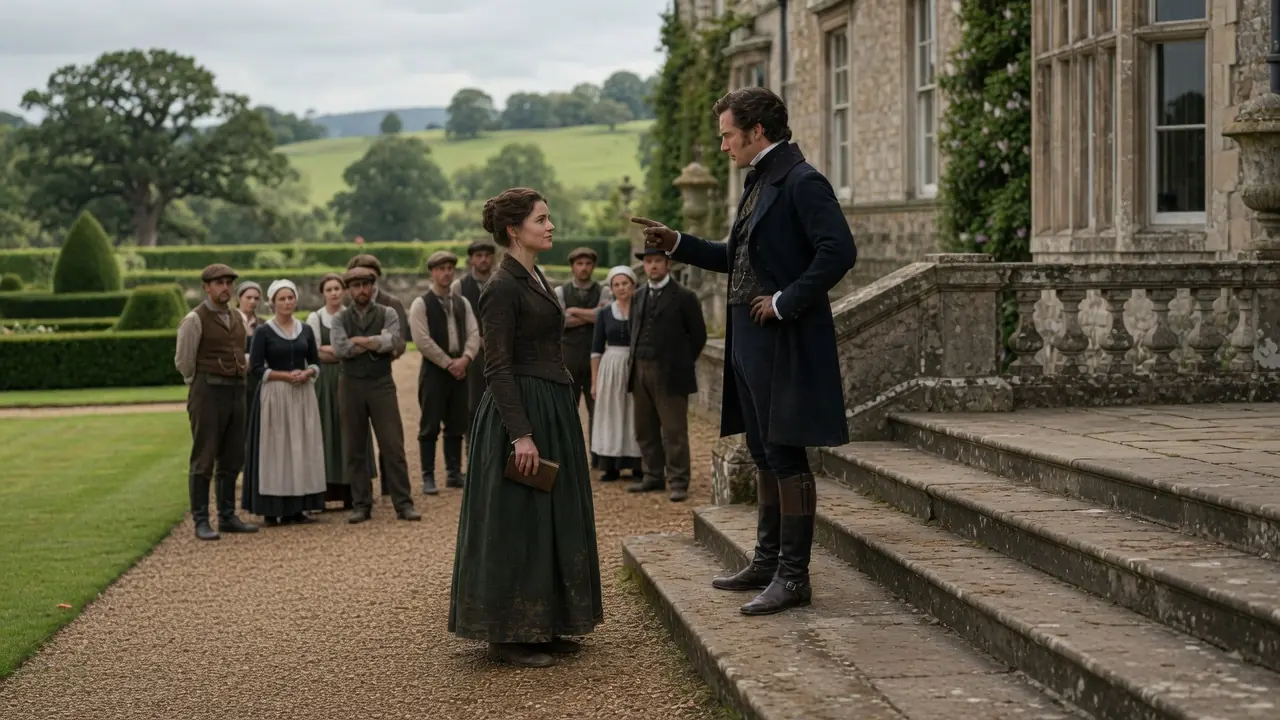
He had gone back to section four and found it there, precisely as stated. He had felt reading it the very specific sensation of a man who is not accustomed to being efficiently managed discovering that it is not unpleasant. The problem with Drove was the Fenwick letter. The Fenwick family held a small parcel of land on the estate's northern edge, not a tenancy exactly, but a long-standing arrangement that predated the current title by 60 years and whose legal basis was, at best, ambiguous. Eleanor had identified this in her first week and written to the Fenwicks to clarify the current understanding.
It was a routine administrative matter. She had informed Drove as a courtesy. Drove had written to the Fenwicks first. His letter, which Edward did not see until Eleanor brought it to him, having received a confused reply from the Fenwicks that referenced communications she had not sent, told the Fenwicks that the arrangement was under review at the duke's instruction, that the outcome was uncertain, and that they should seek legal advice at their earliest opportunity. Eleanor placed the letter on Edward's desk and stood back and said nothing.
He read it. He read it again. He set it down. "He knew you had written to them," he said. "He knew.
My letter was on the estate office desk when I left on Friday. By Monday it had been filed without being sent and his letter had gone in its place. He told them the arrangement was under review, which it is not. The Fenwicks have held that land for 60 years. The arrangement is not under review.
It simply needed documenting." She was very still. "They are an elderly couple. His letter will have frightened them." Edward looked at the letter, looked at her.
"Why would he do this?" "Because the Fenwick matter was mine to resolve," she said evenly. "Resolving it would have demonstrated that my appointment was working. Confusing it suggests that my involvement is creating problems." She paused.
"He is not malicious, Ashworth. He is frightened. A frightened person with access to correspondence can do a considerable amount of quiet damage." He stood. "I will speak with him."
"I know." She looked at him directly. "I am not asking you to fight my battles." "I am not fighting your battle," he said. "He interfered with my correspondence.
That is a separate matter." "It is the same matter. It is both matters." She looked at him for a moment. Something moved through her expression, something he was learning to read, the small shifts that preceded the larger ones.
"You are protective," she said. It was not an accusation. It was an observation, precise and direct, the way she made all her observations. "Is that a problem?" "It depends," she said, "on whether the protection is for my benefit or yours."
He stopped. The question landed in the precise way she intended it to, not cruelly but accurately, the way a drainage channel ran true when someone had taken the time to understand the gradient. "Say what you mean," he said. "I mean," she said carefully, "that I have had a man protect me before. He was very thorough about it.
He protected me from difficult conversations and difficult situations and the difficulty of being taken seriously in rooms where he did not think I belonged. He did it with great care and affection and it was" she stopped, started again. "It cost me two years and the use of everything I knew and at the end of it he married someone he didn't need to protect." Edward was very still. "I am not him," he said.
"I know you are not." She met his eyes. "I also know that you lost your family at 19 and have been protecting everything within reach ever since and that it is genuine in you. It is not strategy. It is how you are made."
She paused. "But I am not something that needs protecting. I am someone who needs to be permitted to work. There is a difference and I need you to know it. The room was quiet.
Outside the autumn rain against the windows, the estate going about its preparation for winter, the land settling into its patient cold. "Drove." Edward said after a moment. "I will speak with him about the correspondence because it is my correspondence, and he had no right to intercept it. Not because you cannot manage the situation yourself."
She looked at him. "Yes." She said. "That is the right reason." "And the Fenwicks."
He said. "You will write to them yourself today. Whatever you need from me, a formal statement, a signature, anything, you will have it." "Thank you." "And" He stopped.
This part was harder. "What Crane did to you, the man who used your knowledge, I'm sorry for it." She went still. "I did not tell you his name." "Garrett mentioned a gentleman farmer."
"It was not difficult to understand." She looked at him for a long moment. "It was a long time ago." She said. "I learned from it."
"You learned the wrong thing." He said. Or he chose his words carefully. "You learned a true thing from a limited example and applied it too broadly. Not everyone who values your knowledge is planning to use it and leave."
She was very quiet. The rain against the glass, the autumn light going gray and early. "That is" She said after a moment. "A more generous reading than I have given it." "It is an accurate reading."
She looked at him with the assessing look. The one that was not calculating, but simply careful. The look of a woman who had been given reason to be precise about what she believed. "You are asking me." She said slowly.
"To revise my conclusions." "I am asking you." He said. "To allow that one man's failure is not a rule. And you are not" She stopped.
"I am not." He said. "I am not planning to use what you know and leave. I am not" He stopped himself. He had not intended to go this far and was aware, standing in the estate office with the rain outside and the ledgers on the desk, that he was at the edge of something that had not been of the formal appointment and its professional terms.
"Ashworth." She said quietly. The word landing differently than it ever had before. Not the slip of habit, not the working ease of two people with a shared task. Something more deliberate.
He looked at her. "The Fenwick letter." She said. "I will draft the reply this afternoon." "Yes."
He said. "And I would like to be present when you speak with Drove." He considered it. "No." She looked at him.
"Not because you cannot manage it." He said before she could speak. "Because I am asking you to trust my judgment in this one instance. I know how I will handle it, and I know what it requires, and I think it will go better without an audience, including yours." He paused.
"If I am wrong, you may tell me so afterward." She held his look for a moment, then "Very well." She said. "Your Grace." The title returned, formal, precise, the distance replaced.
He had said something in the last 3 minutes that had warranted it. He turned it over as she gathered her papers. The protection, the Crane reference, the edge of the thing he hadn't quite said, and understood with the slow clarity of a man reaching a conclusion his mind had been building toward without his permission that he was going to have to be considerably more careful. Or possibly considerably less. Drove took the conversation badly, which Edward had expected.
And then took it well, which he had not. The badly part lasted perhaps 10 minutes. The defensive posture, the careful justifications, the practiced fluency of a man who had been explaining himself to himself for long enough that the explanations had acquired the texture of fact. Edward listened without interrupting, which was more unsettling to Drove than interruption would have been. When Drove finished, Edward set the two unopened letters from Garrett on the desk between them and the copy of the Fenwick letter beside them and said nothing.
Drove looked at the letters. The defensive posture left him. What remained was simply a man of 48 who had made a sequence of small wrong choices until they had accumulated into something he could not comfortably look at. "I was afraid." Drove said at last.
Not as an excuse, as a fact. "I know." Edward said. "She is" He stopped. "She is better at it than I am.
The practical work, the people, all of it." He looked at the letters. "I have been here 11 years. I have done my part. The paperwork is correct.
The rents are collected. I am not I did not think I was" He stopped again. "So you are not dismissed." Edward said. "Your role is what we discussed.
Correspondence, ledger administration, legal documentation, those things you do well. I need them done, and I need them done correctly, and you are the right person for them." Drove looked up. "What I do not need" Edward said. "Is for the person doing them to intercept the work of the person doing the rest.
If that happens again, the conversation will end differently." "It will not happen again." "No." Edward said. "It won't."
Drove gathered the letters, returned them to the desk's edge, the precise habit of a man who kept things orderly as a form of control, and stood. He paused at the door. "She is very good." He said without turning. "At all of it.
I want you to know that I know that." "Tell her." Edward said. "Not me." Drove left.
Edward sat alone in the estate office and looked at the rain against the window and thought about 11 years of paperwork filed correctly and two letters from Garrett that never arrived and a frightened man who had managed his fear badly and found that he could be angry and sorry at the same time. Which was the most honest response available. Eleanor was in the walled garden when he went to find her. Not working. Or not working on the garden.
She was sitting on the low stone bench along the south wall out of the rain with a small notebook open on her knee and the expression of a woman thinking. She heard him come through the gate and looked up and did not put the notebook away, which he took as a good sign. "How did it go?" She said. "He will not interfere again."
"You are certain?" "I am." He sat on the opposite end of the bench, which was damp at the edges from the rain's drift, but solid. "He said before he left that he wants you to know he understands how good you are at this." She was quiet for a moment.
"He could have said that to me at any point in 2 years." "Yes, he could have." Edward looked at the garden, at the beds put to rest for winter, the channels cleared, the orderly preparation of a place that had been cared for by someone who intended to go on caring for it. "He was afraid of what it meant for his own position." "That is not an excuse, it is the truth of what happened."
"I know what it is." She looked down at the notebook. "I have some sympathy for it, not for the letters, but for the fear." She closed the notebook. "I have spent 7 years being very good at things in rooms where that was not entirely welcome.
It makes you alert to the same quality in others." He looked at her. "Crane." "And others before him." "And situations before that."
She looked at the garden. "My father was a thorough teacher. He taught me everything he knew about land and management and agriculture because he loved me and because I was interested and because he had no son. He did not think carefully about what it would mean for me to carry all of that knowledge in a world that had no formal place for it." She paused.
"I do not blame him." "He thought knowledge was straightforwardly good. He was not wrong, he was simply not accounting for the full situation." "And Crane accounted for it very precisely." Edward said.
"He saw exactly what I had and exactly what it was worth and exactly how to have access to it without the complication of actually choosing me." She said it without bitterness, the flat accuracy of someone who has finished being bitter and arrived at understanding, which is its own quieter country. "He was not cruel, he was practical. I was useful to him, and when he had taken what was useful, he made the practical choice." "And you learned."
Edward said. "That being useful was the limit of what you could expect." She turned to look at him. "I learned that being remarkable was not the same as being wanted." She held his look steadily.
"Garrett called me remarkable last spring. He meant it as the highest praise, and I thought I heard it, and I thought, yes, that is the word. That is always the word." Edward said nothing. The rain was softer now.
The light going the particular gray of late September afternoon, the garden very still around them. "You are not remarkable." He said. She looked at him. "That is not what I mean."
He stopped, tried again. "What you are is necessary. Not in the way of something useful, in the way of something that changes the shape of everything around it. The ledgers run differently because of you. The field produces differently.
Garrett moves differently. I" He stopped. She was watching him with the careful look. Not closed, but precise, waiting. "I am not someone who says things he does not mean."
He said. "I do not have Crane's facility with useful sentiment. I'm going to say something, and I would ask you to hear it as plainly as I mean it, and not as an echo of someone who said something similar once before." "Say it." She said.
"I came here 3 weeks ago and found the estate in better condition than I deserved, and I called the reason for it irregular and suggested it would be replaced." He turned to face her fully. "And in the 3 weeks since I have consistently, in various ways, made the same mistake. Which is to see something I do not immediately know how to categorize and to attempt to manage it rather than to simply look at it." "Ashworth."
"I am not finished." He said it gently. "I have been managing things since I was 19. Estates and people and situations and the impulse to protect, it is not strategy, as you said, it is how I am made. My father and my brother died, and I was the one who remained, and I have been remaining very thoroughly ever since.
He paused. What I have not done in 14 years of remaining is want anything for myself. Not permitted myself to. There was always the next thing that required attention. She was very still.
You are the first thing, he said, in 14 years that I have wanted for no reason other than that I want it. Not because it is logical, not because it improves the situation, not because you are useful, though you are. You are extraordinarily useful. And I am aware of the risk of saying that now, given everything. But it is also simply true.
He looked at her directly. I want to know what is in the notebook. I want to know what you think about in the garden when you are not working. I want you to use my name, my actual name, without correcting yourself afterward. I want He stopped.
The sentence had more in it than was probably wise to say all at once. I want you to believe that what I am saying is the accurate version, not the useful version, not the version that gets me what I want by the smoothest available route, the true one. Eleanor looked at him. The gray light, the quiet garden. The rain now barely a presence, a sound at the edges rather than a weight.
Edward, she said. His name, the real one, said the way she said the things she meant, precisely, without decoration, with the full weight of her attention behind it. That, he said, is what I mean. She looked at him for a long moment. He could see her working through it, not the emotion, but the evidence.
Eleanor Prentice did not take things on feeling. She assessed. She cross-referenced. She ran the figures and checked the margins and arrived at conclusions she could defend. I am not easy, she said.
I have the estate and the Hartley accounts and Drove's filing system to reorganize and 17 years of being the most competent person in the room and no particular patience for being managed. I know. I will use your name and mean things by it, and you will not always like what I mean. I know. And I am not She stopped.
I'm not going to be careful about this in the way I was careful before. If I do this, I will do it honestly, which means I will tell you when you are wrong, and I will not perform softness I do not feel, and I will correct your drainage assessments when you are incorrect, which will happen. "That has already happened," he said. "Twice. I found it clarifying."
She looked at him. The almost smile the moment before the decision to permit it. And then she permitted it. The real one, not the social performance, not the dry acknowledgement, but the smile of a woman who has been careful for a very long time and has decided on the basis of available evidence to be slightly less so. Edward, she said again, differently this time, testing the weight of it the way she tested everything.
Finding it sound. Eleanor, he said. Outside the walled garden, the estate went about its autumn business, the fields settling, the harvest coming in, the land doing what land does when it has been properly cared for and knows it. Inside, two careful people sat on a damp stone bench in the failing light and arrived without ceremony at the decision to stop being careful in exactly the wrong direction. October came in cold and direct, with the kind of weather Derbyshire offered as a statement of intent rather than an inconvenience.
The fields contracted into their winter selves. The harvest was in, well better than well. The figures Eleanor produced at the first week's accounting showing a 17% improvement on the previous year, which she presented to Edward without comment, and which he read in full and then sat down and said, "The North Field." Primarily, she said. The drainage improvement is compounding.
Each good season makes the next one better. And you designed it in the spring of 1814. In February, actually. In the mud. She looked at the figures.
The returns will continue to improve for another 3 years at minimum. After that, they will plateau at a level that is significantly above where they were when I arrived. He looked at her. And then what? Then we find the next problem, she said, with the matter-of-fact ease of someone who has never been without a next problem and has made a productive peace with this.
"Drove," she said without noticing. He noticed. Drove, in the new arrangement, was orderly and efficient and quiet. He reorganized the correspondence system in the third week of October with a thoroughness that suggested he had been wanting to do it for years and now had the clear scope to do so without encroaching on territory that had never properly been his. He and Eleanor developed gradually and without discussion a working relationship of the specific kind that exists between two people who have had a frank reckoning and have decided to proceed on the basis of what is true rather than what is comfortable.
He came to her office one Tuesday with a letter she had been waiting on from a supplier in Sheffield, delivered it without comment, and then paused at the door. The eastern boundary fence, he said, the contractor's invoice. I've cross-referenced it against the specifications you sent in September. There is a discrepancy of 3 pounds in the materials line. She looked up.
I saw it. I was going to write to them this week. I've already written, he said. I hope that was appropriate. She looked at him steadily.
Yes, she said, that was appropriate. Thank you, Drove. He inclined his head and left. She returned to the Sheffield letter and thought about frightened men and the decisions they made and the ones they made afterward when the fear had been properly named and there was room for something else. Edward found the notebook in the estate office on a Thursday.
Eleanor had left it on the desk when she went to inspect the western fence. A small worn thing, the cover rubbed soft with handling. He did not open it. He moved it to the side of the desk where it would not be in the way of the papers he needed and then sat down and looked at it for slightly longer than was strictly necessary. She came back at 2:00, let in by the housekeeper, and came directly to the estate office and saw him at the desk with the notebook beside the papers, untouched.
You didn't open it, she said. No. She picked it up. You wanted to. Yes.
She looked at him. Then she held it out. There is nothing in it you would find alarming. It is mostly drainage calculations and crop rotation observations and occasionally a record of what the weather looked like on a given afternoon. He took it, opened it to a random page, March 2 years ago, a precise note on water table levels accompanied by a small sketch of the North Field's channel layout, exact and clean.
On the opposite page, in a slightly different hand that was the same hand but faster, less guarded. Cold this morning. The field looks impossible. It is not impossible. Things that look impossible are generally problems that have not yet been properly examined.
He read it twice, closed the notebook and gave it back. March 1814, he said, when you were planning the drainage. Yes. Things that look impossible are generally problems that have not yet been properly examined. I was 25, she said.
I needed the reminder. Do you still? She considered it. Less often, she said. Some things I have learned to look at more quickly.
He looked at her. She held the look. No performance, no guard, simply Eleanor being Eleanor in his estate office on a Thursday afternoon in October with the cold outside and the notebook in her hand. There is a dinner at Alderton next week, he said. Sir Robert Alderton's house, the neighboring estate.
He has invited me and indicated that the invitation extends to my household. He paused. I would like you to come. She was quiet. As your estate manager?
As the person I would like to have beside me at dinner. Those are the same thing. They are both true simultaneously, he said. One does not cancel the other. She turned the notebook in her hands.
There will be talk. Probably. People will draw conclusions. People, he said, will draw accurate conclusions, which is not a problem I am particularly concerned about. She looked at him with the assessing look that was not calculation, but simply her way of being careful.
Except that it was, he had come to understand, becoming less careful and more something else. Something that was looking for permission to arrive somewhere it had already been heading. The dinner is on Wednesday, he said. I know, she said. Sir Robert's cook is very good.
His hospitality is genuine and his conversation is better than most. She paused. I have been to his estate three times in the past 2 years on estate business. Then you will know the house. Better than you will.
Undoubtedly. He allowed himself briefly the smile he had been suppressing. You can tell me where the drafty passages are. There are two, she said. The one between the library and the dining room, and the one outside the morning room that everyone ignores because it has been there since the house was built and no one has thought to examine it properly.
You have thought about examining it. I mentioned it to Sir Robert last spring. He was, as usual, interested and then immediately distracted by a question about his best wheat field, and we did not return to it. Then we will have something to discuss at dinner, Edward said. She looked at him for a moment longer.
Yes, she said. I suppose we will. She went to her side of the desk. She opened the notebook to a new page. She picked up her pen.
The fence contractor replied about the discrepancy, she said. They are sending a corrected invoice. Good. Drove caught it. I know, he told me.
She looked up. He told you? He mentioned it this morning. Said you had thanked him. Edward looked at his papers.
He seemed He seemed to stand differently after. Eleanor was quiet for a moment, then she returned to the notebook. "People generally do," she said, "when when they are thanked for the right thing." The dinner at Alderton was, by every social measure, unremarkable. Sir Robert was exactly as Eleanor had described, warm, interested, easily distracted by his own enthusiasms, a man whose hospitality was genuine because he was genuinely glad to see people rather than because he understood it as a performance.
His wife was quieter and sharper and had the look of a woman who had spent 20 years being the intelligence behind a very affable exterior, which she wore with the comfortable ease of someone who had made her peace with the arrangement. Eleanor wore the same good dress she had worn to their first meeting. Edward had seen her in it before and recognized it and said nothing, which she registered with the peripheral attention she gave to everything. She sat across from him at the table between Sir Robert's eldest son and a neighboring clergyman who turned out to have unexpected views on crop rotation that held her attention for the better part of the fish course. Edward watched her across the table.
He watched her listen to the clergyman with genuine interest and argue a point about winter wheat with the precision and confidence of someone who knew they were right and felt no particular need to soften the knowing. He watched her make Sir Robert laugh twice. Genuine laughter. The kind that arrived before the social decision to laugh, which was the only kind that mattered. He watched Lady Alderton watch Eleanor with the expression of a woman who was drawing accurate conclusions and finding them satisfactory.
After dinner in the drawing room, Lady Alderton appeared at his side with the purposeful approach of a woman who has something to say and has chosen her moment. "She is very good," Lady Alderton said, looking at Eleanor across the room where she was examining a map of the Alderton estate with Sir Robert with the concentrated interest of someone who had found the conversation she had been waiting for all evening. "She is," Edward said. "I mean more broadly than the estate." Lady Alderton looked at him with the directness of a woman who had spent 20 years not saying the imprecise thing.
"She is the kind of person who makes a room function better simply by being in it without being aware of doing so. That is rarer than almost any other quality." "I know," Edward said. Lady Alderton looked at him. "Yes," she said, "I can see that you do."
She moved away with the unhurried satisfaction of a woman who has confirmed something she already believed. Eleanor looked up from the map, found his eyes across the room, held them for a moment, the direct look, nothing withheld, and then returned to Sir Robert's drainage questions, which she had apparently identified as the more pressing matter. He stood by the window and felt, with the clarity of someone who has been working toward a conclusion and has just arrived at it without warning, that he had not been this certain of anything in 14 years. They rode back to Whitmore together, which had not been formally arranged but became the arrangement when Sir Robert's groom brought the horses and it was simply the natural conclusion of the evening. The night was cold and very clear, the kind of October sky that showed everything, stars unambiguous in the absence of cloud.
They rode in comfortable silence for a mile. Eleanor rode well, which did not surprise him. "Lady Alderton," she said eventually. "Yes." "She said something to you after dinner."
"She did?" "What?" He considered. "She said that you make rooms function better without being aware of doing so." A pause.
"That is a very specific compliment." "She is a very specific woman." "What did you say?" "That I knew." He looked at the road ahead.
"She appeared to find that sufficient." Eleanor was quiet. The horses moved, the cold air and the stars and the dark shape of the estate coming into view ahead, the lights of the house visible through the trees. "Edward," she said. "Eleanor."
"I want to say something." She kept her eyes on the road. "And I want to say it without the notebook and without the desk between us and without the formal arrangement and its terms." "Say it." "I have been I have spent this month being slightly less careful," she said, "in the direction of" She paused.
"In your direction. And I want you to know that it is not it is not the situation, it is not the appointment or the estate or the usefulness of any of it. It is" She stopped. "Eleanor." "I find that I think about you," she said plainly, "when there is no practical reason to, when the ledgers are done and the tenant business is resolved and there is nothing requiring your attention.
I think about what you said in the walled garden and the way you moved the notebook without opening it and the fact that you rode to Garrett's field yourself instead of sending someone and did not tell me you had done it until he mentioned it." She paused. "Those are not the thoughts of someone who is being useful. They are the thoughts of someone who is" "Who is what?" he said when she stopped. "Who is considerably further along than is entirely convenient," she said with the dry precision that was her characteristic mode of saying things that cost her, which made them cost more and mean more simultaneously.
He brought his horse alongside hers, close enough that she turned to look at him. The starlight, the road, the estate ahead. "I moved the notebook," he said, "because I wanted to read it and I was not going to read it without your permission and the most honest available position was to leave it somewhere you would see that I had not." She looked at him. "I know," she said.
"That is one of the thoughts." "Eleanor." He looked at her directly. "I have been I have been in a state of sustained certainty about you since approximately the second morning. The certainty has only become more certain."
He paused. "I am not asking you to move faster than you are moving. I'm asking only that you know the direction I am facing and that it has not changed and that it will not." She held his look. The horses moved.
The estate came closer through the dark. "The direction I am facing," she said, "is the same." "Then we are agreed." "We are," she said. "Your Grace."
He looked at her. She was looking straight ahead, the road, the house, the October night, and the corner of her mouth was doing the thing that preceded the smile, which was better than the smile itself because it was the moment before the decision to permit it, which was entirely hers, which was exactly as it should be. "Eleanor," he said. "Edward," she returned without looking at him, with all the weight of two careful people who have stopped being careful in exactly the wrong direction and discovered that the right direction was this, simply this, the road, the cold, and the estate coming into view. No one who had observed the autumn was surprised by what came next, and it caused a particular quality of satisfaction among the Whitmore tenants that expressed itself in the form of Thomas Garrett presenting Edward with a detailed written assessment of the estate's prospects for the following decade, which was thorough and accurate and contained, in the final paragraph, the observation that the current management arrangement appears sound for the long term and the land is in good hands, which was the closest Garrett had come to a personal remark in 30 years of farming and which Edward read aloud to Eleanor that evening and which made her set down her pen and look at the ceiling for a moment in the way she did when she was feeling something she had not yet categorized.
"He will deny writing it if asked," she said. "Certainly." "And he will be right, too." She picked up her pen again. "The western fence figures."
"Eleanor." "The figures are due on Friday." "Eleanor." He took the pen gently from her hand. She looked at him.
"The figures can wait 5 minutes." She looked at the ceiling again. "He called it the current management arrangement," she said. "He put us in the same sentence." "He did."
"Garrett has never put two people in the same sentence unless they were arguing about a field boundary." "No," Edward agreed. "He hasn't." She looked at him with the expression that was not quite the smile and was better, the moment before. "He approves," she said, as though it surprised her, as though after 2 years of Garrett's trust, the personal was something she had not thought to account for.
He does. Edward held her look. So does Lady Alderton. So does your father's memory of what he taught you and why. So does every drainage channel in the North Field.
She stared at him. Then she laughed, the real laugh, the one that arrived before the decision, quick and warm and entirely unguarded, and he thought he would remember it with the same precision he remembered everything about her, filed under essential and cross-referenced with nothing because it required nothing beside it. The drainage channels, she said. They were the first evidence, he said. I should have known then.
I really did know then, she said. You simply called it irregular. I was wrong about what the irregularity was. She picked up her pen again, but she was smiling, the full one, his now as much as hers. The western fence figures, she said, and then I will stop working.
For the evening. For the evening, she conceded. The land will need attention again in the morning. It always does, he said. Yes.
She looked at the figures and then at him and then at the figures again, and he sat across the desk from her in the November evening with the fire and the lamplight and the estate settling into its winter outside and found, for the first time in 14 years, that remaining somewhere felt not like duty but like choice. They were married in January at the church in the village closest to Whitmore Park in the specific cold of a Derbyshire winter that made everything clear and exact and unambiguous. The church was full. Tenants and their families, Sir Robert and Lady Alderton, Drove in his best coat, looking orderly and pleasant and something very close to glad. Thomas Garrett sat in the second row.
He had not worn his best coat, which was either an oversight or a statement. Eleanor suspected the latter and respected it. The ceremony was brief and correct and exactly what it needed to be and when it was done and they stood outside in the January cold with the sky doing what January skies do when they have committed entirely to being themselves. Clear, enormous, without apology. Edward looked at her with the look that had no performed version and said nothing.
Which was the right thing. The North Field, she said. We'll need the channels cleared before February. I know. And the Hartley rent review is in March.
I know. And the contractor still owes us £3. Eleanor. He said it the way he had learned to say it with the full weight of everything he meant by it, which was considerable. Edward, she said the same way.
The cold, the sky, the estate waiting at their backs, patient and familiar, shaped by her hands and his attention and two years of unglamorous work that had quietly saved it. Garrett raised a hand as he passed, not to them specifically, to the general arrangement of the morning, which was his characteristic way of acknowledging things that pleased him without making a performance of the pleasing. Eleanor raised a hand back. Edward nodded. They went inside.
The estate went about its business. The North Field ran true in its channels. The Hartley family was current on their rent. The walled garden waited under its winter cover for the spring. And in the estate office at Whitmore Park, on the corner of the desk where it had always lived, the small worn notebook sat open to a new page, blank as yet, waiting for whatever came next, which was the best possible thing for a blank page to be.