November 1813. A duke calls Bella Hartwell's inherited farm worthless, then spends the next six months riding three and a half miles every Thursday to prove himself wrong. When a parliamentary road plan makes her land worth a fortune, she finds his solicitor's letter. He knew before the first visit. All of it, every Thursday.
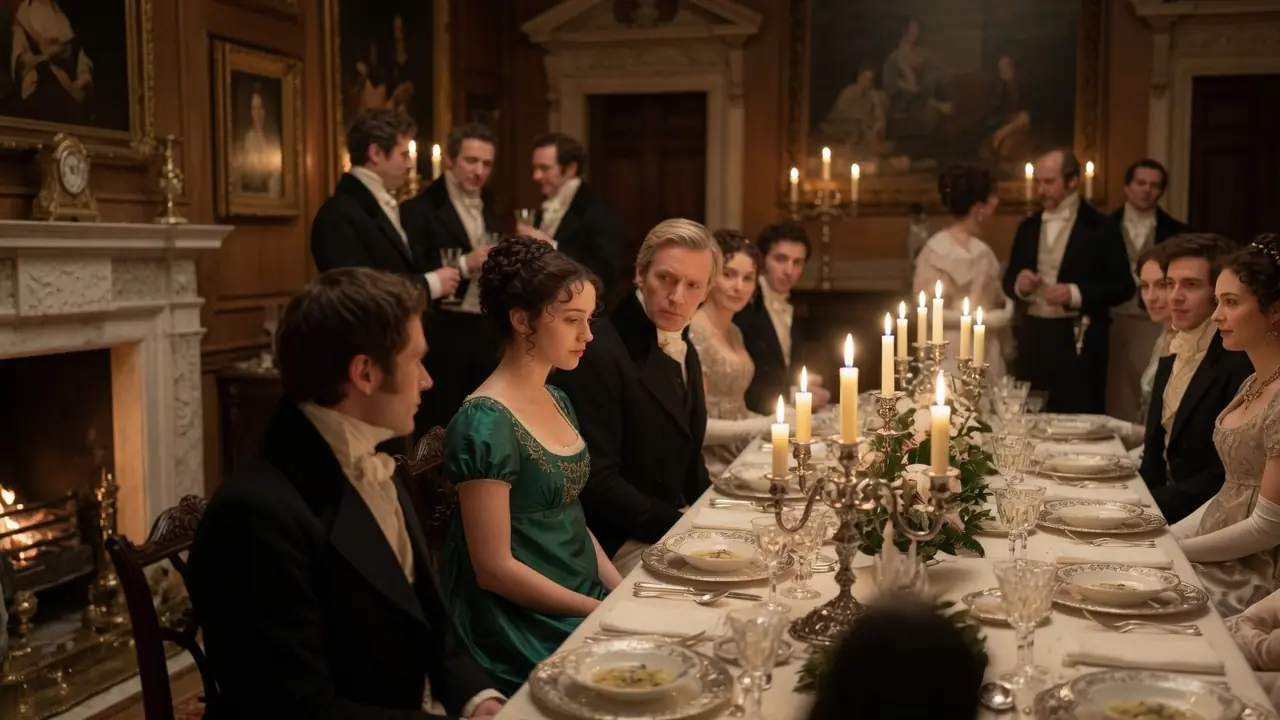
The candles at Sir Edmund Price's table had been lit an hour before they were needed, which told Arabella Hartwell everything she required to know about the evening ahead. It was November. The roads were bad, and Sir Edmund had invited fourteen people to dinner, which meant that someone, probably several someones, would be seated beside a stranger and expected to perform. Bella had arrived early, which she always did when she could not afford a carriage and had to borrow one. The Prices' housekeeper had shown her to the drawing room with the particular warmth reserved for guests who were liked but not important, and Bella had stood by the fire and studied the portrait above the mantle, a Price ancestor in a wig that had not suited him, until Mrs. Price swept in and kissed her cheek, and told her she looked very well, which meant her dress would do.
"It will do," Bella thought, smoothing the green silk at her hip. It had been her mother's altered twice, and it still sat well. The other guests arrived in the usual order. The people who mattered first, then the people who mattered to the people who mattered, then everyone else.
Bella was in the last group and did not mind it. She accepted a glass of ratafia from a footman, positioned herself where she could see the door and waited. She was watching the door when he came in. Not because she knew who he was.
She didn't, not immediately. She was watching because she always watched doors. It was a habit her father had called impertinent, and her aunt had called vulgar, and Bella had decided was simply accurate. You learned more from how a person entered a room than from anything they said in it.
This one entered as though the room had been expecting him, which she gathered from the sudden adjustment of posture among the assembled company. It had. He was tall, blonde, going darker at the temples, with the kind of face that had probably been striking at 20, and was considerably more so at whatever age he was now. He gave his coat to a footman without looking at the footman. He scanned the room once, not with curiosity, with assessment, and then Sir Edmund was at his elbow, and the introductions began.
"The Duke of Thornfield," she heard. She revised her estimate of the evening. She was placed beside him at dinner. This was either Sir Edmund's mischief or Mrs. Price's, and Bella would determine which later, for now she unfolded her napkin, accepted the soup, and waited for the Duke of Thornfield to decide whether she existed.
He decided after the fish course. "Miss Hartwell," he said, the way one says a thing one has just recalled. "You are the Hartwells of Fenwick?" "The farm?" Bella said. "Yes." A pause. "I was not aware there were Hartwells at Fenwick." "There have been Hartwells at Fenwick for sixty years," Bella said pleasantly.
"We are simply not the sort of Hartwells anyone announces." He looked at her. His eyes were hazel, she noticed, shifting between brown and something greener and not at present particularly warm. "Your father died in March." "I manage the farm now."
Another pause longer. "Alone?" he said. "I have two farm hands and a very opinionated housekeeper. Whether that constitutes alone depends on your definitions."
She turned to look at him directly. "Do you manage your own land, Your Grace, or do you have people for that?" The gentleman on her left, a Mr. Fallow who bred horses and had opinions about them, looked up with the expression of a man who has witnessed a small explosion, and is not certain he is safe. The Duke of Thornfield was quiet for a moment.
Not the quiet of a fence, the quiet of a man recalibrating. "I have a land steward," he said. "Several, in fact." "And do you find that you understand the land better for it or less?" "Miss Hartwell," his voice was even, "are you asking whether I am competent?"
"I am asking whether you are informed," she said. They are different questions. "You may be extremely competent and still have no idea what is actually happening in your north fields." Mr. Fallow developed a pressing interest in his bread roll.
The Duke looked at her for a long moment. She met it without difficulty. She had grown up looking men in the eye when they would have preferred she didn't and had found that the discomfort was almost always theirs. "My north fields," he said finally, "are in excellent order." "I'm glad to hear it," Bella said, and meant it.
"Mine are not at present. The drainage wants work, but they will be." She turned back to her soup. After a moment she heard him pick up his own spoon. The conversation at the table moved on.
The usual topics, the roads, the weather, a distant war, a closer marriage. Bella listened more than she spoke, which was her habit at dinners, where she was the least important person present. She asked Mr. Fallow about his horses, which was all the invitation he required, and half attended to his answer, while she kept a peripheral awareness of the man on her right. He did not speak to her again directly, until the table turned for dessert.
"You said they will be," he said without preamble. "Your Northfields?" She blinked. He had apparently been keeping a peripheral awareness of his own. "Yes, that is a considerable undertaking for one person."
"It is," Bella agreed. Most things worth doing are. He studied her with that assessing look again. The one from the doorway applied at closer range.
"You are not what I expected," he said. "You expected nothing," she said. "You didn't know I existed until the fish course." "That's not the same as expectation."
A beat. And then something changed in his expression. Not warmth exactly, but the adjustment of a man who has been slightly surprised and is choosing not to show it fully. "Fair," he said.
It was the most unguarded thing he'd said all evening, and it came and went so quickly she might have missed it. The ladies withdrew. Bella sat beside Mrs. Price on the settee and listened to Miss Fallow, the horse breeder's daughter, seventeen and delightful, describe a novel she was reading. Bella asked questions.
Miss Fallow glowed. Mrs. Price watched Bella with the fond speculative expression of a woman who has arranged a seating plan and is satisfied with the results. "Well," Mrs. Price said when Miss Fallow had gone to the pianoforte. "You survived." "I'm not sure that's the word I'd choose," Bella said.
"He's perfectly civil." "He is," Mrs. Price agreed. "He's been perfectly civil to everyone since Eleanor died. It's quite different from being agreeable." Bella considered this. How long ago? Four years.
The boy was seven. Mrs. Price smoothed her skirt. He doesn't come to dinners generally. I was surprised he accepted.
Perhaps he needed to eat. Mrs. Price gave her a look. Perhaps. When the gentleman rejoined them, Bella was at the instrument, having relieved Miss Fallow of a piece that required more fingers than Miss Fallow had currently trained.
She played it through once without error, and did not look up when the room filled again. She was aware, with the precision of someone who had learned to track rooms, that the Duke of Thornfield did not go to the card tables. He accepted a cup of tea from the tray, positioned himself near the window, and stood. She finished the piece.
There was polite applause. She stood and yielded the instrument to Miss Fallow, who had recovered her courage. When she turned, he was closer than he had been. "Can you play well?" he said.
"It will do," Bella said. She said it about the piece which she knew was not her finest. She hadn't practiced in a fortnight, and the third movement had a passage she had smoothed over rather than executed. She meant I am not finished improving it.
He heard it as a deflection. She could see him deciding to let it pass. "You mentioned your farm," he said. "Fenwick.
It's what, four miles south of the Thornfield boundary." "Three and a half," she said. "On the road past the mill." He nodded slowly. The hazel eyes moved to the window. There was nothing to see.
It was full dark. And back to her. The drainage work. Is that a new undertaking or ongoing?
Does it matter to you? She asked, not rudely, with the same genuine curiosity she brought to most questions. He paused. I suppose not.
Then I'm wondering why you're asking. Another of those recalibrating silences. She was beginning to recognize them. The space between what he had prepared to say and what the conversation was actually requiring of him. Conversation, he said.
You don't seem like a man who makes conversation, Bella said. You seem like a man who gathers information. Those are quite different activities and only one of them is rude to name. He looked at her for a long moment.
Outside the wind came up against the windows and Miss Fallow struck a wrong note and recovered it. You are very direct, he said. Is it inconvenient? It is unusual.
That's not what I asked. Something passed across his face, too quick to catch fully, but not displeasure. He looked down at his tea. "No," he said.
"It is not inconvenient." Bella nodded, satisfied. "Good. To answer the question, the drainage work has been ongoing for two years. My father began it and did not finish.
I intend to. What does it require? Channels on the north side, a redirected berm along the lower field, and one very good frost next February to show me where the water is actually going." She paused. "Also money," but that is true of most things. He made a sound that was almost not quite a laugh.
Mrs. Dench. Yes. Does she have opinions on the drainage? She has opinions on everything, Bella said.
Most of them correct. She thinks the lower berm needs to come two feet further east than I've put it. She is probably right. And you will move it.
When she has told me so four more times, Bella smiled. She needs to feel she has convinced me. It costs nothing. He was quiet again.
A different quality of quiet this time, less assessing, more attentive. I should say good night, Bella said. She had borrowed the Fenwick's trap, and the lane was already going to be unpleasant. It was a very good evening.
Miss Hartwell. He said it as she was half turned away. She looked back. The berm, he said. Two feet east, you said.
Mrs. Dench said. Hmm. He held his teacup. The firelight caught the angles of his face and turned them briefly less severe.
I would move it. She regarded him. Have you had occasion to redirect drainage berms your grace? Twice, he said.
Both times I was wrong about the distance. Both times my steward was right. Bella held his gaze for a moment. It will do, she said, meaning that is actually useful, and I will remember it.
And went to find her coat. She did not look back. She did not need to. She had learned from the doorway that he watched rooms, and she was still in his.
The drive home was cold, and the lane was worse than she'd feared. Mrs. Dench had left a lamp burning in the hall, which Bella extinguished herself rather than wake anyone. She stood in the dark kitchen for a moment, thinking about nothing in particular. Then she went to bed.
She did not think about him again until morning, which she considered a reasonable interval. Over breakfast, with the account books open and the north field requiring decisions, she thought about the berm and the frost and the question of whether a man who had drainage stewards for his drainage problems had any right to recommend placement. She decided he had been correct anyway. She moved the berm two feet east that Thursday.
Mrs. Dench found out on Friday and was insufferable about it for a week. Bella did not mention where the idea had come from. Some information was not relevant. Spring came late to that part of the county, as it generally did, grudgingly in fits, with cold mornings persisting a full fortnight after the calendar had declared it April.
Bella noticed it less than most, because she had too much to do to pay close attention to the season. The Northfield's drainage channels were dug by mid-March, the lower berm resettled two feet east and holding, and she had turned her attention to the east boundary fence, which was losing an argument with a stand of ash trees, whose roots had decided the fence posts were an obstacle rather than a fixed fact. She was arguing with the fence on the morning of the 14th of April, when she looked up and found a horse on her lane, her very good horse, the kind that cost more than her annual income, and knew it. The Duke of Thornfield dismounted with the ease of a man for whom dismounting is not an action requiring thought.
He handed the reins to no one because he had apparently come alone and looped them over the gate post with the practiced efficiency of a man who had grown up doing it himself which she had not expected. Miss Hartwell, he said, "your grace." She straightened, pushing her hair back from her face with her forearm because her hands were dirty. She was wearing her working dress, which was not the green silk. She did not apologize for either of these things.
Were you expected? No. He looked at the fence. Trouble. The ash trees have opinions about where the boundary is, she said.
I disagree. We are currently negotiating. He considered the fence with the expression she was starting to recognize. Not dismissive, but measuring.
He had looked at her the same way at Sir Edmund's table, like something he hadn't placed yet. Thornfield Park is 4 miles north, he said. Three and a half, she said again. I was in the area on a Tuesday morning.
It is not exclusively a Tuesday landscape, he said, and she heard the dry edge she had noted at dinner, the wit he apparently kept for occasions when he had no prepared material. No, she agreed. It looks much the same on Wednesdays. She pulled off her working gloves and tucked them into her pocket.
Will you come in? He came in. Mrs. Dench produced tea with the expression of a woman who had decided to reserve judgment, which meant she had formed a judgment already, but was keeping it in a drawer. Bella did not look at her.
They sat in the small parlor. Small was the word for it. Honest was another. It had the proportions of a room that had been furnished once, well, and not touched since, because there was no money and no need.
And she poured tea and looked at him and waited. He looked at the room, not critically taking stock. You've managed the farm since March, he said alone. Since March last year, she said, "My father was ill for some months before." "I'm sorry." "Thank you." She passed him his cup.
"Was there something particular that brought you this way, or was it purely the landscape?" His mouth moved, not quite a smile, but the shape of one suppressed. "I had some business near the mill," he said. "A tenant dispute. It was concluded by nine, which left the morning free." And you thought of Fenwick?
I thought of the berm, he said, whether it had held. She studied him. He returned the look without difficulty, which was unusual. Most men either looked away from her direct attention or held it with the self-consciousness of someone doing a thing they decided to do.
He simply looked back as though attention was neutral. It held, she said. Mrs. Dench was very pleased with herself, as she should be. He looked at his tea.
You moved it. She told me to for a week. But you moved it when you decided to, he said, not when she told you. Bella paused at Yes.
You heard the advice and waited until you decided it was correct. Is that unusual? In my experience, he said, most people either take advice immediately to appear agreeable or reject it entirely to appear decisive. Waiting until you've assessed it is a third option.
It seems like the obvious option. Hmm. He drank his tea. It is not in practice common.
She watched him. There was something different about him in this room than there had been at Sir Edmund's table. Not easier, exactly. He was not an easy man, she suspected, but less performed.
At dinner he had had an audience. Here he had only her, and he appeared to have made some internal adjustment for it. "Tell me about your Northfields," she said. "The ones in excellent order," he glanced up.
"Why?" Because you asked about mine, she said, and I should like to know if you have any actual knowledge, or if you were testing whether I'd answer a duke's questions without asking any of your own. A pause. Both, he said initially. And now, now I'm curious.
She considered this. The Northfields, she prompted. He told her briefly, without the decorative detailing she might have expected from a man accustomed to impressing people, just the facts of the land, the clay soil on the upper section, the drainage problem he'd had five years ago, the solution that had cost more than anticipated and worked better than expected. He used precise language. He did not talk down to her.
She noted both things. What resolved it? She asked. We dug the channels deeper than the survey recommended, he said. My steward's suggestion.
He'd seen the same soil type in Lincolnshire. And you took the advice. After two weeks of deciding whether he was right, he looked at her steadily. So no, not immediately.
She smiled. She couldn't quite prevent it. He saw it, and something in his expression settled. I have a field I've fenced off, she said.
The middle section southacing. The soil's different there, sandier. I'm not sure yet what to do with it. Barley, he said without hesitation.
She raised her eyebrows. Sandy, south facing, good drainage implied by your work on the north side. Barley? It will need lime first, but barley.
She looked at him for a moment. Do you know I was told dukes don't actually know anything about their own land. Who told you that? A farmer at the Fenwick market.
He had strong opinions. He was probably describing a different Duke. Richard set his cup down. My father made me walk every field I would inherit before I was allowed to inherit it.
He had strong opinions of his own. He sounds sensible. He was impossible, Richard said, and sensible both. Bella recognized this, the particular combination, the retrospective understanding of a parent whose methods had been maddening and correct.
She looked at her own hands for a moment at the dirt still under her thumbnail that she hadn't quite managed to clean. My father, she said, was the same. He left me the farm because he thought I was the only one who'd actually care for it. My aunt said it was eccentric of him.
Was it? No, she said it was accurate. He nodded slowly. She had the impression he was filing things away, not in the calculating way she'd suspected at dinner, but in the way of a man who finds something genuinely worth remembering.
He stayed another twenty minutes and then took his leave. Mrs. Dench, appearing from nowhere in the hall, took his hat from the peg with an expression of scrupulous neutrality. Good morning, your grace, she said. Mrs. Dench.
He settled his hat. I understand you recommended the berm placement. Mrs. Dench looked at Bella. Bella looked at the window.
I made a suggestion, Mrs. Dench said. A correct one. He nodded to her, an actual nod, not a dismissal, and went out to his horse. Bella watched him from the hall doorway.
He mounted, turned the horse, and was gone down the lane without looking back. "Well," said Mrs. Dench. "Don't," said Bella. "I haven't said a word.
You've said several in your expression. Mrs. Dench folded her hands. The tea things need clearing. They did.
Bella went and cleared them and did not think about hazel eyes or the word barley or the particular quality of a man's attention when he has stopped performing and started actually looking. She thought about barley though. She went and looked at the south field in the afternoon, walked the perimeter, crouched and took a handful of soil and felt the texture of it. Sandy south facing.
She put the soil down and stood up and brushed her hands clean. Barley, she thought, and went in for her supper. He came back. She had half expected it, and half talked herself out of the expectation, which meant that when he appeared on the lane 3 weeks later, different day, same excellent horse, no prior notice.
She was neither surprised nor unsurprised, but simply present. This time he brought a reason. He had found, he said, a document in the Thornfield records that referenced a right of way along her eastern boundary, the side with the ash trees. He thought she should know, as it might affect the fence dispute.
He produced the document, which was genuine, which she could see immediately, and which did in fact affect the fence dispute. You rode three and a half miles to bring me a document, she said. I had business near the mill again, he said. The same tenant dispute.
A pause. A different one. She looked at him. He looked at the document.
She took it. Come in then, she said. This time, Mrs. Dench produced the tea faster, which told Bella everything about the state of Mrs. Dench's feelings. They sat in the parlor again, and Bella read the document carefully while he drank his tea without fidgeting, which she appreciated.
She had had visitors who fidgeted while she read and found it insupportable. The right of way runs along the boundary, not through it, she said. So, the fence placement isn't actually affected. No, he agreed.
She set the document down, looked at him. He looked back. The silence had the quality of something they were both choosing not to name. "How is your son?" she asked.
He blinked. The smallest possible blink, the adjustment of a man who had been expecting a different question. "James." "He is well. He is at less.
How old is he now?" "He will be eleven in June," a pause. He is very precise about the distinction between 10 and 11. Between what he is and what he is about to be, Richard said, "He has been precise about it since he was seven." Bella considered this. Does he like it, the estate, the land?
He likes the horses, he said. He has not yet decided about the land. He is 10. You decided at 11.
I decided at nine, he said. My father put me on a horse and rode me to the far boundary and asked me what I saw. I told him I saw fields. He told me to look again.
I looked again. I saw people. He paused. Tenants, farmers, workers.
He said that was what the land was. Not the soil, not the drainage. The people whose living depended on whether I took it seriously. Bella was quiet.
And do you take it seriously? I hope so. He said it without performance. I tried to.
She believed him. That was the thing about him that she hadn't quite accounted for, that she kept finding reasons to believe him, even when she was looking for reasons not to. "James should see the farm," she said, "if he'd like. Some boys find it useful to see a small operation.
It's easier to understand than a large estate. You can see all of it at once." Richard looked at her. "You are offering to show my son your farm." I am offering to show your son the drainage channels, she said, which are genuinely interesting if you like to know where water goes, which some ten-year-olds do, and some don't. And some don't, but then he'd know that, too, which is also useful information.
He considered her for a moment. You are very good at offering things that are also practical, he said. I find it economical, she said. One thing that is both.
He stayed an hour. He asked about the barley, whether she'd decided. She hadn't, not yet. She was going to look at what the board of agriculture pamphlet said about soil composition first.
She told him there were papers from Holkham on improving light soils, and a correspondent of her father's at the agricultural society, who might know more. He looked at her with an expression she hadn't seen from him before. "I didn't know anyone in this county was reading the board of agriculture reports," he said. My father subscribed to everything they published, she said.
I continued to. The pamphlets are not expensive. No, he said. He was looking at her again in that way, the filing away.
No, they're not. He left at noon. He said nothing about returning. She noticed this.
He returned in a fortnight. The third visit had no pretext at all. He appeared on the lane on a Thursday afternoon, and when she opened the door and looked at him, he simply said, "I was nearby." and she said, "You were not." And he said, "No." And she stood back and let him in. They walked the farm that afternoon.
It was her suggestion she wanted to check the east boundary, and he fell into step beside her, and it became, by natural progression, a full circuit. She showed him the south field, the sandy soil, the way the light fell differently there than on the heavier clay to the north. She showed him the ash trees and the fence and the right of way that didn't actually affect anything. She showed him the drainage channels which were holding beautifully and felt the particular satisfaction of showing good work to someone who could assess it accurately.
He could assess it accurately. He asked the right questions, not the questions of a man performing interest, but the questions of someone who wanted to know about the depth of the channels, about the gradient, about what she'd done with the spoil. The spoils in the kitchen garden, she said. Mrs. Dench puts everything in the kitchen garden eventually.
She sounds formidable. She is the most practical person I know, Bella said. And she has been keeping this house running since before I was born, and she told my father where to put three successive generations of fence posts, and she was right every time. She paused.
I am very glad of her. That's not nothing, he said. She glanced at him. He was looking at the channels and she wasn't certain he'd meant for her to hear it.
It had the quality of a thing said half to himself, but she did hear it and she tucked it away and they walked on. They had come back around to the house, the full circuit complete. When he stopped at the gate and looked back across the farm, she stood beside him. The late afternoon light was doing something particular to the Northfield, making it look better than it was, or possibly exactly as good as it was.
She could never quite tell with Northfields. It's a good farm, he said. It will do, she said. He looked at her then directly with the full weight of those shifting hazel eyes.
I think, he said slowly. That phrase does not mean what it sounds like. It means exactly what it sounds like, she said. It will do.
It is not finished, and it is not what it will be, but it is already sufficient, and I am not done with it yet. He was quiet. Yes, he said. I think that is exactly what it means.
They stood at the gate for another moment, and then he collected his horse and went down the lane, and Bella stayed at the gate for a while after he had gone, looking at the north field in the late light. She was in difficulty. She knew it with the same precision with which she knew the gradient of a drainage channel or the composition of her southfield soil. It was simply a fact, present and inconvenient, and the most practical response was to acknowledge it and decide what to do next.
She decided to do nothing for now. He came back the following Thursday, and the Thursday after that until Thursday became a word with a particular weight in her week. Mrs. Dench said nothing, which was the loudest possible statement. The farm hands, John, who was 50, and Tom, who was 19 and entirely transparent, began to have the horse ready at the gate at half 3, which was when he generally appeared, and Bella said nothing about this either, because acknowledging it would require her to feel something about it, and she had decided that feeling things about it was a project for a later date.
He was different each time, not in character. He was consistently himself, which he had come to appreciate as a rarer quality than it sounded, but he became incrementally less performed. By the fifth Thursday, the dry wit arrived without the delay. By the sixth, he corrected her once about the chalk content of the Southfield.
She had estimated too low, he thought, and she argued back. And they stood in the south field for twenty minutes disagreeing about chalk until she said she'd write to the agricultural society contact and they'd know more. And he said, "When?" With an urgency that was more than academic, and then appeared to know he'd betrayed something, because he looked away at the ash trees. "I've written already," she said, giving him the retreat.
"He should reply within the month." "Good," he looked at the trees. The ash needs cutting back. I know. Before the roots damage the fence posts further.
I know, she said. It's on the list. What else is on the list? She told him.
He listened. It was a long list, as all farm lists are, and he did not fidget or gloss. Only asked questions at the right moments. And at some point she noticed that the sun was lower than it should be, and that they had been standing in the south field for an hour.
"You'll lose the light," she said. He looked up. Looked at the sky with the automatic calculation of a man who has spent enough time outdoors to read light accurately. Yes, he said I should go. He didn't go.
My son, he said, James, he asks about you. She looked at him. Does he? I mentioned the farm once.
He remembered. He wants to know if the drainage channels are the kind you can see from the edge or if you have to go in to look at them. He paused. He is very particular about this kind of detail.
They're visible from the edge, she said. But you can also go in if you have the right boots, which I strongly recommend. He has the right boots. A pause.
Would the offer still stand? Bring him on a Sunday, she said. When the work is lighter and Mrs. Dench has time to make something for tea. 10-year-old boys require something for tea.
Most people require something for tea, he said. You've never mentioned it, she pointed out. You always provide it anyway. I do, she said.
You're welcome. He looked at her for a moment with the expression she had never quite managed to name. Not the assessing one, not the filing away one, but something that had replaced both of them over the course of the past weeks. Something more open and considerably more inconvenient for both of them.
Sunday, he said. Sunday, she agreed. He went. The light went with him.
Bella stayed in the Southfield until it was genuinely dark and then went in and did not mention the Sunday plan to Mrs. Dench because she would like at least 1 hour before Mrs. Dench's expression became insufferable. She told her at breakfast. Mrs. Dench's expression was immediately insufferable. James Vane, Lord Seaton, as he was properly styled, though he bore it with the slightly burdened heir of a boy, who knows that courtesy titles are significant, and would prefer to earn significance through other means, was 10 years and 11 months old, had his father's hazel eyes and his mother's dark hair, and had evidently decided before arrival that he was going to be respectful to Miss Hartwell, and had rehearsed it so thoroughly that when he shook her hand, he did it with the concentrated formality of someone performing a diplomatic function.
How do you do, Miss Hartwell? He said. Very well, thank you, she said. Have you brought the right boots?
He blinked. The rehearsal had not covered this, and looked down at his feet. Yes, he said. Good.
The channels first then before tea. Your father says you want to know if you can see them from the edge. He said you can, James said. He's right, but it's better to look from inside.
She looked at Richard over James's head. Richard looked back and she caught something in his face. Not the measured look, not the assessing one, something that her inventory of his expressions did not yet have a name for. "Come on then," she said, and led them to the north field.
"James Vane was, it transpired, precisely the kind of boy who found drainage channels genuinely interesting. He crouched at the edge and peered in with the same focused attention his father brought to things and asked questions that were in their 10-year-old way the right questions. Where did the water go? How fast did it move?
What happened in a heavy frost? Bella answered each one. Richard stood slightly behind them both, and when she glanced back once she found him watching her, not the channel. She looked away, she looked at the channel.
The frost shows you where the water is actually going, she told James, which is not always where you thought. You have to be wrong first and then let the winter tell you. My father says you have to be wrong before you can be right, James said. Your father is correct, Bella said.
He won't always admit it, but he usually is. Behind her, she heard something that might have been a suppressed sound of protest. She kept her eyes on the channel. James went home with mud on his boots and a great deal of information about soil composition. He had not expected to acquire that afternoon.
At the gate, he shook her hand again, less rehearsed this time, more genuine, and told her the channels were exactly what he'd hoped. "That's not nothing," she said, which was what his father had said about Mrs. Dench, though James didn't know that. "Richard did. She saw him register it.
He stayed after James rode ahead." This had not been discussed. He simply didn't go and she didn't suggest that he should and they walked back to the parlor because the evening was cold and coming faster than the afternoon had promised. Mrs. Dench had left tea things and vanished which was diplomatic. They sat.
The fire had been built up. The parlor was the size it always was, which was small, and with Richard Vane in it, the small was more noticeable, not because he took up excessive space, but because she was more aware than usual of where exactly the space was. He liked it. Richard said.
He's a curious boy. Bella said curiosity is the only requirement for finding something interesting. He has the rest. You were good with him.
He was easy to be good with. She poured the tea, passed him his cup. Their fingers did not touch in the exchange, which she was aware of with a precision that annoyed her. Does he have other Does he see children his age?
Friends, are his cousins? A boy at the neighboring estate? Richard looked at his tea. He is somewhat solitary by nature since his mother died.
He was seven. Yes. A pause. She watched the fire.
My mother died when I was nine, she said. Not in return for the confidence, not as a strategy. Simply because it was relevant, and she said things that were relevant. I became solitary too for a while.
Then I became very interested in the chickens. He looked at her. The chickens? We had 12.
I learned everything about them. Their individual characters, their preferences, their particular grievances with each other. It was, she said, extremely useful later in life when I needed to understand people who would not explain themselves. A beat.
Then he laughed. Not the suppressed almost sound she'd heard before. An actual laugh, quiet, short, real. It changed his whole face.
She had not heard him laugh before. She had not expected it to be this inconvenient. She looked at her tea. "Bella," he said, and then stopped.
She looked up. He had used her name, not Miss Hartwell, not with any particular intention she could identify, and perhaps without realizing it, because he was looking at her with the expression she still didn't have a name for, and there was a quality to the room that had changed in the past 30 seconds, in a way that could not be undone. She did not help him. She waited.
In her experience, this was the right thing to do to wait and let the sentence form or not form and to find out which it did not form. He looked at the fire. She looked at the fire. After a moment he said, "The soil, your correspondent at the agricultural society.
You said he should reply within the month." "Yes," she said. "I'd like to know what he says." He looked back at her steady, "If you'd be willing to tell me." Of course, she said. They drank their tea. The fire settled.
Outside, the light had gone entirely, and the room was lit only by the fire and one lamp, and it was late enough that he should go, and neither of them said so for another twenty minutes. When he finally stood, and she stood, and they were in the small hall with his coat and his hat, something happened that she had not planned, and that, reviewing it afterward, she could not have precisely accounted for. He had his coat on and his hat in his hand. She was standing close.
The hall required it. It was not a large hall. And he looked down at her, and she looked up at him, and he said very quietly, "I should not." And then stopped and kissed her. It was not long.
It was not undignified. It was a kiss that understood itself, which was more than she could say for him in that moment, because when it was over, and she stepped back, he had the look of a man who has done something that surprised him considerably. "You should go," she said. "Yes," he said.
Good night, your grace," he said. Nothing. He put on his hat. He went out.
She stood in the hall for a while in the dark. Then she went and sat by the fire and looked at it for a long time. She was, she decided, in a great deal of difficulty, and she was not at all certain what to do about it, because she had been managing her own land and her own life for long enough to know the difference between a thing that would resolve itself and a thing that required a decision. And this was unquestionably the latter.
She made no decision that night. She made tea instead, which was not a solution, but was at least warm, and she sat with it until it was cold, and then she went to bed. Six weeks. He did not come for six weeks after the Sunday with James, and Bella did not send word, and the weeks had a quality she recognized, not quite absence, not quite waiting, but the particular texture of something suspended. She worked.
The reply came from the agricultural society contact a Mr. Graves methodical and thorough confirming that the Southfield's composition would suit barley well with lime preparation in autumn. She wrote the findings in her ledger and did not think about who had suggested barley in the first place. She thought about the barley. The road proposal appeared in the county gazette in the third week of July. A brief notice, technical in its language, describing a proposed turnpike route that a private bill before Parliament would authorize, running southeast from the market town through the farmland south of Thornfield.
The bill had been under committee review since spring, the notice said, and a public meeting for affected landowners would follow in August. Bella read the notice twice. The route description was not yet specific as to individual fields. That detail would follow the formal parliamentary survey, which had not yet been opened to public inspection.
She turned the page and read about a disputed mill dam in the next parish, and put the gazette down. She went and looked at the north field. It was doing well. The channels were clear, the water moving as it should, the grass on the upper section coming in thicker than last year.
She stood at the boundary and looked north, where the land rolled up toward the Thornfield estate, invisible beyond the rise. She went in and made a note to ask her solicitor about the road proposal. She had not yet written to the solicitor when Mrs. Price called. Mrs. Price arrived on a Wednesday, which was unusual.
She arrived in a state of slightly elevated concern, which was less unusual. Mrs. Price kept a close eye on the welfare of people she had decided were her responsibility, and Bella had been added to this list some years ago, without being precisely consulted. She came in, accepted tea, sat in the parlor chair that was becoming associated in Bella's mind with visitors who required careful management, and produced from her reticule a small packet of papers. "These came to us by mistake," Mrs. Price said, misdirected from Thornfield.
"The carrier put them with our post. I'm sorry it took a day to bring them. I was in Berry. Bella took the packet.
Thank you." Ply did not read them, Mrs. Price said with the particular precision of a woman who has not read something she could have read and wishes this noted. Of course, Bella said. Mrs. Price stayed another quarter hour and talked about her daughter's forthcoming confinement and the poor condition of the East Road and whether the Fallow girl's attachment to a young man in Norfolk was likely to come to anything. Bella listened and responded and saw her out and stood in the hall with the packet of papers.
She set it on the hall table. She went out to check the east fence, which was still in dispute with the ashtrees. She came in an hour later and stood in the hall. She picked up the packet.
They were, as Mrs. Price had said, misdirected, addressed to Thornfield Park, bearing the marks of having gone to Price Hall first. Three letters, the outer two, of no particular interest. The third, the third was from a Mr. Clement solicitor of the firm Clement, Hatch, Ipswich. She should not have read it.
She read it. It was dated the 22nd of March. It referenced a parliamentary agent's report recently commissioned on the proposed turnpike bill then in committee. The agent had obtained advance sight of the route schedule, the specific parcel by parcel list of affected lands not yet made public and had confirmed that the proposed line would cross a northern field at Fenwick Farm.
Should the bill pass, that field would carry material value as a compulsory purchase site, the agent advised, at rates well above its current agricultural worth. It referenced in the third paragraph Richard's instruction. Acquire the Fenwick Northern Field before the parliamentary schedule is made public, and the owner understands its value. The owner is a Miss Hartwell, a young woman recently come into the property, and the acquisition ought to be concluded quietly and at a reasonable agricultural rate before the bill's passage makes the true position plain.
Bella read this paragraph twice. She set the letter down on the hall table. She stood in the hall for a moment. The house was quiet.
Mrs. Dench was in the kitchen. Outside, she could hear Tom moving around the yard. She put on her coat. She went out to the north field.
She walked the length of the east channel, the full run of it, from the upper boundary to where it turned south near the gate. The water moved under her feet through the good, dark soil, as it should, as she had designed it to move. The grass was thick on the banks. She crouched at the corner and looked at the junction where the east channel met the main drain.
Acquire the Fenwick northern field before the parliamentary schedule is made public. She stood up Before the owner understands its value. She walked back to the house. She took off her coat.
She went into the parlor and sat down and looked at the fire and thought. She thought for a long time. She went through it methodically, the way she went through the accounts, not the feelings of it first, but the facts. He had known about the turnpike bill in March before it was public knowledge.
His parliamentary agent had obtained the route schedule in advance. He had known the Northfield was in its path. He had come to her in April with a document about a right of way which was genuine and which proved nothing except that he was careful. He had come back and back and she had.
She had. She got up. She went to the hall. She picked up the letter and read it again Before the owner understands its value.
She put it back down. She stood at the parlor window and looked at the north field. It was late afternoon. The light was doing the thing it did at this hour, making the grass look better than it was or as good as it was.
She could never decide. It will do, she thought, and the phrase had a different sound in her head now. Harder, colder, the sound of something that had been warm and had been left in the wrong weather. She went to her writing desk.
She got out her paper and her pen. She did not write to Richard. She wrote to her solicitor. She asked him about the turnpike bill, about the parliamentary process, about what rights an affected landowner held before a compulsory purchase was made formal, and what the proper rate ought to be.
She asked him to respond quickly. She sealed the letter. She put the misdirected packet, all three letters, including the third, on the corner of her writing desk where she would see it. She went to help Mrs. Dench with supper.
She ate supper. She said nothing. That night she sat in the dark parlor after Mrs. Dench had gone to bed, no candle, only the banked fire giving the room its light, and she allowed herself to think about the kiss, not with sentiment, with accuracy. He had known about the bill in March.
He had come to her in April, six weeks after his agent obtained the route schedule, always with a reason, each reason thinner than the last. He had walked her fields with her, asked her questions, listened to her answers, made her laugh, called her Bella, as though it were a thing he had always said, and then crossed the room. And the questions were these. Had he come to her intending deception throughout?
Or had the deception become complicated? And if it had become complicated, at what point? And did that change what she was owed? She was not, she found, in doubt about what she was owed.
She was owed honesty. She had not received it. This was a fact, like the chalk content of the south field, like the gradient of the drainage channel. It was not altered by whether his feelings had become real somewhere in the middle of the arrangement.
She did not know if his feelings had become real. She suspected they had because she was a good reader of people, and she had been reading him for 3 months, and some of what she had read had seemed. Had seemed. She stopped.
She was doing the thing she had decided not to do, which was to make allowances based on what she hoped was true rather than what she knew. She knew what the letter said. She knew what the letter said, and she was going to sit with it until Richard Vane came to her, as he would, because there was a plan in motion, and plans came to their conclusion, and she was going to find out what he had to say for himself, and then she was going to decide. Outside the Northfield was dark, and the channels were doing their work in the silence, and the land was exactly what it had always been, hers, and not finished, and already sufficient, and no one else's to negotiate away.
No one's. He came on a Thursday. Of course he did. Thursday had become the word for him, and she had known since Wednesday evening that he would come.
The way you know a frost is coming before the temperature has dropped. Something in the quality of the air, the particular stillness that precedes a change in weather. She had the letter on the writing desk. She had moved it there from the hall table, then back to the hall table, then to the writing desk again. She had decided the writing desk was correct.
It was where she did her accounting, where she settled figures and balanced what was owed against what was paid, and that was the register in which she intended to conduct this conversation. She was in the parlor when she heard the horse on the lane. She did not go to the window. She sat where she was with her hands in her lap and listened to Mrs. Dench answer the door.
Miss Hartwell, his voice in the hall and then the parlor door and then him. He looked, she noted it with the same precision she brought to everything, somewhat less composed than usual, not disordered. He was a man whose composure ran deep, but there was something around the eyes, the jaw, that suggested the past six weeks had not been entirely easy. Good, said some part of her quietly, that she did not give the floor to your grace, she said.
Do sit down. He sat. She did not offer tea. She watched him notice the absence of tea.
I had thought, he said, to come sooner. I know, she said. You know, Thursdays are yours, she said. By custom, you missed four of them.
He looked at her steadily. I was uncertain of my welcome. And now, and now I found I could not be uncertain indefinitely, he said. It is not a state I manage.
Well, "No," she said. "I don't suppose it is." She rose and went to the writing desk. She picked up the letter. She set it on the table between them.
He looked at it. She watched his face. A muscle moved in his jaw once, then it stilled. "He said nothing." "That came by mistake," Bella said with a misdirected packet from Mrs. Price.
"She brought it several weeks ago." She paused. I have read it. I can see that, he said. Thou should like to know, she said, sitting back down with the same tone she used when she was genuinely curious, which she was, whether you intended to tell me.
A long pause. I don't know, he said. That is an honest answer, she said. I appreciate it.
Try another one. When did you know about the bill? March, he said. My parliamentary agent obtained the route schedule on the 22nd.
It had not yet been made public. And you came to me on the 14th of April. Yes. With a document about a right of way.
Yes. Which was genuine. It was genuine, he said. I did not manufacture a reason I found one.
That is a distinction. Bella said that I am not certain. Does you the credit you think it does. He looked at her. No, he said, you're right.
It doesn't. She had expected him to argue, to manage, to use the considerable intelligence she had spent 3 months recognizing and respecting. He wasn't managing. He was sitting with his hands on his knees looking at her and not managing at all, and she was not sure what to do with that.
The letter says," she said, keeping her voice even, that I am a young woman recently come into the property, and that the acquisition ought to be concluded quietly at an agricultural rate before the bill's passage makes the true position plain. She looked at him. "Did you read this letter before it was sent?" "I did not write those words," he said. "My solicitor characterized," He stopped, started again.
"I communicated the facts of your situation to my solicitor. He drew his own conclusions about the approach. I did not correct them. A pause which is not the same as authorship, but is not far from it either.
No, Bella said, "It isn't." They were quiet. Outside Tom crossed the yard. The sound of his boots on the gravel came and went. "Miss Hartwell," he said.
"Bella." He said her name the same way he had said it in this room six weeks ago, not as a strategy, as a fact. When did it become complicated for you? She looked at him. I beg your pardon.
You asked me once, he said, what it would cost me to tell you the truth. I'm asking you the same. When did you know? She was quiet for a moment.
The drainage channels, she said, the first time you came. You asked about them as though they mattered, and they do matter, and very few people understand that they do. She paused. I was in difficulty from quite early on.
That is not an excuse. It is simply the accounting. He nodded once, his hands were still on his knees. When did it become complicated for you?
She asked. He looked at the fire. The Southfield, he said. The second visit.
When you talked about what you intended it to be. A pause. And then you said the farm would do. And I understood that you meant it was yours and not finished and already sufficient.
And I... He stopped. I knew then that I was in difficulty. And I told myself it did not matter because I had not yet made you a formal offer on the land. That is not the same as honesty, Bella said.
No, he said it is not, I am aware. How you let it grow, she said. Whatever this was, you let it grow while you were also planning to acquire my field before the bill made its value apparent. Yes.
And at no point, she said, did you think to tell me what you knew about the parliamentary schedule, about the value, about why you first came? No, he said I did not. Why not? The question sat in the room.
He looked at it. Because by the time I should have, he said, I had already stayed too long and asked too much, and he stopped. His voice had not roughened, but something in it had changed. The control of it, the careful architecture, because I did not want to watch you decide that the whole of it was false.
The whole of it was not false, Bella said. That is precisely the problem. He looked at her. She looked back.
The fire settled in the grate with a small collapse of sound. If it had been false throughout, she said, it would be considerably simpler. You would be a man who had tried to deceive me for commercial advantage, and I would know precisely what to think. Instead, you are a man who started with deception, and then in the middle of it became, as far as I can judge, honest, and the deception is still there underneath, and I cannot pretend it isn't, and you did not give me the choice of knowing.
He was very still. "That is what you owe me," she said. "Not an apology, a choice. You took it before I could make it." "Yes," he said.
I did. She looked at him for a long moment. He met it. He had always met her attention directly, which was one of the first things she had noticed about him, and which had turned out to mean something different than she'd assumed.
"The land," she said, "my Northfield. I have written to Clement," he said. I instructed him to withdraw all interest in Fenwick. As of 3 weeks ago, there is no offer, no intention of an offer, and no claim of any kind.
He paused. I can show you the letter if you wish. I brought a copy. She regarded him.
Why did you write to him 3 weeks ago? He looked at her. Because I decided that whatever else was true, I was not going to attempt to acquire your field while he stopped. While I was in a position to want something else entirely.
That, she said, is the first thing you have said today that tells me anything useful. He said nothing. He was watching her the way he had watched her at the dinner party that first night with the full quality of his attention, assessing and not managing to be only assessing. I need you to go, she said.
He nodded. He rose. Not permanently, she said before she had quite decided to say it. I need you to go today.
I need time to think, and I cannot think with you in the room. You are, she paused. You take up a great deal of space even when you are being quiet. Something happened in his face.
Not the almost laugh, something quieter and more serious. Yes, he said. All right. He went to the door, paused.
She expected him to say something to find some final word, the way men of his kind generally found final words, something that would constitute the last move in the negotiation. He didn't. He stood at the door with his hat in his hand, and he said nothing. And the absence of the thing he might have said was harder than anything she had expected. "Thursday," she said.
He turned. "Come on Thursday," she said. "If you like." He looked at her for a moment. "Yes," he said.
"I will." He went out. She heard the horse. She heard the lane and then nothing. And she sat in the parlor with the letter on the table between the chairs and the fire burning down to coals.
She did not move it. She left it there. She sat until Mrs. Dench came in at supper time and looked at the table and looked at Bella and said nothing whatsoever, which was, Bella thought, probably the kindest thing she could have done. Thursday came.
He came with it as agreed, and she received him, and they sat in the parlor with the letter no longer on the table between the chairs, because she had put it in the writing desk the day before. She had put it in the writing desk, and she had decided that leaving it on the table was theater, and she did not do theater. They drank their tea. He asked about the east fence, whether the ash had been cut back.
She said it had the week previous. Tom and a man hired from the village with the right equipment. He asked how the roots looked. Now the trees were reduced.
She said better than she'd feared. The posts were still sound. Only the upper boundary rail wanted replacing. I have timber at Thornfield, he said.
Seasoned oak. I could have some brought down. She looked at him. That is a gift.
It is wood for a fence, he said. Yes, she said, "Which is a gift?" He met her look. Will you take it? She considered.
She was not a woman who accepted gifts without understanding them, and he knew this, and was watching her understand it now. The offer was not manipulation. She was fairly certain it was not manipulation. She was as certain as she could be about anything that came from him.
It was a man finding the size of gesture he could make without overstepping and it was exactly the right size and she was aware of both these things. Yes, she said thank you. He nodded. The conversation moved on.
They had been talking for an hour when she said without planning to. She had not planned to. She had been planning to wait, to think further, to be more certain than she was. I am not certain what you thought I would decide.
He looked at her. He had been looking at the window where the late light was coming through at an angle that made the room different from how it usually was. He looked back at her. I did not know, he said.
I thought it possible you would decide to have nothing more to do with me. I thought it equally possible that you might not. He paused. I could not determine the probability.
You are not predictable. Did it bother you? Consistently, he said from the dinner party onward. She felt the corner of her mouth move.
She did not let it move further. The dinner party. You asked me if I was competent or merely informed, he said, in front of twelve people. I have not forgotten it.
You never answered. No, he said. I was still deciding if I was annoyed. Were you for approximately 10 minutes?
He said, "And then I was something else entirely, and I have not been entirely certain what it was since." She looked at him. He looked back. The light through the window had shifted to gold, the last of it before the day went. I am still angry with you, she said.
Yes, he said. I know. I expect I will be for some time. I expect so too, he said.
And I am also, she stopped. She chose the word with care because she chose words with care always. I am also not only angry. He was very still.
That is all I will say today, she said. I thought you should know the accounting. Yes, he said. Thank you.
They sat for another twenty minutes, and she played the pianoforte for a quarter of an hour, not to perform because he had seen through her performing months ago, but because she wanted to, and because the parlor felt different when there was music in it, less careful. He sat and listened without comment, without the polite applause she'd had at Sir Edmund's table, which she preferred. When she finished, he said nothing, and the silence was the right kind. He left before dark.
At the gate he turned his horse and looked back at the house. She was at the parlor window, not hiding it, and she thought she saw him nod, which might have been to her or to some private decision, and then he was gone down the lane. She stood at the window for a while. Not only angry, she had said it.
It was in the air now, like the chalk content of the Southfield, a fact that had always been there, and only needed saying to become something you had to account for. She went and sat at the writing desk and opened the accounts. She did the figures twice and got the same answer both times, which meant she had been right. And she set down the pen and she thought, "All right, then.
Just that, just all right, then." The county, as the county does, moved on. The Turnpike bill passed its committee stage in August and was confirmed in the county gazette in the last week of the month with a formal notice from the Turnpike Trust and a schedule of public meetings at which landowners whose property fell in or near the proposed route might attend and submit their interests. The parliamentary survey, the parcel by parcel list that specified exactly which fields the route would cross, was now open to public inspection at the offices of the clerk to the justices. Bella read the notice.
She folded the gazette. She wrote to Mr. Abernathy that same evening and made an appointment for the following Tuesday, which was as soon as he could see her. Her solicitor, a small round man with the aspect of someone accustomed to receiving information without alarm, read the parliamentary survey with her at his desk, found Fenwick's northern field on the schedule, and told her what she had already begun to suspect. "The trust will need to acquire the land," he said. By agreement or by compulsory purchase.
The compensation rates are set by statute under the act. And are they fair rates? Bella asked. He considered this with the honesty she had come to appreciate.
They are legal rates, he said. They are not always the same as fair. Then I should know the market value before they approach me formally. You should, he agreed.
I would also advise you, Miss Hartwell, not to accept a first offer. The trust's opening position is generally below what they will ultimately pay. Mr. Abernathy, she said, I have never accepted a first offer of anything in my life. He looked at her over his spectacles with something that might have been relief.
Good, he said. There is also the question of a marriage settlement, should that circumstance arise. Your solicitor should ensure any property you currently hold is properly vested for your separate use before any such arrangement is concluded. The trust compensation, if paid before that point, would be yours to settle as you see fit.
If paid after, the disposition becomes considerably more complex. Bella looked at him steadily. I'm aware of that, Mr. Abernathy. I thought you might be, he said, and made a note.
She did not sell the field. Not yet. There were public meetings to attend, valuations to obtain, and she intended to know exactly what she held before she decided what to do with it. She attended the first public meeting in the market town in September, sat in the third row, asked four questions, and left with better information than she'd arrived with.
The Duke of Thornfield was not at the meeting. She noticed his absence with the precision she brought to most things, noted it, and did not know what to do with it. She did not see him for 3 weeks after the confrontation Thursday. He came on the fourth Thursday, and they had tea, and talked about the ash trees and the fence rail, and the question of whether the kitchen garden wanted expansion before winter, and it was almost exactly like the Thursdays before everything, except that it was not, and they both knew it, and neither of them pretended otherwise.
He did not press. She did not decide. The weeks had the quality of something that was neither moving nor still, held carefully by two people who had agreed without saying so that they were not yet finished with the accounting. Sir Edmund Price hosted a card evening in mid-September.
The invitation came to Bella by the second post on a Monday, and she was going to decline it. She had the valuation appointment and the fence rail to supervise, and then she thought, I will not be the one to absent myself from my own county. She went. The Prices' drawing room held twelve people arranged around two card tables with a fire and several lamps and the general warmth of a gathering that was smaller than dinner and therefore more honest. Bella arrived at 8, was kissed by Mrs. Price, and assessed the room in the way she always did.
He was there, seated at the far table, playing whist with Sir Edmund and two neighboring landowners. He looked up when she came in, and she met it, and she looked away first, which she noted with some irritation. She was placed at the other table, partnered with Mrs. Fallow, and the cards were dealt, and she played. She was a good card player.
She had learned young from her father, who played with the same unsentimental attention he brought to everything, not as entertainment, but as practice in reading people. She watched her opponent's hands and faces, and played accordingly, and she did not think about the other table. She thought about the other table. At the interval when the tea tray came round and the tables dissolved for twenty minutes, she was standing near the fire with a cup when he appeared beside her.
Not suddenly, he crossed the room with the unhurried movement of a man who has decided to do something and is not performing the decision. Miss Hartwell, he said, "your grace," she turned to face him. "You were winning," she added, because she had been watching after all. "Was I?" he said.
Third hand in the second rubber. You held the ace of trumps and sat on it until your partner could make the lead. She said it was the right call. You won the trick when you needed it.
A pause. You were watching. I watch rooms. She said, "You know this.
I know this." He agreed. They stood by the fire. Around them. The room reassembled itself into small conversations, and the two of them were one, which Mrs. price registered from across the room with an expression of comprehensive satisfaction that Bella chose not to acknowledge.
James, he said, he has asked about you. She looked at him, has he? He wants to know if the barley has gone in yet. A pause.
I told him you were still waiting on the valuation before you decided what to plant. He said that sounded correct. He is a perceptive boy, she said. He has decided, Richard said with the quality of a man reporting something that has slightly undone him, that you are the most sensible person of his acquaintance.
She looked at her tea. That is a very high compliment from an eleven-year-old who has assessed the available options and reached a conclusion. He turned eleven in June, Richard said. He was very precise about the occasion.
Of course he was. She smiled. The real one, not the polite one. He had learned the difference.
The road plan, meanwhile, was in the gazette and on every landowner's lips in the county. Two of her neighbors had already approached the trust's surveyor. She had not. I attended the public meeting, she said.
I know, he said. I heard. And you chose not to attend. I had a prior engagement, a pause.
And I thought your dealings with the trust ought to be your own, without my presence complicating the room. She looked at him for a moment. That was considerate of you. It was also self-interested, he said.
I did not want to be the thing you were explaining when you should have been listening. She was quiet. She felt the familiar quality of something she had been trying to keep in its proper place moving slightly from where she had put it. The field, she said.
Have you truly withdrawn all interest? You may write to Clement directly if you wish, he said. He will confirm it. I believe you, she said.
He blinked, the small adjustment she had first seen at the dinner party. Do you? I believe you withdrew the interest, she said. I am still deciding what that means.
That is fair, he said. It is not about fair, she said. It is about accurate. His mouth moved.
Not quite the almost laugh, something quieter, something that was not withheld but was careful. The tables were reconvening. Mrs. Price was signaling from the far side of the room with the delicacy of a woman who is signaling and wishes it known she is not signaling. "James is welcome to come and see the barley," Bella said, "when I've decided about the barley." "And me," he said.
She looked at him. He held it, the look, the question, the particular quality of this specific moment which had happened in rooms and by fences and in south fields, and had never quite become less charged for all its repetition. And you," she said. She went back to her table. She picked up her cards.
Across the room she heard Sir Edmund say something that made Richard laugh, the real laugh, quiet and short, and the sound of it was inconvenient as it always was, and she played her hand and did not think about it. She won the rubber. In the last week of September, two of her neighbors came separately to the farm with offers for the north field. The first was Mr. Hatch of Fenwick Green, a farmer of 50 years who wanted the land for grazing, and offered a sum that was reasonable as agricultural land and entirely ignorant of the turnpike schedule.
The second was a Mr. Portsmouth, whose family owned the mill, who had been to the public meeting himself, and was better informed. Bella declined both with the particular courtesy she used for declining things she had already decided about. "The field is not for sale," she told Mr. Portsmouth, who had come to the parlor with his hat and his arithmetic and an opening offer that assumed she hadn't done hers. "Miss Hartwell," he said, "with the trust proceeding under parliamentary authority.
You'll find holding out only extends the process. The compulsory rate is fixed. The compulsory rate applies after formal acquisition proceedings are initiated," Bella said, which they have not yet been. "Until that point, the field belongs to me, and I am not selling it to you, Mr. Portsmouth.
Mr. Portsmouth left. Mrs. Dench, who had been hovering in the hall, came in. "Well done," she said, which was her highest register of praise. "It will do," Bella said, and meant it as a defiance of Mr. Portsmouth of the trust of anyone who had looked at her north field and seen something other than hers.
Mrs. Price called on the Thursday that Richard did not, and she mentioned, with the careful casualness of someone who had thought about the delivery, that she had seen the Duke at the market, and he had asked after Miss Hartwell in a way that seemed to her, if she were to characterize it, not entirely composed. Hmm, said Bella. He did not ask about the field, Mrs. Price said. He asked whether she was managing the trust business well, and whether her solicitor was equal to it.
A pause. I told him Mr. Abernathy was excellent. He said he was glad. She smoothed her skirt.
He also said, and I thought this was rather another pause, the pause of a woman selecting her word. Careful, he said that if Miss Hartwell found herself wanting access to someone with experience of parliamentary agents and trust negotiations, he had people who were at her disposal with no expectation attached. Bella was quiet for a moment. He said that he did.
Mrs. Price collected her gloves. He looked, she added, with the finality of a woman delivering the last of what she has prepared, not very well in himself. He is managing, but he is not easy, she rose. I only mention it because you are my friend, and I do not enjoy watching either of you be careful when it is costing you both something.
We are being sensible, Bella said. You are being sensible, Mrs. Price agreed. He is being disciplined. They are the same from the outside and very different from the inside.
And I speak from 40 years of marriage. She kissed Bella's cheek and went. Bella sat in the parlor for a long time after. Then she went to the writing desk and she wrote a letter, not to her solicitor.
She wrote it, read it back, crossed out two lines that were too much, rewrote them, looked at the result, and decided it was honest. She sent it. He came on Saturday, not Thursday. Saturday because she had asked him to come Saturday, and he had written back to say he would.
She had been in the North Field in the morning, and came in at noon and changed her dress, not the green silk, but the blue wool, which was clean and presentable, and Mrs. Dench produced a lunch that was better than strictly necessary, and retired with an expression that dared anyone to comment. He arrived at 12. She heard the horse and his voice at the door, and then the parlor door, and then him. "The letter from Clement," she said.
"May I see it?" He produced it from his coat without a word. She read it. It was everything he had said. It was a clear withdrawal of all instructions regarding Fenwick.
Formally worded absolute. No reservation, no option clause, no contingency. She read it twice. She handed it back.
Thank you, she said. He nodded. Sit down, she said. Mrs. Dench has made lunch.
He sat. They ate. She had decided beforehand that she was not going to make the conversation do work it wasn't ready to do. So she talked about the trust negotiations which were at the stage of formal valuation.
Mr. Abernathy having submitted her particulars and about James's term which Richard told her was going well. The boy having developed a ferocious interest in surveying after a visit to a neighboring estate where the steward had shown him a theodolyte. She had an opinion about theodolites which surprised him. He had not used one in 8 years and found her opinion interesting.
They cleared the lunch things. She poured tea. She looked at him across the small table. "I want to tell you something," she said.
He set his cup down. He looked at her with the full attention, the real one, the one she had first seen at the dinner party and had watched develop into something that had no performance in it at all. "When I found the letter," she said, "the first thing I felt was not anger." She paused. I was confused about that for some time.
I thought the anger should come first because the situation clearly called for it, but it didn't. The first thing I felt was tired, not by you. By the fact that the thing I had half suspected, that there was a reason you had come, had turned out to be true. That the version of events in which I was simply a woman worth talking to, had turned out to be too good.
He was very still. And then I was angry, she said. And the anger was entirely correct, and I stand by it. But I thought you should know the sequence because you asked me once, or almost asked me, when it became complicated for me, and the honest answer is that it became complicated very early, and the letter made it worse, but not different in kind.
It was already what it was. She looked at him steadily. You cannot make someone feel something by deception. You can obtain their trust by deception.
But what they feel is real regardless of what prompted it. Bella, he said, I am not saying this to excuse you, she said. I am saying it because it is accurate and because I am tired of being careful about being accurate. I know, he said.
I know you're not excusing me. He looked at her and the expression she had never properly named was fully present now. Nothing managed about it. May I say something?
Please, she said. I came to Fenwick in April because of the land, he said. That is true. I had the agents report.
I had the route schedule. I had a reason. I came with that reason, and it was not honorable, and I have thought about it a great deal since. He paused.
And then I came into your hall, and you looked at my horse and my document about a right of way, and asked me plainly whether you were expected, and I he stopped. You what? She said, "I thought this is not going to go the way I planned." She looked at him. And how had you planned it?
I had planned, he said, to make a reasonable offer in due course for a field you did not yet know was in the parliamentary schedule. I had planned to be civil and efficient and to have the matter concluded before the trust formalized their acquisition proceedings. A pause. I had not planned to be asked whether I was in the area in that tone at the door by a woman with mud on her hands, who did not appear to care at all that I was a duke.
I cared, Bella said. It simply did not seem relevant to the question. "No," he said. "I understood that rather immediately." He looked at his hands, and I came back and kept coming back, and the plan became something I was keeping in a separate room.
And then I stopped thinking about the room because the room was not as interesting as what was happening in the rest of the house. And then he stopped again. "And then I kissed you," he said. And it was the most honest thing I had done since March and I walked out to my horse thinking that I had not handled any of it correctly and was not certain it mattered. She was quiet for a moment.
Richard, she said, and she used his name for the first time, and they both heard it. What do you want? He looked at her. You know what I want?
I want you to say it, she said. I am not accepting a first offer of anything. Not from the trust and not from you. Something happened in his face. The almost laugh and under it something that was not almost anything that was direct and clear and entirely present.
I want you, he said, not the field. I stopped wanting the field sometime in May when I was trying to decide whether to write to Clement, and I realized I was not trying to decide about Clement at all. I was trying to decide whether I had done enough damage to be beyond recovery. He paused.
I decided I had not. I may have been wrong. You were not wrong, she said. He looked at her.
You were wrong about a great deal, she said, but not about that. She set her teacup down. I am going to say something, and I want you to listen carefully. Yes, he said.
I am keeping the field, she said. When the trust makes their formal offer, I will negotiate through Mr. Abernathy, and I will accept a fair rate, and the compensation will go into Fenwick. The farm continues as a separate holding. She held his gaze.
Before any other arrangement is made, I will have a marriage settlement drawn up. The farm will be vested in trust for my separate use. That is not negotiable, and it is not a reflection of my confidence in you. It is simply what the farm is.
I would not ask you to give it up, he said without hesitation. I know, she said. I'm telling you anyway, because telling you is not the same as assuming. He looked at her steadily.
Two solicitors, he said, whatever terms you require. Whatever terms I require, she agreed. Good. She paused.
I am not a straightforward proposition. I have opinions about drainage and chalk content, and when to move berms, and I expect to be listened to, and I will not change what I am, because the title attached to my address improves. I would not want you to, he said. I came back for what you are.
If I wanted a woman who changed herself for the room, I could have found one without riding three and a half miles in April. She held his gaze for a moment. "All right," she said. "All right," he repeated.
"Ask me properly," she said. "I deserve that." He looked at her for a long moment, and then without performance and without the elaborate architecture of a man who is accustomed to being granted what he asks for, he said, "Will you marry me?" She regarded him. "I will think about it," she said. He took this with the steadiness of a man who has accepted he is owed no less.
That is entirely reasonable, he said. Come on Thursday, she said. I will, he said. He came on Thursday and Friday and the following Monday because she had a question about the theodolite James had mentioned and she was not going to write it down and wait.
She told him yes on the Wednesday. She told him, standing in the south field in the particular light of early evening, with the sandy soil under their feet, and the ash trees dealt with, and the north field beyond them doing exactly what she had designed it to do. Yes, she said, "I will marry you." He looked at her. The hazel eyes were warm, not differently warm, not a new warmth, but the same one she had been watching develop since April, now given room.
Thank you, he said, which was not what most men would have said, and which was therefore exactly right. He put his hand out. She took it. They stood in the south field for a while looking at the farm while the light did what it did at this hour, which was to make everything look both better and exactly as it was.
"It will do," she said, looking at the north field and the channels and the whole of what she had made of her father's land. He looked at the farm with her, and then he looked at her. "Yes," he said. That it will. She did not correct his use of the phrase.
She decided it was a gift she could accept. They were married in October. Bella had wanted October because it was a good working month, the harvest in and the autumn plowing not yet begun, and because the church at Fenwick stood on a slight rise at the eastern edge of the village, its porch open to the south, and from the porch step on a clear morning you could see the direction of her land, the long roll of the north field, the line of the ash trees against the sky, even if you could not pick out one channel from another at that distance. She had stood there once in February to check in the methodical way she checked everything.
The shape of the farm was visible. That was sufficient. Richard had wanted whatever she wanted, which she found considerably more agreeable than she'd expected from a man of his habits. The marriage settlement had taken five weeks and two solicitors as agreed.
Bella read every clause herself and queried three of them. Mr. Abernathy told her the final instrument was the most thorough settlement for a woman's separate property he had drawn in 15 years. She told him that was the intention. He told her he was glad she was his client and not his opposing counsel.
The Northfield's compensation paid by the trust in September at a rate Mr. Abernathy described as an excellent outcome after two rounds of negotiation was paid into Fenwick's account before the wedding and remained there earmarked for the Southfield's improvement. The farm was vested in trust for Bella's separate use to be managed by her, improved by her, and passed according to her direction. It was all in writing. Mrs. Dench, informed of this, had said, "Good," in the tone she used for things that were obviously correct, and had simply taken the right amount of time to arrange.
The parish church at Fenwick held thirty people, though on this occasion it held fourteen. The Prices, the Fallows, Mr. Abernathy, two of Bella's cousins from Suffolk, who had arrived the night before and cried already at breakfast, Mrs. Dench in a bonnet that was better than any of them had known she owned, two of Richard's neighbors from the Thornfield side of the county, and James. James, Lord Seaton, as the world would have it, though he continued to find the title slightly in excess of what the occasion required, stood beside his father at the front of the church. He was wearing his good coat and his best boots, and he held himself with the concentrated formality of someone who had understood the assignment, and was executing it precisely. He had turned eleven in June.
He had the look of a boy, who was planning to be twelve soon, and found the idea reasonable. When Bella came in, on the arm of Sir Edmund Price, who had been asked because he and Mrs. Price had started it all and deserved to finish it. James turned his head and looked at her with the serious hazel eyes and then looked at his father, and whatever he saw in his father's face made him look back at Bella with a different expression, less formal, more decided, as though a question he hadn't quite known he was asking had been answered. She wore her mother's brooch, blue enamel, small at the collar of her dress.
Mrs. Dench had pinned it for her that morning with a steadiness of hand that was not quite matched by the steadiness of her expression, and Bella had said nothing, and Mrs. Dench had said nothing, and it had been in its way everything. The ceremony was the church's own, brief and unadorned, and saying what it needed to say. Richard said his part in a voice that was steady and low, and meant every syllable. Bella said hers in the voice she used for things she had decided about.
When it was over, Richard looked at her for a moment with the expression she had finally named sometime in August, standing in the South Field. Relief, not happiness, or not only relief, the particular quality of a man for whom things had stopped being uncertain. She had found it once she named it rather affecting. Well, he said, "Well," she agreed.
Outside on the porch, while Sir Edmund shook hands with everyone in reach, and Mrs. Price cried with a composure that was doing enormous work. Bella turned to James. Have you ever seen a drainage field? She said.
James looked at her. Father says you asked him that. I ask everyone that, she said. It is a useful sorting question.
He said you showed him. I showed him the channels, she said. There is rather more to show if you'd like. James looked at his father who was watching them both with the relief expression and then back at Bella.
Yes, James said. I'd like. Good. We'll go next week.
Bring the right boots. I always bring the right boots now, he said with a dignity that was entirely his own. She almost said, "That's not nothing." She kept it. Some things were for keeping.
The business of becoming a duchess was Bella found mostly paperwork which suited her. There were letters to write and households to reconcile, and the question of Mrs. Dench, who was not. Bella had made plain to the Thornfield housekeeper in a conversation of considerable courtesy and absolute clarity going anywhere. Mrs. Dench was installed at Fenwick, which remained under Bella's management, and which she rode out to twice a week on a horse Richard had given her that was not as good as his, but was better than anything she'd owned, which she considered a reasonable opening position that she might revisit.
She walked the Thornfield fields in October, the day after they returned from a fortnight in Bath. Richard's concession to convention, Bella's to Richard, and found them, as described, the north fields in excellent order, the south fields somewhat less so, a clay pan in the lower section that Hollis had been managing around for three years without quite resolving. "The channels need to go deeper," she said, looking at it. Hollis, who was standing beside her with the expression of a man who has been saying this for three years and has not yet been authorized to act on it, said carefully, "That has been my view, your grace." She looked at him.
She had not yet accustomed herself to the form of address, and was not certain she would. "How much deeper?" he told her. She asked two questions. He answered them accurately.
She told Richard that evening that Hollis was excellent, and the South Fields wanted deeper channels, and Richard said yes to both without the surprise she'd half expected, because he had apparently reached the same conclusion, and had been waiting for a second opinion he trusted. Hollis has been telling you for three years, she said. "Hollis is my steward," Richard said. "You are not." She looked at him.
"You are considerably more difficult to disagree with," he said with the dry edge she had first heard at Sir Edmund's table. It is a different category of opinion. I will try not to be insufferable about it, she said. You won't succeed, he said, but I find I don't mind.
She held his gaze for a moment, and then, because she was in her own parlor, and it was the evening, and there was no one to perform for, she let him see that she didn't mind either. He crossed the room. She let him. This was not the small dark hall at Fenwick, not the accidental proximity of a space that required it.
This was a choice made openly, and they were both aware of it. He kissed her the way the first one had not quite been, not the kiss of a man who has surprised himself, but the kiss of one who has decided, and is not going back on the decision, and knows she has made the same one. When she stepped back, it was not to end it, but to look at him, which she did with the same directness she brought to everything, and what she saw in his face was the relief expression underneath and above and around everything else. It will do, she said, meaning the room, the house, the evening, the whole arrangement.
He understood. She had watched him learn to understand it over the course of a year, and he had it now fully the specific weight of it. Yes, he said, "I believe it will." Their daughter arrived the following September, early, but not alarmingly so, in the wide bedroom at Thornfield that had better light than any room in the house, because Bella had moved them to it in February, on the grounds that the previous bedroom's eastern aspect was unintelligible. They named her Margaret Eleanor.
Margaret for Bella's aunt, who had been impossible and right about several things. Eleanor for Richard's first wife, because the child would grow up in a house with James, who had been 7 years old when his mother died, and Bella had decided this firmly, and Richard had looked at her with the relief expression for a long moment, and then said very quietly, "Thank you." James held her on the third day in the chair by the bedroom window with the deliberateness of a boy who has researched a thing and intends to do it correctly. She settled in his arms with the compact certainty of a new person who has not yet discovered the world has edges. He looked at his father over her head.
She has your nose, he said with the gravity of an important report. She has mine, Bella said from the bed. Look at the shape of it. Richard came and looked at the baby's nose with the seriousness the question deserved.
Hers, he concluded. Thank you, said Bella. She might grow into yours, James offered diplomatically. She might, Bella agreed.
We'll see. James looked back down at the baby. Hello, Lady Margaret, he said carefully, trying out the form of address, deciding it would do, and Margaret appeared to look back, though she was three days old, and the light was behind her. Nine months later, the Southfield at Fenwick was in its first barley season. The lime had gone in the previous autumn, the seed in April, and it was coming through thick and even in the June rows, better than Bella had projected, and close to what she'd hoped.
Mr. Hollis, who had taken a professional interest in the experiment after the Thornfield Southfield's channels were deepened over winter, had come twice to look, and had said it was better than he'd expected, which Bella accepted as the compliment it was. Lady Margaret Vane, nine months old, was asleep in the crook of her mother's arm in the parlor at Thornfield. She slept with the total conviction of someone who has made a decision and is committed to it, which Bella found already characteristic. James, twelve now and taller than he had any right to be, was explaining something to his father.
He had been explaining it for several minutes with the focused urgency of a boy who has discovered a thing and needs it understood. Richard was listening, not with the patience adults give children when they are waiting for them to finish, but with the specific attention he reserved for things that mattered. Bella watched this from the corner of her eye, without making it obvious that she was watching. The Fenwick barley, James was saying, yields better per acre than our Southfield did, even accounting for the lime cost because the drainage improvement changes the water table in the adjacent sections as well.
The benefit isn't only in the channel field. The adjacent beds get the runoff benefit, Richard said. He was not summarizing, he was continuing the thought. Yes, James's face did something not surprise, but the specific satisfaction of being understood without having to explain further.
So, if Hollis redirected the lower channel on our east section, "We'd need to survey the gradient first," Richard said. Hollis would know the numbers. "Can we ask him tomorrow?" James said. "He's coming about the fence posts." "He is," Richard said.
"Yes, ask him." James subsided into the consideration of this, which apparently required standing still and staring at the middle distance for a moment, and in the resulting quiet, Richard looked across the room at Bella. She had been trying to put the baby down for the past half hour. Lady Margaret's opinion on this was clear and consistently expressed. Richard's expression from across the room took in the baby and the situation and the particular quality of Bella's current equanimity and something in his face went warm and quiet.
She will sleep eventually. He said she will sleep when she decides to. Bella said she has decided not yet. Like her mother, he said her mother sleeps perfectly well.
Bella said when there is time. There is never time. There is always exactly as much time as there is. She said, which is not the same thing. He almost laughed.
She watched it happen. Lady Margaret stirred, made a small sound, did not wake. Bella looked down at her, the compact certainty of her, the nose that was Bella's, the hands that were Richards, the absolute imperiousness to opinion that was, as far as Bella could determine, entirely her own invention, and felt the quality of the afternoon settle around her, the fire, the lamp. James talking about drainage with the concentrated passion of a boy who has found the thing he finds interesting.
Her husband watching her with the expression she had named correctly in a Southfield 14 months ago. It will do, she said. Not to the baby or the room or anyone in particular. She said it the way she had always said it about the farm, about the channels, about work that was not finished and was already sufficient and was hers and not done with yet.
Richard set down his tea. Yes, he said, I believe it will. He had learned the phrase. She had watched him learn it.
Not the words which were easy, but the weight of it. The specific meaning that was not modesty and not deflection, but the particular pride of someone who looks at what they have made and says, "This is mine, and I am not finished, and it is already enough." And he had learned it. It had taken him long enough. James looked up from his thinking.
He glanced at his father, at his stepmother, at his sleeping halfsister. He appeared to assess the room with the hazel eyes and reach a conclusion. Shall I ask Mrs. Dench about supper, he said. She will tell you when supper is ready, Bella said, and asking will not accelerate the process and may slow it.
Right, said James, who had learned this also. I'll wait. He sat down by the fire with the agricultural pamphlet he had borrowed from Bella's stack, the one on soil drainage in the eastern counties, and opened it to the page he'd marked and read. Bella looked at her daughter.
Her daughter slept. Richard looked at Bella. The fire settled. The lamp held.
Outside the Thornfield fields went on in the June evening, the north fields that were in excellent order. The south fields that Hollis had surveyed in February and improved in March. The whole of it tended and known and not finished, every acre of it. Three and a half miles south, the Fenwick channels ran as they always had, the water moving through the good soil exactly as she had designed it to move. The barley stood in its rows in the long light.
The land did not stop when nobody was watching. Neither did anything that mattered.