Pruitt, who had served three generations of the family, and feared none of them, folded his arms across his waist coat. The morning sun came white and hard through the tall windows, picking out the gray at his temples and the deep crease of his disapproval. "And what does Your Grace propose to do when some farmer's daughter falls in love with a laborer named—what is it you've settled on? Thorne, Gabriel Thorne." He liked the plainness of it.
A thorn was a small honest thing that drew blood and asked no pardon. If she loves Gabriel Thorne, Pruitt, then I shall have something not one man in the House of Lords can claim. I shall be wanted for myself. You were wanted for yourself once. The words landed soft, but they landed true, and Gabriel felt them somewhere beneath the borrowed shirt.
He did not answer at first. He crossed instead to the window and looked down at the long sweep of the south lawn, mown to velvet by men he had never spoken to, and remembered the conservatory at Lady Harrowby's, the heat of the orange trees, the bright careless voice of the woman he had meant to marry, telling her friend that the dukedom was the only tolerable thing about him, that she could shut her eyes to the rest. He had stood three feet behind a potted lemon and heard every word, and he had been smiling for the better part of the evening, so no one had seen the smile go out. "That was a long time ago," he said. "Mind the dogs.
They fret when I'm gone." He took up the battered hat, the patched coat, the boots Pruitt had procured from a genuinely astonished under-gardener, and he became, between one door and the next, a man no servant bowed to. It was the most extraordinary sensation of his life. He walked out through the kitchen passage rather than the hall, and the cook did not curtsy, because the cook did not know him, and the freedom of that small invisibility went to his head like wine. By the time the mail coach set him down at the crossroads below Nettlecombe, two days later, and forty miles from anyone who had ever called him Your Grace, the Duke had begun to enjoy himself enormously. He had paid his own fare.
He had carried his own bag. He had eaten bread and hard cheese with a tinker who told him a long and filthy story about a parson, and he had laughed until his sides ached, and the tinker had clapped him on the shoulder as an equal. No one had ever clapped Gabriel on the shoulder in his life. The village lay in a green fold of the hills, all gold and dust under the high summer sky. Heat shimmered off the chalk road.
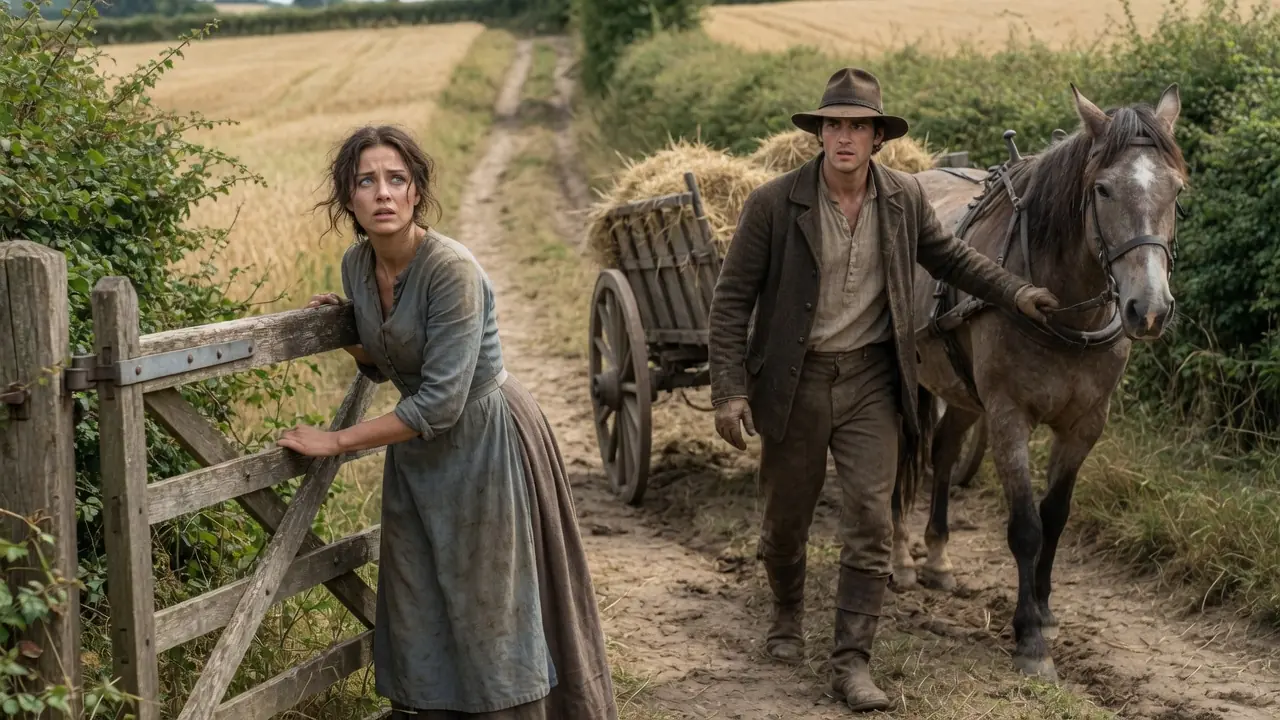
The hedgerows hung heavy with dog rose and the dark beginnings of blackberries, and somewhere a corncrake rasped its dry endless note from a field of standing wheat. Gabriel breathed it in. Cut grass, warm stone, the manure sweetness of a farmyard, the green water smell of a stream he could hear but not see, and he thought he had never in his life smelled anything so alive. He was still thinking it when he heard the woman swearing. She was not by any measure he had been raised to use, swearing as a lady should. She was swearing as a wheelwright might fluently and with feeling from the far side of a five-barred gate that hung off its top hinge at a drunkard's angle and pinned her cart half in and half out of the lane.
Gabriel stopped in the road. The cart was loaded with cut hay, and one wheel had dropped into the dry rut where the gate post had rotted and sunk, and the gate itself had swung wide and jammed against the load, so that the whole contrivance was wedged fast, horse straining, woman heaving at the gate with both hands, the air full of dust, and the smell of bruised grass and the panicked stamp of the cob between the shafts. "Easy," he said to the horse first, because the horse was nearest to bolting. He set his bag in the verge. Easy.
Now, the woman whipped round. And who, she said, told you the gate was yours to mend. She was, he registered with the small shock of a man who has spent his life among studied beauties, and never met a careless one, extraordinarily lovely, not in the way of the ballroom. There was no powder, no art, no performance of it. Her hair had come half down from its pins, and clung dark with sweat at her temple.
Her sleeves were rolled to the elbow over brown forearms. There was a streak of dust across one cheekbone, and a high color of effort in her face, and her eyes, when they fixed on him, where the gray of slate after rain, and twice as unimpressed. The curve of her throat, where the collar fell open, caught the light. He had been taught a hundred polished things to say to a beautiful woman. "Every one of them deserted him.""Nobody," Gabriel said. "I am offering." Your hinge is gone, and your wheel is in the rut. And your horse will have the shafts off in a moment if someone doesn't take his head. "My horse is none of your—"" the cob lunged. The cart groaned. She lunged with it, and Gabriel was already there, one hand to the bridle, his weight planted, his shoulders straining the seams of the borrowed coat as he checked the animal, and held him still by main strength.
For a moment there was only the horse's hot breath and her breath and his. Now he said very calm. Lift the gate off the load when I take the weight of the cart. On three. She looked at him a beat longer than was civil.
Measuring he thought the way a horse-coper measures a beast he suspects of being sound and cannot think why it's cheap. Then she set her jaw and got her hands under the gate. He put his back to the cart. He had rowed at Oxford and boxed at Jackson's and ridden to hounds since he was six, and he had thought himself a strong man, and he discovered in the next 10 seconds that he had never once in his life used his strength for anything that mattered. The cart did not want to move.
He made it move. His boots skidded in the chalk. The muscles of his thighs and shoulders burned. The wheel came grinding up out of the rut with a sound like a tooth pulled, and she swung the gate clear, and the whole thing lurched forward onto the level, and stopped, and the horse blew, and settled, and began with vast equine indifference to crop the verge. Gabriel straightened, his palms stung, his heart was going like a hammer, and he was grinning like the fool he had paid to call him.
The woman pushed her hair out of her face with the back of one wrist and surveyed him with open suspicion. You're not from here. "No, you talk like a magistrate, and you're dressed like a hedger. She folded her arms. The streak of dust shifted on her cheek as she frowned.
Which is it?""It is neither," Gabriel said, and found with some surprise that the lie came easily once it had a hand to hold. It's a man looking for work. Thorne. Gabriel Thorne. I can hedge and ditch, and I can mind a horse, as you've seen, and I'll do a day's labor for a day's bread, and a corner of dry barn to sleep in, if there's any to be had hereabouts." She did not unbend.
There's no work here that pays. Not this year. But she was looking past him now at the cart, at the broken gate, at the sun already sliding down the western shoulder of the hill, and he could see her doing a sum behind her eyes, and he could see that the sum came out badly, however she added it. "Where have you come from?""North," he said, which was true. And nowhere that misses me, which was truer.
Something in that made her glance back at him, not softer, but sharper, as if he'd said a thing she recognized. Then she clicked her tongue at the cob and took the bridle herself. I haven't the means to hire a stranger. Mister Thorne, I can give you supper for the gate, and that's the honest end of it. Come on, if you're coming, I'll not stand in the lane making conversation while my hay sits out to spoil.
He took up his bag and fell in beside the cart. The lane wound down between the hedges towards a huddle of gray roofs and a square church tower the color of old bone, and the dust rose around their feet, and the swallows cut low across the stubble after the evening flies. "You haven't told me your name," he said. "No," she agreed. "I haven't." He waited.
She let him wait the length of a field, and he understood that she was doing it on purpose, and he found he liked her for it more than was sensible. "Merrow," she said at last. Eliza Merrow, "The farm's mine, Brook End, what's left of it. And before you ask, no, there's no man to speak to first. And yes, I do mean mine.
And if that troubles you, you can take the gate back and find your supper elsewhere.""It doesn't trouble me," Gabriel said. It troubles most. She said it lightly, but he caught the iron under it. The small braced flinch of a woman who had said the same sentence too many times to too many men and learned to say it first. Before they could, a boy came pelting up the lane towards them as they reached the farm gate. Twelve or thirteen, all elbows and bare brown feet with the same slate eyes and a cowick that defied the summer like a flag.
Liza. Liza. Crayle's man was here again. He left a paper. I put it on table.
He stopped dead at the sight of Gabriel and looked him up and down with the frank rudeness of the young. Who's that? That's Mr. Thorne, who mended the bottom gate and is staying to supper, said Eliza. Mister Thorne, my brother Jem. Jem, take Bess in and rub her down before you do anything else.
She's had a fright. "He is too clean to be a hedger," Jem announced to the world at large, and was gone with the horse before his sister could clout him. Gabriel looked down at his own hands, the palms reddened now and beginning to blister, but the backs still smooth, the nails still neat, the hands of a man who had never gripped anything harder than a pen and a rein. "Too clean," he curled them shut. "He's not wrong," Eliza said, watching him do it.
There was nothing soft in her face, but there was something awake in it now, something that had not been there at the gate, and it made him more careful and more reckless both at once. You're a puzzle, Mr. Thorne. I don't care for puzzles. I have enough I can't solve as it is. The farmhouse kitchen was low and dim, and smelled of woodsmoke and onions, and the green tang of herbs hung drying from the beams.
And after the white glare of the lane, it took Gabriel's eyes a moment to find the shape of it. The wide hearth, the scrubbed deal table, the dresser of mismatched crockery, the one good chair with a man's coat still hung over the back of it, though there was plainly no man in the house. He understood the coat without being told, he looked away from it. Eliza set bread and cheese, and a crock of butter on the table, and a jug of small beer, and ham cut thin, because there was not much ham, and she did all of it with the brisk economy of a woman counting every slice. And Gabriel, who had that morning declined a breakfast of nine dishes, ate the plain food as though it were the finest he had been offered in years, because in every way that signified. It was the paper Jem spoke of, he said, when the worst of his hunger had gone.
Crails man, her hand stilled on the loaf. "That is no business of yours.""No," he agreed. But I have a strong back and no master, and you have a farm and trouble, and it seems to me those things might be made to suit each other if you'd let them." She set down the knife. Outside the light had gone amber, and it came through the small panes in long, warm bars, and lay across the table between them. From the yard came the steady swish swish of Jem at the horse with a wisp of straw and the drowsy complaint of hens going to roost and further off the church clock striking the half hour flat and sweet across the fields.
Septon Crayle Eliza said holds the note on this farm. My father the smallest paws the kind of person makes stepping over a place in the floor they know to be unsound my father borrowed against the land. Two winters passed when the harvest failed and the sheep took sick. He meant to pay it back. He was a good man and a poor man of business, and those two things don't lie down easy together.
She lifted her chin. He has been gone since the spring. The note falls due at Michaelmas, and Mr. Crayle has been kind enough to call near every week to remind me of it, and kinder still to suggest a way I might be spared the trouble of paying. Gabriel did not need it spelled. He found to his own surprise that his jaw had tightened. "He's offered for you. He's offered to fold Brook End into his own land and me into his house along with it.""Yes," he puts it more prettily. Her mouth twisted. "He is a handsome man, Mr. Crayle, and a rich one, and the whole parish thinks I'm a fool 10 times over for not jumping at it. Perhaps I am.
But I find I would sooner break my back keeping what is mine than be grateful to a man for taking it. She looked at him then direct as a blow. So you see there's nothing here worth a strong stranger's summer. The harvest won't cover the note. I can't pay you.
And in eight weeks this will likely be Crayle's barn you're sitting in and his beer you're drinking and you'd do better walking on. The half hour's silence stretched. A moth blundered against the window. Gabriel turned his cup slowly between his blistered hands, and thought about the eight weeks he had carved out of his own life for the express purpose of being no one, and about how he had come here meaning to be loved as a poor man, and how he might, with one quiet word, make this proud and weary woman's whole world stand straight again, and how he could not say that word without unsaying everything he had come to find."eight weeks is what I have," he said instead. I'll take the corner of the barn and a place at your table, and you'll pay me nothing but that, and I'll bring your harvest in.
After Michaelmas is after Michaelmas. We'll see who's sitting in whose barn when it comes. "You are either a saint, or you are running from something.""I am running from something,", Gabriel said. Because the truth, told plainly, made the best disguise of all. Most men are. "It does not make my arm any weaker." She studied him a long moment, and he held still under it, and at last she gave a short laugh that had no comfort in it, but a great deal of recognition. "No," she said. "I don't suppose it does." He had been three days at Brook End, and he had ruined two pairs of borrowed gloves, blistered both hands raw, fallen into the duck pond, and discovered muscles in his back he had not previously been introduced to. When Septon Crayle came riding into the yard on a gray hunter worth more than the farm, Gabriel was up to the elbows in the kitchen garden ditch, clearing the choke of summer weed from the channel that fed the pump, when he heard the hooves, and looked up through the haze of midges, and saw the man dismount without being asked, and hand his reins to Jem as though the boy were a post set there for the purpose. Crayle was, as Eliza had said, handsome, fair, and well-made, and beautifully dressed. His riding coat a deep bottle green that no farmer within twenty miles could have paid for.
His boots taking the dust without dimming. He had the easy, contented face of a man who has never once been refused anything he truly meant to have. "Eliza," he did not raise his hat. "You have a man in your ditch." She had come out onto the step, drying her hands on her apron, and Gabriel watched her arrange her face into something flat and courteous and entirely closed. I have a man clearing the ditch.
Yes, good day, Mr. Crayle. "A new one." Crayle's gaze drifted to Gabriel, took in the rolled sleeves and the mud and the broad bent back, and dismissed him with a thoroughness Gabriel had spent his whole life doing to others, and had never once felt done to him. It was, he found, instructive. You have a strange notion of economy, my dear, hiring labor you can't feed when there's an easier road at your very door.
He works for his keep. Eliza's voice did not change. And the road at my door is mine to walk or not, Mr. Crayle, as I believe I've said. Crayle smiled. He came up the path towards her, unhurried, peeling off one glove, and the smell of him reached Gabriel, even from the ditch, Spanish leather and bergamot, the cologne of a London season, monstrously out of place among the cabbages. "I've brought the new draft of the agreement," he said. I've been generous, more than the land's worth, given its state. You might at least do me the courtesy of reading it before you let pride and a hireling stand between your brother and a roof." He glanced deliberately at Jem. "Boys grow. They need feeding.
They need prospects. It would be a pity if sentiment cost the child his." Gabriel was out of the ditch before he had decided to move. He did not strike the man. He had learned somewhere between the conservatory and the mail coach that the loudest thing a powerful man can do is be quiet. He simply walked up the path mud to the knee and put himself not violently only entirely between crale and the step and stood there a full head the better of him in the shoulders and said in a voice he had spent years learning to use on men who governed counties. "The lady has answered you twice. A gentleman hears an answer the first time." The yard went still. Even the hen stopped. Crayle's pale eyes came up to Gabriel's face and for the first time looked at him. Really looked and something flickered there.
A small puzzled snag. The snag of a man who hears the wrong accent come out of the wrong mouth and cannot place why it troubles him. "And what?" Crayle said softly. "Are you a man clearing a ditch?" said Gabriel. The two of them held it a moment longer.
Then Crayle laughed, light and cold, and stepped back and drew his glove on again, finger by finger. How fortunate for you, Eliza, to have found a hierling with such pretty manners. "Do enjoy them while you can afford them." He tossed a folded paper onto the step at her feet, where it lay white against the worn stone. Michaelmas, my dear, the day after the harvest home. I shall come for my answer, and I think we both know what it will have to be.
He went to his horse, took the reins from Jem without a glance, and swung up. Good day. Mind your man doesn't strain himself above his station. He rode out. The dust hung gold in his wake, and slowly settled.
Eliza let out a breath. She bent and picked up the paper without unfolding it. And Gabriel saw that her hands were not quite steady, and that she hated that they weren't, and that she would have walked into the duck pond herself before she let him see it. "You shouldn't have done that," she said. "Lo, no," Gabriel agreed. "Probably not. He'll remember your face now. He's a man who remembers faces." She turned the folded note over once and did not open it. And you have a face that doesn't match the rest of you, Mr. Thorne. I told you. I don't care for puzzles.
But she did not tell him to go, and they both heard that she didn't, and the not saying of it sat between them in the settling dust like a thing agreed. That evening, when the long light had gone, and the swifts had given way to the first slow bats, Gabriel sat on an upturned pail outside the barn, and looked at his two ruined hands in the last of the dusk. The blisters had broken and were beginning already to harden. He flexed them and felt the new ache of them, the honest ache. And he thought that in a single week as a poor man he had been clapped on the shoulder by a tinker, fed at a proud woman's plain table, and stood between a bully and a barefoot boy, and that not one of those three things had ever happened to the Duke of Ashworth, who could have bought and raised and rebuilt the whole of Nettlecombe before breakfast, and had never been wanted in it for a single hour.
He should write to Pruitt. He should, by every measure of sense, write tonight, and tell him the experiment was a fine one, and would end at Michaelmas, as planned, when he would settle the wretched note from his own coffers by some untraceable hand, and leave Eliza Merrow her farm and her pride both, and ride back to his 9,000 acres, no worse, for the summer. He sat with that thought a long while, and could not make himself rise to find paper. It was the rattle of wheels that broke it. Late, too late for any honest traveler, coming fast up the chalk road from the crossroads.
Gabriel got to his feet. A pair of carriage lamps swung yellow through the dark hedges, and a coach swept round into the village street below the farm, and pulled up sharp by the church, and a voice carried up clear on the still night air. A London voice, crisp and impatient, asking the way of someone roused from bed. The Duke of Ashworth, tall, dark, seven and twenty. We have reason to believe he came south by the mail.
There's a reward and no questions for word of where his grace is lodging. Gabriel stood very still in the dark of the barn doorway, his broken hands hanging open at his sides, and did not move so much as a finger as the lamplight swung slowly up the lane towards Brook End. The lamplight reached the gate, slowed and stopped. Gabriel did not breathe. Through the open barn door he could see the church below, the coach black against the pale road.
Two men a foot now with a lantern between them and the round shape of old Tab. The sexton in his nightshirt pointing first one way and then doubtfully another. The London voice carried up thin and clear on the warm dark air, and every word of it walked the length of Gabriel's spine. A guinea for the right house. Two, if he's in it.
He heard Tab mumble something about strangers, about the Merrow girl having took on a hand only this week. A big fellow dark come down from the north. And then he heard the latch of the farmhouse door. Eliza came out into the yard with a shawl thrown over her shift and a candle cupped in one hand, and she did not look at the barn. And Gabriel understood at once, and with a lurch of something he could not name that she had heard the carriage to, and had thought first not of herself, but of him.
She came down the path to the gate, unhurried, the candle steady, and she set her shoulder against the post, and waited, like a woman whose sleep had been spoiled, and who meant the spoiler to know it. "It's the middle of the night," she called down,"and you've woke my hens and my brother both. State your business or take it back to wherever they grow men with no manners. The lantern came bobbing up the lane. Gabriel pressed back into the black behind the door and watched through the gap of the hinge.
A narrow man in a caped coat stepped into the candle's reach, hat in hand now, oiled civility. "Forgive the hour, mistress. We're seeking a gentleman. Tall, dark-haired, seven and twenty, of quality, though he may not look it. He'd have come south within the fortnight. There's money in it for any who seen him, and no trouble for you.
A gentleman. Eliza let the word sit here in Nettlecombe. And then she laughed, a low, tired, genuinely amused laugh that Gabriel would not have believed her capable of an hour before. Mister, the last gentleman that came through this village was the bishop, and he stopped four minutes to change horses and complained the whole of them about the road. We do not keep gentlemen.
We cannot afford their appetites. You've taken on a man this week, I'm told. A stranger. I've taken on a hedger, she said, who eats like three horses and snores like a fourth. And if you've come forty miles in the dark looking for him, you're welcome to him and his appetite both.
Only you'll pay me for the bread he's had first. She tilted the candle so the light fell on her own plain face, her undressed hair, the patched shawl. Do I look like a woman keeping a duke in her barn? Go on. There's a bed at the Box and Anchor in Sturton, six miles east, and a landlord who'll take your guinea and tell you a fine tale for it.
He's better at tales than I am. I only know the truth, and the truth is you've the wrong village. The narrow man looked at her a moment longer. Then he inclined his head, replaced his hat, and the lantern withdrew back down the lane to the coach, and the coach turned in the churchyard with a great deal of swearing and clatter, and went grinding away east toward Sturton, and the lie she had handed him. The candle did not so much as waver until the sound of the wheels had died.
Then Eliza let out a breath that took her shoulders down with it and turned and walked straight to the barn and stood in the doorway looking at Gabriel where he stood in the dark with his ruined hands open at his sides. Well, she said, "Mister Thorne," he could think of nothing to say that was not a worse lie than the one she just told for him. So he said nothing, and the silence filled up with the small night sounds, a cow shifting in the byre, a moth ticking against the horn pane of her lantern, the slow drip of the broken pump channel he had not yet finished mending. "I'm not going to ask you," Eliza said at last,"because I've decided I'd rather not be lying when Crayle comes asking, and he will come asking. A man may keep his own counsel under my roof, so long as his counsel does me no harm." She came a step closer.
The candle lit the underside of her face, the stubborn jaw, the eyes that had gone past suspicion into something harder and more frightening, which was thought. But I'll have one true answer out of you tonight, and you'll give it me plain. Or you'll take your bag and your appetite down that lane behind them. Are you a danger to this house? No. It came out of him with a force that surprised them both.
Eliza, no. On anything you like. On my own grave. I'd cut my hand off before I brought trouble to your door. You've already brought it, but she said it without heat, weighing him, and whatever scale she used, he must have come out a hair on the right side of it, because the candle dipped, and she turned away. "Tall, dark, seven and twenty," she said to the dark of the yard, almost to herself. Of quality, though he may not look it. A short breath through her nose. I knew you were too clean to be a hedger. I'm a great deal dirtier than I was a week ago. Gabriel offered.
She stopped. She looked back at him over her shoulder. And for the space of a heartbeat, her mouth twitched. Not a smile. She would not give him a smile, but the ghost of where one might one day live.
And then she mastered it. Mend my pump channel before you sleep. She said since you're up and mister Thorne, whoever's looking for you, they're looking with money. And money has a long memory and longer legs. Whatever you're running from, it runs faster than you do.
You'd do well to remember it. She went back up the path and the door closed, and the bar came down behind it with a small final sound. Gabriel mended the channel by feel in the dark, his blistered hands in the cold water, and found that he was absurdly happier than he had been in a decade. The hay had to come in before the weather turned. And so for three days there was no time for searches or secrets or anything but the work.
And Gabriel learned the work the way a man learns to swim who has been thrown off a boat and all at once and with a great deal of swallowed water. The sun came up white over the eastern hedge by 4, and did not let go of the fields till 9 at night. He learned the long ache of the scythe, and the particular treachery of a hayfork in unpracticed hands. He learned that the chaff got everywhere, down the collar and into the boots, and under the lids of the eyes, and that it itched like a judgment. He learned the smell of cut grass curing in the heat, until he carried it in his very skin.
By the second noon, his shirt was stuck to his back, and his hands had passed through pain into a kind of numb competence, and Eliza, raking the swath beside him in an old straw hat with her sleeves rolled high, had stopped watching him, as though he might bolt and started, instead simply watching him work. "You're better than you were," she allowed over bread and cold bacon in the shade of the wagon at the dinner hour. Jim lay flat on his back in the stubble nearby, hat over his face, one barefoot tapping at the hot blue air. "You've stopped holding the fork like it owes you money.""I have been on excellent terms with the fork since this morning," Gabriel said. "We came to an understanding.
I would stop fighting it, and it would stop putting me on my face in front of your brother." From under the hat, Jem said, "You did go on your face, grand though." Liza laughed so hard she had to sit. I did not laugh, said Eliza. You sat right down in the hay and laughed. I sat down because the heat took me. It was a coincidence of timing.
But she was fighting it again, that almost smile, and this time she lost. It broke across her face, brief and bright as a fish turning in dark water. And it changed her so wholly. Took ten years and a hundred weight of care off her in a single second that Gabriel forgot to chew. She caught him looking. The smile went, but it had been there, and they had both seen it, and she covered the place where it had been by reaching for the beer jug.
Eat, she said. We've the home meadow yet, and the glass is dropping. Smell the air. There's weather in it by Friday. Gabriel smelled the air.
He smelled cut grass and hot dust and the iron tang of the cob's sweat and very faint and far beneath it. A green wet weight on the western breeze that he would not have known a week ago for the smell of coming rain. Friday he agreed as though he had known all along and she gave him a look that said she knew exactly how much he was bluffing and thought the better of him for trying. They got the home meadow in by Thursday dusk. The last load swaying up the lane in the violet light with Jem riding the top of it crowing like a cockerel and the rain came Friday noon exactly as she had promised drumming on the barn roof while the dry hay sat snug beneath it and Gabriel stood in the doorway and watched it come down in gray ropes across the hills and felt for the work of his own two hands a satisfaction no acre of his 9,000 had ever given him. It was that same Friday in the wet that the trouble he had brought walked back up the lane wearing a bottle green coat.
Crayle came on foot this time under an umbrella a manservant held over him and he did not come to the kitchen door. He went to the barn where Gabriel was forking the last of the load up into the loft and he stood in the dry of the doorway shaking the rain from his sleeves and watched and let himself be watched before he spoke. "You interest me, Crayle said. "Thorne, is it? Gabriel set the fork in the hay and came down the ladder unhurried and met him on the threshing floor with the rain loud above them both. ""Mr. Crayle, I made some inquiries." Crayle's pale eyes were pleasant and entirely without warmth. ""North," the girl said. "But there's no farm north of here lost a hand this season, and no parish I can find that owns a Gabriel Thorn of your description, and I have a great many parishes that owe me favors, so I look rather hard when I look." He drew off his gloves, finger by finger, the old fastidious habit. And then last night, I'm told there were gentlemen of London asking through Sturton for a runaway of quality, tall, dark, near thirty.
And I find myself standing in a ditch girl's barn, looking at a ditcher who speaks like the bench of magistrates and has the hands of a clerk gone soft. And I think to myself, now there is a sum that adds. The rain hammered. Somewhere a runnel found the floor and began to spread a dark tongue across the boards between them. "You have a great deal of arithmetic for a wet afternoon," Gabriel said. "I have a great deal at stake." Crayle took a step nearer and dropped his voice, confiding, almost gentle, which was worse than threat. Let me be plain with you, Thorne, since you admire plainness. I want that farm. I have wanted it twenty years since her father refused me the bottom water meadow out of pure pigheaded spite. And I have been patient, and patience is about to pay.
The note falls due at Michaelmas, and she cannot meet it. And when she cannot, I will have the land and the girl with it, and I will not have it inconvenienced in the last fortnight by a stray gentleman playing at hayseed for reasons of his own." He smiled. "Whatever you are, whatever you're running from, or two, it has nothing to do with Brook End. So here is my offer. One man of the world to another.
Go tonight. There's twenty pounds in it for you to be over the county line by morning." and my silence thrown in, which is worth a deal more than twenty pounds to a man the London gentleman wants so badly. And if I stay, "Then I write to London," Crayle said simply,"and tell them where their duke is digging turnips. I don't know your business, but they do. And they'll pay better than I will, and you'll be carried off out of her life in a closed coach with the whole village watching.
And she will be left here, ruined of her last harvest help, with a fortnight to find money that isn't in the ground, and a certain knowledge that the one strong arm she trusted was a liar and a fraud who couldn't even keep his own name straight. He let that settle. She's had enough men disappoint her, I should think. Spare her the spectacle. Take the twenty pounds and be the one who simply went.
Gabriel stood very still. The rain came down. He thought of Eliza's face by candle light, saying, "Are you a danger to this house?" and he understood that Crayle had just handed him the precise shape of the harm he had sworn he would never bring wrapped in twenty pounds and a man's servant's umbrella, and that the worst of it was that the man was not entirely wrong. "You mistake me," Gabriel said at last, and his voice had gone very quiet. The quiet that had emptied the yard a week ago. "I'm not a man of the world, Mr. Crayle. I'm a man clearing a ditch." And the ditch's answer to your offer is the same the lady gave you twice. No, write your letter. Send it where you like. But understand, whatever I am, the moment your letter goes, I am no longer a stray gentleman playing at hayseed.
I am a man with nothing to lose in this parish but her good opinion and a very long reach, and a particular dislike of men who threatened boys to get at Meadows. He picked the gloves up off the bail where Crayle had laid them, and held them out flat on his palm. The way one returns a thing to a man one is finished with. Good day. Mind the puddle.
It's deepening behind you. Crayle's smile did not move. But something behind it did. That snag again. The wrong accent from the wrong mouth.
And now the dawning infuriating suspicion that the sum he'd added so cleverly might have a figure in it he hadn't reckoned. He took the gloves. You're a fool, he said softly. But a well spoken one. We'll see how the speech holds up at Michaelmas.
He turned, stepped neatly round the spreading puddle, and went out into the rain after his umbrella, and Gabriel watched the bottle green coat go down the lane until the hedges took it. He had won the round. He knew he had won it, and he stood in the loud, wet barn, knowing also that he had just bought himself a fortnight of borrowed time against a letter that might go to London any hour Crayle chose, and that he had not the smallest idea how he was going to keep both of his promises, to be loved as a poor man, and to leave this woman her farm, when the keeping of either now seemed certain to break the other. She had seen the umbrella from the dairy window. She was waiting for him under the lean to when he crossed the yard through the rain.
Her arms folded, the wet darkening the shoulders of her gown, and her face had gone back to the closed flat thing it had been at the gate the first day, only worse, because now there was hurt in it. She was too proud to show and showed anyway. What did he want to buy me off? There was no use in any lie but the small ones now. Twenty pounds to be gone by morning. And you said.
I gave him his gloves back. She searched his face in the gray light, the rain dripping off the lean to edge between them in a thin bright curtain. He knows something, she said. It was not a question. He came up here through this weather to say it to you and not to me.
Men don't trouble to threaten a hireling. They turn him off and forget him by dinner. So, you're not a hireling and he knows what you are. And I her voice caught and she dragged it level by main strength, the same strength she'd used on the cart. I am the only one in this yard standing in the rain who does not. And I have a brother to feed, Gabriel Thorne, and a fortnight to save my whole life in, and I cannot, I will not build the last of it on a man I can't see the bottom of.
Eliza, is it money? She said, "Are you a thief? Have you a wife somewhere? Is that it? A wife and a debt and the law behind you?" She was not crying.
She would not. But the questions came faster now. Each one a stone she was throwing to see which would make a splash. Did you do a thing a man can't undo? Just tell me that much.
Tell me whether the trouble that's coming for you is the kind that washes off or the kind that stains everything it touches. Because that's the only part of your secret that's mine to need. And Gabriel, who could have ended it there? Who could have said, "I am the Duke of Ashworth, and there is no debt and no wife and no crime. Only a foolish wager I made with my own heart, and I can pay your note tomorrow with money you will never see.
Leave my hand." stood with the truth crowding up behind his teeth and could not let it past because the moment he did she would never again look at him and see the man. She would see the coronet and the coffers and she would take his help because she had no choice and hate him forever for making her grateful exactly as he had hated being wanted for the title. And the one true thing he had found in this whole green valley would be spoiled in the saying. So he gave her the largest piece of truth he owned. That was not the whole of it.
It's the kind that washes off. He said, "I swear it to you. I have no wife. I've broken no law. I've harmed no living soul.
The thing I'm running from is a a name, a position, a life that was choosing me before I ever got the chance to choose it. I left it to find out whether I was worth anything at all without it. And I came here and I found out. And the finding has been the best three weeks of my life, and I would not trade them for the whole of what I left behind." He took a breath. The rain ran off the eve. That's the truth, Eliza.
All of it, but the name. And the name I can't give you yet. Not because it's a stain, but because it's a wall. And the moment you hear it, you'll stop seeing me over the top of it. Give me to Michaelmas.
Let me bring this through. And if I've not earned the rest of it by then, I'll go and take the wall with me, and you'll never have to wonder again. For a long moment, she said nothing at all. The rain eased, the drumming on the lean to thinned to a patter, then to the slow drip of leaves. From the house came Jem's voice, raised in cheerful argument with the cat.
And Eliza Merrow looked at the stranger in her yard with the broken hands and the wrong accent and the secret he would not put down. And Gabriel watched her weigh him one more time and could not for his life tell which way the scale was tipping. "A wall," she repeated slowly. Not a stain on my grave. You have a great deal of confidence in your own grave, for a man who keeps swearing on it.
But the iron had gone half out of her voice, and something rofal had come into the place of it, and Gabriel felt the whole afternoon turn on that small change the way the cart had turned up out of the rut. "Michaelmas," she said. You have until Michaelmas. And not because I believe you. I don't.
Not the half of it, but because I have 6 weeks to save Brook End, and you're the strongest back in the parish, and I'm too far gone to be choosing my saints. She unfolded her arms. But hear me, Thorne. If your trouble comes up that lane, and it's the staining kind after all, if you've lied to me standing here in the wet with my brother in earshot, I'll not weep over you. I'll hand you to it myself and bar the door.
Are we understood? Understood? Gabriel said, and meant it more than he had meant anything in his life. She nodded once, sharp, and turned for the house, and stopped, and looked back, and the last of the rain caught silver in her hair, where it had come down from its pins. There were three of them at the church last night, she said. "Not two," I counted the lamps. Two came up the lane, and one stayed below with the coach. She let that land. And this morning when I went down for the milk, Tab told me the coach didn't go on to Sturton after all. It turned east out of the village and then doubled back along the marsh road and put up at the crale arms, Septon's own house, Thorne, that bears his own name.
Your London gentleman slept under your enemy's roof last night. She pulled her shawl close. So you've less time than you think and fewer friends and a man who wants this farm sitting between you and the people hunting you holding both ends of the rope. I'd mend more than my pump channel tonight if I were you. I'd think hard about which wall comes down first.
And she went in out of the wet and left him standing in the dripping yard with the whole shape of the trap laid suddenly bare before him. And not the first idea how to climb out of it before it closed. For two days the rain kept its promise, and then thought better of it, and the valley came up steaming into a hot blue Sunday, with the hay dry in the barn, and the meadows already greening over where the scythe had passed. Gabriel had reached the stage of his apprenticeship, where the work no longer surprised him at every turn, and so there was room in him that evening to notice things. The long gold slant of light through the open kitchen door, the swallows stitching the eaves, the small companionable sounds of a house settling toward dark. Jem had gone to his bed loud and reluctant.
The cat had taken the warm flag by the hearth. And Eliza, having looked at Gabriel's hands across the supper table for the third time in a quarter of an hour, set down her cup with the air of a woman conceding a point against her judgment. "Give me your hands," she said. "They are well enough.""They are split to the second knuckle, and you've been holding the spoon like it's made of nettles. Give them here, Thorne." I'll not have you laming yourself the week before I need you most.
She had a small crock down off the dresser already. Brown salve that smelled of beeswax and comfrey and something sharper underneath. And she set it on the table and held out one work roughened palm and waited, and Gabriel, after a moment, laid his ruined hand in hers. Her fingers were warm and exact. She turned his hand to the candle light and frowned at the broken blisters, the raw new skin, the half-healed places where the fork had bitten, and she worked the salve in with her thumb in slow, firm circles, and Gabriel sat very still and forgot to breathe quite properly. He had been touched all his life by people paid to touch him, the valet, the barber, the tailor's chalked hands.
He had never once been touched like this, plainly for his own mending, by someone who owed him nothing and did it anyway. You've the hands of a gentleman still under the damage, she observed, not looking up. "It is coming off you slow, the clean, but it is coming." I'm told I went on my face quite convincingly on Tuesday. You did? The ghost of the smile again, there and gone, hidden in the bend of her head.
Jem's not stopped speaking of it. He's decided you're the best entertainment to come through Nettlecombe since the dancing bear. "High praise. Was the bear well-spoken?" The bear said Eliza gravely pressing salve into the heel of his thumb had better manners than half the men who've sat at this table and it didn't eat near so much. And she did laugh then.
No, the real one, the one that took the years off her. And she let it come because she thought herself unobserved in the dusk light. And Gabriel watched it happen three feet from his face and felt the whole untidy summer narrow to the warm point of her thumb on his palm. She finished the one hand and took the other without asking. Outside a corncrake rasped in the standing wheat. The candle gutted and stood up again. "There," she said, releasing him. Wear the gloves to the hanging or you'll start over. And don't. She capped the crock with a small decisive sound. Don't look at me like that, Thor.
I docked the cob the same way, and I don't mean anything tender by it. "I did not say a word.""You did not have to. You have a loud face." But she did not move her chair back, and neither did he. And for a while they simply sat in the dying light with the cat purring and the house breathing around them. And it was, Gabriel thought, the nearest thing to peace he had ever been let near.
He woke before four to the white of the eastern sky, and lay on the straw in the barn with his salved hands easy for the first time in days, and he made somewhere in that gray hour. The decision that undid him. He could not pay the note openly. That much had been plain from the first, to set gold on Eliza Merrow's table, was to lose her, to watch the woman go out of her eyes, and the grateful stranger come in, to become to her precisely the wall he had run 40 m to be rid of. But the note had a holder, and the holder was a man, and men who held notes could be bought out by other men they never met through agents who left no name.
Pruitt could do it in a week. A London attorney writing to whatever country lawyer drew up Crayle's papers. A quiet purchase of the debt at a premium that would make refusal foolish, and then the note would simply pass in October into the hands of some faceless trust that wanted only its modest interest paid slow over twenty years, and Brook End would be saved, and Eliza would keep her farm and her pride and her ignorance, all three, and never know that the hedger in her barn had reached out one invisible hand and set her whole tilted world straight. It was, Gabriel told himself, the only way to keep both promises at once. He wrote the letter at the dairy table by the first light on a leaf torn from the small book he carried in the small swift hand would know. Buy up the note on Brook End Farm, Nettlecombe parish, holder of Mr. Septon Crayle, drawn some two winters past against one Merrow. The sum I do not know, but cannot exceed three hundred.
Use Hartwell. Use no name of mine. Leave no thread that runs back here. Do it quiet and do it quick. I have until Michaelmas and not an hour passed.
Tell my mother nothing. I am well. I am, God help me, happy, he read it twice. He sealed it with a blob of candle grease and his thumb for want of a ring he had left in a drawer two counties north. And he stood in the cool dairy with the milk smell around him and the letter in his blistered hand and felt for one bad moment the precise shape of the thing he was doing arranging her life behind her back managing her deciding her future without her leave and felt how close it sat to a thing he despised but she would never know that was the whole of it she would never know and so it could not wound her and a wound she never felt was no wound at Paul, he gave the letter that same morning to the carrier, old Marpole, who took the Sturton Road every Monday with eggs and butter, and would put it on the mail at the crossroads for a penny, and ask nothing. For the north, Gabriel told him, "And there's a second penny in it if it goes today and not tomorrow." Marpole bit the coin, nodded, and stowed the folded paper in the deep pocket of his smock among the straw and the egg boxes, and clucked his pony into the lane, and Gabriel watched the cart go down toward the crossroads in the early heat, and told himself the worst of his troubles was now twelve miles off, and travailing away from him.
He could not have been more wrong, and he had the whole of Monday to not know it. It was Tuesday noon with the sun standing white and merciless over the upper field and Gabriel a 100 yards into a hedge he was laying for the autumn that he saw the bottle green coat again and saw with it the thing that turned the summer over. Crayle came on the grey hunter and he came not alone. A second rider kept pace at his shoulder, narrow, caped, a city seat on a hired horse. And Gabriel knew the cut of him before he could see the face, knew it in the cold drop of his own stomach, the man from the church, the oiled voice that had asked the lane for a duke.
They rode up the headland to where Gabriel stood billhook in hand among the half-laid thorn, and they stopped, and Crayle looked down at him with a satisfaction so complete it was almost peaceful. There he is, Crayle said. I told you the speech would give him away. Ditches don't talk like the bench, Mr. Sims. I have a good ear for a man pretending to be less than he is.
It takes one. The narrow man Sims leaned from his saddle and studied Gabriel's face with the frank professional attention of a man matching a likeness to a list. And from his coat he drew a small flat case, and he opened it and turned it so the noon sun fell square on the thing inside. It was a miniature on ivory, no bigger than a crown piece set in a worn gold rim. A dark young man in a high black stock, three-quarter face, the mouth grave, the brow exact.
It was a fair likeness. It had been painted at Ashworth two years since for his mother's writing desk, and Gabriel had sat for it through four tedious mornings, and forgotten it entirely. Is Grace the Duke of Ashworth? So said almost kindly. You've led us a dance, sir.
The dowager is beside herself. Gabriel stood among the cut thorn with the billhook hanging from his salved hand and the sweat running cold down his spine and across the white field 50 yards off where she had been turning the sway with Jem. Eliza had stopped. She had seen the riders. She stood with the rake upright in her two hands and her straw hat pushed back, too far to hear, near enough to read the shape of it.
The gentleman's case held open, the two mounted men, the hedger gone stone still before them. And even at 50 yards, Gabriel felt her begin slowly to understand. Don't, he said to Crayle very low. Don't what? Crayle's smile widened.
He had been waiting for this. He had built the morning around it. Don't let the lady see what she's been feeding. "My dear Thorne, forgive me, Your Grace. I should think she's earned the truth. She's given you her table and her trust and her good name in front of the whole parish.
And all the while, he raised his voice now, pitched it to carry clean across the dry field. All the while, she's been sheltering a duke under a beggar's coat, and lying to honest searches to keep him hid. Eliza, come and meet your hedger. Come and make your curtsy to his grace. The rake came down.
Eliza crossed the stubble toward them with the flat, unhurried walk Gabriel had learned to dread, and her face when it came into reach was not flat at all. It was open, terribly open. The way a thing is open that has been struck before it can close. And her gray eyes went from Crayle's triumph to the open case in the searcher's hand, to Gabriel standing dumb in the wreck of the hedge. And she looked at the little painted face on the ivory, and then up at the living one above her, and Gabriel watched the wall he had feared come down between them at last. Only it came down the wrong way entirely.
Not his to hide behind, but hers to keep him out. "Is it you," she said. He could not lie to her again. He had used the last of his lies on Marpole's penny. "Yes," Gabriel said.
She did not strike him, though her hand had risen halfway, and she let it fall again, fisted white at the knuckle. She did not weep. She stood in the white field with the chaff caught in her hair, and the two horsemen above her like judges, and she said in a voice gone flat and very far away, "Get off my land, Mr. Crayle, and take your gentlemen with you. You've said your peace, and I've heard it. Go now, Eliza.
Be reasonable off my land. It cracked across the field like a whip, and even the grey hunter shifted under it, and Crayle's smile faltered for the first time that summer. You came to my hayfield to break a thing in front of my brother, and you've broke it. Be satisfied. Go and be satisfied somewhere I can't see your face." She turned her back on him entirely, on a man who held the note to her whole life.
She turned her back as though he were a peddler she'd seen off the step, and that was answer enough that even Crayle found nothing to set against it. He gathered his reins. He looked at Gabriel a moment. The snag in him finally settled into knowledge, and what was in his face now was not puzzlement, but appetite. "Well speak again, Your Grace," he said. "You and I, before my elmas, there's a great deal we might arrange between gentlemen. Now the masquerade's done. And he rode off down the headland with Sims trailing, the two of them small and dark against the shimmer. And Gabriel let them go because every part of him was turned the other way toward the woman standing rigid in the cut grass with her back to him and her shoulders set like a gate against a flood. Eliza, don't.
She did not turn. Don't you say my name in that voice. That's the voice, isn't it? The real one. The one you've been letting out a little at a time, so I'd not notice you spending it. She turned then, and her eyes were dry and bright and worse than any weeping.
A duke. 9,000 acres, the man said, on the ride up. I heard that much before you saw them. 9,000 acres, and you slept in my barn, and you ate my thin ham slice by slice while I counted it. And you let me give you the salve off my own dresser for hands that have never in their lives needed to work.
And you sat there and let me Gabriel, you let me doctor a duke's blisters like he was something the rain washed up. Every word I gave you was true, but the name I told you it was a wall, not a stain. A wall. She laughed and it had no bottom to it. Oh, you told me true.
I'll grant you that. You told me clever. You have a gift for telling a body the truth in a shape that keeps the heart of it back. A wall. You knew.
You stood in my yard in the wet and watched me come apart, asking, "Was it money? Was it a wife?" And all the while the thing was that you'd money enough to buy my whole life 10 times over and were keeping it from me like a coin behind your back so I dance prettier for the want of it. I kept it from you so you'd not stop seeing me. And there it is. She stepped close to him, near enough that he could see the chaff on her lashes, the high color gone to white at her mouth.
So you'd not stop seeing you, so I'd keep loving the hedger, and never reckon the duke. It was never my heart you were guarding, Thorne. It was your own little experiment. Did I want the man and not the coronet? Wasn't that the sum?
You came down here to be told you were worth something without the name. And you used my farm and my trouble and my brother for the proving of it, and you'd have ridden off at Michaelmas with your answer in your pocket and left us to trail. A breathcaugh mastered came level. Tell me I'm wrong. Tell me one part of that's wrong, and I'll beg your pardon for all of it.
And Gabriel, who could have told her about Marple's letter, and the note brought quiet, and the whole of his clumsy, arrogant, well-ment scheme to save her, opened his mouth to do it, and understood, in the same breath, that it would only prove her case entire. I have arranged your life behind your back. I have decided your future without your leave. I have done to you in secret the very thing you turned from Crayle's face. He shut his mouth and she saw the shutting and read it for what it was.
No, she said softly. I didn't think so. She walked away from him across the field and she did not look back and Gabriel stood among the half-laid thorn with the billhook in his salved hand and let her go because there was nothing in him fit to call her back with. The corncrake rasped the heat pressed down. Somewhere below, Jem's voice rose thin and frightened across the stubble.
Liza, Liza, who were those men? Why is she? And was hushed, and the farm went quiet in the white noon. The particular quiet of a house where something has come apart in the open, and everyone has agreed not to say so yet. He did not sleep in the barn that night.
He sat in the doorway of it with his back to the post where he had sat the evening the coach came, and he watched the one lit window of the farmhouse burn late, and then go dark, and he turned his mended hands over in the moonlight, and thought about walls. He had built one of his whole life, the title, the distance, the smooth, unspendable name, and he had come here to learn whether a woman could love the man on the near side of it. And he had learned it. She had laughed at his fork and salved his palms and turned her proud back on a man who held her ruin in his fist. All of it for a hedger named Thorne who owned nothing.
She had loved the man. He had had his answer for three days and been too cowardly with happiness to know it. And now he had spent it not on the lie of the name. She might have forgiven the name. He had spent it on the second wall, the secret one. The kind hand reaching out of the dark to manage her life into shape without her knowing and that she could not forgive.
Because that was the exact and total denial of everything she was. I'd sooner break my back keeping what's mine than be grateful to a man for taking it. She had told him at the first table. He had heard it, and he had gone and done it anyway, gently, certain he knew better, the way men of 9,000 acres always knew better, and called it love. Toward the depth of the night, he heard the latch, and turned, and Eliza was a pale shape on the path with the shawl about her, and no candle this time, only the moon. "I'll not turn you out tonight," she said before he could rise. Jem thinks the sun rises where you stand, and I'll not break the boy's heart at 1:00 in the morning to spite a duke. You'll have the barn till the hay is wholly in. That's your work, and you'll finish it, and I'll feed you for it, and after that you'll go back to your 9,000 acres, and will neither of us speak of this summer again." Her voice was steady now, scoured clean of the fields fury, and worse for it. But I'll have you know one thing since you set such store by truth told plain.
Crayle rode straight to his own house from my field. The London men are under his roof this minute. He holds my note and he holds your name both. And tomorrow or the day after he'll come up that lane with a price on the one to get the other. Your freedom for my farm or my farm for your freedom.
He'll not care which way it runs so long as he wins it. And I want you to understand Your Grace that you brought that man his winning hand. You, the thing that's coming for me at Michaelmas is wearing your coat. She drew the shawl close. The moon stood in her loosened hair.
So mend the hedge and bring the harvest, and then take your wall away north, where it can't fall on anyone smaller than itself. That's the last thing I'll ask of you. Good night. She went back up the path and the door closed and no bar came down this time. And somehow the absence of the bar was worse than the sound of it had ever been, for it meant she had stopped troubling to lock him out, having decided there was nothing left in her house for him to reach.
Gabriel sat in the barn mouth with the cold dew gathering on his shoulders, and the whole shape of the trap at last entire before him, Crayle, the searches behind, the note falling due. The woman barred against him by his own kind hand, and not a single road out that did not run straight through the one truth he had sworn he would never make her swallow. Below in the village a dog barked once, and gave it up, and down the moon pale chalk of the crossroads lane, faint and far and unmistakable in the still summer dark, came the slow grind of carriage wheels. Climbing, the wheels did not pass. They climbed the last of the chalk and turned in at the bottom gate.
The gate Gabriel had mended his first hour in the parish, and a traveling coach, plain and black and gray, with the dust of forty miles, came to a halt in the farmyard with a groan of springs and a stamping of tired horses. Gabriel was on his feet, the moon laid the whole scene out cold and exact, the steaming flanks of the team, the breath rising off them, the coachman climbing stiffly down, and a face at the carriage window he would have known in the dark of a coal cellar. Pruitt, he said, Your Grace. Pruitt opened the door from inside and set down the step himself because there was no footman and the emission told Gabriel more than a speech. I did write that money has long legs. I had hoped to outrun mine here.
I did not. Brace yourself. The second figure to descend needed no step and took none. She came down out of the coach small and straight as a fire iron in deep gray traveling silk with a cane of black ebony. And she stood in the muck of a Dorset farmyard at 1:00 in the morning and surveyed it. The dung, the byre, the leaning barn, her son in a hedges coat with three weeks of sun on his face and dirt under his nails with the flat appalled composure of a woman who has seen a great deal and intends to be surprised by none of it.
Mother, Gabriel said, Gabriel the Dowager Duchess of Ashworth tasted the smell of the place once briefly through her nose. There is a hen, she observed, asleep upon your hat. He took the hat off. The hen objected and resettled on the barn rail. The whole monstrous gap between his two lives stood open in the moonlight, and for a moment neither of them could find the bridge across it. "You wrote me nothing," she said at last for 3 weeks. Pruitt fed me lies about the waters at Bath until a man named Sims came to my door. To my door in Grosvenor Square to tell me my son had been seen laying hedges in a hamlet, no map troubles to name, and that he was prepared to be discreet for a consideration. Do you know what it is, Gabriel, to be made to pay a stranger for news of your own child? To learn you are alive from a man with his hand out. The cane struck the cobble once.
I came myself. I would not send a servant to fetch you as though you were a parcel left at an inn. Whatever you have done, whatever you are doing, you will tell me to my face and then you will come home. I am not coming home, Gabriel said. The horse is blew.
Somewhere in the dark, the corncrake started up its dry, endless note, and the duchess turned her head toward it as though it had been a remark. I rather thought you might say that, she said. Pruitt warned me. Pruitt the case. Pruitt brought the flat leather case from the coach and held it under the carriage lamp, and Gabriel's stomach went cold.
And then, strangely still, he knew that case. It traveled with every important paper the house possessed. I had your letter late on Monday night, Pruitt said quietly. Hartwell was instructed within the hour, and Hartwell, being Hartwell, moved before he was asked twice. The note drawn against Brook End Farm holder and Mr. Septon Crayle principal £270 and some shillings of compounded interest.
It was purchased outright on Tuesday morning at a premium no country attorney would refuse. Offered through a nameless agent as a mere speculator's whim, so that Mr. Crayle took the gold gladly, never once suspecting the new holder meant to spare the girl rather than foreclose on her, and it sits here. He drew a folded parchment from the case, sealed and tied. Your Grace owns Miss Merrow's debt entire. Crayle cannot foreclose.
Crayle cannot bargain. He holds nothing now but his temper. Gabriel looked at the folded paper in the lamplight and felt the full weight of what he had done settle onto him, and behind it, like a second weight dropped on the first, the sound of the latch at the farmhouse door. She came out into the moonlit yard in her shawl, barefoot on the cold flags, and she stopped dead at the sight of it. The grand coach, the small gray, terrible old woman, the manservant with the leather case, and Gabriel standing in the middle of his masquerade, with all the props of his real life laid bare around him.
The duchess turned. The two women looked at one another across the muck of the farmyard, the one in silk and the one in a patched shawl, and Gabriel watched his mother do the same swift, merciless sum she had done a thousand times across a thousand ballrooms and watched it come out against every expectation he had with something that was not contempt. You are the Merrow girl, the duchess said. I'm Eliza Merrow, her chin came up. This is my farm and it's the middle of the night and I'll thank you to tell me which of you owns the coach that's frightened my horse before I send my brother for the constable.
I own the coach, said the duchess. My son, it appears owns your barn, your hedges, and now a glance at Pruitt's hand, a quantity of your private business he had no earthly right to meddle in. I find I have a great deal in common with you, Miss Merrow. We have both been managed by the same arrogant young man, and neither of us was consulted. She inclined her head a precise half inch.
I am told the salve on his hands is yours. It is competent work. I have paid surgeons in Harley Street who did worse. Eliza did not curtsy, but something in her shoulders changed the brace of a woman who had expected a blow and met instead a strange flat fairness. She did not know how to fight.
Her eyes went to the folded parchment in Pruitt's hand. "What's that paper?" she said. "The one he's holding like it bites." And Gabriel, because there was nothing left in the world to hide behind, and he was tired to his bones of building walls, said, "It's your note. I bought it. I bought your life out from under Crayle on Tuesday and told no one and meant to tell you never." The yard went very still.
The corncrake rasped. Eliza's face did not crack this time. It closed slow and final like the bar coming down on a door. Of course you did, she said. Of course you did.
He did not sleep. And neither by the light burning late in the farmhouse did she. The dowager was bestowed with grim dignity in the only chamber fit for her, where swore she lay rigid upon the bolster, reciting the agricultural failings of Dorset, the coachman, and the horses took the barn. And Gabriel sat out the short summer night in the lee of the byre, with the folded note in his hands, turning it over and over until the eastern sky went pearl, and then rose, and the first hard gold of the day came up over the standing wheat. Septon Crayle came up the lane at 8 on the Grey Hunter with Sims at his shoulder and triumph in the set of his fine fair head and reined in hard at the sight of a duke's coach standing in the dung of Brook End.
Gabriel was waiting for him in the yard. So was Eliza on her own step, arms folded, with Jem held close against her side, and the dowager seated behind them in the one good chair carried out into the morning air like a throne. Her cane planted, her face a closed gray book, WellCrail said, recovering himself, sliding down. He took in the coach, the old woman, the whole reverse tableau, and his smile worked hard and held. Your Grace travels grandly for a hayseed.
I thought to find you alone. No matter. We can still do our business. Better perhaps with witnesses. I'll keep it brief.
He turned to Eliza. Your hireling is the Duke of Ashworth. The men hunting him are under my roof and in my pay. I hold your note. Marry me, Eliza, and I'll see his secret kept, and your brother fed and Brook End folded gently into my acres.
Refuse me. And the note falls due at Michaelmas and the duke is delivered to his keepers and you keep neither. He spread his hands all reason. I have always been the easier road. I am only asking you at last to take it.
"Mr. Crayle." Gabriel's voice was very quiet. "You should look at the paper before you sell it twice." Pruitt stepped forward and held out the note. Open now and turned it so the morning sun fell square on the lower margin where the assignment was written and signed and sealed. The debt was assigned on Tuesday last, Pruitt said in the dry tone of a man reading a weather report. I have the conveyance here.
The relevant line runs thus. Title and interest in the within note are hereby sold and made over absolutely. Your own attorney drew it, Mr. Crayle. Your own seal countersigned the receipt of the money. You sold Miss Merrow's ruin for a handsome profit on Tuesday morning before you ever rode up to her field on Tuesday noon to threaten her with it.
You have spent two days bargaining with a thing you no longer own. The silence in the yard had a flaw to it. Crayle's beautiful face went through several things very fast, and what it arrived at at last was the cold, blank fury of a man who has been not merely beaten, but made to look a fool in front of a boy and an old woman and the girl he meant to have. "Then I'll sell what I do own," he said thickly. "His name, Sims.""Mr. Sims is no longer in your employ, said the Dowager Duchess of Ashworth, without rising.
I have engaged him at twice your wage, and on the single condition that he forget the road to Nettlecombe entirely. Sims, on his hired horse, removed his hat to her with the supple loyalty of a man who knows precisely where the money sleeps. You have nothing to sell, Mr. Crayle. You never did. You only had a frightened girl and a quiet village and the comfortable habit of being the largest man in a small place.
My son, I am sorry to say, is in the habit of being the largest man in rather larger places, and he has spoiled your market. Go home. The hour grows warm, and you are perspiring through an excellent coat." Crayle stood a moment longer in the strengthening sun, and Gabriel watched the whole edifice of 20 patient years come down behind the man's pale eyes, and felt no triumph in it, only the flat distaste of seeing a cruelty stripped of its power and left to stand naked and ordinary in a farmyard. "You think you've won her," Crayle said softly, gathering his reins. "You haven't.
You bought her. You're worse than I am. Your Grace. I never pretended to be anything but what I was. He swung up. She'll know it too.
By and by, there's no woman alive forgives being purchased. He wheeled the gray and put it down the lane at a hard canter. Sims trailing him to the gate, and then pointedly no further, and the dust hung gold in the morning, and slowly, slowly settled, as it had the first day, over a yard that no longer had any room in it for him. And Gabriel turned to find that Crayle had aimed his last shot true, because Eliza was looking at the folded note in Pruitt's hand, as though it were the very thing the man had named, a price, a purchase, a leash, dressed up as a rescue. He crossed the yard to her. He took the note from Pruitt and he put it open into her two work roughened hands and folded her fingers over it himself and let go. "It is yours," he said. Not paid by me to keep you, not held over you to bend you. Yours to tear in half this minute if you like, or to pay back at a shilling a year to whatever stranger's name we put on it, or to burn in your own great. I bought it in secret because I told myself a secret kindness couldn't wound you. And I was a coward and a fool and exactly the kind of man you warned me of at your own table the first night.
The kind who knows better and arranges your life behind your back and calls it love. You were right in the field. Every word. I came here to find out whether I was worth anything without the name. And I used your trouble for the proving of it. And the proving cost you more than it cost me and that was wrong.
He stopped. His voice was not steady and he let it not be. So there is the note and here is the man with no coat to hide in and no kindness done behind your back. I'll not manage you again. Not the smallest thing.
Whatever happens next, you'll choose it with your eyes open or it won't happen at all. Eliza looked down at the parchment in her hands. She read the line, sold and made over absolutely, her lips moving over it, and then she read it again, and Jem pressed against her side, and the dowager watched from her chair, and Pruitt studied the middle distance, and the whole bright morning held its breath. "You'd let me burn it," she said."£270.
You'd stand there and let me put it in the fire. I'd hand you the spill myself. She did not burn it. She folded it slow and exact along the creases Pruitt had made, and she held it against her apron, and when she looked up, her gray eyes were wet at last and furious at being so, and she let them be both. "You great, arrogant fool of a man," she said, low and shaking. "Do you know what you did with your secret kindness? You took the one thing that was mine. Not the farm, the fight. I was going to lose Brook End, standing up, Gabriel, on my own two feet with my chin in the air. And that was going to be mine.
The losing of it, the only thing he couldn't take. And you reached out of the dark, and you tidied it away so I'd never have to stand the cost of it. And you'd have ridden north feeling fine and warm about yourself. And I'd never even have known there was a battle I didn't get to lose. She dashed the back of her wrist across her eyes, savage with it.
That's the wound, not the money. The money I could forgive. You decided I was a thing to be spared. "I know it," he said. "I know it now."
And you're standing there letting me say it, not arguing, not smoothing it. She stared at him as though he had changed shape. "That is new." "I have a deal of new in me lately. I fell in a duck pond. I went on my face in front of your brother.
I had my whole self taken away from me at a crossroads and I found out there was a man left under it after all. And I find I like him better. And he is in love with you, Eliza Merrow, past all sense or rescue. And he has just learned far too late that loving a person and managing them are opposite things, and he had them confused his whole life. Gabriel did not move to touch her.
He stood his ground in the muck with his ruined open hands at his sides. I'm not asking you to be grateful. I'd hate it if you were. I'm asking you to put the duke out of your sight the way you can't seem to. And look at the hedger one more time and tell me whether there's anything left in your house for him to come back to.
And if there isn't, I'll go and the note stays yours. And that's the end. The corncrake had stopped. In the new silence, Jem looked up at his sister with his whole twelve-year-old heart in his face and said in a furious whisper that carried to every soul in the yard, "Liza, say yes. He mends gates." And Eliza Merrow laughed.
The real one, the bottomless one, the one that took ten years and a hundredweight of care off her in a single second. Laughed with the note crushed to her apron and the tears running and the grand coach steaming behind her, and a duchess watching from a kitchen chair. And she put out one warm exact hand, and took a fistful of the rough brown wool of his coat, the coat that smelled of hay and tallow and honest labor, and pulled the duke down to her by it. "You are still too clean," she said against his mouth. "We'll work on it." The Dowager Duchess of Ashworth permitted herself from the doorway of the kitchen chair. A single observation. Well, she said to the morning, to the forty years she had spent believing her son incapable of a wholehearted thing. "He has at last found a woman who wants his arm and despises his coronet. I confess I had stopped hoping."
Pruitt, you will write to my dressmaker. It appears I am to have a daughter who owns a pig. "Three pigs," said Jem helpfully. "Three pigs," the duchess amended, with the air of a woman revising a treaty. God help the family.
They were wed at the gray church below the farm on a gold morning in early autumn with the harvest home not three days gone and the last of the wheat standing in stooks across the upper field and the whole of Nettlecombe came, because the whole of Nettlecombe had opinions and meant to air them. Eliza wore no silk. She wore a gown the color of ripe wheat that the duchess had wanted to bury under Brussels lace. And Eliza had quietly, immovably refused, and the Duchess had looked at her a long moment, and then said, "No, you are right. You do not need it," which was the nearest that formidable woman came all her life, to a benediction.
Jem gave his sister away and wept and swore he hadn't. Pruitt stood up beside the Duke and got something in his eye. And the note, £270, and some shillings, the price of a whole tilted world, Eliza had paid back in full on the wedding morning, with one shilling pressed into Gabriel's palm before the banns were read. There, she'd said, paid a shilling down, and the rest forgiven by the holder, who I'm told is sweet on me. Now, no man in this parish can ever say, "I came to you owing.
The farm's mine, free and clear, and I'm marrying you off it, not out of it." Mind you, remember the difference. "On my grave," he'd said. "You and your grave." But she'd kissed him for it. Quick, behind the dairy, where only the cob could see. It was Christmas before the last of the village stopped calling him Thorn by habit, and spring before he stopped answering to it.
And by then the thing had settled into the shape it would keep. They lived the half and half life they built between them, stubborn and unprecedented and entirely their own. The great house in the north for the dark months where Eliza ran the dowager's vast cold rooms with the same brisk economy she'd once used on a thin slice of ham and made the duchess laugh against her will twice a week and never once curtsied lower than she meant. And Brook End for the long light summers where the Duke of Ashworth laid his own hedges and brought in his own hay and went on at least one memorable occasion each year comprehensively on his face in front of his brother-in-law who had grown a foot and lost none of his frankness. On a white June morning a year on from the crossroads Gabriel stood in the bottom lane with a billhook in hands that had long since stopped being too clean, hard now, brown, split and healed and split again a laboring man's hands on a duke's arms and mended the five-barred gate that had pinned a cart and a swearing woman half in and half out of the lane and changed the whole course of his life. The dog rose hung heavy in the hedge. The corncrake rasped in the standing wheat.
And down the chalk road, gold and dust under the high summer sky, came Eliza, with a basket on her arm, and the wheat colored ribbon of her bonnet undone. And she stopped at the gate he was hanging true on its new hinge, and looked at his work, with the slate gray eyes that had measured him the first hour, and never quite stopped. "It's straight," she allowed. "High praise.""Do not fish." But she sat down the basket and leaned on the mended gate beside him in the warm green morning, her shoulder against his, and watched the swallows cut low across the stubble after the evening flies. And for a while neither of them troubled to say anything at all, because they had found, the two of them, the one thing not a man in the House of Lords could buy, and not a girl in Dorset could be talked out of, which is to be wanted plainly, for nothing but yourself by someone who has seen the whole of you and stayed to mend the gate. "Gabriel Thorne," she said at last, fond against his arm. "Gabriel Ashworth," he corrected. "I married a hedger," said Eliza. "I'll call you what I like." And the sun came down warm on the chalk and the wheat, and the two of them at the gate, and she put her hand in his rough one, and held it.