She was not plain, precisely, but she possessed a quietude that the roaring peacock-hued society of the ton simply did not know what to do with. Her gown, a pale gray silk, was a testament to her status, present but not participating. It was a color that did not ask for attention. It was the color of invisibility. From her vantage point, she had a clear view of her mother, Lady Henrietta Channing, holding court near the refreshment table.
Her mother was all vibrant color and sharp, brilliant laughter, a stark contrast to Frances herself. Lady Henrietta's smiles were weapons, and her eyes, so like Frances's own in shape and color, were constantly scanning the room, assessing, calculating. Tonight, they were fixed with predatory intent on Lord Merivale, a man whose fortune was as vast as his character was shallow. And every so often, those calculating eyes would flick towards Frances, a silent order in their depths. Be charming.
Be visible. Be valuable. Frances felt a familiar cold dread coil in her stomach. She turned away. Her gaze drifting towards the tall French windows that opened onto the damp chill of a London evening.
And that is when she saw him. He was not part of the ball. He was part of the city's vast unseen machinery that kept such nights running. A laborer by the look of his worn coat and sturdy boots tasked with some late-night errand in the mews behind the great house. He stood for a moment under the yellow splash of a gas lamp, his face cast in shadow and light.
He was not looking at the glittering spectacle within. His attention was fixed on a small, scruffy dog that was nosing at a discarded wrapper in the gutter. The dog was limping, its tail a pathetic comma against the cobblestones. As Frances watched, the man, the laborer, knelt. Not a sudden movement, but a slow, deliberate unfolding, as if his joints ached.
He reached into his coat and broke off a piece of what looked like a small loaf of bread. He did not toss it. He held it out on his open palm, patient and still, until the little dog summoned its courage and crept forward to take it. The man did not pet the dog. He simply watched it eat, his head slightly bowed.
And in that simple, quiet gesture, Frances felt a shock of recognition. It was a moment of dignity, of kindness offered with no expectation of reward. It was everything the glittering room behind her was not. A sharp voice cut through her reverie. Frances, stop mooning at the window like a half-wit.
Lord Merivale is approaching. Lady Henrietta was beside her, her fingers a pincer on Frances's arm. The scent of her mother's jasmine perfume was suffocating. Smile, she hissed. And for God's sake, try to have an opinion on something other than the weather.
Frances turned from the window. The man and the dog were gone. The mews were empty again, swallowed by the night. But the image of that small, profound kindness remained, a tiny, warm ember in the cold cavern of the evening. It was a secret she held, a world away from the false smiles and brittle laughter of the ballroom.
She did not know his name. She did not know his story. She only knew that in a world demanding she be seen, he had seen something small and broken and offered it solace. And that, she thought, was a thing of infinite value. The next morning, the dam of her mother's patience finally broke.
The confrontation did not happen in the drawing room, a stage for civilized disagreement. It happened in Frances's own bedchamber, a violation of her last remaining sanctuary. Lady Henrietta swept in, a whirlwind of frustrated ambition, a sheaf of papers clutched in her hand like a weapon. She did not bother with pleasantries. It is done, she announced, her voice tight with a terrible sort of triumph.
I have spoken with Lord Merivale's man of business. The initial terms are acceptable. Frances was sitting at her small writing desk attempting to answer a letter from her aunt in the country. She put down her pen, its nib leaving a small black tear on the cream paper. What terms, Mama?
The only terms that matter. Lady Henrietta slapped the papers down on the desk. They were a litany of debts, a black and white accounting of the ruin that had been creeping up on the Channing family for years. Her father's gambling, his failed investments, her mother's frantic spending to keep up appearances. It was all there.
A stack of papers that felt heavier than a tombstone. Lord Merivale has agreed to settle all of it, her mother said, pacing the small room. Every last shilling. Your father will be spared the Fleet. We will not be cast into the street.
We will be saved. Frances looked at her mother's flushed face, the feverish light in her eyes. She had the look of a general who has just sacrificed an entire battalion to win a minor skirmish. And the price? Frances asked, her voice barely a whisper.
The price is a wedding. A very brilliant wedding. Lady Henrietta stopped pacing and loomed over her. You will be Lady Merivale. You will have more money than you can spend, more jewels than you can wear.
You will be a baroness. Is that not what every girl dreams of? Frances looked at the papers, then back at her mother. She thought of Lord Merivale, his damp hands, his small, cruel eyes that seemed to strip a person bare of all dignity. She thought of his sneering laugh and the way he spoke of his horses with more affection than he ever would a wife."No." she said. The word was small, but it landed in the silent room with the force of a stone. Lady Henrietta blinked."What did you say?" "I said no. I will not marry him." For a moment, her mother looked utterly baffled as if Frances had suddenly begun speaking in a foreign tongue.
Then the bafflement curdled into rage."You will not." she spat, her voice dropping to a venomous whisper."You will not. Do you have any idea what you are saying? Do you see these?" She shook the papers in Frances's face."This is not a game, you foolish girl. This is our survival. Your father's freedom. My... our place in society. And you would throw it all away because of some childish distaste for a man who is willing to save us." "He is not saving us." Frances said, finding a strength she did not know she possessed."He's buying me and you are selling me." The slap was so sudden, so sharp, it was more a sound than a feeling at first. A crack in the tense air. Then the sting bloomed on her cheek, hot and shameful. Frances did not cry. She had learned a long time ago that tears were exactly what her mother wanted.
They were a sign of surrender. She met her mother's furious gaze."I will not do it." Lady Henrietta's face was a mask of fury."You will." she said, her voice shaking."You will marry Lord Merivale within the month, or I will see you locked in this room until you beg me for the privilege.
You have no choice, Frances. You have never had a choice." She stormed out, locking the door behind her with a definitive metallic click. Frances stood in the silent room, the echo of the lock ringing in her ears. Her cheek throbbed. She looked at the papers on her desk, the cold, hard facts of her family's disgrace.
Her mother was right. She had no choice. The world had offered her two paths, marriage to a monster or a shared descent into poverty and shame. But as she stood there, a third path began to form in her mind, a wild, desperate, unthinkable path. An image came to her, unbidden.
A man kneeling in the gaslight, offering a piece of bread to a stray dog, an act of quiet decency in a world that felt devoid of it. He was nothing, a laborer, a beggar for all she knew. He had no name, no fortune, no standing. He was the absolute antithesis of Lord Merivale. He was, in the eyes of her mother and her world, less than nothing.
And that, she realized with a dizzying, terrifying clarity, was exactly what she needed. If she were to be owned, she would choose her owner. And she would choose a man her mother could never, ever claim as a victory. She would not be sold. She would give herself away for a price of her own choosing.
It was not freedom, not truly, but it was defiance. And at that moment, defiance was the only thing she had left. She bribed the maid, Agnes, with a silver locket, the last piece of jewelry that was truly her own. The girl's eyes went wide, but she took it. Her loyalty purchased for a few shillings worth of silver and sentiment.
The door was unlocked an hour after dawn. Frances did not take a carriage. She walked. She pulled a plain woolen shawl over her head, making herself one with the gray, anonymous morning crowd of shop girls and clerks. She did not know the man's name or where he lived.
She had only a fool's hope and a single desperate memory to guide her. She returned to the mews behind Lady Danbury's house, a place of horse manure, hay, and the sharp smell of rain on stone. She asked. She was clumsy about it. Her gentle voice and refined accent utterly out of place.
She described the man, tall, quiet, with a worn but clean coat. She described the dog. Most people shrugged and turned away. But a stable boy chewing on a piece of straw recognized the description."Ah, you mean Cole?" he said. "Quiet fellow. Does odd jobs. Lives over on Sparrow Street, I think. Number seven." Sparrow Street. The name itself sounded impoverished.
It was a narrow, winding lane of soot-stained brick tenements, the air thick with the smell of coal smoke and boiled cabbage. Number seven was a grim-faced building with a peeling door and dark watchful windows. Frances' heart hammered against her ribs. This was madness. She should turn back.
She should go home, lock herself in her room, and resign herself to her fate. But the memory of her mother's triumphant face, of Lord Merivale's wet-lipped smile, pushed her forward. She knocked on the door. 1 second. 2 seconds.
3. The door opened. It was him. Miles Cole. He looked different in the daylight.
Without the kind theatricality of the gaslight. He was younger than she had thought. Perhaps 30 or so. His face was lean, all sharp angles and planes. With a dusting of dark stubble on his jaw.
His hair was raven black. And in need of a trim. And his eyes. His eyes were the most startling shade of sea gray. Cool and assessing.
They held a depth and an intelligence that seemed at odds with his surroundings. He wore a simple collarless shirt. And worn trousers. And he smelled faintly of soap and sawdust. He did not look surprised to see a well-dressed lady on his doorstep.
He did not look anything at all. His expression was a carefully blank canvas. Yes? His voice was low and rough, as if unused. Frances' carefully rehearsed speech evaporated.
I am Miss Channing. She stammered. Feeling the foolishness of her errand press down on her. I saw you. The other night.
With the dog. A flicker of something in those gray eyes. Not recognition. Perhaps annoyance. I know what you mean."You gave it bread." she insisted, her voice gaining a desperate edge."I saw you from the window of the ball." he said nothing. The silence stretched, thick and uncomfortable. A child cried from a window overhead. She took a breath and plunged ahead."I have a proposition for you, Mr. Cole." "I am not for hire." he said and made to close the door."Wait." she cried, putting a hand on the rough wood."Please. This is not... it is a business arrangement, a marriage." The door stopped moving. He looked at her hand then back at her face.
For the first time an emotion registered in his expression. Utter disbelief with a faint shading of pity."You are mad." he said, not unkindly."Or you are in a great deal of trouble. Either way, you have the wrong man." "No." she said, her desperation making her bold."You are exactly the right man. You are... you are not of my world. That is why it must be you." She fumbled in her reticule and pulled out a small worn leather pouch."I have 50 pounds. It is all I have.
But it is yours if you will marry me today." 50 pounds was a fortune to a man like him. It was a year's wages. More. She saw the calculation in his eyes as he looked at the pouch. He was not a saint then.
He was a man with needs. He was silent for a long time. His gaze fixed on her face, searching. She felt as though he were reading the entire sorry history of her life in her eyes. The defiance, the terror.
Why? He finally asked. His voice was softer now. I am being forced into a marriage with a man I despise, she said. The truth raw and unadorned.
A cruel man. If I am already married, even to She faltered, not wanting to insult him. Even to a beggar. He finished for her. His voice flat.
There was no bitterness in it. Just a statement of fact. Yes. She whispered. He looked past her.
Down the grimy street. As if weighing her offer against the entire world. She could not imagine what he was thinking. Was he thinking of the 50 pounds? Of the absurdity of it all?
Or was he, like her, simply thinking of survival? Then his gaze returned to hers. It was steady and unnervingly clear. There would be conditions. Relief washed over so potent it almost made her knees buckle.
Anything. This is a transaction. Nothing more. You will not be my wife in any true sense. I will not be your husband.
We will be strangers who share a name. Is that understood? Yes, she breathed. And the money. He said.
His eyes on the pouch in her hand. I will take it. But not for myself. It will be held for you. Should you ever need it.
This was not what she expected. She had expected greed, or at least a grudging acceptance. This was something else. It was honorable."All right," she said, confused but agreeing.
One more thing, he said, his voice hardening slightly. If we do this, you will live as I live. There will be no fine gowns, no carriages, no servants. There will be this. He gestured vaguely at the dark, narrow hallway behind him.
Can you accept that? She thought of her gilded cage, of her mother's suffocating ambition, of Lord Merivale's grasping hands. She looked at this strange, quiet man with his startling eyes and his inexplicable code of honor. This was not a cage. This was a door to an entirely different world.
A terrifying, unknown world, but one of her own choosing. Yes, she said. And this time, the word was not small or whispered. It was firm. It was certain.
I can. He gave a single, sharp nod. Very well, Miss Channing. Let's go and get you married. From his perspective, the girl on his doorstep was a ghost.
A ghost from a world he had deliberately, painfully left behind. He'd seen her type before, in the drawing rooms and ballrooms he now only viewed from the outside, like a pressed flower in a book. A beautiful, brittle thing, preserved but lifeless. But this one was different. There was a crack in her porcelain facade.
He'd seen it from the mews that night. While the others danced and laughed, she had stood at the window, her expression one of such profound, quiet sorrow, it had struck him like a physical blow. He was not, by nature, a man given to whimsy, but he had found himself looking for her at that window again the next night, and the next. And now, here she was, Frances Channing, proposing marriage with a bag of coins and desperation in her eyes. His first instinct was to say no, to shut the door and bolt it.
Her world was poison. He had spent two years carefully excising it from his life, trading the title of duke for the anonymity of Cole, the laborer. He had traded the crushing weight of expectation and memory for the simple, honest ache of physical work. He had found a strange, monastic peace in the grime of Sparrow Street. This girl threatened that peace.
She was a spark of damask and perfume in his world of coal dust and grit. But he could not shut the door because he saw the truth of her predicament in the slight tremor of her hand, in the defiant set of her jaw. He recognized the look of a trapped animal. And he had always had a soft spot for trapped things. The 50 pounds was an insult and a key.
An insult because his fortune could buy and sell her family a thousand times over. A key because it gave him the perfect excuse. A man like Cole would not refuse 50 pounds. A man like Cole would see it as a windfall, a miracle. To refuse would be to break character, to invite questions he could not answer.
There would be conditions, he'd said, testing her, testing himself. You will not be my wife in any true sense. This was for him as much as for her. He had a wife once, a ghost of a memory that still haunted the silent halls of his real home. He could not, would not replace her.
Not with this girl. Not with anyone. This would be a marriage of paper, not of heart. The money will be held for you. This was a matter of principle.
He would not take her last pittance. It offended his sense of order. The duke in him, the man he tried so hard to suppress, would not allow it. You will live as I live. This was the final, most important test.
If she was merely a spoiled girl having a tantrum, this would send her running back to her gilded cage. If she was serious, if she was truly desperate, she would stay. She had stayed. She had said yes, and so Alexander, Duke of Whitchurch, known to the world as Miles Cole, found himself standing in the dusty vestry of a forgotten city church, next to a girl with the eyes of a startled fawn, pledging his name, his false name, in a vow that was both a lie and a terrible binding truth. The vicar was old and smelled of damp wool.
The only witnesses were a grizzled verger and the hovering spirits of a thousand forgotten baptisms. The ring was a simple band of brass, purchased for a few pennies from a street vendor on the way. It looked absurdly cheap and foreign on her slender, well-manicured hand. When the vicar pronounced them man and wife, there was no joyous kiss, no swell of organ music, only an awkward, cavernous silence. He had just bound himself to a stranger.
He had just dragged a girl from the frying pan of her life and dropped her directly into the fire of his own complicated secret one. It was the most reckless, idiotic thing he had ever done. And as he looked at her, standing so still and pale in the gloom, he felt a terrifying, unwelcome flicker of something he had not felt in years. Responsibility. The rooms on Sparrow Street were cleaner than Frances had expected, but just as sparse.
There were two of them. A small sitting room with a table, two chairs, and a fireplace, and an even smaller bedroom with a narrow bed and a single window that looked out onto a brick wall. There were books, though. Stacks of them. Not the leather-bound, gold-tooled volumes of her father's library, but worn, well-read paperbacks.
Plato, Shakespeare, a book of poetry by a man named Keats. The reality of her situation settled upon her not as a sudden crash, but as a slow, creeping chill. She had done it. She was Mrs. Cole. This grim little space was her home.
The silent, watchful man who was now her husband was her only companion. The first few days were a study in silence. Miles, he had told her to call him Miles, would leave early in the morning before the sun had fully risen and return late in the evening, weary and covered in a fine layer of dust. He would nod to her, wash his face and hands in a basin of cold water, and then sat at the table to eat the simple meal she had prepared. She had never cooked a meal in her life.
The first day, she had burned the oats to a black, smoky crisp. The second, she had nearly sliced her finger off while trying to chop a potato. But she learned. She learned from the landlady, a gruff, kind-faced woman named Mrs. Gable, who showed her how to make the most of a few pennies, how to make a stew that would last for 3 days, how to bake a passable loaf of bread. She learned the rhythms of Sparrow Street.
She knew that Mrs. Gable's son, Tommy, had a cough that would not quit. She knew that the man in the room above theirs played the fiddle, sad and lonely tunes that drifted down through the floorboards at night. She knew that the children who played in the street, despite their dirty faces and ragged clothes, laughed with a freedom she had never known. And she learned about her husband, not from what he said. He said almost nothing, but from what he did.
She learned that he was meticulously clean, despite his often dirty work, that he kept his few clothes neatly folded, his books arranged in a specific order. She learned that he read every night, his brow furrowed in concentration, his long fingers tracing the lines of text. She learned that he left a small bowl of milk on the doorstep every evening for a stray cat. The same quiet kindness she had first witnessed, repeated in a different key. He never touched her.
He slept on a thin pallet on the floor of the sitting room, leaving the bed in the bedroom for her. He never entered the bedroom without knocking first. He treated her with a formal, distant courtesy that was more unnerving than any cruelty. He was a locked room, a puzzle to which she had no key. Who was this man?
This laborer who read Greek philosophy and showed tenderness to stray animals. He was no simple beggar. There was a core of steel in him. A quiet authority that had nothing to do with wealth or station. One evening, a week after their wedding, he came home later than usual.
He was not just tired. He was tense. There was a new hard line to his mouth."We are leaving London." he said without preamble. Frances was stirring a pot of soup over the fire.
She turned to look at him."Leaving? Where are we going?" "To the country." "What part of the country?" "It is better if you do not know." He looked at her. His sea-gray eyes unreadable."There are complications.
People are looking for you. Your family." A cold knot of fear tightened in her stomach. Her mother. She had imagined her mother's fury, but she had not considered that Lady Henrietta would actually act, that she would hunt Frances down."They want to have the marriage annulled." he said, his voice flat."They are claiming you were coerced, that you were not of sound mind." "But that's not true." Frances cried."I chose this. I chose you." The words hung in the air between them. I chose you. It sounded more intimate than she had intended.
Something shifted in his expression. The hardness softened just for a moment. I know. He said. His voice softer than she had ever heard it.
But they will not believe it. We must go. Somewhere they cannot find us. She looked around the small grim room. It had been her prison and her sanctuary for a week.
Now he was asking her to leave it. To step out into an even greater unknown. But what choice did she have? Her only anchor in this strange new life was the stranger she had married. When do we leave?
She asked."Tomorrow. At dawn." That night she lay in the narrow bed listening to the sound of his steady breathing from the other room. He was a mystery.
A protector. Her husband. And she was utterly terrifyingly in his power. She had fled one cage only to find herself in another. A cage whose bars were invisible.
But whose lock was held by a man she did not know at all. They left as they had arrived. In the gray pre-dawn. Anonymous. And silent.
But this time. They did not walk. A carriage was waiting at the end of the street. Not a fancy crested carriage. But a sturdy plain traveling coach.
With two strong horses. Frances stared at it bewildered. This was a level of expense far beyond the means of a simple laborer. Where did this come from? She asked as Miles handed her in."A friend," He said, his tone discouraging further questions. The journey took 3 days. They traveled north leaving the sprawling smoky stain of London behind them. The city gave way to tidy suburbs then to rolling green countryside. The air grew cleaner sweeter.
It smelled of damp earth and new leaves. Miles was even more silent during the journey lost in his own thoughts. He stared out the window but Frances had the sense that he was not seeing the landscape rushing by. He was looking at something far away. Something in his past.
She did not press him. She was beginning to understand that his silence was a kind of wall. And she did not yet have the right to look over it. She watched him when he thought she wasn't looking. She studied the sharp line of his jaw the way his dark lashes rested against his cheek when he dozed the strength in his hands as they rested on his knee.
He was a man of contradictions of hidden depths. And despite her fear despite the uncertainty of her situation she felt a flicker of something else. Curiosity. A deep unsettling curiosity about the man she had married. On the evening of the third day the carriage turned off the main road and onto a private tree-lined drive.
The trees were ancient oaks their branches forming a dense canopy overhead. The drive went on for miles. Frances's bewilderment grew with each passing minute. This was not the approach to a humble country cottage. This was the approach to an estate.
Finally, the trees parted and she saw it. The house, too grand to be called a house, sat on a gentle rise overlooking a lake that shimmered like a sheet of silver in the fading light. It was built of pale honey-colored stone that seemed to have grown from the land itself. It was vast with wings that stretched out like welcoming arms and dozens of windows that glittered like diamonds as they caught the last rays of the sun.
It was not merely beautiful. It was magnificent. It breathed power and history and old, old money. The carriage rolled to a stop before the grand entrance. A set of massive oak doors swung open and a line of servants appeared.
Their faces a mixture of shock and disbelief. An elderly butler, his back ramrod straight, stepped forward. He looked at Miles, still dressed in his laborer's clothes, and then at Frances in her simple woolen dress. But there was no disdain in his eyes, only a deep, profound, and utterly astonished relief. He bowed low.
Your Grace, he said, his voice thick with emotion. Welcome home, Your Grace. The words echoed in the sudden profound silence. Frances turned to look at the man beside her, her husband, Miles Cole, the laborer from Sparrow Street. He was not looking at the butler.
He was looking at her. His sea-gray eyes filled with a weary resignation and something else she could not name. Regret, perhaps. Frances, he said, and his voice was the same low, quiet voice she had come to know. There is something I must tell you.
But he did not need to. She knew. The grand house, the servants, the title. It all clicked into place with a sickening, dizzying lurch. He was not Miles Cole.
He had never been Miles Cole. He was a duke. And this magnificent, breathtaking estate, this was his home. She had not married a beggar. She had married a prince in disguise.
And she had never, in her entire life, felt more like a fool. Alexander felt her shock as a physical thing, a tremor that ran through the carriage. He saw the understanding dawn in her eyes, followed swiftly by a look of profound betrayal. He deserved it. He had lied to her.
Not in words, perhaps, but in every action, every moment of their strange marriage. He had not planned to bring her here, to Falconcroft. This house was a mausoleum, filled with the ghosts of a life he had run away from. His plan had been to secret her away in a small, remote cottage on the estate, to keep her safe and hidden until he could figure out what to do. But his man of business in London, the only one who knew of his double life, had sent an urgent message.
It was not just her mother. Lord Merivale was a more dangerous man than Frances knew. He was using his considerable influence, calling in favors, painting a picture of Frances as a hysterical, unstable girl kidnapped by a charlatan. They were petitioning the courts. They were hiring men to find her.
A simple cottage would not be safe. The only place he could truly protect her was here, within the walls of his own fortress. So, he had brought her home. And in doing so, he had been forced to kill Miles Cole. Your Grace, the butler, Hargrove, said again, his composure beginning to crack.
We we had feared the worst. I am well, Hargrove, Alexander said, his voice taking on a tone of command that Frances had never heard before. It was the voice of a man used to being obeyed, the voice of a duke. This is my wife, the duchess. He said the words, and they felt foreign and absurd on his tongue.
The duchess. This pale, quiet girl in a cheap woolen dress. Hargrove's eyes widened, but years of training held his tongue. He simply bowed, lower this time. Your Grace, he said, his voice now directed at Frances.
Frances did not seem to hear him. She was staring at Alexander, her eyes wide with a mixture of anger and hurt. You lied to me, she whispered, so only he could hear. Yes, he admitted, the word a stone in his throat. We will speak of it later.
He turned back to the staff. See to the duchess's comfort. She will take the main suite in the east wing. There was a flicker of surprise among the servants. The east wing had been closed for 2 years.
Alexander helped Frances down from the carriage. Her hand was cold and stiff in his. She moved like a sleepwalker, her gaze sweeping over the grand facade of the house, the immaculate lawns, the army of servants. She was in shock. He led her inside into the great hall.
It was a cavernous space with a ceiling that soared two stories high, adorned with intricate plasterwork. Portraits of his ancestors, a long line of stern-faced Dukes of Whitchurch, stared down from the walls. The air was cold and still. The house felt as if it had been holding its breath for a very long time. He left her in the care of a fluttering, nervous head housemaid, and retreated to the one place in the house that still felt like his own, the library.
It was a magnificent room, two stories high, lined from floor to ceiling with books. It smelled of old leather and beeswax and memories. He poured himself a brandy, his hand shaking slightly. He had not had a drink in 2 years. The fiery liquid was a shock to his system.
He had made a mess, a terrible, complicated mess. He had brought this girl into his world, a world she was utterly unprepared for, to solve a problem in her own. He had done it to protect her. Yes. But if he were being honest with himself, there was more to it.
He had been intrigued by her, by her quiet courage, her strange proposition, her sad, intelligent eyes. He had been lonely, and he had acted on an impulse for the first time in years. Now that impulse had a name, Duchess, And was currently being installed in his late wife's bedroom. The thought sent a fresh jolt of panic through him. No.
He had not thought this through at all. He had come to Sparrow Street to escape. To forget. After Eleanor's death, the title, the house, the life of the Duke of Whitchurch had become a torment. Every room held a memory.
Every well-meaning word of sympathy from his peers was a fresh stab of pain. So, he had vanished. He had created Miles Cole. A man with no past. No future.
No expectations. A man who could lose himself in the simple, brutal rhythm of physical labor. A man who was blessedly, completely numb. Frances Channing had made him feel something again. And he wasn't sure if he was grateful or terrified.
He heard a soft knock on the library door. "Come in," he called out, his voice rough. It was Frances. She had not changed her dress.
But she had taken off her shawl. She looked small and lost in the vast book-lined room. They put me in a bedroom. She said. Her voice flat.
It is larger than the entire apartment on Sparrow Street. There is a fireplace that is taller than I am. And a bathtub made of marble. He said nothing. Just swirled the brandy in his glass."Why?" she asked, her voice trembling with suppressed emotion. Why did you lie?"Who are you?" "My name is Alexander St. John, Duke of Whitchurch, he said, forcing himself to meet her gaze."The lie was my life as Miles Cole." I am sorry for the deception. It was not my intention to involve you in it."Not your intention?" She laughed, a short, bitter sound. You married me. You bound me to your lie. What did you think was going to happen?"I don't know," he admitted. And it was the honest truth.""I was trying to protect you. And then things became complicated."" She walked further into the room, her gaze sweeping over the thousands of books.
So, this is you. She said softly. The books in the other room. Plato, Shakespeare. It wasn't a disguise.
It was the only true thing about you. He was taken aback by her perception. Yes. He said. She stopped before his desk.
She picked up a silver-framed portrait that sat there. It was a miniature of a beautiful, laughing woman with blond hair and vivacious blue eyes. Who is this? Frances asked. Alexander felt a familiar tightness in his chest.
That was my wife. He said. Eleanor. The late Duchess. Frances put the portrait down gently.
She looked at him. And for the first time, the anger in her eyes was replaced by something else. Understanding. Pity. She died.
Frances stated, not a question. Two years ago. He confirmed. In this house. The silence that followed was different.
It was not angry or awkward. It was filled with a shared, unspoken sorrow. She mourning the loss of her freedom and identity. He mourning a woman he had loved and lost."The rooms they put me in," Frances said softly, "they were hers, weren't they?" He flinched.
He had not considered that. He'd simply ordered the best rooms for her."Yes," he admitted."I can have you moved." "No," she said, surprising him."It's all right." She looked around the library again, at the portraits, the endless books, the heavy velvet curtains."I think I am beginning to understand." She looked at him, her gaze clear and direct."You were not just hiding from my family, were you, Your Grace? You were hiding from all of this." He had no answer for that. He could only look at this strange, perceptive girl he had married. This girl who had seen through his disguise, not to the duke, but to the grieving man beneath.
And he felt the first crack in the ice that had encased his heart for two long years. The days that followed were a strange sort of dream. Frances was a duchess. She had a lady's maid, a shy girl named Lucy, who was terrified of her. She had closets full of gowns that had belonged to the late Duchess Eleanor.
Beautiful, vibrant dresses in silks and velvets that felt like costumes from another woman's life. She ate her meals alone in a vast dining room, at one end of a table so long she could barely see the other. The food was exquisite, served on porcelain plates with the ducal crest, but it tasted like ash in her mouth. She missed the simple, lumpy stew she had learned to make on Sparrow Street. The Duke, Alexander, remained a distant, ghostly presence.
He was polite, considerate, but absent. He took his meals in his library. She would sometimes see him from her window, a solitary figure walking the vast, manicured grounds, his hands clasped behind his back, his head bowed. He was a king in exile in his own kingdom. The house, Falconcroft, was her cage now.
A much more beautiful cage, but a cage nonetheless. The servants were respectful, but wary. They looked at her with a mixture of curiosity and pity. She was the mad woman from London, the beggar duchess who had somehow ensnared their grieving duke. She knew what they whispered in the servants' hall.
She did not try to correct them. What could she say? The truth was even more bizarre than the fiction. Instead of fighting it, she began to explore. She learned the house.
With Lucy trailing nervously behind her, she walked its endless corridors, her hand trailing along the silk-covered walls. She discovered hidden staircases, forgotten rooms draped in white dust cloths, and a music room with a grand piano that was woefully out of tune. The house was sleeping. It was grieving, just like its master. She found her way to the library often.
It was the heart of the house and the heart of the man who owned it. He was always there, surrounded by his books, as if building a fortress of paper and ink around himself. She would not speak to him. She would simply choose a book from the shelves, a novel by Miss Austen, a book of travels, and settle in a wingback chair by the fire on the opposite side of the room. He would look up when she entered.
A flicker of surprise in his gray eyes, and give a curt nod. And then they would sit in silence. The only sounds the rustle of a turning page and the crackle of the fire. It was a strange, silent companionship. But it was companionship.
She was no longer just the beggar duchess. She was a quiet presence in his sanctuary. She was a witness. She did not ask him for anything. She did not try to draw him out.
She simply was. One afternoon, she found him not in the library, but in the conservatory. It was a beautiful glass structure at the back of the house, but it had fallen into neglect. The exotic plants were either dead or overgrown, and dust lay thick on the glass panes. He was standing before a withered orange tree, his expression bleak."She loved this room," he said without turning around. He knew it was her."She made it her own. She could make anything grow." Frances said nothing. She walked over to a nearby table and picked up a pair of dusty pruning shears.
She began to snip away the dead leaves from a wilting rose bush. Her movements were slow, methodical. He watched her for a long time."What are you doing?" he finally asked."It needs to be done." she said simply, not looking up."If you leave things in the dark for too long, they die. Sometimes you have to let the light in." She was not just talking about the plants. They both knew it. The next day, when she went down for breakfast, she found the long, lonely dining table had been changed. A small, round table had been set up in the sunny bay window, set for two.
Alexander was already there, reading a newspaper. He looked up as she entered."Good morning, Frances." he said. It was the first time he had used her given name without it feeling like a formality. Something moved at the corner of his mouth.
Not quite a smile. The almost. She sat down opposite him. The sun streamed in through the window, warm on her face. For the first time since she had arrived at Falconcroft, the food tasted like hope.
The arrival of the Dowager Duchess of Whitchurch was announced by a flurry of activity and a carriage that was even grander than the Duke's. Lady Mary Ella St. John was Alexander's mother, a woman whose reputation preceded her. She was known in the ton for her sharp wit, her even sharper tongue, and her unwavering devotion to her son. Frances dreaded the meeting. She was an impostor, a fraud.
Surely this formidable woman would see right through her and have her thrown out on her ear. She was summoned to the main drawing room, a vast, formal space that they had not yet used. The dowager was standing by the fireplace, a small, bird-like woman swathed in elegant black silk. Her eyes, the same startling sea gray as her son's, missed nothing. Alexander stood stiffly beside her."Mother," he said, "may I present my wife, Frances, Duchess of Whitchurch." The dowager's gaze swept over Frances, from the top of her plainly styled hair to the tip of her simple slippers. The gown she wore was one of Eleanor's, a pale blue morning dress that hung a little loosely on her frame."So," the dowager said, her voice crisp, "you are the girl who married my son in a back alley church and dragged him out of hiding." Frances's heart sank."Your Grace," she began, but the dowager waved a dismissive hand."Oh, spare me the pleasantries.
I have had a very long journey, and I am not in the mood for them." She turned to her son."Leave us, Alexander. I wish to speak to your wife alone." Alexander hesitated, a protective instinct flickering in his eyes."Mother, perhaps Go!" she commanded. He went.
The room was silent. The dowager continued to study Frances, her head tilted to one side."You are not at all what I expected," she said finally."I am seldom what anyone expects, Your Grace," Frances replied, her voice quiet but steady. A flicker of amusement in the old woman's eyes.
No, I don't suppose you are. The reports from London paint you as either a lunatic or a scheming seductress. You do not look like either. She gestured to a nearby sofa. Sit.
Tell me everything. And do not even think of lying to me. I can smell a lie from a mile away. And so, Frances told her. She told her about her mother.
About Lord Merivale. About the desperation that had driven her to Sparrow Street. She told her about the quiet laborer who read Plato and was kind to stray animals. She told her about the sham marriage that had become all too real. She left nothing out.
When she was finished, the dowager was silent for a long time. She looked at her son's portrait which hung over the mantelpiece. He has not been home in 2 years, she said softly. Since Eleanor passed, this house died with her. He died with her.
He walled himself up in his grief and refused to see anyone. I thought I had lost him. She turned back to Frances and her sharp eyes were surprisingly gentle. He has written to me. For the first time in 2 years, I have received a letter from my son.
He told me about you. He said you were unexpected. I am a complication he did not need, Frances said. Nonsense, the dowager sniffed. You are exactly what he needed.
He was drowning, my dear, and you, in your own mad way, threw him a lifeline. You have brought him home. You have made him a duke again, whether he likes it or not. She leaned forward, her gaze intense. He's a good man, Frances, my son.
But he is a fool when it comes to his own heart. He thinks he is protecting Eleanor's memory by punishing himself. He needs someone to show him that it is all right to live again. She patted Frances's hand. Her fingers were cool and dry, like autumn leaves.
You have made a start. The small table at breakfast, that was a masterstroke. Bringing the library back to life. Waking up the conservatory. I have seen the changes.
The house is breathing again. All because of you. Tears welled in Frances's eyes. Tears of relief, of gratitude. She had found an ally in the most unexpected of places.
Now, the dowager said, her voice brisk once more. We have work to do. This business in London will not go away on its own. Your mother and that odious Lord Merivale are making a great deal of noise. We must make more.
What do you mean? Frances asked. The dowager's eyes gleamed with a familiar calculating light. The same light Frances had seen in her own mother, but this time it was aimed in her defense. I mean, the dowager said, a slow smile spreading across her face, that it is time for the Duke and Duchess of Whitchurch to be reintroduced to society.
We are going to throw a ball, and you, my dear, are going to be the most talked about woman in London. The decision was made. They would return to London. Not to the grime of Sparrow Street, but to Whitchurch House, the family's palatial London residence that had stood empty for 2 years. Alexander was against it at first, the thought of returning to the London season, of the endless parade of balls and dinners, of the sympathetic, pitying glances, filled him with a cold dread.
He had run from that world for a reason. But his mother, with her unassailable logic, and Frances, with her quiet, steady presence, wore him down."You cannot hide forever, Alexander," his mother had said. "You are the Duke of Whitchurch. It is not just a title, it is a duty, and your first duty is to your wife.
You must protect her name. You must protect your name." He had looked at Frances then. She had not said a word, but her eyes held a silent plea. She had trusted him. She had placed her life in his hands.
And now, her reputation, her very future, was being torn to shreds because of the choice she had made. The choice he had allowed her to make. He had a duty to her. A duty that went beyond the paper contract they had signed in that dusty church. He was her husband."Very well," he had agreed."We will go to London." The return to the city was a world away from their escape. They traveled in the Dowager's crested coach, with outriders and a procession of servants. Whitchurch House was a magnificent mansion on Grosvenor Square. A full staff had been hired and had worked for a week to prepare it for their arrival.
It was another gilded cage, but this one was different. It was a fortress from which they would launch their campaign. The dowager was in her element. She was a general marshaling her troops. Invitations were sent.
A date was set for the ball. It would be the event of the season. The guest list was a carefully curated collection of the most powerful, the most influential, and the most gossipy members of the ton. Frances, meanwhile, was subjected to a different kind of battle. The battle of the modiste.
She was poked, prodded, and measured for a new wardrobe."You cannot be seen in Eleanor's clothes," the dowager had declared."They are not you. You are not a ghost. You are the new duchess.
You must have your own style." Frances' style, it turned out, was one of quiet elegance. The dowager, with her keen eye, understood that to dress Frances in the latest, most flamboyant fashions would be a mistake. It would look like a costume. Instead, they chose fabrics of the highest quality in subtle, rich colors. Deep emerald, sapphire blue, and a warm, creamy ivory.
The cuts were simple, classic, accentuating Frances' slender grace. She was not being remade into someone else. She was being revealed. During this time, something shifted between Frances and Alexander. The shared purpose, the impending battle, forged a new kind of intimacy between them.
They were co-conspirators. They spent their evenings in the London Library, which was smaller and more intimate than the one at Falconcroft. They would discuss the guest list, plan the menu, and talk. For the first time, they truly talked. He told her about his life before, about his time at Oxford, his travels on the continent, his love for architecture.
He spoke of his father, the previous Duke, a stern and demanding man. And haltingly, he spoke of Eleanor."We grew up together," he said one night, staring into the fire."Our families had always intended for us to marry. It was expected.
She was vivacious, full of life. She lit up every room she entered. I loved her. But I am not sure she was ever truly happy here. I think I think this life, the duties, the expectations, it suffocated her." He fell silent.
Frances did not press him. She simply listened. She was a safe harbor for his words, his memories."She became ill," he continued, his voice low."A fever that would not break.
The doctors could do nothing. She died in the East Wing at Falconcroft. And I failed her. I could not save her." "It was not your fault," Frances said softly."Wasn't it?" he asked, his voice raw with a grief that was still so fresh."I was her husband. I was supposed to protect her." Frances reached out and placed her hand on his arm. It was the first time she had initiated any physical contact. His muscles were tense beneath her fingers. He looked at her hand, then up at her face.
His sea-gray eyes were filled with a storm of emotions."My mother is right," he said, his voice barely a whisper."You are unexpected, Frances." He leaned in, and for a heart-stopping moment, she thought he was going to kiss her. Her heart hammered against her ribs. She wanted him to.
She realized with a sudden, shocking clarity that she wanted him to kiss her. But he didn't. He pulled back, a look of conflict on his face. The ghost of Eleanor was still between them. He stood up abruptly."It is late," he said, his voice once again formal."You should get some rest." He turned and left the room, leaving Frances alone with the fire and the frantic, hopeful beating of her own heart. A few nights later, as they were working on the seating plan for the ball, she stumbled over his name."We should place Lord and Lady Ashworth here," she said, pointing to the diagram."And perhaps the Duke of perhaps Miles Your Grace should sit here." She still did not know what to call him.
Your Grace felt too formal. Alexander felt too intimate. Miles was a lie. He looked up from the list he was writing. He put down his pen."My name is Alexander," he said, his voice quiet but firm."I would be honored if you would use it." She looked at him. At this man of so many names, so many identities. The beggar, the duke, the grieving husband, Alexander."Alexander," she said.
The name felt right on her tongue. It was not the name of a duke or a laborer. It was the name of the man she was beginning to know. The man she was, she feared, beginning to love. A slow smile touched his lips.
A real smile this time, not an almost. It transformed his face, chasing away the shadows. Thank you, Frances, he said. And in that moment, in the quiet of the library, with a battle looming before them, they were not a duke and a duchess or a rich man and a poor girl. They were simply Alexander and Frances.
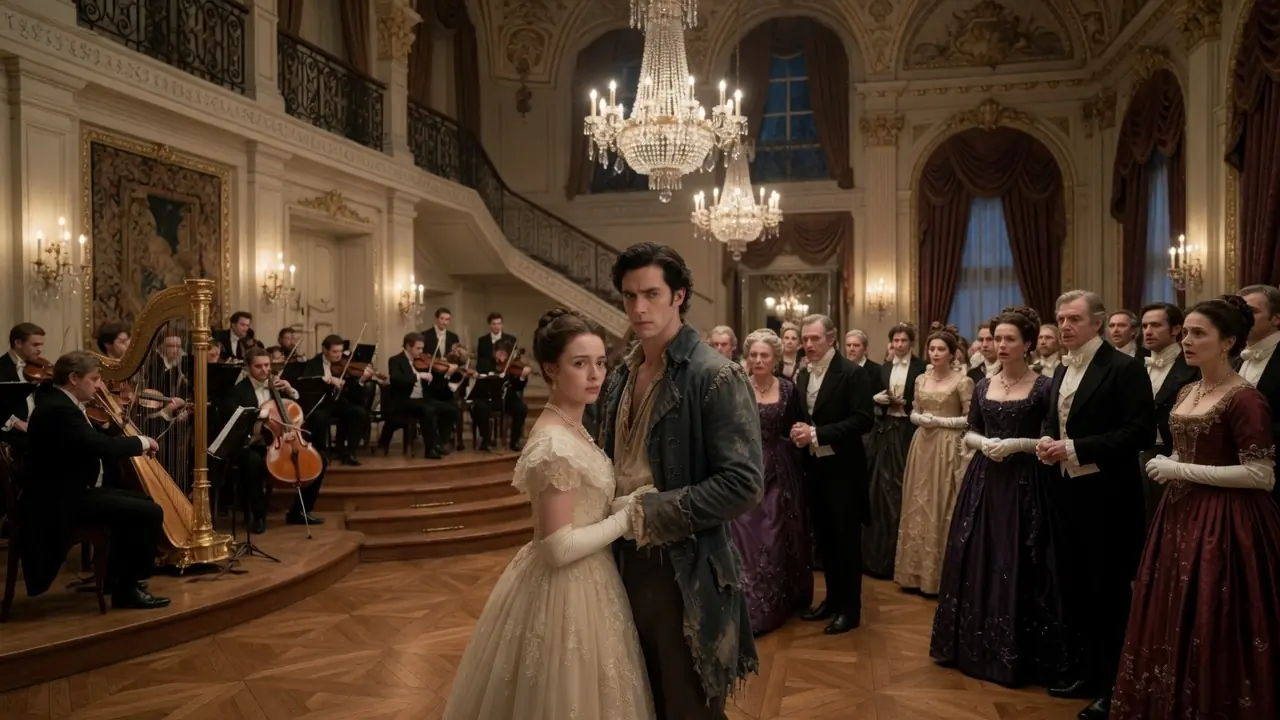
And it was enough. The night of the ball arrived. Whitchurch House was ablaze with light. Music and laughter spilled out into Grosvenor Square. Every carriage in London, it seemed, was lined up outside.
Frances stood at the top of the grand staircase, Alexander at her side. She wore the ivory gown. It was simple in its elegance, adorned only with a string of pearls that had been a gift from the dowager. Her hair was swept up, revealing the graceful line of her neck. She did not look like a girl playing dress-up.
She looked like a duchess. She was terrified. Her hands were ice cold. Alexander must have sensed it because he reached over and took her hand in his. His was warm and steady.
Ready? he asked, his voice low. She looked at him. He was magnificent in his formal evening wear. The dark coat emphasizing the breadth of his shoulders. The star of a ducal order glittered on his chest.
He was every inch the duke. But his eyes, his sea-gray eyes, were fixed on her. And they held not the arrogance of a duke, but the quiet concern of a husband."No." she whispered honestly. He squeezed her hand."Neither am I." he admitted."But we will face them together." Together. The word was a shield. They descended the staircase. A hush fell over the crowd.
Every eye in the room turned to watch them. They saw the lost Duke of Whitchurch returned from his self-imposed exile. And they saw the woman on his arm. The mysterious beggar wife. The dowager was waiting for them at the bottom of the stairs.
She beamed."Perfect." she mouthed. The night became a blur of introductions, of faces smiling, eyes assessing. Frances navigated it with a grace she had not known she possessed. She remembered names, made polite conversation, and smiled until her face ached.
Alexander was a constant steady presence at her side. His hand resting lightly on the small of her back. He deflected the impertinent questions, steered her away from the most notorious gossips, and filled her champagne glass when it was empty. They were a team. They were a united front.
And the ton, fickle as it was, was beginning to be won over. The whispers were changing. She was not a mad woman. She was a mystery. An original.
Quiet, yes, but with a certain poise. And the Duke, well, he was clearly besotted. And then, they arrived. Frances saw them first. Her mother, Lady Henrietta, and Lord Merivale, standing in the doorway as if they owned the place.
They had not been invited. Lady Henrietta was dressed in a gown of garish purple, her face a mask of furious determination. Lord Merivale was at her side, a sneer playing on his lips. They had come for a public confrontation. A wave of nausea washed over Frances.
Her carefully constructed composure threatened to crumble. She felt Alexander tense beside her."It's all right," he murmured, his voice a low rumble in her ear."I'm here." Lady Henrietta spotted them and began to push her way through the crowd, Lord Merivale in her wake. The crowd parted before them, sensing a drama about to unfold.
The music faltered and died. The room fell silent."Frances!" her mother called out, her voice shrill."Thank God we have found you. We have been so worried." She rushed forward and grabbed Frances's arm, her fingers digging in like claws."My poor darling girl, held captive by this... this charlatan?" She turned to the assembled crowd."This man," she announced, pointing a trembling finger at Alexander, "is an impostor, a fraud. He tricked my poor impressionable daughter into a sham marriage. He is a common laborer, a beggar who calls himself Cole." A collective gasp went through the room. This was better than a play.
Lord Merivale stepped forward."We are here to take her home." he said, his voice unctuous."The marriage will be annulled. Lady Frances will be my wife, as was always intended." He reached for Frances's other arm. Frances felt trapped, a prize in a tug-of-war between three people who wanted to own her.
But then she looked at Alexander. He was perfectly still. His face was a calm, cold mask of aristocratic disdain. He looked down at Lord Merivale's hand on his wife's arm, then back up at the man's face."Unhand my wife." he said.
The words were not loud, but they cut through the silence like a shard of ice. They were a command, not a request. Lord Merivale faltered, his bravado wavering in the face of such cold authority."Your wife?" Lady Henrietta shrieked with laughter."This man is no duke.
He is a nobody. Tell them, Frances. Tell them the truth." All eyes were on Frances. This was the moment. Her mother was offering her an escape, a way back to her old life.
All she had to do was denounce the man beside her. She looked at her mother, at her face twisted with desperation and greed. She looked at Lord Merivale, at his cruel, possessive eyes. And then she looked at Alexander, her husband, the man who had shown her kindness when she was invisible, who had given her a way out when she had none, the man who had shared his grief with her, who had let her into the locked rooms of his heart, the man who was standing beside her now, ready to face down the world for her. She had made her choice on Sparrow Street in a moment of desperate defiance.
Now, she made it again in the heart of London society, in the full glare of a hundred pairs of eyes. But this time, it was not out of defiance. It was out of love. She gently removed her mother's hand from her arm. She stepped away from Lord Merivale, and she stepped closer to Alexander, looping her arm through his."I am sorry, Mama," she said, her voice clear and strong, ringing through the silent ballroom."But you are mistaken. This is my husband, Alexander St. John, the Duke of Whitchurch, and I am his Duchess." She turned to Alexander and smiled, a genuine, radiant smile."And I have never been happier." The silence was broken by a single, sharp sound. The Dowager Duchess, standing nearby, began to applaud.
Slowly at first, then with gusto. One by one, others joined in. The Duke and Duchess of Bainbridge, Lady Danbury, the room erupted in applause. The ton had made its decision. They were on the side of the Duke and his mysterious, lovely Duchess.
Lady Henrietta stared, her mouth agape. Her plan had not just failed, it had backfired spectacularly. She had tried to expose a fraud and had only succeeded in cementing her daughter's place at the very pinnacle of society. She looked not like a concerned mother, but like a mad, jealous shrew. Lord Merivale, ever the opportunist, saw that the tide had turned against him.
He mumbled a hasty excuse and vanished into the crowd. Lady Henrietta was left alone, isolated in a sea of disapproving faces. Frances looked at her mother, and she felt no triumph, only a deep, profound sadness. She saw a woman who had been so consumed by her own ambition, by her fear of poverty and insignificance, that she had been willing to sell her own daughter. She was not a monster.
She was just a small, frightened woman whose world had just collapsed around her. It was a pathetic, lonely end to a lifetime of scheming. Alexander put his arm around Frances's waist and drew her close."Let's give them something to talk about." he whispered. He led her to the center of the floor.
He nodded to the musicians who struck up a waltz. And as the entire London society looked on, the Duke and Duchess of Whitchurch danced. For Frances, the room, the music, the people, they all faded away. There was only Alexander. His hand warm and sure at her waist.
His sea-gray eyes looking at her with an expression of such open, unguarded love that it took her breath away."I love you, Frances." he murmured, his lips close to her ear."I think I have from the moment you stood on my doorstep and proposed to a beggar." "I love you, Alexander." she whispered back, her heart so full it felt as if it might burst."My duke." He smiled.
A true, brilliant smile that lit up his entire face. And in the center of the glittering ballroom, surrounded by the ghosts of their past and the promise of their future, he lowered his head and kissed her. It was not the chaste, formal kiss of a duke and duchess. It was the deep, passionate, and long overdue kiss of a man and a woman who had found each other in the most unexpected of ways, and who were, at long last, finally home. Epilogue.
Six months later, the autumn sun cast a golden glow over the grounds of Falconcroft. The trees that lined the lake were a riot of red and gold, their leaves rustling in the crisp, clean air. The house was alive. The windows were thrown open, and the sound of laughter and music drifted out into the gardens. The house was breathing again.
Frances stood on the terrace, a soft, woolen shawl wrapped around her shoulders. She was watching Alexander. He was down by the lake, skipping stones across the water with Tommy, the landlady's son from Sparrow Street. After the ball, after her mother had retreated to the country in disgrace, Frances had insisted. Mrs. Gable, Tommy, and the handful of other souls from Sparrow Street who had shown her kindness were brought to Falconcroft.
Mrs. Gable was now the head housekeeper, her gruff efficiency a terror to the younger maids. Tommy, his cough finally cured by the country air and a doctor's care, was a happy, healthy boy who hero-worshipped the Duke. Alexander looked up and saw her watching. He smiled that easy, wonderful smile that was still so new and waved. She waved back, her heart full.
He was a different man from the haunted ghost who had walked these grounds 6 months ago. The shadows were gone from his eyes, replaced by a warmth and a light that was all for her. He was a duke again, not because of duty, but because of choice. He had embraced his responsibilities, petitioning for reforms for the poor in the House of Lords, using his power and his experience as Miles Cole to do some good in the world. He had not forgotten Eleanor.
Her portrait still sat in the library, but now, beside it, sat a new one, a small, exquisite miniature of Frances. The two women, the two duchesses, coexisted peacefully. The past was not erased, but honored, and the present was vibrant and full of life. Alexander jogged up the lawn to join her on the terrace. He wrapped his arms around her from behind, resting his chin on her shoulder."What are you thinking about?" he asked, his voice a low murmur against her ear."I was thinking about a man," she said, leaning back against his chest."A man I saw from a ballroom window. He was kneeling in the dirt, giving his last piece of bread to a stray dog." He was quiet for a moment."I was thinking about a girl," he said softly."A girl who stood on my doorstep and offered me £50 and a chance to feel something again. She turned in his arms to face him. You were seen, Alexander. She said. Her hand coming up to cup his cheek.
Even in the dark. Even when you thought you were invisible. I saw you. And you. He said.
His voice thick with emotion. As he brought his own hand up to mirror hers. You were never invisible to me, Frances. You were the only thing I saw. He kissed her then.
A slow, gentle kiss filled with the quiet certainty of their love. It was not a transaction. Or a defiance. Or an escape. It was a choice.
A home. A beginning. And as the sun set over their laughing, living house. They stood together. No longer hiding.
No longer lost. But simply, finally, seen.