Evelyn Harper did not scream. She did not weep. She set her coffee cup down on the breakfast table with the gentleness of a woman who had already decided everything, rose from her chair, smoothed the front of her dress with both hands, and curtsied low—composed and final—before the man who had just told a room full of people that he married her because no better woman would have him.
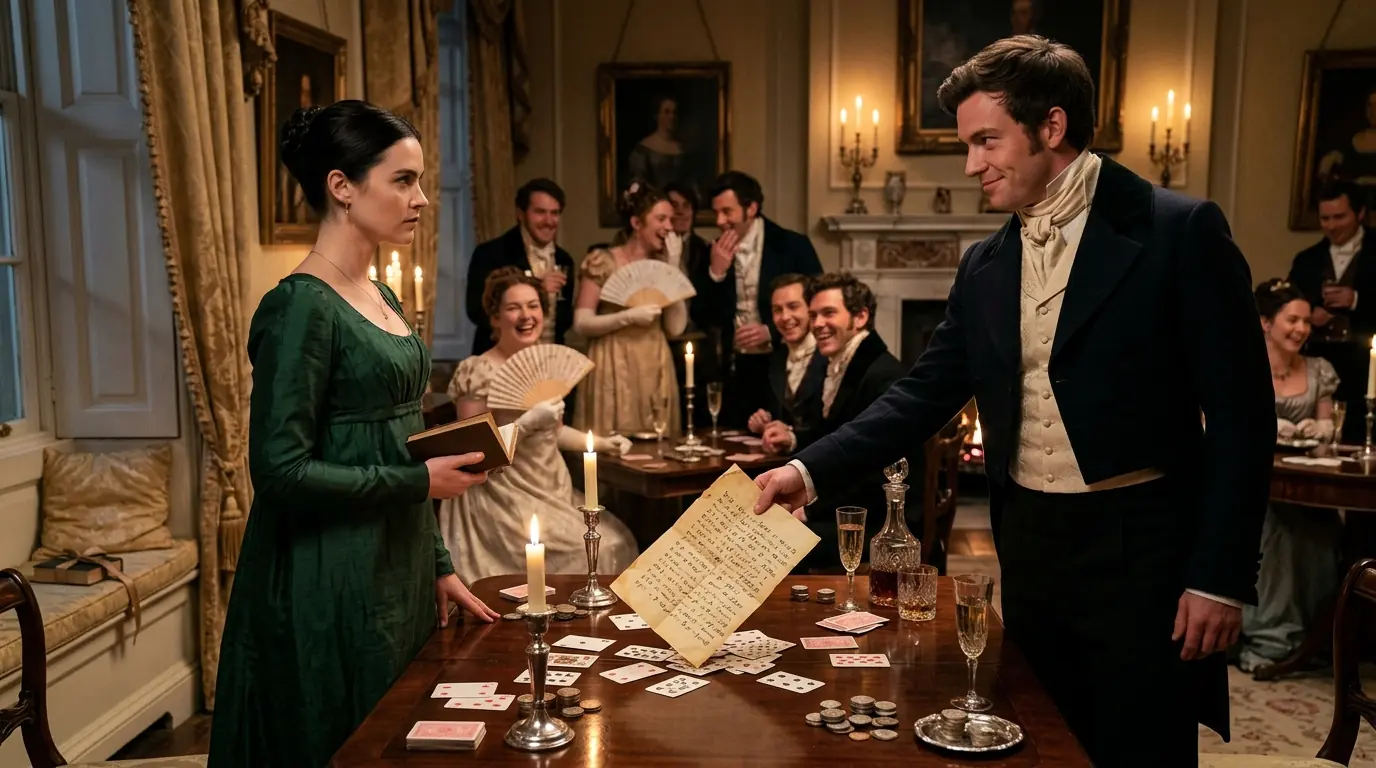
The summer of 1816 arrived in Virginia the way it always did: hot and indifferent, pressing down on the red clay roads and the wide tobacco fields with equal weight, carrying nothing for the people moving beneath it. And inside the Whitmore estate, breakfast was served at precisely 8:00, the way it had been served every morning for forty years.
Evelyn Harper Whitmore sat at the far end of the long mahogany table and did not look at her husband. This was not unusual. In two years of marriage, she had learned to find safe places to rest her eyes: the silver pitcher near the window, the embroidered edge of the tablecloth, the pattern on her own porcelain cup. Places that did not carry opinions. Places that did not measure her.
She was twenty-six years old. She had brown hair that was too ordinary to be called chestnut and too dark to be called golden. Her face was pleasant enough—she knew that—but pleasantness was not the word men used when they spoke of the women they admired. She had heard herself described, when people thought she was not listening, as sensible, reliable, a decent sort of woman. No one ever called her beautiful. She had made her peace with that long before Nathaniel Whitmore proposed.
At the other end of the table, Nathaniel sat with the particular posture of a man accustomed to every room arranging itself around him. He was thirty-four, broad-shouldered in the way that old Virginia families seemed to produce naturally, as though the land itself demanded a certain physical authority from the men who owned it. His face was handsome in a severe way, all sharp angles and controlled expression, and his dark eyes moved across his correspondence with the same efficient calm he brought to everything. He had not looked at Evelyn yet this morning. He rarely did at breakfast.
His mother sat between them: Margaret Whitmore, sixty-one years old and in perfect health, which Evelyn had once overheard a neighboring woman describe as a punishment from God on the Whitmore household. Margaret wore black, as she had every day since her husband died seven years ago, though everyone in the county understood the black had less to do with grief and more to do with an aesthetic preference for severity.
Margaret was watching Evelyn's hands. She often did this—tracked the movement of Evelyn's hands across the table, cataloging small violations of propriety that she would present later in the day, privately, with the measured tone of a schoolteacher who has already lost all patience.
This morning, Evelyn was reaching for the bread basket.
"The Caldwells are coming on Thursday," Margaret said. Her voice had the quality of a courtroom pronouncement.
"I know, ma'am," Evelyn said. "I've already spoken with Mrs. Adler about the menu."
"I wasn't asking about the menu." Margaret set down her fork. "I was informing you because I'd like you to wear the blue dress. Not the one you chose last autumn. The other one. The one that covers your arms properly."
Evelyn kept her expression still. "Of course."
"The Caldwell boy is coming with his new fiancée. She studied in Boston." Margaret paused to let that land. "Accomplished girl. Lovely family."
"I'm sure she is."
Nathaniel turned a page of his correspondence.
"Nathaniel." Margaret turned to her son. "I think it would be appropriate for you to speak with the Caldwells about the land dispute before dinner. Not during. James Caldwell takes business at the table as a personal affront."
"I'm aware of how James Caldwell takes things," Nathaniel said without looking up.
"Good." Margaret picked up her fork again. She glanced at Evelyn. "You might also consider having Cook prepare the stuffed pheasant. The Caldwells remember the last time we served quail, and I believe there was some dissatisfaction."
"The quail was perfectly cooked," Evelyn said.
"That isn't the point."
"Then what is the point, ma'am?"
The question came out more directly than Evelyn intended—or perhaps exactly as she intended. She was no longer entirely sure of the difference.
Margaret looked at her for a long moment. "The point is that certain families have expectations, and we meet them."
"I've been meeting them for two years," Evelyn said quietly. "I believe I understand the expectations."
Something shifted in the room. It was almost nothing: a tightening in Margaret's jaw, a slight pause in the sound of Nathaniel's pages turning. The housemaid near the sideboard found something very interesting to examine on the wall.
"That tone," Margaret said, "is not appropriate at the breakfast table."
"I apologize, ma'am." But she didn't look down. That was the change. She used to look down.
Nathaniel finally set his correspondence aside. He looked at Evelyn—not the way a man looks at someone he loves, but the way a man looks at a problem he has been ignoring for long enough that it has developed a voice. "There's no need for tension," he said.
"I agree," Evelyn said.
"Then perhaps," Margaret said, her voice sharpening at its edges, "your wife might consider that this household has a certain standing in this county, and that standing requires—"
"Mrs. Whitmore." Evelyn set her cup down. "I have managed this household every day for two years. I have organized every dinner, mediated every disagreement among the staff, overseen the household accounts, corresponded with every family you've asked me to correspond with, and attended every function you required me to attend. I have done all of this without complaint and without credit. I am asking only to be spoken to as though I am part of this family, not a servant who requires correction at the breakfast table."
The silence that followed was total. The housemaid near the sideboard had stopped pretending to examine the wall and was now simply frozen. Margaret sat very straight.
"Well."
"Evelyn." Nathaniel's voice was quiet. Warning-quiet.
"I'm not being unreasonable," Evelyn said.
"You are speaking to my mother."
"I am aware of that."
"Then you understand this is not how things are done."