The moment my eleven-year-old son picked up his backpack from the first-class seat his grandfather had bought for him, something inside me went quiet in a way that frightened me.
Not angry yet.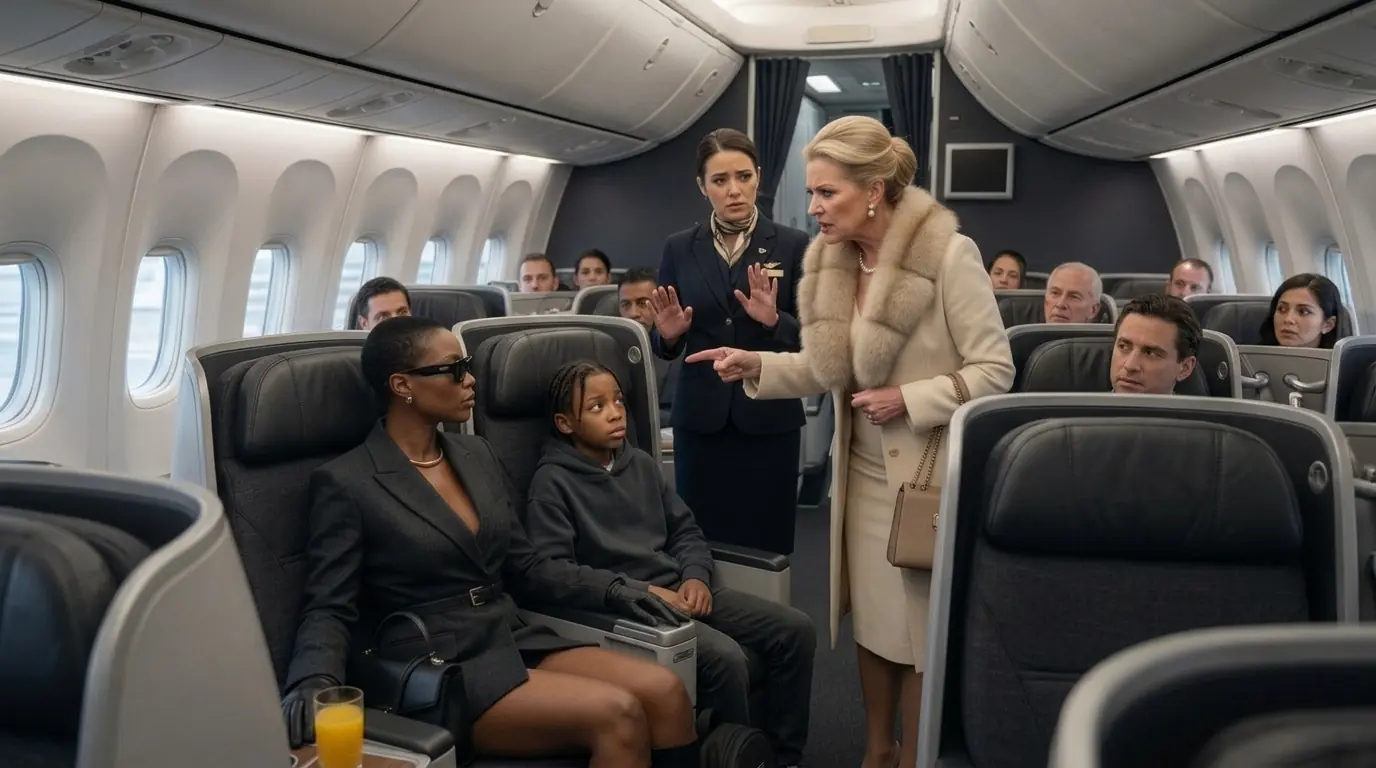
Not loud.
Quiet.
The kind of quiet that arrives when a mother understands her child has just learned something the world had no right to teach him.
My son’s name was Jordan Miles, and that flight was supposed to be his birthday gift. A simple trip from Eastbridge International to Westhaven Coast Terminal, just him and me, one long flight across the country, one chance for him to sit near the front of the plane instead of walking past it with careful curiosity.
He had turned eleven two days earlier.
My father, Walter Brooks, had surprised him with the tickets after Jordan won the youth division of a regional violin competition. First class, window seat, warm meal, the whole thing. My father said it was time the boy learned comfort was not something other people were born owning.
“Let him sit where the world can’t pretend it has no room,” Dad told me over the phone.
So there we were, in seats 2A and 2B, while Jordan tried not to look overwhelmed by the world unfolding around him.
He touched the seat controls like they were museum pieces.
He unfolded the blanket and refolded it neatly.
When the flight attendant handed him sparkling apple juice in a real glass, he looked at me with wide eyes and whispered, “Mom, do they always serve drinks like this up here?”
I smiled.
“Today they do.”
For the first fifteen minutes, I let myself believe it would be perfect.
Jordan wore his favorite navy hoodie, clean black sneakers, and the silver watch my father had given him that morning. His hair was braided neatly, and his violin case was already stored safely in the closet near the front. He had packed a notebook, a pencil, and the paperback mystery novel he was determined to finish before landing.
He looked happy.
Not spoiled.
Not loud.
Not entitled.
Happy.
That should not have been a problem.
Then the woman in 3A stepped into the cabin.
She entered like the plane owed her something.
Her coat was pale beige, expensive enough to make silence around it. Her handbag hung from her arm like a trophy. She wore oversized sunglasses even though we were still indoors, and her perfume reached us before her voice did.
She stopped beside Jordan’s seat.
Not beside her own.
His.
Her eyes moved over him slowly.
His hoodie.
His braids.
His apple juice.
His small hand resting on the armrest as if he was still asking permission to enjoy it.
Then her mouth tightened.
“Excuse me,” she said, loud enough for everyone near us to hear. “There seems to be a mistake.”
I looked up from my phone.
“Can I help you?”
She did not look at me.
She leaned slightly toward the aisle and lifted one manicured finger toward Jordan.
“I paid nearly five thousand dollars for this cabin,” she said. “I expect a certain level of peace.”
Jordan’s smile vanished.
My body went still.
The woman continued, “I did not pay to sit near a child who clearly belongs in the back.”
The words landed so neatly that for one second, nobody knew how ugly they were supposed to sound.
Then the cabin shifted.
A man in 1C glanced down at his tablet.
A couple across the aisle suddenly became fascinated by the safety card.
A businessman near the window pressed his lips together and did nothing.
Jordan lowered his glass.
“Mom,” he whispered.
I reached for the boarding passes in my bag, not because I owed her proof, but because mothers learn quickly that evidence sometimes protects their children faster than outrage.
Before I could pull them out, the woman snapped her fingers toward the front galley.
Snapped.
At a flight attendant.
A young attendant named Claire hurried over, still holding a stack of welcome menus. Her smile was professional, but I saw the exhaustion in her eyes. The kind that comes from knowing kindness is required even when respect is not returned.
“Ma’am, is everything all right?”
“No,” the woman said. “Everything is not all right.”
She pointed toward Jordan.
“This boy is in the wrong cabin.”
Claire glanced at Jordan, then at me.
“He has a valid boarding pass for that seat.”
The woman laughed.
Cold.
Short.
“Then your system is broken.”
Jordan looked down at his lap.
The woman folded her arms.
“I’m a Platinum Premier member. I fly this route constantly. I know what this cabin is supposed to feel like.”
Claire’s face changed slightly.
That phrase had power.
Platinum Premier.
It was not just a loyalty level.
It was a weapon people like this carried because too many companies had taught them it worked.
The woman continued.
“He is fidgeting. He is staring at everything. He is making the environment uncomfortable. Move him.”
Jordan had not been fidgeting.
He had been amazed.
Apparently wonder, in the wrong child, looked like disturbance.
I stood halfway from my seat.
“My son is not moving.”
The woman finally looked at me.
Her eyes swept over my simple black sweater, my jeans, my old leather tote.
“And you are?”
“His mother.”
“How fortunate for him.”
The insult was quiet, but it had teeth.
Claire stepped in quickly.
“Ma’am, I’m going to ask that we keep the boarding process calm. The child is assigned here.”
“The child,” the woman repeated, “is ruining the tone of the cabin.”
Jordan touched my sleeve.
His fingers were cold.
“Mom,” he whispered. “Please.”
I looked down at him.
“No.”
“I don’t want to sit here anymore.”
My throat tightened.
“You have every right to sit here.”
“I know.”
His voice trembled once, then steadied in a way no child should have to learn.
“But I don’t want to sit beside someone who hates that I’m here.”
The whole cabin heard him.
Nobody answered.
That silence told me more about the plane than the woman had.
Claire’s eyes filled with tears she fought hard to keep professional.
The woman in 3A gave a satisfied little breath, as if Jordan’s pain had inconvenienced her less than his presence.
“There’s an empty seat in the back,” Jordan said softly. “I saw it when we boarded.”
“Jordan.”
“It’s okay.”
It was not okay.
But he stood before I could stop him.
He picked up his backpack and his notebook. He held the sparkling apple juice carefully, as if spilling it would prove something about him. Then he stepped into the aisle.
No one moved.
Not the businessman.
Not the couple.
Not the man pretending to read the tablet.
Not one adult in that first-class cabin stood up and said, “This child stays.”
My son walked past the curtain toward economy with his head high and his shoulders stiff.
The woman slid into the comfort that had been bought for him and adjusted her silk scarf like justice had been served.
I watched Jordan disappear behind the curtain.
Then I sat back down.
Slowly.
The woman looked pleased.
She thought stillness meant defeat.
She did not know I had been raised by Walter Brooks.
My father had started as a night janitor at airports, cleaning private lounges after men in suits dropped cigar ash on carpet and left newspapers on chairs. He built his life one graveyard shift at a time, studied logistics during lunch breaks, bought into ground-service contracts before anyone took him seriously, and eventually became the owner of Westhaven Coast Terminal’s private operations lease.
He was not famous.
But airlines knew his name.
So did executives who needed their jets handled properly, their crews moved quickly, their passengers protected from disorder, and their contracts renewed without embarrassment.
I opened my phone and sent him a message.
Change of plans. Don’t meet us inside. Meet us at the stairs. A Platinum Premier member just taught Jordan he doesn’t belong in first class.
My father replied in nine seconds.
Bring my grandson off last.
That was all.
For the next five hours, I sat in 2B beside an empty seat that felt louder than the engines.
The woman’s name, I later learned, was Patricia Ellsworth.
She ordered champagne before takeoff and complained it was too warm. She asked Claire if “the disturbance had been settled.” She reclined her seat, put on a cashmere eye mask, and slept as if cruelty had been exhausting.
I wanted to go to Jordan immediately.
I wanted to take him by the hand, bring him back, and make every passenger look at him until shame found a place to sit.
But he had asked for quiet.
So I gave him quiet.
Not surrender.
Quiet.
Halfway through the flight, I walked to the back under the excuse of using the restroom. Jordan was in row 36, by the window, squeezed between a sleeping college student and an elderly man with kind eyes who had given him the armrest.
His notebook was open on his lap.
But he was not writing.
He was staring out at the clouds, his face reflected faintly in the window, looking older than he had that morning.
I crouched beside him.
“Hey, baby.”
He turned quickly and gave me a smile that hurt more than crying would have.
“I’m fine.”
“No, you’re not.”
He looked down at his notebook.
“I didn’t want Grandpa to be embarrassed.”
The sentence nearly broke me.
He had been humiliated in public, and his first thought was protecting the pride of the man who loved him.
“Jordan,” I said, keeping my voice low, “your grandfather is not embarrassed by you. He is proud of you.”
“I left the seat.”
“You protected yourself.”
“I let her win.”
I shook my head.
“She thinks she won because she does not understand what winning is.”
He looked at me then, eyes bright.
“Will it always be like that?”
I wanted to lie.
Mothers are tempted to lie when the truth is too heavy for children.
But Jordan had already been handed enough false comfort for one day.
“Sometimes,” I said. “But not always. And not without consequence.”
The elderly man beside him shifted slightly.
“I’m sorry,” he said.
I looked at him.
He appeared to be in his seventies, white-haired, wearing a brown cardigan over a checked shirt. His voice was quiet and rough around the edges.
“I should have said something when he came back here,” he continued. “I didn’t know what had happened until he sat down and tried not to cry.”
Jordan looked embarrassed.
The old man turned toward him.
“I was a teacher for thirty-eight years. I know the difference between a child being difficult and a child being hurt.”
Jordan swallowed.
The man held out a small packet of cookies from his meal tray.
“I didn’t want these. Couldn’t enjoy them after that.”
Jordan hesitated.
Then accepted them.
“Thank you, sir.”
“My name is Frank.”
“Jordan.”
“Good name.”
That small exchange steadied him more than all my fury could have.
When I returned to first class, Patricia had removed her eye mask and was sipping champagne.
She looked at me as I sat down.
“Hopefully he’s more comfortable now.”
I turned my head slowly.
“You should rest while you can.”
Her brow tightened.
“Excuse me?”
“Landing may be stressful.”
She gave a short laugh.
“I don’t know what that means, but I’m sure it sounded clever in your head.”
I did not answer.
There are some people who only understand a door when it closes in their face.
As we descended into Westhaven, Claire came through the cabin collecting glasses.
When she reached me, she lowered her voice.
“I filed an incident report during the flight.”
I looked up.
“You did?”
Her hands trembled slightly around the tray.
“Yes. And a passenger in row one recorded most of the exchange.”
Across the aisle, the businessman who had stared at his tablet during the incident did not look at us, but he lifted his phone just slightly.
A signal.
Late courage.
Still courage.
Claire swallowed.
“I should have done more.”
“Yes,” I said.
The answer hurt her, but it was the truth.
Then I added, “But doing something now still matters.”
Her eyes filled.
“Thank you.”
Patricia leaned forward.
“Excuse me. Some of us are trying to enjoy the approach.”
Claire looked at her.
For once, she did not apologize.
She simply said, “Of course, Ms. Ellsworth,” and moved on.
It was small.
But I saw the crack.
When the plane landed, Patricia rose before the seatbelt sign had fully gone off.
Of course she did.
She pulled down her bag, adjusted her beige coat, and waited near the front of the cabin with the confidence of a woman used to being first off every plane and first believed in every room.
Outside the window, I saw the private terminal steps roll into place.
A black car waited on the tarmac.
Beside it stood my father.
Walter Brooks wore a charcoal suit, a black overcoat, and the same calm expression he used when negotiating contracts worth more than entire neighborhoods. His hair had gone silver years ago, but he still stood like the man who had once scrubbed floors without letting anyone bend his spine.
My phone buzzed.
Bring him out last.
The cabin door opened.
Warm California air entered the plane.
Two ground supervisors stood at the top of the stairs, not smiling.
Patricia stepped forward.
One of them looked at a tablet.
“Ms. Patricia Ellsworth?”
She smiled at first.
“Yes?”
“Please step aside. We need to discuss an in-flight discrimination complaint.”
Her face changed instantly.
“A what?”
Behind her, the aisle went still.
“This is absurd,” Patricia snapped. “I’m a Platinum Premier member.”
The supervisor nodded.
“We are aware.”
That answer did something to her.
It removed the magic from the words.
She turned toward me.
“You did this.”
I stood slowly.
“No. You did.”
Then I walked past her and through the curtain to row 36.
Jordan stood when he saw me.
His backpack was on one shoulder. His notebook was against his chest. Frank, the old teacher, stood beside him holding the cookie wrapper like evidence of a small kindness.
“Come on,” I said. “Grandpa’s waiting.”
Jordan hesitated.
“Is she still there?”
“Yes.”
His shoulders tightened.
I took his hand.
“Look forward.”
We walked through the plane together.
Past passengers who had seen too much and done too little.
Past the first-class seat that had been his.
Past Patricia Ellsworth, who now stood between two supervisors with a face drained of its certainty.
This time, every person watched Jordan.
Not with amusement.
Not with suspicion.
With recognition.
At the top of the stairs, Jordan saw my father.
For one second, he looked like he might hold himself together.
Then my father opened his arms.
“There’s my birthday boy.”
Jordan ran down the stairs.
The moment he reached him, he stopped being brave.
He folded into my father’s chest and sobbed.
My father held him with one arm and looked up at the plane with eyes that made even the ground crew go still.
Patricia was escorted down moments later, still arguing.
“I demand to speak to whoever is in charge.”
My father gently released Jordan and turned.
“That would be me.”
Patricia looked him over.
Her eyes flickered with irritation before recognition began to catch up.
“And you are?”
“Walter Brooks. Owner and managing operator of this terminal facility, primary ground-services contractor for this airline’s Westhaven operations, and the grandfather of the child you had removed from his paid seat.”
The words struck her one at a time.
She blinked.
“I didn’t know he was your grandson.”
The silence on the tarmac became almost perfect.
My father tilted his head.
“That is not the defense you think it is.”
Patricia’s mouth tightened.
“I requested a seating adjustment. I have rights as a premium passenger.”
“You called him ‘this,’” my father said.
She went pale.
Claire stood behind her on the stairs.
The businessman from 1C had come down too, phone in hand.
The first supervisor lifted the tablet.
“We have the incident report, witness statements, and video.”
Patricia turned on Claire.
“You little—”
“Careful,” my father said.
One word.
Nothing more.
It was enough.
Patricia stopped.
Then Frank, the retired teacher from row 36, stepped forward with Jordan’s notebook.
“You forgot this, young man.”
Jordan wiped his face quickly and reached for it.
“Thank you.”
But Frank did not let go immediately.
He looked at me, then my father.
“I don’t mean to interfere,” he said. “But you should read the last page.”
Jordan froze.
“No.”
I looked at him.
“Jordan?”
His face flushed with panic.
“Mom, please.”
Frank’s voice softened.
“I taught children for a long time. Sometimes what they write while adults fail them matters.”
My father turned to Jordan.
“I will only read it if you allow me.”
Jordan looked at the ground.
Then gave the smallest nod.
My father opened the notebook.
At first, his face remained calm.
Then his hand tightened.
He read aloud, and his voice broke only once.
“When I grow up, I want to build a place where nobody has to prove they belong before they are allowed to sit down.”
No one moved.
Not the crew.
Not the supervisors.
Not the passengers.
Not Patricia.
My father looked down at the page again.
“If Grandpa can own terminals, maybe I can build doors.”
That was the moment Patricia stopped being the center of the story.
My father closed the notebook slowly.
He looked at Jordan not as a humiliated boy, but as a future standing on the tarmac with tear-streaked cheeks and a backpack sliding off one shoulder.
“You wrote that today?”
Jordan nodded.
My father turned to the lead supervisor.
“Cancel the private birthday reception.”
I blinked.
“Dad?”
He looked at me, then at Jordan.
“We’re changing the plan.”
I thought he meant punishment.
And part of it did come.
Patricia’s loyalty account was suspended pending review. The airline issued a formal apology. Claire’s report became the reason the company could not pretend it had handled the situation properly. The passenger video went viral by morning, and the phrase “the boy in 2A” spread faster than anyone expected.
But that was not the real twist.
The real twist came four weeks later.
My father invited Jordan and me back to Westhaven Coast Terminal for what he called “a small announcement.” There is no such thing as a small announcement when Walter Brooks asks people to wear decent shoes.
Jordan wore a navy blazer, his clean sneakers, and the same watch from the flight.
He brought his violin case because my father asked him to.
Reporters stood in the terminal atrium when we arrived. Airline executives waited near a covered sign. Claire stood near the front, nervous but smiling. Frank, the retired teacher, had been invited too and looked deeply uncomfortable being treated like an honored guest.
Then I saw Patricia.
She stood near the back in a plain gray coat, no sunglasses, no expensive performance of importance. My first feeling was anger, quick and hot.
“What is she doing here?” I whispered.
My father did not look away from the stage.
“Watch.”
He stepped to the microphone.
“Years ago,” he began, “I cleaned floors in terminals where travelers stepped around me without seeing me. I learned then that access means very little without dignity.”
The room quieted.
“I built my company to open doors. But recently, my grandson reminded me that open doors are not enough if children still have to prove they deserve to walk through them.”
He looked at Jordan.
Jordan stood very still beside me.
My father pulled the cloth from the sign.
It read:
THE JORDAN BROOKS TRAVELING STRINGS FOUNDATION
Jordan stopped breathing.
My father continued.
“This foundation will provide first-flight experiences, music travel scholarships, mentorship, and passenger dignity advocacy for children who are too often told, loudly or quietly, that certain rooms are not built for them.”
Applause rose through the atrium.
Jordan looked at me, stunned.
But my father lifted his hand.
“One more thing.”
The room quieted again.
“The first private contribution came from someone who learned this lesson publicly.”
Every head turned toward Patricia.
She walked forward slowly.
The room shifted around her, suspicion moving faster than sympathy.
She reached the microphone and looked at Jordan.
For once, her face carried no arrogance.
“I cannot undo what I said,” she began.
Her voice was thin.
“I cannot undo what I made you feel. I cannot undo the fact that I used status to make a child feel smaller than me.”
Jordan looked at her without blinking.
“But I can say this publicly: I was cruel. I was wrong. And I confused money with worth.”
She swallowed.
“Your grandfather gave me a choice. Fight the consequences in court, or fund the first year of this foundation anonymously.”
A murmur ran through the atrium.
Patricia looked at Walter.
“I chose anonymously.”
Then she looked back at Jordan.
“But Jordan chose otherwise.”
I turned sharply to my son.
“You knew?”
Jordan nodded, eyes wet.
“Grandpa asked me what would make the story better.”
My father smiled faintly.
“And he said punishment only matters if it builds something that wasn’t there before.”
That was the twist that stole my breath.
The child who had been pushed out of first class had been given the power to choose revenge.
He chose a doorway.
Patricia faced him fully.
“Thank you for giving me a chance to become useful after being unforgivable.”
Jordan held his notebook against his chest.
For a long moment, nobody moved.
Then he said, “I don’t forgive you yet.”
Patricia nodded quickly, tears filling her eyes.
“I understand.”
“But I hope the kids who fly because of this foundation never meet someone like you.”
The room went silent.
Jordan continued.
“And if they do, I hope someone stands up before they have to move.”
The applause that followed was not polite.
It was thunder.
Months later, the first group of children came through Westhaven Coast Terminal under the foundation’s care.
They arrived in thrift-store jackets, church shoes, wheelchairs, bright braids, hearing aids, violin cases, sketchbooks, and sneakers with worn soles. Some had never flown before. Some had never left their state. Some looked at the planes through the glass with the same wonder Jordan had shown before it was stolen from him.
This time, nobody stole it.
Jordan stood beside my father at the entrance, greeting each child like a host welcoming guests into a home.
Claire was there too, newly promoted to Passenger Dignity Training Lead. She taught crews how to respond before harm became policy, before fear became silence, before a child had to be the bravest person on a plane.
Frank volunteered with the reading and journaling program.
He told every child, “Write down what the world teaches you. Then decide which parts deserve to be rewritten.”
As for Patricia, she kept donating.
Quietly.
Consistently.
She was not celebrated as a hero, because she was not one.
But sometimes the best ending for someone who caused harm is not applause.
It is a lifetime of repair without control over whether forgiveness ever arrives.
On the foundation’s first anniversary, Jordan played violin in the terminal atrium.
The music rose toward the glass ceiling, soft and brave. Travelers slowed. Children watched. My father stood beneath the sign with Jordan’s name on it, his eyes shining in the way proud men try to hide.
When Jordan finished, the atrium erupted.
He lowered the violin and looked at me.
Not with the fake smile from row 36.
A real one.
“Mom,” he said afterward, “I think I understand something.”
“What?”
He looked around at the children, the open doors, the waiting planes, and his grandfather standing where no one could overlook him anymore.
“Sometimes losing a seat shows you that you were supposed to build the whole room.”
That was the part Patricia never saw coming.
She thought she had moved my son to the back of the plane.
All she really did was push him toward the front of his own destiny.