The ballroom had been designed to make rich people feel permanent.
Crystal chandeliers hung from the ceiling like frozen fireworks. Waiters moved between marble columns with silver trays, pouring champagne into glasses that cost more than some people’s rent. The floor shone so brightly that every polished shoe, silk gown, and diamond bracelet seemed doubled in its reflection.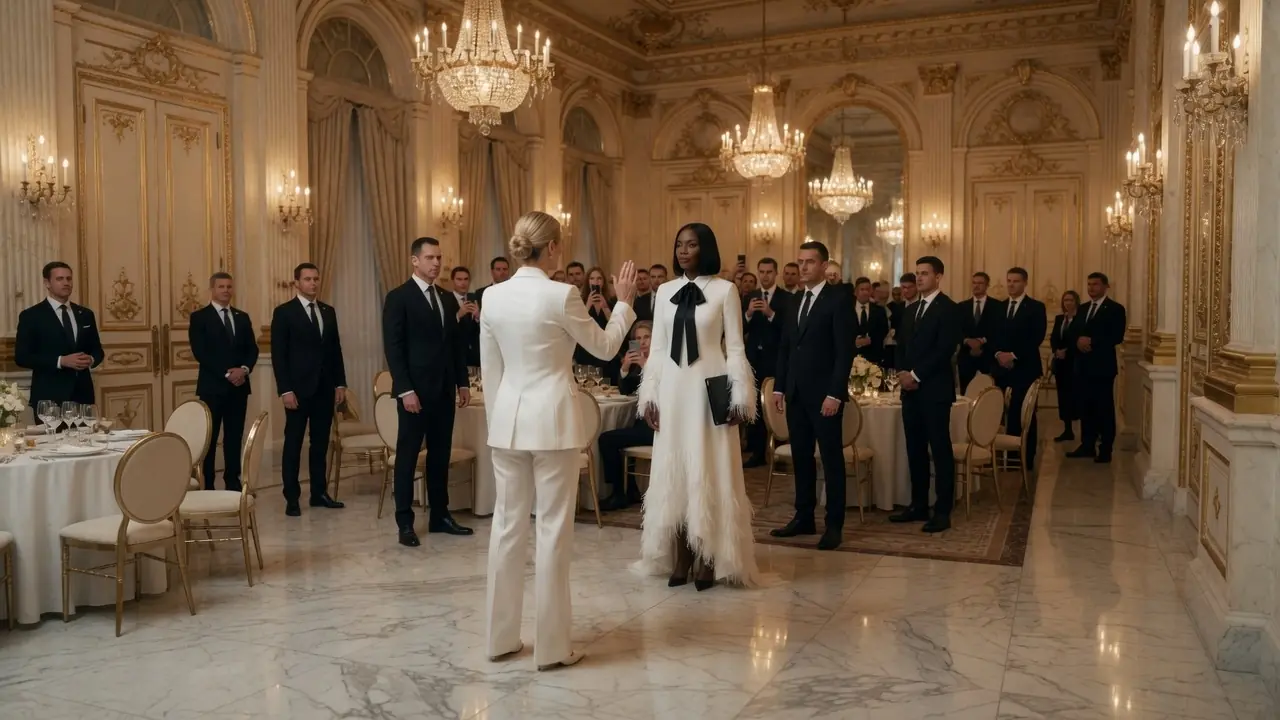
This was the annual summit of Valecrest Global Partners, a financial empire that liked to call itself “the future of ethical capital.” Nobody laughed when they said it. People rarely laugh at phrases attached to enough money.
At the center of the room stood Margaret Vale.
She was tall, white, silver-haired, and elegant in a way that felt sharpened rather than softened by age. Her cream suit fit like armor. Her smile was flawless. Her eyes were colder than the ice sculptures arranged along the dessert table.
Margaret had built Valecrest into one of the most admired private investment firms in the country. Magazines called her visionary. Board members called her disciplined. Employees called her impossible, but usually only in parking lots, bathrooms, or encrypted messages.
That night, she stood beneath the stage lights holding a microphone, ready to announce the company’s largest expansion fund.
Three point four billion dollars.
That number moved through the ballroom like music.
It meant acquisitions.
It meant fees.
It meant bonuses.
It meant investors could keep smiling as if the world were nothing more than a table set for them.
Then Margaret saw the woman standing near the back wall.
The woman was Black, maybe in her early forties, calm and still in a simple navy dress. She wore no visible designer label. No assistant hovered at her shoulder. No photographer followed her. She held a slim leather portfolio at her side and watched the room as if she were studying not the decorations, but the people beneath them.
Her name was Simone Avery.
Almost no one in that ballroom knew it.
That was their first mistake.
To most of the guests, Simone looked like someone who had walked into the wrong event. Perhaps a staff member dressed too nicely. Perhaps a junior associate’s guest. Perhaps someone who had slipped past registration by confidence alone.
To Margaret Vale, that was enough.
The CEO’s smile tightened before anyone understood why.
She paused mid-sentence, turned slightly toward the back of the ballroom, and lifted one hand.
“Security,” Margaret said into the microphone, her voice smooth and clear. “Please assist the woman near the rear exit. This is a private summit.”
The room froze.
Conversations died.
Glasses stopped halfway to mouths.
Then phones began to rise, because humiliation had become a spectator sport and everyone wanted evidence as long as it did not cost them anything.
Two security guards started walking toward Simone.
She did not step back.
She did not argue.
She did not pull out her phone or demand a manager or shout about who she was.
She simply stood there, one hand resting lightly on the leather portfolio, watching Margaret Vale with the patient expression of a woman who had been underestimated by better people than this.
Margaret stepped down from the stage.
Her heels clicked across the marble floor, each step measured, graceful, and public. A few executives at the front table leaned toward one another, whispering. Several smiled the way people smile when they are relieved the humiliation is happening to someone else.
Margaret stopped in front of Simone.
“I’m sure there has been some confusion,” she said.
Simone looked at her.
“There hasn’t.”
The answer was quiet.
Too quiet to be theatrical, but somehow loud enough to make the nearest tables turn.
Margaret’s expression did not change, but something hardened behind her eyes.
“This summit is for principal investors, board partners, and registered institutional guests.”
“I know.”
“Then perhaps,” Margaret said, letting her eyes move over Simone’s dress, her hair, her calm posture, “you are accompanying someone?”
A soft laugh came from a table nearby.
Not loud.
Just enough.
The kind of laugh that does not want to be recorded as racist or cruel, but wants to enjoy being both.
Simone turned her head slightly toward the laughter.
Nobody there met her eyes.
Margaret continued, her voice still sweet.
“Someone from your firm, maybe? Or are you with one of the service teams?”
That question moved through the room like smoke.
Everyone understood what she meant.
You do not belong here alone.
Simone did not respond immediately.
She looked past Margaret at the stage, at the banner that read VALECREST GLOBAL PARTNERS: TRUST BUILDS TOMORROW, and almost smiled.
“Trust,” she said softly.
Margaret blinked.
“Excuse me?”
“Nothing.”
The security guards reached them.
One stood to Simone’s left. The other stopped too close to her portfolio, as if the leather case might also need escorting out.
“Ma’am,” the first guard said, clearly uncomfortable, “we’re going to need you to come with us.”
Simone looked at him.
“Did you check the guest registry?”
The guard hesitated.
Margaret answered before he could.
“She is not on it.”
Simone returned her gaze to Margaret.
“You’re certain?”
Margaret’s smile sharpened.
“I know who belongs in my room.”
That sentence changed the air.
It did not explode.
It settled.
A few people lowered their phones slightly, uncertain now, because Simone’s calm did not match the scene they had expected. She was not shrinking. She was not embarrassed. She looked almost as if Margaret had finally said the exact words she had come to hear.
Simone slowly lifted her portfolio.
Margaret’s tone cooled.
“Do not make this difficult.”
Simone paused.
“Difficult for whom?”
Nobody laughed that time.
She opened the portfolio.
Inside were sealed documents, a black metal access card, and a folder embossed with the Valecrest crest. The second guard saw the crest first. His shoulders changed. Then Margaret saw it too.
For the first time all evening, her smile faltered.
“What is that?”
Simone removed the folder carefully.
“The capital commitment agreement,” she said.
Margaret stared.
Simone’s voice remained steady.
“The one your board spent seven months negotiating with Avery Meridian Capital.”
A whisper ran through the nearest tables.
“Avery Meridian?”
“That’s the anchor investor.”
“The $3.4 billion allocation?”
Margaret’s face lost a shade of color.
But pride, when old enough, does not collapse quickly. It becomes rigid first.
“That agreement is handled through our institutional division,” Margaret said.
“Yes,” Simone replied.
Then she looked directly into Margaret’s eyes.
“I own the institutional division.”
The ballroom went silent in a way silence rarely does.
Not empty.
Full.
Full of people realizing they had just watched the most powerful woman in the room insult the one person holding the money that made all their confidence possible.
Margaret opened her mouth.
Nothing came out.
Simone took out her phone, pressed one number, and waited.
When the call connected, her voice did not rise.
“Daniel, freeze the $3.4 billion allocation to Valecrest Global Partners immediately.”
A gasp broke across the room.
Margaret stepped forward.
“Wait.”
Simone did not look away.
“Notify our legal desk. Preserve all summit footage. And inform the Valecrest board that their CEO just ordered security to remove the principal investor from her own capital event.”
The ballroom did not erupt.
It caved inward.
A fork struck a plate with a small, sharp sound. Someone whispered, “Oh my God.” A banker at table four pushed his chair back too quickly and nearly knocked over his drink.
Margaret’s face changed from command to calculation.
“Ms. Avery,” she said, suddenly careful with the name. “There has clearly been a misunderstanding.”
Simone lowered her phone but did not end the call.
“No. There has been a demonstration.”
The voice on the phone spoke faintly.
“Allocation frozen. Board notification awaiting final instruction.”
Margaret’s head turned toward the phone.
“Awaiting instruction? No. Stop that.”
Simone looked at the two guards.
Both had stepped back.
That small retreat told the ballroom everything. The woman they had almost removed was now the center of gravity, and everyone else was adjusting around her.
Margaret tried again.
“Simone, may I call you Simone?”
“No.”
The word was not loud.
It was final.
Margaret’s jaw tightened.
“We should discuss this privately.”
Simone glanced at the microphone still in Margaret’s hand.
“You chose public.”
Margaret looked down at the microphone as if it had betrayed her.
Around the room, phones remained raised. Some guests were still recording. Others were deleting nothing yet, because the power in the room was changing too quickly and no one knew what evidence might become useful.
The board chair, Leonard Frost, stood from the front table.
He was an old man with silver eyebrows, a navy tuxedo, and the cautious instincts of someone who had survived forty years by abandoning sinking ships early.
“Ms. Avery,” he called carefully, “may the board request a few minutes of your time?”
Simone looked at him.
“You had seven months of my time.”
Leonard swallowed.
“Then allow us ten minutes to salvage what our CEO has damaged in seven.”
Margaret turned sharply.
“Leonard.”
He did not look at her.
That was the second collapse.
The first was money.
The second was obedience.
People who had smiled at Margaret twenty minutes earlier were now doing math in their heads. Three point four billion dollars was not a donation. It was the foundation under Valecrest’s expansion fund. Without it, two acquisitions stalled, bridge financing tightened, pending pension commitments froze, and Margaret’s reputation became less like granite and more like glass.
Simone looked at her phone.
“Daniel, pause the public withdrawal notice for ten minutes.”
Margaret inhaled.
Simone continued.
“Keep the allocation frozen.”
Margaret’s hope died before it could stand.
Daniel answered, “Understood.”
Simone ended the call.
Then she turned toward the room.
“No one touches my documents. No one deletes recordings. No one leaves with internal materials from tonight.”
Margaret’s eyes narrowed.
“You’re giving orders in my summit now?”
Simone looked at Leonard.
“No. Your board is about to.”
The emergency meeting took place in the private salon behind the ballroom.
It was a smaller room, built for quiet deals and expensive secrets. Gold mirrors lined the walls. A marble fireplace burned beneath a portrait of Valecrest’s founder, Everett Vale, whose painted eyes seemed annoyed that the living had become so careless.
Simone sat at one end of the long table.
Margaret sat across from her, hands folded, face composed again but pale beneath the makeup.
Leonard Frost sat between them, flanked by four directors, two corporate attorneys, the head of communications, and a compliance officer who looked as if she wanted to leave through the wall.
Outside the closed doors, the ballroom hummed like a storm trapped under glass.
Leonard began.
“Ms. Avery, on behalf of the board, I apologize.”
Simone looked at Margaret.
Margaret did not speak.
Leonard turned.
“Margaret.”
The CEO’s lips tightened.
“I regret the confusion regarding Ms. Avery’s credentials.”
Simone leaned back.
“My credentials were not the issue.”
Margaret’s eyes flashed.
Simone opened her portfolio again and removed a single page.
“The issue is culture.”
She placed the page on the table.
“The capital agreement includes a conduct covenant.”
One attorney stiffened.
Margaret looked at him.
“What covenant?”
The attorney cleared his throat.
“Executive integrity and non-discrimination clause.”
Margaret stared.
Simone nodded.
“Avery Meridian required it because our due diligence raised concerns about exclusionary leadership patterns inside Valecrest.”
Margaret gave a short laugh.
“You put a morality trap in an investment contract?”
“No,” Simone said. “I put consequences in it.”
Leonard read the clause aloud.
“The anchor investor may suspend, delay, or withdraw capital upon credible evidence of discriminatory exclusion, reputational misconduct, executive instability, or behavior materially inconsistent with fiduciary trust.”
The room went still.
Margaret turned to her attorney.
“You allowed this?”
The attorney answered carefully.
“You signed it.”
Arrogant people often read contracts as if failure clauses are written for someone else.
Simone removed a second document.
“There is more.”
Margaret closed her eyes.
“Of course there is.”
Simone placed a sealed memo in front of Leonard.
“Three weeks ago, my office received an anonymous complaint involving Valecrest’s expansion fund.”
The compliance officer went very still.
Simone noticed.
She continued.
“The complaint alleges that minority-owned subcontractors were used to secure public pension commitments, then stripped of meaningful participation once capital was approved. It also alleges management fees were routed through preferred vendors tied to senior leadership.”
The room became louder without anyone speaking.
That was what panic did.
It thickened the air.
Leonard opened the memo with slow fingers.
Margaret leaned forward.
“You are threatening to destroy a company because I questioned your presence at an event?”
“No,” Simone said. “I am protecting capital because you showed me what happens inside this company when someone does not look like the person you expected to respect.”
Margaret’s face hardened.
“This firm employs thousands of people.”
“Then you should have treated fiduciary trust as something larger than your ego.”
Leonard rubbed his forehead.
“What do you want?”
Simone looked at each board member in turn.
“Immediate suspension of Margaret Vale’s authority over the expansion fund. Independent forensic audit. Preservation of all communications related to pension placements, subcontractor certification, vendor selection, and investor representation.”
Margaret stood.
“Absolutely not.”
Simone stood too.
She was not as tall as Margaret, but the room adjusted to her anyway.
“Then the $3.4 billion leaves tonight.”
Margaret’s voice sharpened.
“You do not get to walk into my company and seize control.”
Simone tapped the signed agreement.
“I did not walk into your company.”
Her voice remained calm.
“I financed the room you just tried to throw me out of.”
The board asked Margaret to wait outside.
For the first time anyone in the room could remember, Margaret Vale was told to leave a room built around her authority.
She stared at Leonard as if he had committed treason.
“You cannot be serious.”
“I am,” Leonard said quietly. “This is now a board matter.”
Margaret looked around the table for rescue.
No one offered it.
She turned to Simone.
“You planned this.”
Simone shook her head.
“I prepared for it.”
“That is the same thing.”
“No,” Simone said. “Planning would mean I wanted you to do this. Preparation means women like me learn early that rooms like this can turn at any moment.”
Margaret’s mouth twitched.
Then she left.
The door closed with a soft click that sounded louder than it should have.
For the next twenty minutes, the board spoke in the language of crisis: optics, fiduciary exposure, pension liability, investor trust, executive containment, reputational damage.
Simone listened.
Boards reveal themselves fastest when they are afraid.
Finally, a director named Elaine Cho looked directly at her.
“Ms. Avery,” Elaine said, “what are you not saying?”
Simone turned toward her.
It was the first honest question of the night.
“I am not saying the anonymous complaint included a name.”
Leonard looked up.
“Whose name?”
Simone slid a smaller envelope across the table.
“Grace Avery.”
Elaine’s expression changed.
“Related to you?”
“My mother.”
No one moved.
Even the communications director stopped checking her phone.
“My mother ran a small regulatory consulting firm thirty-two years ago,” Simone said. “She was hired by Valecrest’s predecessor, Vale & Harrow Advisory, to examine public pension disclosures.”
Leonard frowned.
“Valecrest did not exist thirty-two years ago.”
“No,” Simone replied. “But Vale & Harrow did.”
The oldest director, a retired banker named Peter Lang, turned pale.
Simone saw it.
“My mother found irregular fee routing through vendors tied to senior leadership. She wrote a report. Her contract was terminated. Her firm was blacklisted. Within a year, she lost her business, then our home.”
Her voice stayed level, but the room felt every word.
“She died when I was fourteen.”
Peter lowered his head.
“I remember Grace.”
Simone looked at him.
“Then you remember what was done to her.”
Nobody answered.
A dead woman had entered the room, and everyone seemed afraid to offer her a chair.
Elaine spoke gently.
“What changed three weeks ago?”
Simone tapped the envelope.
“The complaint included pages from my mother’s original report. The same structures she flagged then appear, under new names, in your current expansion fund.”
The salon door opened hard.
Margaret stood in the doorway.
Her face had gone white with fury.
“Do not speak about Grace Avery.”
The room froze around the mistake.
Simone slowly turned.
“You knew my mother.”
Margaret’s mouth tightened.
“No.”
“You just said her name.”
Margaret looked toward Leonard.
“This meeting is unauthorized without me.”
Elaine stood.
“You were asked to wait outside.”
Margaret ignored her.
Her eyes stayed on Simone.
“You should never have come here.”
Simone stepped away from the table.
“Why?”
Margaret said nothing.
Peter Lang’s voice came from the far end of the table, thin and shaking.
“She was there.”
Everyone turned.
Margaret snapped, “Peter.”
But guilt, once old enough, moves without permission.
“The day Grace Avery delivered the report,” Peter said. “Margaret was there. She was young then. An associate. Her father brought her into the meeting.”
Simone stared at Margaret.
“Your father?”
Margaret lifted her chin.
“Everett Vale founded everything this company became.”
Peter whispered, “Everett Vale buried the report.”
The room fell into a silence so heavy it seemed to press against the mirrors.
Simone felt her mother’s name standing beside her.
Not as memory.
As evidence.
Margaret’s voice dropped.
“You have no idea what that report would have done.”
“To whom?” Simone asked. “The firm? Your father? You?”
“To everyone.”
“No,” Simone said. “To the people stealing.”
Margaret stepped forward.
“My father said Grace was reckless.”
“My mother was accurate.”
“She was going to trigger a public collapse.”
“She was trying to stop a private theft.”
Margaret’s composure cracked.
“She came to our house.”
Simone went still.
“What?”
Margaret looked away.
“She came to the house after the board refused to hear her. She had a box of files. It was raining. She brought you.”
The memory struck Simone like light through a broken door.
Rain on her face.
Her mother’s hand tight around hers.
A gate taller than any building she had ever seen.
A blonde girl watching from an upstairs window.
“I was there?” Simone whispered.
“Yes,” Margaret said. “You were wearing a yellow raincoat.”
Simone closed her eyes.
For years, she had thought that memory was a dream.
Margaret continued, her voice strangely hollow.
“My father told security not to let her in. She stood outside with you for almost an hour.”
“And you watched.”
Margaret’s answer was barely audible.
“Yes.”
Simone opened her eyes.
“That was my mother’s last month alive.”
Margaret flinched.
Then Simone’s phone buzzed.
Daniel.
She answered.
“Go.”
His voice was urgent.
“Simone, forensic pre-scan found a legacy equity instrument in the Vale & Harrow archive.”
Margaret’s entire body went rigid.
Simone saw it.
“What kind of instrument?”
“A whistleblower recovery clause tied to the original advisory partnership. It names Grace Avery as a contingent beneficiary if her report established material fraud.”
Leonard stood.
Peter covered his mouth.
Daniel continued.
“If valid, her estate was entitled to twenty percent of recovered management interests from the affected pension structures.”
Simone looked at Margaret.
Margaret whispered, “No one was supposed to find that.”
The room erupted.
Simone raised one hand.
“Daniel, say that again.”
“If the clause holds, Valecrest may have been built partly on equity owed to Grace Avery’s estate.”
Simone felt the floor of history split beneath her.
Her mother had not simply been silenced.
She had been robbed.
And Simone had just been ordered out of a ballroom celebrating the fortune built on that robbery.
Margaret gripped the back of a chair.
“She signed a waiver.”
Daniel answered through the phone.
“We have no valid waiver in the archive.”
Simone’s voice became very cold.
“Then we find it.”
Margaret looked away.
Too fast.
Simone saw.
So did Elaine.
So did Leonard.
The waiver existed.
And Margaret Vale knew where it was.
They found it at 12:38 a.m.
Not in the legal archive.
Not in the board files.
Not in any place a clean document would live.
It was inside Margaret Vale’s private safe, behind a framed photograph of Everett Vale shaking hands with a governor.
The waiver was yellowed at the edges.
Grace Avery’s signature sat at the bottom.
The forensic attorney noticed the problem almost immediately.
The date was wrong.
Grace Avery had supposedly signed the waiver four days after she died.
No one spoke when the attorney said it.
Even Margaret sank into a chair as if her bones had finally surrendered.
The empire had not merely buried Grace Avery’s work.
It had forged her silence.
By 1:14 a.m., the board suspended Margaret Vale pending investigation.
By 1:22 a.m., Simone authorized a public freeze of the $3.4 billion allocation.
By 1:39 a.m., every person still in the ballroom understood that the gala had become an autopsy.
Margaret did not cry.
That would have made her easier to pity.
She sat perfectly still in her cream suit, staring at the forged signature as if it were a ghost that had finally learned how to testify.
Simone stood across from her holding Grace Avery’s old report.
“You knew,” Simone said.
Margaret’s voice was flat.
“I knew my father destroyed her.”
Simone waited.
Margaret swallowed.
“I did not know about the forged date until years later.”
“And you stayed.”
Margaret looked up.
“So did everyone.”
It was not a defense.
It was an indictment.
Peter Lang was crying quietly. Leonard looked ill. Elaine had already called outside counsel, federal regulators, pension trustees, and document preservation specialists.
The machine had finally begun moving.
Not from courage.
From fear of being next.
At 2:06 a.m., Simone stepped back into the ballroom.
Many guests were still there.
Some stayed for gossip.
Some stayed because they were afraid to be seen leaving.
Some stayed because history was happening, and even cowards like to witness what they would never cause.
Simone walked to the stage Margaret had occupied earlier.
The microphone still waited there.
The chandeliers still glittered.
The marble still reflected everything.
But the room no longer felt untouchable.
It felt exposed.
Simone looked out at the bankers, executives, investors, reporters, and phones still raised.
“My mother, Grace Avery, was removed from rooms like this before I was old enough to understand why,” she said.
Her voice did not shake.
“She found fraud. She documented it. She was threatened, blacklisted, and erased.”
A murmur moved through the ballroom.
Simone lifted the old report.
“Tonight, I was nearly removed from a summit funded by capital my firm controlled, by a company built on the same arrogance that destroyed her.”
The room held its breath.
“This is not only about $3.4 billion.”
She looked toward the salon doors where Margaret remained out of sight.
“This is about what happens when power mistakes silence for permission.”
The clip of that speech reached twelve million views before sunrise.
By morning, pension trustees demanded independent audits.
By noon, regulators opened inquiries.
By the end of the week, Valecrest Global Partners had lost three strategic partnerships, five board members, and the illusion that Margaret Vale was inevitable.
But the strangest truth came two weeks later.
A package arrived at Simone’s office with no return address.
Inside was a cassette tape, a small yellow raincoat button, and a letter written in Margaret’s handwriting.
The first line read:
I was the girl behind the glass.
Simone sat alone in her office for nearly an hour before playing the tape.
When she did, her mother’s voice filled the room.
Rain hammered somewhere in the background.
“Everett, those funds belong to teachers, nurses, city workers. You cannot bury the report.”
Then a man’s voice answered.
Everett Vale.
Cold.
Amused.
“You should have taken the settlement, Grace.”
A younger voice whispered in the distance.
“Father, let them in. There’s a little girl outside.”
Simone stopped breathing.
Margaret.
Not the CEO.
Not the woman who had ordered security.
A girl behind glass.
Everett snapped, “Go upstairs, Margaret.”
The tape crackled.
Then Grace Avery’s voice softened.
“Simone, baby, keep your coat closed.”
The memory returned whole.
Rain on her eyelashes.
Her mother kneeling before her.
A blonde girl behind the window, crying silently with one hand pressed to the glass.
For most of her life, Simone had imagined the Vale family as a wall.
But someone inside that wall had seen her.
Margaret’s letter explained the rest.
She had found the tape after her father died.
She had hidden it.
She had told herself the truth would destroy thousands of jobs, then told herself she was protecting the company, then told herself it was too late, then told herself nothing until silence became a second skin.
And when Simone appeared at the summit, Margaret recognized her immediately.
Not from her name.
From her face.
From the little girl in the yellow raincoat.
That was why she had ordered her removed.
Not because she did not know who Simone was.
Because she did.
The revelation did not absolve Margaret.
Simone knew that.
Fear can explain cowardice, but it cannot turn cowardice into innocence.
Still, the truth was sadder than revenge had promised to be.
Margaret had spent her life becoming the kind of woman her father would never lock outside.
And in doing so, she became the woman who locked Simone out.
Six months later, Valecrest entered a court-supervised restructuring.
Avery Meridian returned only under brutal terms: restitution to affected pension funds, public acknowledgment of Grace Avery’s report, forfeiture of executive bonuses tied to fraudulent structures, and creation of an independent whistleblower protection trust.
The trust was named for Grace.
Margaret resigned.
She testified against surviving members of her father’s old circle.
She lost her company, her reputation, and most of the people who once smiled beside her in photographs.
At the final hearing, Margaret saw Simone across the aisle and stood.
“I am sorry,” she said.
Simone studied her.
“For my mother?”
Margaret shook her head.
“For becoming my father.”
Simone did not forgive her that day.
Forgiveness is not a curtain you pull over the crime so everyone can leave the theater feeling clean.
But she accepted the truth.
And sometimes truth is the first mercy the dead receive.
A year later, Simone returned to the same ballroom.
The chandeliers were still there.
The marble still shone.
The gold mirrors still reflected wealth back at itself.
But the stage held a different banner now.
THE GRACE AVERY FUND FOR ETHICAL CAPITAL
Simone stood beneath the lights in a navy dress, the same slim portfolio resting beside her.
This time, no one asked who had invited her.
No one asked whom she was accompanying.
No one asked whether she belonged.
When she stepped to the microphone, the entire room rose.
Not because she demanded it.
Because the room remembered.
Near the back of the ballroom, on an easel beneath a soft light, stood a photograph of Grace Avery. She was young in the picture, brilliant-eyed and determined, holding a box of files against her hip like a woman carrying the future even after the present refused her.
Beside the photograph lay a single yellow button from a child’s raincoat.
Simone touched the microphone.
“My mother once stood outside a locked door with the truth in her hands,” she said.
Her voice carried across the room.
“Tonight, that door is open.”
Then she looked at the photograph.
Not the bankers.
Not the cameras.
Not the board.
Her mother.
And for one shining second, the empire that tried to erase Grace Avery became the room that finally said her name.