"Try beating me, lady."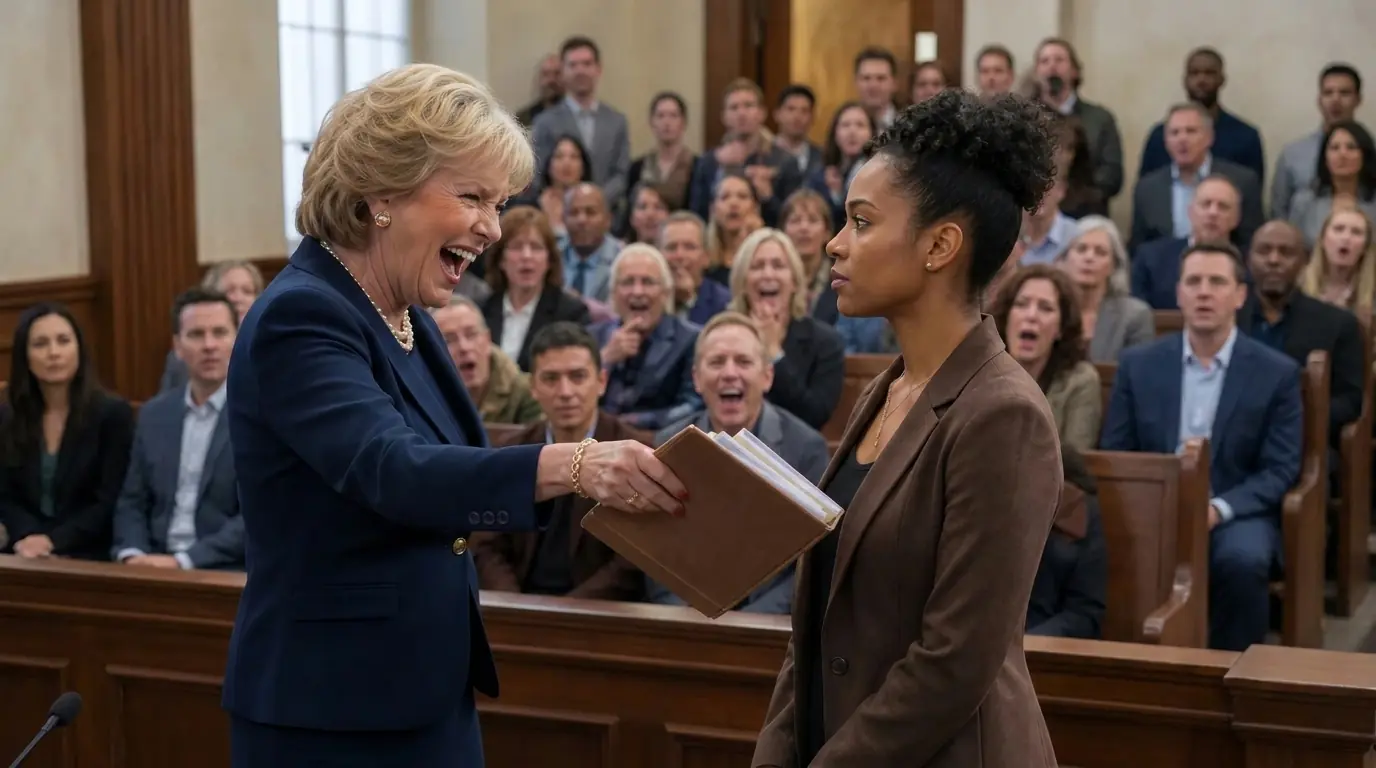
Diane Harrington leaned back, scanning Lena from head to toe. "Where's your lawyer? Oh, wait. You *are* the lawyer in that outfit?"
The courtroom erupted in laughter.
"No lawyer has ever beaten me. And you dare? Why would I argue with a stupid Black woman like you?"
Diane grabbed Lena's brown folder, flipped through it, and tossed it down like trash.
"A first grader's notebook. Go home. Give it back to your daughter. Next time, bring your brain."
Lena didn't move, didn't blink. "Are you finished, Mrs. Harrington? I will present my case, and I will win."
Diane smirked. "All right. Let's see how you win."
What Diane didn't know was who this woman really was, or what was inside that brown folder—and why, as Lena spoke her final words, the judge slowly rose from her chair.
Richmond, Virginia. 6:00 in the morning.
Lena Adams was already awake. She lay still for a long moment, staring at the ceiling of her two-bedroom apartment—paint peeling near the window, the radiator humming. Outside, a garbage truck groaned down the block.
She got up quietly, careful not to wake Chloe. In the bathroom, she splashed cold water on her face. Thirty-two years old. Tired eyes, strong jaw. She pulled her hair into a ponytail and moved to the kitchen. Eggs sizzling in the pan, toast in the toaster. The apartment smelled like butter and cheap coffee—the only luxury she allowed herself each morning.
"Mommy?" Chloe stood in the hallway, barefoot, dragging a stuffed rabbit by one ear.
"Morning, baby. Breakfast is almost ready." Lena knelt, kissed her daughter's forehead, and braided her hair—two neat cornrows, just the way Chloe liked. The smell of cocoa butter lingered between her fingers. Chloe hummed a little song from school. For a few minutes, everything was soft. Everything was simple.
By 7:15, they were out the door—four blocks to school, past the laundromat, past the corner store where Mr. Gaines always waved. Chloe skipped ahead on the sidewalk. Lena watched her and smiled.
Then, she went to work.
The Richmond Community Legal Aid Center sat in a narrow brick building on East Broad Street. Worn carpet, buzzing fluorescent lights, three desks, two filing cabinets, and a coffee maker that hadn't worked since last winter.
Lena was the senior paralegal. She answered phones, organized case files, and helped walk-in clients fill out paperwork they didn't understand: restraining orders, custody forms, eviction defenses. Every day, someone else's crisis landed on her desk.
Everyone in that office knew she was overqualified. Her best friend, Denise Brown, said it all the time: "Girl, you graduated from Columbia Law. You clerked for a federal judge. Why are you sitting here answering phones?"
Lena always gave the same answer: "This is where I need to be right now."
What she never said, what she never talked about, was why she left.
Four years ago, Lena Adams was one of the brightest young attorneys at a top litigation firm in Washington, D.C. Top five percent of her class at Columbia Law. Clerked for Judge Harold Bennett on the Fourth Circuit Court of Appeals. Partners talked about her making partner before forty.
Then a white colleague accused her of leaking confidential client information to a rival firm. It wasn't true. Not a single word. But the accusation was enough. The firm launched an internal investigation that dragged on for eight months.
During those months, Lena was locked out of client files. Colleagues stopped making eye contact. Conversations died when she entered a room. She sat in a glass office with nothing to do, watching her reputation dissolve like sugar in water.
When the investigation ended, she was fully cleared—no evidence, no wrongdoing, nothing. But the damage was done. Her marriage crumbled under the weight of it, ending in a quiet divorce. She packed two suitcases, took Chloe, and moved to Richmond. She put her Columbia Law diploma in a desk drawer—not on the wall. She wasn't hiding it; she just couldn't look at it every day. She wasn't sure the system that diploma represented deserved her trust anymore.
And that was the life Lena Adams built: small, quiet, safe.
The property was a small commercial lot on the edge of Church Hill, a neighborhood gentrifying fast. Lena had received it in the divorce settlement from her ex-husband's family—a brick building with a faded awning, a cracked parking lot with weeds pushing through. Not much to most people, but to Victoria Cole, a wealthy white real estate developer, that lot was the final piece of a $40 million project. Without it, her entire redevelopment plan collapsed.
Victoria offered to buy it. Lena said no.
Victoria offered again, lower, with a tight smile. Lena said no again.
So, Victoria sued. She claimed the land belonged to her family based on a verbal agreement between her late father and Lena's former father-in-law—never written, never witnessed, never recorded. And to win, she hired the best: Diane Harrington, senior partner at Harrington & Cole, thirty years undefeated in civil property cases.
When Diane learned her opponent was a Black single mother with no attorney, she laughed. She turned to her associate, Brett Sullivan, and said, "This will be over before lunch."
Lena couldn't afford a lawyer. She called four firms in the first week. Two never called back. One quoted $15,000 just to start. The last one said, "Honestly, Ms. Adams, if Diane Harrington is on the other side, save your money. You don't stand a chance."
So, Lena decided to represent herself.
She filed her initial response on a Tuesday afternoon, typing it at the legal aid office after hours. Denise stayed late to help format it. It wasn't fancy, but it was clean and complete.
Three days later, a courier arrived at her door with a thick brown envelope from Harrington & Cole. Inside were over four hundred pages: interrogatories, document demands, requests for admissions, deposition notices—each page more suffocating than the last.
Lena sat at her kitchen table that night, staring at the stack. Chloe was already asleep. The apartment was dead quiet, save for the hum of the refrigerator and the slow drip from the bathroom faucet she kept meaning to fix. She picked up the first page and started reading. She didn't stop until 2:00 in the morning.
This was Diane Harrington's signature move: paper warfare. Bury the other side in so many documents, so many deadlines, so many demands that they either miss something critical or collapse under the pressure. Against a pro se litigant with no team and no budget, it was a slow execution. Diane had used it dozens of times on single mothers, on elderly homeowners, on people who couldn't fight back. It always worked.
Every night that week, after Chloe was in bed, Lena sat back down at the kitchen table with a yellow legal pad, a black pen, and cold coffee going stale beside her. The kitchen light flickered every few minutes, casting shadows across the paperwork. She went through every page, every question, every demand, line by line, word by word. She didn't miss a single deadline.
But Diane wasn't done. Not even close.
Two weeks later, Lena received a deposition notice—not at a neutral office, not at the courthouse, but at Harrington & Cole's headquarters on the top floor of a glass tower in downtown Richmond.
Lena arrived alone, wearing her best blazer, which was slightly too big in the shoulders, and carrying a single folder. Her shoes clicked against the cold marble lobby floor. The receptionist barely glanced at her.
She was led into a conference room the size of her entire apartment: floor-to-ceiling windows overlooking the city, a polished mahogany table that could seat twenty, crystal water glasses lined up in a row. At the far end sat Diane, flanked by Brett Sullivan and two junior associates, with a paralegal in the corner surrounded by exhibit boxes and a court reporter with her fingers poised on the keys.
Five against one.
Diane didn't stand when Lena entered. She glanced at her watch. "You're three minutes late. Let's not waste any more of my time."
The questions started immediately, and they weren't about the property.
"How much do you earn per year, Ms. Adams? Do you receive any form of government assistance? How many hours per week do you actually spend with your daughter? Do you consider yourself a present mother? Would you say your living situation is stable enough for a prolonged legal proceeding, or is it already falling apart?"
Lena answered each question calmly, precisely, without breaking eye contact.
Then, Diane leaned forward. "Is it true you left your previous law firm while under investigation for leaking confidential client information?"
Lena paused—one second, two seconds. "The investigation found zero evidence of wrongdoing. I was fully cleared."
Diane smiled. "That's not what I asked. Did you leave while under investigation? Yes or no?"
"I left after being cleared."
"Interesting." Diane tilted her head. "So you do have legal training. A fancy degree, top of your class, I hear. And yet..." She gestured around the room—at her team, at the boxes, at the court reporter. "...you couldn't find a single attorney in this entire state willing to sit next to you today. What does that tell us about your case, Ms. Adams?"
Brett Sullivan stared at his blank notepad; he didn't write a word. One of the junior associates looked away.
The humiliation didn't stop at the deposition. The following week, Lena walked through the courthouse hallway to file a motion and heard laughter ahead. Diane and Victoria Cole were standing near the elevators, talking to another attorney.
Victoria spotted Lena first. Her eyes traveled slowly from Lena's shoes to her face, the way you'd look at something stuck to the bottom of your shoe.
"Wait," Victoria raised her hand. "That's her? That's who's holding up my $40 million project?" She laughed out loud. "Diane, *this* woman is the reason I've been delayed three months?"
Diane shrugged. "Don't worry, Vic. People like her always fold. Always. Give it another week."
A security camera above the elevator recorded the entire exchange, and a local journalist covering another case that day saw it from across the hallway.
Lena kept walking. She filed her motion at the clerk's window, didn't respond, and didn't react—head up, back straight, eyes forward. But when she got to her car, she sat in the driver's seat for a long time, hands on the wheel, engine off, forehead pressed against the steering wheel with her eyes closed.
The worst came two days later during a recess at a preliminary hearing. The hallway was nearly empty when Diane found Lena near the water fountain. She stepped close—too close, close enough that Lena could smell her perfume, something expensive and sharp.
"Let me be honest with you," Diane said quietly. No audience, no smirk, no theater, no performance—just cold assertion. "You are in way over your head. You have no resources, no support, no chance. I will drag this through every appeal, every motion, every continuance available under the law. I will bleed you dry. Not because I have to, but because I can. And nobody in this building is going to lift a finger to stop me."
She paused, letting the words land.
"Walk away now, and you keep whatever dignity you have left. Push this any further, and I promise you won't have a single dollar remaining when I'm finished."
Lena looked at her, straight in the eyes. "Are you threatening me, Mrs. Harrington?"
Diane smiled, wide and slow. "I'm advising you—free of charge. Pro bono."
Lena didn't respond. She turned and walked back into the courtroom. Her hands were shaking underneath the folder she pressed against her chest, but her steps were steady. She didn't look back.
That night, after putting Chloe to bed, Lena sat alone at the kitchen table. Same yellow pad, same black pen. The apartment was so quiet she could hear her own heartbeat. She wasn't writing; she was just sitting there, staring at the wall, the weight of everything pressing down on her chest like a stone.
She thought about quitting—really quitting. For the first time since this started, she imagined picking up the phone and saying two words: *I'm done.* She thought about how easy it would be, how the pressure would just vanish, how she could go back to answering phones, braiding Chloe's hair, and pretending none of this ever happened.
Then she heard Chloe cough softly in the next room—a small sound, barely there.
Lena looked down at the pen on the table. She stared at it for what felt like an hour, and then she picked it up.
Something changed that night. It wasn't dramatic—there was no speech, no sudden burst of music—just a woman sitting alone at a kitchen table at 1:00 in the morning, holding a pen she had almost put down for good. But she didn't put it down. And that made all the difference.
Lena didn't go to bed. She opened the first folder, the one with Victoria Cole's original complaint, and started reading it again. Not skimming, not surviving—reading it the way she was trained to, the way she used to read case files at the firm in D.C., with a surgeon's eye, looking for the one thread that, if pulled, would unravel everything.
By 3:00 in the morning, she had found the first loose thread.
Victoria's claim rested entirely on the so-called verbal agreement between her late father and Lena's former father-in-law. There was no written contract, no signed document. The only physical evidence Victoria had submitted was a handwritten memorandum—a single page she claimed her father had written, summarizing the agreement.
Lena held the photocopy of that memorandum under the kitchen light and stared at it. Something about the date. Something about the address.
She pulled out her laptop—an old one, slow, with a cracked hinge—and opened the county records database. It took forty minutes of searching, but she found it. The memorandum referenced a property address on Oakmont Drive. But according to county planning records, Oakmont Drive didn't exist until two years after the date written on the memorandum; the street had been called Warehouse Row until the city renamed it as part of a rezoning project. Victoria's father couldn't have written that address on that date. It was impossible.
Lena sat back in her chair, her heart beating fast.
She kept going. The memorandum also included a notary stamp—a detail meant to give the document an air of legitimacy. Lena looked up the notary's license number. The license had expired fourteen months before the date on the document.
Two inconsistencies: both verifiable, both devastating.
She opened a new page on the yellow legal pad. Not notes this time—strategy.
The next morning, Lena dropped Chloe at school and went straight to the legal aid office. She told Denise everything. Denise listened, eyes wide, then pulled up the county clerk's archive on her computer.
"If there's anything else in there, any other document related to the property, we'll find it," Denise said.
They spent three days searching. The county clerk's archive was not digital; it was a basement room in the old municipal building with rows and rows of metal shelving, cardboard boxes labeled by year, fluorescent lights buzzing overhead, and the smell of old paper and dust.
On the third day, in a box from twenty-two years ago, Lena found it: a letter, typed on personal letterhead, signed by Victoria Cole's father. The letter was addressed to Lena's former father-in-law, and in it, Victoria's father explicitly acknowledged in writing, clearly and without ambiguity, that the commercial property on Church Hill belonged fully and entirely to the Adams family. There was no agreement to transfer it; there never had been.
Lena held the letter with both hands. She read it twice, three times. Her fingers were trembling. This single piece of paper destroyed Victoria's entire case.
Lena made a certified copy. She placed the original back in the archive and slid the copy into her brown folder—the same folder Diane had picked up and tossed down like trash.
She didn't tell anyone except Denise. Not yet. She knew that if Diane found out about the letter before trial, she would find a way to suppress it, discredit it, or bury it in procedural motions. The element of surprise was the only advantage Lena had, and she intended to use it at exactly the right moment.
But Lena wasn't done preparing. That evening, she sat in her car in the parking lot of the legal aid office and made a phone call she hadn't made in four years.
"Judge Bennett? This is Lena Adams."
Silence on the other end. Then a slow, warm voice: "Lena. My God. It's been a long time."
Judge Harold Bennett, retired, seventy-one years old, had supervised Lena during her clerkship on the Fourth Circuit. He had written her a letter of recommendation that called her "the most naturally gifted legal mind I have encountered in thirty years on the bench." When Lena left the profession, he was the only person from her old life who had called to check on her.
She told him about the case—about Victoria, about Diane, about representing herself. He listened without interrupting.
When she finished, he said, "What do you need from me?"
"I need you to testify about my work, about my abilities. Would you be willing to appear by video?"
"Lena, I would fly to Richmond and sit in that courtroom myself if you asked me to."
She smiled for the first time in weeks.
Three days later, another door opened—a knock on Lena's apartment door on a Saturday morning. She opened it to find Martha Dawson standing on the doorstep: an elderly white woman with silver hair, a wool cardigan, and sharp blue eyes.
Martha was sixty-eight and had lived in the Church Hill neighborhood for over forty years. She had known both families—the Coles and the Adams family—and she remembered something no one else did.
"I remember the neighborhood meeting," Martha said, standing in Lena's kitchen with a cup of tea in her hands. "It was years ago. Victoria's father stood up in front of everyone and said, clearly, in front of the whole room, that the property belonged to the Adams family. His exact words were, 'That land is theirs. Always has been.' I remember it because I thought it was such a decent thing to say."
"Would you be willing to testify to that in court?" Lena asked.
Martha set her teacup down. "Honey, I've been waiting for someone to ask."
That week, Lena filed a series of pre-trial motions. She formatted them precisely—clean citations, tight arguments. Each motion was strategically designed, not just to argue her case, but to lock in specific evidentiary rules that would prevent Diane from excluding the letter or Martha's testimony at trial.
Diane received the motions and barely read them. She filed a motion to dismiss, calling Lena's filings "amateurish at best."
Judge Eleanor Whitfield denied the motion to dismiss, noting without elaboration that Lena's filings were well-constructed and procedurally sound.
Diane told Brett Sullivan it was beginner's luck. Brett read the filings that night at his apartment. For the first time, he felt something he hadn't expected: he felt worried.
Lena had the letter. She had Martha. She had Judge Bennett. But she knew that wasn't enough.
Diane Harrington didn't lose because her clients were always right; she won because she controlled everything—the pace, the evidence, the witnesses, the mood in the room. If Lena walked in with just the letter, Diane would challenge its authenticity or drown it in objections before anyone could read a single word. Lena needed to dismantle Diane's case piece by piece before she ever opened that folder.
So she went hunting.
Diane's filing listed a forensic handwriting expert, Dr. Charles Whitmore, who would testify that the handwritten memorandum was authentic. Impressive credentials: thirty years of experience, published in two academic journals, testified in over fifty cases.
Lena spent an evening searching federal court databases while Denise sat beside her pulling case numbers. At 11:15 that night, they found it.
Three years ago, Whitmore had testified in a federal fraud case in the Eastern District of Virginia. The judge struck his testimony from the record and issued a written opinion calling his analysis "unreliable and insufficiently rigorous." The case number was right there in the database, available to anyone who bothered to look. Diane clearly hadn't bothered.
But that wasn't all. Buried on page 312 of Diane's billing disclosures, Lena found the payment to Whitmore: $18,000—three times the standard rate for a handwriting analysis in a civil property case. You don't pay an expert triple the going rate unless you need them to say something very specific. Lena circled the number twice on her yellow legal pad.
Next, Victoria's sworn declaration: Victoria described the verbal agreement happening at the Cole family residence on Birch Lane in the summer of 1999. But county property records showed the Cole family didn't purchase the Birch Lane house until March of 2001. Victoria had placed herself in a house her family didn't yet own, describing a conversation that couldn't have happened there.
Three inconsistencies now: the street name that didn't exist yet, the expired notary stamp, and the impossible meeting location. Each one small enough to explain on its own, but together, an unmistakable pattern of fabrication.
Lena organized her cross-examination across six yellow legal pad pages. Every question mapped to a specific document, every document tied to a verifiable public record, every fact designed to lead Diane's witnesses into a corner they couldn't escape.
Past midnight, Chloe had been asleep for hours. The apartment was perfectly still. Lena walked to her bedroom and opened the desk drawer. The Columbia Law diploma sat where it had been for four years, face down beneath old bills and expired coupons. She pulled it out slowly, holding it under the bedroom light—her name, the gold seal, the date.
She hadn't looked at it in so long it felt like it belonged to someone else entirely—a younger, braver woman, a version of herself who still believed the system could be fair. But tonight, for the first time in four years, she didn't feel the bitterness or the shame. She felt something she hadn't felt since the day she walked out of that D.C. firm for the last time: she felt ready.
She placed the diploma on the nightstand, leaning it against the lamp, and looked at it for a long moment. Then she turned off the light. Tomorrow, she would walk into that courtroom alone—no team, no firm, no safety net. Just the truth, and a brown folder that Diane Harrington should never have tossed like trash.
The morning of the trial, the sky over Richmond was flat and gray.
Lena dropped Chloe at school at 7:15. Chloe held on to her hand a little longer than usual at the gate. "Good luck today, Mommy," she said.
Lena kissed her forehead. "I'll see you tonight, baby."
She drove to the courthouse in silence—no radio, no music, just the sound of the engine and her own breathing.
The courtroom was filling when she arrived. Word had spread: a single mother representing herself against Diane Harrington. People wanted to see it. The gallery was nearly full—local attorneys, courthouse staff, and a reporter from the *Richmond Times-Dispatch* sitting in the third row with a notebook open on her lap.
Diane Harrington arrived at exactly 9:00. She walked in like she owned the building. Behind her came Brett Sullivan, two junior associates, and a paralegal pushing a cart stacked with four boxes of exhibits. Their shoes echoed in unison across the marble floor.
Then Lena walked in—alone. One blazer, one brown folder, one glass of water. Whispers rippled through the gallery. Diane glanced at Lena, then turned to Brett with a small smile. She didn't say anything; she didn't need to. The image spoke for itself: an army on one side, a woman with a folder on the other.
Judge Eleanor Whitfield entered. The courtroom rose. She sat down, adjusted her glasses, and said, "We will now hear opening statements. Ms. Harrington, you may begin."
Diane stood. Her opening was a performance—polished, theatrical, dripping with confidence. She paced the floor, gestured toward her exhibit boxes, and referred to Lena as "the opposing party" without ever using her name once.
"This is a straightforward property matter, Your Honor," Diane said. "The respondent has no legal representation, limited understanding of civil procedure, and with all due respect, no case. We intend to prove that this property rightfully belongs to my client based on a long-standing family agreement."
She sat down. The gallery murmured.
"Ms. Adams," Judge Whitfield said. "Your opening statement."
Lena stood. She didn't move from behind her table, didn't pace, and didn't perform. She spoke without notes.
"Your Honor, my name is Lena Adams. I am representing myself in this matter because I could not afford an attorney, but I want this court to know that I am not here unprepared. I intend to demonstrate three things: First, that the document submitted by the plaintiff is not authentic. Second, that the plaintiff's own testimony contains factual impossibilities. And third, that the property in question has belonged to my family legally, continuously, and without dispute for over thirty years."
She sat down. Six sentences—no wasted words.
Judge Whitfield looked at Lena for a moment longer than necessary. Then she turned to Diane. "Call your first witness."
Diane called Victoria Cole to the stand. Victoria testified with practiced confidence, describing the verbal agreement between her father and Lena's former father-in-law, producing the handwritten memorandum, and dabbing her eyes at one point—a well-timed display of emotion.
Then it was Lena's turn.
"Ms. Cole, you stated that this memorandum was written by your father. Is that correct?"
"Yes."
"And the date on this document is June 14th, 1998, correct?"
"That's correct."
"This memorandum references a property address on Oakmont Drive. Is that correct?"
"Yes."
Lena picked up a single sheet of paper from her folder. "According to the Richmond County Planning Commission, the street now known as Oakmont Drive was officially renamed from Warehouse Row on March 3rd, 2000—nearly two years after the date on this memorandum. Can you explain how your father referenced a street name that didn't exist yet?"
Victoria opened her mouth, closed it, and looked at Diane.
Diane stood. "Objection. The witness is not a cartography expert."
"Overruled," Judge Whitfield said. "The question pertains to the document the plaintiff submitted. Answer the question, Ms. Cole."
Victoria stammered. "I... he must have... perhaps he updated it later."
"Updated a document you just testified was written in 1998?"
Silence. Lena continued.
"The memorandum also bears a notary stamp, license number 441906. I checked with the Virginia Secretary of State's office. That license expired in April of 1996—more than two years before the date on this document."
Victoria's face went pale.
Diane stood again. "Your Honor, I'd like to request a brief recess."
"Denied," Judge Whitfield said. "Continue, Ms. Adams."
Lena turned to the gallery for just a moment—not for dramatic effect, but because she needed a breath. Then she faced Victoria again.
"One more question, Ms. Cole. Your sworn declaration states that the verbal agreement took place at your family's residence on Birch Lane in the summer of 1999. But county records show your family didn't purchase the Birch Lane property until March of 2001. So the street name on the memorandum didn't exist, the notary license had expired, and the meeting happened in a house your family didn't own yet." Lena set the paper down. "No further questions."
The courtroom was dead silent. Diane sat frozen in her chair. Brett Sullivan closed his laptop slowly. One of the junior associates stared at the table. And from the bench, Judge Eleanor Whitfield looked at Lena Adams—really looked at her—for the first time.
Diane Harrington had not become the most feared litigator in Virginia by folding under pressure. She had been surprised before, but she had never, in thirty years, lost a case she intended to win. She did not intend to start today.
During the lunch recess, Diane made three phone calls in twelve minutes, pacing the hallway with her phone pressed to her ear. Brett Sullivan stood nearby, watching her face tighten with every call. By the time she hung up, she had a new strategy: if she couldn't win on the evidence, she would destroy Lena's credibility.
When court reconvened, Diane called Dr. Charles Whitmore to the stand, her forensic handwriting expert. Whitmore testified that the memorandum was consistent with the writing style of Victoria's late father.
Lena stood for cross-examination. "Dr. Whitmore, how much were you paid for your analysis in this case?"
"That's... that's a standard consulting fee of $18,000."
"The standard rate for a forensic handwriting analysis in Virginia is approximately $6,000. You were paid three times that, correct?"
Whitmore shifted. "My rates reflect my experience."
"Your experience." Lena picked up a document. "In *United States v. Brennan*, Eastern District of Virginia, three years ago, Judge Calloway struck your testimony from the record. She wrote that your methodology was—and I'm reading directly—'unreliable and insufficiently rigorous.' Do you recall that?"
Whitmore's face went red. "That was... that case was different."
"Did Judge Calloway strike your testimony? Yes or no?"
"Yes, but—"
"No further questions."
Diane was on her feet before Whitmore left the stand. "Your Honor, I'd like to redirect."
"Briefly," Judge Whitfield said.
But the damage was done. The gallery murmured, the reporter wrote furiously, and Brett sat motionless. Diane needed to shift the momentum fast, and she knew exactly how.
"Your Honor, I'd like to enter into evidence a personnel file from Holloway & Grant, a law firm in Washington, D.C."
Lena's stomach dropped. Diane turned to face her—no smile now, no smirk, no performance, just cold, calculated aim.
"Ms. Adams, isn't it true that you were the subject of a formal investigation at Holloway & Grant for leaking confidential client information to a competitor?"
The courtroom went quiet. Lena stood up slowly. "That investigation found zero evidence of wrongdoing. I was fully exonerated."
"That's not what I asked. Were you investigated? Yes or no?"
"I was investigated, and I was cleared."
"Cleared?" Diane repeated the word like it tasted sour. "And yet you left the firm, left the profession, moved to a different state, and stopped practicing law entirely. Those are not the actions of someone who was cleared, Ms. Adams. Those are the actions of someone who got caught."
The gallery erupted—murmurs became whispers, whispers became stares. Lena felt the heat rise in her chest, the old wound buried for four years ripped open right there in front of everyone.
Before she could respond, Judge Whitfield's gavel came down hard. "Ms. Harrington!" The judge's voice was ice. "This is a property dispute, not a character trial. The respondent's employment history has no bearing on ownership of this land. If you attempt this again, I will hold you in contempt. Am I clear?"
"Understood, Your Honor."
"Court is adjourned until 9:00 tomorrow morning."
The gavel came down again. Conversations erupted across the gallery.
In the hallway, Victoria Cole grabbed Diane's arm. "What was that? You said this would be easy! You said she was nobody!"
Diane pulled her arm free. "It's not over."
"It better not be!" Victoria's voice rose, loud enough for everyone in the hallway to hear. "Because I am not losing a $40 million project to her! That land is wasted in the hands of someone like her!"
*Wasted.* The words echoed down the corridor. Two clerks looked up. The reporter from the *Richmond Times-Dispatch*, walking toward the exit, stopped, turned around slowly, and wrote something down in her notebook. Victoria didn't notice, but Diane did—and for the first time that day, something close to real fear crossed her face.
Down the hallway, Lena stood alone near the courthouse exit—back against the wall, folder pressed against her chest, eyes closed. She wasn't celebrating; she wasn't relieved. She was remembering what it felt like to be accused, to have the thing she buried deepest dragged into the open and used against her in front of strangers, in front of a judge.
But she was still standing. And tomorrow, she would finish what she started.
Day two.
Lena arrived at the courthouse before 8:00. Same blazer, same brown folder, but something was different: the way she walked, the way she held her shoulders. She wasn't surviving anymore. Not today. She was hunting.
The courtroom was packed—word had spread fast overnight, and people stood along the back wall. The reporter sat in the third row, notebook ready.
Judge Whitfield entered. The room rose. "Ms. Adams, you may call your first witness."
"I'd like to call Martha Dawson."
Diane frowned and flipped through her notes; the name wasn't there. Lena had added her at the last possible deadline, buried in a supplemental filing Diane had overlooked.
Martha walked to the stand: silver hair, wool cardigan, sharp blue eyes. She sat with the calm of a woman who had waited a long time to say what she was about to say.
"Mrs. Dawson, how long have you lived in the Church Hill neighborhood?"
"Forty-three years."
"Do you recall a neighborhood meeting where Victoria Cole's father discussed this property?"
"I do. He stood up in front of the whole room and said—his exact words—'That land belongs to the Adams family. Always has.' I remember because I thought it was a decent thing to say."
Diane shot to her feet. "Objection! Hearsay!"
Lena didn't hesitate. "Declaration against interest, Your Honor. Mr. Cole was acknowledging his family had no claim—a statement directly contrary to the interest of his own estate."
Judge Whitfield paused, then nodded. "Overruled."
Diane sat down slowly. Brett Sullivan stared at Lena like he was seeing her for the first time.
Lena's second witness appeared on a screen mounted to the wall via video link: an older man in a study lined with bookshelves. "Please state your name and former title for the record."
"Harold Bennett. Retired judge, United States Court of Appeals for the Fourth Circuit."
A ripple went through the gallery. Diane's pen stopped moving.
"Judge Bennett, are you familiar with Lena Adams?"
"I am. She served as my law clerk for two years. In thirty years on the federal bench, she was the most naturally gifted legal mind I ever had the privilege of working with. Her departure from the profession was a personal tragedy, not a professional failing."
Diane stood. "Objection, irrelevant! This is a property case."
Judge Whitfield looked at her. "It speaks to credibility. Overruled."
Then Lena opened the brown folder—the same folder Diane had picked up and tossed down like trash on day one, the same folder she had laughed at and called a first grader's notebook, the same folder that had sat on that table through every insult, every smirk, every act of contempt.
She pulled out a single document and walked it to the clerk, who passed it to the judge.
"Your Honor, this is a letter recovered from the county clerk's archive, written by Victoria Cole's late father. In it, he explicitly acknowledges in his own words that the property on Church Hill belongs fully and entirely to the Adams family. He states clearly that no agreement to transfer it ever existed."
The courtroom went silent. Victoria Cole's face drained of color as she gripped the edge of her seat with both hands.
Diane stood. "Your Honor, I request a recess to review this document."
"Denied," Judge Whitfield said. "The county archives were available to both parties throughout discovery. Continue, Ms. Adams."
Lena returned to her table. She didn't sit down; she delivered her closing argument entirely from memory—no notes, no cards, no script.
"Your Honor, the plaintiff's memorandum references a street that didn't exist when it was supposedly written. It bears a notary stamp from an expired license. The plaintiff described a meeting in a house her family didn't yet own. And the plaintiff's own father, in writing, in his own hand, confirmed that this property belongs to my family." She paused, letting the silence fill every corner of the room. "Mrs. Harrington walked into this courtroom believing that the size of her team, the cost of her suit, and the color of my skin would determine the outcome." Her voice didn't waver, not even slightly. "She was wrong."
And then it happened.
From behind the bench, Judge Eleanor Whitfield—known across Virginia as "The Stone," a judge who had not once in twenty-eight years shown personal emotion in her courtroom—slowly rose from her chair.
The room froze. Every head turned, every whisper died, every breath stopped. She stood there for a moment, looking directly at Lena Adams. The courtroom was so quiet you could hear the fluorescent lights humming above.
Then she nodded—just once, just slightly—and said five words: "Please continue, Ms. Adams."
Lena's eyes glistened. Her jaw tightened; her hands trembled at her sides. But her voice held steady. "No further arguments, Your Honor. The evidence speaks for itself."
Complete silence. Not a sound.
Then, from somewhere in the back of the gallery, someone began to clap. Then another, and another. Judge Whitfield raised her hand and the room fell still, but the message had already been delivered. Every single person in that courtroom understood exactly what they had just witnessed.
Judge Whitfield didn't wait long. She looked down at the documents in front of her: the letter, the memorandum, the county records, the exposed notary stamp. She removed her glasses slowly, set them on the bench, and spoke in a voice that carried to every corner of the room.
"This court finds in favor of the respondent, Lena Adams. The plaintiff's claim is dismissed with prejudice."
*With prejudice.* That meant Victoria Cole could never bring this case again. It was over, permanently.
But the judge wasn't finished. She turned to Diane Harrington, her voice calm, measured, and absolutely devastating.
"Mrs. Harrington, in my twenty-eight years on this bench, I have rarely witnessed such contempt—not only for an opposing party, but for the integrity of this court. You submitted a document with verifiable inconsistencies that a first-year law student could have identified. You presented an expert witness whose testimony had been previously struck from the federal record. And you attempted to discredit the respondent by introducing irrelevant employment history designed solely to prejudice this proceeding." She paused. "I am formally referring your conduct to the Virginia State Bar for ethics review. Additionally, I am sanctioning you for discovery abuse and courtroom intimidation. You will receive the written order by end of day."
Diane stood completely motionless, her face blank—not defiant, not angry, just empty. The face of a woman watching thirty years of reputation collapse in sixty seconds.
Brett Sullivan quietly closed his laptop. He didn't look at Diane. He stacked his papers neatly, placed them in his bag, and sat still.
In the gallery, the reporter had stopped writing; she was just watching.
Victoria Cole stood up from her seat, her lips pressed into a tight line. She walked up to Diane in the hallway and said, "You told me this was guaranteed. You told me she was nothing."
Diane didn't respond.
"We are done," Victoria said. "I'll be finding new counsel, and I'll be sending your firm a bill for wasted time." She turned and walked away without another word.
Within forty-eight hours, the dominoes began to fall.
Day one: The reporter from the *Richmond Times-Dispatch* published her article. The headline read: *Single Mom Defeats Top Litigator in Stunning David vs. Goliath Property Case.* The article included details of the hallway exchange, the security camera footage, and Victoria Cole's words: "That land is wasted in the hands of someone like her." The article went viral within hours.
Day three: The hashtag #LenaAdams began trending. Legal commentators across social media praised her cross-examination. Two of Harrington & Cole's largest corporate clients quietly terminated their retainer agreements.
Week two: Three former opponents of Diane Harrington contacted the Virginia State Bar. Each one reported similar patterns: intimidation of pro se litigants, aggressive personal attacks, and a disproportionate pattern of targeting people of color. The bar opened a formal investigation.
Month two: The disciplinary hearing was held. Evidence was presented: deposition transcripts, courthouse footage, billing records, and testimony from former opponents. Diane's defense was that aggressive advocacy was not misconduct. The panel disagreed. Her law license was suspended for eighteen months. She was ordered to complete two hundred hours of pro bono legal work for underserved communities and mandatory ethics training.
Month three: Brett Sullivan submitted his resignation from Harrington & Cole. In his cover letter to a public defender's office, he wrote: *"I watched someone with nothing defeat someone with everything, and I realized I had been standing on the wrong side."*
The afternoon of the verdict, Lena didn't go home right away. She sat in her car in the courthouse parking lot—engine off, windows up, hands on the steering wheel. She didn't call anyone; she didn't check her phone. She just sat there, eyes closed, breathing.
Then she leaned forward, pressed her forehead against the wheel, and cried—not from sadness, not from exhaustion, but from relief. Pure, overwhelming relief. The kind that only comes when you've been holding your breath for so long that you forgot what it felt like to breathe.
She sat there for fifteen minutes. Then she wiped her eyes, started the engine, and drove to Chloe's school.
Chloe ran to her at the gate. "Mommy, how was your day?"
Lena knelt down and held her daughter tight, breathing in the cocoa butter, feeling Chloe's small arms wrap around her neck.
"It was a good day, baby," she said. "It was a really good day."
Six months later, the property on Church Hill looked different. The faded awning was gone, the weeds had been cleared, and a fresh sign hung above the front door in clean black letters: **The Adams Community Justice Center**.
Inside, folding chairs were arranged in neat rows. A table near the entrance held intake forms and a bowl of peppermints. The walls had been painted a warm cream. The fluorescent lights still buzzed—some things don't change—but the carpet was new, and it felt like a place where people could breathe.
Denise Brown stood by the door, greeting people as they walked in: neighbors, single mothers, elderly couples clutching envelopes full of paperwork they didn't understand.
Chloe sat in the corner, coloring quietly. She looked up when a local news camera pointed her way, then smiled and went right back to her crayons.
Lena stood at the front of the room. She smoothed her blazer—the same one still slightly too big in the shoulders—took a deep breath, and smiled.
"Welcome, everyone. My name is Lena Adams, and I'm here to help."