Excuse me, sir. I’d like to check my account balance, please.
A black kid in worn-out shoes stood at the counter. 10 years old, cracked soles, frayed laces, thrift store jacket swallowing his small frame.
The bank manager stopped, looked the boy up and down slowly, then burst out laughing.
“Check your account?” His voice echoed across the marble lobby. “This is First National Heritage Bank, not a welfare office for street kids.”
Bradley Whitmore stepped closer. His expensive cologne clashed with his ugly sneer.
“Look at those shoes. Look at that skin.” He shook his head in theatrical disgust. “Another black kid looking for a handout. You people are all the same. Get out before I call security. We serve real customers here.”
The security guard moved closer, hand on his baton.
A wealthy customer shouted from behind:
“Throw him out already. He’s stinking up the place.”
Laughter rippled through the lobby, cruel, loud, united against one small boy.
No one defended him. Not a single person.
But not one of them could have imagined what would happen next.
Within the hour, Bradley Whitmore himself would be begging, not for money, but for mercy.
Wesley Brooks didn’t run. He didn’t scream. He stood his ground, just like Grandma Eleanor taught him.
“Sir, I have an account here.” His voice trembled but didn’t break. “My grandmother opened it for me. She passed away two months ago. She left me this.”
He held up a brown envelope.
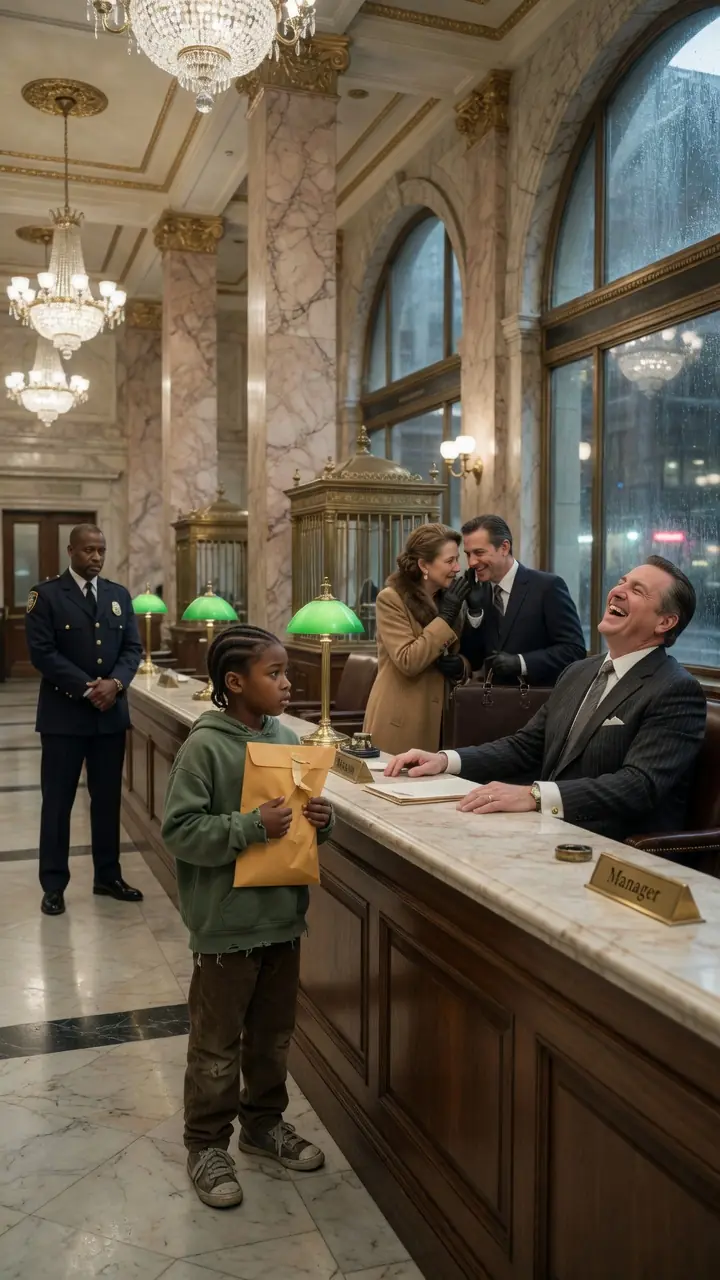
Inside were the documents, the bank card, the letter Grandma wrote him before she died.
Bradley Whitmore rolled his eyes dramatically.
“Your grandmother?”
He looked around at the watching customers, playing to his audience.
“Let me guess. She also left you a mansion in the Hamptons and a private jet.”
Laughter again. The wealthy customers loved the show.
Chelsea Morrison, the senior teller, leaned over her counter, her lip curled with disgust.
“Sir, should I call the police? This kid is obviously running some kind of scam.”
Bradley waved his hand.
“Not yet. Let’s see what kind of con he’s pulling first.”
He snatched the envelope from Wesley’s hands, pulled out the documents roughly.
His eyes scanned them with bored contempt.
Then he saw the bank card.
Black. Premium tier. Platinum Reserve. The kind issued only to high-net-worth clients.
For one second, something flickered across Bradley’s face.
Confusion.
Maybe even doubt.
But prejudice is a powerful thing.
It can blind you to what’s right in front of your eyes.
Bradley shook off his doubt.
“Where did you steal this?”
He held up the card, showing it to the lobby like evidence in a courtroom.
“A black kid from the projects with a Platinum Reserve card? You really expect me to believe that?”
Wesley’s hands trembled.
“I didn’t steal anything. It’s mine. My grandma—”
“Your grandma?”
Bradley threw the card on the counter. It skidded across the marble surface.
“I’ve been in banking for 15 years, kid. I know a fraud when I see one.”
He pointed to the far corner of the lobby, near the janitor’s closet, near the bathroom entrance, the worst seats in the building.
“Sit over there. Don’t move. Don’t talk to anyone. I’m calling headquarters to verify this so-called account.”
Wesley walked to the corner, head down, shoulders hunched, each step heavier than the last.
He sat on the cold metal chair.
Alone.
Surrounded by marble and brass and wealth that seemed to mock his worn-out shoes.
He pulled out Grandma Eleanor’s letter.
Her handwriting was shaky, but full of love.
“My brave Wesley,
Never let anyone make you feel small. You are worth more than they will ever know.”
He read those words three times, trying to believe them.
His phone buzzed.
A text from Uncle Lawrence.
“Stuck in a meeting. Be there in 20 minutes. You’re doing great, champ.”
Wesley almost smiled.
He had no idea how much those 20 minutes would change everything.
Tier one: the waiting game.
15 minutes passed. Then 20. Then 25.
Wesley sat in the corner, invisible, forgotten, erased.
The bank hummed with activity around him. Customers came and went. Tellers smiled and processed transactions. Business continued as usual.
But not for Wesley.
He watched Bradley Whitmore help a white man in a golf polo open a brand-new account.
The man had arrived 15 minutes after Wesley.
He was served immediately.
No questions, no suspicion, no demands for extra identification.
Just smiles and handshakes and “welcome to First National Heritage.”
Wesley watched Chelsea Morrison bring Bradley a cup of coffee from the break room.
They stood together near the water cooler, laughing.
Their eyes kept drifting toward Wesley’s corner.
More laughter.
He couldn’t hear what they were saying.
He didn’t need to.
He watched a wealthy woman in a designer dress deposit a check for what looked like thousands of dollars.
The whole process took three minutes.
She left without even glancing at the black kid sitting alone near the janitor’s closet.
An older woman named Diane Campbell finished her transaction at the main counter.
She was different from the others.
She glanced at Wesley, her face tightened with something that looked like discomfort, maybe guilt.
For one moment, Wesley thought she might come over, might ask if he was okay, might be the one person in this entire building who showed some basic human kindness.
But she didn’t.
She just clutched her designer purse a little tighter and walked toward the exit.
Her heels clicked against the marble.
Each click a small betrayal.
Wesley pulled out Grandma Eleanor’s letter again.
The paper was already soft from being handled so many times. The edges were starting to fray, just like his nerves.
“You are braver than you believe, stronger than you seem, and loved more than you know.”
Grandma used to read him that quote every night before bed.
She said a famous author wrote it.
“Winnie the Pooh,” she told him with a wink. “Even bears know wisdom.”
He didn’t remember the author.
He just remembered her voice.
Warm like honey. Safe like a fortress. Gone like smoke.
His phone buzzed again.
Uncle Lawrence.
“Meeting running long. 15 more minutes. Stay strong, champ.”
Wesley typed back with shaking fingers.
“Okay.”
He didn’t mention the laughter, the insults, the way Bradley looked at him like he was trash that needed to be disposed of.
He didn’t want to worry Uncle Lawrence.
30 minutes now.
Still waiting.
Still invisible.
A security guard named Jerome Davis stood near the entrance.
He was black like Wesley, mid-50s, tired eyes that had seen too much, gray creeping into his close-cropped hair.
Jerome had witnessed everything.
The insults.
The laughter.
The way Bradley humiliated the boy in front of everyone.
He wanted to speak up.
God, he really did.
But he had a mortgage. Two kids in college. 11 years at this bank building toward a pension.
Silence meant employment.
Employment meant survival.
Survival meant his family didn’t end up on the street.
Jerome looked away.
Hated himself for it.
Looked away anyway.
Tier two: the interrogation.
Finally, after 32 minutes, Bradley called Wesley over.
Not to the main counter where normal customers were served.
To a small desk in the back corner, away from the pleasant banking areas, away from the comfortable chairs and complimentary coffee.
Wesley sat down in the hard plastic chair, placed his grandmother’s documents on the desk carefully.
Bradley didn’t touch them.
Didn’t even look at them.
“Let’s try this again.”
His voice was cold, clinical, the voice of a man performing for the security cameras.
“You claim you have an account at this bank. You claim your grandmother left you money. But you have no proper ID, no guardian present, no proof of address, and frankly, kid, you don’t look like someone who belongs in an institution like this.”
Wesley’s throat tightened.
“I have my school ID and my grandma’s letter and the bank card with my name on it.”
Bradley picked up the school ID with two fingers like it might be contaminated.
“Lincoln Elementary School. Fifth grade.”
He tossed it back on the desk.
It slid toward Wesley, almost falling off the edge.
“This proves absolutely nothing. Any kid can get a school ID. Doesn’t mean you have money in our bank.”
“But the card—”
“Where are your parents?”
The question hit Wesley like a physical blow.
His father had left before he was born.
His mother had died when he was three.
Car accident.
He didn’t even remember her face except from photographs.
“I… I live with my uncle.” His voice came out small, wounded.
“And where is this mysterious uncle?”
“He’s coming. He’s in a meeting. An important meeting.”
Bradley leaned back in his expensive leather chair, crossed his arms over his expensive silk tie.
“A meeting? Of course. How convenient.”
His smirk was ugly.
“Let me guess. He’s the CEO of some Fortune 500 company. That’s why a 10-year-old black kid in raggedy shoes has a Platinum Reserve card. Because his uncle is so rich and important.”
Before Wesley could respond, Chelsea appeared beside Bradley.
She bent down and whispered something in his ear.
They both looked at Wesley.
Chelsea’s smirk matched Bradley’s perfectly.
“I don’t know what kind of scam you and your so-called uncle are running,” Bradley said louder now, wanting the other customers to hear, “but it won’t work here. I’m freezing this account pending a full investigation.”
Wesley’s eyes went wide.
“You can’t do that. That’s my grandma’s money. She saved her whole life.”
“Your grandma?”
Bradley’s voice dripped with sarcasm. Each word a small knife.
“Right. The teacher who supposedly left you a fortune. Tell me something, kid. What did she really do? Rob a bank herself? Deal drugs? What?”
The words hung in the air like poison.
Wesley felt something crack inside his chest in the place where he kept Grandma Eleanor’s memory safe.
Tier three: public abuse of power.
Bradley stood up from his desk, straightened his tie, smoothed his jacket.
Then he raised his voice, made absolutely sure the entire lobby could hear every word.
“Ladies and gentlemen, I apologize for this disruption.”
His voice carried like a practiced actor’s.
“This is what we deal with every single day. People who don’t belong in places like this trying to take what isn’t theirs.”
Six customers watched the spectacle.
Some nodded in agreement, their prejudices confirmed.
Others looked uncomfortable but stayed silent.
None of them spoke up.
Diane Campbell had returned.
She’d made it to her car in the parking lot, but she couldn’t turn the key, couldn’t drive away.
Something, guilt, conscience, basic humanity had pulled her back inside.
Now she stood near the entrance, watching everything unfold.
Her hands were shaking.
“I don’t know where you stole that card,” Bradley continued, pointing at Wesley like a prosecutor at a trial. “I don’t know what kind of lies you’ve been told, but you are not getting a single penny from this bank. Not today, not tomorrow, not ever.”
Wesley’s vision blurred with tears.
He tried to stop them.
“Boys don’t cry,” some voice in his head said.
Grandma’s voice answered:
“Boys feel, Wesley. Feeling is strength.”
“My grandma worked 40 years,” he managed to say.
His voice cracked, but he kept going.
“She was a teacher at Lincoln Elementary. She saved everything for me. She promised—”
“Spare me the sob story.”
Bradley’s voice was a slap.
“I’ve heard them all before. Every con artist has a dead grandmother and a tragic tale.”
He turned to Jerome, still standing by the entrance.
“Security, escort this kid out of my bank now.”
Jerome didn’t move.
His feet felt nailed to the marble floor.
“Did you hear me?” Bradley’s voice sharpened. “I said now.”
Jerome walked toward Wesley slowly.
Each step a small death of his self-respect.
11 years of silence.
11 years of watching Bradley humiliate people who didn’t fit his image of a real customer.
Immigrants struggling with English.
Women in secondhand clothes.
Elderly people confused by technology.
Anyone who looked poor, sounded different, seemed vulnerable.
Jerome had never spoken up.
Not once.
Not ever.
Today was no different.
Today he was still a coward.
He stopped in front of Wesley, extended his hand, couldn’t meet the boy’s eyes.
Wesley stood up on his own.
He didn’t need help.
He picked up his grandmother’s letter from the desk, pressed it against his heart like a shield, walked toward the door with as much dignity as a 10-year-old could carry.
Bradley’s voice followed him like a curse.
“Next time you want to beg for money, try a homeless shelter or a street corner. That’s more your natural environment.”
Someone in the lobby actually laughed.
A real laugh.
Loud and cruel.
Wesley reached the exit.
His phone started ringing.
The screen lit up.
“Uncle Lawrence calling.”
He tried to answer.
His hands were shaking too badly.
The phone slipped from his fingers.
Crashed onto the marble floor.
The screen cracked.
Jerome picked it up.
For one moment, their eyes met.
In that moment, Wesley saw something he didn’t expect.
Shame.
Bone-deep, soul-crushing shame.
Jerome was drowning in it.
But shame wasn’t enough.
Words were needed.
Action was needed.
Jerome handed back the phone.
Said nothing.
Let the boy walk out alone.
Wesley pushed through the automatic doors.
They closed behind him with a soft whoosh.
Inside the bank, Bradley straightened his tie again, smiled at Chelsea.
“And that’s how you handle it,” he said, satisfaction oozing from every word. “Give these people an inch, they’ll take everything.”
Chelsea nodded, but her smile had faded.
Something uncomfortable stirred in her stomach.
Bradley’s phone buzzed.
An email notification.
Subject line:
URGENT — Q4 INVESTOR VISIT — IMMEDIATE PREPARATION REQUIRED
He glanced at it, deleted it without reading.
Too busy.
Too important.
Too confident in his own power.
He should have read that email.
He really, really should have.
Outside, rain had started falling.
Not heavy.
Just enough to turn the city gray and cold and lonely.
Wesley sat on the concrete bench near the bank entrance clutching Grandma Eleanor’s letter with both hands while rain dotted the cracked screen of his phone.
People walked past him without slowing down.
Businessmen with umbrellas.
Women carrying shopping bags.
Cars splashing water against the curb.
Nobody noticed the little black boy sitting alone trying not to cry in public.
Or maybe they noticed and chose not to care.
Inside the bank, Bradley Whitmore poured himself fresh coffee from the executive machine behind the teller stations.
“Unbelievable,” he muttered. “These people are getting bolder every year.”
Chelsea didn’t answer immediately.
She kept glancing toward the entrance doors.
Toward the empty spot where Wesley had been sitting.
“Do you think maybe we should’ve waited for his uncle?”
Bradley laughed.
“Oh come on, Chelsea. You actually believed that story?”
“The card looked real.”
“That’s because stolen cards are real.”
He sipped his coffee calmly.
“Listen to me carefully. People like that survive by manipulating sympathy. Sad stories, dead relatives, fake accounts. You fall for it once, you’ll spend your whole career getting played.”
Chelsea nodded slowly.
But the discomfort in her stomach kept growing.
Meanwhile outside, Wesley finally answered the phone.
“Uncle Lawrence?”
The moment he heard Wesley’s voice, Lawrence Brooks knew something was wrong.
“What happened?”
Wesley tried to speak normally.
Failed.
“They… they said Grandma’s account wasn’t real.”
Silence.
Then:
“Who said that?”
“The manager.”
Another silence.
Heavier this time.
“Are you still there?”
“No. They made me leave.”
Lawrence inhaled sharply.
Wesley heard papers moving, a chair scraping backward violently.
“I’m coming right now.”
“I’m sorry.”
“For what?”
“I think I messed everything up.”
Lawrence’s voice changed instantly.
Firm. Controlled. Protective.
“Listen to me carefully, champ. You did absolutely nothing wrong. Nothing. Stay exactly where you are. I’ll be there in ten minutes.”
The line disconnected.
Inside the bank, Bradley finally opened the investor email he ignored earlier.
His expression shifted slightly while reading.
VISITING INVESTOR REPRESENTATIVE:
LAWRENCE BROOKS — BROOKS CAPITAL HOLDINGS
Estimated arrival: 8:45 AM.
Bradley frowned.
Brooks Capital.
The name sounded familiar.
Very familiar.
He clicked the attachment.
A profile photo opened.
Clean suit.
Silver tie.
Confident expression.
Bradley’s coffee cup froze halfway to his mouth.
Because the man in the photograph looked exactly like the person Wesley called Uncle Lawrence.
“No…”
Chelsea looked over.
“What?”
Bradley zoomed in on the image.
LAWRENCE BROOKS
Senior Partner — Brooks Capital Holdings
Primary Stakeholder — First National Heritage Bank Expansion Initiative
Bradley’s stomach dropped violently.
Brooks Capital owned 18% of the bank.
Eighteen percent.
Lawrence Brooks wasn’t just an investor.
He was one of the most powerful men connected to the institution.
Bradley stood up so fast his chair nearly tipped over.
“Where’s that kid?”
Chelsea blinked.
“He left.”
“No, no, no…”
For the first time all morning, panic entered Bradley Whitmore’s voice.
He rushed toward the entrance.
Jerome immediately knew something changed.
“What happened?”
Bradley ignored him completely, staring through the glass doors toward the rain-covered sidewalk outside.
And there sat Wesley.
Small frame.
Oversized jacket.
Holding that letter against his chest like it was the only thing keeping him together.
Bradley’s face drained of color.
Because suddenly every word replayed in his head perfectly.
“Street kid.”
“You people.”
“Natural environment.”
Each sentence transformed from casual cruelty into career-ending evidence.
Chelsea whispered:
“Oh my God.”
Jerome looked between them slowly.
Then realization hit him too.
That boy.
That quiet little boy they threw out into the rain.
He actually belonged there more than any of them.
A black SUV turned sharply into the parking lot outside.
Then another behind it.
Security detail.
Executive vehicles.
The first SUV stopped directly near the entrance curb.
Lawrence Brooks stepped out wearing a dark navy suit worth more than Bradley probably earned in two months.
But the expensive clothes weren’t what terrified Bradley most.
It was Lawrence’s face.
Cold.
Focused.
Furious.
The kind of fury powerful people rarely show publicly because they usually don’t need to.
Lawrence saw Wesley sitting alone in the rain and immediately dropped all professional composure.
“Wesley.”
The boy stood quickly.
“I’m sorry.”
Lawrence wrapped both arms around him instantly.
“You never apologize for other people’s cruelty.”
Jerome looked away sharply after hearing that.
Because guilt hit him so hard he physically couldn’t watch.
Lawrence crouched slightly to check Wesley’s cracked phone screen, the tears dried on his face, the trembling hands still clutching Eleanor’s letter.
Then Lawrence looked up.
Straight through the glass entrance.
Straight at Bradley Whitmore.
And Bradley felt genuine fear for the first time in his professional life.
Not fear of losing money.
Not fear of embarrassment.
Fear of consequence.
Real consequence.
The automatic doors opened.
Lawrence entered slowly holding Wesley’s shoulder gently beside him.
The entire bank went silent.
Phones stopped ringing.
Keyboards stopped clicking.
Even customers sensed something massive shifting in the room.
Bradley forced himself to smile.
“Mr. Brooks, I can explain—”
Lawrence’s voice cut through the lobby like steel.
“Don’t.”
One word.
That was all it took.
Bradley stopped talking immediately.
Because power recognizes greater power instantly.
And in this moment, Bradley finally understood something Wesley knew all along.
Money wasn’t the most valuable thing Grandma Eleanor left behind.
Protection was.
Lawrence Brooks walked forward slowly.
Every employee in the bank instinctively moved aside.
Not because he raised his voice.
Because real authority doesn’t need performance.
Wesley stayed beside him clutching Grandma Eleanor’s letter while rainwater still dripped from the edges of his thrift-store jacket onto the polished marble floor.
Bradley Whitmore tried again.
“Mr. Brooks, there’s been a misunderstanding—”
“No.”
Lawrence’s eyes never left him.
“There’s been a revelation.”
Silence crushed the lobby.
Chelsea Morrison felt physically sick now.
Jerome stood near the entrance unable to look directly at Wesley anymore.
Because suddenly everyone inside First National Heritage Bank understood the same horrifying thing:
They didn’t mistreat a scammer.
They humiliated a grieving child.
Lawrence crouched beside Wesley gently.
“Champ, can I see Grandma Eleanor’s letter?”
Wesley handed it over carefully.
Lawrence unfolded the paper slowly.
The whole lobby watched.
Eleanor Brooks.
Former elementary school teacher.
Retired after 40 years.
Client with First National Heritage for 31 years.
The account Bradley mocked?
Real.
Very real.
Lawrence looked toward Bradley again.
“My mother trusted this bank with everything she saved across four decades.”
Bradley swallowed hard.
“And today your employees treated her grandson like trash because he wore secondhand shoes.”
Nobody breathed.
Lawrence stepped toward the teller counter.
“You know the tragic thing?”
His voice stayed calm.
“She actually warned me this might happen.”
Bradley blinked.
“What?”
Lawrence nodded once sadly.
“She told Wesley people would see his skin before they saw his character.”
Wesley lowered his eyes.
Lawrence continued:
“She told him some institutions smile politely while humiliating people they think don’t belong.”
The words sliced through the marble lobby.
Because everyone knew now:
Eleanor predicted this perfectly.
Bradley tried desperately to recover control.
“Mr. Brooks, if we made an error in procedure—”
“Procedure?”
For the first time, anger cracked through Lawrence’s composure.
“You publicly mocked a ten-year-old orphan.”
The word orphan landed brutally.
Several customers visibly flinched.
Lawrence stepped closer.
“You accused him of theft.”
Another step.
“You froze his inheritance account without cause.”
Another.
“You told security to throw him into the street while customers laughed.”
Bradley backed up instinctively.
Because hearing the events repeated plainly stripped away all the professional language hiding the cruelty underneath.
Chelsea whispered softly:
“Oh God…”
Lawrence looked around the lobby slowly.
At the wealthy customers who laughed earlier.
At the silent bystanders.
At Jerome standing frozen with shame.
“You know what scares me most?”
Nobody answered.
“How normal this felt to all of you.”
Silence.
Because that was the truth.
No alarms triggered when a black child got humiliated publicly.
No one stopped it.
No one interrupted it.
Not until power entered the room wearing an expensive suit.
Lawrence rested one hand gently on Wesley’s shoulder.
“This boy came here alone because my mother taught him responsibility.”
His voice softened slightly.
“She wanted him to learn confidence. Independence. Pride.”
Then his eyes hardened again.
“And instead you taught him exactly how quickly this world punishes black children for existing in the wrong spaces.”
Jerome finally spoke.
Quietly.
“He didn’t do anything wrong.”
Everyone turned.
Bradley snapped instantly.
“Jerome, stay out of this.”
But Jerome looked exhausted suddenly.
11 years of silence finally collapsing under the weight of one small boy sitting alone near a janitor’s closet.
“No.”
His voice shook.
“But he didn’t.”
Bradley stared at him in disbelief.
Jerome continued slowly.
“I watched the whole thing.”
His eyes moved toward Wesley briefly.
“And I should’ve said something sooner.”
Wesley looked surprised.
Because finally, finally, one adult inside this building admitted the truth out loud.
Lawrence nodded slightly toward Jerome.
“That matters.”
Bradley looked panicked now.
“Mr. Brooks, please. We value diversity and inclusion at First National—”
“Stop.”
Lawrence’s voice cut like a knife.
“Do not insult us further with corporate slogans.”
The entire lobby went dead silent again.
Because everyone recognized that tone.
Final.
Dangerous.
Lawrence reached into his jacket and removed his phone calmly.
Then he said the sentence that destroyed Bradley Whitmore completely:
“I already contacted the board.”
Bradley’s face lost all remaining color.
“The board?”
“Yes.”
Lawrence looked him directly in the eyes.
“And the video.”
Bradley froze.
Greg Wilson.
The customer recording earlier near the entrance.
He uploaded everything.
Already viral.
Already spreading.
The insults.
The racial comments.
The laughter.
The image of Wesley sitting alone near the janitor’s closet clutching his grandmother’s letter while wealthy customers watched silently.
Chelsea grabbed the counter edge slightly to steady herself.
Lawrence’s phone buzzed.
He glanced down briefly.
Then looked back at Bradley.
“The board chair wants your resignation before noon.”
The words hit like a gunshot.
Bradley opened his mouth.
Nothing came out.
Because suddenly all his power vanished at once.
The title.
The authority.
The confidence.
Gone.
Destroyed by the simple truth of who he chose to humiliate when he thought nobody important was watching.
Wesley tugged lightly on Lawrence’s sleeve.
“Uncle Lawrence?”
Lawrence immediately softened.
“Yeah, champ?”
“Can we just go home?”
The whole lobby nearly broke at that sentence.
Not revenge.
Not anger.
Not money.
The boy just wanted safety.
Home.
Lawrence knelt beside him again.
“We can.”
Then Wesley asked quietly:
“Did Grandma know people would act like this?”
Lawrence looked at Eleanor’s letter for a long moment before answering.
“Yes.”
Wesley’s small face tightened.
“Then why did she still save money here?”
Lawrence smiled sadly.
“Because your grandmother believed people can choose to become better once truth reaches them.”
Silence spread across the bank again.
Heavy.
Human.
And somewhere deep beneath the shame swallowing First National Heritage Bank whole, several people standing inside that lobby realized something they would carry for the rest of their lives:
The cruelest systems survive not because terrible people build them…
But because ordinary people stay quiet while children get hurt inside them.
The board meeting started at 11:47 a.m.
Three floors above the lobby where Wesley Brooks had been humiliated, twelve executives sat around a polished walnut table staring at paused video footage on a massive screen.
Frame frozen:
A ten-year-old black boy clutching a cracked phone and a brown envelope while Bradley Whitmore pointed toward the door.
The room felt poisoned by silence.
Board Chairwoman Evelyn Price finally spoke.
“Play it.”
Nobody argued.
The footage resumed.
Bradley’s voice echoed through the conference room speakers:
“Try a homeless shelter or a street corner. That’s more your natural environment.”
Several executives visibly winced.
One removed his glasses slowly and rubbed both eyes.
Another stared at the table unable to watch further.
But Evelyn Price watched every second.
The laughter.
The mockery.
The way customers joined in once authority gave them permission.
Then the footage showed Wesley dropping his phone.
Showed Jerome handing it back silently.
Showed the little boy walking into the rain alone.
The video ended.
Nobody moved.
Finally Evelyn looked toward Bradley sitting at the far end of the conference table.
“Do you understand the scale of this disaster?”
Bradley’s voice sounded hollow now.
“It was a misunderstanding.”
“No.”
Evelyn’s answer came instantly.
“It was racism.”
The word landed like concrete.
Direct.
Undeniable.
Bradley straightened slightly.
“I never mentioned race.”
One board member actually laughed bitterly at that.
“You called him ‘you people.’”
Another spoke coldly:
“You assumed theft before identity verification.”
Another:
“You publicly degraded a child based entirely on appearance.”
Every sentence stripped away another layer of Bradley’s remaining defense.
Lawrence Brooks sat silently halfway down the table beside legal counsel.
Wesley wasn’t present.
Thank God.
No child should have to watch adults debate whether his humiliation technically qualified as discrimination.
Evelyn folded her hands.
“Mr. Brooks has informed us his nephew no longer feels safe entering any branch of this institution.”
Bradley looked toward Lawrence desperately.
“Mr. Brooks, surely we can resolve this privately—”
Lawrence finally spoke again.
“No.”
Calm.
Controlled.
Terrifying.
“My mother spent thirty-one years believing this bank valued dignity.”
He glanced toward the paused image of Wesley on the screen.
“This morning your institution taught her grandson the opposite.”
Bradley’s breathing became uneven.
The legal advisor cleared his throat carefully.
“There’s also the issue of public response.”
Another screen lit up.
Millions of views.
News coverage exploding nationwide.
FIRST NATIONAL HERITAGE ACCUSED OF RACIAL PROFILING CHILD CUSTOMER.
BANK MANAGER HUMILIATES ORPHAN OVER PLATINUM ACCOUNT.
VIDEO OF CHILD THROWN OUT OF BANK SPARKS OUTRAGE.
Sponsors pulling partnerships.
Investors panicking.
Employees anonymously sharing similar stories online.
Because once one person speaks safely, others finally do too.
A woman from compliance opened another file.
“We’ve already identified fourteen prior complaints involving Mr. Whitmore.”
Bradley turned sharply.
“What?”
“Mostly minorities, elderly clients, and lower-income customers reporting humiliation or discriminatory treatment.”
His stomach dropped.
Because suddenly the pattern existed on paper.
Documented.
Trackable.
Real.
Evelyn looked disgusted.
“And somehow none of this triggered disciplinary review.”
No one answered.
Because everyone understood why.
Banks protect profit first.
And Bradley looked profitable.
Until today.
Lawrence spoke quietly:
“The most dangerous prejudice is the kind institutions normalize through silence.”
The room stayed still.
Because every executive at that table now carried some amount of guilt.
Not for creating Bradley Whitmore.
For rewarding him.
Promoting him.
Ignoring warning signs because the complaints came from people without power.
Evelyn finally slid a folder across the table.
Termination papers.
Effective immediately.
Bradley stared at them blankly.
“This can’t happen over one incident.”
Lawrence looked at him for a long moment.
Then answered softly:
“It didn’t.”
Silence.
“This happened over every previous incident where nobody stopped you.”
That one finished him.
Bradley lowered into his chair like his bones stopped working properly.
The board chairwoman’s voice softened slightly.
Not kind.
Just tired.
“You saw a grieving black child and assumed criminality before humanity.”
Another pause.
“And the terrifying part is you truly believed that was professionalism.”
Bradley looked down at his hands.
For the first time in years, maybe decades, certainty abandoned him.
Because deep down beneath the ego and prejudice and authority…
He knew they were right.
Meanwhile downstairs in the lobby, Jerome sat alone in the employee break room staring at the security badge hanging around his neck.
11 years.
11 years of watching people get diminished quietly while he stayed silent to protect his paycheck.
The shame sat so heavy in his chest he could barely breathe around it.
A soft knock interrupted him.
Chelsea stood in the doorway.
Eyes red.
Mascara smudged.
“I can’t stop thinking about that little boy.”
Jerome nodded slowly.
“Me neither.”
She sat across from him heavily.
“I laughed.”
The confession barely came out.
Jerome looked down.
“I stayed quiet.”
Both truths sat between them ugly and real.
Chelsea whispered:
“Why does it feel normal when it’s happening?”
Jerome answered honestly.
“Because systems teach people comfort matters more than courage.”
Upstairs, Bradley Whitmore finally signed the resignation papers with shaking hands.
The pen scratched loudly against the paper.
Small sound.
Massive consequence.
Lawrence stood afterward preparing to leave.
Then paused beside Bradley one final time.
“My nephew will survive this.”
Bradley looked up weakly.
“But he’ll remember it forever.”
Lawrence’s eyes hardened.
“And so should you.”
Then he walked out.
Leaving Bradley Whitmore alone inside the ruins of the career he destroyed the moment he looked at a little black boy and saw suspicion before humanity.
Bradley Whitmore left the building through the underground parking garage at 2:14 p.m.
Not through the marble lobby where he spent 15 years performing authority.
Not past the teller stations where employees used to straighten their posture when he walked by.
He left underground because the board didn’t trust the public reaction if customers saw him after the video spread.
That detail stayed with him.
The same institution that protected him for years suddenly treated him like a liability needing quiet removal.
Outside, reporters already crowded the main entrance.
News vans.
Cameras.
Headlines running across live broadcasts.
“Bank Manager Resigns After Viral Discrimination Incident.”
Bradley sat alone inside his BMW gripping the steering wheel while his phone exploded with notifications.
Former colleagues distancing themselves.
Friends not answering texts.
Corporate statements using words like “unacceptable conduct” and “values misalignment.”
The language institutions use when pretending one man alone created a culture everyone else tolerated comfortably.
Meanwhile, three miles away, Wesley sat at Grandma Eleanor’s kitchen table while Lawrence made grilled cheese sandwiches neither of them were hungry enough to eat.
Rain tapped softly against the apartment windows.
The small space smelled like tomato soup and old books and the lavender lotion Eleanor always used after washing dishes.
Wesley still looked exhausted.
Not physically.
Soul tired.
Lawrence set the plate down gently.
“You need to eat something, champ.”
Wesley nodded but didn’t touch the sandwich.
His grandmother’s letter sat unfolded beside him again.
He’d read it six times since leaving the bank.
Like maybe the words protected him somehow.
Lawrence finally sat across from him carefully.
“You wanna talk about it?”
Long silence.
Then quietly:
“Did they hate me before I even talked?”
The question nearly broke Lawrence’s heart completely.
Because children ask things adults spend decades learning how not to say out loud.
Lawrence answered honestly.
“Yeah.”
Wesley lowered his eyes.
“Because I’m black?”
Lawrence inhaled slowly.
“Partly.”
Another silence.
“And because you looked poor.”
Wesley stared at the table.
Grandma Eleanor used to say truth matters even when it hurts.
So Lawrence told the truth.
“But listen to me carefully.”
Wesley looked up slightly.
“What happened today says something ugly about them.”
His voice softened.
“Not about you.”
Wesley nodded faintly.
But Lawrence knew some wounds enter too early.
Too young.
The kind that reshape how a child walks through the world afterward.
Later that evening, Diane Campbell sat alone in her luxury townhouse unable to stop replaying the bank lobby in her mind.
The little boy near the janitor’s closet.
The cracked phone.
The trembling hands.
And herself walking away the first time because speaking up felt uncomfortable.
She poured wine she didn’t want.
Turned off the television.
Turned it back on five minutes later.
Every channel carried the story now.
The footage.
The outrage.
The public statements.
Then came the image of Wesley sitting alone outside in the rain holding Eleanor’s letter against his chest.
Diane covered her mouth instantly.
Because suddenly she understood something horrifying:
She remembered the exact moment she chose silence over kindness.
And now she would remember it forever.
At First National Heritage Bank, emergency corporate meetings continued into the night.
PR teams.
Legal consultants.
Crisis management specialists.
Everyone focused on reputational damage.
Almost nobody focused first on Wesley.
That mattered too.
Jerome noticed it immediately.
At 8:00 p.m., he walked into Evelyn Price’s temporary office holding his security badge.
“I’m resigning.”
Evelyn looked up sharply.
“Mr. Davis—”
“I watched that child get humiliated.”
His voice shook heavily now.
“And I did nothing.”
Evelyn studied him quietly.
“You weren’t the one insulting him.”
“No.”
Jerome’s eyes filled.
“But I helped create the silence around it.”
The room stayed still.
Because that was the deeper truth underneath the scandal.
Cruel systems survive through active cruelty from a few people…
And passive permission from everyone else.
Jerome placed the badge on the desk.
“I kept telling myself survival meant staying quiet.”
He looked away briefly.
“But if a little boy can stand there alone with dignity while adults tear him apart…”
His voice cracked.
“…then maybe I could’ve found enough courage to say one sentence.”
Evelyn didn’t stop him from leaving.
Because some guilt can’t be managed through HR language.
It has to be carried.
That same night, Lawrence found Wesley asleep at the kitchen table beside Grandma Eleanor’s letter.
Still clutching it loosely in one hand.
The lamp cast soft gold light across his face.
For a moment he looked younger than ten.
Just a little boy missing his grandmother.
Lawrence gently lifted the letter.
A second page slipped loose from the envelope.
He frowned slightly.
They hadn’t seen this page earlier.
Lawrence unfolded it carefully.
Eleanor’s handwriting.
Shakier than the first page.
Addressed not to Wesley.
To whoever might one day underestimate him.
Lawrence began reading silently.
“If you are reading this because my grandson was treated as lesser before being treated as human, then I need you to understand something clearly.
Wesley comes from generations of people who survived systems designed to convince them they were small.
Do not mistake gentleness for weakness.
And do not mistake worn clothes for lack of worth.
One day this child will grow into a man who remembers exactly how you made him feel when he was powerless.
Pray that memory teaches him compassion instead of bitterness.”
Lawrence stopped reading.
The apartment went completely quiet except for rain against the windows.
Then slowly, painfully, he realized something.
Eleanor knew.
Not specifically.
But deeply.
She knew exactly what kind of world Wesley would inherit.
And even from beyond death, she was still trying to protect him from it.
The next morning, Wesley woke up before sunrise.
For a few seconds, lying on Grandma Eleanor’s old couch beneath the knitted blanket she made three winters ago, he forgot what happened at the bank.
Then he saw the cracked phone on the coffee table.
Saw Uncle Lawrence asleep upright in the armchair nearby, still wearing yesterday’s wrinkled dress shirt because he never made it to bed.
And everything came back.
The laughter.
The pointing.
“Street kid.”
“You people.”
Wesley stared at the ceiling quietly.
Children understand humiliation differently than adults.
Adults replay anger.
Children replay belonging.
The question looping inside Wesley’s mind wasn’t:
Why were they mean?
It was:
What was wrong with me that made them think they could be?
Across town, Bradley Whitmore hadn’t slept at all.
By 6:30 a.m., every major news outlet carried his face.
The footage replayed endlessly.
Not the polished confident manager from corporate brochures.
A different man.
Cruel.
Smirking.
Pointing at a grieving child while wealthy customers laughed.
His phone finally stopped buzzing around dawn.
Because there was nobody left to call.
The bank revoked his company accounts overnight.
Security deactivated his credentials.
Even Chelsea Morrison sent one final message before blocking his number:
“I should’ve stopped you. But I also should’ve stopped myself.”
That line bothered Bradley more than the headlines.
Because for the first time, he started realizing something uncomfortable:
None of this felt unusual yesterday morning.
Not to him.
Not to the customers.
Not even to the employees watching.
That was the real horror.
Meanwhile at Lincoln Elementary School, the story had already spread.
Kids overheard parents talking.
Teachers saw the news before first bell.
By lunchtime, half the fifth grade knew Wesley Brooks was “the bank kid from TV.”
Some children treated him differently immediately.
Kinder.
Softer.
Others stared too long trying to connect the quiet classmate they knew with the viral videos adults were discussing online.
Mrs. Alvarez, Wesley’s teacher, found him alone during recess sitting beneath the old oak tree near the basketball courts reading Grandma Eleanor’s letter again.
She sat beside him gently.
“You doing okay?”
Automatic answer.
“Yeah.”
She smiled sadly.
“That usually means no.”
Wesley looked down at the paper.
“Did I do something wrong?”
The question shattered her.
Because no child should carry responsibility for adult prejudice.
Mrs. Alvarez answered carefully.
“No, sweetheart.”
“Then why were they so mad I was there?”
She took a slow breath.
“Some people decide who belongs before they learn who someone actually is.”
Wesley frowned slightly.
“That’s stupid.”
Mrs. Alvarez laughed softly despite herself.
“Yes.”
A long pause.
“Very.”
Wesley folded the letter carefully.
“Grandma used to say people can become mean when they’re scared.”
Mrs. Alvarez looked at him quietly.
“What do you think they were scared of?”
He thought for several seconds.
Then answered with painful honesty:
“Maybe they thought if someone like me belonged there too… then being special wouldn’t feel special anymore.”
The teacher stared at him.
Because somehow this ten-year-old child understood class, race, and power more clearly than many adults ever would.
That afternoon, Lawrence received another call from the board of First National Heritage.
Formal apologies.
Offers.
Settlements.
Scholarship funds for Wesley.
PR-driven repair attempts disguised as compassion.
Lawrence listened silently.
Then finally asked one question:
“Did any of you apologize before the video went viral?”
Silence answered him.
Exactly as he expected.
At 5:00 p.m., there was a knock at the apartment door.
Lawrence opened it carefully.
Jerome Davis stood there holding his security uniform folded neatly over one arm.
He looked older than yesterday.
Smaller somehow.
“I know I shouldn’t bother you,” Jerome said quietly. “But I needed to say this in person.”
Lawrence stepped aside silently.
Jerome entered slowly.
Then saw Wesley sitting at the kitchen table.
For several seconds, neither spoke.
Finally Jerome swallowed hard.
“I failed you yesterday.”
Wesley looked down.
Jerome continued:
“I told myself staying quiet protected my family.”
His voice cracked.
“But really… I was protecting myself from discomfort while a child got hurt.”
Lawrence watched silently from the doorway.
Jerome crouched slightly despite aching knees.
“You deserved at least one adult willing to say what was happening was wrong.”
Wesley finally looked up.
“Why didn’t you?”
The honesty hit like a blade.
Jerome answered truthfully.
“Because courage gets expensive when you’re scared.”
Silence.
Then Wesley asked something even harder.
“Are you scared now?”
Jerome’s eyes filled instantly.
“Yes.”
A tear slid down his face before he wiped it away quickly.
“But I was more scared of becoming the kind of man who watches little boys get humiliated and calls it survival.”
The apartment stayed quiet after that.
Then something unexpected happened.
Wesley stood up slowly.
Walked across the room.
And hugged him.
Jerome broke completely.
Not loud.
Not dramatic.
Just years of buried shame finally cracking open inside a tired man who spent too long confusing silence with safety.
Lawrence looked away briefly to give him dignity.
Outside, evening settled over the city while traffic lights blinked red and gold through the rain.
And inside Grandma Eleanor’s tiny apartment, three generations of black men sat quietly carrying different versions of the same wound:
Learning how to survive a world that often questioned their humanity before recognizing it.
But also learning something else.
That dignity grows back faster when people stop facing pain alone.
Three days later, Wesley received a letter from First National Heritage Bank.
Heavy paper.
Gold embossed logo.
Executive signatures at the bottom.
Corporate apology language polished by legal teams and PR consultants who probably never once imagined a grieving ten-year-old would become a national conversation about race, dignity, and silence.
Lawrence read it first at the kitchen counter while Wesley ate cereal quietly nearby.
“Dear Mr. Brooks…”
He stopped halfway through.
Wesley looked up.
“What?”
Lawrence folded the letter slowly.
“They’re apologizing.”
Wesley thought about that.
Then asked:
“Because they’re sorry?”
The question hung heavily in the apartment.
Lawrence answered honestly.
“Partly.”
Another pause.
“And partly because millions of people saw what happened.”
Wesley nodded slowly.
Even at ten, he understood the difference.
Real remorse sounds different than damage control.
That afternoon, another package arrived.
No corporate logo this time.
Handwritten address.
Inside sat dozens of letters from strangers across the country.
Teachers.
Veterans.
Single mothers.
Bank employees from other states.
Even children.
One envelope contained five dollars taped to notebook paper with a message written in crayon:
“For your new phone. I’m sorry grownups were mean to you.”
Wesley stared at that one for a very long time.
Another letter came from an elderly white man in Ohio.
“I was one of the people who used to stay quiet in rooms like that. Watching your story made me realize silence is not neutrality. It’s participation. I’m trying to become better before my grandchildren inherit the worst parts of me.”
Lawrence read that one twice.
Because maybe Grandma Eleanor was right.
Maybe truth reaching people really could change them sometimes.
Not everyone.
But enough.
Meanwhile, inside First National Heritage Bank headquarters, executives worked desperately to contain fallout spreading far beyond one viral video.
Employees from branches across the country started speaking up publicly.
Stories poured out.
A Latina woman denied loan assistance until her white husband arrived.
An elderly black veteran mistaken for a janitor inside the investment wing.
A Muslim couple followed by security during a mortgage consultation.
Years of quiet humiliation suddenly finding language all at once.
The problem was never just Bradley Whitmore.
He was simply the first person caught clearly enough that nobody could look away anymore.
Evelyn Price understood that faster than the rest of the board.
Which is why, five days after the incident, she personally requested a meeting with Wesley.
Lawrence almost declined immediately.
But Wesley surprised him.
“I wanna go.”
“You sure?”
Wesley nodded carefully.
“I don’t want them deciding what the story means without me there.”
The sentence sounded too old for a child.
But trauma ages people unevenly.
The meeting took place in a private conference room, not the lobby where everything happened.
That mattered.
Evelyn Price stood when Wesley entered.
Not performative.
Respectful.
“Mr. Brooks.”
Nobody had ever called Wesley “Mr. Brooks” before.
He noticed immediately.
Evelyn noticed him noticing.
“I owe you an apology.”
Wesley sat quietly beside Lawrence.
Evelyn continued:
“Not just for what one manager did. For what this institution allowed to become normal.”
No corporate jargon.
No defensive phrasing.
Just truth.
Wesley looked at her carefully.
“Did you know people got treated like that before me?”
Evelyn answered honestly.
“Yes.”
Lawrence glanced toward her sharply.
But she kept going.
“Not always as openly. Not always on camera. But yes.”
Silence spread across the conference room.
Because adults rarely tell children the truth this directly.
Wesley lowered his eyes briefly.
“Then why didn’t anybody stop it sooner?”
Evelyn looked tired suddenly.
Older.
“Because powerful systems become very good at protecting comfort instead of confronting harm.”
Another pause.
“And because people like me kept believing fixing small incidents mattered more than questioning the culture creating them.”
Wesley thought quietly for several seconds.
Then asked the question nobody else at the bank had asked yet.
“Do you think Bradley hated me?”
Evelyn inhaled slowly.
“No.”
The answer surprised Lawrence.
And Wesley too.
“I think he learned to associate wealth with humanity and poverty with suspicion.”
Her voice stayed careful.
“And after enough years, he stopped realizing he was making those judgments at all.”
Wesley frowned.
“That’s worse.”
Evelyn blinked slightly.
Because he was right.
Conscious cruelty can be confronted.
Unconscious cruelty hides inside normal behavior for generations.
Evelyn slid a folder gently across the table.
“This account belonged to your grandmother for thirty-one years.”
Inside sat documents.
Balances.
Savings plans.
Investment growth.
Every sacrifice Eleanor Brooks quietly made across four decades teaching elementary school.
Wesley stared at the final number silently.
It was more money than he imagined existed for ordinary people.
Grandma Eleanor skipped vacations.
Worked summer tutoring programs.
Bought secondhand clothes for herself so Wesley could have school supplies.
Every dollar inside that account represented love converted into protection.
Wesley’s eyes filled instantly.
“She really saved all this for me?”
Lawrence put one hand gently on his shoulder.
“Yes, champ.”
Evelyn watched quietly.
Then said something unexpected.
“Your grandmother visited this branch every Friday.”
Wesley looked up quickly.
“She did?”
Evelyn nodded.
“She knew every teller by name.”
A faint sad smile crossed her face.
“And she spent years telling employees about her grandson.”
The room went still.
“Bradley probably met her at least twenty times.”
Lawrence’s expression hardened immediately.
Because suddenly the cruelty became even uglier.
Bradley didn’t just fail to recognize Wesley’s wealth.
He failed to recognize Wesley’s humanity despite already knowing the woman who loved him most in the world.
Wesley whispered softly:
“Grandma would’ve been really disappointed in him.”
Evelyn nodded once.
“Yes.”
Then after a long pause:
“But I think she would’ve been more disappointed in everyone who stayed silent.”
The conference room fell quiet again.
And somewhere deep inside that silence sat the uncomfortable truth Eleanor Brooks understood long before the viral videos and headlines:
The world rarely changes because cruel people suddenly become kind.
It changes because ordinary people finally decide silence costs too much.
When Wesley and Lawrence left the bank that afternoon, reporters waited outside like vultures circling fresh pain.
Cameras turned instantly.
Microphones lifted.
“Wesley, how does it feel to be discriminated against?”
“Lawrence, are you suing the bank?”
“Do you forgive Bradley Whitmore?”
Lawrence tightened his arm protectively around Wesley’s shoulders and kept walking.
Because some people see suffering and immediately turn it into content.
But Wesley stopped for one second before entering the SUV.
Not because he wanted attention.
Because he remembered Grandma Eleanor saying:
“If people finally decide to listen, tell the truth clearly.”
So Wesley looked toward the cameras and said quietly:
“I just wanted to check my account.”
That was it.
No speech.
No anger.
Just the simple heartbreaking truth underneath the entire scandal.
The clip spread faster than everything else.
Not the shouting.
Not the resignation.
That sentence.
“I just wanted to check my account.”
Because suddenly millions of people understood how small the original moment really was.
A child entering a bank.
A normal thing.
An ordinary thing.
Until prejudice turned it into humiliation.
Over the next several weeks, something strange started happening around the country.
Banks reviewed profiling policies quietly.
Restaurants reconsidered dress-code enforcement.
Hotels retrained front desk staff.
Not all because they suddenly became moral.
Many were simply afraid of becoming the next viral headline.
Still.
Change is change even when fear starts it.
At Lincoln Elementary, Mrs. Alvarez introduced a new classroom exercise.
Every Friday, students wrote anonymous notes describing a moment someone made them feel seen.
One child wrote:
“The lunch lady remembers I hate tomatoes.”
Another:
“My brother waits for me after school so I don’t walk home alone.”
And one note simply read:
“My grandma always looked at me like I mattered before I did anything special.”
Mrs. Alvarez cried reading that one because she knew immediately who wrote it.
Meanwhile, Jerome Davis struggled with unemployment harder than expected.
Not financially at first.
Emotionally.
For 11 years he measured his worth through staying quiet enough to survive.
Now silence felt unbearable.
One evening he visited Wesley and Lawrence carrying a worn cardboard box.
Inside sat old photographs.
His father in military uniform.
His grandfather outside a Mississippi church in 1962.
Black-and-white images of men surviving worlds that constantly questioned whether they belonged in public spaces at all.
Jerome placed one photo carefully on the kitchen table.
“My grandfather got beaten for trying to register people to vote.”
Wesley stared quietly at the picture.
Jerome swallowed hard.
“And I still almost stayed silent in a bank lobby because I was scared to lose a paycheck.”
Lawrence sat nearby listening silently.
Jerome looked at Wesley directly.
“I need you to understand something.”
“What?”
“You didn’t embarrass me that day.”
His eyes filled slightly.
“You reminded me who I was supposed to be.”
The apartment stayed quiet after that.
Then Wesley asked softly:
“Do you think people can actually change?”
Jerome thought for a very long time before answering.
“Yes.”
A pause.
“But usually only after the cost of staying the same becomes too painful.”
Months later, First National Heritage officially renamed Wesley’s account.
Not for publicity.
At Lawrence’s insistence, no press release announced it.
No cameras.
No ceremony.
Just a quiet internal designation entered permanently into the system:
THE ELEANOR BROOKS LEGACY ACCOUNT.
Attached beneath it sat one required employee note visible anytime staff accessed the file:
“Every customer deserves dignity before verification.”
Simple sentence.
Massive history behind it.
And slowly, quietly, new employees began asking older staff what happened.
Why the note existed.
Who Eleanor Brooks was.
Who Wesley was.
Stories spread.
Not just about racism.
About silence.
About courage.
About how ordinary institutions can become dangerous once people stop seeing humanity before hierarchy.
Years later, Wesley would barely remember Bradley Whitmore’s exact face.
Trauma fades unevenly.
Some details disappear while others stay sharp forever.
But he would always remember three things clearly:
The sound of laughter inside the bank lobby.
The feeling of Grandma Eleanor’s letter pressed against his chest.
And the moment Jerome Davis finally chose courage over silence.
Because in the end, the story that changed Wesley’s life most wasn’t really about the man who humiliated him.
It was about discovering which people finally stood beside him once the humiliation began.
And Grandma Eleanor had been right all along.
A child can survive cruelty.
What scars them permanently is believing nobody noticed it happened.