You forgot one thing. I don't forgive stupid witches. If you ever hear your wife say, "He's a good man, just not ambitious," change the locks. Trust me on this one.
I'm Chris Dalton, 39 years old, and I learned this lesson the hard way when my wife decided to trade me in for a newer model with a bigger bank account. Let me paint you a picture of my life before everything went to hell.
I'm an IT security contractor in Cleveland, Ohio. Nothing fancy, but I'm good at what I do. I keep corporate networks safe from hackers and make decent money doing it. My wife, Fiona, 36 and climbing the corporate ladder like her ass was on fire, worked for Meridian Financial Group downtown. She'd been there five years, starting as a junior analyst and working her way up to senior executive.
The signs were there, looking back. The late nights that became later nights. The networking events that happened three times a week. The way she'd shower immediately when she got home like she was washing off evidence. The new clothes, the expensive perfume, the way she'd check her phone and smile at messages she'd never share with me.
But the real kicker came on a Tuesday evening in September. I was fixing dinner when I heard voices from our backyard. Fiona was hosting her monthly book club, though I suspected they spent more time gossiping than discussing literature.
I was carrying a pitcher of iced tea outside when I heard Tasha Morrison's voice drift through the screen door. "So, when's Fee finally going to dump Chris for her work husband?" Tasha was saying, her voice dripping with that particular brand of malicious excitement that comes with sharing juicy gossip.
Kim Patterson, recently divorced and apparently eager to see everyone else join her misery club, laughed. "Girl, if I had Bryce Caraway sniffing around me, I wouldn't waste another minute with a guy who still shops at Walmart."
I froze in the doorway, pitcher in hand, ice cubes clinking softly.
"Bryce is loaded," Tasha continued. "Old money, connections, that house in Shaker Heights. And he's crazy about Fee. Did you see the way he looked at her at the company retreat?"
"Plus he's married," Kim added with a giggle. "Nothing hotter than a man who's willing to risk it all for you."
My blood turned to ice water. Bryce Caraway was Fiona's boss, a 44-year-old trust fund baby who'd inherited his position at Meridian along with a mansion and a superiority complex. I'd met him exactly twice, both times at company functions where he'd looked at me like I was something stuck to his shoe.
"The poor fool has no idea," Tasha said. And I could hear the cruel satisfaction in her voice. "Fee says he still thinks they're happily married. Meanwhile, she's been planning her exit strategy for months."
I set the pitcher down quietly on the kitchen counter and walked to my home office. My hands were shaking as I opened my filing cabinet and pulled out our marriage documents. Specifically, the prenuptial agreement my paranoid father had insisted I get before marrying Fiona.
Dad had been a divorce attorney for 30 years before he died, and he'd seen enough marriages implode to know that love doesn't always conquer all. "Son," he'd told me. "Hope for the best, but plan for the worst, and make sure there are consequences for bad behavior."
I thought he was being overly cautious at the time. Fiona had signed the prenup without much fuss, probably figuring it was just standard paperwork. What she hadn't paid attention to was section 12C, something Dad had called the compensation clause.
In simple terms, if either spouse initiated divorce proceedings due to infidelity, the cheating party owed the other five years of spousal support plus a $50,000 penalty for breach of marital contract. Dad had been particularly proud of that clause, calling it his nuclear option for unfaithful spouses.
I sat in my office reading the document three times to make sure I understood it correctly. Then I started laughing. Not happy laughter, but the kind of bitter ironic laughter that comes when you realize the universe has a twisted sense of humor.
My phone buzzed with a text message from Fiona. "Book club running late. Don't wait up." I texted back, "No problem. Take your time."
The next morning, Fiona left for work early claiming she had an important presentation. I waited until her car disappeared around the corner, then called my brother Dave. He's a Cleveland police detective, ex-military like me, and the only person I trusted completely.
"Dave, I need a favor," I said when he answered.
"What's up, little brother?"
"I need you to run a background check on someone. Bryce Caraway works at Meridian Financial."
There was a pause. "This about Fee?"
"Maybe. Can you do it quietly?"
"Give me a few hours."
While I waited, I did some digging of my own. Fiona had left her work tablet at home, and her password was embarrassingly easy to crack. Within minutes, I was scrolling through months of text messages between her and Bryce.
The messages started professionally enough, but by June they'd turned personal. By July, they were discussing hotel weekend getaways. By August, they were planning my demise.
"You need to dump him soon," one message from Bryce read. "My divorce attorney says the longer we wait, the messier this gets."
Fiona's response made my stomach turn. "I know, baby. I just need to find the right moment. Maybe after his birthday. I don't want to seem completely heartless."
My birthday had been three weeks ago. Apparently, I'd bought myself a little extra time with my wife's guilty conscience. The most recent message was from yesterday. "You're dumping him this weekend, right? I've already put a deposit down on that condo we looked at. We can start our real life together."
Fiona had responded with a heart emoji.
Dave called back around noon. "Your boy Bryce is a piece of work," he said. "Two DUIs, both sealed because Daddy's got connections. Three sexual harassment complaints at work, all settled out of court. And get this, he's been married to the same woman for 15 years. Sylvia Caraway comes from money herself."
"So, he's not getting divorced?"
"Not according to public records. In fact, they just bought a new house together six months ago."
I thanked Dave and hung up, pieces of the puzzle falling into place. Bryce was playing both women, promising Fiona a future while keeping his wealthy wife as backup. It was almost impressive in its calculated cruelty.
That evening, Fiona came home with takeout from our favorite restaurant and a bottle of expensive wine. She was being unusually affectionate, touching my arm when she talked, laughing at my jokes. I recognized it now for what it was — guilt overcompensation.
"Chris, honey," she said as we finished dinner. "I've been thinking about us lately."
Here it comes, I thought. "Oh, yeah?"
"I think we need to have a serious conversation about our future."
I took a sip of wine and looked at her across the table. She was beautiful. I had to give her that. Shoulder-length blonde hair, green eyes, the kind of smile that had made me fall in love with her eight years ago. Too bad I was looking at a stranger now.
"What kind of conversation?" I asked.
She took a deep breath. "I think we both know things haven't been right between us for a while. We've grown apart, want different things. I've been offered some incredible opportunities at work, and I need to focus on my career right now."
"Opportunities with Bryce Caraway?"
The color drained from her face. "What?"
"Your boss, Bryce, the guy you've been sleeping with for the past four months?"
"I know about the hotels. I know about the weekend trips. I know about the condo he's buying for you." I pulled out my phone and showed her the screenshots of their text messages. "I also know he's not actually getting divorced despite what he's been telling you."
She stared at the phone, her face cycling through shock, anger, and finally resignation. "How long have you known?"
"Long enough."
"Chris, I can explain."
"No need. I actually appreciate the honesty. Well, the forced honesty."
I stood up and walked to my office, returning with the prenuptial agreement. "I think you should read section 12C again."
She took the document with shaking hands, her eyes scanning the page. I watched as understanding dawned on her face.
"$50,000?" she whispered. "Plus five years of spousal support calculated at your current salary level. By my math, that's about $300,000 total."
"Chris, you can't be serious. We can work this out."
"Actually, Fee, I think this is the perfect solution. You get your freedom to be with Bryce, and I get compensated for the inconvenience of being betrayed by my wife."
She stood up abruptly, knocking over her wine glass. Red liquid spread across the white tablecloth like blood. "This is insane. No court would uphold this."
"Want to bet? Dad wrote ironclad contracts, and you signed it willingly. Plus, I've got evidence of your affair documented going back months." I smiled at her, and I could see my expression unsettled her. "But hey, I'm sure Bryce will be happy to help with the payments. After all, he's getting what he wanted."
Fiona stormed out of the dining room, and I heard her on the phone in the bedroom, her voice rising and falling in urgent whispers. An hour later, she came back downstairs with a suitcase.
"I'm staying at Kim's tonight," she said. "We'll discuss this when you've calmed down."
"I'm perfectly calm. In fact, I haven't been this calm in months."
She paused at the door. "You know, Chris, maybe this is for the best. You're a good man, but you're not ambitious. I need someone who can match my drive."
"And I need someone who doesn't sleep with their boss. Funny how things work out."
After she left, I poured myself a scotch and sat in my living room looking around at the house we'd bought together three years ago. It was a nice place, nothing fancy, but comfortable. A real home, or at least it had been.
My phone rang. Dave.
"Heard through the grapevine that Fee's been making calls," he said. "Asking questions about how to challenge prenups."
"Let her ask. Dad knew what he was doing."
"You okay, brother?"
I thought about that for a moment. Was I okay? My wife had cheated on me, lied to me, and was planning to dump me for a married man who was probably lying to her too. By all rights, I should be devastated. Instead, I felt something I hadn't experienced in months — relief.
"Yeah, Dave. I think I'm going to be just fine."
Three days later, Fiona called to arrange a meeting. She wanted to discuss our situation like adults, she said. The location she chose was interesting — Chez Laurent, the most expensive restaurant in Cleveland and the same place where we'd had our first anniversary dinner.
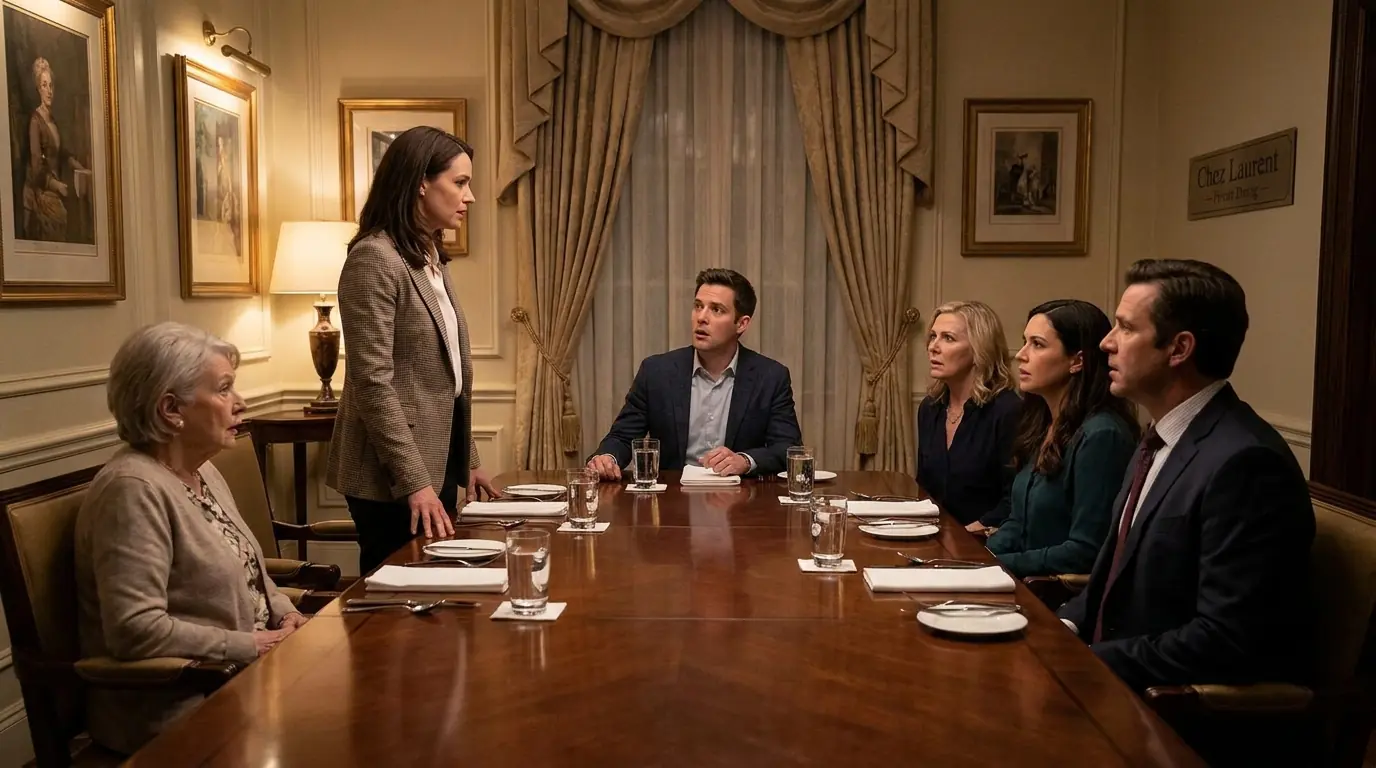
I arrived 15 minutes early and was surprised to find the private dining room filled with people. Fiona's mother, Margaret, was there, of course, looking like she'd stepped out of a country club catalog. Tasha and Kim flanked her like backup singers, but the real surprise was seeing Bryce Caraway sitting at the head of the table like he owned the place.
"Chris." Fiona stood up as I entered, her smile bright and fake. "Thank you for coming. I thought it would be good to have our families and friends here for this conversation."
I looked around the room, taking inventory. Margaret gave me the same disapproving look she'd perfected over eight years of marriage. Tasha and Kim whispered to each other behind their menus. Bryce watched me with undisguised contempt, clearly expecting me to fold under pressure.
"Interesting guest list," I said, taking the empty seat across from Fiona. "Though I noticed my family didn't get an invitation."
"We wanted to keep this small," Margaret said, her voice dripping with condescension. "Family only."
"And Bryce's family, how exactly?"
The table went quiet. Bryce cleared his throat. "I'm here as a friend of Fiona's and as someone who cares about her future."
"How thoughtful. Does your wife know you're here?"
His face reddened. "My personal life isn't your concern."
"Funny, I feel the same way about mine."
Fiona jumped in quickly. "Chris, I asked everyone here because I wanted to be completely honest about where I stand. I've made some difficult decisions and I wanted the people I care about to understand."
She stood up and I realized she'd planned this moment carefully. The lighting, the audience, the dramatic positioning — it was all calculated for maximum impact.
"I'm filing for divorce," she announced. "I've tried to make my marriage work, but I can't continue living a lie. I found someone who shares my ambitions, my dreams, my vision for the future. Someone who understands what I need."
She looked directly at Bryce, who smiled smugly. Margaret dabbed at her eyes with a napkin, playing her part perfectly. Tasha actually pulled out her phone and started recording.
"I know this is difficult," Fiona continued, "but I hope Chris will be mature about this and make the process as smooth as possible for everyone involved."
The room fell silent, all eyes on me. They were expecting tears, anger, desperate pleading. Instead, I started laughing.
"That's it?" I said, still chuckling. "That's your big announcement, Fi? Honey, you could have just texted me."
Fiona's confident expression wavered. "Chris, this is serious."
"Oh, I know it is. Very serious. Expensive, too."
I pulled out my phone and opened the calculator app. "Let's see, five years of spousal support at your current salary, carry the one, plus the $50,000 penalty. That comes to roughly $320,000."
Margaret gasped. "What is he talking about?"
"The prenup," I explained cheerfully. "Section 12C, the compensation clause. Fi owes me a rather substantial sum for initiating divorce proceedings due to her infidelity."
Bryce leaned forward. "That's ridiculous. No court would enforce something like that."
"Actually, they would. See, my dad was a divorce attorney and he wrote that prenup specifically to discourage this exact situation. It's completely legal and ironclad." I looked at Fiona, whose face had gone pale. "You did read the whole thing before you signed it, right?"
"Chris, you're being unreasonable," Margaret said. "Fiona has found happiness. Surely you don't want to stand in the way of that."
"I'm not standing in the way of anything. I'm just expecting to be compensated for my wife's betrayal. Think of it as a breach of contract, Fi."
Tasha lowered her phone. "This is getting weird."
"It's about to get weirder," I said, pulling out a folder I'd brought with me. "See, I've been doing some research on my soon-to-be ex-wife's boyfriend here."
Bryce's smug expression disappeared. "What kind of research?"
"The kind that reveals you're not actually getting divorced. In fact, you and Sylvia just renewed your country club membership for another five years. Hardly the action of a man planning to leave his wife."
I opened the folder and spread out printed documents. Bank statements, hotel receipts, credit card bills — all the evidence I'd gathered of their affair.
"Did you know," I continued conversationally, "that Bryce here has been charging your hotel rooms to his company credit card? That's technically embezzlement since Meridian Financial has strict policies about personal use of corporate funds."
Fiona looked at Bryce in confusion. "You said you were handling the expenses."
"I was handling them," he said quickly. "This is just a misunderstanding."
"A misunderstanding that could cost you your job," I pointed out, "especially when HR finds out you've been sleeping with a subordinate. That's a violation of company policy, too, isn't it?"
The room had gone completely silent. Margaret looked like she was about to faint. Kim was staring at the documents spread across the table. Tasha had started recording again, but now she seemed more interested in capturing Bryce's discomfort than Fiona's announcement.
"What do you want?" Bryce asked quietly.
"Nothing from you," I said. "You're not my problem. My problem is with my wife, who owes me $320,000 for breaking her marriage contract."
Fiona finally found her voice. "Chris, please, we can work something out. We don't need to involve lawyers and courts."
"Actually, we do. See, I've already filed a response to your divorce petition, including a counterclaim for breach of contract. My attorney says it's one of the most solid cases he's ever seen."
I stood up and straightened my jacket. "But hey, don't let me ruin your celebration. Enjoy your dinner. I'm sure Bryce can afford to pick up the tab, at least until his wife finds out about his extracurricular activities."
As I walked toward the door, I heard Margaret's voice behind me. "Fiona, what is he talking about? What prenup?"
I paused at the doorway and looked back at the table. Fiona was staring at Bryce, who was studying his hands. Tasha and Kim were whispering furiously. Margaret looked like she was having a stroke.
"Oh, and Bryce," I said, "you might want to call your lawyer. Something tells me you're going to need one."
I left them there, arguing in increasingly loud voices. As I walked through the restaurant's main dining room, I could hear Fiona's voice rising above the others. "You said you were getting divorced."
The valet brought my car around and I tipped him $20. It felt good to be generous. After all, I was about to come into a substantial sum of money.
My phone started ringing before I'd even left the parking lot. First Fiona, then Margaret, then Kim. I let them all go to voicemail. Whatever they had to say, they could say it to my lawyer.
Dave called as I was pulling into my driveway. "How'd it go?"
"Better than expected. They thought they were ambushing me, but it turns out I was the one with the heavy artillery."
"Need me to swing by? Make sure there's no trouble?"
"Nah, I'm good. Though you might want to keep an ear out for domestic disturbance calls from Chez Laurent. Things were getting pretty heated when I left."
I hung up and went inside, pouring myself a scotch and settling into my favorite chair. The house felt different now — not empty, but peaceful, like a weight had been lifted.
My phone buzzed with a text from Fiona. "We need to talk. This doesn't have to be ugly."
I texted back. "You're right, it doesn't have to be ugly. It's going to be expensive, though."
She didn't respond, but 20 minutes later I heard a car pull into my driveway. Through the window, I watched Fiona get out of her BMW, followed by Bryce. They stood on my front porch for a full minute before Fiona finally rang the doorbell.
I opened the door and leaned against the frame. "Back so soon? How was dinner?"
"Chris, we need to talk," Fiona said. "Can we come in?"
"We?"
Bryce stepped forward. "Look, I think there's been a misunderstanding. We're all adults here. Surely we can work something out."
I looked at him for a long moment. "You know what, Bryce? You're absolutely right. We are all adults. That's why I'm expecting my wife to honor the contract she signed like an adult."
"The prenup is unconscionable," he said. "No reasonable person would agree to those terms."
"Fiona did. Eight years ago, in front of witnesses, with her own attorney present." I smiled at him. "But I appreciate your concern for my wife's financial well-being. Very generous of you, considering you're married to someone else."
Fiona grabbed Bryce's arm. "Let me handle this." She looked at me with what I'm sure she thought was her most persuasive expression. "Chris, I know you're hurt. I know I handled this badly. But demanding $300,000 — that's not the man I married."
"You're right," I said. "The man you married was naive enough to trust you. This is the man you created when you decided to sleep with your boss."
"I never meant for it to happen this way."
"But it did happen this way, and now there are consequences."
I stepped back and started to close the door. "You should probably call your lawyer. I have a feeling you're going to need one."
As I shut the door, I heard Bryce say, "This is extortion."
Through the window, I watched them argue on my front porch for another five minutes before they left. Bryce's BMW disappeared into the night carrying my cheating wife toward an uncertain future.
I finished my scotch and went to bed, sleeping better than I had in months.
The next morning brought the first salvo in what would become an all-out war. I woke up to 17 missed calls and 43 text messages, most from numbers I didn't recognize. Apparently, word of last night's dinner theater had spread through Fiona's social circle like wildfire.
The messages ranged from supportive ("You go, Chris") to hostile ("You're a monster for doing this to Fi"). But the most interesting one came from an unknown number at 3:47 a.m. "Drop the lawsuit or you'll regret it."
I forwarded the message to Dave, then made coffee and checked my email. My inbox was flooded with messages from friends, co-workers, and people I barely knew.
Fiona had clearly launched a social media campaign painting herself as the victim of a vindictive ex-husband. Her Facebook post, which had already garnered 200 likes and 50 comments, read: "Going through a difficult divorce. Please keep me in your thoughts as I navigate this challenging time. Some people show their true colors when things get tough." #staystrong #newbeginnings
The comments were a mix of support for Fiona and questions about what had really happened. Several people had shared the post, spreading her version of events throughout our mutual social network.
I was composing my own response when my doorbell rang. Through the peephole, I saw Pete Morrison, my best friend since high school and the owner of Murphy's Pub downtown. He was holding a bag from the local deli and a cardboard tray with two coffee cups.
"Figured you might need some sustenance," Pete said when I opened the door. "And someone to talk to who isn't a lawyer."
We sat at my kitchen table eating bagels and drinking coffee while I filled him in on the previous night's events. Pete listened without interruption, occasionally shaking his head or muttering under his breath.
"So, let me get this straight," he said when I finished. "Fi's been cheating with her married boss for months, planning to dump you, and now she's surprised that there are consequences. That about sums it up? And this prenup actually gives you legal grounds to collect damages?"
"$320,000 according to my lawyer."
Pete whistled low. "Your dad really was paranoid, wasn't he?"
"Paranoid and thorough. He always said the best defense against betrayal was making it expensive."
My phone rang. The caller ID showed my attorney's office.
"Chris, it's Robert Kellerman. We need to talk. Can you come in this morning?"
"What's wrong?"
"Nothing's wrong, exactly, but Fiona's attorney called and they're playing hardball. They're claiming the prenup is invalid due to coercion and unconscionability. They're also threatening to countersue for emotional distress."
I looked at Pete, who was listening intently. "Can they do that?"
"They can try, but I've reviewed your father's work and it's solid. The prenup was properly executed, you both had independent counsel, and the terms, while harsh, aren't legally unconscionable. Can you be here at 10?"
After I hung up, Pete refilled our coffee cups. "So, what's your next move?"
"Honestly, I'm not sure. Part of me wants to just let her go and move on with my life. But another part of me is pissed off enough to fight this to the bitter end."
"What does your gut tell you?"
I thought about that for a moment. "My gut tells me that if I let her walk away without consequences, she'll do this to the next guy too, and Bryce will keep using his position to prey on employees."
"Then you fight."
"Even if it gets ugly?"
Pete grinned. "Brother, it's already ugly. The question is whether you're going to let them make it ugly on their terms or yours."
I was getting ready to leave for my lawyer's office when Dave called. "Got some interesting information about that threatening text you forwarded," he said. "The number traces back to a burner phone, but we pulled security footage from the cell tower it pinged. Guess who was in that area at 3:47 a.m.?"
"Surprise me."
"Bryce Caraway's BMW. License plate matches the registration."
I felt a cold anger settle in my chest. "So, he's moved from infidelity to intimidation?"
"Looks that way. I can't do anything official without more evidence, but I thought you should know."
"Thanks, Dave. I owe you one."
"You owe me about 50, but who's counting?"
At Robert Kellerman's office, I learned that Fiona's legal team was more aggressive than I'd expected. They'd filed a motion to invalidate the prenup and were demanding immediate mediation.
"They're also spreading rumors about your mental state," Robert said, sliding a document across his desk. "Claiming you've become obsessed with revenge and are making threats."
I read through the filing, my anger building with each paragraph. According to Fiona's version of events, I was a controlling husband who'd forced her to sign an unconscionable prenup and was now using it to financially abuse her.
"This is complete fiction," I said.
"I know, but it's what they're going with. They're painting you as the villain and her as the victim."
Robert leaned back in his chair. "The good news is that we have evidence of her infidelity going back months. The bad news is that public opinion matters in these cases and they're winning the PR war."
"So, what do we do?"
"We fight fire with fire. Document everything, gather more evidence, and prepare for a long battle. Are you sure you want to go down this road? It's going to get expensive and messy."
I thought about Pete's words about my gut instinct regarding the threatening text message. "I'm sure."
"Then let's get to work."
I spent the rest of the day at Robert's office going through financial records and planning our strategy. By the time I left, it was after 6:00 p.m. and I was exhausted.
The first sign that things were escalating came when I pulled into my driveway. Someone had spray-painted "Asshole" across my garage door in bright red letters.
I sat in my car for a moment staring at the graffiti, feeling a mix of anger and disbelief. I was taking pictures of the damage when my neighbor, Mrs. Chen, came over from her yard.
"I saw who did it," she said quietly. "Two young women, maybe late 20s. They had a camera with them, like they were filming it."
"Did you recognize them?"
"One of them looked familiar. I think she's been to your house before. Blonde hair, drives a white SUV."
Kim Patterson. I should have known.
I called Dave to report the vandalism, then spent an hour cleaning off the paint. It came off easier than I'd expected, which suggested they'd used washable spray paint. This was about humiliation, not permanent damage.
My phone buzzed with a notification from Facebook. Someone had tagged me in a video. I opened the app and found a recording of Kim and Tasha spray-painting my garage, with Kim providing commentary like she was hosting a reality show.
"This is what happens when you try to financially abuse a woman," she was saying to the camera. "Chris Dalton thinks he can use his dead daddy's contract to steal money from his ex-wife, but we're not going to let that happen."
The video had been posted two hours ago and already had over 100 views and dozens of comments. Most were supportive of Kim and Tasha, calling me everything from a greedy fool to a pathetic loser.
I screenshotted the video and sent it to Robert. Evidence of criminal mischief, harassment, and defamation. If Fiona's team wanted to play dirty, I was happy to accommodate them.
But as I sat in my living room that evening looking at the clean garage door and scrolling through the increasingly hostile comments on social media, I realized this was just the beginning. Fiona and her allies were declaring war, and they weren't planning to fight fair.
That was fine with me. I'd learned a few things about warfare during my time in the Marines, and the first rule was simple: when someone declares war on you, you win it.
I opened my laptop and started making plans.
The next few days brought a steady escalation of hostilities. Fiona's social media campaign intensified with daily posts about her abusive ex-husband and his unconscionable demands. Her friends shared increasingly dramatic stories about my alleged controlling behavior, most of which were complete fabrications.
The low point came when Margaret posted a long Facebook rant claiming I'd financially terrorized her daughter and was using legal loopholes to steal money from a hard-working woman. The post went viral in our local community, garnering over 500 shares and 1,000 comments.
But the real problem wasn't social media — it was the impact on my business. Three clients canceled contracts after seeing the online accusations. My reputation in Cleveland's tight-knit IT community was taking a beating.
"You need to respond publicly," Pete said during one of our regular coffee meetings. "Letting them control the narrative is destroying you."
"Robert says to stay quiet and let the legal process work."
"Robert doesn't have to live in this town after the divorce is final. You do."
He had a point. I'd been following my lawyer's advice to avoid public statements, but my silence was being interpreted as guilt. It was time to change tactics.
That evening, I crafted a careful Facebook post of my own.
"I've remained silent while false accusations have been made against me, but I feel compelled to set the record straight. I discovered my wife was having an affair with her married boss. When she filed for divorce, I exercised my legal rights under a prenuptial agreement we both signed. I'm not seeking revenge. I'm seeking justice for betrayal. The truth will come out in court."
I attached copies of the prenup and select text messages between Fiona and Bryce, with a note that I had extensive documentation of their affair.
The response was immediate and dramatic. Within an hour, my post had more engagement than anything I'd ever shared. The comment section became a battlefield, with friends and strangers taking sides. But more importantly, the narrative began to shift. People who'd assumed I was a vindictive ex-husband started questioning Fiona's version of events. Several mutual friends reached out privately to offer support.
The next morning brought an angry call from Fiona. "How dare you post our private messages?" she screamed into the phone. "You're trying to humiliate me."
"I'm trying to defend myself against your lies," I replied calmly. "If you don't want people to know you're a cheater, maybe don't cheat."
"Those messages are taken out of context."
"Really? What context makes 'I can't wait to dump Chris and start our real life together' acceptable?"
She hung up on me.
An hour later, Bryce called from his office number. "You need to take down that post," he said without preamble. "You're interfering with my marriage and my business."
"I'm defending my reputation. If that interferes with your life, maybe you should have thought about that before you started sleeping with my wife. This is harassment. I'll have my lawyer contact you."
"Please do. My lawyer loves billable hours."
The call that really surprised me came that afternoon from Sylvia Caraway, Bryce's wife.
"Mr. Dalton, this is Sylvia Caraway. I think we should meet."
We arranged to meet at a quiet coffee shop in Shaker Heights, away from prying eyes. Sylvia was exactly what I'd expected — elegant, well-dressed, and clearly accustomed to getting her way.
"I want to thank you," she said after we'd ordered coffee. "I've suspected Bryce was having an affair, but I couldn't prove it. Your Facebook post gave me the evidence I needed."
"I'm sorry you had to find out this way."
"Don't be. I'm grateful. I've already filed for divorce, and my attorney says the infidelity evidence will help significantly in the settlement." She smiled coldly. "Bryce is about to discover that two can play the expensive divorce game."
"What about his job?"
"I've already spoken to the board of directors at Meridian. Bryce's position is tenuous at best. Using company funds for personal expenses, sleeping with subordinates — it's exactly the kind of scandal they want to avoid."
I felt a grim satisfaction. Bryce's arrogance was finally catching up with him.
"There's something else," Sylvia continued. "I have information about Bryce and your wife that might interest you. Financial records, hotel receipts, evidence of other affairs. I'm willing to share it if it helps your case."
"Why would you do that?"
"Because I want to see them both pay for what they've done. Bryce destroyed our marriage, and your wife helped him do it. They deserve whatever consequences they get."
We exchanged contact information, and I left the coffee shop feeling like I'd gained a powerful ally. Sylvia Caraway had resources, connections, and a motivation for revenge that matched my own.
But the war was far from over.
That evening I discovered someone had slashed two of my tires and keyed my car. The message was clear. The other side was escalating beyond social media harassment.
I called Dave to report the vandalism, then had my car towed to a repair shop. While I waited for the tow truck, I noticed a black sedan parked across the street with two men inside. When I looked directly at them, the car pulled away.
"You're being watched," Dave said when he arrived to take the report. "Professional surveillance by the look of it."
"Bryce?"
"Probably. Rich guys love hiring private investigators when they feel threatened."
He handed me a business card. "Call this guy. Victor Santos, personal security. He's ex-military, discreet, and he owes me a favor."
"You think I need a bodyguard?"
"I think you need someone watching your back. This thing is getting out of hand."
That night I met Victor Santos at Murphy's Pub. He was a big man, maybe 6'4" and 250 pounds, with the kind of presence that made other people step aside. Pete served us beers and discreetly withdrew to give us privacy.
"Dave says you're having trouble with some rich boy and his girlfriend," Victor said.
I filled him in on the situation, including the surveillance and escalating harassment.
"Standard intimidation tactics," Victor said. "They're trying to make you back down. Question is, are you planning to?"
"No."
"Good. Because if you were, I'd tell you to take the money and run. But if you're committed to this fight, I can help you win it."
"What do you have in mind?"
Victor smiled, and it wasn't a pleasant expression. "Rich people hate being embarrassed more than anything else. They're used to buying their way out of problems quietly. But if you make their problems public, make them expensive, make them humiliating, they fold fast."
"I'm listening."
"First, we document everything they're doing. Every threat, every act of harassment, every illegal surveillance. Then, we turn the tables. Make them react instead of act."
"How?"
"Leave that to me. But I'll need your permission to get creative."
I thought about the slashed tires, the threatening messages, the coordinated social media attack. They'd declared war on me, and they weren't fighting fair.
"Do it," I said.
Victor's smile widened. "This is going to be fun."
The next morning I woke up to find my garbage cans overturned and trash scattered across my yard. But when I went outside to clean up the mess, I discovered Victor had already been there. He'd collected every piece of trash and arranged it in neat piles, with photographs documenting the vandalism.
"Security cameras go live today," he said, appearing from behind my garage. "Motion sensors, night vision, the works. Anyone comes near your property, we'll know about it."
"What about the surveillance team?"
"Taken care of. Amazing how uncomfortable private investigators get when someone starts following them."
Over the next few days, the harassment attempts continued, but became increasingly ineffective. Every act of vandalism was documented. Every threatening message was traced. Every attempt at intimidation was countered.
More importantly, Victor began his own campaign of psychological warfare. Bryce started receiving packages at his office — legal documents about infidelity laws, pamphlets about sexual harassment, flowers with condolence cards expressing sympathy for his failing marriage.
Fiona's harassment campaign faltered as her allies began to worry about legal consequences. Kim and Tasha stopped posting videos after receiving cease and desist letters. Margaret's Facebook rants became less frequent after Victor arranged for protesters to picket her country club with signs reading "Homewrecker supporter."
The turning point came two weeks later. I was having dinner at Murphy's Pub when Pete came over with a grim expression.
"You need to see this," he said, handing me his phone.
The local news website was running a story about Bryce Caraway's resignation from Meridian Financial. According to the article, he was stepping down to pursue other opportunities. But the real reason was buried in the final paragraph. An internal investigation had found evidence of policy violations, including misuse of company funds and inappropriate relationships with employees.
"Sylvia's work?" Pete asked.
"Probably. She said the board was investigating."
My phone buzzed with a text from an unknown number. "We need to talk. F."
I showed the message to Pete. "Think it's a trap?"
"Only one way to find out."
I texted back. "My lawyer's office. Tomorrow at 2:00 p.m."
Her response came immediately. "Fine."
The war was about to enter its final phase.
Fiona arrived at Robert Kellerman's office looking nothing like the confident woman who had announced her divorce plans at Chez Laurent three weeks earlier. Her designer clothes couldn't hide the stress lines around her eyes, or the way her hands shook when she reached for her coffee cup.
She was accompanied by a new lawyer, a sharp-faced woman named Patricia Vance, who had a reputation for aggressive tactics and expensive fees. Bryce was notably absent.
"My client is prepared to discuss a settlement," Patricia began without preamble. "Given the circumstances, we believe a compromise is in everyone's best interest."
"What circumstances?" Robert asked.
"Mr. Caraway's employment situation has changed," Patricia said carefully. "This has affected my client's financial position and her ability to meet the demands of the prenuptial agreement."
I almost laughed. They were admitting that Fiona's plan had been to use Bryce's money to pay me off, and now that he was unemployed, she couldn't afford it.
"What kind of settlement are you proposing?" Robert asked.
Patricia slid a document across the table. "$50,000 paid over two years in exchange for Mr. Dalton waiving all claims under the prenuptial agreement."
I looked at the proposal, then at Fiona. She was staring at her hands, unable to meet my eyes.
"Counter offer," I said. "Full amount as specified in the prenup, paid according to the original terms."
"That's impossible," Fiona said, speaking for the first time. "Chris, be reasonable. I don't have that kind of money."
"You should have thought about that before you decided to cheat."
"I made a mistake. People make mistakes."
"Mistakes have consequences. You signed a contract that spelled out exactly what those consequences would be."
Patricia leaned forward. "Mr. Dalton, my client has lost her job due to the harassment campaign you've waged against her employer. She's facing social ostracism, financial ruin, and emotional distress. Continuing to pursue this claim would be vindictive."
"Your client lost her job because she was sleeping with her married boss and helping him embezzle company funds," Robert replied smoothly. "And the only harassment I'm aware of has been directed at my client."
"We have documentation of Mr. Dalton's social media attacks, his release of private communications, and his coordination with Mrs. Caraway to destroy my client's reputation."
"We have documentation of infidelity, conspiracy, vandalism, and intimidation," Robert countered. "Would you like to compare evidence?"
The meeting went downhill from there. Patricia made increasingly desperate offers while Robert calmly rejected each one. Fiona sat in silence, looking like she wanted to disappear.
Finally, Patricia gathered her papers. "We'll see you in court, Mr. Kellerman. My client will not be extorted."
"Looking forward to it," Robert replied.
After they left, Robert turned to me. "They're broke. Bryce probably promised to pay your settlement, but now that he's unemployed and facing his own expensive divorce, he can't help her."
"So, what happens now?"
"Now we go to court and get a judgment. Then we start seizing assets — her car, her jewelry, her share of any property. It won't be the full amount immediately, but we'll get it eventually."
I left the law office feeling strangely empty. I'd won, but it felt more like survival than victory. Fiona's life was falling apart, but I took no pleasure in her destruction.
That evening, I was sitting on my back porch when Dave stopped by with a six-pack of beer.
"Heard the meeting didn't go well," he said, settling into the chair next to mine.
"Depends on your perspective. From a legal standpoint, it went perfectly."
"And from a human standpoint?"
I thought about that for a moment. "I used to love her, Dave. Eight years of marriage and I really thought we'd grow old together. Seeing her like this — it's not satisfying. It's just sad."
"You having second thoughts?"
"About the divorce? No. About the money? Maybe."
Dave opened two beers and handed me one. "You know what Dad used to say about bullies?"
Our father had died when I was 25, but his lessons had stuck with both of us. That you can't let them win or they'll keep bullying people.
"Exactly. Fee and Bryce thought they could destroy your life without consequences. If you let them walk away, they'll do it to the next guy."
"Bryce is already finished. He lost his job, his wife, his reputation."
"And Fee?"
I didn't have an answer for that.
The next morning brought news that changed everything. Victor called me at 7:00 a.m., his voice grim.
"Turn on channel 5 news," he said.
I grabbed the remote and flipped to the local morning show. The lead story made my blood run cold.
"A Cleveland woman was found dead in her downtown apartment last night in what police are calling an apparent suicide," the anchor was saying. "Kim Patterson, 34, was discovered by her landlord after neighbors reported a disturbance. Patterson had recently been involved in a high-profile divorce case that had generated significant social media attention."
The story continued with details about Kim's involvement in my situation, the harassment campaign, and the legal troubles she'd been facing. It painted her as a victim of cyberbullying who'd been driven to desperation.
I turned off the TV and sat in stunned silence. Kim was dead. Annoying, gossipy, vindictive Kim who'd spray-painted my garage and made videos mocking me on social media. She was gone, and according to the news, it was somehow my fault.
My phone started ringing immediately. Reporters, friends, strangers who'd gotten my number somehow. I let them all go to voicemail.
The doorbell rang around noon. Through the peephole, I saw Fiona standing on my porch alone, her face streaked with tears. I opened the door but didn't invite her in.
"Did you see the news?" she asked.
"Yeah."
"Kim's dead, Chris. She killed herself because of what you did to us."
"What I did? I defended myself against harassment and vandalism. Kim made her own choices."
"You destroyed her life. You had her arrested, sued her, made her a pariah in her own community."
"She committed crimes, Fee. I documented them and pressed charges. That's how the legal system works."
Fiona stepped closer, her grief transforming into rage. "You could have been the bigger person. You could have walked away, but you had to have your revenge, didn't you? You had to make everyone pay."
"I didn't make anyone do anything. You chose to cheat. Kim chose to harass me. Bryce chose to embezzle company funds. I just refused to be a victim."
"And now Kim's dead."
"And that's tragic, but it's not my fault."
Fiona stared at me for a long moment, her expression cycling through anger, grief, and something that might have been recognition.
"I don't know who you are anymore," she said finally.
"I'm the same person I always was. You just never bothered to really know me."
She turned and walked away without another word. I watched her get into her car and drive off, probably for the last time.
The media attention from Kim's death brought unwanted scrutiny to my case. Reporters camped outside my house, neighbors avoided me, and my remaining clients grew nervous about the association.
But it also brought something unexpected — support from other people who'd been victims of infidelity and harassment. I received hundreds of emails and letters from men and women who'd been cheated on, lied to, and publicly humiliated by unfaithful spouses.
"Thank you for fighting back," one letter read. "My ex-husband destroyed our marriage and tried to destroy my reputation, but I was too scared to stand up to him. Seeing your courage gives me hope."
Another wrote, "The prenup idea is brilliant. I'm having my lawyer draft something similar before my daughter gets married."
I realized that my fight had become about more than just money or revenge. It had become a symbol of refusing to be victimized, of demanding consequences for betrayal.
The court hearing was scheduled for the following Monday. Robert was confident we'd win, but the media attention had made everything more complicated.
"The judge is going to be under a lot of pressure," he warned me. "Kim's death has changed the narrative. They're going to try to paint you as a vindictive bully who drove a woman to suicide."
"Can they do that legally?"
"No, but they can try to influence public opinion and put pressure on the court. We need to be prepared for anything."
Sunday night, I sat in my living room going through old photo albums. Pictures of Fiona and me on our wedding day, vacations we'd taken, holidays with family. Eight years of memories that now felt like artifacts from someone else's life.
I found a picture from our second anniversary, both of us laughing at some joke I couldn't remember. Fiona looked genuinely happy, and so did I. Had it all been fake or had we really been happy once?
My phone buzzed with a text from an unknown number. "Good luck tomorrow. You deserve justice. SC."
Sylvia Caraway. Even Bryce's ex-wife was rooting for me.
I put away the photo albums and went to bed early. Tomorrow would determine whether my father's paranoid contract would hold up in court, whether justice would prevail over public sympathy, whether standing up for myself had been worth the cost.
As I drifted off to sleep, I thought about Kim Patterson and felt a stab of genuine sadness. She'd made terrible choices and paid the ultimate price, but her death didn't change the fundamental truth of my situation.
I'd been betrayed, and I deserved compensation for that betrayal. Tomorrow, a judge would decide if I was right.
The courthouse was surrounded by protesters when I arrived Monday morning. Signs reading "Justice for Kim" and "Stop bullying victims" competed with others saying "Cheaters should pay" and "Honor marriage contracts."
The media circus had turned my divorce into a public referendum on infidelity, revenge, and personal responsibility.
Victor escorted me through the crowd, his massive presence deterring the more aggressive protesters. Cameras flashed and reporters shouted questions, but I kept my head down and my mouth shut until we reached the courthouse steps.
"Mr. Dalton," a reporter called out, "do you feel responsible for Kim Patterson's death?"
I stopped and turned to face the cameras. Robert had advised me to say nothing, but I felt compelled to respond.
"Kim Patterson's death was a tragedy," I said clearly, "but I will not accept responsibility for the choices other people made. I was the victim of infidelity and harassment. I used legal means to defend myself. That's not bullying. That's justice."
Inside the courtroom, I was surprised by the number of spectators. The gallery was packed with reporters, friends, family members, and curious onlookers. Fiona sat in the front row with her mother and Tasha, all three women dressed in black like they were attending a funeral.
Judge Patricia Morrison was a stern-faced woman in her 50s with a reputation for no-nonsense rulings. She called the court to order and immediately addressed the media attention.
"This is a civil proceeding to determine the validity and enforceability of a prenuptial agreement," she said firmly. "It is not a trial about anyone's character, and it is not a public forum for social commentary. I will not tolerate disruptions, outbursts, or grandstanding from anyone in this courtroom."
Fiona's new attorney, Patricia Vance, opened with an emotional appeal about unconscionable contracts and vindictive enforcement. She painted me as the controlling husband who'd forced his wife to sign an unfair agreement and was now using it to financially destroy her.
"Your Honor, the defendant signed this prenup under duress without fully understanding its implications," Vance argued. "The compensation clause is punitive and excessive, designed not to protect assets but to punish behavior. No reasonable person would agree to such terms."
She spent 20 minutes detailing Fiona's financial hardship, her job loss, and the campaign of harassment that had allegedly driven Kim Patterson to suicide. It was a masterful performance that had several spectators nodding in sympathy.
Robert's response was methodical and devastating.
"Your Honor, the defendant was 36 years old when she signed this agreement," he began. "She was a college graduate with a business degree and several years of corporate experience. And she was represented by independent counsel who advised her of her rights. She had two weeks to review the document before signing it."
He presented evidence of the lengthy negotiation process, including emails between the attorneys and multiple drafts of the contract. Fiona hadn't just signed the prenup — she'd actively participated in crafting its terms.
"The defendant now claims she didn't understand the compensation clause, but the record shows her attorney specifically advised her about it," Robert continued. "In fact, the defendant requested that the clause be mutual, applying equally to both parties. She wanted the same protection against infidelity that she now claims is unconscionable."
That revelation caused a stir in the courtroom. Fiona had insisted on the very clause she was now challenging.
Robert then presented the evidence of infidelity — text messages, hotel receipts, witness testimony, and financial records showing Bryce had used company funds to pay for their affair. The documentation was overwhelming and undeniable.
"The defendant didn't make a mistake, Your Honor. She made a calculated decision to violate her marriage vows and her contractual obligations. The compensation clause exists precisely to address this situation."
Vance tried to counter with testimony about my alleged harassment campaign, but Robert systematically dismantled each claim. The social media posts were factual responses to false accusations. The coordination with Sylvia Caraway was legitimate information sharing between victims of the same affair. The documentation of harassment was evidence gathering for legitimate legal proceedings.
"Mr. Dalton didn't harass anyone," Robert argued. "He defended himself against a coordinated campaign of defamation and intimidation. The tragic death of Kim Patterson, while regrettable, resulted from her own criminal actions and their legal consequences."
The most powerful moment came when Robert called me to testify. I'd been dreading this, but as I sat in the witness chair and looked out at the packed courtroom, I felt a strange calm.
"Mr. Dalton, did you force your wife to sign the prenuptial agreement?" Robert asked.
"No. We both agreed it was a good idea to protect our individual assets."
"Did you ever threaten or coerce her regarding the agreement?"
"Never. Her attorney was present for all discussions and she had full opportunity to negotiate terms."
"When did you first learn of your wife's affair?"
I told the story of overhearing her friends at the book club, discovering the text messages, and realizing the extent of the deception. My voice remained steady throughout, but I could see several jurors nodding in sympathy.
"Mr. Dalton, some people have characterized your enforcement of this agreement as vindictive. How do you respond to that?"
I looked directly at Fiona, who was staring at her hands.
"Your Honor, I loved my wife for eight years. I trusted her completely, supported her career, and tried to be a good husband. When I discovered she'd been lying to me for months, planning to leave me for another man, and coordinating with her friends to humiliate me publicly, I felt like my entire life had been a fraud."
My voice cracked slightly, and I paused to compose myself.
"The prenup wasn't about revenge. It was about consequences. Actions have consequences, and betrayal should be expensive. If that makes me vindictive, then I accept that label."
Vance's cross-examination was aggressive but ineffective. She tried to paint me as obsessed with revenge, but I remained calm and factual. She attempted to blame me for Kim's death, but Robert's objections were sustained.
The most dramatic moment came when Vance called Fiona to testify. She took the stand looking fragile and remorseful, clearly hoping to generate sympathy.
"Mrs. Dalton, do you regret your affair?" Vance asked.
"Every day," Fiona replied, tears streaming down her face. "I made a terrible mistake that hurt everyone I cared about. I never meant for things to go this far."
"Do you believe the compensation clause is fair?"
"No. It's designed to destroy me financially. Chris knows I can't pay that amount."
But Robert's cross-examination revealed the calculation behind her tears.
"Mrs. Dalton, when you began your affair with Mr. Caraway, were you planning to divorce your husband?"
Fiona hesitated. "Eventually, yes."
"And you discussed using Mr. Caraway's wealth to pay any settlement to your husband, didn't you?"
"We talked about it."
"In fact, you told Mr. Caraway that the prenup wouldn't be a problem because he could afford to pay it, correct?"
Fiona's composure cracked. "That's not — I mean —"
"You only considered the compensation clause unfair when Mr. Caraway lost his job and couldn't help you pay it, isn't that true?"
"That's not fair."
"Answer the question, Mrs. Dalton."
"Yes," she whispered.
The courtroom was silent as the implications sank in. Fiona had been perfectly willing to enforce the prenup when she thought someone else would pay. She only found it unconscionable when the bill came due to her.
Judge Morrison recessed for lunch, and I spent the break in a conference room with Robert and Victor. The mood was cautiously optimistic.
"She destroyed herself up there," Robert said. "Admitting she planned to use Bryce's money to pay you off was devastating."
"What about the Kim Patterson angle?"
"The judge shut that down. It's not relevant to the contract dispute, and Vance knows it."
When court resumed, both sides presented brief closing arguments. Vance made one final emotional plea about excessive punishment and social responsibility. Robert stuck to the law and the facts.
Judge Morrison retired to chambers for two hours. When she returned, the courtroom was packed to capacity.
"This case has generated significant public attention and emotion," she began. "But my decision must be based on law, not sympathy or social pressure."
She reviewed the elements of contract law, the standards for unconscionability, and the evidence of breach.
"The defendant argues that the compensation clause is unconscionable and unenforceable. However, the evidence shows that she was a sophisticated party with independent counsel who actively participated in negotiating this agreement. The terms, while substantial, are not so extreme as to shock the conscience of the court."
My heart began to race.
"The defendant also argues that enforcement would be vindictive and excessive. But the purpose of this clause is clearly stated in the agreement itself — to provide compensation for the breach of marital obligations and to deter infidelity. The plaintiff has proven by clear and convincing evidence that the defendant committed infidelity over an extended period."
Judge Morrison looked directly at Fiona.
"The defendant's testimony revealed that she considered this clause enforceable when she believed someone else would pay it. Her current claim of unconscionability appears to be based on her changed financial circumstances, rather than any inherent unfairness in the agreement."
The judge paused, and the courtroom held its collective breath.
"Therefore, this court finds the prenuptial agreement valid and enforceable. The defendant is ordered to pay the plaintiff compensation in the amount of $320,000 plus court costs and attorney fees, according to the terms specified in the agreement."
The courtroom erupted. Fiona collapsed into sobs while her mother and Tasha tried to comfort her. Reporters rushed for the exits to file their stories. Protesters outside began chanting competing slogans.
I sat in stunned silence, feeling no triumph or satisfaction. I'd won, but the victory felt hollow. Kim Patterson was still dead. Fiona's life was still ruined. Bryce was still unemployed and divorced. But justice had been served. Actions had consequences. Betrayal was expensive.
As we left the courthouse, a reporter shouted one final question. "Mr. Dalton, was it worth it?"
I stopped and considered the question seriously. Eight years of marriage destroyed, friendships ended, a woman dead, a community divided — all for money I didn't really need and revenge that brought no satisfaction.
"Ask me in ten years," I said finally.
Victor drove me home through streets lined with protesters and news vans. My house looked the same as always, but everything felt different. I was a single man now, legally and financially vindicated, but emotionally exhausted.
That evening, I sat on my back porch with a glass of scotch, watching the sunset paint the sky in shades of gold and crimson.
My phone had been ringing constantly with interview requests, congratulations from supporters, and threats from Fiona's allies.
Dave stopped by around 8:00, carrying a six-pack of beer and wearing a satisfied grin.
"So, how does it feel to be the most famous divorced guy in Cleveland?" he asked.
"Weird. Expensive. Complicated."
"Any regrets?"
I thought about that for a long time. "I regret that it came to this. I regret that Kim felt like suicide was her only option. I regret that eight years of marriage ended in a courtroom battle. But I don't regret standing up for myself. If I'd let Fiona walk away without consequences, she would have learned that betrayal is free. Bryce would have learned that he could destroy marriages without cost. The next victims might not have been as prepared to fight back."
Dave opened two beers and handed me one. "Dad would be proud."
"Think so?"
"Hell yes. He always said the law was about protecting people who couldn't protect themselves. You protected yourself, and you set a precedent that might protect the next guy."
We sat in comfortable silence, drinking beer and watching the stars appear in the darkening sky. Tomorrow would bring new challenges — collecting the judgment, rebuilding my reputation, figuring out what came next.
But tonight, I was content to sit on my porch, financially secure and morally vindicated, watching the world turn without me.
Fiona had wanted to trade up for a better life. Instead, she'd learned that some trades come with a price she couldn't afford to pay.
And I'd learned that sometimes the best revenge isn't getting even — it's getting everything you're legally entitled to, plus interest.
The compensation clause had done exactly what my father intended. It made betrayal expensive, consequences real, and justice possible.
In the end, that was worth more than any amount of money.