Ten-year-old Caleb Morris first heard the engine cough while everyone else was watching fireworks.
The county fairgrounds outside Lebanon, Missouri, were glowing with lights. Children carried paper cups of lemonade. Parents held bags of kettle corn. Teenagers crowded near the Ferris wheel, laughing loudly every time the seats swung too high. Somewhere near the livestock barn, a country band played an old song through crackling speakers, and the smell of fried dough, grilled corn, and wet grass drifted through the summer evening.
Caleb should have been thinking about the fair.
He should have been thinking about the small plastic airplane his mother had bought him from a prize booth, or the blue cotton candy he had eaten too fast, or the fireworks beginning over the far field.
But Caleb had always heard machines before he heard celebration.
He heard the sound from the gravel parking area behind the fairgrounds.
A rough cough.
A weak sputter.
Then a sharp backfire that made him turn his head.
Most people only glanced toward it and looked away. The fireworks were more interesting. The music was louder. The fair was too alive for anyone to care about one old car struggling in the dark corner of the lot.
But Caleb listened.
His father had taught him that.
Before the accident at the sawmill. Before the hospital room. Before the funeral where Caleb wore a shirt that scratched his neck and watched adults cry into folded tissues. Before his mother began working two jobs and pretending she was not tired.
Back when life still had Saturday mornings in the driveway, Caleb used to sit on a wooden crate beside his father while he worked on old trucks and lawn mowers.
“Listen first,” his father, Matthew Morris, would say. “Machines complain before they quit. People do too, if you pay attention.”
Caleb had paid attention ever since.
He heard when his mother’s voice got too cheerful because she was hiding worry.
He heard when the refrigerator motor sounded different and told her before it stopped working.
He heard when the school bus squealed near the front brakes and mentioned it to the driver, who laughed at first, then thanked him two days later.
And now he heard trouble in the gravel lot.
Caleb stood near the fence holding the little plastic airplane in one hand.
His mother, Annie Morris, was helping at the church pie booth. She had told him to stay near the lights, not wander past the livestock barn, and come back as soon as the fireworks ended.
He looked toward the booth.
She was busy handing slices of pie to a line of customers.
The engine coughed again.
Caleb slipped around the edge of the crowd and walked toward the parking lot.
The car was easy to find.
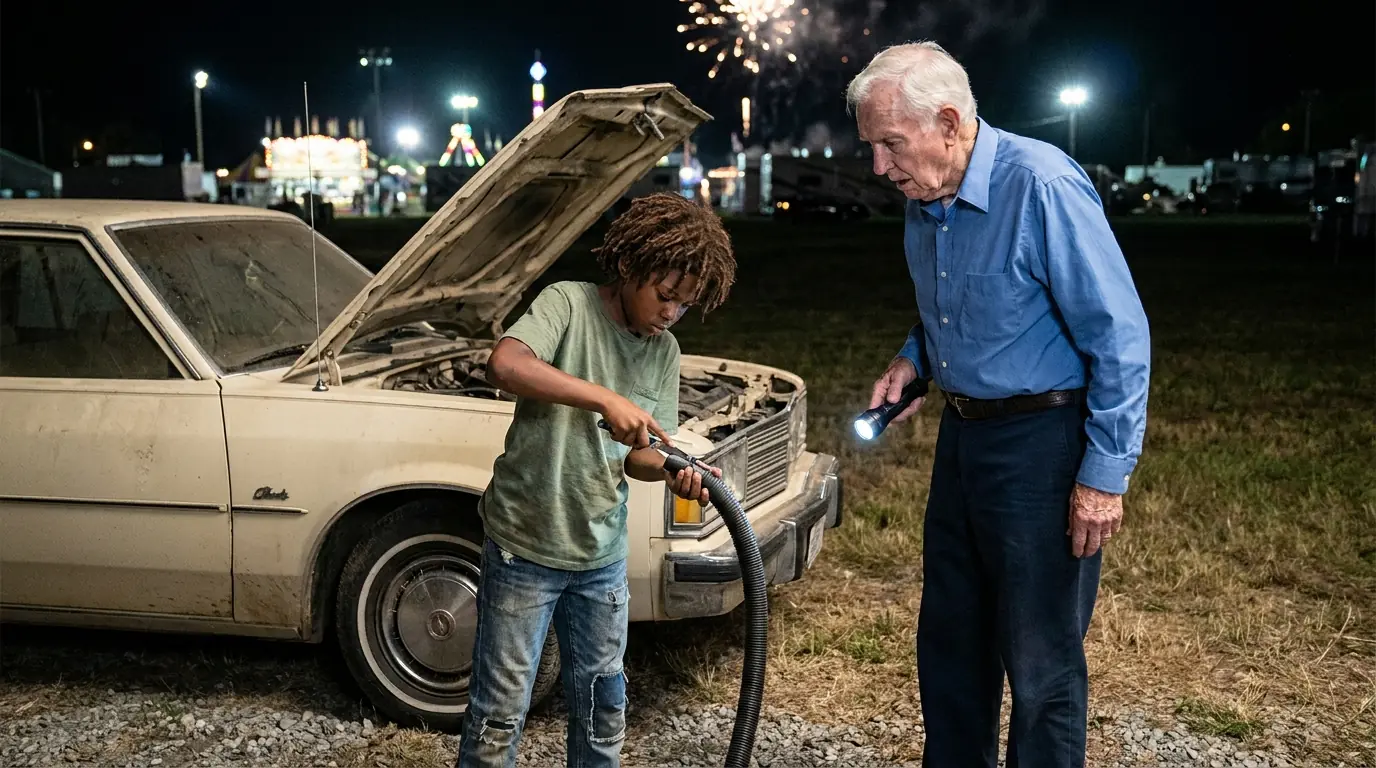
It was an old cream-colored sedan parked beneath a flickering security light near the far fence. Its hood was up. An elderly man stood beside it, one hand braced on the fender, the other holding a flashlight that trembled slightly. He was tall but thin, with white hair, a weathered face, and a clean blue shirt tucked into brown trousers. His boots were polished but old, and his shoulders bent forward as if the years had slowly pressed them down.
He turned the key again.
The engine sputtered, shook, and died.
The old man leaned against the car and closed his eyes.
Caleb stopped a few feet away.
“Sir?”
The old man opened his eyes quickly.
“Oh.” He looked surprised to see a boy standing there. “Hello.”
“Your car won’t stay running?”
The old man gave a tired little laugh.
“That is a polite way to describe betrayal.”
Caleb almost smiled.
“Can I hear it once more?”
“Hear it?”
“Yes, sir.”
The old man studied him carefully. Caleb was small for ten, with messy brown hair, serious gray eyes, a faded green T-shirt from last year’s school field day, jeans with a patch at one knee, and sneakers worn thin at the soles. He did not look like anyone’s mechanic. But he looked confident in the quiet way children look when they have learned something real.
“What’s your name?” the old man asked.
“Caleb Morris.”
“Morris?”
“Yes, sir.”
“Matthew Morris’s boy?”
Caleb swallowed.
“Yes.”
The old man slowly removed his hat.
“Your father fixed my hay baler once after two grown men told me to scrap it.”
Caleb looked down.
“He was good at that.”
“He was good at more than that,” the old man said gently. “I’m George Whitfield.”
Caleb nodded politely.
“Nice to meet you, Mr. Whitfield.”
George looked back at the car.
“Well, Caleb Morris, since your father once rescued my baler, maybe you can tell me why this old car has decided to humiliate me at the county fair.”
Caleb stepped closer, careful not to touch anything yet.
“Try it again.”
George climbed into the driver’s seat and turned the key.
The sedan started for two seconds. The idle stumbled badly, the engine shook, then it died with a soft pop.
Caleb tilted his head.
“Fuel or air,” he said.
George leaned out. “What?”
“It’s trying to run, but something’s wrong with the mixture. It doesn’t sound like the battery. It starts. It just can’t keep going.”
George blinked.
“You got all that from listening?”
“My dad said engines tell on themselves.”
George smiled faintly.
“He did say things like that.”
Caleb stepped near the open hood and looked carefully. The engine was old but clean. Not neglected. He noticed a faint fuel smell, then a small vacuum hose near the carburetor hanging loose and cracked at the end.
“There,” Caleb said, pointing.
George leaned in and squinted.
“What am I looking at?”
“That hose came loose. It might be letting in too much air. That would make it run rough and die.”
George stared at the little hose.
“Well, I’ll be.”
“Do you have tape?”
“In the glove box, maybe.”
George found a roll of old electrical tape and handed it to him. Caleb inspected the hose. It was cracked near the end, but there was enough length to trim and reattach if he had something sharp. He reached into his pocket and pulled out a small folding utility blade attached to a key ring.
George raised an eyebrow.
“You carry tools to the fair?”
Caleb looked embarrassed.
“Just small ones.”
“Your mother know?”
Caleb paused.
George chuckled.
“That means no.”
“I don’t use it unless I need it.”
“And I suppose this counts?”
“Yes, sir.”
Caleb trimmed the cracked end carefully, pushed the hose back onto the fitting, and wrapped it with tape to hold it temporarily.
“It needs a new hose,” he said. “This is only enough to get you home.”
George nodded seriously.
“Understood.”
“Try it now.”
George turned the key again.
The sedan started.
The idle shook once, then steadied.
George sat behind the wheel with both hands frozen on it.
The fireworks exploded red and gold over the fairgrounds behind them, but George kept looking at the dashboard as if the sound of that old engine meant more than anything happening in the sky.
Caleb lowered the hood gently.
George stepped out.
“You fixed it.”
“Temporarily.”
“That’s still fixing.”
Caleb shrugged, suddenly shy.
George reached for his wallet.
“How much do I owe you?”
Caleb shook his head immediately.
“Nothing.”
“Caleb, you saved me calling a tow truck.”
“My mom says helping someone stuck doesn’t need a bill.”
George’s face softened.
“Your mother sounds like someone your father would have chosen.”
Caleb looked toward the pie booth.
“She works hard.”
“I imagine she does.”
George followed Caleb’s gaze and saw Annie Morris across the fairgrounds, smiling at customers while looking tired enough to fall asleep standing.
He also noticed Caleb’s shoes, the patched jeans, the careful way he held the plastic airplane as if it was not cheap but precious.
George reached into the car and pulled out a brown paper bag.
“At least take this.”
Caleb stepped back.
“I shouldn’t.”
“It isn’t money,” George said. “It’s two sandwiches my sister packed for me because she thinks I’ll starve between lunch and breakfast. I only ate one.”
Caleb hesitated.
His stomach answered before he did.
George pretended not to notice.
“Extra food should not go to waste.”
That made it easier to accept.
“Thank you,” Caleb said.
George gave him the bag.
Then he held out a small card.
“If your mother allows it, come by Whitfield Farm sometime. I still have machines that complain louder than I do.”
Caleb looked at the card.
Whitfield Farm
George Whitfield
Livestock, Hay, Repair Barn
His eyes brightened at the words “repair barn.”
George noticed.
“Your father used to stop by now and then. Good man. Patient hands.”
Caleb’s throat tightened.
“Thank you.”
A voice called from across the lot.
“Caleb Morris!”
He turned.
His mother was standing near the fence, worry sharp on her face.
Caleb ran toward her immediately.
“I’m sorry, Mom.”
Annie knelt and grabbed his shoulders.
“What did I tell you?”
“I heard a car.”
“You left the fair lights.”
“Mr. Whitfield’s car wouldn’t stay running.”
“You cannot just walk into a parking lot alone.”
“I know.”
George approached slowly, hat in hand.
“Mrs. Morris, this is my fault. I should have found you before letting him look at the car.”
Annie stood, her expression protective.
“Mr. Whitfield?”
“Yes, ma’am. I knew your husband.”
Her face changed.
Many people in town had known Matthew, but fewer still spoke his name gently.
“Caleb helped you?”
“He did more than help. He listened, found a loose vacuum hose, trimmed it, reattached it, and got me running again.”
Annie looked at her son.
Pride and fear crossed her face at the same time.
“He’s ten.”
George nodded.
“Yes, ma’am. And he should not be used like a grown man. But he has his father’s ear for engines.”
Caleb looked down at the gravel.
Annie sighed softly.
“He has his father’s heart too. That’s what scares me.”
George understood that more than she expected.
“I won’t keep you. But I gave him my card. If you ever feel comfortable, I’d be honored to show him the repair barn. With you there, of course.”
Annie took the card, but her face remained cautious.
“We’ll see.”
George smiled.
“That is fair.”
On the ride home that night, Caleb sat beside his mother in their old pickup, holding the paper bag with the sandwich inside.
For a while, neither spoke.
The fair lights disappeared behind them. The road turned quiet. Crickets sang in the ditches.
Finally, Annie said, “You scared me.”
“I’m sorry.”
“I know why you stopped.”
Caleb looked down.
“Dad would have.”
“Yes,” she whispered. “He would have.”
“I miss fixing things with him.”
Annie’s hands tightened on the steering wheel.
“I know.”
“At school, nobody talks about him anymore.”
“They don’t know how.”
“I don’t want to forget his voice.”
Annie pulled the truck to the side of the road.
Caleb looked up, startled.
His mother turned toward him with tears in her eyes.
“You will not forget him.”
“What if I do?”
“You won’t. Because every time you listen before fixing, every time you help someone without making them feel small, every time you use what he taught you kindly, his voice is still here.”
Caleb’s eyes burned.
Annie reached over and touched his cheek.
“But I need you safe. Your dad would want that too.”
Caleb nodded.
“I’ll ask next time.”
“You promise?”
“I promise.”
The next Monday after school, Caleb found George Whitfield standing outside their small rented house.
Annie was on the porch with him, arms folded, listening carefully.
Caleb slowed his bike.
“Mr. Whitfield?”
George smiled.
“Hello, Caleb.”
Annie looked at her son.
“Mr. Whitfield came to ask permission before asking you anything. That is how adults are supposed to do it.”
Caleb understood the lesson immediately.
“Yes, ma’am.”
George held up both hands.
“I came with a proposal. Only a proposal.”
Caleb parked his bike near the porch.
George continued, “The county fair has a junior repair exhibit next year. Mostly older kids enter restored bicycles, lawn mower engines, small farm equipment, things like that. I used to help sponsor it, but fewer kids enter these days.”
Caleb listened, heart beginning to race.
George glanced at Annie.
“I have an old garden tractor in my barn. Not dangerous if handled properly. It doesn’t run. I thought, with your mother’s permission, you might like to help restore it over the next year. Slowly. Safely. School first. Your mother can be there whenever she wants.”
Caleb looked at his mother so quickly that George nearly smiled.
Annie did not answer right away.
“We can’t pay for parts.”
“I have parts.”
“We can’t pay you for lessons.”
“I’m not selling lessons.”
“I don’t want him doing work that benefits your farm.”
George’s expression became serious.
“Mrs. Morris, if I need farm work done, I hire grown men. This would be for him.”
Annie studied him.
“Why?”
George looked toward the road, then back at her.
“Because after my wife died, I let the repair barn go quiet. Because your husband once helped me when I couldn’t afford pride. Because your boy reminded me that useful knowledge should not die with old men.”
The porch became still.
Caleb looked at the card in his mother’s hand.
Annie’s voice softened.
“My husband wanted to teach him more.”
“I know.”
“He didn’t get enough time.”
“No,” George said quietly. “He didn’t.”
Annie closed her eyes.
When she opened them, Caleb saw tears there.
“One afternoon,” she said. “I come with him. We see the place. Then we decide.”
Caleb tried not to jump.
He failed a little.
The next Saturday, Annie drove him to Whitfield Farm.
It sat beyond town on rolling land with hayfields, red barns, wire fences, and a gravel drive lined with walnut trees. Cattle grazed in a pasture beyond the barn. A weather vane turned slowly on the roof. The place felt old, but not abandoned. It felt like it had stories stored in every board.
George met them outside the repair barn.
Inside, tools hung neatly on pegboards. Old license plates lined one wall. A wooden workbench stretched beneath a row of windows. There were shelves full of labeled jars, tractor manuals, oil cans, and parts arranged with the care of someone who respected small things.
Caleb stepped inside like he was entering a library.
Annie noticed.
Her face softened painfully.
George led them to the back corner.
Under a canvas tarp sat the garden tractor.
When he pulled the tarp away, Caleb saw a small old machine with faded orange paint, cracked tires, and a seat torn down one side. It looked tired, but not hopeless.
“This belonged to my wife, June,” George said.
Caleb looked up.
“She drove it?”
“She insisted on mowing the orchard herself. Said I cut corners too wide.”
Annie smiled faintly.
George touched the cracked seat.
“She loved that little tractor. After she passed, I parked it here and stopped looking at it.”
The barn was quiet.
Caleb understood.
Some things hurt too much to fix because fixing them meant touching the memory.
George cleared his throat.
“The first lesson would not be engines.”
“What would it be?” Caleb asked.
“Cleaning. Looking. Writing down what we see. A good repair begins with respect.”
Annie looked at him then.
For the first time, she truly relaxed.
“That sounds like Matthew.”
George nodded.
“He and I agreed on many things.”
So the project began.
Every Saturday afternoon, after homework and chores, Caleb went to Whitfield Farm. At first Annie stayed the entire time. Later, she stayed for coffee in George’s kitchen, then eventually trusted Caleb to work in the barn while she picked up extra hours or rested for the first time in months.
George never rushed.
They washed the tractor. Took photos. Labeled parts. Inspected belts, fuel lines, wiring, tires, blades, and the old engine. Caleb kept a notebook titled:
JUNE’S GARDEN TRACTOR
RESTORATION PROJECT
WITH MR. WHITFIELD
On the first page, he wrote:
Rule 1: Listen first.
Rule 2: Clean before fixing.
Rule 3: No shame in asking.
Rule 4: Old does not mean useless.
George read the fourth rule and turned away for a moment.
“Good rule,” he said, his voice rough.
Winter came.
The barn grew cold, but George kept a small heater near the workbench. Caleb wore gloves with the fingertips cut out so he could handle small parts. They rebuilt the carburetor with George doing the delicate work and Caleb learning every step. They replaced cracked fuel lines, cleaned the tank, changed the spark plug, repaired wiring, and patched the seat.
Some days, Caleb spoke constantly.
Other days, George told stories.
About June making peach jam in August.
About the year a storm knocked down half the orchard.
About Matthew Morris coming over in the rain to repair a machine George needed before hay season.
“He wouldn’t take full pay,” George said one afternoon.
Caleb smiled sadly.
“That sounds like Dad.”
“He said neighbors shouldn’t charge neighbors like strangers.”
Caleb looked down at the wrench in his hand.
“My mom says that too.”
“Then both your parents understood something important.”
By spring, the tractor was ready for its first start.
Annie came to watch.
George stood beside the tractor with one hand on the hood.
“You do the honors,” he said.
Caleb stepped back.
“Me?”
“You’ve earned it.”
Caleb climbed onto the seat carefully. His feet barely reached, but it did not matter. George stood beside him and pointed to the key.
“Remember. No panic.”
Caleb nodded.
“Machines don’t like panic.”
George smiled.
Caleb turned the key.
The engine cranked.
Once.
Twice.
Then it caught.
A rough little chug filled the barn.
Caleb’s whole face lit up.
“It runs!”
Annie covered her mouth.
George stood very still, his eyes wet.
The tractor idled steadily, brighter than it had any right to sound after years of silence.
George whispered, “June would have laughed.”
Caleb looked at him.
“Because it’s loud?”
“Because she would say I finally let someone smarter fix it.”
Annie laughed through tears.
From that day on, the project became more than a repair. It became a story the whole town slowly learned.
George entered the tractor in the next county fair junior repair exhibit under Caleb’s name, with a note explaining that the project had been supervised by an adult mentor. Caleb prepared a small display board showing the before photos, the steps, the parts replaced, and the rules he had written in his notebook.
On fair day, Caleb wore his cleanest shirt and stood beside the restored orange garden tractor in the exhibit tent. George stood a few feet behind him, pretending not to hover. Annie stood near the entrance, holding her phone, taking too many pictures.
People stopped to read the display.
Some asked questions.
Caleb answered carefully.
“What was the hardest part?”
“Not rushing.”
“What did you learn?”
“That cleaning teaches you what’s really broken.”
“Who taught you?”
Caleb looked toward George, then toward his mother.
“My dad started teaching me. Mr. Whitfield helped me keep learning.”
Annie had to turn away after that.
At the end of the day, the judges announced the ribbons.
Caleb won first place in the junior restoration category.
For a moment, he did not understand.
Then George clapped so loudly people turned.
Annie ran to hug him.
The blue ribbon had Caleb Morris’s name printed on it.
He held it like it was made of glass.
That should have been the end of the gift.
But it wasn’t.
A week later, George asked Annie and Caleb to come to the farm for dinner.
Annie was nervous because George sounded serious on the phone. Caleb was nervous because adults sounding serious usually meant bills, sickness, or bad news.
But dinner was peaceful. Roast chicken. Green beans. Cornbread. Peach cobbler from June’s old recipe.
Afterward, George led them to the repair barn.
The restored garden tractor sat near the workbench, polished and proud.
Beside it was a wooden sign covered with cloth.
Caleb looked at it.
“What’s that?”
George’s hands shook slightly as he held his cane.
“I’ve been talking with the fair board, the school, and the county extension office.”
Annie looked confused.
“About what?”
George nodded toward the sign.
“Pull the cloth, Caleb.”
Caleb stepped forward and removed it.
The sign read:
THE MATTHEW MORRIS YOUTH REPAIR SCHOLARSHIP
For Young Hands Learning Patient Work
Caleb stared at the words.
His father’s name.
Matthew Morris.
His chest tightened so hard he could not breathe.
Annie gasped softly, then began crying.
George spoke gently.
“The scholarship will help children who want to learn repair, mechanics, farm maintenance, and practical skills. Tools, safety classes, fair entries, transportation, whatever they need. Caleb will be the first recipient, if his mother agrees.”
Caleb turned toward him.
“You named it after my dad?”
George nodded.
“Because he taught you. And because he once helped me when I needed it. I should have honored him sooner.”
Annie covered her mouth.
George looked at her.
“It also includes funds for Caleb’s future training. Trade school, engineering, agriculture, whatever path he chooses when the time comes. Not enough for everything, maybe. But enough to open doors.”
Caleb touched the letters of his father’s name.
“Dad would have liked this.”
George’s voice broke.
“I hope so.”
Annie whispered, “He would have loved it.”
George knelt slowly in front of Caleb, though his knees clearly hurt.
“That night at the fair, you fixed my car,” he said. “But more than that, you brought sound back into my barn. You brought June’s tractor back to life. You brought your father’s lessons with you.”
Caleb’s eyes filled.
“I just wanted to help.”
George smiled through tears.
“That is how the best things usually begin.”
Caleb hugged him.
George held him carefully at first, then tighter.
For a long moment, the repair barn was quiet except for Annie’s soft crying and the wind moving through the walnut trees outside.
Years passed.
The Matthew Morris Youth Repair Scholarship grew beyond what George expected. The county fair added more junior practical-skills categories. Children restored bicycles, birdhouses, small engines, wagons, lamps, and garden tools. George’s repair barn became a supervised Saturday learning place where kids could come with parents, mentors, and volunteers.
Caleb grew taller.
At twelve, he helped younger kids label parts.
At fourteen, he restored his first lawn mower engine.
At sixteen, he rebuilt a small tractor with George supervising from a chair because his knees had grown worse.
At eighteen, he won a state award for agricultural mechanics and received a full technical scholarship through a foundation that had heard about the program.
Through it all, the blue ribbon from that first tractor stayed framed on the barn wall.
Beside it hung a photograph of Caleb at ten years old, standing proudly beside June’s restored orange garden tractor.
And beside that was a photograph of Matthew Morris, smiling beside his old garage.
George lived long enough to see Caleb graduate high school.
After the ceremony, Caleb drove straight to Whitfield Farm wearing his cap and gown. George sat on the porch, older now, thinner, but smiling as Caleb walked up the steps.
“I brought you something,” Caleb said.
He handed George a copy of his graduation photo.
On the back, he had written:
For Mr. Whitfield, who helped me keep listening.
George read it twice.
Then he wiped his eyes with the corner of his sleeve.
“You did the hard work, son.”
Caleb sat beside him.
“You gave me a place to do it.”
They looked out toward the barn together.
The orchard trees moved gently in the summer wind. The repair barn doors were open. Somewhere inside, younger kids were laughing while a volunteer taught them how to sort wrenches.
George smiled.
“June would have loved all that noise.”
Caleb nodded.
“So would Dad.”
Years later, when Caleb Morris became the director of a regional youth trades program, people often asked how he had started.
They expected him to talk about school, training, or awards.
But Caleb always told them about the county fair.
He told them about fireworks and a cream-colored sedan coughing in the dark corner of a gravel lot.
He told them about an old man who missed his wife.
A boy who missed his father.
A loose vacuum hose.
A garden tractor under a tarp.
A blue ribbon with his name.
And a scholarship with his father’s.
Then he would smile and say the lesson that had carried him all those years.
“Sometimes the thing you fix is small. A hose. A wire. A loose part nobody noticed. But if you listen carefully, that small repair can start a whole life moving again.”