Picture the most powerful man in London. A man who could silence a ballroom with a single look. Whose name alone made grown men straighten their spines and women flutter their fans with nervous energy. A man so accustomed to reverence that he had forgotten somewhere along the way what it felt like to simply be spoken to.
Now picture a rainy afternoon in the spring of 1810. Picture a small confectionery on Marylebone High Street. The windows fogged with warmth. The air thick with the scent of burnt sugar and cardamom.
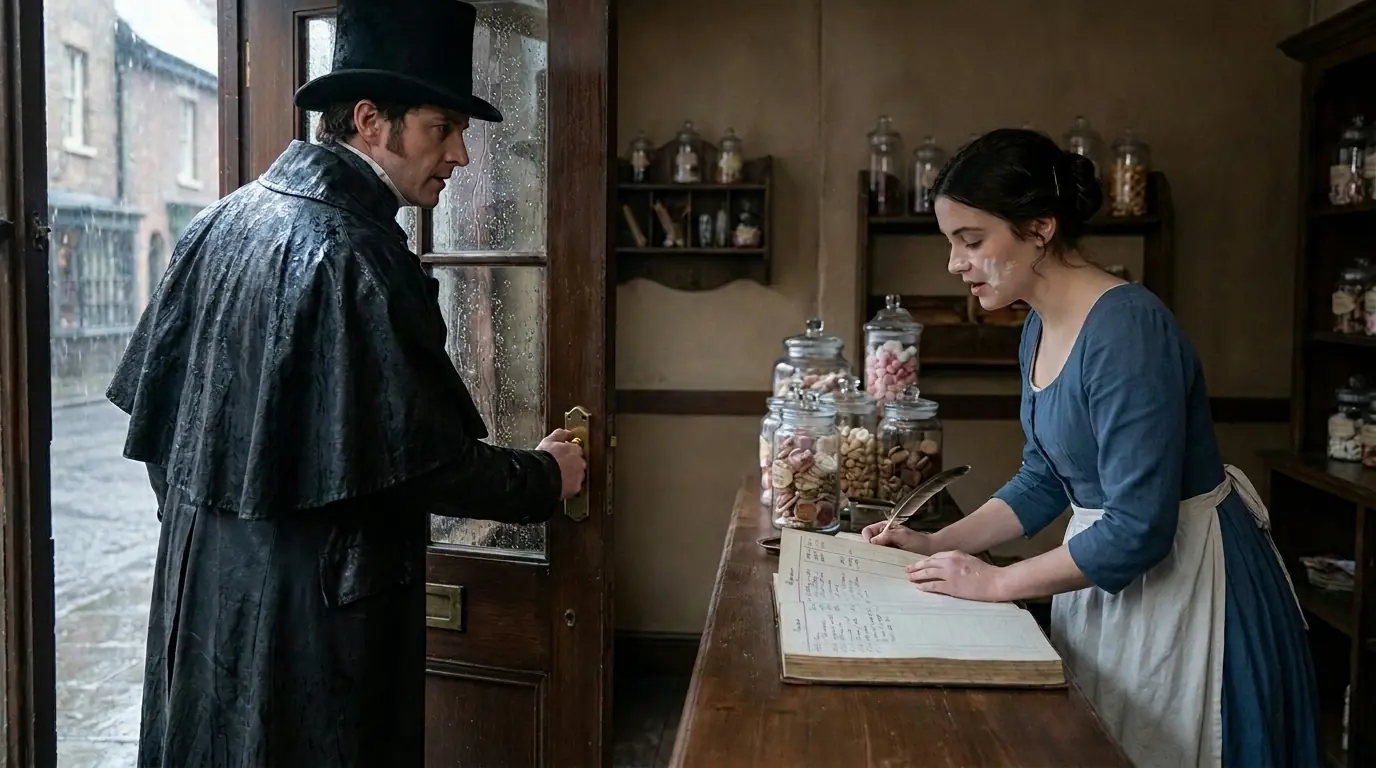
Picture that same man soaking wet, slightly undignified, and standing in the doorway like a lost spaniel. Being told, in no uncertain terms, by a young woman with flour on her cheek and absolutely no idea who he was, that he was dripping on the clean floor and would he please either come in or go out. Because she was not about to mop twice before supper. He came in.
He never really left. This is the story of Leopold Ashcroft, the Duke of Harwick, and Rose Mullins, the confectioner's daughter who treated him like an ordinary man. And in doing so, made him fall utterly, helplessly, and rather inconveniently in love. London in the spring of 1810 was, as it always was, a city of performances. Every carriage ride was a theater. Every park promenade was a stage.
Every dinner party was a carefully rehearsed production in which everyone knew their lines and the only crime was to deviate from the script. Leopold Ashcroft had been performing since he was 11 years old. That was the year his father died, the year the title passed to him, the year a succession of gray-faced solicitors and weeping relations had gathered in the library of Harwick Hall and looked at a boy who was still too short for his riding boots and told him, in so many words, that he was now responsible for everything. He was 31 now.
20 years of responsibility. 20 years of being watched, consulted, deferred to. 20 years of walking into rooms and feeling the temperature change, not because he was cold, but because everyone else became so very careful. He was not a cruel man.
He was not even, by most measures, an unkind one. He was simply a man who had been treated like a monument for so long that he had begun to suspect that was all he was. He had a sense of humor, actually. A rather good one.
Dry, precise, delivered with such a straight face that only the sharpest people in the room caught it at all. His solicitor caught it sometimes. His valet, never. His mother, occasionally, though she pretended otherwise on principle.
The trouble was that no one laughed with him. They smiled carefully. They nodded with appropriate appreciation, but they did not actually laugh, not freely, not the way people laugh when something genuinely delights them, because they were too busy being properly respectful of the Duke of Harwick. It had been raining since morning, a proper London rain, gray, determined, personally vindictive.
Leopold had dismissed his carriage two streets back on an impulse he could not have explained, intending to walk the remaining distance to his club and clear his head after for tedious morning of estate correspondence. The rain, apparently, had not been consulted on this plan. By the time he reached Marylebone High Street, his coat was ruined and his mood was occupying a very particular category that sat somewhere between resigned and irritable. He saw the warm glow of a shop window through the downpour and he pushed open the door without reading the sign above it.
The bell above the door announced him. No one looked up immediately. That was the first unusual thing. He was so accustomed to entering spaces and having every head swivel toward him that the simple fact of being ignored gave him a small, startled jolt of something he would later identify as relief.
The shop was narrow and warmly lit. Its shelves lined with glass jars of candied peel and spiced biscuits. Its counter bearing a collection of delicate pastries arranged under a bell jar. Two women sat at a small table near the window deep in conversation over cups of tea.
A girl of about 12 was sweeping behind the counter with the half-hearted energy of someone who would very much rather be doing anything else. And at the back of the room, behind the counter, a young woman was writing in a ledger with the focused intensity of someone engaged in actual arithmetic. She had flour on her cheek. Her dark hair was pinned up with more efficiency than elegance.
Several strands having escaped to curl at the back of her neck. She wore a plain blue dress under a white apron. She did not look up when he entered. He was dripping onto the floor.
He became aware of this gradually. At the door, the young woman said without looking up from her ledger. Leopold glanced behind him. He had, indeed, left the door slightly ajar.
He pushed it shut. The rain drummed against the glass. Thank you. Now she looked up, her eyes dark and direct, the kind that assessed rather than admired, moved from his face to his thoroughly soaked coat to the small puddle forming at his feet.
Her expression was not unkind. It was simply honest. You are dripping on my clean floor. I am aware, Leopold said.
There is a chair near the window. If you would like to sit, I can bring you something warm while you wait out the rain. But if you are only here to drip, I am afraid I must ask you to do it outside. I have mopped once already this morning.
One of the women at the small table looked up with mild alarm. Something in the way this young person was speaking to a clearly well-dressed gentleman struck her as potentially dangerous. The young woman behind the counter did not share her concern. She was already returning to her ledger.
Leopold sat in the chair near the window. He had not planned to. His feet simply moved in that direction while his mind was still processing the experience of being told, very pleasantly but entirely without apology, that he was an inconvenience. What would you like?
Though there was a directness about her that made her seem ageless in a way. The flower on her cheek was on the left side. He noticed this with odd precision. Tea, he said.
If that is possible. We sell tea. Everything here is possible if you can pay for it. She wrote something on the notepad.
Anything to eat? We have almond biscuits today that are genuinely very good. I would not say that if they weren't. We also have some lemon tartlets left from yesterday that are perfectly adequate but not exceptional.
And I would rather you not waste your money on adequate. Leopold stared at her. In 20 years of being a duke, no shopkeeper had ever told him anything was merely adequate. "The almond biscuits," he said.
"Wise." She was already walking back to the counter. He sat there for 40 minutes. Outside, the rain did not relent. Inside, he drank excellent tea and ate three almond biscuits that were, without qualification, exactly as good as advertised.
And he watched the young woman behind the counter manage her small shop with a quiet, unshowy competence that he found inexplicably soothing. She helped two more customers. She finished her ledger. She showed the sweeping girl, Maggie, "Not like that, like this." The proper angle for reaching under the display stand.
She was not performing. She was simply working. It occurred to Leopold, watching her, that he could not remember the last time he had been in the presence of someone who was simply doing a thing without any awareness of being observed. He was preparing to leave.
The rain had eased to a drizzle when she appeared at his table with the bill. He looked at the figure. He looked at her. "I have no coins smaller than a half crown," he said.
She didn't blink. "Then I'll make change." She did. Exact change, counted out with the brisk efficiency of someone who had been doing arithmetic since before she could ride. She set it on the table, collected the cups, and said, simply, "Come back when the almond paste comes in from Suffolk.
It should arrive by Thursday and they'll be even better." "I may do that," Leopold said, which was not the sort of thing he usually said to shopkeepers. He walked out into the damp afternoon. He stood on Marylebone High Street for a moment. Rain damp and oddly lighter than he had felt in months.
He read the sign above the door. Mullins Fine Confectionery established 1793. He went back on Thursday. He told himself it was the biscuits.
This was not entirely a lie. The biscuits were exceptional. But it was not entirely the truth, either. The truth was harder to articulate.
The truth was something like there was a woman in a shop on Marylebone High Street who spoke to him as though he were a person and he had apparently been starving for that without knowing it. He came back on Thursday as she had suggested and then the following Tuesday because he had business in the area and then the Friday after that which he could not quite explain even to himself. He always sat at the chair by the window. She always brought him tea without being asked after the second visit and something new to try.
A honey cake, a bergamot cream, a small square of ginger preserved plum that tasted like autumn with the same candid assessment of its merits. "This one is extraordinary." she might say, setting a plate before him. Or "This one is good, but I think the spice balance is slightly off. Tell me what you think.
You seem like someone who would actually notice." Or memorably about a violet fondant she had been experimenting with "This is a disaster. I'm giving it to you because I want an honest opinion from someone who won't feel obligated to spare my feelings and you have that look." "What look?" Leopold asked, genuinely curious. "Like you're accustomed to being told the truth." she said. "Most people aren't, you know.
Most people want the comfortable version." He ate the violet fondant. It was, indeed, a disaster. Clawingly sweet, the floral note overwhelming everything else. He said so.
She nodded, satisfied, and made a note in her ledger. Her name, he learned in increments, was Rose Mullins. Her father, Arthur Mullins, had founded the shop 17 years ago and still ran the kitchen with fierce pride, though his gout was slowing him down. Her mother had died 6 years earlier, in 1804, when Rose was 21.
She had stepped into the front of house that same week. There had been no arrangement, no formal discussion, simply a ledger left open on the counter, and Rose sitting down in front of it. And she had not stepped back since, which made her He did the calculation quietly. 27 now.
She had a younger brother at school, a fact she mentioned with a matter-of-fact affection that suggested she was paying for at least part of it, though she would never have said so in those words. She never asked his name. This astonished him. Every person he encountered, from the highest peer to the lowest clerk, knew who he was or tried to find out immediately.
Rose Mullins did not ask. And he had the strong impression that it was not shyness, but simply a lack of interest in the category of information. He was a customer, a good one, regular, polite, paid without complaint, and useful for honest opinions on experimental flavors. Whatever he was outside this shop was, apparently, not her concern.
He found this extraordinary. He also found that he was not in a hurry to correct it. He told her his name was Leopold, which was true. He did not mention the rest.
"That's a serious name," she said the first time he offered it. "I am told I am a serious person." She looked at him with that direct assessing gaze of hers, the one that made him feel pleasantly like she was actually seeing him. "Are you?" "Less than I appear, I think." She seemed to consider this. "That's interesting.
Most people are exactly as serious as they appear, sometimes more." She went back to her work. "I'll keep that in mind." He did not know what she was keeping in mind. He thought about it on the way home. What he did not know was what Rose made of him in those early weeks.
She noticed him, of course. She was sharp. And he was notable even without a title. There was something in the way he held himself, in the quality of his coat, in the unhurried way he moved through the world, that marked him as a man of considerable means and probably considerable consequence.
She was not unworldly enough to miss it. But he came in alone. He was not flashy about his resources. He did not condescend or flirt, which she appreciated greatly.
She had plenty of experience with gentlemen who used confectionery shops as venues for the latter, and she had developed an extremely efficient way of ending those conversations. He asked her opinion as though it genuinely mattered to him, which was unusual enough that she had noted it. And he laughed quietly, just once, when she described the violet fondant incident to him as a creative catastrophe with ambitions beyond its means. A small laugh, surprised out of him, as though he had not expected to find something funny.
She liked him, she decided, in the way one likes a regular customer who is good at being present without being an intrusion. Nothing more complicated than that. At least, that was what she told herself in April. By May, she was not so sure.
May arrived in London with a kind of aggressive cheerfulness that always made Rose slightly suspicious. She had lived her whole life in this city and she knew better than to trust good weather. It was never committed, only visiting. Still, May was May.
The park near the shop smelled of cut grass and someone's roses. Customers came in with lighter moods and ordered things with lavender and elderflower. Maggie swept the front step twice a day without being asked, which was either seasonal enthusiasm or a sign that she had developed a sudden passion for cleanliness. And Rose suspected neither.
Everything felt, in that particular May, slightly more present than it usually did. The colors a degree brighter, the sounds a fraction sharper. And Rose, who was a practical woman and knew better than to romanticize the ordinary, could not entirely account for why she found herself making a new recipe, a rose and cardamom shortbread, and thinking, while she was pressing the petals into the dough, that she was doing it because she thought Leopold might like it. She stopped.
She looked at the dough. This was not, she told herself firmly, significant. She made things based on customers' tastes all the time. That was good business.
She had made Mrs. Hartley's favorite salted caramel specifically because Mrs. Hartley came in every Wednesday and bought two portions and told her neighbors. And that was excellent for trade.
She had developed the bergamot cream entirely on account of Mr. Singh from three streets over, who had mentioned once in passing that his mother had grown bergamot trees in Calcutta and it was the smell he most associated with home. She did these things because she was a thoughtful businesswoman who paid attention to her customers. This was the same thing entirely.
She looked at the dough for another moment. It was possible it was not entirely the same thing. The rose and cardamom shortbread was excellent. She set a piece on his plate the next Thursday without comment and watched from behind the counter as he tasted it.
Something shifted in his expression. Something that was not quite a smile, but was in the same neighborhood. Warm and slightly private. The kind of expression that moves through a person before they've decided whether to show it.
"This is very good." he said. "I thought you might like it." "Why?" She opened her mouth, closed it, tried again. "You ordered the cardamom tea twice and you're called Leopold, which is I don't know. It's a name that goes with roses somehow." He looked at her for a beat longer than was strictly necessary.
The air between them held something she couldn't quite name. The way air holds the charge before rain. Present and anticipatory. "You made this for me?" "I made a batch." she said crisply, "and you are the first to try it.
Don't make it peculiar." "I wouldn't dream of it." He ate three of them and said nothing else about it. And she was unreasonably grateful for that. What she was less grateful for, in a way that she found both irritating and unavoidable, was how thoroughly she had begun to look forward to Thursdays. She had always been a person of routine.
Early mornings, the kitchen first, accounts before noon, the ledger before closing. And she had not previously understood how much texture a single regular appointment could add to a week. By Wednesday evenings, she was mildly distracted. By Thursday mornings, she had generally assigned the distraction to menu planning or accounts or some other sensible category.
And by Thursday afternoon, she had abandoned the pretense. The thing about Leopold, the thing she was slowly and reluctantly becoming aware of, was that he paid attention. Not in the way of men who paid attention because they wanted something from you, with that particular acquisitive alertness that she had learned over years behind the counter to identify and deflect. He paid attention in the way of someone who was genuinely interested in the answer.
He remembered things she said. He asked follow-up questions about her brother's school term, about whether the Suffolk almond paste had arrived on schedule, about a passing mention she'd made of wanting to try a French nougatine technique she'd read about in a translated pamphlet. He asked as though these things mattered. And the terrible part was that when he asked, she felt as though they did.
As though the small details of her days were worth attention, which was not something she had often been given cause to feel. She had not had that in a long time. She had not let herself want it because wanting things you did not expect to receive was an expensive habit. Her father noticed, which she could have done without.
Arthur Mullins was a man of very few illusions and considerable powers of observation. He had built a successful business on exactly these qualities. And he observed over supper one evening in early May, that the gentleman who came on Thursdays and occasional Tuesdays had been coming for 6 weeks and had never once looked at the pastries the way men usually looked at pastries. "How do men usually look at pastries?" Rose asked, keeping her voice perfectly even.
"E, with hunger," her father said. "He looks at the pastries like a man who is there for something else and doesn't mind the pastries." "He is there for the and conversation," Rose said. He is a regular customer. Mhm, said her father in the particular tone that meant he had a great deal more to say and had decided for now not to say it.
This tone had been refined over decades of raising a daughter who had strong opinions about being advised and it was a masterpiece of its kind, equally present and absent, equally a comment and not a comment. She ignored this with the ease of long practice. What she could not as easily ignore was the afternoon in mid-May when Leopold arrived slightly later than usual, clearly fresh from some engagement that had required more formal dress, his cravat more elaborate than his usual style, his coat finer, and there was a certain contained tension in him that she had not seen before. It sat in his shoulders, in the particular stillness of someone who has been performing all morning and has only now found a room where they can stop.
He sat down at his usual chair and she brought the tea and he was quiet for a long moment, looking out at the street, at the ordinary afternoon commerce of Marylebone High Street moving past the window. Difficult morning? she asked because she always said what she thought. Difficult decade, he said and then made a face that suggested he hadn't meant to say that.
She looked at him for a moment. Then she sat down in the other chair. This was mildly against her own rule about not sitting with customers. It was the kind of thing that invited misunderstanding and she had enough experience with misunderstanding to be cautious, but the shop was quiet and something in his expression suggested that the usual transaction was not what was needed right now.
He looked, if she were honest, like a man who had forgotten how to simply be in a room. Is there anything to be done about it? Or is it the kind of difficult that just needs to be waited out? He looked at her.
That look he had sometimes, like she'd said something that surprised him pleasantly, something he'd expected to hear from no one in particular. Waited out, mostly. The difficulty is structural. The worst kind.
Yes. A pause. The teacup turning between his hands. May I ask you something that might seem impertinent?
You may ask. I can't promise not to find it impertinent. Fair enough. He set the cup down.
Do you ever miss having someone who simply talks to you? Not to your position, or your family situation, or what you represent. Just to you. Rose was quiet for a moment.
The question landed somewhere specific. A place she kept closed, generally, behind a door that was always politely bolted. She had managed the shop for 5 years since her mother died. Had managed the accounts and the staff and her father's health and her brother's school fees.
And in that time, she had learned very efficiently to be useful and had perhaps grown less practiced at being simply herself in the presence of another person. Yes, she said, I do. Why? Because I have been sitting here every week for 6 weeks and I think you are the only person I speak to who isn't also performing something.
She looked at him for a long moment. He had not said anything flowery or elaborate. He had said something true and said it plainly, without ornament. And she was startled to find that her chest felt tight in a way that was nothing like indigestion.
I'm not performing, she said. I never learned how. I know, he said. That's what I meant.
She got up and went back to the counter because she needed to do something with her hands and because she was not quite ready to examine why that exchange had felt like something significant had shifted. She brought him a second biscuit without charging for it, and he took it with a quiet thank you, and neither of them mentioned the conversation again. But, it stayed with her. It stayed with her through the rest of May and into the beginning of June, sitting in the back of her thoughts like a stone in her shoe.
Not painful, precisely, but impossible to ignore for long. And always there when she was still. The letter arrived on the 3rd of June. Lady Whitmore, a client of long-standing who purchased all her entertainments confections from Mullins, and had done so since Rose's mother was alive, was hosting a garden party in celebration of her son Edmund's elevation to a new civic appointment.
She required the shop to provide petits fours, decorated biscuits, and a centerpiece cake. She also, charmingly, extended an invitation to Rose herself to attend as a mark of her personal esteem, which was unusual, but not unheard of. Lady Whitmore was that kind of woman, generous in ways that crossed lines other people drew without thinking. Rose accepted both commissions.
She spent 4 days in the kitchen with her father, producing several hundred small perfections in spun sugar and almond cream. And she arrived on the afternoon of June the 8th at Whitmore House in Cavendish Square in her best dress, dark green silk, properly pressed, with her hair done by Maggie's rather more capable elder sister, feeling competent and calm, and quite ready for an afternoon of polite social performance. She was not, it should be noted, ready for what happened next. The garden was full of London's gleaming upper reaches, men in coats that cost more than her quarterly takings, women in silks that shimmered in the afternoon light.
All of them arranged in the careful formations of a society that knew exactly who it was, and expected everyone else to know too. Rose navigated it comfortably enough having been at enough such events in her professional capacity to know the geography. She was standing near the rose bushes with a glass of lemonade when the announcement was made. Lady Whitmore, beaming, presented the principal guest.
Arriving now, apparently after a delay she attributed to parliamentary obligations, who had most graciously agreed to honor the occasion with his presence. His Grace, the Duke of Harwick. Rose's glass of lemonade did not fall. She had good reflexes, but her grip on it became very suddenly significantly tighter.
He walked through the garden doors with the easy, unhurried authority of someone who had spent his entire life arriving in rooms and having them rearrange themselves around him. Which, she now understood with the totality of a truth that had always been present, but never assembled, was exactly what had happened. He was taller outdoors, somehow, or perhaps it was the light. Or perhaps it was simply that she was seeing him without the frame of her shop around him.
Without the tea and the narrow chair and the context that had made him ordinary. He was not ordinary. How had she not known he was not ordinary? She ran through their conversations quickly, searching for a moment where she might have pieced it together, and found nothing.
He had told her his name was Leopold. He had never offered anything else. He had sat in her shop and eaten her biscuits and talked to her about cardamom and difficult decades. And she had sat across from him without the faintest idea that she was speaking to one of the most powerful men in England.
She was going to be mortified later. She could feel the mortification queuing, waiting its turn. But right now, she was simply frozen, staring. He had not seen her yet.
He was speaking to Lady Whitmore, inclining his head with that particular grave courtesy that she now now recognized as not merely personal temperament, but the refined product of a lifetime of social training. Around him, people had arranged themselves in the unconscious gravitational formation she had noticed in her shop and not understood. He was the center. Everything oriented to him.
He turned. His gaze moved across the garden in the practiced sweep of a man accustomed to reading a room in seconds. And then he saw her. It was worth pausing here, in this moment, before everything became complicated.
Because in this moment, before the discomfort, before the argument, before the long and knotted middle section of this story, something happened in Leopold Ashcroft's expression that several people standing nearby noticed and none of them could quite account for. The practiced gravity of the Duke of Harwick shifted very slightly into something warmer and considerably more unguarded for precisely the space of a breath. Then, it settled back. He crossed the garden toward her with a steadiness that she would later recognize as deliberate.
"Miss Mullins," he said. "Your Grace," she said. The words felt foreign in her mouth, pointed at him. A beat of silence.
"I should have," he began. "You should have," she agreed. "It did not seem It did not seem," she repeated pleasantly, "like information you felt I needed." He absorbed this. "May I explain?" "You may try," she said.
I reserve the right to be unconvinced. Something moved in his expression. Not quite the smile, but the same neighborhood. That seems entirely fair.
She did not speak to him privately at the garden party. There were too many eyes. Too many interested glances already sliding their way from across the rose beds. She smiled at what he said when he said it.
She was not going to give London the satisfaction of visible conflict. And she excused herself after 20 minutes with perfect social correctness. She spent the carriage ride home, a borrowed carriage, Lady Whitmore's doing, sorting through what she felt, which was considerable and slightly chaotic. There was embarrassment.
Yes. She had spoken to a duke as though he were a regular person for 6 weeks. She had told him the violet fondant was a disaster. She had sat down at his table uninvited and talked to him about difficult decades as though they were equals.
Well, she had not been wrong, exactly, to do any of those things. They were, she maintained, perfectly reasonable things to do when speaking to a regular customer called Leopold. The problem was that she had not been speaking to a regular customer called Leopold. She had been speaking to the Duke of Harwick, who had apparently found her ignorance charming enough to maintain indefinitely.
And that that was the part that stung. Not that she hadn't known that he had known she didn't know and had let it continue. And the question was why. She turned this question over for the rest of the evening.
By morning, she had arrived at an answer, and the answer was the most troubling possibility of all. She was novel to him, an amusement, a curiosity, a confectioner's daughter who didn't know how to perform the correct deference. And wasn't that delightful? Wasn't that a refreshing little holiday from the usual?
He would tire of it eventually. Men like him always had somewhere else to be, something grander to attend to. And when the novelty wore off, she would simply be a shop on Marylebone High Street that he used to visit. She found this conclusion deeply sensible.
She also found that it made her stomach hurt in a way that had nothing to do with the petit fours she'd eaten rather too many of the previous afternoon. He came on Thursday. Of course he came on Thursday. She brought him his tea.
She did not bring a new thing to try. She stood at the counter with the same pleasant efficiency she showed every customer, and she waited. He did not try to pretend nothing had happened. She had expected he might.
Instead, he looked at her steadily across the small room and said, "You are wondering why I didn't tell you." "I know why," she said. "I'm wondering if my reason matches yours." He considered this. "What what is your reason?" "Because it was pleasant," she said with deliberate evenness. "Speaking to someone who had no idea who you were.
A novelty. Something different to do on a Thursday afternoon when the rain keeps you from your usual entertainments." He was quiet for a moment. Not the uncomfortable quiet of someone who has been caught, but the careful quiet of someone who is thinking about how to say something precisely. "No," he said.
"I know that is not why." He turned the teacup. "May I tell you the actual reason?" "You may try," she said, because she couldn't help it. It was what she'd said at the garden party, and the repetition of it was not accidental. The corner of his mouth moved.
The actual reason is that when I walked into your shop, you spoke to me as a person, not as a title, not as a consequence. You told me I was dripping on your floor and offered me a choice. And it was the most straightforwardly human thing anyone had said to me in longer than I can account for. And I thought that if I told you who I was, you would stop.
And I was not ready for that to stop. Rose was quiet. Outside, a cart horse clattered over the cobbles. Maggie dropped something in the back room.
"That is a better reason than mine," she said finally. "I am glad to hear it. It is still a dishonesty." "Yes," he said without qualification or excuse. "It is." She respected that.
She respected that he didn't try to make it smaller. She set a biscuit on his table, the rose and cardamom, because she had made a batch that morning, possibly because she had known he would come. And she went back to the counter. "Leopold," she said after a moment.
He looked up. "I spoke to you as a person because you are one. That isn't conditional on who you are outside this shop." He was looking at her with an expression she couldn't fully name, something that was open and a little overwhelmed and entirely unguarded in a way she suspected the Duke of Harwick very rarely was. "I know that now," he said.
"I wasn't sure before." "That's very sad," she said. And she meant it. And he knew she did. And they didn't make it into more than it was.
He finished his tea. He left. She stood at the counter for a while looking at the door. The problem, she told herself with absolute clarity, was that she believed him.
She believed him and it changed the shape of everything. June turned into July with its usual absence of permission. London went to the country for the summer. Largely, the great houses emptied.
The park grew quieter. The social machinery slowed to a seasonal pause. Marylebone High Street became slightly more navigable without the constant traffic of season's carriages clattering through at all hours. The shop was busy in the particular way of summer.
Lemon things and elderflower things and a new line of lavender biscuits that Rose had developed almost accidentally and which were selling faster than she could make them. Leopold, to her surprise, did not disappear to one of his no doubt magnificent country estates. She had assumed he would. The aristocracy's summer migration was as reliable as any other seasonal pattern.
And she had spent the last days of June preparing herself in a very practical way for his absence. She had told herself this would be useful. A natural pause. Some distance from which to assess the situation clearly.
He came on the first Thursday of July. He came on the second. He said, when she asked, that he had gone to Wiltshire briefly but found the country in July somewhat oppressive without occupation. And London in summer had a different quality that he had discovered he preferred.
She did not entirely believe this was the whole reason. And she strongly suspected he knew she didn't believe it. And they moved past the subject with the mutual efficiency of two people who have decided not to examine something too directly. What grew between them in that summer was neither rapid nor dramatic.
It was the slower, more durable variety. The kind that builds in the space between conversations, in the questions asked and the answers given, in the small accumulated evidence of being known. He told her about his estates, the one in Wiltshire that he actually liked with its kitchen gardens and a folly his grandfather had built in a moment of architectural enthusiasm that Leopold found both absurd and oddly endearing. The one in Northumberland that was beautiful in the way that beautiful things sometimes are when they're also cold and slightly depressing.
The house in town that was correct in every particular, the proportions right, the furniture excellent, the staff impeccable and felt somehow like someone else had ordered it. "Like a room you've rented." Rose said. He looked at her. "Exactly like that." She told him about the shop's history, her mother's recipes, the ones she still made exactly as written in the faded notebook that lived in the top kitchen drawer and was not to be adapted under any circumstances.
Her father's stubbornness about the almond suppliers which had caused a significant professional falling out in 1804 from which the relationship had never fully recovered on either side. The way the smell of almond paste in the morning still made her feel just for a moment like her mother was in the next room. She had not said that to anyone before and she was briefly alarmed by having said it now. But he received it with a quietness that made it feel exactly the right size, not too significant, not dismissed.
And she was grateful for that in a way she had no good language for. He laughed more. Not the small surprised laughs of the beginning, the ones that escaped him before he'd decided to let them. Those had been endearing in their involuntary quality, like light through a crack.
Now they were fuller, open, unguarded. The kind that reached his whole face and made him look, she thought, like a man who had been away from himself for a long time and was finding his way back. She was the primary cause of these and was not, she admitted to herself privately, unhappy about it. There was something deeply satisfying about making a serious man laugh, genuinely laugh, not chuckle politely, not perform amusement, that she suspected she could become dangerously accustomed to.
The week he told her about the parliamentary debate that had somehow devolved into a procedural argument about the correct protocol for addressing a committee that no longer technically existed, but whose dissolution had never been formalized. She laughed until she had to put down her pen. He watched her laugh with an expression she filed carefully away, and declined to look at too directly. She was also, privately, and with increasing difficulty, not allowing herself to be happy about it in any larger sense, because the suspicion she had initially formed about his motivations, the novelty theory, the curiosity theory, the comfortable story she had told herself in those first raw days after the garden party, had been replaced by something almost worse.
Certainty about the impossibility of the situation. She was a confectioner's daughter. Her hands smelled of sugar and butter. She kept the accounts herself because she couldn't always afford not to.
He was the Duke of Harwick, which meant parliament and great houses, and a lineage that had been significant since before the Mullins family had thought to open a shop. The world they lived in had very clear rules about this. And those rules were not written in her favor, regardless of what she felt, or what she believed he felt, or what happened between them across a narrow table on Thursday afternoons. She did not say this.
She simply kept the pleasant, clear-eyed warmth between them carefully calibrated, because she was a sensible woman, and sensible women did not tumble toward men who lived three social strata above them, and assume anything good would come of it. Her self-discipline was impeccable. She was extremely proud of it. She was also she had begun to suspect somewhat exhausted by it.
Then, in the third week of July, he arrived on a Tuesday with a particular kind of tension around him that she had learned by now to read. It was not the external tension, not the formal dress, not the recent engagement quality, but something more internal. The kind of tension that comes from having made a decision and being in the process of living with it before acting on it. "What happened?" she asked, setting down the tea.
"Nothing catastrophic," he said. "And my mother has a candidate." "For what?" "For me." He said it with the wry exhaustion of someone who had been having this conversation for years in slightly different forms from a succession of well-meaning parties. "She does this periodically. There is a lady, suitable, appropriate, everything in the correct order.
And my mother would very much like me to pay her proper attention before the season ends." Rose aligned her notepad with precise care. Her hands were steady. She was proud of her hands. "And will you?" He looked at her directly.
The answer was not what she might have expected from a man in his position. No careful diplomacy, no tactful deflection, no performance of appropriate uncertainty. He said it simply, as he said everything, "That depends on whether there is a reason not to." The question was not ambiguous. Rose felt it land with considerable precision somewhere in the general area of her rib cage.
She also felt, with equal precision, every practical reason to step back from the edge it was standing on. She was aware, in this moment, of the full weight of the life she had built. The shop, the accounts, her father in the kitchen, the lavender biscuits that were selling faster than she could make them, and how completely it occupied a different world from his. And she was aware, beneath that, of something else.
A warmth so consistent and so present that she had spent 3 months carefully not naming it. "I think," she said carefully, "that I am probably not what your mother has in mind when she talks about reasons." "No," he said. "She isn't, but I'm asking you, not her." "Leopold." She set down the notepad. "You know what I am, what my family is, what the world would say." "I know what you are," he said.
"I've been paying attention for 4 months." He paused, and when he continued, there was nothing performative in it, no rhetoric, no flourish, only the same plain precision she had always valued in him. "I know you're the person who told me the violet fondant was a disaster, and then offered to share the failure equally. I know you're the person who sat down with me when I needed someone to talk to, without being asked, and without making it significant. I know you're the person who makes rose and cardamom shortbread, and pretends not to know who it's for.
I know those things with considerable certainty. The rest of it, the categories the world wants to put people in, those are real, but they're not the only real things." She was quiet. The shop was quiet. Outside, Marylebone High Street offered up its ordinary afternoon sounds.
A horse, a child, someone calling a name from a window. "I need to think," she said. "I know." He stirred. "I'll come Thursday." "You always come Thursday." "Yes," he said.
"I always do." He left. She stood very still for a long moment. And then she went into the kitchen and she made three dozen almond biscuits because she needed to do something with her hands and because she was not, she realized with the force of something that had been waiting a long time for permission, in the slightest danger of being sensible about this. She was also, she allowed herself to understand at last, quite thoroughly, in love with him.
She had been for some time. She had been very busy pretending otherwise. Thursday came. She was ready.
She had spent two days thinking, genuinely thinking, with the same rigor she applied to accounts and recipes, because this was a decision and she made decisions properly. She thought about her father, who would be surprised but not, she suspected, opposed. She thought about her brother at school, about the shop's reputation, about what the world would say and what it actually meant versus what it felt like it meant. She thought about the women at Lady Whitmore's garden party with their silk dresses and their practiced social ease and whether she wanted that life or merely whether that life was adjacent to something she actually wanted.
She thought about Leopold in the doorway in the rain being told he was dripping on the floor. She thought about the look on his face like a man who had not been spoken to like a person in a very long time. She had been so concerned about not being foolish that she had almost forgotten to ask herself what she actually felt. When she asked, the answer was immediate and slightly mortifying in its simplicity.
She felt certain. The way she felt certain about recipes, about accounts, about the correct ratio of rose to cardamom. She felt certain in the particular way that has nothing to do with logic and everything to do with the part of you that recognizes something as true before you finished forming the thought. She was in love with him.
She had been for some time. She had been very busy pretending otherwise. He arrived at 10 past 3, which was his usual time. He sat in the usual chair.
She brought the tea and sat in the other chair without ceremony, which made him look at her with careful attention. "I've been thinking," she said. "I assumed you had." "I'm not going to pretend I'm not frightened," she said. "I am.
The world has a great deal of opinions about people like me and people like you and what happens when those categories collide. And most of those opinions are not flattering to the people like me." "That's honest," he said. "I'm I'm always honest. You know that." She folded her hands on the table.
"I'm also not going to pretend I haven't been telling myself sensible stories for 2 months about why this is impossible and why I should step back from it. I'm very good at sensible stories." "You are," he agreed. "Catastrophically good." "But I think" she paused, and she squared her shoulders, and she looked at him with the same direct, unperforming clarity that had felt him in the doorway back in April. "I think that if you asked me whether I wanted to try and I said no out of a fear of what London might think, I would spend a very long time being very sensible and quite miserable about it.
And I have too much to do to be miserable." Leopold was looking at her very steadily. She could see it in his face. The same quality she had seen in the garden at Lady Whitmore's. That unguarded warmth he generally kept assembled correctly.
It was not assembled correctly now. "Are you saying yes?" he said. "I'm saying I want to." she said. "I'm saying I think you are worth the considerable inconvenience.
I'm saying that you make me feel like the things I think and say actually matter, and I had forgotten that people could do that, and I'm not inclined to dismiss it for the sake of appropriate behavior." She looked at him steadily. "That is a yes, Leopold, in case the preamble was confusing." He was quiet for a moment. Then he said in a voice that was somewhat different from his usual measured tone, "I have been coming to this shop for 4 months. I have been thinking about you for most of that time.
I have been looking in a way I had not managed to articulate even to myself for exactly what you described. Someone who speaks to me, not to the title. And you did that before you even knew what the title was, which means it has nothing to do with it." He set the teacup down. "I am very much in love with you, Rose Mullins.
I have been for some time, and I would be honored, genuinely honored, if you would allow me to address your father." Rose exhaled. It was not quite a laugh, but it was in the vicinity. "He's in the kitchen. He knows you're here." Leopold blinked.
He "He always knows you're here," she said. "He's been waiting for this conversation for approximately 2 months. He will pretend he wasn't." The look on Leopold's face at this, the particular mixture of surprise and delight and slight embarrassment, was, she thought, one of the best things she had ever seen. "Shall I go to him now?" he asked.
"Finish your tea first," she said. "It would be rude not to." Arthur Mullins received the Duke of Harwich in the kitchen of his confectionery with the particular composure of a man who had been composing himself for this eventuality for 2 months and was not about to let it show. He was at the worktop when Leopold came through, sleeves rolled to the elbow, stirring something that smelled of orange peel and clove. He did not stop stirring.
He said, without turning around, "Sit down." Leopold sat on the stool beside the drying rack, which was not a dignified thing to sit on and which Arthur Mullins had almost certainly placed there deliberately. "My daughter tells me you have been coming in on Thursdays since April," Arthur said. "And occasional Tuesdays," Leopold said. "Mhm." Arthur set down the spoon.
He turned, folded his arms, and looked at Leopold with the frank, unhurried appraisal of a man who had spent 30 years judging the quality of things. "She also tells me she did not know who you were for 2 months. That is correct. And you did not tell her." "No." Arthur was quiet for a moment.
"Why not?" Leopold looked at him directly. "Because she spoke to me like a person. I was afraid that would stop." Something shifted in Arthur Mullins's expression. Not softening, exactly, but a slight recalibration.
The look of a man reassessing a set of figures. He picked the spoon back up and returned to his stirring. "She is not going to become someone else because you have a title," he said. "I want to be clear about that.
I would be very disappointed if she did. She will argue with you. She already does. She will keep the shop." "I assumed she would." Another silence.
The orange and clove filled the kitchen between them, warm and unconcerned with the conversation. Arthur tasted the mixture, frowned at it, added something from a small jar. "She has not been happy," he said, without looking up. Not unhappy, mind you.
She has never been a woman who sat about feeling sorry for herself. But she has been carrying a great deal for a long time. Alone. He put the lid on the pot.
I would like that to stop. So would I. Leopold said. That is rather the whole point.
Arthur turned and looked at him again. Whatever he found in Leopold's expression appeared to satisfy him. He gave a single nod. Brisk.
Decided. The nod of a man who had made up his mind and was not given to fanfare about it. Finish your tea, he said. She will be wondering what is taking so long.
Leopold said he counted on it, all of it. And went back to the front of the shop. Where Rose was standing at the counter with her arms folded and an expression that was trying very hard to be patient and not entirely succeeding. What followed was not simple.
The world did not rearrange its prejudices because two people had been honest with each other across a tea table. There were conversations. Some elegant, some rather less so. There were relations of Leopold's who received the news of his intentions with expressions that covered the full range from stunned to personally affronted.
There was one particularly memorable dinner at which an elderly countess suggested in tones of magnificent concern that the duke might benefit from some rest as he appeared to be under some strain. Which was the most indirect way anyone had yet found to say that they thought he had lost his mind. Leopold, who had an extremely dry sense of humor that no one had ever previously been quite bold enough to laugh at, looked at Rose across the dinner table at this point. And they had a conversation entirely in expressions that lasted approximately 3 seconds and contained more amusement than anything else.
His mother required somewhat longer. The Dowager Duchess of Harwick was a woman of considerable intelligence who had spent 30 years watching her son become gradually more correct and gradually less himself. And she was, once the initial shock had passed, and once she had spent a week in the country being privately furious about it, honest enough to admit that she had noticed. She came to the shop in September unannounced while Leopold was not there.
And she sat at the table by the window, and she ordered tea. Rose brought it herself. They regarded each other with the frank mutual assessment of two people who understood that a great deal depended on the next 20 minutes. The Dowager asked three questions.
Rose answered them without performance or apology. The third question was, "Does my son laugh when he is here?" "He does," Rose said. The Dowager was quiet for a moment. "Good," she said.
"He has not done that in a very long time." She finished her tea. She left a generous gratuity and said, on her way out, that the almond biscuits were exceptional, and that she would send her housekeeper on Thursdays. She did. She also attended the wedding in November at Daulton, Wiltshire, and told no one what she thought of the whole business.
Which, from a woman of her particular habits of expression, was as close to approval as anyone was likely to receive. Rose, for her part, was not naive about the work of it. She was not going to become a Duchess overnight in any way that counted, not in her own estimation, not in the estimation of London, not in the estimation of the people who would look at her origin and reach their conclusions before she'd opened her mouth. She knew this.
She was also not inclined to pretend it was fine when it wasn't. And she was not inclined to smooth herself into something smaller to make it easier for people who hadn't earned the right to her deference. She had not learned how to perform. She was not going to learn now.
What she did instead was this. She was exactly who she was. She was direct and occasionally said the wrong thing to the right people and the right thing to the people who mattered. She laughed at Leopold's jokes with the full laugh they deserved, which had the twin effects of delighting him and mildly alarming his valet.
She asked questions at dinners that were, strictly speaking, more pointed than was considered appropriate and was interested in the answers. She wore beautiful clothes that Lady Whitmore helped her select, not because she wanted to pass as something she wasn't, but because she had always, quietly, loved beautiful things and could now afford them. She was kind, consistently and without calculation, to people who were watching to see what she would do. London, which ran largely on the fuel of novelty, was not indifferent to a duke who had married in a private ceremony in Wiltshire in November of 1810, a confectioner's daughter from Marylebone who had apparently not known who he was for the first 2 months of their acquaintance and showed no signs of being particularly apologetic about it.
The story circulated, as stories do. Some people found it scandalous. Some people found it charming. A few sharp-minded people found it, accurately, rather romantic.
The violet fondant story made it into the drawing rooms eventually because these things always do. Rose had not given Leopold permission to tell it. He claimed, with entirely unconvincing innocence, that he had no idea how these things spread. She did not believe him.
She told him so. He laughed. Really laughed. That open, unguarded laugh that still, two years after the first time she'd heard it, made something warm move through her chest.
"I love you," he said, "incidentally." "You're terrible," she said. That was not a denial. "No," she said. "It wasn't." The shop on Marylebone High Street remained open.
Rose had been very clear about this. It was not a negotiating point. It was simply a statement of how things were going to be. Her father continued to run the kitchen with fierce pride and slightly better management of his gout, on account of having significantly less financial pressure.
Though no one mentioned that directly. Her brother Thomas finished school at the end of 1811, at 17, and went on to read law, which was what he had always wanted, and what Rose had quietly arranged, through means she considered nobody's business but her own. He wrote her a letter when he found out, which was not a short letter, and which she kept in the top kitchen drawer beside their mother's recipe notebook. And on certain Thursdays, when the light came through the fogged windows, and the shop smelled of burnt sugar and cardamom, a man with considerable power and an extremely dry sense of humor that his wife found irresistible would stop by for tea.
He always sat in the chair by the window. Sometimes she brought him something new to try. She always gave him her honest opinion, and he always laughed. People sometimes asked, in later years, what had made the Duke of Harwick fall in love with a confectioner's daughter from Marylebone.
The question was always phrased this way. What had she done? What was it about her? As though there must have been a particular trick to it.
There was no trick. There was a rainy afternoon and a woman who needed him to make a choice about the door. There was a chair by a fogged window and tea that was made exactly as it should be. There was a voice that said plainly and without any performance at all that the violet fondant was a disaster.
And that the rose and cardamom shortbread was for him specifically. Even if it was impolite to say so. There was a person who spoke to him like a person. That was the whole of it.
In a world that had spent 30 years treating Leopold Ashcroft like a monument. Rose Mullins had simply treated him like a man. She had not known this was unusual. She had not known it was exactly what he needed.
She had not for quite some time known he was a duke at all. He never fully recovered from the novelty of being known. He was very grateful for that.