She was 10 years old when she told him she would marry him one day. He laughed. Genuinely, warmly, bowed his head, and promptly forgot she existed. She did not forget. Not at 15. Not at 18. Not in 10 years at a school in Bath with his face somewhere in the back of every quiet evening.
And when she finally returned to London at 20, she had one question she needed answered. Had she spent a decade loving a man or a memory? He was 40. He had told his mother, told his club, told anyone who asked that he was too old to choose a bride, that the season for all of that had passed him by.
What he had not told anyone, because he had not admitted it even to himself, was that no woman had ever made him feel the thing he was supposed to be looking for. Until the night a young woman walked into his library, looked at the bookshelves instead of at him, and something in the back of his mind went very, very quiet.
There are moments in a person’s life so small, so unremarkable at the time, that they pass without ceremony. A door left open, a name spoken by accident, a sentence finished before anyone could think to stop it. The night of October the 17th, 1800, was one of those moments.
It arrived wearing candlelight and the smell of roasted pheasant, folded neatly inside an evening that the world would have no reason to remember. Lady Whitmore’s autumn dinner party was, by all accounts, one of the finer gatherings of the season. The drawing room of Whitmore House on Grosvenor Square had been arranged with the specific intention of impressing people who already had everything, which is always the most difficult audience.
Crystal caught the light of 50 candles. Conversation flowed between courses like a well-trained river, directed, purposeful, never overflowing its banks. Duke Maximilian Royce, the ninth Duke of Ashvale, arrived at half past 7:00 and was immediately surrounded.
This was not vanity on his part. It was simply physics. A man of 30, unmarried, possessed of one of the oldest titles in England, and a fortune that required three separate accountants to manage, creates a gravitational pull in any room he enters. Ladies smiled too broadly. Mothers tilted their chins. Even the gentlemen adjusted their posture, as though proximity to such a man required a certain straightening of the spine.
Maximilian bore it all with the particular kind of patience that comes not from virtue, but from long habit. He had been navigating these rooms since he was 19. He knew every variation of the social performance on offer, every careful laugh, every studied glance from beneath carefully lowered lashes.
He was not cruel about it. He simply noticed, and in noticing had learned to keep a certain distance between himself and the warmth everyone around him seemed so desperate to manufacture. He excused himself from a particularly determined conversation about hunting estates somewhere after the second course and stepped into the corridor for air.
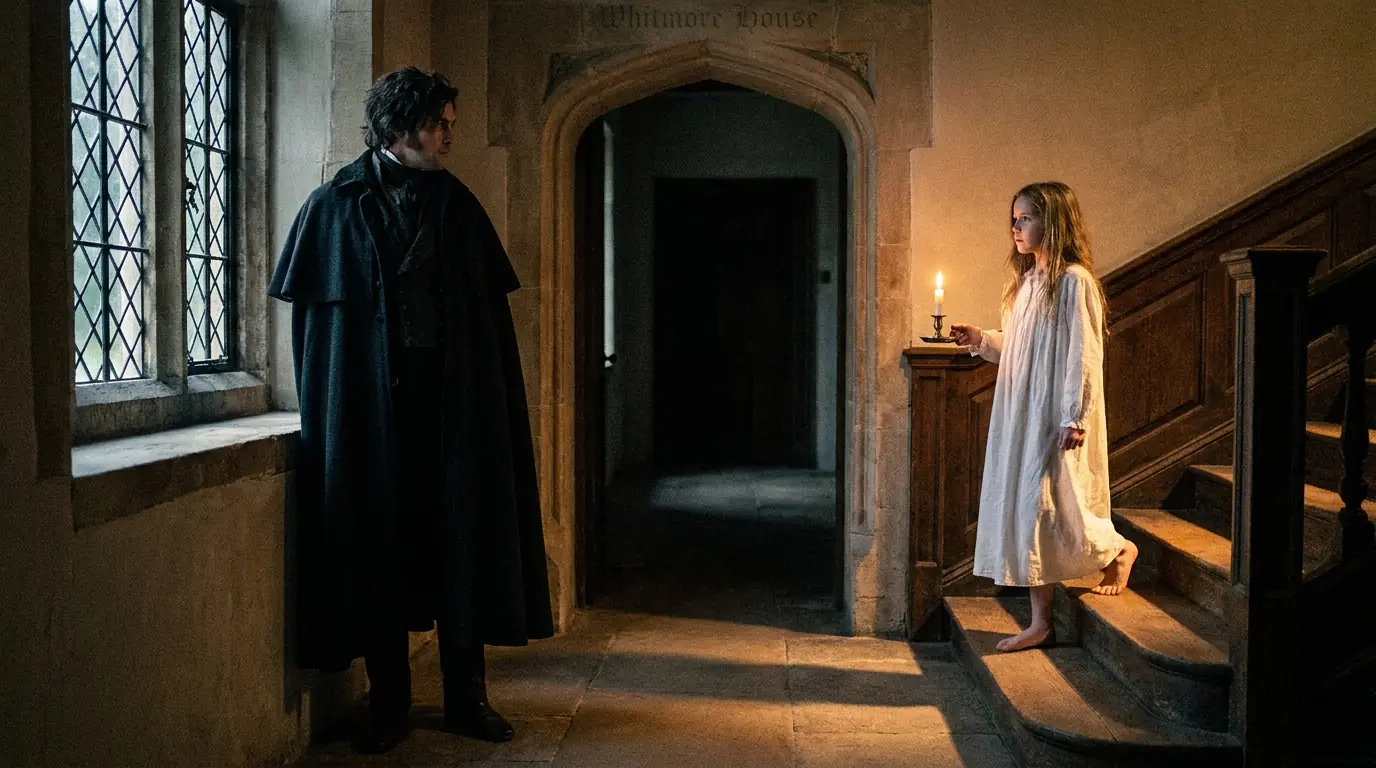
The hallway was lit with fewer candles than the drawing room, which was precisely its appeal. He stood by the window at the far end, looking out at the square below, grateful for 30 seconds of silence. He heard her before he saw her.
A small sound, not quite a gasp, more like the sound a person makes when they’ve been caught doing something they knew perfectly well they shouldn’t be doing. He turned. She was standing at the top of the servants’ staircase, half in shadow, clearly having descended from the floor above where the children had presumably been put to bed hours ago.
She was perhaps 10 years old, dressed in a white nightgown with her dark hair loose around her shoulders, and she was looking at him with an expression of such complete calm that it immediately distinguished her from anyone else he’d encountered that evening. Most children, caught out of bed in a house full of adults, would have fled or burst into tears.
This one simply looked at him, assessed him the way a serious person assesses a problem they have just discovered, and then walked forward into the candlelight as though she had every right to be there. You’re the Duke. Not a question, a categorization.
He found, to his mild surprise, that he was not annoyed. I am, and you are very much not supposed to be down here. I couldn’t sleep. With the simple authority of someone stating a fact that required no apology.
The candles smell different when there are this many of them. Waxy. It comes up through the floor. He regarded her. She regarded him back without the flutter or the performance that every other person in that house had offered him that evening.
There was something quietly restoring about it. Well, what is your name? Ada Pemberton. Lady Whitmore is my aunt.
A pause, precise and considered. My mother says you are the most eligible man in London. Your mother is not the first person to say so. She also says you’ll never marry because you’re too proud to be happy.
Ada tilted her head slightly, not unkindly, as though she were delivering this information as a service rather than an insult. A sound escaped him. Something he hadn’t produced in quite some time. A genuine laugh, brief, surprised, real.
She may be right. Ada considered this for a moment, then, with the utter sincerity that only children and the very old seem capable of sustaining, she looked up at him and said, When I grow up, I’m going to marry you.
He felt the laugh still warm in his chest. He gave her a small bow, the kind a man gives when he wants to honor a declaration without condescending to it. Then I shall have the great honor of waiting for you, Miss Pemberton.
She nodded, satisfied, and turned to go back up the stairs. At the top, she paused and looked back over her shoulder. You shouldn’t stand by cold windows. You’ll catch a chill.
And then she was gone. Back into the dark above. Maximilian stood in the corridor a moment longer than he needed to. Then he smiled, once, privately, and returned to the drawing room, and to the dinner party, and to the life that was already arranged around him like furniture in a house he had never quite chosen.
He forgot her entirely by morning. This is the part that matters. Ada Pemberton did not forget. Three weeks after that dinner, she was enrolled at Miss Hartley’s Seminary for Young Ladies in Bath, an institution that prided itself on producing women of refinement, restraint, and appropriate ambition.
The school was set in a wide Georgian building on a quiet street, surrounded by gardens that were beautiful and completely inaccessible to the students from October through April. Bath was not London. The fashionable set that gathered there was older, slower, less electric, but it was far enough from Grosvenor Square that a 10-year-old girl could carry a private thought without anyone asking her about it, and close enough to civilization that she could grow into something.
She grew, year by year, season by season, with the patient and deliberate quality that defined everything she did. She was not the most beautiful girl at Miss Hartley’s. Beauty there was abundant and took many forms, but she was perhaps the most interesting, which is a different, and in the long run, more useful quality.
He was not a fantasy she constructed around herself. He was a fixed point she had chosen when she was too young to choose wisely, and had chosen again, deliberately, every year since. That was the part she never told anyone. The choosing.
She knew, with the clear-eyed practicality that Miss Hartley’s had done its best to cultivate and accidentally succeeded in producing, that he would not remember her. A man like the Duke of Ashvale moved through evenings the way a river moves through a landscape, shaping everything around him, remembering nothing.
She had been a 10-year-old child in a corridor. She was not naive enough to think she had registered as anything more than a small, pleasant interruption, but she was returning to London. Her parents had decided the 1810 season was to be her first, and the letters that arrived from her mother over the winter of 1809 were full of plans and arrangements and the particular breathless energy of a woman who has been waiting to launch her daughter into society and finally sees the moment approaching.
Ada read these letters in her room at Miss Hartley’s, by the window, with a composure that her mother would have found suspicious if she’d seen it. She was not nervous about the season. She was not nervous about the dinners or the assemblies or the prospect of suitors.
She was thinking about one thing only, and that thing was this. She was going to see him again. And whatever happened next, whatever the truth of him turned out to be, whatever the distance between the man and the memory, she would know.
She would finally know. She packed her trunk at the end of March 1810 with the thoroughness of someone who does not intend to return. 10 years. She had been patient for 10 years.
Patience, she had learned at Miss Hartley’s, was not the same as passivity. It was just waiting with your eyes open. The Duke of Ashvale had not changed his position on marriage.
He had, if anything, reinforced it. He was 40 years old in the spring of 1810. 40. A number that his mother, the Dowager Duchess, had apparently decided was a kind of deadline.
She made her position known at breakfast in January with the calm certainty of someone announcing the weather. While Maximilian was reading correspondence and hoping very much to be left alone. You are too old to go another season without choosing a bride. People are beginning to talk.
People have always talked. Without looking up from his correspondence. It is their primary occupation. Maximilian. His name in her voice had a particular weight that still, at 40, produced the instinct to pay attention.
You need an heir. The estate needs continuity. And frankly, I am tired of making excuses for you at dinner parties. He set down his papers and looked at her with the expression he reserved for conversations he intended to end quickly.
I am too old, he said, each word measured and deliberate, to begin choosing a bride. The ship, as they say, has sailed. The appropriate season for all of that was 15 years ago, and I am afraid I simply missed it.
The Dowager Duchess held his gaze for a long moment. That, she said at last, is the most convenient lie you have ever told yourself. And she left the room, the most effective response available to her.
He sat with that sentence longer than he would have liked. He was not unaware of what he was doing. He had been a perceptive man since childhood and had not grown less so with age.
He understood that the cynicism was partly construction, a wall he had built brick by brick from every season he had moved through without finding what he hadn’t quite known he was looking for. He understood that his mother was not wrong.
He simply found it easier to be wrong about it himself. The spring season began in April. He attended because he always attended, the assemblies, the dinners, the afternoon calls, with the weary competence of a man who has learned to be present without being available.
He smiled. He danced once per evening, usually with the hostess or her eldest daughter, whoever would be most gratified and least encouraged. He left before midnight, every year the same. An impeccable performance of participation that had gradually become indistinguishable from indifference.
Lady Whitmore’s spring dinner, the 22nd of April, was the 14th such occasion Maximilian had attended at that house. He arrived, was surrounded, endured it, and had excused himself to the library for a moment of peace somewhere between the soup and the fish when the butler appeared in the doorway.
Miss Ada Pemberton, the man announced, apparently to the room at large, as two young women followed him in from the corridor. And Miss Clara Pemberton, nieces of Lady Whitmore, recently returned from Bath.
Maximilian looked up from the title page of a book he hadn’t opened. She was the one on the left, dark hair, dressed now, not loose, and something in the angle of her jaw, in the quality of her stillness, that struck him with the peculiar sensation of a word he knew he recognized but couldn’t quite place.
She was 20 years old, composed in the way that only women who have spent years learning to be are composed, and she was not looking at him. She was looking at the bookshelves. He found this almost comically disarming.
Every person he had encountered in a decade of seasons turned toward him the moment he entered a room, as if drawn by some invisible current. This woman had walked into a room he was already in with full awareness that he was there, the butler had seen to that, and had chosen to look at the bookshelves instead.
He watched her scan the spines with genuine interest. He watched the slight movement of her lips as she read titles silently. He watched her tilt her head at one particular volume as though it had said something worth considering.
Her sister murmured something to her. She turned then, gracefully, without hurry, and her gaze moved across the room and landed on him with neither the flutter nor the performance he expected. Simply, recognition. Or something that looked very much like it.
Your Grace. A greeting so perfectly measured it contained both courtesy and nothing else. He inclined his head. Miss Pemberton, you have recently returned from Bath, I understand.
10 years in Bath. A beat. Yes. Something snagged in him. 10 years. Pemberton, Lady Whitmore’s niece.
He turned the arithmetic over in his mind the way you turn a key that almost fits, feeling the resistance, the near catch of tumblers that haven’t quite aligned yet. He didn’t get there. Not yet.
Instead, he simply stood in the library of Whitmore House holding an unopened book while Ada Pemberton looked at him with 20-year-old eyes that seemed to be waiting for something he hadn’t yet understood he owed her. He thought about her for 3 days after that dinner.
This surprised him considerably. He was not a man who thought about people. They encountered each other seven times in the following 3 weeks. Maximilian counted and then was annoyed at himself for counting.
The Hargreave ball on the 1st of May, the afternoon concert at Mrs. Drummond’s house on the 7th, a chance meeting at Hatchards on the 9th, where he came in for political pamphlets and found her at the far end of the fiction shelf, deep in something she didn’t set down when he entered.
He had to clear his throat. She looked up without embarrassment and asked whether he had an opinion on Fielding. He did not, particularly, but found that he was formulating one.
He began to attend events he had previously declined. He told himself this was coincidence, then that it was curiosity, then that it was simply a reasonable expansion of his social obligations, and by the third lie, he had stopped telling himself anything at all and simply showed up.
The other women of the season noticed. His mother noticed. The gentlemen in his club made remarks he deflected with the skill of a man who has had 20 years of practice at deflection.
Society, as a collective organism, observed that the Duke of Ashvale, the man who had declared himself too old and too finished to begin anything, was appearing with suspicious regularity wherever a certain Miss Pemberton happened to be. Society found this tremendously entertaining, which it always does.
Ada, for her part, gave him very little to work with. This was, he was slowly realizing, entirely deliberate. She was warm in the way an intelligent woman chooses to be warm, present, engaged, genuinely interested in what was being said, but she offered him no extra measure of anything, no additional softness, no performance of availability, no meaningful glances calculated to encourage.
She treated him with absolute consistency as exactly what he was, a man she had met at a dinner party, nothing more, nothing that acknowledged the particular quality of attention he kept bringing into rooms and directing at her. He found this intolerable in a way he couldn’t entirely explain.
It was at the Ashvale musicale, the 14th of May, that he finally managed to put himself beside her long enough for a real conversation. The musicale was the kind of event where the music serves primarily as excuse, a reason for 50 people to sit in one room and communicate sideways with their eyes while pretending to listen to a soprano.
He had positioned himself on the aisle seat beside her before she noticed, which gave him a small and probably unworthy satisfaction. You don’t look like a man who enjoys music. Softly, without looking at him.
The soprano was in the middle of an introduction. I enjoy certain music. Equally quiet. I find I am enjoying this evening rather more than usual.
Nothing from her in response. The soprano began Handel, something ceremonial and too slow for the room. Around them, people listened with the focused expression of those trying to look like they were listening.
You were at Miss Hartley’s in Bath, he said. 10 years. From 1800. A confirmation, not a question, and she received it as one.
I left in March 1810. He turned the number over. He had been 30 in 1800. He had attended Lady Whitmore’s dinner in October of 1800.
The corridor, the candles, a 10-year-old girl in a white nightgown with dark hair loose around her shoulders, standing at the top of the servants’ staircase. He turned to look at her. She was watching the soprano.
Her profile was composed, entirely still, giving away absolutely nothing. But there was a faint quality to her stillness, something that didn’t quite fit the word calm, that made the hair rise very slightly on his forearms.
Miss Pemberton. A pause. Have we met before this season? A beat. Not hesitation, a decision being made.
Then she turned her head and looked at him with those dark, composed, 10-years-patient eyes. Once, she said. Or a very long time ago.
And she turned back to the music. He did not sleep that night. He lay in the dark at Ashvale House in Berkeley Square, staring at the ceiling, pulling at a thread of memory he couldn’t quite catch hold of.
Something in a corridor. Candlewax. A laugh that had surprised him. A voice with too much composure in it for its age. He caught it at 4:00 in the morning.
The thread came loose all at once, and he remembered. A small girl, barefoot, with enormous gravity and dark hair down, looking up at him with the exact same quality of stillness that Ada Pemberton brought into every room she entered, saying, without a trace of self-consciousness, without the slightest awareness that it was extraordinary, When I grow up, I’m going to marry you.
And him, laughing, promising, as a joke, to wait. He lay there for a long time with that memory and what it meant. He had laughed and forgotten. She had been 10 years old and had, what, held onto it? Used it as a compass?
He had no way of knowing, because she had given him nothing. Nothing except that one word, Once, delivered with the patience of someone who had been practicing that particular restraint for a very long time.
He told himself it was nothing. Children say extraordinary things and mean them for an afternoon. He told himself this firmly, and then lay awake until dawn thinking about her hands, which had been folded very precisely in her lap during the Handel, and about the way she looked at bookshelves when she thought no one was watching.
Lady Drummond’s garden party, the 28th of May, was the kind of afternoon that English society had invented specifically to put people in proximity without giving them any excuse to be alone together. The garden was full, perhaps 80 guests moving across manicured grass under a sky that had decided, unusually for late May, to be entirely cooperative.
There were tables with lemonade and small plates of things that no one was really eating, and a string quartet at the far end near the roses, who played pieces that drifted pleasantly across the lawn without demanding anyone’s full attention. Maximilian found Ada near the wisteria.
She was standing with her back partly to the party, looking at the climbing plant with what he had come to recognize as genuine interest, the kind she brought to anything she examined, which was different from the performed interest most people offered to the world. Her sister was across the lawn with a group of young people.
She was alone for the first time in his memory of her, and he moved before he had decided to. Miss Pemberton. She turned. The sunlight was full in her face, and she didn’t squint against it, just received it.
And there was something in that small thing that tightened something in his chest. Your Grace. She waited. Composure perfectly intact.
He wanted to say something direct, something honest, something that would close the distance between what he knew and what she was deliberately not confirming. Instead, he found himself asking whether she enjoyed wisteria.
The corner of her mouth moved, not quite a smile, but adjacent to one. I was thinking about the structure of it, how it climbs. It winds so tightly around whatever it clings to that after a certain point, you can no longer say which is holding which.
He looked at the wisteria. He looked back at her. That is a rather precise observation for a garden party. I am a rather precise person.
No apology in it, just the fact. They were quiet for a moment that contained, as their silences increasingly contained, a great deal that was not silence. Around them, the party moved and laughed and performed.
Neither of them looked at it. I remembered, he said. He hadn’t planned to. The words simply arrived, and he let them. October 1800, the corridor at Whitmore House. You were supposed to be in bed.
Something shifted in her face. Not surprise, the opposite of surprise. A quality of stillness that had been braced for this moment and was now meeting it without flinching.
She held his gaze for a long beat that felt like several different things at once. You remembered. Neutral, giving him nothing.
I’m sorry I didn’t remember sooner. You had no reason to. Simply stated, I was a child. Children say things.
He wanted to ask her the question directly. He wanted to say, Did you mean it? Do you still mean it? Did you come back to London because of a promise I made laughing in a corridor when you were 10 years old and I was too foolish to understand that anything I said to you might matter?
He said none of it. 40 years of composure made direct questions feel like removing armor in the middle of a battlefield. He said instead, I hope Bath was, that is, I hope it was a good 10 years.
It was. The almost smile again, more definite now, and instructive. They were interrupted, as they were always interrupted, by the arrival of other people with other purposes.
Lady Ashworth appeared with a young lord who needed introducing. The moment dispersed like smoke in an open window. But Maximilian stood in the garden for a long time after Ada had been drawn away, looking at the wisteria, thinking about the word instructive and what it meant from a woman who chose her words with the care of someone who understood that every one of them cost something.
By the first week of June, the observation had become a consensus. The Duke of Ashvale was pursuing Miss Ada Pemberton. This conclusion, accurate in its result if somewhat imprecise about its cause, generated the full range of social responses that might be expected.
The mothers of unmarried daughters were quietly disappointed. The young men who had begun to circle Ada with interest now circled with more urgency, understanding without being told that the window they had imagined was perhaps smaller than it looked.
Lady Whitmore herself moved through her days with a particular satisfaction, taking credit for a connection she had not engineered and would have been shocked to learn existed. Ada’s mother arrived from the country in the second week of June, summoned by letters from Lady Whitmore that were too carefully vague to be anything other than news.
She arrived and immediately assessed the situation with the accuracy of a woman who has been watching society for 30 years, took her daughter’s arm at the earliest opportunity, and demanded a plain account. Ada was quiet for a moment, not evasive, simply taking stock.
He is exactly what I expected, she said at last, and nothing like what I imagined. Her mother waited. He is guarded. He has built something very careful around himself and lives inside it quite comfortably.
I don’t think he knows how to want something openly without immediately building walls around the wanting. Most men of his age don’t, her mother said practically.
I know. Ada’s voice was thoughtful. I just wonder if he’s already decided the answer is no before he’s let himself understand what the question is.
Her mother looked at her daughter, 20 years old, with 10 years of careful patience behind her, and a particular quality of resolve that had always been in her, even at 10, even in nightgowns in cold corridors, and said nothing.
Sometimes silence is its own kind of answer. Meanwhile, a young viscount named Hereford had decided to stop being cautious. Lord Edmund Hereford was 28, handsome in an uncomplicated way, with a pleasant estate in Shropshire and a temperament that could be described, charitably, as straightforward, and less charitably, as simple.
He had admired Ada from a distance for the first weeks of the season and had spent the last 2 weeks moving steadily closer. By the 9th of June, at the Greystone card party, he had made his intentions clear enough that Ada could not have misunderstood them.
He sat beside her at the card table for 3 hours. He was attentive, amusing, interested in her opinions, and notably unafraid of saying directly what he meant. Ada liked him, genuinely.
He was easy in a way that Maximilian was not. He offered warmth that didn’t have to be excavated from beneath years of carefully constructed distance.
Maximilian arrived late to the card party and registered the situation in approximately 30 seconds. He had never been a jealous man. This was his considered view of himself, based on 40 years of not having felt it.
He discovered, standing in the doorway of the Greystone card room, watching Lord Hereford lean toward Ada to say something that made her laugh, that his considered view had simply been waiting for the appropriate stimulus.
What moved through him was not comfortable. It was not something he could address with composure or deflect with a well-constructed sentence. It sat in the center of him like something struck by flint.
He played cards on the other side of the room and spoke to people and smiled when it was required. And every 10 minutes, he looked across and Lord Hereford was still there.
And Ada was still laughing. And the thing in his chest did not improve. He left at 11:00 without speaking to her.
He walked home through the June dark and arrived at Ashvale House in a temper he was too proud to acknowledge and too intelligent not to understand. And went to his study and sat in the chair behind his desk and thought, for the first time without flinching, about what he was actually doing.
He was 40 years old. He had told his mother, told himself, told anyone who asked, that the time had passed. He had built a very comfortable architecture of resignation around himself and lived in it for years and had been, if not happy, at least insulated from the particular kind of unhappiness that wanting something you cannot have produces.
And now, there was Ada Pemberton, 20 years old, with a 10-year-old’s declaration still somewhere in the room between them. And a young viscount who was not complicated and not guarded and would give her a straightforward life with straightforward warmth.
He wanted her, not as an abstraction, not as a pleasant diversion in an otherwise predictable season. He wanted her specifically, precisely, the way she tilted her head at books and chose her words and looked at wisteria and refused to give him anything he hadn’t earned.
He had been circling that truth for 6 weeks. He was done circling. The question was what he was going to do about it.
And whether he had, in his decade of careful inaction, already run out of time. The Pemberton household received the news on the morning of June the 15th.
Lord Edmund Hereford had sent a formal letter of interest to Ada’s father, who was traveling from the country and expected in London within the week. Nothing was official. Nothing was decided.
But the letter existed. And Lady Whitmore told Ada about it over breakfast with the satisfaction of a woman who considers the closing of a chapter a satisfying ending in itself. Ada read the letter.
She set it down. She ate her breakfast. She thought about Lord Hereford and his uncomplicated warmth and his estate in Shropshire, where the wisteria probably climbed perfectly reasonable trellises and asked nothing complicated of anyone.
She thought about what a good life that could be. And she thought about Maximilian Royce, who had remembered her at 4:00 in the morning 3 weeks after the musicale, and who had said he was sorry for not remembering sooner.
And who had been circling her for 6 weeks with all the careful approach of a man trying to land somewhere he wasn’t sure he was allowed. She thought about a man who had publicly, repeatedly, emphatically declared himself too old to choose a bride.
And who had, in that same breath, been showing up wherever she was with the reliability of a compass finding north. She had been patient for 10 years.
She’d been patient enough. The Langley afternoon reception on the 16th of June was a large, loose affair. 30 people across two drawing rooms and a conservatory.
The kind of event where conversations could be private without being conspicuous. Ada arrived with her sister and her mother, spoke to several people with perfect courtesy, and then, when the moment presented itself, walked to the conservatory where she knew he would be.
Because Maximilian always eventually found his way to the edges of rooms and conservatories were the most defensible edge available. He was standing near the palms, looking out at the small enclosed garden beyond the glass.
And he turned when she entered. Something moved across his face. Relief, she thought, or its cousin. And then the composure came back down like a curtain.
She stopped a few feet from him. The conservatory was empty of other guests. Through the glass, the garden sat still and green in the afternoon light.
I need to say something to you. And I need you to let me finish before you respond. He nodded once.
She took a breath, not of uncertainty, but of the kind of precision she applied to everything. Do I came back to London because of you? Not entirely.
The season was always the plan and I was always going to come. But I came back willing, without dread, because for 10 years the thing I most wanted to do when I returned was stand in the same room as you, at 20, and understand whether what I felt at 10 was a child’s fantasy or something true.
He was very still. I have spent 6 weeks in the same rooms as you. And the answer is that it was something true, which is inconvenient.
And I am aware that it is inconvenient. And I am aware that you are 40 years old and have decided, thoroughly, publicly, and with impressive consistency, that you are too old and too finished for this sort of thing.
You have said it to your mother. You have said it to your club. You have said it to anyone who asked. She held his gaze.
And yet here you are. A pause. Precise. Deliberate.
Lord Hereford has written to my father. He will arrive from the country this week. I have not decided anything.
And I will not decide anything without a stop, a breath, a new start. I have been waiting 10 years for you to see me.
Not the child in the corridor. Me. And I am standing here now telling you exactly what I mean, because I am finished with patience and I have run out of time for it.
Her voice dropped, not softer, but quieter, the way a fire burns lower without going out. And so choose me now, she said, or let me go.
The conservatory was entirely quiet. Somewhere in the house behind them, a door opened and a burst of laughter came through from the drawing room.
And then the door closed again and it was quiet again. He looked at her. And she watched something happen in him.
A process she could not name precisely, but she could see it. The architecture of 40 years of careful distance meeting something it had not been built to withstand.
He opened his mouth, closed it. Something passed across his face that she had not seen there before. Something unguarded and almost raw.
And then he said her name. Just that. Ada. With all the composure gone from it.
She waited. You were 10 years old. His voice was rough at the edges in a way it had never been.
You cannot have You cannot have decided at 10. I decided at 10. And I decided again at 15. And at 18.
And I decided this morning before I came here. Her gaze didn’t waver. How many times does a person have to choose the same thing before it counts?
He had no answer. She hadn’t expected him to. Not immediately. Not with the truth of what she had said still landing.
She let it land. She gave it the space it needed. I’ll be at Lady Whitmore’s house tonight.
And then my father arrives. And after that She didn’t finish the sentence.
She didn’t need to. She walked back through the conservatory and into the drawing room and back into the afternoon reception.
And she did not look back, because she had said what she had to say and it was done and the rest was not in her hands. Maximilian stood among the palms for a very long time.
He thought about everything she had said. And then he thought about the thing she had not said. The thing underneath all of it.
The thing he had finally, undeniably, understood. He had spent years telling everyone within earshot that he was too old to choose a bride.
And in doing so, had chosen the most comfortable kind of cowardice available to a man of his position. The kind that looks like philosophy.
She had given him his answer. Now, he had to give her his. The clock on the mantelpiece at Whitmore House struck 12.
Ada was in her room, not sleeping. She had not expected to sleep. She was sitting in the chair by the window with a book she had not opened, watching the street below in the particular way you watch for something you don’t quite permit yourself to name.
The knock at the front door came at 10:00 past the hour. She heard it from upstairs. One sharp knock, deliberate, not hesitant.
She heard the stir of the night footman roused from his chair, the slow approach of footsteps, the groan of the front door on its hinges. She heard a voice, low, male, impossible to distinguish from this distance.
She heard the footman’s voice in response. She was already at her bedroom door, already in the corridor, moving toward the landing before she had decided to move.
She looked down the staircase. He He was standing in the entrance hall of Whitmore House and he had no hat. She saw that first, the absence of it, the way his hair was disordered as though he had come on foot and come quickly.
He had no gloves, either. He was still in his evening clothes from wherever he had spent the first part of the night. And there was about him an entire absence of the careful composure that had been his most consistent feature in all the weeks she had known him as an adult.
He looked up. She was standing at the top of the stairs in her dressing gown with her dark hair loose around her shoulders and a candle in her hand and she was 20 years old.
And she was also 10 years old in a corridor. And the two things existed in the same moment without contradiction. He stared at her.
She watched him take a breath that seemed to cost him something. I remember everything. His voice carried up the staircase without effort.
Low, rough, entirely unguarded. The corridor. The candles. You told me not to stand by cold windows or I’d catch a chill.
I have thought about that every day for 6 weeks and did not understand why until approximately 2 hours ago. She came down the stairs.
Slowly. Because this was not a moment to rush. She stopped three steps from the bottom, which put them at nearly the same height.
And she looked at him. I laughed. No excuse in it, just the plain accounting of it.
The You said something true and I laughed and I forgot and I have been an idiot for 10 years in ways I am only beginning to catalog. He looked at her with the kind of directness that costs a man something when it doesn’t come naturally.
I am 40 years old and I have spent a great deal of energy convincing myself and everyone around me that wanting something was no longer available to me as an option. I was wrong.
Specifically, particularly wrong about this. A step forward. About you.
She looked at him for a long moment. The candle in her hand threw light across his face and she could see the truth of what he was saying.
Not the composure of a man who has prepared a speech. But the stripped and simple truth of a man who has run out of architecture.
I told you I would wait for you. He continued. Very quietly.
I said it as a joke in a corridor when I was 30 and foolish and had no idea what I was saying. I would like to say it now and mean it if you will allow me to.
She descended the last three steps. She was very close to him now. Close enough to see that he was breathing unevenly.
That his hands, without the hat, without the gloves, were not entirely steady. This man who was always steady.
This man who had built steadiness into an art form. I’ve been waiting 10 years for this. She whispered.
He heard it. The weight of all 10 years in four words. The choosing and the choosing again.
The patience that was never passivity. Something broke open in him at the words. Quietly, without drama, the way ice breaks in spring.
Not with violence, but with the long inevitability of a season finally changing. He reached for her hand.
Both of them. Bare. No gloves. No ceremony.
And held it in his with a care that was new in him. That he was clearly learning as he went.
He looked down at it for a moment. Then up at her. Will you allow me to speak to your father when he arrives?
The formality of the question was entirely at odds with the roughness still in his voice. And she loved both at once.
Yes. He let out a breath. Slow.
Long. The breath of a man who has been holding something for a very long time and is only now putting it down.
He brought her hand up and pressed his lips to her knuckles. Briefly. Warmly.
In the way of a man who intends to have many years to do this properly and is beginning now. You should go back upstairs.
It is past midnight and I have already compromised your reputation by approximately 10 different measures tonight. You knocked on the front door.
She pointed out. Very properly. At midnight. Without a hat.
The corner of his mouth moved. And there it was. The laugh she remembered from 20 years ago.
The one that transformed him. The truest thing in his face. My mother is going to be insufferable about this.
Mine already is. He laughed. A real laugh.
The full version of it. The one she had been waiting since 1800 to hear again. It filled the entrance hall and she felt it settle in her chest like something finally placed exactly where it belonged.
He released her hand. She went back up the stairs. At the top, she turned.
Because some things are worth the repetition across decades. Your Grace.
He looked up. You should have a hat made for waiting in. You’ll catch a chill.
He looked at her. This woman of 20 who had carried a 10-year-old’s declaration across a decade and offered it back to him.
True and whole and unhurried. And his face was open in a way it had not been in many years.
Possibly ever. I’ll have several made.
He said. They were married in August.
A quiet ceremony in the chapel at Ashvale Park. Maximilian’s country estate in Wiltshire where the wisteria on the south wall had been climbing the stones since 1743 and showed no signs of stopping.
The Dowager Duchess cried, which she would have found undignified if she had been less pleased. Ada’s mother cried louder and with considerably more volume having long ago decided that she was entitled to.
Lord Edmund Hereford sent a very gracious letter of congratulation which Ada read and set aside with a respect for him that had not diminished. He was, she thought, exactly what he appeared to be and that was more than most people managed.
She hoped sincerely that he found someone who deserved him. The ton talked as the ton always talks.
They said it was the strangest match of the decade. The Duke of Ashvale who had declared himself too old to choose a bride.
Married to a girl 20 years his junior. The niece of Lady Whitmore of all people.
A Bath Seminary graduate with no particular fortune and no particular connection beyond the one she had apparently been quietly building for 10 years. They said it quickly.
And then they said it less. And then they stopped saying it.
Because every person who encountered the Duke and Duchess of Ashvale together in a room reported the same thing. The man who had built composure into an identity was in the presence of his wife.
Entirely and permanently at ease. He laughed differently. He occupied rooms differently.
He had stopped building walls and started opening windows, which is a thing that happens to people when they finally permit themselves to want what they want. Ada did not need anyone to report this.
She had the original in front of her every day and every day she found it exactly as true as the night before. They were in the library at Ashvale House in September.
She reading, he at his correspondence. Both of them in the familiar quiet that had become the texture of their days together.
When he looked up without preamble and said, You were 10 years old. She looked up from her book.
As I know. It is a very young age to decide something. It is.
She considered him across the room with the same composure she’d carried through 10 years of Bath winters and one very particular London season. But I decided again every year.
That should count for something. He looked at her for a moment.
This man who had learned slowly, with the particular grace of someone unlearning a lifelong habit. To let things simply be felt.
It counts for everything. He said.
She smiled. Not the contained, measured smile she had worn through the whole of the season.
But the full one. The unguarded one.
The one she had been keeping for him. He folded the letter he’d been writing and set it aside, which meant the correspondence was finished for the afternoon, which meant he was entirely present, which was still, even now, even months in, her favorite thing about being married to him.
The man who had spent 40 years at a remove had learned, with astonishing thoroughness, to arrive. Outside the library windows, London moved through its September business.
The season was over. The assemblies, the balls, the card parties, the careful performance of availability and interest.
All of it folded away for another year. Autumn was coming in from the north.
Turning the park leaves at their edges. Bringing the smell of cold stone and wood smoke and the particular quality of English light that makes everything look like a painting of itself.
Inside the library, the Duchess of Ashvale returned to her book. The Duke of Ashvale returned to his correspondence.
Stayed with it for approximately 4 minutes and then he set it aside again in favor of crossing the room and sitting beside his wife on the settee. Which was not a thing the ninth Duke of Ashvale had ever been observed doing before the summer of 1810 and which he now did with the ease of a man who has found, finally, the place where he is most himself.
She leaned against his shoulder without looking up from her page. He let her.
Without speaking. Which was its own language.
Some promises are made at 30 and kept at 40. Some declarations are true at 10 and truer at 20.
And some loves are so patient, so precise, so absolutely clear about what they are from the very beginning, that all the years between are not delay. They are simply the time it takes for the slower of the two hearts to catch up.
The wisteria on the south wall of Ashvale Park had been climbing for 67 years by the time Ada and Maximilian came to live there. It had long since passed the point where you could say which was the stone and which was the vine.
Some things become so thoroughly intertwined that the question stops mattering. This was, in the end, exactly what Ada had predicted from the very beginning.
She had always been a very precise person.