The elevator doors opened onto ash blonde wood floors, low jazz playing somewhere overhead, a Rothko-style painting in burnt orange and black hanging on the far wall above a leather bench. A single white orchid sat on the concierge desk in a hand-blown glass vase. Two clients in their 60s were sipping espresso at a small table by the window reading the Financial Times. The air smelled like lemon furniture wax and freshly ground Ethiopian coffee beans. Somewhere down the hall, a printer hummed softly to itself.
Margaret Wilson looked up from her terminal.
Her smile was already in place when the doors opened.
It was the smile of a woman who had been waiting for him.
The doorman in the lobby downstairs, Tyler Brooks, had called up two full minutes earlier.
“A gentleman for the 32nd. No appointment listed.”
Margaret had answered:
“Send him up, Tyler. I’ll handle it from here.”
She had been handling it for 12 long years.
She stood up the moment she saw him.
She stepped out from behind her concierge desk, a small deliberate movement that put her body squarely between Bradley and the open space of the private suite beyond her.
“Good morning, sir. I think you may be on the wrong floor this morning.”
Her voice was bright. Sing-song.
The voice you use with a small child who has wandered into the wrong classroom by accident.
“The general banking lobby is on the first level. Would you like me to call the elevator back down for you right now?”
Bradley stopped walking.
He smiled. Polite. Small.
“I’m fine, thank you very much. I was hoping to speak with a private client adviser this morning, if possible.”
Margaret’s smile tightened at the corners.
It was a small tightening, the kind only a person who has been looked at this way before would ever notice.
Bradley noticed.
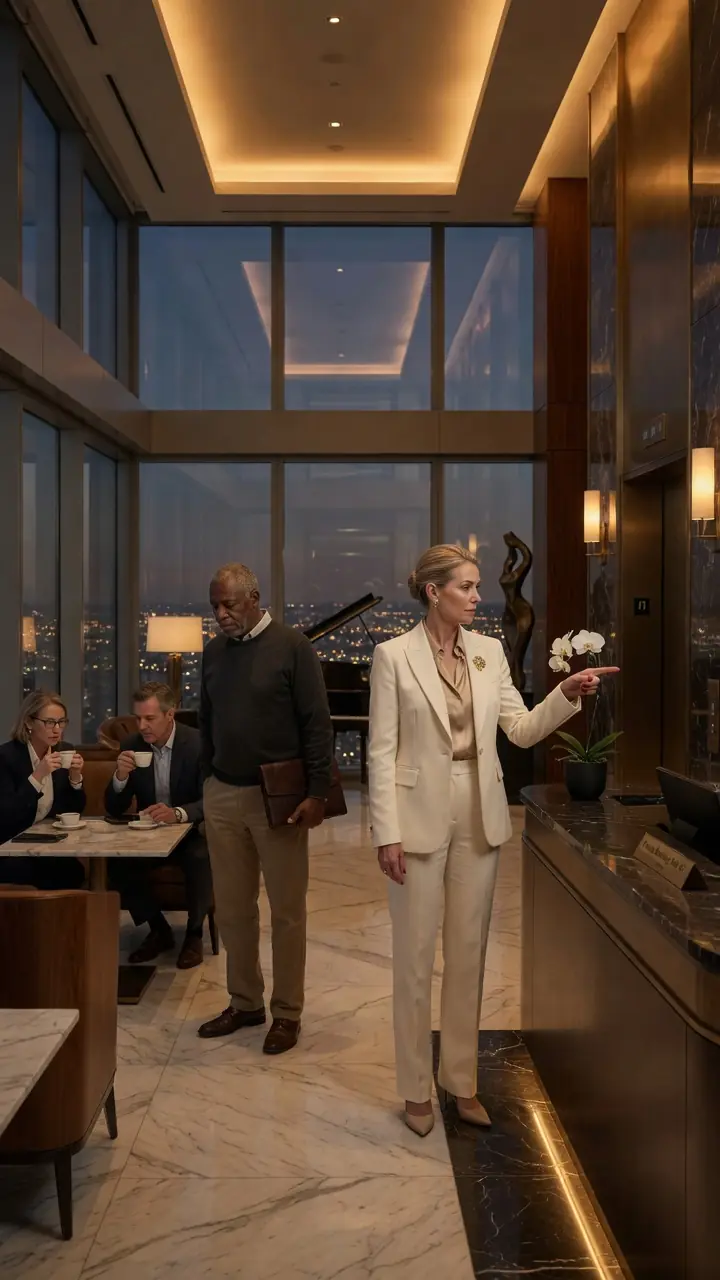
He had been noticing it for 62 years.
“Sir,” she said, and the word sir sounded like a word she was holding with a pair of tweezers.
“This floor is for our clients. The ATM lobby is on Lexington Avenue, just around the corner.”
“That way.”
She pointed.
Her finger was perfectly steady.
Her nail polish was the color of dried blood, freshly done at a salon on Madison.
One of the men at the window glanced up over the top of his folded Financial Times.
The corner of his mouth twitched.
He went back to his paper without saying a single word, but his eyes did not return to the page.
Bradley took a slow, measured breath.
“I understand,” he said. “I’d actually like to open an account, a private client account, if that’s possible today.”
Margaret laughed out loud.
It was not a quiet laugh.
It was a real laugh, the kind you let out when you think the person across from you is genuinely funny.
She put a hand flat on her chest.
She shook her head twice as if to clear it of something stuck.
“Sir,” she said, “our minimum here is $25 million.”
“This isn’t a regular savings account.”
The word million hung in the air like a slap across his face.
Bradley kept his face perfectly still.
“Yes,” he said. “I’m aware of the minimum requirement.”
Margaret blinked twice.
For just a half second, something flickered behind her eyes.
Not doubt. Not yet.
Just the small adjustment of a person whose well-rehearsed script had been briefly interrupted.
Then she smiled again.
Wider this time.
Sweeter.
The way a person smiles when they have decided to be patient with someone they consider beneath them.
“Tell you what,” she said. “Why don’t I have someone from our community banking team come up and have a little chat with you? They have wonderful products, starter accounts, great things for people who are just beginning their financial journey.”
The phrase “people who are just beginning” did something to the entire room.
The man at the window glanced up again.
He stayed looking this time.
Hannah Brown at desk four lifted her head from her keyboard.
Her hands stopped typing midword.
Even the printer down the hall seemed quieter than it had been a moment before.
Bradley reached slowly into the inside pocket of his sweater.
Margaret’s whole body went stiff.
Her right hand drifted just an inch toward the small panic button mounted under the edge of her desk.
He pulled out a slim leather wallet.
He took out a New Jersey driver’s license.
He set it down gently on her desk between them.
“My name is Bradley Davis,” he said. “I’d like to open an account this morning, please.”
Margaret picked up the license between two fingernails.
She turned to her terminal.
She typed his name slowly.
The system pinged once.
No record found.
Her smile became something else entirely.
“Mr. Davis,” she said, and now the sir was gone and the mister was wearing those same tweezers.
“You’re not in our system.”
“You have no account here at Bowmont Crest.”
“That’s correct,” Bradley said. “I’m here to open one this morning.”
“That’s not how this process works at our institution.”
“How does it work?”
Margaret’s jaw tightened.
The thin blue vein at her temple stood out for a second, then settled back down.
“It works,” she said, “by appointment only, through a personal referral from an existing client or a sitting member of our board.”
“Do you have a referral letter, Mr. Davis?”
Bradley said nothing for a long moment.
He didn’t have a referral letter.
He owned the board.
“I see,” Margaret said. “Well then there’s also a second matter.”
Bradley said quietly:
“I’d like to access a safe deposit box.”
“It was opened here in 1962.”
“The box number is 1162.”
Margaret stared at him for a long second.
Then she laughed again.
Smaller this time.
More dangerous.
It was a laugh with something very hard inside it, like a heavy coin dropped into an empty tin cup.
“Sir, safe deposit boxes from 1962 are not just accessed by walking in off the street.”
“We require proof of ownership, valid photo identification, a certified death certificate if you’re claiming inheritance, the original brass key—”
“I have all of that,” Bradley said.
He reached slowly into the inside pocket of his sweater one more time.
He pulled out a folded ivory envelope yellowed at the corners with age.
He set it carefully on the desk next to his driver’s license.
Inside, Margaret could see the edge of a sheet of notebook paper, the corner of what looked like an old paper key tag, and the edge of an official document bearing a New Jersey state seal in gold.
Margaret did not pick the envelope up.
She looked at it the way a person looks at a stain on a clean white tablecloth at a formal dinner.
“Charles,” she said softly into the small earpiece tucked behind her right ear. “Can you send someone up to 32? I have a guest who is confused about his location this morning.”
The word guest was the most insulting word she had used yet that morning.
Somewhere down the elevator shaft below them, a security radio crackled to life.
Static first.
Then a man’s low, calm voice answered her clearly.
“Copy that, Margaret. Two minutes out from your floor.”
Hannah Brown at desk four slid her chair back two inches across the polished wood.
Her hands were shaking visibly.
She looked at the ivory envelope sitting on Margaret’s desk.
She looked at the calm, tired face of the Black man standing there in the charcoal sweater.
She looked at Margaret smiling her tweezer smile at him.
And for the first time in eight long months working at Bowmont Crest, Hannah Brown stood up from her chair without being asked by anyone.
The elevator chimed again.
The doors slid open behind Bradley.
Charles Hampton stepped onto the 32nd floor first.
He was in his early 50s, white, broad in the shoulders, wearing a navy security blazer with the Bowmont Crest crest stitched in gold above the pocket.
Eighteen years on this floor.
Twelve years before that with the NYPD in the Bronx.
He had the kind of face that had stopped being surprised by anything a long time ago.
Behind him came a younger guard, mid-20s, name tag J. Reeves, his hand resting lightly on the radio at his belt.
Charles took in the scene in one slow look.
The Black man in the charcoal sweater standing calm.
Margaret behind her desk smiling the wrong kind of smile.
The ivory envelope on the wood.
The driver’s license.
The two clients at the window suddenly very interested in their espresso cups.
Charles did not love what he was looking at.
“Mr. Davis,” he said, his voice low and careful. “I’m sorry to trouble you. Would you mind stepping into one of our verification rooms for just a moment, just so we can sort everything out properly?”
Bradley nodded once.
“Of course.”
He picked up his license.
He picked up the ivory envelope slowly and slid it back into the inside pocket of his sweater.
Margaret’s eyes followed the envelope the whole way.
They walked down a narrow side hallway off the suite.
White walls.
Recessed lighting.
Three unmarked doors.
Charles opened the second one.
Room 32B.
A small brass plate read.
Inside was a small windowless office.
One round table.
Three chairs.
A single security camera mounted in the corner ceiling, its small red light blinking steadily once every two seconds.
Margaret followed the men in.
She closed the door behind her.
The room smelled faintly of cleaning solution and old paper.
“Mr. Davis,” Margaret said, her voice no longer sing-song, “empty your pockets onto the table, please. The bag as well.”
Bradley did not move for a moment.
“On what authority?”
“On the authority that you came to a private financial institution claiming to be a client when you are not, and we have reason to believe you may be attempting to commit fraud.”
Charles shifted his weight.
“Margaret, we don’t have—”
Charles.
Margaret cut him off, her eyes never leaving Bradley.
“This is my floor. I will handle the verification.”
Charles closed his mouth.
His jaw worked once.
He stepped back against the wall.
Bradley set his slim leather wallet on the table.
He set his phone beside it, screen down.
He set the ivory envelope down.
Last, he placed a small leather notebook, the kind a man carries in his back pocket, the cover soft and worn.
Margaret reached past the wallet and the envelope.
She picked up the notebook first.
She opened it.
She flipped through the pages slowly, one at a time.
Inside, in Bradley’s careful handwriting, were notes from board meetings, names, dates, numbers in long columns.
The phrase “Bowmont Crest closing 6:14 p.m. Monday” was written near the bottom of the most recent page, circled twice.
Margaret did not understand what she was looking at.
She decided, in the way people like Margaret decide things, that whatever she did not understand must be suspicious.
“This,” she said, holding the notebook up, “is staying with me.”
“We’ll be calling the police.”
“That notebook is private,” Bradley said quietly.
“Nothing in this room is private until I say it is.”
She set the notebook down on her side of the table.
She picked up the ivory envelope next.
She slid one finger under the flap.
“Don’t,” Bradley said.
His voice was still calm, but something underneath it had shifted.
The way a calm river shifts a half inch when a stone drops into it far upstream.
Margaret opened the envelope.
She took out the brass key first.
She held it up between two fingers, the paper tag dangling, the dim fluorescent light catching the edge of his mother’s faded handwriting.
“Box 1162.
Lil.”
Bradley, for the first time that whole morning, leaned forward in his chair.
“That,” he said, and his voice cracked just slightly on the next word, “is my mother’s.”
“Please… please put it down.”
Margaret looked at the key.
She looked at Bradley.
She looked at the key again.
Then she did the cruelest small thing she had done all morning.
She did not put the key down.
She set it carefully on the far edge of the table on her side, well beyond the reach of Bradley’s open hand.
“Personal items,” she said, “will be held as evidence until law enforcement has reviewed them.”
“Including sentimental ones.”
Bradley pulled his hand back.
He rested it on his lap.
Beneath the edge of the table, where Margaret could not see, his fingers closed slowly into a fist.
His knuckles went pale, then white.
Across the room, Charles Hampton turned his face toward the wall.
He could not look at the table anymore.
He had seen a lot of things in 18 years.
He had not seen this exact thing.
Margaret leaned across the table.
She dropped her voice low below where she thought the camera microphone could pick it up.
She was wrong about the camera.
“Listen to me,” she said. “I don’t know what you thought you were going to pull here today.”
“We get people like you in this building every couple of months.”
“It’s embarrassing for everyone involved.”
“So here’s what I’m going to do. If you walk out of here quietly right now, I won’t press charges.”
“You won’t have a problem with NYPD.”
“Understood?”
Bradley said nothing.
“Are you slow?” Margaret said.
“Did you understand what I just said to you?”
Bradley reached slowly for his phone on the table.
Margaret’s hand came down on the table beside his wrist with a sharp slap.
Not on him.
Near him.
Close enough that Charles flinched against the wall.
“Hands where I can see them, sir.”
“I’d like to make one phone call,” Bradley said.
“After we call the police, not before.”
“That’s not how the law works.”
“It’s how it works on this floor.”
Margaret pulled her own phone out of her blazer pocket.
She lifted it above the notebook on the table.
She tapped the screen.
There was a small electronic click.
She had taken a photograph of the open page.
The one with the bank’s name.
The one circled twice.
“For the police report,” she said calmly.
“Evidence of intent.”
She did not realize in that moment that she had just photographed confidential merger and acquisition information onto her personal device.
She did not realize this was a federal securities violation.
She did not realize the GPS coordinates and the exact timestamp were now embedded in the metadata of her own phone.
She did not realize she had just handed the investigators their best piece of evidence.
She also did not realize that downstairs on sublevel two, a quiet compliance employee named Gregory Hayes was sitting at a long desk with a pair of headphones on, typing every word she had said in room 32B in real time into the bank’s mandatory FINRA interaction log.
He had been typing for nine minutes already.
When he typed the line:
“We get people like you in this building every couple of months,”
his fingers stopped on the keyboard.
He read it twice.
He set his pen down.
He picked up the internal phone on his desk and dialed Lawrence Taylor, chief compliance officer, on the 28th floor.
Bradley’s phone, face down on the table, began to buzz.
Once.
Twice.
Three times.
A long string of insistent vibrations.
It was Eleanor Anderson, his chief of staff, calling for the fourth time that morning.
She had been calling since 7:30.
He had not answered.
Margaret looked at the buzzing phone.
“You can call whoever you want,” she said, “after the police arrive.”
Bradley looked at her steadily.
“That call,” he said quietly, “is going to keep coming.”
“And when it doesn’t get answered, three people are going to be very upset.”
“One of them owns this building.”
Margaret rolled her eyes.
“Sure he does.”
But Charles Hampton against the wall did not roll his eyes.
Charles had worked under nine different bank presidents in 18 years.
He had learned slowly to read a man’s face.
The face across the table from Margaret right now did not look like the face of a fraud.
It looked like a face he should already know.
Down the hallway, the elevator chimed once more.
Lawrence Taylor was stepping out of the stairwell, breathing hard.
He had taken the stairs from the 28th floor because they were faster.
He did not know yet that this decision was going to save Margaret Wilson from the worst single mistake of her life and end her career anyway.
The door to room 32B opened without a knock.
Lawrence Taylor stepped inside.
He was 44, white, lean, with the kind of careful posture that comes from three weeks of trying very hard not to make a mistake in a new job.
He had been chief compliance officer at Bowmont Crest Bank for exactly 22 days.
He had sat through two board meetings.
In both meetings, he had seen photographs of the man who, as of 6:14 p.m. the previous Monday, owned 58% of this institution.
He looked at Bradley.
He looked at Bradley again because the first look had not been enough.
He looked at Margaret.
He looked at the brass key sitting on the far edge of the table, the small paper tag with the words:
“Box 1162.
Lil.”
He looked at the ivory envelope, the notebook, the driver’s license.
He looked at Bradley a third time.
The color drained out of Lawrence Taylor’s face the way water drains out of a kitchen sink.
Slowly around the edges first.
Then all at once.
“Margaret,” he said.
His voice was tight and strange, as if he were speaking through a small straw.
“Step outside right now.”
Margaret blinked.
“Lawrence, I have this completely under—”
“Margaret.”
His voice went up just slightly.
“Outside. Now. Please.”
She set down the notebook.
She walked past him into the narrow hallway.
Lawrence pulled the door of room 32B almost closed behind him, leaving just an inch open.
In the hallway, Lawrence put one hand against the wall as if he needed it to stand up.
“Margaret,” he whispered, his voice low and shaking, “do you know who that man is in there?”
“He’s a walk-in,” she said. “He claims he wants to open an account. I have it under—”
“That is Bradley Davis.”
The name meant nothing to her for a second.
Her face stayed flat.
Then it began to change.
The way a face changes when somebody slowly turns up the lights in a room you thought was empty and you realize there has been someone sitting in the corner the whole time.
“That,” Lawrence said, “is the controlling shareholder of this bank.”
“His holding company closed the acquisition Monday evening at 6:14.”
“He owns 58% of Bowmont Crest as of Monday.”
“He owns the floor you are standing on.”
“He owns the chair you sit in.”
“He owns me.”
“He owns you.”
Margaret’s mouth opened.
No sound came out.
“Did you,” Lawrence said, his voice now barely a whisper, “call the police?”
“Not yet.”
“Oh, thank God.”
Margaret’s hand reached back behind her, fumbling until it found the wall.
She leaned against it.
Her face had gone an odd color somewhere between paper and ash.
Lawrence opened the door to room 32B and stepped back inside.
He left Margaret in the hallway.
“Mr. Davis,” he said.
His voice was completely different now.
Quiet.
Formal.
Carefully respectful.
“Sir, I am so deeply sorry.”
“My name is Lawrence Taylor. I am the chief compliance officer of this bank.”
“There has been a catastrophic misunderstanding here this morning.”
“May I get you anything at all? Water, coffee, anything?”
Bradley looked at him for a long moment.
“I’d like my mother’s key back,” he said quietly.
“And my notebook.”
“And my phone.”
Lawrence nearly tripped over the leg of his own chair sliding the items across the table to him.
He picked up the brass key himself carefully with both hands and placed it gently into Bradley’s open palm as if it were made of glass.
Bradley closed his fingers around it.
He held it for a long second against his chest.
Then he picked up the phone.
He pressed one button.
Eleanor Anderson answered before the first full ring.
“Bradley, where are you? I have been calling for 40 minutes.”
“El, I’m on the 32nd floor of Bowmont Crest.”
“Can you and Vincent come up and bring Patricia with you?”
There was a pause on the other end.
Then Eleanor’s voice came back sharp and cold as a January morning.
“We have been outside the building in the car for 25 minutes. We were giving you space.”
“Come up now.”
“On our way.”
The elevator chimed three and a half minutes later.
The doors opened and three people stepped out onto the 32nd floor.
Eleanor Anderson came first in a navy suit, her hair pulled back tight, no smile, a leather folder under one arm.
Vincent Williams came second.
The general counsel of Bowmont Crest Holdings.
Briefcase in hand.
His face perfectly calm in the way that very angry lawyers learn to make their faces perfectly calm.
And third:
Patricia Moore.
The newly appointed acting CEO of Bowmont Crest Bank.
Fifty-two years old.
Cream-colored coat.
Reading glasses pushed up on top of her head.
A Black woman with 26 years of senior banking experience at three Fortune 500 institutions before this one.
Patricia had taken the job three weeks earlier.
In her first week, she had pulled the complete HR file of every floor manager in the building.
She had read each one carefully on a yellow legal pad at her kitchen table on a Sunday.
Margaret’s file had been the thickest of all of them.
Patricia stopped in the hallway.
She looked at Margaret leaning against the wall, white-faced and silent.
“Margaret Wilson,” Patricia said. “Twelve years with this bank.”
“Three prior internal complaints in your HR file. All three of them closed without any action. Is that correct?”
Margaret’s mouth opened.
“I… how did you—”
“I pulled every floor manager’s complete file my first week on the job,” Patricia said.
“Yours had the most paper in it of anyone in this building.”
Margaret began to cry.
The tears came fast.
Neat.
Well rehearsed.
They ran down both cheeks in matching lines.
She put one hand flat against her chest, fingers spread the way a woman in a movie clutches her pearls.
“Mr. Davis,” she said, her voice breaking carefully on the mister, “I am so deeply sorry.”
“I didn’t recognize you.”
“You weren’t on the appointment list.”
“I was just trying to protect the floor.”
“We’ve had security incidents.”
“I was following protocol.”
“I never meant—”
“You told me to use the ATM on Lexington,” Bradley said quietly.
“That was a misunderstanding, Mr. Davis. I—”
“You laughed when I said I’d like to open an account.”
“I didn’t mean—”
“You told me in that room that you get people like me in this building every couple of months.”
“What did you mean by people like me, Margaret?”
Margaret’s mouth opened.
No words came out.
The silence in the hallway grew so large it felt like a fourth person had walked in and sat down between them.
The two clients at the window had set down their espressos.
The man with the Financial Times, Harold Whitman, retired partner at a white-shoe firm, 40 years at the bar, had folded his paper flat.
He was watching Margaret the way a man watches a building catch fire.
Hannah Brown at desk four stood gripping the back of her chair.
Patricia Moore took one step forward.
Her voice was calm and precise.
“Margaret Wilson, as of this moment, you are suspended without pay effective immediately pending termination review.”
“Your access badge will be deactivated before you reach the lobby.”
“You will not return to this floor.”
“Charles.”
Charles Hampton straightened.
“Yes, ma’am.”
“Please escort Ms. Wilson down to HR on the 12th.”
“They will collect her badge, her keys, and her bank-issued phone.”
“After that, please walk her off the property through the side entrance on 52nd.”
“Yes, ma’am.”
“Lawrence.”
Lawrence Taylor stepped forward.
“Yes, ma’am.”
“Secure her office.”
“Seal the desk and the photograph she just took on her personal device of Mr. Davis’s notebook.”
“I want a litigation hold on that phone before she crosses the lobby.”
“Yes, ma’am.”
“Hannah Brown.”
Hannah jumped slightly.
“Yes, ma’am.”
Patricia softened.
“Please come with me.”
“Not about anything you’ve done wrong.”
“About what you saw.”
Hannah’s eyes filled.
She nodded.
Margaret turned toward Bradley one more time.
The tears were no longer neat.
The mascara had begun to run.
“Mr. Davis, please… if you would just give me one chance to explain.”
Bradley looked at her for a long moment.
He did not raise his voice.
He did not lean forward.
He simply spoke the way his mother used to speak when she had decided something was finished.
“Margaret, you had every chance this morning.”
“You had a chance when I walked in.”
“You had a chance when I said please.”
“You had a chance when I told you that key in your hand belonged to my mother.”
“You chose every single time the same answer.”
“So no.”
“You don’t get one more.”
He turned away.
Charles took Margaret gently by the elbow.
Not roughly.
Just firmly.
They walked together toward the elevator.
The doors opened.
They stepped inside.
Just before the doors closed, Margaret looked back at the suite.
At the orchid on her desk.
At Hannah Brown standing tall by desk four.
The doors slid shut.
In the elevator’s mirrored walls, Margaret saw her own face for the first time that morning.
Mascara running.
Hands empty.
She pressed her forehead against the cold glass and did not lift it again until the 12th floor.
Bradley turned to Charles’s young partner, Jay Reeves, who was still by the wall.
“You,” he said quietly. “You didn’t say anything in there.”
“But you didn’t stop her either.”
“Remember that.”
“Both halves of it.”
“For the rest of your career.”
Jay Reeves swallowed hard.
“Yes, sir.”
Bradley turned to Charles, who had returned alone from the elevator.
“Charles, you tried to stop her twice.”
“I will not forget that.”
“But I need to know something.”
Charles stood very still.
“How many times has this happened on this floor before today?”
Charles was silent for a long moment.
Then finally:
“More times,” he said quietly, “than I should have ever let happen, sir.”
Bradley nodded once.
“Then we have work to do.”
“You and I.”
The story did not stay quiet for very long at all.
Forty-eight hours after Margaret Wilson was walked out the side entrance on 52nd Street, Vincent Williams opened a full internal investigation into the entire matter.
Hannah Brown gave a formal sworn statement in a conference room on the 28th floor of the building with two outside attorneys present in the room.
Gregory Hayes brought up the full FINRA interaction log from sublevel two.
Eleven minutes and forty-two seconds of realtime transcript.
Every single word Margaret had said in room 32B preserved with precise timestamps.
Sentinel One Compliance, the independent third-party vendor that monitored every verification room in the entire building, produced clean audio and clear video from the corner camera that Margaret had assumed all morning was switched off.
HR pulled Margaret’s complete 12-year personnel file.
The three prior complaints surfaced quickly within the first 24 hours.
The first was a Black financial adviser named Devon Whitaker who had quit the bank in 2019 after Margaret had personally blocked him from three separate internal promotions.
The second was a Hispanic client named Mr. Reyes who had closed a $4 million account in 2021 after Margaret had asked him three different times if he was truly sure about the wire instructions he had given.
The third was a Filipino American intern in 2023 who had reported Margaret directly to HR and was told it was simply a personality conflict between the two of them.
All three complaints had been quietly buried by the previous head of HR, a woman named Cynthia Ross.
She was placed on administrative leave that same week and resigned formally by Friday morning of the following week.
On Thursday morning of that following week, the New York Times ran the full story above the fold on the front page.
The headline read:
“Inside the 32nd Floor: How One of America’s Oldest Private Banks Treated the Man Who Owned It.”
The piece included six full minutes of clear audio from the FINRA log.
It included a sworn affidavit from Harold Whitman, the retired partner with the Financial Times that morning, who had written in his own beautifully clipped legal handwriting:
“In 40 years at the bar, this was the worst conduct I have ever personally witnessed inside any banking lobby in this country.”
By Thursday afternoon, the story was running on every major cable network across America.
CNN ran it at the top of every hour all afternoon long.
MSNBC dedicated an entire evening segment to the case.
Even Fox News ran a reluctant six-minute piece on the matter that night.
Social media took apart Margaret’s LinkedIn profile, her old Instagram account, her college sorority photos from years past.
Her face was suddenly everywhere across the country.
Bowmont Crest’s stock dropped 6% in the first 90 minutes of Thursday trading.
Then Bradley Davis sat down for a single four-minute on-camera interview with a single reporter from a single network.
He did not shout.
He did not lecture anyone.
He said very quietly:
“We are going to rebuild the culture of this institution from the studs up.”
“We are going to do it because it is the right thing to do and because my mother deserved to walk into a building like this one once in her life.”
“She never did.”
By close of trading Friday afternoon, the stock had recovered fully and closed up 2.3%.
Bradley Davis did not personally sue Margaret Wilson.
He said publicly on the record that he did not need the money from her.
But Hannah Brown became a federal witness in an EEOC pattern-and-practice investigation.
The two prior complainants, Devon Whitaker and the Filipino American intern, Marisol Aino, refiled their civil suits with new legal representation paid for quietly behind the scenes by Bradley’s personal foundation.
The bank settled both cases out of court within 60 days.
Combined settlement amount:
$18.5 million total.
The New York State Department of Financial Services, led by Superintendent Diane Carile, opened a formal review of Bowmont Crest’s customer discrimination practices.
The bank entered into a binding three-year consent decree with full independent monitoring and an additional $3.2 million in mandatory compliance investment going forward.
Margaret Wilson’s full personal reckoning came in slow, steady stages over the next four months.
FINRA, the Financial Industry Regulatory Authority, permanently revoked her Series 6, Series 63, and Series 65 licenses.
She was banned for life from any registered position at any financial institution operating anywhere in the United States.
Her full record was published on the public BrokerCheck database for any future employer to find.
Vassar College and Columbia Business School both quietly removed her name from their distinguished alumni listings on their official websites.
Within the same week, the Manhattan District Attorney’s Office reviewed the Sentinel One footage from room 32B in full.
Margaret was formally charged with unlawful detention and false imprisonment, both Class A misdemeanors under New York State law, for holding Bradley Davis inside room 32B against his will that morning and for refusing to allow him to make a single phone call.
At trial, she took a plea deal.
Judge Eleanor Whitfield imposed the final sentence in a courtroom on Centre Street downtown.
180 days suspended.
Three full years of supervised probation.
Two hundred hours of mandatory community service.
A permanent criminal record that would follow her on every job application for the rest of her natural life.
Judge Whitfield’s final remarks on the official court record read:
“This courtroom will not pretend that what occurred on the 32nd floor of Bowmont Crest Bank was an accident of judgment.”
“It was a choice.”
“It was a clear pattern.”
“And the law is not going to dignify it with a lighter word than the one it actually deserves.”
Patricia Moore launched a full bankwide cultural review the very next Monday morning.
Every concierge desk on every private floor in the Bowmont Crest Tower was removed by the end of that same month, replaced with an open-floor policy throughout the entire building.
No more soft gatekeeping anywhere on any floor.
Every client-facing employee in the building, from teller to managing director, was required to complete an annual independent civil rights training certified by an outside firm based in Boston.
And Bradley Davis, out of his own personal foundation, established a $25 million scholarship fund for first-generation Black and Latino students entering finance at HBCUs and CUNY schools across the entire country.
He named the scholarship after his mother.
He called it the Lillian Davis Future Fellows Program.
The first cohort was announced six weeks later in a small press release.
Eighty-two students.
Full tuition.
Full housing.
Full mentorship for four full years.
Bradley signed each acceptance letter himself by hand with a black fountain pen on heavy ivory paper.
His mother’s old paper.
The same kind she had used to write him 53 handwritten letters across 53 long years.
Three weeks after the New York Times story ran, Bradley Davis walked back into the Bowmont Crest Tower.
He wore the same charcoal sweater.
The same jeans.
The same scuffed brown loafers.
On purpose.
This time the lobby looked different already.
The frosted-glass elevator that used to lead to the private client suite now opened the same way to everyone.
The brass plaque that read “By Appointment Only” had been quietly unscrewed and put away.
Tyler Brooks, the young doorman, opened the revolving door and said simply:
“Good morning, Mr. Davis. Welcome back.”
Patricia Moore was waiting in the lobby.
She did not take him up to the 32nd floor.
She took him down.
They rode the freight elevator together, the slow industrial one, down past sublevel two where Gregory Hayes still typed in his quiet office, all the way down to sublevel three.
The air down there was cool and faintly metallic.
The hallway lights were old fluorescents that hummed softly overhead.
Their footsteps echoed against the concrete floor.
Patricia stopped in front of a small brass door.
The brass had not been polished in decades.
The number stamped into the plate read:
1162.
Bradley knelt down on the concrete in his old jeans.
He slid his mother’s brass key into the lock.
He turned it.
The lock gave way with a small dry click.
After 64 years of silence…
the door swung open.
Inside the box, there was no money.
No gold.
No stock certificates.
No jewelry.
Inside was a small bundle of 53 handwritten letters tied together with a faded pale blue ribbon.
And beneath the letters…
a single old employee ID card, the laminate yellowed with age.
The photograph showed a young Black woman with bright eyes and a small hopeful smile.
The text on the card read:
“Lillian Davis
Custodial Staff
Bowmont Crest Bank
Floors 28 through 32
Hired 1961”
Bradley sat down on the concrete floor.
Patricia put one hand over her mouth.
He had not known.
Not once in 62 years.
His mother had cleaned the very floor that threw him out for 23 years.
And she had never told him.
He untied the ribbon.
He picked up the letter on top.
The one she had written for his 62nd birthday.
The last one she would ever write.
The paper smelled faintly of her hand cream.
“Bradley, my son,” the letter began.
“I rented this little box when you were seven with six months of my cleaning wages from this building because I wanted one small thing inside these walls to belong to me.”
“I cleaned their desks.”
“I emptied their trash.”
“I heard them laugh about people like me when they thought I didn’t speak English well enough to understand.”
“I hope when you read this, you have not become a person like that.”
“Every person in this world deserves respect and the love of others.”
“I only hoped you would grow up to be a good man.”
“I never hoped for success or for you to help society.”
“But my son turned out to be so much more than I ever dared dream.”
“And you have made your mother so very proud.”
“Always loved, my dear boy.”
“Mom.”
A single tear fell from Bradley’s face onto the page.
It landed on the word mom and made the ink bloom slowly outward.
He sat on the concrete for a long time.
And Patricia sat down beside him.
And neither one said a word.
Bradley Davis did not win because he was richer than Margaret Wilson.
He won because he was patient enough to let her show him exactly who she really was.
Because a junior adviser named Hannah Brown was brave enough to stand up from her chair.
Because a compliance officer in a basement did not look away from his keyboard.
And because a woman in a custodial uniform 62 years ago rented a small brass box and left her son a letter saying:
“Every person in this world deserves respect.”
Justice did not fall from the sky on the 32nd floor.
It was built across generations by mothers who taught with love and by strangers who refused to look away.
Three months later, Hannah Brown received a handwritten envelope at her apartment in Queens.
Heavy ivory paper.
No return address.
Inside was a single letter signed by Bradley Davis himself.
“Hannah,
Most people think courage looks loud.
They think it sounds like speeches or courtroom arguments or somebody standing on a table demanding justice.
But sometimes courage is much smaller than that.
Sometimes courage is simply a person standing up from a chair when everyone else decides to stay seated.
You changed the direction of that morning the moment you stood.
My mother would have liked you very much.
Thank you.
— Bradley”
Folded behind the letter was one more page.
An official offer.
Associate Vice President.
Private Client Ethics Division.
Bowmont Crest Bank.
Starting salary:
$310,000 annually.
At the bottom, handwritten in black fountain pen:
“People who see dignity clearly should help lead institutions.”
On the same afternoon that Hannah received the letter, Bradley Davis stood quietly in the small Newark cemetery where his mother was buried.
No reporters.
No cameras.
Just fresh flowers beside a gray headstone.
He knelt carefully and placed the old employee ID card against the base of the stone for a moment before slipping it back into his coat pocket.
“You belonged there too,” he said softly.
The wind moved gently through the cemetery trees.
Bradley smiled faintly to himself.
Then he looked up toward the city skyline rising far beyond the hills.
Toward the glass tower where his mother once emptied trash cans while executives walked past without learning her name.
And somewhere inside that same building now, students funded by the Lillian Davis Future Fellows Program were beginning internships on floors that once would never have welcomed them.
Real change almost never arrives all at once.
It arrives because one person refuses to stay silent.
Then another.
Then another.
Until eventually the room itself changes.
Bradley stood slowly beside his mother’s grave.
He brushed a small piece of dirt from the edge of the headstone.
Then he whispered the final words she had written him:
“Every person in this world deserves respect.”
And for the first time in the long history of Bowmont Crest Bank…
the building was finally beginning to deserve her too.