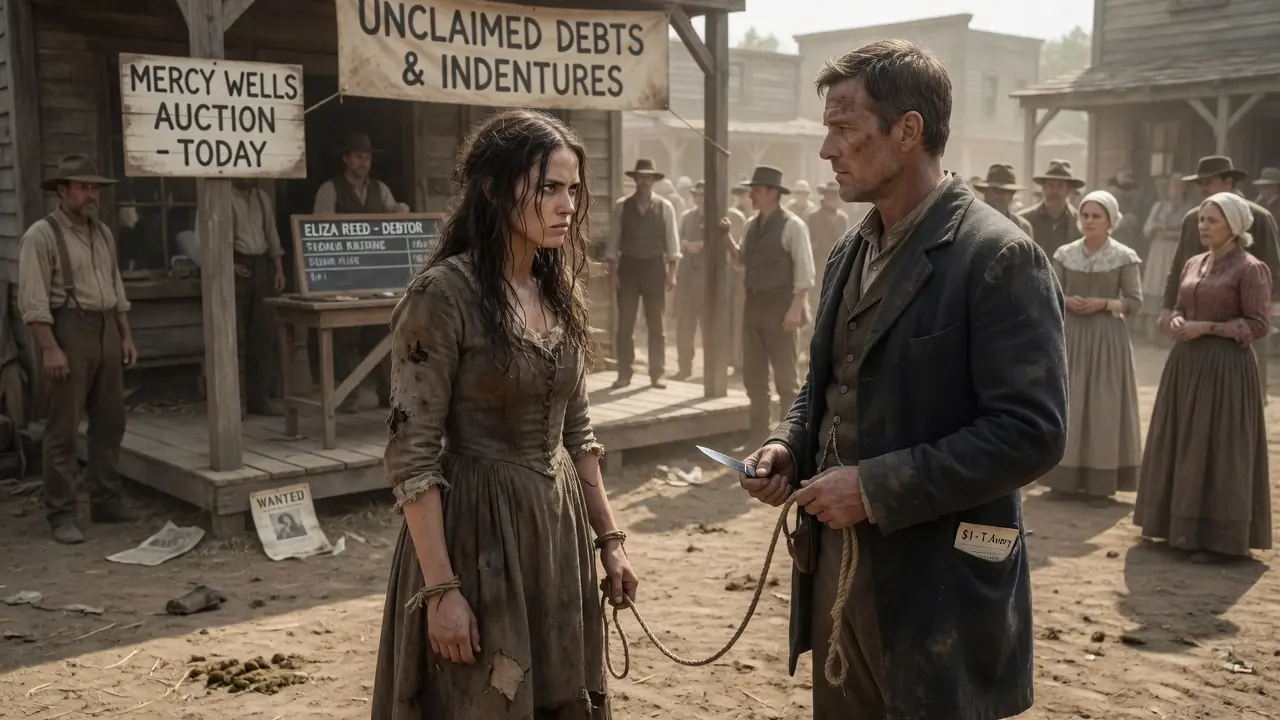
She stood with her hands bound, jaw set, refusing to beg. When the whisper slipped out anyway, it surprised even her. You’ll regret choosing me. The man below the platform didn’t smile right away. He studied her face, the bruises she didn’t hide, the fire she wouldn’t put out.
Then his mouth curved, slow and certain. No one laughed at first. They were too confused, too sure they had heard wrong. Eliza Reed had learned early that fear made noise. Silence, when chosen, could be the armor. She held it now as the auctioneer’s voice cracked the morning open, rolling over the square like a verdict already decided.
She was 23, though the desert had aged her beyond her years. Her wrists burned where rope bit skin. Her bare feet scorched against the wood beneath her. Dust clung to her dress, gray and torn. The fabric was stiff with old blood from the night she fought back and lost.
Men crowded the square in Mercy Wells. Ranchers with narrow eyes, merchants with careful hands, men who smelled profit the way buzzards smelled heat. They leaned in, measuring her worth without meeting her gaze. The auctioneer cleared his throat and spoke of debts and vagrancy and contracts, words that turned people into property.
He grabbed Eliza’s chin to show her teeth. She jerked away hard enough to make him stumble. Laughter rippled. She didn’t flinch. She stared straight ahead and memorized faces. Who’ll start the bidding? the auctioneer called. Strong, healthy, a year of labor to settle the fine.
Silence answered, then a number. Then a lower one. Each call scraped something raw inside her chest. She didn’t cry. She wouldn’t. A man in a sweat-dark vest made a crude joke. Another laughed too loud. Eliza felt the weight of it press down. Not the numbers. The ease.
Then a voice cut through the square, calm, low, certain. $1. The laughter burst free, loud and sharp. Men turned. Some sneered. Others blinked. The speaker stood at the edge of the crowd, tall, broad-shouldered. His clothes were plain, canvas pants, a faded blue shirt, boots worn thin by miles.
He didn’t grin. He didn’t posture. He just stood there, steady as a fence post. The auctioneer scoffed. That’s not a bid. It is, the man said. You asked. Another bidder protested. Rules were argued. The auctioneer sputtered.
The man didn’t raise his voice. He didn’t need to. I’ll take the contract, he said, for $1. The crowd roared again. Someone called him a fool. Someone else said loneliness did strange things to a man. Eliza watched him closely, not with hope, with caution.
She’d learned the difference. The auctioneer sneered. And what would you do with her? The man looked up then, finally meeting Eliza’s eyes. There was no hunger there, no calculation, just recognition. As if he saw the whole of her standing on that platform and refused to look away.
Free her, he said. The sound dropped out of the world. Even the wind seemed to pause. The auctioneer blinked. That’s not legal? the man asked quietly. It is. A murmur spread, uneasy, reluctant. Truth had a way of doing that.
The man reached into his pocket and held up a silver dollar. It flashed in the sun, clean, unworn. Do we have a deal? he asked. The auctioneer hesitated, then snatched the coin like it burned. Paper changed hands. A signature scratched.
And before anyone could stop him, the man tore the contract in two, then again. The pieces fell to the dirt. Eliza’s breath caught hard and painful. The man climbed the steps toward her, not fast, not slow. He stopped an arm’s length away.
May I? he asked, nodding to the ropes. No one had asked her that in a long time. She swallowed and nodded once. His hands were rough, but careful. He worked the knots without pulling, without rushing.
When the rope fell away, her arms trembled. She flexed her fingers like she was relearning them. Can you walk? he asked. She nodded again. Then walk, he said. Don’t look back.
Eliza stepped down from the platform. Each footfall felt unreal. The crowd parted, some muttering, some staring. She walked through them with her head high and her hands free. The man fell into step beside her, close enough to shield, far enough to respect.
At the edge of the square, her knees buckled. She caught herself on a hitching post, breath shaking loose at last. Why? she demanded, the question sharp with fear. What do you want from me?
He looked out toward the open land beyond town, red earth, endless sky. My name’s Thomas Avery, he said. I don’t want anything. She laughed once, bitter. Men don’t do things like that for nothing.
Thomas nodded. I had a sister. That was all he said at first. It was enough. They took her, he went on, years ago. By the time I found her, I was too late. Eliza felt the anger drain, leaving something hollow and heavy.
When I saw you up there, he said, finally looking at her again, I knew what late looked like. I wasn’t going to be it twice. She searched his face for the lie, found none. I don’t have anywhere to go, she said.
After a mile, a voice called from behind them, warning and cruel. You’ll regret it, a man shouted. That woman’s trouble. Thomas didn’t turn around. Only thing I regret, he said evenly, is not getting there sooner.
Eliza faced forward, heart pounding as the town fell away behind them and the desert opened wide. She didn’t know what waited at the end of the road, but for the first time in years, it was her choice to find out.
The ride lasted 3 hours. Eliza counted each one. The land stretched empty and honest, scrub and stone under a sky that never apologized. Thomas rode a few paces ahead, quiet, letting the rhythm of the horses settle what words could not.
He checked on her without staring, adjusted their pace when her hands stiffened on the reins, said nothing when she winced. At a shallow spring, he dismounted and offered water. She drank like someone relearning trust. The cold shocked her teeth. She welcomed it.
They didn’t speak until the ranch came into view, a low house, a leaning barn, windmill ticking like a tired clock. This is it, Thomas said. It wasn’t much. To Eliza, it was everything.
Inside, the house was clean and plain, one table, two chairs, a stove blackened by years of use, two doors. Thomas opened one and stepped aside. That room’s yours, he said. It locks.
She noticed that first, the bolt, the simple promise of it. When he left her alone, she slid the bolt home and leaned against the door, shaking. The room was small, but the bed was clean. There was a basin, a pitcher, a window with glass.
She washed the dust from her skin and stared at her wrists, raw, bruised, free. That night they ate in quiet, bread, meat, water. He told her she could eat more. She didn’t. Sleep came hard.
When it did, it brought dreams she had no names for. Morning brought coffee. She woke to the smell of it and a single wild flower in a tin cup on her windowsill, purple, delicate, unexplained. Eliza touched it like it might vanish.
Days passed. Work filled them. Thomas taught without commanding, fence posts, feed, water, how to move with the land instead of fighting it. He never asked about her past, never stood too close, never entered her room.
She found herself waking earlier, watching him mend tack by lamplight, sitting with coffee in the quiet before dawn. It felt dangerous, the peace of it. On the seventh day, a rider appeared at noon.
Eliza saw him first, dust on the horizon, a single figure moving fast. Thomas stilled. His hand went to his belt. Inside, he said. She didn’t argue. She took the rifle from its place instead and stood where she could see without being seen.
The rider stopped short of the fence, young, nervous. He tipped his hat. Mr. Avery, he called. Name’s Luke Barton. I ride for Calvin Ross. Eliza’s stomach tightened. She knew that name.
Thomas’s voice stayed level. What does Ross want? Checking on a woman, Luke said. One taken from an auction. Folks are asking questions. Thomas took a step closer. Is Ross suddenly concerned about women’s welfare?
Luke flushed. Just delivering a message. Then deliver this, Thomas said. Eliza Reed is free. She stays here by choice. Anyone who bothers her answers to me. Luke hesitated. There’s talk, sir.
There always is. Luke nodded and rode off. That night, Eliza couldn’t sleep. They’ll keep coming, she said from the doorway. Thomas looked up from the table. Maybe.
You shouldn’t pay for my trouble. He set the cup down carefully. You’re not trouble. The words settled deep, heavy, dangerous. The visits didn’t stop, men passing through, excuses thin as dust, eyes measuring.
On the tenth day, Eliza said it aloud. Maybe I should go. Thomas froze. Is that what you want? I don’t want to ruin what you’ve built.
He met her gaze. What I built doesn’t matter if it costs someone their dignity. She stayed. The town did not forgive it. They went in together for supplies. The looks followed. The whispers cut.
A woman spat a name Eliza had worn before in shed. Thomas stepped between them, quiet, absolute. The ride home was silent. That night Eliza lay awake listening to the house breathe, to Thomas pacing, to her own heart refusing caution.
She knew then she loved him. She hated herself for it. It happened 3 weeks later. A man arrived at night, desperate, bleeding fear into the dark. He brought a girl, 16, bruised, half gone.
They’re hunting her, the man said. Bounty hunters, contracts, paper says she belongs to a house in Tucson. Thomas didn’t hesitate. Bring her in. Eliza took charge, cleaned wounds, whispered steady truths, saw herself reflected in the girl’s eyes.
The name was Rose. They worked through the night. Barricaded doors, loaded rifles, drew lines in dust and conscience. At dawn riders appeared. Five of them, armed, confident.
Thomas stood on the porch. You’re not taking her. The leader smiled like he’d been waiting for the words. Law says otherwise. Eliza watched from the loft, heart hammering.
She saw the math written in the men’s eyes. They left with a promise to return. That night they planned. Rose couldn’t stay, not here, not with hunters circling. We run, the man said.
No, Eliza said, We distract. Thomas turned to her sharply. No. She met his gaze. They don’t know her face, not anymore. I can buy her time. Thomas’s voice broke.
I won’t trade one life for another. I’m choosing, she said, like you did. The plan formed like a wound, ugly, necessary. At dusk Rose left hidden in a wagon heading west.
Eliza stayed. When the riders came back, they found her. Hands bound again, horse beneath her. Night swallowing the ranch behind. She caught Thomas’s eye once as they rode away.
Don’t follow, she tried to say. Come for me, she meant. The desert closed in. Hooves pounded. Somewhere behind her a promise took shape. She whispered it to the dark.
Please be on time. The men rode hard through the night. Eliza learned quickly how pain changes shape when you expect it. The rope burned her wrists. The saddle rubbed her raw.
Fear pressed in like heat. But beneath it all ran a steady current of resolve. She counted turns, watched stars, memorized rock shapes and the way the land sloped under the horses’ hooves.
She would not disappear quietly. They stopped near dawn in a narrow cut of stone where the wind couldn’t reach. The men laughed too loud, passed a bottle, argued about money.
Eliza stayed silent, head bowed, letting them believe she was smaller than she was. The leader, a thick-necked man with a scar down his cheek, crouched in front of her as the light came up.
You don’t look 16, he said. Eliza swallowed. They make you old fast. He grabbed her wrist, turning it, studied the calluses, the scars. Something shifted in his eyes.
By midmorning suspicion turned sharp. She’s not the girl, he said to the others. We’ve been played. The blow came fast. White light, blood in her mouth.
Eliza didn’t scream. Where is she? he snarled. Eliza smiled through broken breath. Gone. That smile cost her, but it was worth it.
They turned back toward the ranch. Thomas Avery did not wait for certainty. The moment the dust faded behind the riders, he moved. He saddled two horses, grabbed rifles, water, rope.
He didn’t pack carefully, he packed fast. An older ranch hand named Caleb met him at the fence. Gray beard, steady hands. I’m coming, Caleb said. Thomas nodded once.
That was all. They followed the trail Eliza had left without meaning to. A torn strip of cloth, a scuffed stone, marks only someone who knew loss would think to look for.
She’s alive, Caleb said quietly. I know, Thomas replied. They rode until night swallowed the land again. The canyon was a scar cut deep into the earth.
The men had chosen it well. High ground, narrow passage, no easy way through. Eliza was tied to a juniper at the bottom, wrists numb, face swollen. She kept her eyes open, listened.
She heard Thomas before she saw him. The first shot cracked the air open, then another, then chaos. The men scattered, shouted, fired blind into shadows. Thomas moved like a storm that had been waiting years to break.
He didn’t shout, didn’t posture. He advanced with purpose, every step measured. Caleb flanked left, steady and precise. Eliza worked the rope with fingers slick from blood and grit.
Slow, careful. A man slipped down the rock face toward her, young, nervous. She didn’t hesitate. The stone fit her hand like fate. When the rifle hit the dirt, she took it.
She climbed. The rim exploded into noise and smoke. Men fell, rock shattered. The air smelled of iron and dust. Eliza saw Thomas pinned behind stone reloading.
A man rose behind him, rifle lifting. She aimed. The recoil nearly took her off her feet. The man dropped. Thomas turned. Their eyes met. Everything unsaid lived there.
The leader charged then, pistols out, rage naked on his face. Eliza’s rifle jammed. Thomas stepped forward empty-handed. They collided hard, fists, bone, breath knocked loose.
The leader got hands on Thomas’s throat, squeezed. Eliza screamed his name. Thomas drove his thumb into the man’s eye and rolled free. He didn’t stop until the man stopped moving.
Silence fell hard. Caleb tied the survivors. Thomas staggered. Eliza reached him first. You came, she said. Always, he answered.
They rode back slow, wounded, alive. The ranch came into view under a pale sky. It looked smaller now, stronger. Thomas helped Eliza down. She leaned into him without thinking.
He held her like it was instinct, not choice. I thought I’d lost you, he said into her hair. You didn’t, she replied. You were on time.
That night, as lantern light flickered, Thomas finally said the words he’d been carrying since the auction block. I love you. Eliza laughed and cried at once.
I’ve loved you since the flower, she admitted. I was afraid to say it. Me, too. They didn’t rush.
They sat, held hands, let the truth settle. News traveled fast. The hunters were arrested, papers questioned, law bent then broke. Rose was safe.
A letter came weeks later. California, new name, new life. Spring crept into the land. One morning Thomas stood on the porch with a small wooden box.
No contracts, he said. No debts, just choice. Eliza smiled, fierce and sure. Yes.
The desert watched as they promised to walk forward together, not saved, not owned, chosen. And every morning after, something small waited on the windowsill, a flower, a stone, a reminder.
He had chosen her. She chose him back. Peace never arrives all at once. It comes in pieces, quiet ones, fragile ones. After the canyon, the ranch felt different, not safer, just awake.
Eliza healed slowly. Bruises faded to yellow, then to memory. Her wrists scabbed, split, and finally closed. Thomas watched without hovering, though she felt his attention like a hand at her back.
He cooked when she slept too long. He left water by the door when the heat rose. He never asked what hurt. He noticed. Caleb stayed a few days, long enough to make repairs, and longer still to be sure the land had settled.
Before he left, he took Thomas aside. You drew a line, the old man said. Men like Ross don’t forget lines. Thomas nodded. Neither do I.
The words weren’t brave, they were tired. They returned to work. Fences, windmill, stock. The simple rhythm grounded them. Eliza learned the land the way you learn a scar, slowly, with respect.
Some nights she woke shaking. Thomas never crossed the threshold of her room. He sat on the floor outside until her breathing steadied. Sometimes he spoke Elena’s name. Sometimes he said nothing.
In town, Mercy Wells buzzed. People watched them closer now. Some with approval, more with judgment. The preacher’s wife crossed the street to avoid Eliza. A rancher tipped his hat to Thomas and said nothing at all.
Calvin Ross did not come himself. He sent word. A folded paper arrived with a rider who wouldn’t meet Eliza’s eyes. Thomas read it once, then again.
They’re filing a claim, he said. For what? Eliza asked. Harboring stolen property, obstruction, vigilantism. Eliza laughed once. It came out wrong.
All words for doing the right thing. They’ll try to make an example, Thomas said. The hearing was set for 2 weeks out. They prepared.
Not for a fight, for testimony. Thomas rode out to neighboring ranches. He spoke little. He listened more. Some doors closed. Others opened.
Quiet offers of support slipped into his hands like contraband. Eliza stayed back and worked. She cleaned the house, mended shirts, planted a small patch of beans near the windmill.
She needed something that grew. One afternoon she found Thomas sitting on the porch steps, head in his hands. Say it, she said. He looked up.
If this goes bad, I’m not leaving. I know, he said. But I need to say it anyway. She sat beside him, close enough to touch, didn’t.
I won’t let them take you, he said, by paper or by force. Eliza met his eyes. I don’t want to be protected. I want to be believed.
He nodded slowly. Then we make them listen. The day of the hearing dawned bright and unforgiving. They rode in together.
The room smelled of sweat and dust and old wood. Men filled the benches, women whispered behind fans. Ross sat up front, clean shirt, clean hands, clean lies.
Eliza stood when called. She didn’t lower her eyes. She told them about the auction, the rope, the numbers. She spoke plain, no tears, no flourishes.
Thomas spoke next about contracts, about law, about what paper allowed men to do to women when no one pushed back. A murmur ran through the room.
Ross smiled thinly. You interfered with lawful recovery. I interfered with cruelty, Thomas said. The magistrate frowned, asked questions, wrote notes.
Then a woman stood. Mrs. Klein, widow, laundry owner. She told them she’d seen Eliza dragged through town in chains weeks before the auction.
Told them she’d heard the laughter. Another man stood, then another. The room shifted, not loudly, but enough. The ruling came at dusk.
Charges dismissed, warnings issued, no apology offered. Outside, Ross brushed past Thomas and leaned close. This isn’t finished, he said softly.
Thomas didn’t answer. Eliza did. It is for me. Ross looked at her like she’d spoken a foreign language. They rode home under a sky bruised purple and gold.
I was scared, Thomas admitted. So was I, Eliza said, but not the way I used to be. That night he didn’t leave a flower on the sill.
He knocked. She opened the door and waited. I won’t cross unless you ask, he said. She reached out and took his hand.
Stay. They didn’t rush. They sat on the edge of the bed, talked about nothing, everything. When he kissed her, it was careful, like he was afraid to wake something fragile.
Eliza kissed him back, steady and sure. Spring broke the land open. Green came where there had been none. The beans climbed, the stock fattened.
The windmill stopped screaming and settled into a steady creak. Eliza laughed more, not often, but real. Thomas smiled easier, he slept.
Then the riders came, three of them, late afternoon. Dust rising sharp and fast. Eliza felt it before she saw them. The way the air tightened.
Thomas stepped out with his rifle slung but visible. The leader raised his hands. We’re not here for trouble. You found it anyway, Thomas said.
They brought a paper, new seal, new judge, old intent. Search warrant, the man said, for stolen property. Eliza’s heart kicked hard.
You already lost, she said. The man shrugged. Orders changed. Thomas’s jaw tightened. He read the paper once, then he folded it.
You can search, he said, but you won’t find what you want. Cracked. The men dismounted, spread out. Eliza stood in the doorway and watched them cross her land like they owned it.
One man headed for the barn, another toward the house. The third stayed close to Thomas, too close. Eliza’s hand drifted to the knife at her belt.
She didn’t draw it, not yet. The search took too long. Drawers opened, chests kicked, walls knocked. Then a shout from the barn.
Found something. Eliza’s breath stopped. Thomas moved first. Eliza followed. In the barn, one man stood over a crate she’d never seen before.
Ross’s mark burned into the wood. Thomas stared. So, he said quietly, you planted it. The man’s smile was quick and ugly.
Looks like we did. The third rider reached for his gun. Eliza moved. The world narrowed. And somewhere behind the barn, a rifle.
The rifle crack split the air like dry wood snapping. Everyone froze. Dust lifted from the barn wall where the bullet struck, inches above the planted crate.
The man who’d reached for his gun swore and dropped flat. The others scrambled, shouting over each other, hands flying to weapons. Eliza didn’t think, she moved.
She shoved Thomas sideways, hard enough to throw him off balance, and drew the knife in one clean motion. The blade felt familiar, honest.
Down, she said. Another shot rang out, closer this time, tearing splinters from the doorframe. The horses screamed and pulled against their ties.
Chaos spilled into the yard. Thomas rolled behind a feed trough and came up with his rifle. He didn’t fire yet, he searched.
Caleb, he muttered. From the rise behind the corral, a gray hat lifted once, then vanished. The riders hadn’t expected resistance, not real resistance.
They’d expected fear, papers, compliance. They’d misjudged the land. Two shots came in quick succession, precise. One man spun and dropped his gun, clutching his shoulder.
Another ducked behind the windmill, breath loud with panic. Callahan, the leader shouted, trying for authority. This isn’t how this has to go.
Thomas’s voice cut back, cold and clear. You planted evidence on my property, that makes you criminals. You don’t know that, the man yelled.
I know, Eliza said, stepping into view with the knife low and steady. Because I didn’t bring that crate here, you did. The leader’s eyes flicked to her, measured, calculating.
Ma’am, he said, changing tone, step aside. She didn’t. Another shot cracked from the rise. Dirt jumped at the leader’s boots.
He swore and stumbled back. Enough, he barked to his men, fall back. They dragged the wounded rider toward their horses.
One tried to lift the crate. Thomas fired once, the bullet tore the rope from the man’s hands. Leave it, Thomas said, and go.
The riders mounted in a mess of fear and pride, retreating in a cloud of dust that tasted bitter and unfinished. Silence fell heavy.
Caleb emerged from behind the rise, rifle slung, face grim. They won’t stop, he said, they’ll bring more paper, more men. Thomas nodded.
I know. Eliza’s hand shook now that the danger had passed. She slid the knife back into its sheath and leaned against the barn wall, breath coming fast.
Thomas crossed the space between them and took her shoulders gently. You hurt? he asked. She shook her head. I was ready.
He searched her face, seeing something new there. Not fear, not defiance, choice. That night they didn’t sleep. They packed, quiet, efficient.
Caleb stayed long enough to help load a wagon and burn the crate until nothing remained but ash and truth. Before dawn, he rode east with word for a judge who still remembered the difference between law and justice.
Eliza stood at the window as the fire died down. The smell of smoke curled through the room. They’ll say we ran, she said. Thomas set the last sack of grain by the door.
We’re not running. We’re moving, she corrected. He smiled once, tired, proud. They left at first light.
The road south cut through low country and stone washes, places where the land hid what it needed to. They traveled slow, careful. Thomas taught Eliza how to read the sky for weather.
She showed him how to leave signs only the desperate would notice. By the third day, riders followed at a distance. By the fifth, they closed in.
They made camp in a stand of cottonwood where the river bent and the night carried sound far. Eliza felt it before she heard it. Hooves, too many.
Thomas handed her the rifle without a word. I don’t want to be the reason, she started. You’re not, he said, you’re the reason I don’t back down.
They took positions. Caleb had taught her well. She breathed, waited. The men came loud, confident. Ross among them, clean coat, dusty now, smile gone.
You could have made this easy, Ross called, you still can. Thomas stepped forward into the firelight. You don’t get to decide what’s easy.
Ross’s gaze slid to Eliza. This woman cost you everything. Eliza laughed, low and sharp. No, I gave it back. Ross sneered.
She’s trouble. Thomas didn’t look at her when he answered. She’s my wife. The word landed between them like a stone dropped in water.
Eliza’s heart kicked hard. He hadn’t asked. He hadn’t warned her. He’d chosen. Ross’s face twisted. You think that changes anything?
It changes everything, Thomas said. The first shot came from the trees. The fight was fast, brutal, close. Eliza fired twice and hit once.
She felt the impact in her shoulder and kept breathing. A man rushed her. She dropped the rifle and met him with the knife, the way survival had taught her.
Quick, final. Thomas took a blow to the ribs and kept moving. He drove Ross back toward the river, fury controlled and cold.
Ross slipped on wet stone, fell hard. Thomas stood over him, breath ragged, gun raised. You could end this, Ross spat, law’s still on my side.
Thomas lowered the gun. No, he said, it isn’t. Caleb’s horse thundered in from the dark. Two more riders behind him, lawmen, badges catching firelight.
Ross went still. It was over. They returned to the ranch weeks later. The land had waited. Caleb rode on with thanks and quiet respect.
The papers came through clean. No more claims, no more riders. One morning, Thomas brought Eliza a small box.
I didn’t plan it right, he said, but I won’t wait. Eliza slipped it on, hand steady. Good, she said, neither will I.
They stood on the porch as the sun rose, the desert stretching wide and honest before them. Tomorrow would bring work and memory, and scars that didn’t fade.
But today was theirs, and that was enough. The desert has a way of remembering, even after the riders were gone, even after the law settled and the dust fell back into place.
The land held the echo of what had happened. Eliza felt it in the quiet mornings, in the way the wind moved through the grass like a held breath finally released.
They did not speak much about the fight. They spoke about work. Thomas rose before dawn again, but now Eliza rose with him. Coffee boiled, bread warmed.
The small ritual stitched their days together. Not grand, not dramatic. Honest. She took over the ledger. He repaired the north fence.
They argued once about planting too close to the wash and laughed after when the beans proved her right. At night they learned each other slowly.
Thomas learned where her scars pulled tight when storms came. Eliza learned when his silence meant grief and when it meant peace. They did not rush healing.
They respected it. Word spread anyway. Some neighbors came by under the excuse of borrowed tools or broken tech. They didn’t say much, just nodded.
Left jars of honey. A sack of seed. Quiet offerings that meant more than apologies. Others never came again. Eliza stopped caring.
One afternoon a wagon rolled up carrying a woman with silver in her hair and eyes sharp with memory. She stepped down carefully and held Eliza’s hands like she had been waiting years to do it.
My daughter is alive because of you, The woman said. I will never forget that. Eliza swallowed and nodded. Words felt too small.
Life did not soften after that, it steadied. The ranch survived the summer. Barely. But it survived. Rain came late and mean.
The windmill broke twice. Thomas cursed. Eliza learned how to fix it anyway. In October they stood together in the yard with a small circle of people who mattered.
No preacher, no town blessing. Just promises spoken clear. I won’t own you, Thomas said. I won’t cage you. I will walk beside you if you’ll have me.
Eliza met his eyes. I won’t be small for you. I won’t hide my teeth or my scars. But I will choose you every day I wake up.
That was the marriage. They marked it with coffee and bread and a single wildflower set between them on the table. The first winter was hard.
Cold bit the house and memories bit harder. Some nights Eliza woke fighting ghosts. Thomas learned to wake without touching, to speak her name until she found the present again.
Some nights Thomas woke shaking, Elena’s face close behind his eyes. Eliza sat with him until dawn, her hand steady on his back. They did not save each other.
They stayed. Spring came gentler than expected. The land greened. The beans climbed. The stock held. Eliza found herself smiling without noticing first.
One morning she found the window sill empty. No flower, no stone. She frowned then laughed softly when she turned and saw Thomas in the doorway holding a small wooden box.
I figured it was time, he said. Inside lay a silver dollar. Old. Worn smooth by hands and history. The same one, he said.
Tracked it down. Cost me more than it’s worth. Eliza took it carefully. Her throat tightened. A reminder, he added.
Of what people said you were worth and how wrong they were. She closed her fingers around it. Best dollar ever spent.
Best dollar I ever waited too long to use, he said. Eliza closed her fingers around it. Best dollar ever spent.
Best dollar I ever waited too long to use, he said. Years passed, not quietly but truly. Girls came sometimes, women too.
Sent by whispers and half-believed stories. Eliza never asked many questions. She offered a room, a lock, time. Thomas fixed fences and stayed out of the way unless needed.
He learned when to stand in front and when to stand back. The desert kept its truths. Some stayed, some moved on.
All left stronger than they arrived. One evening long after the sun sank red and slow, Eliza asked him the question she had carried since the auction block.
Do you ever regret it? she said. Choosing me? Thomas didn’t answer right away. He looked out over the land.
Over fences held by stubborn posts and work done one day at a time. No, he said finally. I regret the years I believed pain was mine alone.
I regret the moments I stayed quiet when I should have stood up. He turned to her, But you, never. Eliza leaned into him feeling the truth settle.
They were older when the story started spreading beyond Mercy Wells. People added flourishes, took liberties, some got it wrong. Eliza let them.
She knew the truth. It wasn’t a dollar that saved her. It was a choice. Made and remade. Every morning. Every hard night.
On the anniversary of the auction, Thomas left no gift on the sill. Instead he stood beside her in the early light, coffee steaming between their hands.
You still think I’d regret choosing you? he asked quietly. Eliza smiled fierce and sure. No, she said.
I think we both regret waiting. The desert stretched wide and unforgiving and honest around them.
And within it two people stood who had been bought, broken and counted wrong. They had counted themselves instead.
And that made all the difference.