The Fungus That Eats Radiation — And May Help Humans Survive in Space
News 06/12/2025 15:46
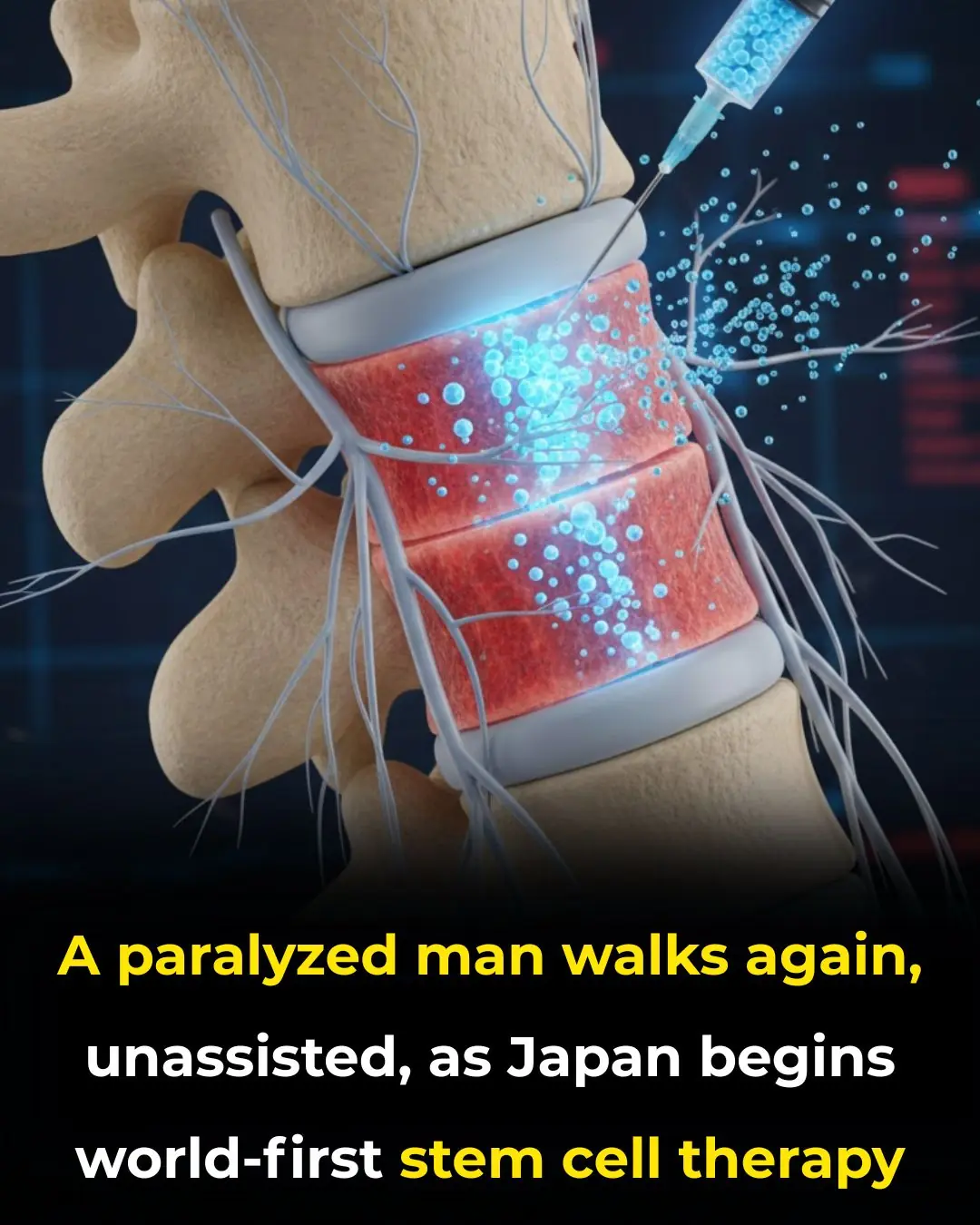
In a breakthrough that could reshape the future of regenerative medicine, Japanese scientists have achieved a milestone once thought impossible: a man who was completely paralyzed from a severe spinal cord injury is now walking again — unassisted.
This extraordinary recovery comes from pioneering research at Keio University in Tokyo, where scientists are using one of the most advanced biomedical tools of our time — induced pluripotent stem cells (iPSCs).
iPSCs are reprogrammed human cells — often taken from a patient’s own body — that are transformed back into a stem-cell–like state. In this form, they regain the ability to become almost any type of cell, including neurons, bone, muscle, or organ tissue.
For patients with spinal cord injuries — where nerve cells are damaged or destroyed — this technology provides a new way to rebuild neural pathways that were once considered permanently lost.
At Keio University, researchers used iPSCs to create specialized neural stem cells designed to repair the spinal cord. These cells were then injected directly into the damaged region, where they began integrating with the patient’s existing nervous system.
The clinical trial involved four patients, each with severe spinal cord damage that had left them paralyzed.
Here’s what the early results revealed:
One patient has recovered enough motor function to stand, move his legs, and begin walking exercises — without assistance.
Another patient has regained partial control of their limbs, showing significant improvement in mobility.
No serious side effects were observed among any of the participants, a crucial sign for the safety of future treatments.
These results, while preliminary, mark the strongest real-world evidence so far that stem cell–based regeneration of the spinal cord is possible in humans.
Spinal cord injuries affect millions of people worldwide. For most patients, paralysis is considered irreversible because the central nervous system has a limited ability to repair itself.
But this trial offers something truly revolutionary:
Not just improved sensation or small movements — but the ability to stand and walk again.
The absence of major side effects makes the treatment far more promising for large-scale clinical use.
Unlike embryonic stem cells, iPSCs are created without using embryos, making the technology more widely acceptable and easier to regulate.
This therapy could eventually help:
Patients with traumatic injuries
Stroke survivors
People with degenerative diseases such as ALS or spinal muscular atrophy
Japan has long been at the forefront of stem cell innovation. In fact, Dr. Shinya Yamanaka — also from Japan — won the Nobel Prize for discovering iPSCs in 2006.
Now, Japanese researchers are pushing the boundaries even further with clinical trials proving these cells can help restore function in the human body.
While the therapy is still in early testing, the signs are remarkable. For the first time, regenerative medicine is not just slowing damage — it is rebuilding what was lost.
If future trials continue to produce similar results, this treatment could become the world’s first practical, scalable cure for paralysis.
What happened in a Tokyo laboratory may one day transform life for millions — offering the kind of hope that medicine has never been able to promise before.
A man who was once paralyzed is now taking steps again.
And for humanity, it feels like the first steps toward a new medical future. ✨